Connect locations, roles, and deliberate positioning, then learn the fixed expressions.
One identifiable position in a larger setting
One identifiable position in a larger setting
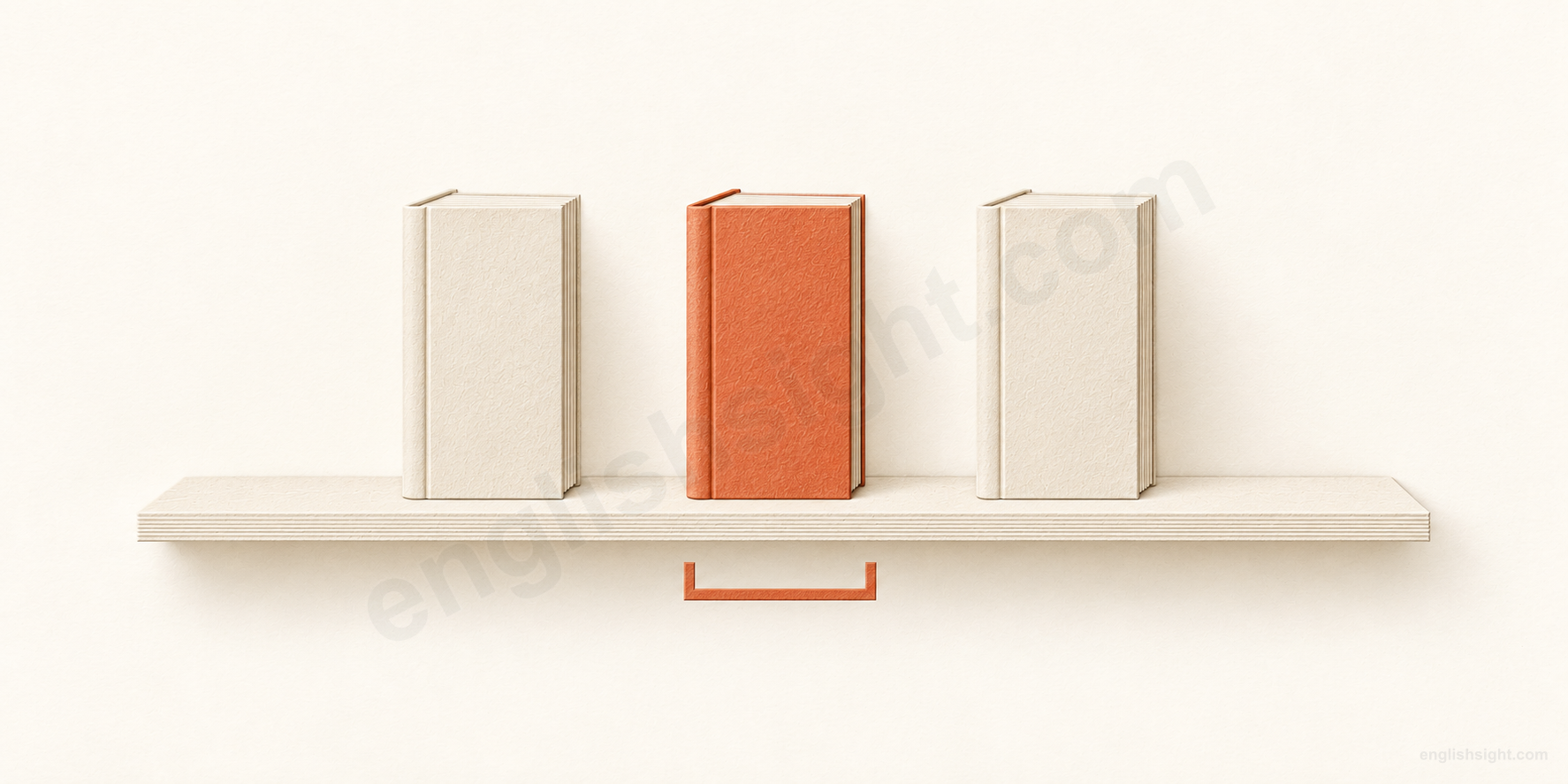
One shelf holds three books.
place
The orange book occupies that place.
Pick out the middle position.
The orange book occupies an identifiable place among its neighbors.
A place is an identifiable position within a setting; placing something often assigns it to a position. The setting can be physical or abstract.
The shelf illustrates the noun’s position relation. It does not mean that every place is a correct slot, or that every use involves fitting an object into a container.
A place identifies where someone or something is, or where it can belong within a setting. That setting may be a landscape, a bookshelf, a queue, a course, or a social arrangement. As a verb, place often means put or assign something to a position.
This connection is a teaching model, not a claim about an identical picture in every English speaker’s mind. Fixed expressions such as take place and go places need their own explanations; a spatial picture cannot predict them all.
01
Locations, homes, and points within something
A place can be a whole town, a useful site, or one identifiable part of a surface or sequence. The surrounding words tell us the scale.
01
a / the place (where + clause); places like + noun
a place where…
identify a location
Setting / starting situation
You need to say where an event happened.
Position / intended meaning
You identify a particular location.
Place names a location; where introduces what happens there.
Place is a countable noun with a broad range: a corner, a village, a building, or a country can all be a place. The context supplies its size. Use a place for an unspecified location and the place when the listener can identify it.
In the place where we met, where already supplies the location relation. You can also say the place we met. In places like this, like introduces an example of a type of location; it does not mean the locations are identical. A place of interest is somewhere worth visiting, such as a historic site; a guide might say The castle is one of the town’s main places of interest.
In a sentence
We stopped at the place where the two paths meet.
Watch the difference Place needs a determiner in ordinary singular noun use: a quiet place, not quiet place.
02
a place to + verb; a place for + noun; place of + noun
a place to stay / a place for…
find somewhere suitable for an activity
Setting / starting situation
You need somewhere to spend the night.
Position / intended meaning
You identify accommodation suited to that need.
The infinitive gives the intended activity; for gives a person or purpose.
A place to stay, a place to eat, and a place to park identify locations by what someone can do there. A meeting place and a parking place name a location by its function. Place of birth, place of work, and place of worship use of to specify the relevant event or activity. Place of work is more formal than workplace. Place of worship is a broad term covering churches, mosques, temples, and other sites used for worship.
A place for the children can mean somewhere suitable for them. This is no place for children rejects its suitability, not its existence. This is not the place to argue can also reject the present occasion: the objection need not concern the building itself. There is a time and place for something says it needs an appropriate occasion or setting; saying this now often implies that the present situation is unsuitable.
In a sentence
Have you found a place to stay near the station?
Watch the difference Use a place to eat, not a place for eat. For + -ing is possible when describing a function, as in a place for storing tools.
03
at / to + possessive + place; a place of one’s own
at my place
refer informally to someone’s home
Setting / starting situation
You invite a friend to your home.
Position / intended meaning
The listener understands whose home you mean.
A possessive plus place can stand for a home.
My place, your place, and Sam’s place are informal ways to refer to a house or apartment without specifying its type. At my place describes being there; to my place describes a destination.
A place of my own means a home for my independent use. It need not be property I own: someone renting alone can say this too. The place can also refer back to a home already under discussion.
In a sentence
Would you like to have lunch at our place on Sunday?
Watch the difference At our place means at our home here; in our place can instead mean instead of us.
04
put + object + (back) in its place; return + object + to its place
back in its place
put something where it belongs
Setting / starting situation
A tool is away from its usual storage position.
Position / intended meaning
It is returned to its designated position.
A thing’s place is its usual or intended position.
Its place means the position assigned to an object by habit, design, or an arrangement. A place for everything describes having a suitable position for each item; everything in its place describes the items actually being there.
The possessive identifies whose position is meant. Put the file in its place and put the file in my place are very different: the second would normally suggest replacing me, not storing my file.
In a sentence
Please put the scissors back in their place in the drawer.
Watch the difference The diagram illustrates one identified position; ordinary place does not always mean a correct or assigned position.
05
in places; in + number + places; from place to place
in places / in two places
refer to certain parts of a whole
Setting / starting situation
Some sections of a path are damaged.
Position / intended meaning
You describe the affected parts without naming each one.
Plural places can pick out parts of a surface or work.
The wall is cracked in two places counts separate affected points. The path is muddy in places means some parts are muddy, without saying which or how many. The whole path need not be muddy.
The use extends to a book, film, or speech: The story is confusing in places means some passages are confusing. From place to place instead compares different locations: Prices vary from place to place.
In a sentence
The footpath is slippery in places after the rain.
Watch the difference In places means in some parts; in place has different fixed meanings.
06
lose / find / mark + possessive + place (in + noun)
lose / mark your place
track the point reached in reading
Setting / starting situation
You pause halfway through a paragraph.
Position / intended meaning
You keep or lose track of where to continue.
Your place can be a point reached within a sequence.
Your place in a book, notes, or music is the point you have reached. Marking your place lets you return to it. Losing your place means being unable to find where you stopped, not losing the physical book.
The same words can concern a queue: losing your place in line means losing your position among waiting people. The noun after in determines which kind of sequence is involved.
In a sentence
I lost my place in the script when the phone rang.
Watch the difference Do not confuse losing your place in a script with losing the script itself.
07
to + number + decimal places
two decimal places
specify the precision of a decimal number
Setting / starting situation
A measurement has more digits than needed.
Position / intended meaning
You give a specified number of digits after the decimal point.
Decimal places count positions after the decimal point.
To two decimal places means retaining two digits to the right of the decimal point, usually with rounding. Thus 6.278 becomes 6.28. The digits before the point are not counted as decimal places.
This is an established mathematical use of position in a sequence. It does not mean two significant figures: significant figures use a different counting rule.
In a sentence
Round 6.278 to two decimal places.
Watch the difference Two decimal places and two significant figures are different instructions.
02
Seats, opportunities, rank, and role
A place also locates a person within an activity or social arrangement. A seat, an admission offer, and a ranking are different kinds of position.
08
save someone a place; take one’s place; set a place for someone
save / take your place
reserve or occupy a position for someone
Setting / starting situation
Someone needs a seat at a full table.
Position / intended meaning
A particular seating position is kept for them.
A place can be a seat or a position in a group.
Save someone a place means keep a position available for them, for example at a table or in a queue. Take your place means go to the position needed for an activity. In a queue, British English commonly uses in the queue, and American English in line.
Set a place for someone at the table means arrange the plates, utensils, and other items they need. A place setting is that group of table items, not the chair alone.
In a sentence
I saved you a place next to the window.
Watch the difference Take your place means occupy your position; take place without a possessive means happen.
09
change / swap places (with + person)
change / swap places
exchange positions with another person
Setting / starting situation
Two people occupy different seats.
Position / intended meaning
Each occupies the other’s seat.
Plural places identifies the two positions being exchanged.
Change places with someone or swap places with someone usually means exchange physical positions. With seats, switch places is another natural option.
It can also compare whole situations: I wouldn’t change places with him means I would not want his circumstances in exchange for mine. No physical move is required in that use.
In a sentence
Could we swap places so I can hear the guide?
Watch the difference Change the place can mean change a location; change places means exchange positions.
10
get / be offered / book a place + at / on / in + activity or institution
a place on a course / in a team
obtain an opportunity to participate
Setting / starting situation
A course has a limited number of admissions.
Position / intended meaning
A candidate is accepted as a participant.
A place can be an available position in an organized activity.
Get, win, be offered, or accept a place can refer to admission rather than a physical seat. British usage commonly has a place at a university and a place on a course; a place in a program or on a team is common in American usage, while in the team is common in British usage.
Book your place means reserve participation, for instance at a workshop. The context may require payment, but place itself does not say that a fee has been paid.
In a sentence
She was offered a place on the evening photography course.
Watch the difference A place at university is an admission opportunity, not necessarily accommodation.
11
be / finish in + ordinal + place; take second place to + noun
in first / second place
state a position in a ranking
Setting / starting situation
Competitors have been compared.
Position / intended meaning
You state where one ranks relative to the others.
Ordinal numbers locate a participant in an ordered result.
Finish in second place describes a result; be in second place can describe the current ranking before the contest ends. Take first place or win first place says someone achieves the top rank.
Take second place to something also has a figurative use: Personal comfort took second place to safety means safety received higher priority. This is not a claim about a literal race.
In a sentence
Our team finished in second place, just one point behind the winners.
Watch the difference In first place has no the; in the first place usually has a different conversational function.
12
find / have a place in + setting; no place for + noun
a place in society / no place for…
describe belonging, importance, or acceptability
Setting / starting situation
You consider how an activity fits within a community.
Position / intended meaning
You identify its role or reject it as inappropriate.
An abstract place is a role within a larger setting.
Find your place in a community means come to understand where you belong or how you can contribute. A place in history refers to lasting historical significance. These uses do not require a physical location. Take your place in society can mean accept or assume a social role or status: After years of exclusion, they could finally take their place in public life. This does not mean replacing one particular person.
There is no place for bullying in this club means bullying is unacceptable here. Compare There is no place to sit, which concerns available seating. The words after place distinguish social acceptance from physical availability.
In a sentence
There is no place for personal insults in this discussion.
Watch the difference No place for an activity may reject it; it need not mean there is too little physical space.
13
it is not + possessive + place + to-infinitive; know one’s place
not your place to…
say an action is outside someone’s role
Setting / starting situation
Someone considers making a decision for another person.
Position / intended meaning
You question their right or responsibility to do so.
A person’s place can concern authority or social expectations.
It is not my place to decide means the decision is outside my role or authority. It can express respect for another person’s choice. It is not your place to criticize can sound like a rebuke.
Know your place can demand that someone accept a lower social status. It often sounds condescending or controlling; it is not a neutral synonym for knowing where your seat is.
In a sentence
It is not my place to choose a career for you.
Watch the difference Use It is not my place to decide, not It is not my place for decide.
03
Position, readiness, replacement, and events
These common combinations distinguish where something belongs, whether arrangements are ready, who replaces whom, and what happens. Learn the complete expression.
14
event + take place (+ time / location)
take place
say that an event happens
Setting / starting situation
An event is scheduled or being described.
Position / intended meaning
You say when or where it happens.
The event is the subject of the complete expression take place.
Take place means happen. It is especially useful for organized events, but can also describe unplanned events. The meeting takes place at noon describes its occurrence; the expression does not literally mean someone takes a location.
Take changes for tense: takes place, took place, has taken place. This expression has no object and no ordinary passive. Compare They held the ceremony and The ceremony was held with The ceremony took place.
In a sentence
The workshop will take place in the library next Tuesday.
Watch the difference Say The event took place, not The event was taken place.
15
A in place of B; in B’s place; take B’s place / the place of B
in place of / take the place of
substitute one person or thing for another
Setting / starting situation
The usual ingredient is unavailable.
Position / intended meaning
A different ingredient performs its function.
One item occupies a role normally filled by another.
Use A in place of B means use A instead of B. In B’s place can express the same substitution. Take B’s place and take the place of B mean replace B; the replacement may be temporary or permanent.
Compare My colleague spoke in my place with My colleague spoke at my place. The first means instead of me; the second locates the speech at my home. A possessive alone does not decide the meaning: the preposition matters.
In a sentence
We used plain yogurt in place of cream in the sauce.
Watch the difference Take my place means replace me; take place means happen.
16
object + be in place; hold + object + in place; push / slide + object + into place
in place / into place
describe or reach a required position
Setting / starting situation
A lid is not yet seated correctly.
Position / intended meaning
It reaches and stays in its fitted position.
In place describes position; into place can describe the move into it.
The lid is in place describes its resulting position. Push it into place describes getting it there. Hold it in place means prevent it from shifting. The meaning here depends on an intended position supplied by the object or situation.
Put something in place can combine an action with its result, so in is possible after put too. The in/into contrast helps explain the relation but does not forbid put it in place.
In a sentence
Slide the cover into place and tighten the screw.
Watch the difference In place is the whole expression here; it does not require an article before place.
17
plans / systems + be in place; put + arrangements + in place
arrangements in place
say a system or plan is established and ready
Setting / starting situation
A team needs a procedure before starting.
Position / intended meaning
The procedure exists and is ready for use.
Abstract arrangements can be in place without occupying a physical slot.
Plans, safeguards, rules, and arrangements can be in place when they have been established or are operating. Put a plan in place means establish it. A policy still in place is still in effect.
The object supplies the interpretation: a lid in place is positioned, while a procedure in place is available or functioning. Readiness does not guarantee that the plan will succeed.
In a sentence
A backup system is now in place for the customer records.
Watch the difference In place does not promise that a procedure is effective in every case.
18
run / jog / march in place
run in place
perform a movement while staying at one spot
Setting / starting situation
You want to warm up without moving forward.
Position / intended meaning
Your legs move while your location stays the same.
In place can mean without traveling away from the spot.
Run, jog, or march in place is common in North American English. British English commonly uses on the spot. This use describes the position of the whole person, not whether every body part remains still.
It differs from a system being in place: the exercise construction concerns a lack of forward travel, while the system construction concerns readiness or operation.
In a sentence
We jogged in place while waiting for the race to start.
Watch the difference Jogging in place still involves movement; it does not mean standing motionless.
19
be / feel / look out of place
out of place
describe wrong position or poor fit with a situation
Setting / starting situation
A person or object does not fit its surroundings.
Position / intended meaning
You identify the mismatch.
The mismatch may concern physical arrangement or social suitability.
A book out of place is in the wrong position. A remark out of place is inappropriate for the situation. Feeling out of place means feeling that you do not belong or fit in, even when you are allowed to be there.
Not a hair out of place describes an extremely neat appearance. These expressions concern fit or order, not necessarily someone leaving a location.
In a sentence
I felt out of place in hiking boots at the formal dinner.
Watch the difference Out of place does not normally mean away from home; out of town expresses that more directly.
20
be / appear + all over the place
all over the place
describe wide distribution or lack of order
Setting / starting situation
Things are scattered or a person’s account is disorganized.
Position / intended meaning
You describe the spread or disorder informally.
The whole expression can be spatial or figurative.
There are cafés all over the place means they are in many locations. Papers all over the place usually suggests they are scattered untidily. Neither use specifies a count or claims every possible location is occupied.
Her explanation was all over the place describes poor organization or focus. The figurative use does not mean the speaker physically moved around. Context decides whether wide distribution or disorder is the point.
In a sentence
The receipts were all over the place after I emptied my bag.
Watch the difference All over the place can mean everywhere or disorganized; do not assume both judgments are always intended.
21
details / plans + fall / slot into place
fall / slot into place
become clear or organized
Setting / starting situation
You have several clues but do not see their connection.
Position / intended meaning
The clues form a coherent understanding.
Parts fitting together provide a teaching link to understanding.
When facts or details fall into place, their connections become clear. When plans fall into place, arrangements begin working together as needed. The expression can describe an emerging result without naming someone who deliberately arranged every part.
Slot into place has a similar figurative use and can also describe a literal fit. Learn the whole combination; fall alone does not mean understand.
In a sentence
Once I saw the original email, the missing details fell into place.
Watch the difference Say The details fell into place, not I fell the details into place.
22
clause + in the first place; in the first place, + reason
in the first place
refer to an original reason or introduce a point
Setting / starting situation
You question why a decision was made originally.
Position / intended meaning
You direct attention back to its starting reason.
This expression concerns the order of reasoning or an earlier decision.
Why did we agree in the first place? asks why we originally agreed, often suggesting regret or doubt. At the end of a question, it commonly challenges the premise or original reason for acting.
At the start, In the first place can introduce the first reason in an argument: In the first place, it costs too much. In the second place can introduce a further point, though firstly and secondly are often simpler. These are different from winning first place.
In a sentence
Why did we book such a large room in the first place?
Watch the difference Keep the article the in this expression; in first place normally concerns a ranking.
04
Putting, assigning, requesting, and recognizing
As a verb, place often assigns something to a location or relationship. Some established object combinations mean making a request, and cannot place concerns recognition.
23
place + object + location; object + be placed + location
place something somewhere
put an object in a chosen position
Setting / starting situation
An object is not yet at the intended location.
Position / intended meaning
Someone puts it at that location.
The object is positioned; the following phrase identifies where.
Place is a transitive verb in this use: someone places an object on, in, under, or beside something. It often suggests deliberate or careful positioning and is common in instructions. Put is the broader everyday alternative.
The position can also be expressed by here, there, or an adverb such as centrally. The passive focuses on the positioned object: The microphone was placed beside the screen. Carefully is typical, not obligatory: things can be placed carelessly too.
In a sentence
Place the microphone beside the screen, not behind it.
Watch the difference Do not replace every use of put with place: put up with noise is a separate fixed expression.
24
place + object + in / under / at + situation; place + burden / restriction + on + person
place someone at risk / under pressure
cause someone to be in a situation
Setting / starting situation
A decision changes someone’s circumstances.
Position / intended meaning
They face a new risk, burden, or responsibility.
The complement states the situation created, not a physical destination.
Place someone in danger, under pressure, in charge, or at risk is more formal than the corresponding put construction. The subject can be a decision or event rather than a human actor. The preposition belongs to the particular expression: at risk, under pressure, in charge.
Place demands or restrictions on someone assigns a burden or limit. These are not all separate phrasal verbs: the object and following prepositional phrase work together to express the relationship. Passive wording is common: We were placed under considerable pressure.
In a sentence
The sudden deadline placed the whole team under pressure.
Watch the difference Use at risk, not in risk; place alone does not select one preposition for every situation.
25
place emphasis / importance / blame on + noun; place trust / faith / confidence in + noun
place importance on / trust in
express an attitude toward a target
Setting / starting situation
You decide what deserves emphasis or confidence.
Position / intended meaning
You state what is important or trusted.
The noun and preposition define the attitude and its target.
Place emphasis on clear writing means emphasize clear writing; place importance on it means regard it as important. Place a high value on it and place a high premium on it similarly express valuing it strongly. On can be followed by a noun or an -ing clause.
Place the blame on someone assigns responsibility for a fault. Place trust, faith, or confidence in someone expresses reliance on them. These are established collocations, so the preposition is not interchangeable: blame on, trust in. Putting trust in someone does not guarantee they are trustworthy.
In a sentence
The course places great emphasis on explaining your reasoning.
Watch the difference Use place trust in someone, not place trust on someone.
26
place an order for + goods / with + supplier; place an ad in + publication; place a bet on + outcome; place a call to + person
place an order / a bet / an ad
make a request or arrange a transaction
Setting / starting situation
A customer is ready to request goods.
Position / intended meaning
The request is submitted to a supplier.
With these objects, place concerns initiating an arrangement.
Place an order for supplies means request them from a seller; place an order with a supplier identifies who receives the request. Place an ad in a newspaper or online means arrange for it to appear there. Place a bet on an outcome means stake money on that outcome; it does not say the bet wins.
The object identifies the act: order, advertisement, and bet are not things simply set on a surface. Place a call means make or arrange a telephone call, often in more formal or service language; make a call is the neutral everyday choice. These combinations are collocations, not particle verbs.
In a sentence
We placed an order for twenty notebooks this morning.
Watch the difference An order can be placed before it is paid for or delivered; place an order does not mean receive the goods.
27
place + person + in + job / setting; place + person + with + employer / carers
place someone in a job / with a family
arrange a suitable position or care setting
Setting / starting situation
An agency is finding work for a candidate.
Position / intended meaning
The candidate is matched with a job.
An organization arranges where a person will work or receive care.
An agency can place a candidate in a job or with an employer. In care contexts, a child may be placed with a foster family or in a care setting. This means arranging the person’s situation, not merely moving their body.
The passive is common when the person matters more than the organization: She was placed with a local company. The complement indicates the arrangement, and does not by itself say whether it is temporary or permanent.
In a sentence
The agency placed two graduates with a local design firm.
Watch the difference Place a person in a job means arrange their employment; it is not the same as the person applying for the job.
28
place + object + in / among + group; place A above / before / over B
place among / above / in a group
assign a category or relative rank
Setting / starting situation
You compare options or assess a learner’s level.
Position / intended meaning
You assign a category or priority.
The assigned position may be in a class, evaluation, or order of importance.
Place learners in an intermediate group means assign them to that level. Place a writer among the best means judge the writer to belong to that group, not physically relocate them.
Place safety above speed means give safety greater priority. Above, before, or over expresses the ranking relationship. This evaluative construction differs from a physical instruction such as Place the sign above the door, though the idea of relative position offers a useful teaching connection.
In a sentence
We place reliability above extra features when choosing software.
Watch the difference The complement decides whether above is physical or a priority comparison.
29
be placed + ordinal; place + ordinal; finish in + ordinal + place
be placed second / place second
report a finishing position
Setting / starting situation
A race has finished.
Position / intended meaning
A competitor receives a stated ranking.
The verb can describe the result rather than a judge physically positioning someone.
She was placed second reports her recorded result. She placed second is also used, especially in North American English. Finished second is a straightforward alternative across varieties.
Without an explicit number, placed in horse racing can mean finishing among the leading competitors; the exact qualifying positions depend on regional usage and the event’s rules. Do not infer a precise rank from The horse was placed alone.
In a sentence
Nora was placed third in the final round.
Watch the difference Being placed does not necessarily mean winning; give a number if the exact rank matters.
30
cannot / could not (quite) place + person / face / voice / accent
I can’t place her
recognize something as familiar without identifying it fully
Setting / starting situation
A face looks familiar.
Position / intended meaning
You cannot remember who the person is or where you met.
Placing here concerns identifying a remembered context.
I can’t place her often means I recognize her face but cannot remember exactly who she is or where I know her from. The object can also be a voice, accent, or name. An accent that is difficult to place is difficult to associate with an origin.
This use is especially common with can’t, couldn’t, or not quite. Treat it as an established recognition sense. It does not mean you are unable to find a seat or a job for the person.
In a sentence
I know that voice, but I can’t quite place it.
Watch the difference Place her here and I can’t place her can use different senses; read the whole context.
31
be well / better / ideally placed to + verb; be well placed for + noun
well placed to / for…
have an advantageous position or location
Setting / starting situation
Someone has experience suited to a task.
Position / intended meaning
They have a good opportunity to do it.
The advantage can come from circumstances or physical location.
Be well placed to do something means be in a favorable position to do it, perhaps because of knowledge, access, or resources. Better placed compares opportunities: the local team may be better placed to respond quickly.
A hotel well placed for the station has a convenient location. A researcher well placed to assess the evidence has a useful position or expertise. The phrase indicates an advantage, not a guarantee of success.
In a sentence
With her local experience, Eva is well placed to lead the project.
Watch the difference Use well placed to lead, not well placed for lead; for introduces a noun or -ing form where appropriate.
05
Situations, feelings, and social expressions
These expressions use place to talk about perspective, emotional condition, success, importance, or power. Their meanings and tone belong to the whole expression.
32
put yourself in + person’s + place; if I were in your place, I would + verb
put yourself in someone’s place
imagine another person’s circumstances
Setting / starting situation
You judge a choice from your own perspective.
Position / intended meaning
You consider what it would be like for the other person.
The place is someone’s situation, not their physical position.
Put yourself in my place asks for empathy: imagine facing my circumstances before judging me. If I were in your place introduces advice from that imagined perspective. I wouldn’t like to be in her place expresses concern about her situation.
Compare I will speak in your place, which means I will replace you as the speaker. Imagining, advice, and replacement are distinguished by the full sentence, not by in your place alone.
In a sentence
Put yourself in his place before criticizing his decision.
Watch the difference Put yourself in his place asks you to imagine; put him in his place has a different, confrontational meaning.
33
be in a good / bad / better / dark place
in a good / bad place
describe an emotional or wider condition
Setting / starting situation
Someone has been struggling emotionally.
Position / intended meaning
They describe their current condition as better or worse.
Place can be a metaphor for a condition or stage in life.
I’m in a better place now can mean I feel more stable or positive than before. In a dark place suggests a very unhappy or troubled emotional state. Context determines the kind of difficulty; the expression is not a medical diagnosis.
The same metaphor can apply to an organization or economy being in a better place. A literal sentence such as We found a good place for lunch instead evaluates an actual location.
In a sentence
After a difficult winter, I’m in a much better place now.
Watch the difference Without context, a good place can be literal; do not assume every use concerns mental health.
34
person / business + be going places; go places
go places
show promise or become successful
Setting / starting situation
A newcomer’s work is attracting attention.
Position / intended meaning
People expect a successful future.
The idiom presents progress in a career or life as movement.
She’s going places means she is becoming successful or seems likely to do so. It is informal and positive. It need not involve travel or moving house.
In a travel context, go places can simply mean visit locations, especially in informal American usage: We don’t have a car, so it’s hard to go places. Use the surrounding context to choose the meaning.
In a sentence
That young illustrator is going places; three publishers want her work.
Watch the difference Going places does not by itself tell you what destination someone is traveling to.
35
have friends / contacts in high places
friends in high places
have contacts with influence
Setting / starting situation
A person knows senior decision-makers.
Position / intended meaning
Those contacts may provide access or influence.
High places are positions of power rather than elevated locations.
Friends or contacts in high places are people with authority or influence. The phrase can sound admiring, joking, or suspicious, depending on the context. It does not automatically accuse anyone of wrongdoing.
The adjective high describes status in this idiom. Friends living in an upstairs apartment would not normally be called friends in high places on that basis alone.
In a sentence
He seems to have friends in high places at the company.
Watch the difference The phrase suggests influence, not necessarily close personal friendship with every contact.
36
have / hold a (special) place in + person’s + heart; someone’s heart is in the right place
a place in someone’s heart
express lasting affection
Setting / starting situation
A person remembers a meaningful teacher.
Position / intended meaning
They express continuing affection for that person.
A place in the heart is an emotional relationship.
Have a special place in my heart means be especially dear to me. It can describe a person, an animal, a hometown, or an experience. It does not imply a romantic relationship.
Her heart is in the right place is different: her intentions are kind, even if her actions are clumsy or mistaken. Here the expression evaluates intention rather than how much others love her.
In a sentence
My first music teacher will always have a special place in my heart.
Watch the difference A place in my heart expresses my affection; her heart is in the right place evaluates her good intentions.
37
give + object + pride of place; object + take pride of place
pride of place
give something the most prominent position
Setting / starting situation
You choose where to display a valued object.
Position / intended meaning
It receives a central or especially visible position.
The arrangement signals the object’s importance.
Give something pride of place means put it in the most prominent or honored position. Take pride of place can describe the item occupying that position. Physical placement is often involved, but an item can also have pride of place in a collection or presentation.
This fixed phrase differs from take pride in something, which means feel pleased about it. A display can give a photograph pride of place even if the sentence does not explicitly describe anyone’s feelings.
In a sentence
The children’s painting has pride of place above the dining table.
Watch the difference Keep the fixed phrase pride of place; pride in place does not express this meaning.
38
put + person + in their place; act as if + clause (someone owns / owned the place)
put someone in their place
rebuke someone who seems too self-important
Setting / starting situation
Someone acts as though they have more authority than they do.
Position / intended meaning
Another person sharply challenges that behavior.
This idiom concerns a social rebuke, not arranging a seat.
Put someone in their place means make them feel less important or confident after they have seemed too proud or assertive. It often conveys confrontation, humiliation, or satisfaction at correcting them; it is not neutral advice language.
Act as if you own the place similarly criticizes overconfident or bossy behavior in a shared setting. Neither expression establishes who legally owns the building.
In a sentence
When he tried to order everyone around, the chair quickly put him in his place.
Watch the difference Put someone in their place is confrontational; put yourself in their place asks for empathy.
39
be in the right / wrong place at the right / wrong time
in the right place at the right time
benefit from a timely opportunity
Setting / starting situation
An opportunity appears unexpectedly.
Position / intended meaning
Someone is positioned to use it.
The complete phrase combines favorable circumstances and timing.
Being in the right place at the right time can explain good luck or being able to use an opportunity. The place may be literal, such as a meeting, or refer more broadly to circumstances.
In the wrong place at the wrong time describes being caught in an unfortunate situation. These phrases do not imply that success or harm is deserved.
In a sentence
I met my future business partner by being in the right place at the right time.
Watch the difference Right in this phrase concerns favorable circumstances; it is not necessarily a moral judgment.
40
be / be caught / be stuck between a rock and a hard place
between a rock and a hard place
face two unpleasant alternatives
Setting / starting situation
Both available choices have serious drawbacks.
Position / intended meaning
You describe being trapped between them.
The fixed expression compares a dilemma to being physically hemmed in.
Between a rock and a hard place means having to choose between two undesirable options. The difficulty lies in the available alternatives, not simply in having a lot of work.
The rock and hard place are part of the conventional expression. Learn them together rather than trying to derive this meaning from place alone.
In a sentence
With rent rising and moving costs so high, we’re stuck between a rock and a hard place.
Watch the difference The phrase implies competing bad options; it is stronger and more specific than simply being busy.
Read the noun, complement, and complete expression
Place, space, room, and position
A place is an identifiable location or position; space often concerns the available extent, and room can mean available capacity. Say There is no room for another chair when capacity is the issue. There is no place for the chair can instead mean there is no suitable position for it. Position is often more precise about arrangement or rank; place is a broad everyday choice.
Countability, forms, and grammar
The ordinary noun is countable: a place, several places. Fixed expressions can omit a determiner, as in in place and take place. The verb forms are place, places, placed, placing; placed is pronounced /pleɪst/. Most verb uses are transitive and allow passive forms; placing describes an ongoing act. Racing allows an intransitive use. Take place is a separate intransitive expression and does not passivize.
Articles and prepositions distinguish meanings
At my place usually means at my home; in my place may mean instead of me or in my situation. Finish in first place concerns rank, while in the first place introduces a reason or refers to the original situation. Place does not select one universal preposition: use at risk, under pressure, blame on, and trust in as complete combinations.
Scope and useful peripheral forms
Informal American any place, some place, and no place can mean anywhere, somewhere, and nowhere: I have no place to go. Place with a capital P can occur in a street name, as in Cedar Place. In formal minutes, place something on record means state it officially: I would like to place our thanks on record. Specialist investment, singing, and exact horse-racing payout senses are not developed here.
Choose the complete meaning
Use the context, the preposition, and any possessive to choose the expression that fits.
1. You want to say when the ceremony happens. Which sentence fits?
2. Your colleague will present instead of you. Which phrase expresses replacement?
3. You regret booking an expensive hotel and question the original decision. Which expression fits?
4. A team has established the arrangements needed for a launch. Which statement fits?
5. You recognize a voice as familiar but cannot remember whose it is. What can you say?
6. You ask someone to imagine the difficulties another person faces. Which request fits?
7. Round 6.278 to two decimal places. Which answer fits?
8. Which sentence correctly reports that the workshop happened yesterday?
Sources and teaching notes
Definitions and usage were checked against the sources below. Explanations, example sentences, and the diagram were written for this lesson; the visual connection is a teaching interpretation.
This diagram helps explain a connection; it is not a picture shared by every native speaker.