Recognize an aircraft, picture a geometric surface, and use the woodworking verb accurately.
A plane stays flat when tilted
Flatness is independent of orientation
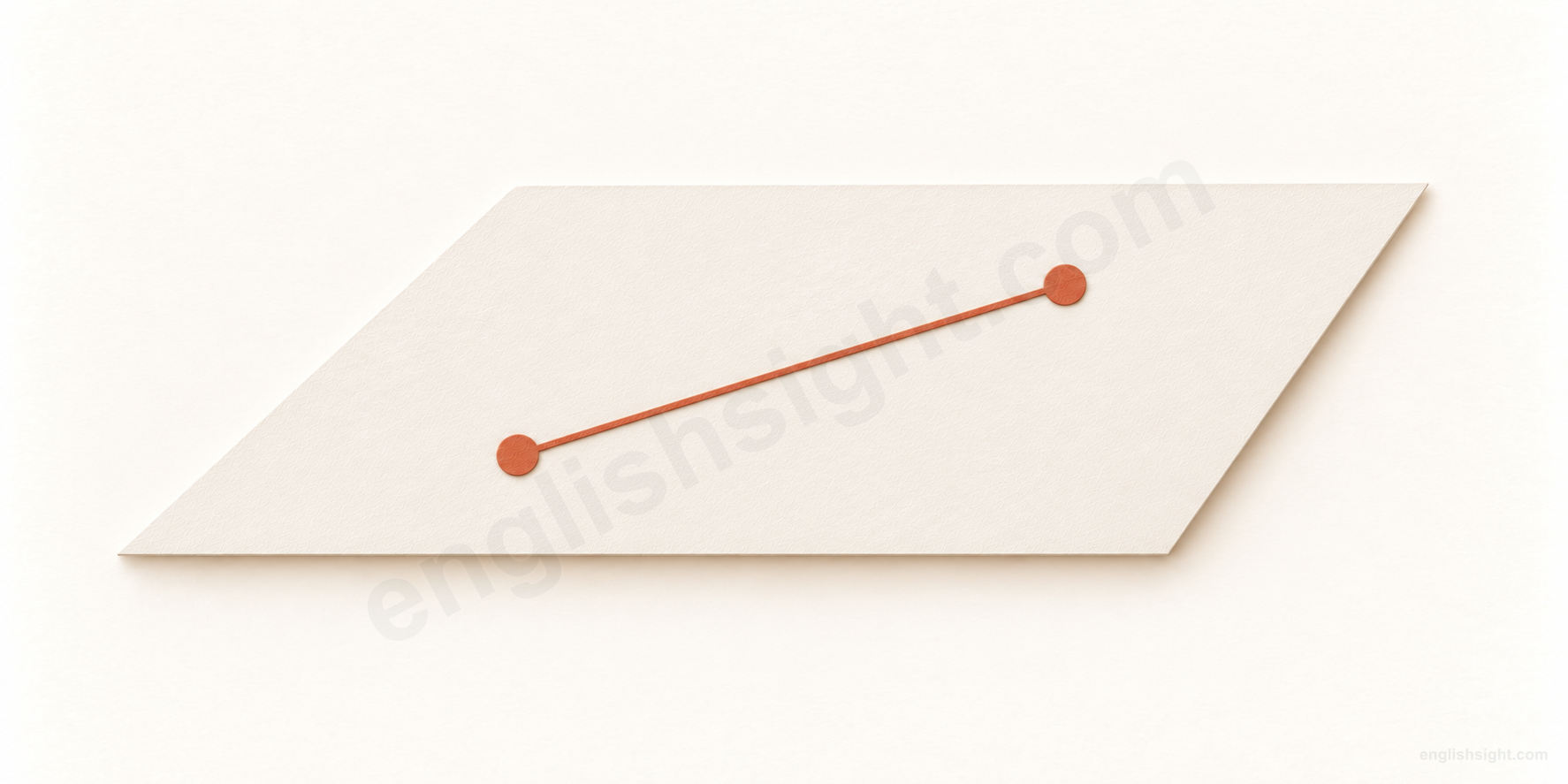
A flat surface is shown at an angle.
plane
Tilting changes orientation, not flatness.
Two points and their straight connection lie in that surface.
The paper shows a portion of a plane. A mathematical plane extends beyond the pictured border.
For the surface family, a plane is flat in two dimensions: a straight line between two points on it stays within that surface. The plane can be tilted without losing its flatness.
The sketch represents a portion of a geometric plane, not a temporal change. Travel, woodworking, movement, and tree contexts have their own uses; the same spelling does not make every branch predictable.
At an airport, plane usually names an aircraft. In geometry, it names a flat surface; in a workshop, it can name a tool or the action of shaving wood. Context selects the branch before a single memorized translation can help.
The surface picture connects geometry with talk about levels and gives a useful link to woodworking. It is a teaching aid, not a universal explanation of the aircraft, tree, or every movement use, and not a claim about what all native speakers imagine.
01
Aircraft and everyday air travel
Name the vehicle, choose a transport expression, and distinguish passengers from pilots.
01
a / the + plane; adjective or noun + plane; plane + noun
a plane / planes
a winged aircraft
Situation / starting point
You see an aircraft waiting at the airport.
Meaning / result
You identify it as a plane.
Plane names the vehicle; surrounding words tell you its type.
In travel conversation, a plane is an aircraft with wings. Plane is used in both British and American English; aeroplane is a British form, and airplane is especially North American. Use a plane for one unspecified vehicle and planes for more than one.
Passenger, cargo, private, and fighter describe different purposes or users: a cargo plane carries goods. A jet is a type of plane, so the words are not interchangeable in every context. A helicopter is not normally called a plane.
A plane ticket is a ticket for air travel, and a plane crash is an accident involving the aircraft. A plane ride is a journey in a plane. These noun combinations keep the aircraft meaning. Flight commonly names the journey or scheduled service: a flight can be cancelled while the plane is used elsewhere.
In a sentence
A small cargo plane landed beside the island’s main road.
Watch the difference Distinguish the vehicle from the journey: a plane has wings; a flight has a departure time.
02
travel / go / fly by plane; be on a / the plane; in a / the plane
by plane / on a plane
name a means of travel or say where someone is
Situation / starting point
You choose air travel instead of a long drive.
Meaning / result
You describe the transport choice and your place aboard.
By plane gives the method; on a plane locates a traveler aboard a vehicle.
Use travel, go, or fly by plane when the means of transport matters: We went by plane. In this transport pattern, plane has no article. Travel by a plane is not the usual neutral way to name the method.
On a plane and on the plane refer to being aboard an aircraft: I left my scarf on the plane. In a plane is also possible when the physical interior matters, especially with a small aircraft; on does not mean sitting on top of the wings.
The difference comes from the preposition and the construction, not a new aircraft sense. Compare We went by plane with We were on the last plane home.
In a sentence
We went by plane, and I slept on the plane for most of the journey.
Watch the difference Use by plane for the transport method, but on the plane when referring to a particular aircraft.
03
catch / miss / take + a / the / my + plane; a plane to + destination
catch / miss / take a plane
use a flight, or fail to reach it in time
Situation / starting point
Your aircraft leaves at nine.
Meaning / result
You either arrive in time to travel or lose that departure.
Catch and miss concern making the departure; take names the travel choice.
Catch a plane means reach it in time to travel. Miss a plane means fail to travel on that departure, typically because you are too late. Neither expression describes catching an object with your hands or simply feeling sad about an aircraft.
Take a plane is a neutral way to describe using air transport, often with a destination: We took a plane to the coast. The next plane means the next available departure in this context.
The plane is the object of catch, miss, or take. These are ordinary verb–noun combinations, not phrasal verbs built from plane.
In a sentence
We left before dawn so we would not miss our plane to Lisbon.
Watch the difference Catching a plane is about reaching the departure in time, not piloting it.
04
board + a / the plane; get on / off + a / the plane
board / get on / get off a plane
enter or leave an aircraft as a traveler
Situation / starting point
Passengers are waiting at the gate.
Meaning / result
They enter the aircraft and later leave it.
Board takes the aircraft directly; get uses on or off.
Board the plane and get on the plane describe entering it for a journey. Leave the plane and get off the plane describe departing from it. You can be on the plane before it takes off.
Board is transitive here: board the plane, without on. Get needs the preposition in this passenger construction: get on it, then get off it. The boarding action belongs to board or get on, while plane names the vehicle.
In a sentence
Please wait until your row is called before you board the plane.
Watch the difference Say board the plane or get on the plane, rather than board on the plane.
05
person + fly + a plane; plane + take off / land
fly a plane / a plane takes off
describe the pilot’s action or the aircraft’s movement
Situation / starting point
A trained pilot prepares the aircraft.
Meaning / result
The plane leaves the ground and later lands.
Fly a plane gives the person control; by plane describes a traveler’s transport.
She flies a plane normally means she pilots it. She flies to work or travels by plane can describe a passenger. Adding the aircraft as the direct object changes who is presented as controlling it.
The plane takes off when it leaves the ground; it lands when it reaches the ground again. These are events involving the aircraft, not meanings created by plane itself. The plane landed is a statement about the vehicle; we landed can refer to its passengers too.
In a sentence
My aunt flies a rescue plane, but I have only traveled as a passenger.
Watch the difference I fly a plane normally claims a piloting skill, rather than simply saying I use air travel.
02
Flat surfaces and geometry
A plane may be real or imagined, horizontal or tilted. Technical adjectives keep this surface meaning.
06
a plane; points / lines in a plane; in the same plane
a plane / in the same plane
a flat surface or an imagined flat surface
Situation / starting point
You mark two points on one flat sheet.
Meaning / result
A straight line joining them stays within that surface.
A geometrical plane is flat; the drawing shows only a bounded portion of it.
In geometry, a plane is a two-dimensional flat surface extending without an edge. We draw a piece of one as a sheet or a slanted parallelogram, but the drawn border is not an actual edge of the mathematical plane.
Points or lines in the same plane share one such flat surface. This is a geometric relationship, not a claim that they are inside an aircraft. In art or architecture, planes can also mean the flat surfaces or faces that make up a form.
The diagram highlights two points and the straight line between them on one flat surface. This is a teaching model for the surface family; it does not explain every unrelated use of the spelling plane.
In a sentence
All three points lie in the same plane.
Watch the difference A drawing has a visible border; the ideal plane it represents continues beyond that border.
07
horizontal / vertical / inclined + plane
a horizontal / vertical / inclined plane
say how a flat surface is oriented
Situation / starting point
You consider a tabletop, a wall, and a ramp.
Meaning / result
Their surfaces face in different directions while remaining flat.
Flat does not mean horizontal: a plane can tilt or stand upright.
Horizontal describes an orientation like a level tabletop. Vertical describes an upright orientation like a wall. Inclined means sloping. All can describe planes; changing orientation does not make a flat surface curved.
An inclined plane can also name a sloping flat surface used as a ramp in elementary mechanics. The adjective supplies the slope; plane supplies the flat-surface idea. A vertical plane is not an aircraft flying upward.
In a sentence
The diagram shows a vertical plane cutting through the center of the sphere.
Watch the difference Do not define every plane as a horizontal surface; flatness and orientation are different.
08
plane + surface / figure / geometry
a plane surface / plane geometry
use plane as a technical adjective
Situation / starting point
You compare a flat figure with a solid shape.
Meaning / result
You describe shapes that fit within one plane.
In technical noun phrases, plane can modify the following noun.
A plane surface is a flat surface. Plane is a specialist adjective here, usually placed before the noun. In ordinary descriptions of furniture, flat is generally the clearer everyday choice.
Plane geometry concerns figures lying in a plane, such as triangles and circles, rather than three-dimensional solids. A plane figure has its points in one plane; the phrase does not describe an airplane-shaped figure.
Compare a plane ticket, where the noun plane identifies a connection with aircraft, with a plane surface, where the adjective describes flatness. The same position before a noun does not guarantee the same grammatical or semantic role.
In a sentence
In plane geometry, we study the angles of triangles.
Watch the difference For a simple description, say a flat table; plane is mainly technical in its adjective use.
03
Levels of thought and achievement
An abstract plane is a metaphorical level; register and context matter.
09
on a higher / different plane; a plane of + abstract noun
on a higher / different plane
a level of thought, ability, or existence
Situation / starting point
You compare ideas or performances.
Meaning / result
You describe them as operating at different levels.
The surface model becomes a metaphorical level, not an actual place above the ground.
On a higher plane of thought, achievement, or existence uses plane for an abstract level. On a different plane can describe a striking difference in ability or outlook: Her analysis is on a different plane from mine.
This wording is more elevated or formal than on a different level. In spiritual writing, a plane of existence refers to a kind or level of existence within that writer’s account; the expression itself does not establish that such realms exist.
The preposition is normally on in these expressions, whereas in the same plane is standard for geometric points. The whole context decides whether plane is physical, mathematical, or metaphorical.
In a sentence
Her latest work operates on a different plane from her early sketches.
Watch the difference Choose on another plane for an abstract level; plain is a different spelling and word.
04
The tool and the work it does
A plane removes thin shavings. Grammar distinguishes the wood being worked from the material being removed.
10
a / the + plane; a hand plane; use a plane to + verb
a plane / a hand plane
a tool that shaves thin layers from wood
Situation / starting point
A wooden edge is uneven.
Meaning / result
A sharp-bladed tool removes thin shavings.
The tool’s blade cuts wood; its flat sole guides the cut.
A woodworking plane has a blade set in a body with a flat bottom. Moving it over wood removes thin shavings to smooth, flatten, or shape the piece. A hand plane is operated by hand.
Here plane is a countable tool noun: a plane, the plane, two planes. The context of a board, blade, carpenter, or workshop distinguishes it from the aircraft. The flat-surface idea helps connect the tool with its work, but the tool must still be learned as a named object.
In a sentence
I used a hand plane to smooth the edge of the shelf.
Watch the difference A plane cuts with a blade; sandpaper smooths by abrasion. They are different tools.
After planing, its surface is smoother or flatter.
The object is the wood being worked; a following adjective describes the result.
As a verb, plane can take the wooden object directly: plane the board or plane the door’s edge. Plane the wood smooth adds the result adjective smooth; it says what the action makes the wood like.
The regular forms are plane, planes, planed, planing. Drop the final e before -ing. Compare planning, from plan, which has two n’s. You can describe an ongoing action or use a passive: The board is being planed.
Have the edge planed means arrange for someone to do this work; the have construction supplies that arrangement. Plane itself does not mean hire or persuade. This action is related to the tool, not to traveling by air.
In a sentence
Mira planed the board smooth before painting it.
Watch the difference Planed is the past form of plane; planned belongs to plan and means something different.
12
plane down + object / plane + object + down; plane off + object / plane + object + off
plane down / plane off
reduce a wooden piece or remove material with a plane
Situation / starting point
The door edge is too thick, with an unwanted ridge.
Meaning / result
Planing reduces the edge or removes the ridge.
Down emphasizes reduction; off identifies material removed.
Plane down the edge and plane the edge down mean shave it to reduce its size or thickness. With a pronoun, say plane it down. Collins lists plane down as a phrasal verb, but its meaning remains close to woodworking plane.
Plane off a ridge or plane a ridge off means remove the ridge by planing. Plane it off keeps the pronoun before off. In plane a little wood off the edge, a little wood is the material removed and the edge names its source.
The particles do not refer to an aircraft descending or taking off. Interpret the wood, surface, and removal context together. Removing wood may improve the fit, but plane down alone does not promise a perfect result.
In a sentence
The door would not close, so we planed its bottom edge down a little.
Watch the difference Use plane it down and plane it off, rather than plane down it or plane off it.
05
Movement and a tree name
Recognize these context-specific branches without treating them as the default meaning in travel conversation.
13
boat / bird + plane; plane across / over + place
the boat planes / a bird planes
skim over water or glide through air
Situation / starting point
A small powerboat gains speed.
Meaning / result
Its hull rises partly and skims the water.
This movement verb is intransitive: the boat or bird is what moves.
In boating, a boat planes when speed lifts it partly out of the water so that it skims along the surface. The boat is planing describes that motion, not a person cutting the boat with a tool.
You may also read that a bird planes: it glides with its wings held still. This is a useful recognition sense in descriptions of nature; glide is an easier general-purpose word for learners to use.
Across the water describes the path in The boat planed across the bay. Across is not a required particle: The boat began to plane is complete too. Keep this movement branch separate from transitive plane the wood.
In a sentence
As it gained speed, the boat began to plane across the bay.
Watch the difference A boat planes without a direct object; a carpenter planes a wooden object.
14
a plane tree; a plane; plane trees / planes
a plane tree / a plane
recognize a tree name
Situation / starting point
You read a description of a shaded city street.
Meaning / result
Plane trees identify the trees growing there.
Plane tree is a tree name, separate from the aircraft and surface uses.
A plane tree is a broad-leaved tree with spreading branches, often planted in towns. Plane alone can also name this tree: The square is lined with planes. Here the plural means trees, not aircraft parked in the square.
Learning the full name plane tree gives a useful context clue and avoids forcing the flat-surface diagram onto a plant name. Detailed species identification is outside this lesson.
In a sentence
Two old plane trees shade the benches beside the library.
Watch the difference Do not confuse plane tree with plain tree: plain means ordinary or undecorated in other contexts.
Let context choose the branch
Plane, plain, and plan
Plane and plain both sound like /pleɪn/, but plain can mean simple or name an open area of land. A flat geometric surface is a plane. Plan is /plæn/; its forms planned and planning differ from planed and planing.
Do not make one picture explain every meaning
The surface model supports geometry and the level metaphor. A plane tree is a lexical name, and a plane in travel is the short form associated with airplane or aeroplane. Recognize these branches from their contexts rather than inventing a shared physical action.
Grammar follows the sense
The main nouns are countable. The zero article in by plane belongs to the transport construction. Woodworking plane can have an object, a result adjective, and a passive; the boat and bird movement uses are intransitive. The technical adjective is normally before its noun.
Coverage boundary
This lesson selects useful modern meanings and constructions, with a few clearly marked recognition uses. It does not expand technical aircraft-surface terminology, specialized moulding tools, or the less usual verb plane meaning travel by aircraft; fly or travel by plane is the practical learner choice.
Choose the branch and the construction
Use the setting, the preposition, and the object to decide.
1. You want to name your means of transport. Which is the usual neutral expression?
2. Which sentence normally says that Jo controls the aircraft?
3. A flat surface is tilted. Can it still represent a portion of a geometric plane?
4. A wooden edge is too thick. Replace the edge with it in a planing instruction.
5. A critic says a musician operates on a different plane. What is the likely meaning?
6. Which spelling describes someone shaving wood right now?
Sources and teaching notes
The dictionary pages below were used to check meanings, forms, and usage. Explanations and examples are original; the surface diagram is a teaching model with explicit limits.
The surface diagram explains one family of uses; it is not a shared mental picture of every English speaker.