From a living plant to deliberate placement—and a separate industrial noun.
Set into a growing position
Establish something in a position
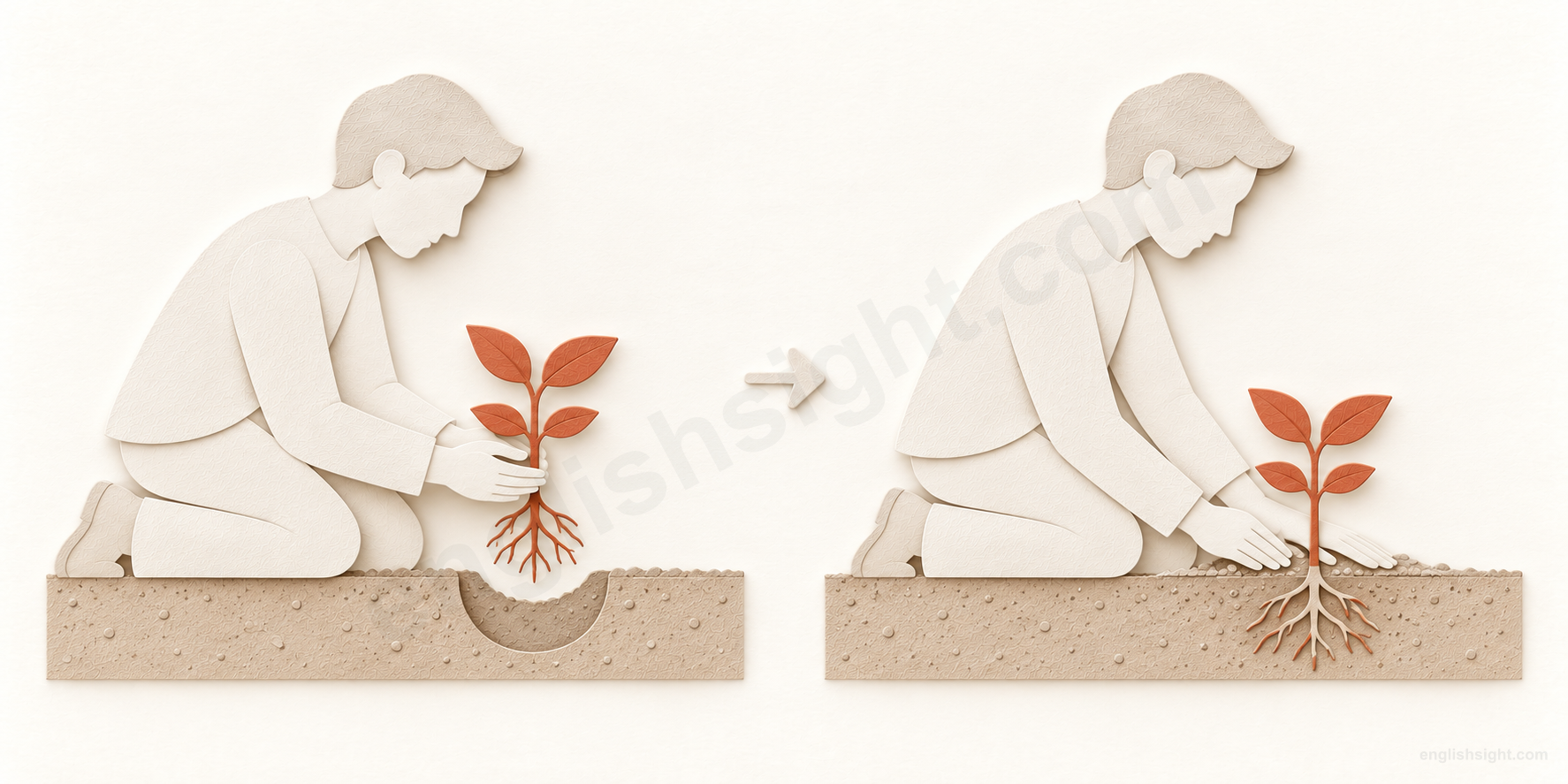
The gardener holds a young plant above a hole, with its roots still above the soil.
plant
The same plant stands with its roots below the soil surface and its leaves above it.
The gardener lowers the roots into the hole and firms the soil around them.
Set the plant into soil for growth; planting does not guarantee that it will grow.
Put a young plant into soil so it can grow there; in several extended uses, deliberately place something where it can remain or have an effect.
This is a teaching connection, not a rule for predicting every phrase. Planting does not guarantee growth, and industrial plant is a separate noun branch.
A plant can be a living thing. As a verb, plant often means deliberately setting something in a place: a tree in soil, feet on the floor, or an idea in a mind. The object and construction tell you which kind of placement is meant.
The growing-place picture links several uses, but does not explain everything. A manufacturing plant and industrial plant belong to an established noun branch that needs separate attention.
01
Living things and gardening
Start with a living plant, then distinguish putting it into soil from caring for it as it grows.
01
a / the + plant; plural plants; plant + noun
a plant / plants
a living organism such as a fern, a flower, or a tree
Starting situation
You notice something growing beside the path.
Meaning in context
You identify it as a plant.
Plant names the whole living thing, not only its flower.
A plant can have roots, a stem, and leaves. In everyday shopping, a plant often means a relatively small one for a room or garden. In a wider discussion of plant life, trees are plants too.
Use a plant for one individual and plants for several: There are three plants by the window. A flower can mean the bloom alone; the plant includes the rest of the living thing. A tomato plant is the organism, not one tomato.
In plant life, plant growth, or plant species, plant modifies another noun. Read the whole phrase: plant life concerns vegetation generally, while a plant can be one individual.
In a sentence
A small plant is growing between the paving stones.
Watch the difference Do not use an uncountable singular for separate living things: three plants, not three plant.
02
grow / water + a plant; a plant grows
grow / water a plant
look after a living plant over time
Starting situation
A plant is already in its pot.
Meaning in context
You give it care as it develops.
Planting is one action; growing and watering can continue afterward.
Grow plants can describe cultivating them; The plants are growing describes their development. Water a plant means give it water. Neither expression necessarily says that you put it into soil today.
A houseplant is kept indoors. A potted plant is in a pot: the noun tells you what it is, and potted describes its container. You can water a plant for years after planting it.
In a sentence
I water the plants in the office every Friday.
Watch the difference I planted it yesterday describes placing it for growth; I grew it describes cultivation or development over time.
03
plant + seed / plant / crop + in + place; be planted
plant seeds / a tree
put seeds or a young plant into soil for growth
Starting situation
Seeds or roots are ready to go into soil.
Meaning in context
They are in the place where growth is intended.
The action establishes a growing position; it does not guarantee survival.
The gardener is the subject, and the seed, bulb, tree, or crop is the object. A location can follow: plant bulbs in a pot. The pot is the growing place, not the thing being planted.
Plant is broader than sow: sow focuses on putting seeds into soil, while you can plant a young tree with roots. Grow focuses on development or cultivation. We planted beans but none grew makes sense.
Planting can be in progress: We are planting trees today. The passive shifts attention to the object: These trees were planted last winter. Newly planted trees tells you about a recent planting action.
In a sentence
We planted two apple trees behind the kitchen.
Watch the difference A tree grows; a gardener plants a tree. Do not say The tree planted when you mean it grew.
04
plant + area + with + plants; area + be planted with + crop
plant a bed with flowers
put plants into an area of land
Starting situation
A garden bed has empty space.
Meaning in context
Flowers occupy the bed.
The object can be the planted area rather than the living things.
Compare plant flowers in the bed with plant the bed with flowers. In the first, flowers is the object; in the second, the bed is the object and with names what is put there.
The bed was planted with flowers keeps the area as the subject of a passive sentence. Plant a garden can describe putting its plants in, not physically lifting a garden into a hole.
In a sentence
The volunteers planted the empty bed with lavender.
Watch the difference With names the plants supplied to the area; in names the place receiving them.
05
plant out + noun; plant + noun / pronoun + out
plant out / plant them out
put young plants into the ground where they will continue growing
Starting situation
Young plants have been started in small containers.
Meaning in context
They are planted in a bed with space to develop.
Out marks planting young plants in their growing site, typically in open ground.
This gardening phrasal verb describes putting young plants into the ground where they are to grow, with room to develop. Typically, seedlings raised in containers or under cover are planted out in an outdoor bed. It is more specific than simply moving a pot to another place.
With a noun, both plant out the seedlings and plant the seedlings out are possible. Put a pronoun between the verb and particle: plant them out. A place can follow: plant them out in the bed.
In a sentence
The seedlings are ready; we can plant them out in the raised bed.
Watch the difference Say plant them out, not plant out them. It does not mean remove or dig up plants.
02
Set something firmly in a position
The object and the following location tell you what is being placed. A flag, your feet, yourself, and a kiss call for different interpretations.
06
plant + object + in / on + place; keep + object + planted
plant a flag / plant your feet
set something firmly in a chosen position
Starting situation
Something has not yet been set in position.
Meaning in context
It is held or supported firmly there.
The emphasis is deliberate, firm placement rather than growth.
A flag can be planted by setting its pole into the ground. With plant your feet, you put your feet down firmly, for example before lifting something heavy. The object decides what physical action is involved.
The location matters: plant a flag on a hill, plant your feet on the floor. The added words tell you where; plant contributes a sense of firm placement. A firmly planted post is already in that position.
In a sentence
Before lifting the box, she planted her feet firmly on the floor.
Watch the difference Plant is stronger and more deliberate than neutral put; it does not mean that the feet will take root.
07
plant + myself / yourself / himself / herself / ourselves / themselves + place
plant yourself somewhere
take a position firmly and deliberately
Starting situation
You are moving or standing elsewhere.
Meaning in context
You take a position and appear determined to stay.
The subject places their own body; the reflexive pronoun refers back to them.
Plant yourself in a doorway suggests a deliberate stance there, sometimes making it difficult for others to pass. Plant yourself in a chair can suggest sitting down with a settled or determined attitude.
Match the pronoun to the subject: I planted myself, she planted herself, they planted themselves. In She planted herself beside the door, beside gives the position; the reflexive form shows that she moves herself.
In a sentence
Leo planted himself in front of the gate and refused to move.
Watch the difference This can imply insistence or obstruction. For an ordinary position, stood or sat may be more neutral.
08
plant + a kiss + on + person / body part
plant a kiss on someone
give a deliberate kiss on a particular spot
Starting situation
A child is about to leave.
Meaning in context
A parent gives the child a kiss.
The kiss is pictured as landing on a particular surface.
Plant a kiss on someone’s cheek is a vivid way of saying kiss the person there. A parent can plant a kiss on a child’s forehead. The noun kiss makes clear that this is affection or greeting, not gardening.
On introduces the person or the place receiving the kiss. Learn the combination as a whole; plant is not a general replacement for give in every expression.
In a sentence
Before school, Dad planted a kiss on Maya’s forehead.
Watch the difference Say plant a kiss on her cheek, not plant her a kiss as a general double-object pattern.
03
Introduce something with an intended effect
Ideas, concealed objects, and secret participants can all be deliberately introduced. Growth is only a teaching comparison for some of these uses.
09
plant + idea + in + someone’s mind; plant (the) seeds of + feeling / attitude
plant an idea / seeds of doubt
introduce a thought that may develop or influence someone
Starting situation
Someone has not considered a possibility.
Meaning in context
They begin to think about or question it.
The seed image suggests a beginning, not a guaranteed result.
Plant an idea in someone’s mind means introduce it so that the person starts considering or accepting it, sometimes without noticing where it came from. The idea is the object; the person’s mind is expressed as its destination.
Plant seeds of doubt is a figurative combination: a comment starts uncertainty that may develop. Seeds of hope suggests a beginning of hope instead. The noun after of tells you what may develop.
This is a teaching link to planting something that can grow. It does not mean that thoughts are physical seeds, or that every suggestion succeeds.
In a sentence
The unexplained charge planted seeds of doubt in her mind.
Watch the difference Do not confuse plant an idea with prove an idea. It describes introducing a thought, not showing that it is true.
10
plant + a story / news item + in + publication
plant a story in the press
arrange for a news item to appear for an undisclosed purpose
Starting situation
An organization wants to influence how people understand an event.
Meaning in context
A story appears as news, while its arrangement or motive stays hidden.
What is introduced is information; the purpose goes beyond simply telling the news.
A person or organization can plant a story in a newspaper or in the press to influence readers or bring about a particular result. The story is the object; the publication is where it is placed.
The expression suggests an arranged appearance and an ulterior purpose. It does not necessarily mean that every detail is invented. Compare publish a story, which reports publication without itself suggesting a concealed agenda.
In a sentence
The drama follows a politician who plants a story in the local press to distract voters.
Watch the difference Do not replace publish with plant in neutral reporting unless you intend to suggest a hidden arrangement or motive.
11
plant + object + in / at + place; object + be planted
plant a device somewhere
place something secretly for a later purpose
Starting situation
A place has no concealed device.
Meaning in context
A device is secretly positioned there.
Secret placement is the key; growth is not involved.
In news or a crime story, someone may plant a listening device in a room or plant a bomb in a building. The object reveals the intended purpose; plant itself does not always mean make something explode.
The passive is common when the person responsible is unknown: A device had been planted in the office. This reports concealment, not evidence of a particular culprit.
In a sentence
The investigators discovered a microphone that had been planted in the meeting room.
Watch the difference Not every hidden object is planted: the word suggests deliberate placement for a purpose.
12
plant + evidence / illegal item + on + person; evidence + be planted
plant evidence on someone
put material among someone’s possessions to make them look guilty
Starting situation
Someone does not possess the incriminating material.
Meaning in context
It is placed there so its discovery points to that person.
On names the person being falsely implicated.
Plant drugs on someone can mean secretly putting drugs in their clothing, bag, or other possessions. It does not require placing them on the outside of the person’s body.
Plant evidence can also refer to a room or other location. The passive focuses on the disputed evidence: She says the evidence was planted. That sentence reports her claim; it does not establish whether it is true.
In a sentence
He said someone had planted the stolen watch in his bag.
Watch the difference Plant evidence suggests fabrication or deceptive placement, not an investigator honestly collecting evidence.
13
plant + person + in + group; person + be a plant
plant someone in a group
secretly arrange for a person to join a group for a purpose
Starting situation
A group does not know an outsider’s real role.
Meaning in context
The person joins while hiding that role.
The person is placed socially, rather than planted physically.
An organization may plant an informer in another group to obtain information. The subject arranges the placement, the object is the person sent, and in introduces the group joined.
An informer may be a plant: here plant is a countable noun naming the secret participant. Not every new member is a plant; the word implies an undisclosed role or agenda.
In a sentence
The detective suspected that a rival company had planted an employee in the team.
Watch the difference The person is the object after plant, not the receiver in a plant someone something construction.
14
a / the + plant; someone / something + be a plant
a plant: staged evidence or participant
a deliberately placed thing or person made to look genuine
Starting situation
A discovery or audience reaction appears spontaneous.
Meaning in context
Someone suspects it was arranged beforehand.
This informal noun points to an undisclosed arrangement.
In a crime story, calling an object a plant can allege that someone put it there as false evidence. A staged participant can also be a plant, for example someone in an audience whose question was arranged in advance.
Context distinguishes the meanings: The fern is a plant identifies a living thing; The questioner was a plant alleges a hidden role. Use a plant for one person or item in this sense.
In a sentence
Viewers wondered whether the enthusiastic questioner was a plant.
Watch the difference This can be an accusation. The noun does not by itself prove that an event was staged.
04
Factories and industrial equipment
This noun branch concerns industrial operations. Learn its countable and uncountable uses separately from the living-thing picture.
15
(industrial process / product) + plant; a plant / several plants
a power / manufacturing / treatment plant
a facility for an industrial process
Starting situation
A town needs power, products, or water treatment.
Meaning in context
A specialized facility performs the process.
This is a countable industrial place, not a living organism.
A manufacturing plant makes products; a power plant produces electricity; a water treatment plant processes water. Plant in this branch can refer to a whole site, not just one room.
Say a plant, two plants, or work at the plant. Factory overlaps when products are made, but a water treatment plant is not usually called a water treatment factory. Learn the process word together with plant.
The seedling diagram does not explain this industrial noun reliably. Treat it as a separate established meaning rather than imagining that every factory is a growing organism.
In a sentence
The city opened a new water treatment plant near the river.
Watch the difference Do not interpret a nuclear plant or power plant as a type of vegetation.
16
plant (uncountable); plant and equipment
plant and equipment
industrial machinery considered collectively
Starting situation
A business needs machines for its operations.
Meaning in context
It invests in industrial machinery.
This equipment meaning is uncountable.
In business and industry, plant can mean the machinery used for a process. In this sense, new plant refers collectively to machinery, not one new factory and not living plants. Heavy plant for construction machinery is especially associated with British English; hire here means rent.
Compare The company bought two plants, which normally means two industrial facilities in a business context, with The company invested in new plant, which can mean new machinery. Use a piece of equipment when you need to count one machine.
In a sentence
The builder hires heavy plant rather than buying every machine.
Watch the difference For the machinery sense, avoid a plant to mean one machine. A plant normally suggests an industrial facility or a living thing.
Read the object and the whole construction
Forms and pronunciation
Plant is both a noun and a verb. The verb forms are plant, plants, planted, planted, planting. The past ending adds a syllable: planted. British English commonly has /plɑːnt/ and American English /plænt/.
Objects, passives, and particles
These verb senses normally take an object, although it can be understood in context: We are planting today. Passives are natural when the placed item matters. Plant out is a separable gardening phrasal verb; in plant an idea in her mind and plant evidence on him, the prepositions introduce destinations or targets.
No automatic causative or growth promise
Use get someone to plant the trees or have the trees planted when someone else does the work. Plant someone to do something is not the general causative equivalent. A planted seed may never grow, and a planted idea may never persuade anyone.
Scope of this lesson
This lesson covers the main modern noun and verb branches and a common gardening phrasal verb. It does not teach specialist snooker, theatrical foreshadowing, fish-stocking, historical colony-founding, or the slang blow sense. Derived forms such as transplant and plant-based need their own explanations.
Choose the meaning that fits
Use the object, context, and following words to decide.
1. You want to describe filling a garden bed with roses. Which pattern makes the bed the object?
2. Replace the seedlings with them in Plant the seedlings out. Which form works?
3. We planted the seeds, but none grew. Is this a contradiction?
4. In a construction report, heavy plant is being hired. What is being rented?
5. A suspect says the stolen watch was planted in her bag. What does she claim?
6. A comment planted seeds of doubt. What happened?
Sources and teaching notes
The linked Oxford and Collins entries support the usage inventory. Explanations and examples are original; connections between senses are teaching interpretations.
The diagram is a teaching aid, not a claim that every native speaker shares one mental picture.