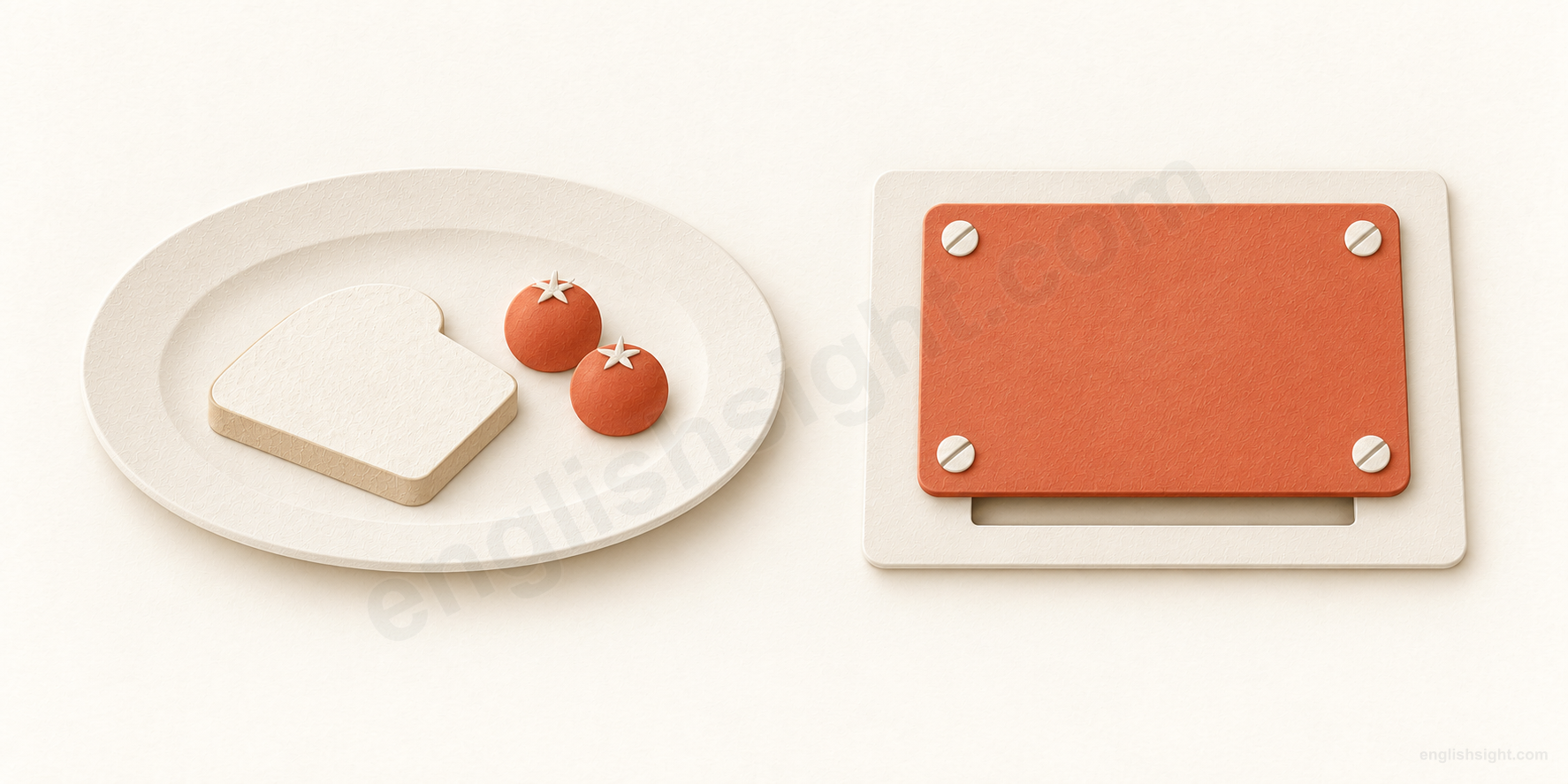
From a dish on the table to panels, coatings, and familiar expressions.
A broad surface serves a purpose
A broad surface serves a purpose
A shallow dish supports food.
plate
A flat metal plate covers most of an opening.
Compare the broad faces and their different purposes.
The dish holds food; the metal plate covers an opening. These are related physical uses, not successive stages.
A plate is often a broad, relatively flat piece that holds, displays, covers, or protects something; in the meal sense, it is a shallow dish.
This is a teaching connection between physical uses, not a rule that every flat object is called a plate. Food quantities, precious-metal collections, and idioms need their own context.
Start with a shallow dish holding food. Then compare a flat metal panel: plate can name a broad, relatively flat piece whose purpose is given by its context. Roundness belongs to the familiar dinner plate, not to every use of the word.
Some meanings shift from the object to its contents or purpose; others belong to specialist vocabulary or fixed expressions. Learn those branches explicitly rather than expecting one picture to predict them all.
01
At the table and at a party
Begin with the object, then notice when plate names the food, a serving, or a shared-meal contribution.
01
a / the + plate; adjective / noun + plate; food on a plate
a dinner plate
a shallow dish for serving or eating food
Situation / object
You are setting places for dinner.
Meaning in context
Each person has a surface for their food.
The plate is the object; the food rests on it.
A plate is usually broad and shallow. A bowl has deeper sides, which make it suitable for liquids or loose food. Plate does not require one particular material: paper plates and ceramic plates are both plates.
Use a dinner plate for a main meal and a side plate for a smaller accompaniment. These noun combinations specify purpose or size; they do not create separate meanings of plate.
Food is on a plate, and people eat off or from plates. Dish is broader: it can name a container, or a prepared kind of food, as in a rice dish.
In a sentence
Could you put a clean plate beside each glass?
Watch the difference For one ordinary object, use a plate, not simply plate. Put food on the plate; in a bowl emphasizes the deeper container.
02
a plate of + food; two plates of + food
a plate of rice
food measured or presented by the plate
Situation / object
Rice is served in two helpings.
Meaning in context
You describe the helpings rather than count grains.
Of names the contents; plates counts the servings.
A plate of rice can mean a dish with rice on it or the quantity served on that dish. If someone eats two plates of rice, they normally eat the contents of two servings, not the dishes.
Compare a seafood plate on a menu, which can name a particular prepared meal. A plate of rice directly identifies what is on the plate; the grammar of of supplies the contents relationship.
In a sentence
After the walk, Mina ate two plates of rice.
Watch the difference Rice remains uncountable here: two plates of rice, not two plates of rices.
03
the + food + plate; cost + amount + a / per plate
a seafood plate / $30 a plate
a complete plated meal, or one person’s meal and service
Situation / object
You read a menu or plan a dinner budget.
Meaning in context
Plate identifies a meal choice or the cost for each guest.
The context changes the focus from crockery to a meal.
A seafood plate can name a whole main course served together, especially in North American English. It is a menu item rather than the name of the ceramic object.
At a dinner advertised at $30 a plate, a plate means the food and service for one person. Here a has the meaning per: thirty dollars for each diner. It is not a price for buying tableware.
In a sentence
The charity dinner costs thirty dollars a plate.
Watch the difference Do not use the event-price interpretation when someone is pricing actual plates in a shop; context decides.
04
clear + possessive + plate; clear the plates (from the table)
clear your plate / clear the plates
eat everything served, or remove the tableware
Situation / object
The meal is nearly finished.
Meaning in context
Either no food remains, or the dishes leave the table.
Whose plate and the surrounding action help resolve clear.
Clear your plate often means finish all the food on it. The expression focuses on the plate’s contents. It does not literally mean eat the plate.
Clear the plates, especially from the table, means take the dishes away. Compare The children cleared their plates before dessert with The server cleared the plates after dessert. The verb clear contributes the idea of leaving something free of its contents or removing things from a place.
In a sentence
When everyone had finished, Jo cleared the plates from the table.
Watch the difference Clearing your plate does not by itself mean washing it. Washing the plates is a separate action.
05
bring a plate (Australian / New Zealand shared-meal invitation)
bring a plate
bring food to share at a gathering
Situation / object
An invitation asks guests to contribute.
Meaning in context
You arrive with a prepared food contribution.
In this regional expression, the expected contribution includes food.
In Australian and New Zealand English, bring a plate on an invitation commonly asks each guest to bring food for the shared meal. An empty plate will usually miss the point.
Outside that context, bring a plate can be completely literal: a host might need extra dishes. The invitation and local custom determine the reading; ask what food would be useful if unsure.
In a sentence
The invitation says to bring a plate, so I’ll make some sandwiches.
Watch the difference This regional convention does not make bring a plate a universal expression for a shared meal.
02
Panels, layers, and special objects
A broad, relatively flat form connects many physical uses. The purpose and the surrounding words identify the particular object.
06
a + material + plate; a plate of + material
a steel plate
a broad, relatively flat solid piece
Situation / object
A joint needs a strong covering or support.
Meaning in context
A shaped metal piece reinforces it.
Flatness is relative to width, not a promise that the material is paper-thin.
A steel plate may be a structural piece in a machine, bridge, or vehicle. An armour plate is a protective piece. These share a broad face and a thickness much smaller than their width.
A metal plate in an arm is an implanted piece used to support a bone. The broad, relatively flat form connects it to structural plates in machines.
The shape connection is useful, but not every flat object is naturally called a plate. A sheet of paper remains a sheet of paper.
In a sentence
A steel plate covers the opening in the machine.
Watch the difference A plate need not be round, and steel plate need not be extremely thin. The dish sense is only one branch.
07
a plate on / beside + place; a nameplate
a nameplate / a brass plate
a panel carrying identifying information
Situation / object
A visitor needs to identify an office.
Meaning in context
A fixed panel displays the occupant’s name.
The flat piece serves as a surface for information.
A plate beside a door may carry a name, job title, or room number. Nameplate is normally written as one word; a brass plate specifies the material.
The verb read can describe the displayed wording: The plate reads “Office.” Plate names the object that carries the message, not the message alone.
In a sentence
A brass plate beside the door gives the doctor’s name.
Watch the difference Use sign as the broader word for a public notice. Plate suggests a particular panel or plaque, not every kind of sign.
08
license plate (US); number plate (UK); a car with + description + plates
a license plate / a number plate
a vehicle’s registration panel
Situation / object
You need to identify a particular car.
Meaning in context
Its letters and numbers provide the registration.
The identifying surface is attached to the vehicle.
License plate is the usual American term; number plate is the usual British term. Registration plate is also used. Plates alone can mean these panels when the vehicle context is clear.
A car with foreign plates has registration panels from elsewhere. Plural plates is common, but the singular is possible when referring to one panel. Local rules about how many panels a vehicle needs are separate from the word’s meaning.
In a sentence
The witness wrote down the number on the car’s license plate.
Watch the difference The plate is the panel; the license plate number is the sequence displayed on it. A driving licence is a different document.
09
a tectonic plate; the Pacific Plate; plate tectonics
a tectonic plate
a huge moving section of Earth’s rigid outer layer
Situation / object
You read an explanation of earthquakes.
Meaning in context
The explanation refers to moving sections of the lithosphere.
Here plate describes a vast slab, not a human-made object.
A tectonic plate is a large section of the lithosphere, the rigid outer part of Earth. The word connects through a broad slab-like form, although the scale and material differ greatly from a dinner plate.
The Pacific Plate is the name of one such plate. Plate tectonics names the scientific theory and field of study concerned with these plates and their movement; it is not the plural of plate.
In a sentence
The map shows the boundary between two tectonic plates.
Watch the difference Do not treat a continent and a tectonic plate as the same thing: a plate can include oceanic regions.
10
a colour / color plate; see Plate + number
a colour plate / Plate 8
a full-page illustration in a book
Situation / object
You use an illustrated reference book.
Meaning in context
A numbered picture page helps you identify the subject.
The word names a published illustration, not its original printing tool.
A plate in a book is a full-page illustration, often printed on a separate leaf or different paper from the main text. Older art and reference books commonly refer readers to a numbered plate.
Compare the printing plate used to produce images: that is a physical printing surface. A book plate is the resulting illustration. Bookplate, written as one word, usually means an ownership label inside a book and is a separate compound.
In a sentence
For a full-colour image of the bird, see Plate 8.
Watch the difference A plate number need not be the page number. Check the book’s own system.
11
a printing plate; a photographic plate
a printing plate / a photographic plate
a prepared surface used to produce or record an image
Situation / object
A printer or photographer prepares an image-making surface.
Meaning in context
The surface transfers ink or records light.
The two compounds name different tools, not interchangeable equipment.
A printing plate carries a prepared image or text that can be transferred in printing. The broad surface connection is direct, but the printing process supplies the specialized function.
A photographic plate carries a light-sensitive coating, traditionally on glass, for recording an image. It is familiar in discussions of older photography and some specialized cameras. It does not mean an ordinary printed photograph.
In a sentence
The museum displays a glass photographic plate from an early camera.
Watch the difference A printing plate transfers an image; a photographic plate records one. Neither is a dinner plate used near a camera.
12
a dental plate; an upper / lower plate
a dental plate
a fitted appliance or base used in the mouth
Situation / object
A conversation concerns artificial teeth or a dental appliance.
Meaning in context
Plate names the fitted mouthpiece or its supporting base.
This specialized object is identified by its dental context.
A dental plate can support artificial teeth. In some usage, plate or plates can refer more broadly to dentures. Other dental plates are fitted appliances used in orthodontic work.
This is a family of specialized uses, not a promise that all such devices have the same design or purpose. Use the full name supplied by the dentist when the distinction matters.
In a sentence
He keeps his spare dental plate in a protective case.
Watch the difference A dental plate is not the same object as a metal plate used to support a bone, even though both occur in healthcare.
13
silver / gold plate (uncountable); the family plate
silver plate / the family plate
a metal coating, plated metalware, or precious-metal household objects collectively
Situation / object
You read a description of antique tableware.
Meaning in context
The description concerns its material or a whole collection.
Mass-noun plate differs from countable dinner plates.
Silver plate can refer to a thin silver coating or to metalware with that covering rather than solid silver. Gold plate has comparable uses. A silver-plated spoon has a coating; it is not necessarily made of silver throughout.
Plate also has an older collective use for valuable household objects made of gold or silver, as in the family plate. That collection can include cups and bowls, not only flat dishes. An antiques description needs context to establish whether items are solid metal or plated.
In a sentence
The catalogue lists the spoons as silver plate rather than solid silver.
Watch the difference A silver plate with a means one object; silver plate without a can name a coating or refer to plated metalware collectively. Context distinguishes these uses from household objects made of precious metal.
14
bony / protective plates; plates of + body material
bony plates
flat protective parts of an animal’s body
Situation / object
A nature book describes an armadillo.
Meaning in context
Its outer covering contains hard protective pieces.
The plate is a body structure with a broad protective face.
In biology, plates can be relatively flat pieces of bone or another hard body material. Bony plates describes their material; protective plates describes their function.
The shape and protection connection helps relate this use to metal armour plates. It does not mean the animal has manufactured armour attached to it.
In a sentence
The armadillo’s back is covered with bony plates.
Watch the difference Not every scale or piece of shell is automatically called a plate; follow the established description of the animal.
15
home plate; the plate; at the plate
home plate / at the plate
the scoring base beside the batter in baseball
Situation / object
A baseball report describes a batter or runner.
Meaning in context
Plate identifies the home base and its playing role.
The sport gives this flat marker a fixed name.
Home plate is the base beside which the batter stands. A runner who completes the circuit returns to it to score. The plate is a common shorter reference within baseball.
A player at the plate is batting, not sitting down to eat. The physical marker connects with the flat-piece idea; the rules and expressions belong to the sport.
In a sentence
The runner reached home plate just before the throw arrived.
Watch the difference The batter stands beside the plate in the batter’s box, not on top of the plate.
16
the collection plate; pass the plate
pass the collection plate
a shallow container used to collect donations
Situation / object
People are making donations during a church service.
Meaning in context
The container passes among them.
The familiar dish form has a particular collection function.
A collection plate is a container for donations, especially in a church. Within that setting, the plate alone may be enough to identify it.
Pass the plate describes sending it along so that people can contribute. The money is not part of the meaning of the verb pass; the collection setting supplies that purpose.
In a sentence
The ushers passed the collection plate along each row.
Watch the difference Outside a donation context, pass the plate can simply mean hand a dish to someone.
03
Putting food on, or covering a surface
As a verb, plate takes an object. Food presentation and metal covering are different actions, so check what is being plated.
17
plate + food; plate (up) + food; plate + food / it + up
plate the food / plate it up
arrange or serve food on plates
Situation / object
The food is cooked but still in the pans.
Meaning in context
Individual portions are arranged ready to serve.
The food is the object; the plate is its destination.
As a cooking verb, plate means put or arrange food on a plate for serving. It is often used when presentation matters: the cook plates the fish, then adds the sauce.
Plate up is also used for serving portions. With an explicit object, plate up the food and plate the food up are possible; a pronoun goes in the middle: plate it up. Up helps present the serving task as completed; it does not mean lift the food higher.
Forms are plate, plates, plated, and plating: drop the final e before -ing. A passive such as The food is plated just before service focuses on the food rather than the cook.
In a sentence
I’ll plate up the fish while you bring the vegetables.
Watch the difference Say plate it up, not plate up it. Plating food means preparing it for serving, not cooking it.
18
plate + object + with + material; be plated with; gold-plated + noun
plate metal with gold
cover a surface with a metal layer or protective sheets
Situation / object
An object needs a surface finish or protective covering.
Meaning in context
Another material forms its outer layer.
The object stays underneath; the covering is added to its surface.
Plate a ring with gold means add a gold layer to the surface. The object being coated comes after plate; with introduces the coating material. Gold-plated and silver-plated are common descriptive forms.
Plate can also mean cover something with separate hard sheets, as in steel-plated doors. A thin deposited coating and a covering made of solid plates are related surface-covering uses, but they involve different physical processes.
The passive is common because the finished object matters: The handle is plated with chrome. This meaning is separate from plating food; the object and the with phrase help you choose.
In a sentence
The maker plated the brass clasp with gold.
Watch the difference Gold-plated does not mean solid gold. In plate the fish with vegetables, the cooking context instead indicates food presentation.
04
Responsibilities, opportunities, and challenges
Learn these as whole expressions. The meal and baseball connections help memory, but the idioms have established meanings.
19
have a lot / enough / too much on + possessive + plate
have a lot on your plate
have many tasks, responsibilities, or problems to handle
Situation / object
Several deadlines and family duties need attention.
Meaning in context
You explain why you cannot take another task.
Your plate is a metaphor for what you already have to deal with.
I have a lot on my plate is informal language for a heavy set of responsibilities or problems. The possessive identifies whose workload it is: my plate, her plate, or our plate.
Have enough on your plate often means you already have as much to handle as is reasonable. Too much on your plate says the load is excessive. A full plate offers a similar image.
The meal connection helps memory: there is already plenty in front of you. But the full expression is conventional; not every phrase about plates has a workload meaning.
In a sentence
I can’t organize the trip this month; I already have too much on my plate.
Watch the difference On my plate describes my responsibilities, not who owns a physical dish. A lot in my plate is not the idiom.
20
hand + person + something + on a plate; hand + something + to + person + on a plate
hand someone something on a plate
give someone an advantage without requiring much effort
Situation / object
A player makes a careless mistake.
Meaning in context
An opponent receives an easy chance.
The opportunity is presented ready to use, like a prepared serving.
Hand someone something on a plate means make it available with little or no effort required from that person. It is especially British and often disapproving: someone got a benefit they did not work for, or an opponent was given an avoidable advantage.
Both hand her the opportunity on a plate and hand the opportunity to her on a plate are possible. The passive is common too: She was handed the opportunity on a plate.
The full expression supplies the ease-of-obtaining meaning. A literal plate of sandwiches can be handed over without implying any criticism.
In a sentence
That careless pass handed the other team a goal on a plate.
Watch the difference Keep on a plate, not on your plate. Changing the article to a possessive can suggest the different workload expression.
21
step up to the plate; step up to the plate and + verb
step up to the plate
come forward to meet a responsibility or challenge
Situation / object
A difficult job needs someone to take charge.
Meaning in context
Someone accepts the challenge and acts.
The expression connects taking a batting position with being ready to act.
Literally, a baseball player steps up to the plate to take a turn at batting. Figuratively, someone steps up to the plate when they accept a challenge or do what a situation requires.
The figurative expression is informal and especially associated with American English. It can praise someone or urge them to take responsibility. The whole phrase matters; plate by itself does not mean courage.
To is followed by the noun phrase the plate. It is not the infinitive marker in this expression: step up to the plate and help, not step up to plate and help.
In a sentence
When the coordinator fell ill, Sara stepped up to the plate and led the event.
Watch the difference This means accept and meet a challenge; it does not guarantee success or refer to a dinner invitation.
22
have a lot of / many / several plates spinning
have a lot of plates spinning
manage several activities that need attention at the same time
Situation / object
Work, study, and family plans all need attention.
Meaning in context
You divide your attention among several ongoing demands.
The image is of several things requiring continued attention, not one serving to finish.
Have a lot of plates spinning is an informal way to describe having many different activities or tasks in progress at once. It emphasizes divided attention, rather than simply one very large job.
The image recalls a performer maintaining several spinning plates. It helps explain the expression, but ordinary speakers using it need not be imagining an actual performance. Compare a lot on my plate, which emphasizes the overall load.
In a sentence
With evening classes and two projects, I have a lot of plates spinning.
Watch the difference Spinning is part of this established expression. It does not mean the tasks are pointless or that they have already failed.
Choose the branch before interpreting the phrase
Count objects; treat collections and materials differently
A plate, three plates, and a plate of food are countable. Plate meaning a metal coating, plated metalware, or precious-metal household objects is uncountable. The noun’s plural and the verb’s third-person form are both plates; the sentence structure distinguishes them.
The noun and verb share a spelling, not one action
Plate is pronounced /pleɪt/. As a verb it is transitive in the uses taught here: plate the fish, plate a clasp with gold. Plated and plating can describe completed or ongoing actions. There is no need to invent a large particle-verb family or causative construction for this word.
Dish, bowl, panel, and coating
A plate is a particular kind of dish, usually shallow; bowl emphasizes deeper sides. A panel can be a broad part of a wall, machine, or display, but is not always called a plate. A coating is a layer applied to something; plating specifies particular covering processes or their results.
Coverage has a boundary
This lesson prioritizes food, familiar panels and materials, everyday idioms, and selected reading vocabulary. Specialist uses in electronics, building construction, laboratory cultures, horse racing, and baseball scoring as a verb are not developed here. Compounds such as hotplate and plate glass have their own meanings.
Choose the meaning from the situation
Use the object, the surrounding words, and the whole expression.
1. A hungry walker eats two plates of rice. What has been counted?
2. A clasp is gold-plated. What does this tell you?
3. A colleague refuses another project because she has too much on her plate. What does she mean?
4. The fish is ready. Which instruction uses plate up naturally with a pronoun?
5. The event needs a leader, and Alex steps up to the plate. What does Alex do?
6. An Australian shared-meal invitation says “Bring a plate.” What is normally expected?
Sources and teaching notes
The sources below support the senses and expressions. Explanations, teaching connections, examples, and the diagram were created for this lesson.
The diagram compares physical uses. It does not describe a picture shared by every native speaker.