Connect enjoyment, enjoyable experiences, and the expressions used to welcome, thank, or agree.
An experience and its enjoyable effect
An experience and the enjoyment it brings
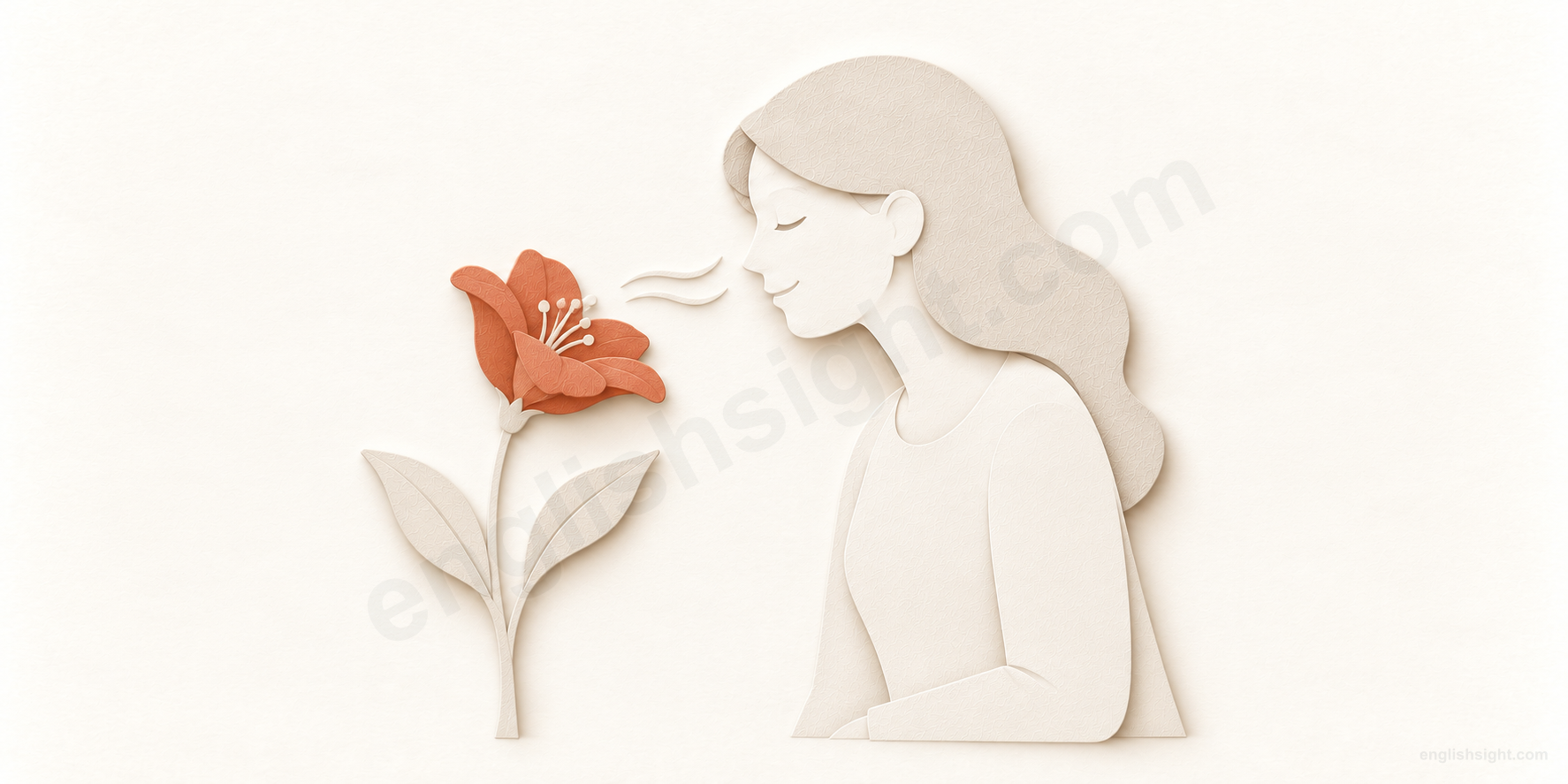
A flower offers a sensory experience.
pleasure
Her closed eye and small smile show quiet enjoyment.
She smells the flower.
The scent gives her pleasure; smelling the flower is a small pleasure.
Something a person experiences gives them enjoyment or satisfaction.
The flower is one example of an enjoyable experience, not the definition of pleasure. The same relationship can involve music, achievement, company, or a sensation. Enjoyment is personal, and the diagram is a teaching aid rather than a claim about a shared native-speaker mental image.
A sound, an activity, or a moment with someone can be enjoyable. Pleasure can name that feeling or, with a or a plural, something that gives you the feeling.
The central relationship is between an experience and the person who enjoys it. It also helps explain polite appreciation. Formal expressions about someone’s wishes have a separate use, so one picture cannot predict every phrase.
01
The feeling and where it comes from
Name enjoyment itself, identify its source, or describe someone’s reaction. The surrounding verb and preposition give each sentence its structure.
01
something + gives / brings + someone + pleasure
give / bring someone pleasure
cause a feeling of enjoyment or satisfaction
Situation / source
You hear a friend’s recorded message.
Feeling / communicative result
Hearing it makes you feel good.
The experience is the source; the person feels the pleasure.
Pleasure names the enjoyable feeling. In Her message gave me pleasure, her message is the subject, me is the person experiencing it, and pleasure names what the message caused. Nothing needs to change hands.
Bring someone pleasure has a similar meaning. You can also say give pleasure to someone. Great, much, and a lot of describe the amount; the feeling itself is normally uncountable. Sheer pleasure emphasizes complete or pure enjoyment.
Pleasure can be quiet, brief, or mixed with other feelings. It does not promise that the person is happy about everything in life.
Example in context
Hearing your message gave me real pleasure.
Watch the difference For the feeling, say great pleasure or a lot of pleasure, not many pleasure. Use a pleasure when counting an enjoyable thing or experience.
02
get pleasure from / out of + noun or -ing; derive pleasure from + noun or -ing
get pleasure from / out of something
experience enjoyment that comes from a source
Situation / source
You spend time repairing old radios.
Feeling / communicative result
You find the activity satisfying.
The person is the subject; from or out of names the source.
Get pleasure from and get pleasure out of describe how an activity or experience feels to someone. Out of does not mean physically removing something in this expression.
Derive pleasure from expresses a similar idea in a more formal style. After from or out of, use a noun or an -ing form: from music; out of repairing things.
Compare Repairing radios gives me pleasure with I get pleasure from repairing radios. The source and the person exchange grammatical roles, but the basic relation stays the same.
Example in context
I get a lot of pleasure out of repairing old radios.
Watch the difference Do not replace from with a bare infinitive: get pleasure from repairing, not get pleasure to repair.
03
take / find + pleasure + in + noun or -ing; take no pleasure in…
take / find pleasure in something
enjoy a particular activity or situation
Situation / source
Maya enjoys getting small details right.
Feeling / communicative result
She spends time on them because they satisfy her.
In introduces what the person enjoys.
Take pleasure in means enjoy or feel satisfaction in something. It does not describe taking an object. Find pleasure in emphasizes discovering or experiencing that enjoyment.
After in, use a noun or -ing form. Take no pleasure in means not enjoy: I take no pleasure in telling you this introduces news the speaker dislikes giving.
The expression does not make its object morally good. Taking pleasure in someone’s difficulty means enjoying that difficulty; the context may criticize this attitude.
Example in context
Maya takes pleasure in getting every small detail right.
Watch the difference Use in getting, not in get. Do not assume take pleasure always describes a kind or helpful activity.
04
smile / beam + with pleasure; someone’s pleasure at + noun or -ing
smile with pleasure / pleasure at something
show enjoyment or satisfaction in response to something
Situation / source
Your sister sees the garden you have planted.
Feeling / communicative result
Her smile shows that she likes it.
With names her feeling; at identifies what prompts it.
With pleasure can describe the feeling accompanying an action: smile with pleasure or glow with pleasure. Here it is part of a description, not necessarily a reply to a request.
Pleasure at a result, or pleasure at seeing it, identifies the event that prompts the feeling. The preposition belongs to the noun phrase: her pleasure at the news.
With does not mean doing something together in this use. Read the full sentence to distinguish a visible reaction from the standalone polite reply With pleasure.
Example in context
She smiled with pleasure when she saw the new garden.
Watch the difference Pleasure is a noun. To describe a person directly, use pleased: She was pleased, not She was pleasure.
05
the pleasure of + noun or -ing; have the pleasure of + -ing
the pleasure of doing something
the enjoyment associated with an experience
Situation / source
After months indoors, you can sit outside again.
Feeling / communicative result
You appreciate the experience itself.
Of connects the feeling to the experience being enjoyed.
The pleasure of sitting outside names what is enjoyable about that experience. Of is followed by a noun or an -ing form, not an ordinary to-infinitive.
Have the pleasure of meeting someone is also a polite way to refer to an enjoyable meeting or opportunity. It often sounds more formal than simply saying I enjoyed meeting her.
These forms focus on a particular experience. They do not mean that pleasure is a physical part owned by the activity.
Example in context
I had forgotten the pleasure of sitting outside on a warm evening.
Watch the difference Keep the patterns apart: the pleasure of sitting, but It is a pleasure to sit here.
02
Things to enjoy and reasons for doing them
A pleasure can be an enjoyable experience. For pleasure explains a purpose, and pleasure before another noun can identify leisure use.
06
a pleasure; one of + possessive + pleasures; the pleasures of + noun
a pleasure / life’s little pleasures
a thing or experience that someone enjoys
Situation / source
You describe the small things you look forward to.
Feeling / communicative result
A morning walk is one item on your list.
Countable pleasure names a source or instance of enjoyment.
When you count enjoyable things, pleasure is countable: a pleasure, two pleasures, one of my pleasures. An activity can be the subject even though pleasure is a noun.
Simple pleasures and life’s little pleasures often refer to modest everyday experiences. Little describes their scale or simplicity; it does not say the enjoyment is unimportant.
Compare The walk gave me pleasure, which names the feeling, with The walk was a pleasure, which calls the whole experience enjoyable.
Example in context
A slow walk before breakfast is one of my simple pleasures.
Watch the difference After one of, use the plural: one of my pleasures, not one of my pleasure.
07
a guilty pleasure; someone’s guilty pleasures
a guilty pleasure
something enjoyed despite a little guilt or embarrassment
Situation / source
You enjoy a TV show you consider rather silly.
Feeling / communicative result
You admit that you keep watching it.
Enjoyment and a reservation exist together.
A guilty pleasure is something you enjoy while feeling that perhaps you should not. The concern might be taste, time spent, or indulgence.
People often use it lightly about entertainment or food. Guilty does not by itself say that a crime has occurred. The phrase describes the person’s mixed attitude, not a universal judgment about the thing.
Example in context
That silly singing show is my guilty pleasure.
Watch the difference Do not read guilty pleasure as a legal category. The phrase can describe mild, playful embarrassment.
08
do / read / travel + for pleasure
do something for pleasure
do it because you enjoy it
Situation / source
You choose a novel after finishing your homework.
Feeling / communicative result
You read it for enjoyment.
For explains the purpose of the activity.
For pleasure answers Why do you do it? It contrasts with doing something for work, study, or another obligation. It does not mean you must be paid or unpaid.
Read for pleasure and travel for pleasure can describe the same outward activities as reading for study or traveling for work. The purpose is different.
For fun is a more informal alternative in many everyday contexts. Neither expression requires loud laughter or excitement.
Example in context
I read history books for pleasure, not for a course.
Watch the difference Use for pleasure for a purpose. With pleasure usually describes a feeling or expresses willing agreement.
09
on business or for pleasure; mix / combine business with pleasure
business or pleasure / mix business with pleasure
contrast work purposes with enjoyment, or combine them
Situation / source
A work trip includes an evening with friends.
Feeling / communicative result
The visit has both a practical and an enjoyable side.
Business and pleasure identify purposes that may overlap.
Business or pleasure? is a short question about the purpose of a visit or trip. A full version is Are you here on business or for pleasure?
Mix business with pleasure means combine work or practical dealings with enjoyable social activity. Combine business with pleasure expresses the same basic idea.
Someone who says they do not mix business with pleasure prefers to keep those areas separate. The expression does not imply that enjoyable work is impossible.
Example in context
We mixed business with pleasure and visited friends after the trade fair.
Watch the difference Pleasure here means leisure or enjoyment. It does not mean a specific enjoyable object that needs a.
10
pleasure + noun: pleasure boat / trip / cruise
a pleasure boat / pleasure trip
a boat or trip intended for leisure
Situation / source
You compare a sightseeing boat with a working vessel.
Feeling / communicative result
One is used for recreation.
Pleasure before a noun classifies its purpose.
In pleasure boat, pleasure describes the boat’s recreational use. A pleasure trip is a trip made for enjoyment. The boat or trip does not itself experience a feeling.
Learn these combinations as ordinary noun phrases. Do not use pleasure as a general replacement for pleasant: a pleasant room is an agreeable room; a pleasure room is not the usual equivalent.
Example in context
We booked a short pleasure cruise around the bay.
Watch the difference The article and plural belong to the main noun: a pleasure boat, two pleasure boats.
03
Meetings, thanks, and willing agreement
These polite expressions have different jobs in a conversation. Learn the whole expression and when to say it.
11
it is / was a pleasure + to-infinitive; it has been a pleasure + -ing
It’s a pleasure to meet you.
politely welcome someone or appreciate a meeting
Situation / source
You are introduced to a new colleague.
Feeling / communicative result
You greet them warmly.
The full sentence evaluates the meeting as enjoyable.
It is a pleasure to meet you is a polite introduction. It is a little more formal than Nice to meet you. The shorter A pleasure to meet you is also used.
At the end of a meeting, It was a pleasure meeting you or It has been a pleasure meeting you looks back on your time together. The wording and tense locate the experience.
It is a pleasure to work with you can appreciate an ongoing professional relationship. Pleasure need not refer to a first meeting.
Example in context
“I’m Elena, your new colleague.” “It’s a pleasure to meet you.”
Watch the difference Keep a: It is a pleasure to meet you. It is pleasure to meet you is not the standard greeting.
12
thanks → My pleasure. / It’s a pleasure. / It was a pleasure.
My pleasure. / It was a pleasure.
respond warmly when someone thanks you
Situation / source
A neighbor thanks you for watering their plants.
Feeling / communicative result
You say you were happy to help.
This reply acknowledges thanks.
My pleasure and It’s a pleasure are established responses to thanks. It was a pleasure works naturally when looking back on the help you gave.
The reply presents the task as something you were glad to do. It does not transfer an object called pleasure, and it is not the usual way to thank the helper yourself.
You’re welcome is another response to thanks. My pleasure adds an explicit sense of willingness or enjoyment and is common in courteous service exchanges.
Example in context
“Thanks for watering the plants.” “My pleasure.”
Watch the difference If you received the help, say Thank you. My pleasure normally comes from the person being thanked.
13
request or invitation → With pleasure.
With pleasure.
gladly accept a request or invitation
Situation / source
Someone asks you to show a visitor around.
Feeling / communicative result
You agree willingly.
This reply accepts something proposed.
With pleasure is a courteous way to say that you are happy to agree or help. It can respond to a request before the task is done.
Compare “Could you help?” “With pleasure” with “Thanks for helping.” “My pleasure.” The first agrees to an action; the second acknowledges thanks. Context can allow overlap, but the conversational jobs are different.
Inside a sentence, with pleasure may simply describe a feeling, as in She smiled with pleasure. The standalone reply is a learned conversational expression.
Example in context
“Could you show our visitor around?” “With pleasure.”
Watch the difference Do not choose for pleasure as the standalone acceptance: it explains a purpose instead.
04
Formal welcomes and decisions
Some expressions sound ceremonial. In at someone’s pleasure, the word refers to wishes or choice; enjoyment is not the main message.
14
it gives + person + great pleasure + to-infinitive
It gives me great pleasure to…
formally introduce welcome news or a person
Situation / source
You are about to introduce a guest at an event.
Feeling / communicative result
You present the introduction as something you are glad to do.
The introductory it points ahead to the to-infinitive.
This ceremonial formula puts the enjoyable act after to: It gives me great pleasure to welcome our guest. Me names the person who feels pleasure.
Great strengthens the noun without making it countable. In an ordinary conversation, I’m very happy to introduce… may sound less ceremonial.
For your viewing pleasure is another formal or promotional phrase: material is provided for people to enjoy looking at. Its tone differs from a simple everyday offer.
Example in context
It gives me great pleasure to introduce our guest, Dr Patel.
Watch the difference Use to introduce, not to introducing. In the pleasure of introducing, of instead requires -ing.
15
request the pleasure of + possessive + company + at an event
request the pleasure of your company
formally invite someone to attend
Situation / source
An organization writes an invitation to a dinner.
Feeling / communicative result
It politely asks the recipient to be present.
Company means someone’s presence, not a business.
Request the pleasure of your company is a formal invitation formula. It presents the guest’s presence as something the hosts would enjoy.
Here of links pleasure to that presence. It does not ask someone to give ownership of a company. Please join us for dinner is a much simpler invitation.
To what do I owe the pleasure? is a separate courteous, sometimes playful question about the reason for someone’s visit or call. It can sound theatrical or ironic; it is not a literal question about money.
Example in context
We request the pleasure of your company at our anniversary dinner.
Watch the difference This wording suits formal written invitations. For an ordinary message to a friend, Would you like to come? is more natural.
16
at + possessive + pleasure; What is your pleasure?
at your / someone’s pleasure
as someone wishes or chooses
Situation / source
A formal rule leaves the timing to the owner.
Feeling / communicative result
The owner decides whether to act.
The expression concerns choice, not necessarily enjoyment.
At someone’s pleasure is formal language meaning according to that person’s wishes. It can describe who has discretion over an action or arrangement.
What is your pleasure? can ask for someone’s wishes or choice in an old-fashioned or ceremonious style. What would you like? is the ordinary conversational alternative.
These choice expressions need their own branch in the lesson. A picture of someone enjoying a flower does not explain a rule about who may decide.
Example in context
Under the agreement, the owner may sell the land at her pleasure.
Watch the difference Do not interpret at her pleasure as for her enjoyment. It says the decision follows her wishes.
Read the noun and the whole expression
Feeling or enjoyable thing?
The feeling is normally uncountable: much pleasure, great pleasure. An enjoyable experience can be countable: a pleasure, simple pleasures. This is a change of grammatical viewpoint, not two unrelated objects.
Pleasure, pleasant, pleased, and please
Pleasure is the noun. A pleasant experience is agreeable; a pleased person feels satisfaction. Please is the ordinary verb in That pleased me, and also the polite word in Please come in. Do not form the verb meaning make happy by using pleasure in everyday conversation.
Tone and strength
Pleasure is often more formal than fun. It can describe calm satisfaction as well as a strong enjoyable feeling. Enjoyment overlaps with it; joy and delight often express stronger happiness. These are tendencies, not a fixed scale or an automatic substitution rule.
Coverage boundary
Pleasure can include physical or sexual enjoyment when context makes that clear; the noun is not automatically sexual. Dictionaries also record the verb pleasure, often with a sexual meaning in modern use. This beginner lesson teaches the modern noun and established expressions, not that verb, legal detention formulas, rare derivatives, or historical uses. Verb-specific passive, causative, and particle-verb patterns are therefore outside its scope.
Choose the intended meaning
Use the situation, the article, and the preposition to decide.
1. Which sentence correctly names an enjoyable experience as one item in a list?
2. You enjoy drawing. Which pattern identifies drawing as the source?
3. Someone asks, “Could you show me the way?” You gladly agree. Which reply fits?
4. You have helped someone. They say “Thank you.” Which reply is conventional?
5. A formal rule says an owner can act “at her pleasure.” What does that mean?
Sources and teaching notes
The dictionary sources below support the uses and patterns. Explanations, examples, exercises, and the diagram are original teaching material; the visual connection is a teaching interpretation.
The diagram illustrates a connection; it does not represent an image shared by every native speaker.