From a farming implement to effort, movement, and investment.
A blade advances; soil turns behind it
Forward movement changes what it meets
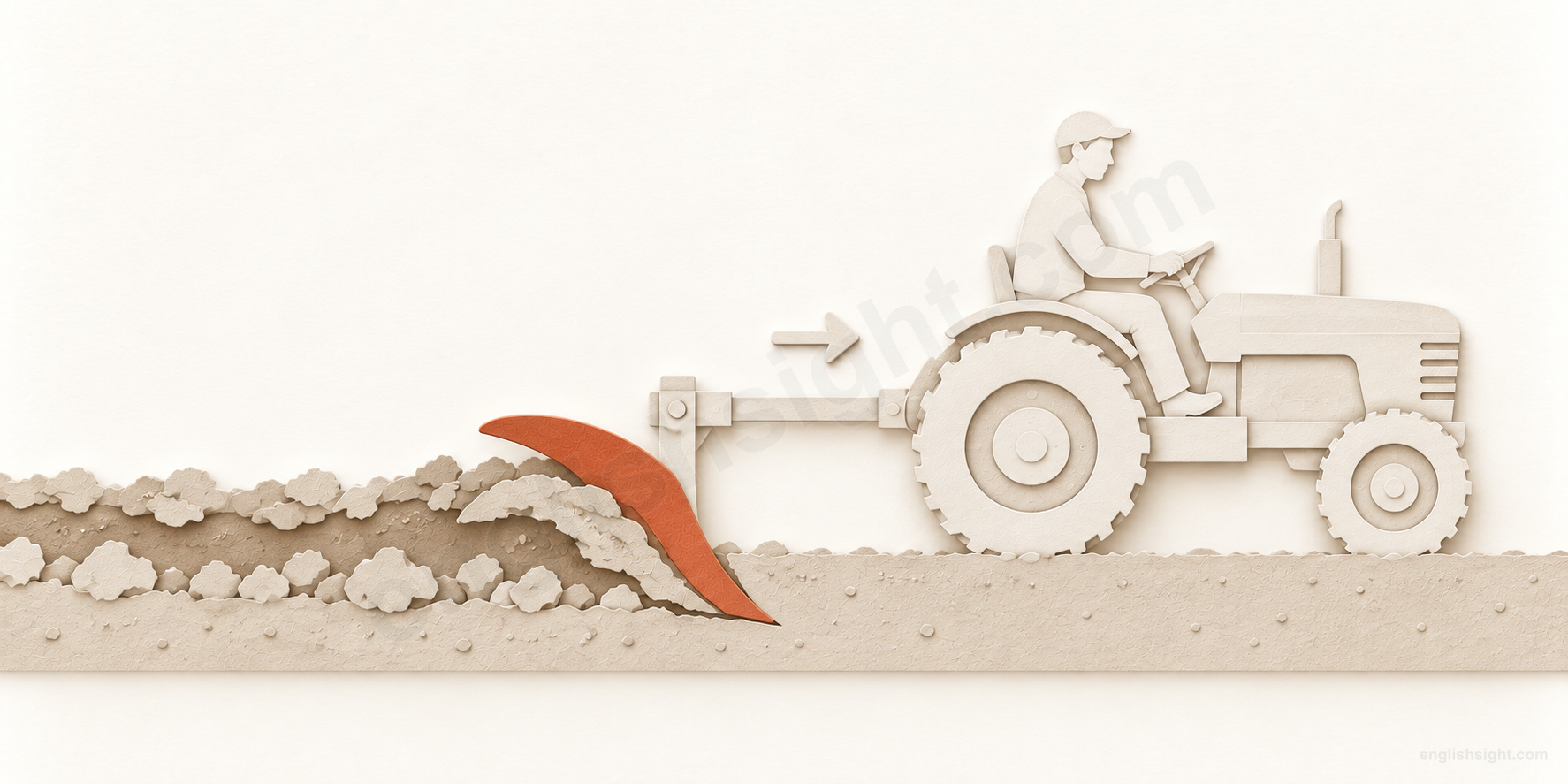
Unturned soil lies ahead of the blade.
plough
Turned soil and a furrow remain behind the blade.
The tractor pulls the plough rightward, cutting and turning the soil.
The plough advances through soil, turning it and leaving a furrow behind.
A plough cuts into and turns soil as it is pulled forward; several figurative uses picture forceful or sustained progress.
The drawing shows literal ploughing. It supports the connection with effort and force; it does not predict every phrase, and ploughing need not be fast or violent.
Plough /plaʊ/ is the usual British spelling; American English normally uses plow. The noun names a soil-turning implement, and the verb describes using it. Other familiar expressions describe difficult progress, forceful movement, or committing money.
A useful teaching connection is a blade being pulled forward while it cuts into and turns the soil. This helps connect several uses, but investment expressions and fixed phrases still need their own grammar and meaning.
01
The tool and the soil
Start with the implement, then notice whether the object names land or material mixed into it.
01
a / the + plough; pull a plough
a plough
the farm implement that cuts and turns soil
Situation before
An unworked field needs preparing.
Action or result
A tractor pulls a bladed implement across it.
The noun names the implement; the tractor supplies the pulling power.
A plough is a countable farm implement with a blade or blades that enter and turn the soil. It can be pulled by a tractor or by animals. A furrow is the long cut or channel left in the ground.
Use a plough for one implement and ploughs for more than one. The tractor and the plough are different pieces of equipment, even when they work together.
In a sentence
The tractor pulls a plough across the field.
Watch the difference A plough turns soil; it does not plant the seeds itself.
02
plough + field / land / soil; be ploughed
plough a field
turn over land with a plough
Situation before
The soil has not been turned.
Action or result
The field has rows of loosened, turned soil.
The field is the object being worked, not something moved from place to place.
Plough can name the action as well as the tool. In plough a field, the farmer or machine is the subject and the land is the object. You can also say The farmer is ploughing when the object is understood.
A passive focuses on the land: The field was ploughed yesterday. A freshly ploughed field describes its resulting condition. Ploughing is the activity; sowing puts seeds in and harvesting collects the crop. You can also plough a furrow: here the object is the channel made, rather than the area of land worked.
In a sentence
We ploughed the lower field before sowing barley.
Watch the difference Ploughing prepares or works soil; it is not a general synonym for every kind of farming.
03
plough up + land; plough + land / it + up
plough up grassland
turn a grassy area into worked soil
Situation before
Grass covers the land.
Action or result
The surface is turned over for cultivation.
Up emphasizes breaking and turning the existing surface.
Plough up an area often means turning over land that was covered in grass or other growth so that crops can be grown. It focuses on the change to that surface, while plough a field can describe routine work.
This particle pattern allows plough the meadow up and plough up the meadow. With a pronoun, use plough it up. Up does not mean the whole field travels upward.
In a sentence
They ploughed up part of the meadow to grow vegetables.
Watch the difference Use plough it up, not plough up it.
04
traffic / vehicles + plough up + ground; ground + be ploughed up
plough up a track
break up a ground surface through repeated movement
Situation before
The wet track has a fairly even surface.
Action or result
Repeated traffic leaves it broken and deeply rutted.
The surface looks worked over even though no farm plough is involved.
Vehicles, animals, or people can plough up soft ground by repeatedly crossing it. Here the result is damage or disturbance, not preparation for crops.
The track was ploughed up by trucks puts the damaged surface first. The comparison is with the marks a plough leaves; it does not mean that the trucks carried an agricultural implement.
In a sentence
Heavy vans have ploughed up the wet track.
Watch the difference Read the subject and situation: plough up can describe unwanted damage as well as cultivation.
05
plough + material + in / under / back in
plough plants in / under
turn plants or other material into the soil
Situation before
Plant material lies on or grows above the surface.
Action or result
The material is mixed into or covered by the turned soil.
The material is the object; in or under gives its resulting position.
Plough crops or grass back in means turning them into the soil, often to improve it. Plough something in or under can also describe burying or mixing material into the ground with a plough.
Compare plough the field, where the object is the area worked, with plough the grass in, where the object is material incorporated. Say plough it in or plough it under; for back in, plough it back in keeps the pronoun before the particles.
In a sentence
After cutting the cover crop, we ploughed it back in.
Watch the difference Plough back in here concerns plant material, not returning business profits.
02
Clearing a way, moving, and crashing
Snow clearing, difficult movement, and violent collisions share physical force but have different results.
06
a snowplough / snowplow; plough / plow + road; plough snow from + place
plough a road / a snowplough
clear snow with a ploughing blade
Situation before
Snow blocks a road.
Action or result
A blade pushes the snow aside and opens the road.
A snowplough moves snow aside rather than turning farmland.
A snowplough is a vehicle or blade used to clear snow; American spelling is snowplow. In a snowy-road context, a plough or plow can refer to this equipment.
Plough a road means clear snow from it with that equipment, especially in North American usage with the spelling plow. Plough the snow from a driveway makes the material being removed explicit. This is different from a car ploughing through deep snow without clearing the road for others.
In a sentence
The road was ploughed before the first bus arrived.
Watch the difference Plough a road needs a snow-clearing context; it does not normally mean turn its soil for crops.
07
plough through + obstacle / water; plough + possessive + way through + place
plough (your way) through
move forcefully or with effort through something
Situation before
Deep snow makes walking difficult.
Action or result
The walker pushes a route through it.
Through names what the mover passes through; it stays before that noun.
A person can plough through snow or a crowd, and a ship can plough through waves. The expression makes movement sound forceful, heavy, or difficult. It need not mean an accident: a ship may be following its intended route.
Plough your way through emphasizes making a route for yourself. Change your to match the subject: she ploughed her way through. A literary alternative such as a ship ploughing the sea uses the water directly as the object.
In a sentence
We ploughed our way through deep snow to the gate.
Watch the difference Keep the complement after through: plough through it, not plough it through for this meaning.
08
vehicle / driver + plough into + person / thing; plough through + obstacle
plough into / through a barrier
crash violently into something or continue destructively through it
Situation before
A vehicle loses control near a fence.
Action or result
It strikes the fence, or breaks through it.
Into highlights impact; through highlights a destructive path across an obstacle.
In a crash report, a vehicle or its driver can plough into a wall, a parked car, or people. This describes a violent collision, not ordinary arrival. With through, the vehicle moves violently through whatever lies in its path.
The van ploughed into a fence tells us it struck the fence. The van ploughed through a fence tells us it broke through. Neither expression says that every kind of movement with plough is uncontrolled; compare a ship ploughing through waves.
In a sentence
The van skidded and ploughed into a stone wall.
Watch the difference Do not confuse a vehicle ploughing into a building with a company ploughing money into a project.
03
Working, eating, and keeping going
These expressions treat a task or quantity as something to get through. The particles distinguish progress from continuation.
09
plough through + book / report / work
plough through a report
work steadily through something demanding or dull
Situation before
A long report still needs reading.
Action or result
You work through it with effort.
The report becomes figurative material to work through, not soil.
Plough through a report, paperwork, or a difficult book describes sustained effort, often when the work feels slow or boring. Read or work through is more neutral; plough through emphasizes the burden.
A completed past event often suggests getting to the end, but I am still ploughing through it clearly does not promise completion. The material follows through, including a pronoun: I ploughed through it. These reading and work expressions are normally active: We ploughed through the report. The report was ploughed would instead suggest a literal or unusual use of the basic verb.
In a sentence
It took all evening to plough through the insurance forms.
Watch the difference Plough through a book does not mean you read it quickly or enjoyed it.
10
plough through + meal / amount of food
plough through a large meal
eat a substantial amount, treating it as something to get through
Situation before
A very large meal is served.
Action or result
The diner eats their way through it.
The food is a quantity consumed, not a place crossed.
Plough through can describe eating a large meal. The expression presents the amount as substantial and the eating as determined progress through it, often with effort. In a completed event, such as Ben ploughed through the meal, it normally suggests that he finished it.
This is expressive wording rather than the neutral verb eat. The meal may be enjoyable; the phrase alone does not settle that. It also does not have one fixed speed: context can emphasize quantity, effort, or determined eating.
In a sentence
After the hike, Ben ploughed through an enormous plate of pasta.
Watch the difference A literal spatial translation of through will miss the eating meaning here.
11
plough on; plough on with + task
plough on (with something)
continue despite difficulty or boredom
Situation before
The task is tiring and progress is slow.
Action or result
You keep working instead of stopping.
On contributes continuation; with introduces the task.
Plough on means keep going with a difficult or dull activity. You can say We ploughed on without naming the activity, or We ploughed on with the report.
Compare plough through the report, which treats the report as material to work through, with plough on with the report, which emphasizes continuing. Plough on does not itself say you finish or succeed.
In a sentence
Despite the interruptions, we ploughed on with the report.
Watch the difference Say plough on with it, not plough it on.
04
Investment and reinvestment
Money is committed to a project; back adds the return of earnings to support the business.
12
plough + money + into + business / project / -ing
plough money into a project
put a substantial amount of money into something
Situation before
A project needs funding.
Action or result
A person or organization commits a large sum to it.
The money is the direct object; into introduces its destination.
Plough money into a business or project is an established investment expression. It stresses the amount committed rather than the physical movement of coins. It often occurs in business or news writing.
The money can also be the subject of a passive: Millions were ploughed into the scheme. Into alone does not tell us that the investment is wise, profitable, or a reinvestment of earlier earnings.
In a sentence
The council ploughed two million pounds into repairing the library.
Watch the difference The structure differs from a crash: money appears between plough and into.
13
plough + profits / earnings + back into + business; plough them back in
plough profits back into a business
reinvest earnings in the activity that produced them
Situation before
A business has earned a profit.
Action or result
The earnings return to support the business.
Back marks reinvestment, rather than simply new funding.
Plough profits back into a company means use its earnings to improve or develop it instead of taking that money out. When the destination is understood, plough the profits back or plough them back in can be enough.
Compare plough money into a new company: the funds need not have come from that company. With a pronoun, say plough it back into the business. Back in can describe money or agricultural material; the object and context decide.
In a sentence
We ploughed the shop’s first profits back into better equipment.
Watch the difference Reinvestment is not necessarily repayment of a debt or a refund to customers.
05
Figurative phrases and a name in the sky
Recognize an independent furrow, a formal land-use phrase, and the capitalized British star-pattern name.
14
plough + your own / a lonely + furrow
plough your own / a lonely furrow
follow an independent course or interest
Situation before
Other people follow a shared approach.
Action or result
One person pursues a different path.
A separate furrow provides a metaphor for an independent course.
To plough your own furrow is to do things your own way, apart from what others do. Plough a lonely furrow can suggest that few people share your work or interests. This is a literary expression, useful for recognition in profiles or commentary.
The furrow is figurative: the person need not farm. Own emphasizes independence; lonely can emphasize isolation. Neither form automatically praises the choice or says that being different leads to success.
In a sentence
While her classmates chose finance, Maya ploughed her own furrow in theatre.
Watch the difference Use a possessive matching the subject: she ploughs her own furrow.
15
land + be / come + under the plough
under the plough
used as land for growing crops
Situation before
Land may support grazing or other uses.
Action or result
The land is used for crops.
The phrase names a use of land, not a position underneath a tool.
Under the plough is a formal British expression for land used to grow crops rather than keep animals on. It can describe agricultural land use without saying that a plough is working there at this moment.
The field is under the plough describes its use; the field is being ploughed describes an action in progress. Under the plough is an established phrase, not a productive rule that any tool after under means land use.
In a sentence
Most of the estate is now under the plough.
Watch the difference Keep the in this expression: under the plough.
16
the Plough; the Big Dipper
the Plough
the British name for a recognizable group of seven stars
Situation before
Someone points out a star pattern in the northern sky.
Action or result
The listener identifies the pattern by its name.
The capital letter signals a name, not a farm implement in the sky.
In British English, the Plough names a familiar seven-star pattern; in North American English it is called the Big Dipper. Learn this as a named pattern, separate from the ordinary countable tool noun.
Use a capital P and normally the: Can you see the Plough? A reference to the night sky makes the name clear. Its resemblance to a tool can help explain the name, but the agricultural action does not predict this use.
In a sentence
We found the Plough above the northern horizon.
Watch the difference Do not use a plough when you mean this named star pattern.
Read the object and the whole expression
Spelling, sound, and forms
Plough rhymes with now, /plaʊ/. British forms are plough, ploughs, ploughed, ploughing; American forms are plow, plows, plowed, plowing. The past ending is pronounced /d/: /plaʊd/. These are spelling variants, not different meanings.
An action verb with several object patterns
Progressive and passive forms are natural where the meaning allows them: The farmer is ploughing; the field was ploughed; profits were ploughed back in. Through and into keep their following complement: plough through it, plough money into it. Particle patterns such as plough it up allow a different word order.
Useful boundaries
The tool image is a teaching connection, not a universal picture in speakers’ minds or a rule for inventing expressions. This lesson covers the farming noun and verb, main particle combinations, snow clearing, and selected fixed phrases. Specialist woodworking senses, the less usual noun for ploughed land, British examination-failure slang, and other derived compounds are outside its main scope.
Choose the meaning from the pattern
Notice the subject, the object, and the word after plough.
1. The company ploughed its profits back into new equipment. What happened?
2. The car ploughed into the wall. What does into highlight?
3. You are only halfway through a dull report and decide to keep working. Which emphasizes continuing?
4. The farmer ploughed the cut plants back in. What went into the soil?
5. Which sentence uses plough as a countable tool noun?
Sources and teaching notes
Definitions and usage were checked against the sources below. Explanations, example sentences, and the diagram were written for this lesson; the visual connection is a teaching interpretation.
This diagram helps explain a connection; it is not a picture shared by every native speaker.