From a pouch in your jacket to money, local areas, and things kept for yourself.
A distinct holding space
A distinct holding space
The shirt is the larger whole.
pocket
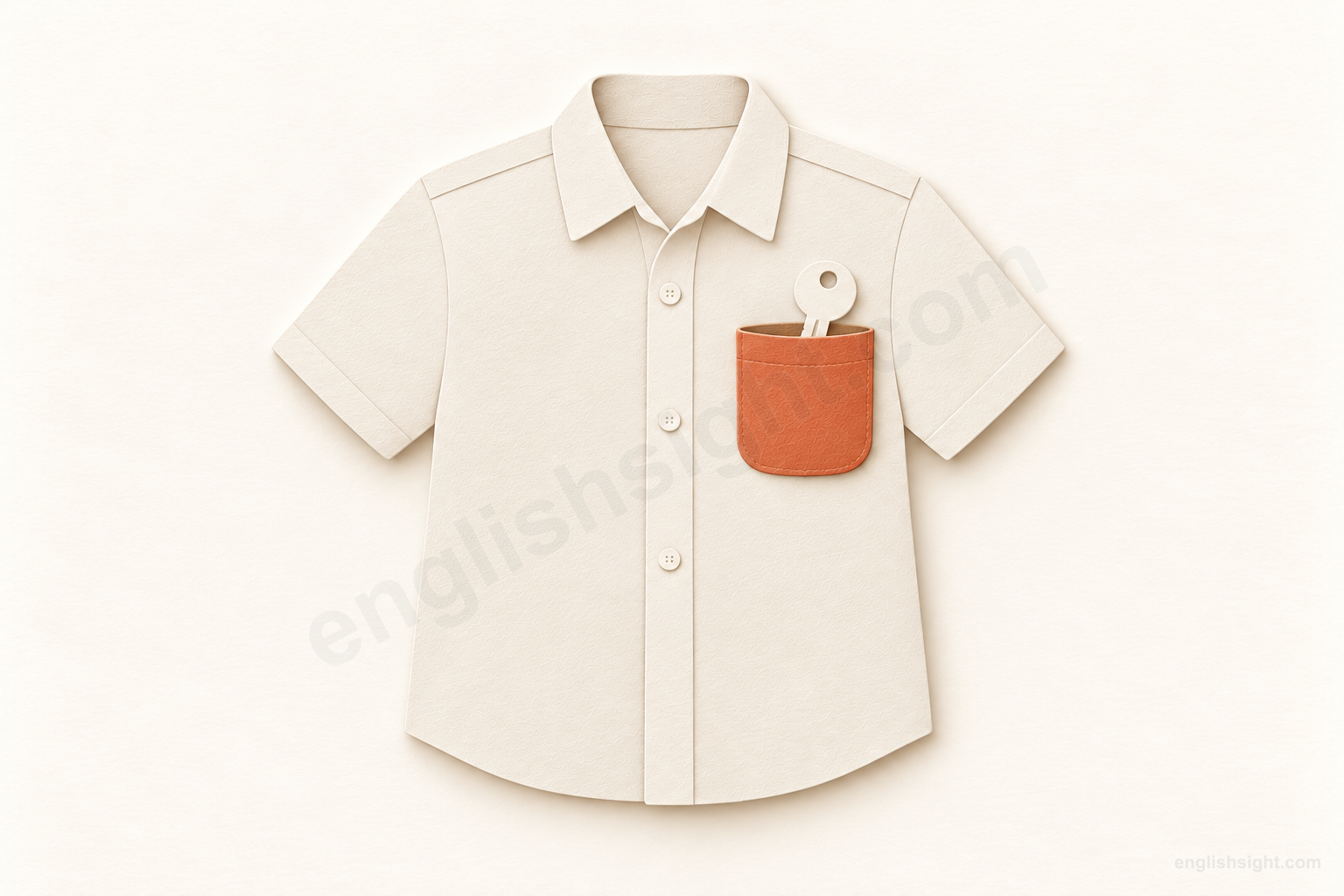
The key rests inside, with its round head above the opening.
A small open pouch is attached to its front.
The pocket is part of the shirt; it holds the key inside.
A pocket is a small pouch or a distinct space within a larger thing, often holding something apart from its surroundings.
This is a teaching connection, not a claim about an image shared by all native speakers. The concrete pouch helps with several extensions; fixed expressions still need their own explanations.
A pocket can hold a key close at hand, form a small compartment in a bag, or name an area that differs from what surrounds it. These uses share a useful idea of a distinct smaller space.
Money expressions often use the pocket to stand for personal resources or gain. Learn each full expression: the physical picture alone cannot predict every meaning.
01
Pouches, small spaces, and compact things
Start with a small holding space. Related nouns can name storage compartments, distinct local areas, and the openings on a pool table.
01
something is in a pocket; put something in/into a pocket; take something out of/from a pocket
in / into / out of a pocket
a small pouch in or on clothing
Situation
A jacket has a small pouch sewn onto it.
What it means here
A key rests inside that pouch.
The pocket belongs to the garment; the object is held inside it.
A pocket is a countable noun: one pocket, two pockets. Name its location with front, back, inside, jacket, or shirt: an inside pocket, my jacket pocket. Hands in pockets describes a posture, not a special idiom.
In usually gives a position: The key is in my pocket. Into highlights entry: I dropped it into my pocket. Put it in my pocket also naturally describes placement. Out of or from marks removal: She took a coin out of her pocket.
In a sentence
I keep a spare key in the inside pocket of my jacket.
Watch the difference Use in for containment. On my pocket would normally mean on its surface, not inside it.
02
check / go through / empty / turn out + possessive + pockets
check / empty / turn out your pockets
look for contents or remove them
Situation
You cannot find a ticket.
What it means here
You inspect the pouches in your clothes.
The action verb says whether you search the pocket or remove its contents.
Check your pockets and go through your pockets mean look in them, often to find a missing item. Empty your pockets means remove what is inside. Turn out your pockets commonly means empty them too; the fabric may be pulled outward.
A pocket full of coins describes its contents. A pocketful of coins treats that quantity as one amount. Neither expression tells you how much the coins are worth.
In a sentence
Please empty your pockets before you step through the scanner.
Watch the difference Turn out your pockets does not mean turn your whole body around. The object is pockets.
03
a pocket in/on something; a pocket for + noun
a seat / bag / folder pocket
a small attached storage compartment
Situation
A backpack has a separate sleeve at its side.
What it means here
A bottle can be stored in that sleeve.
A pocket can be part of an object other than clothing.
The storage meaning extends to a seat-back pocket, a car-door pocket, a backpack pocket, and a folder pocket for loose papers. It is a smaller holding part of the larger object, not necessarily a separate bag.
Use a pocket for something to name its intended contents: a pocket for a map. A compartment can be larger or more fully enclosed; pocket commonly suggests a pouch, sleeve, or similar smaller space.
In a sentence
Put the receipt in the small pocket at the front of the bag.
Watch the difference A handbag is not normally called a pocket just because it holds small things.
04
pocket + noun; pocket-sized / pocket-size + noun
a pocket dictionary / pocket-sized
small enough to carry easily
Situation
A normal reference book is too large to carry everywhere.
What it means here
A smaller edition is made for carrying.
Before another noun, pocket can describe a compact version.
A pocket dictionary, pocket calculator, or pocket edition is designed to be small and portable. Dictionaries may label pocket an adjective or a noun used as a modifier; the useful pattern is pocket before another noun.
Pocket-sized and pocket-size are adjectives with the same general compactness idea. A pocket-sized guide need not fit every actual pocket. This does not mean a dictionary about pockets.
Pocket can also describe something smaller than usual, as in a pocket park. A park is not portable: this is the miniature-size branch, not a claim about literal carrying.
In a sentence
I bought a pocket dictionary for the trip.
Watch the difference For a size description after be, use This guide is pocket-sized, rather than This guide is pocket.
05
a pocket of + noun; pockets of + noun
a pocket of air / resistance
a distinct small area or group within a larger surrounding area
Situation
Most of a region has one condition.
What it means here
A smaller part has a different condition.
A pocket need not have cloth walls: its surroundings make it distinct.
A pocket of air can be air enclosed within another substance. Pockets of poverty, unemployment, or resistance are localized areas or groups with that condition. The boundary may be social or geographical rather than a physical container.
Of introduces what characterizes the pocket: a pocket of cold air, pockets of resistance. Small is relative to the surroundings; the phrase does not give a fixed measurement. It also does not necessarily describe something deliberately stored.
In a sentence
The city is growing richer, but pockets of poverty remain.
Watch the difference A pocket of poverty is an area with poverty, not money saved by a poor person.
06
a corner/side pocket; pocket + ball
a corner pocket / pocket a ball
an opening on a pool table; send a ball into it
Situation
A ball is on the playing surface.
What it means here
A shot sends it into an opening at the edge.
Here pocket names the receiving opening and can also name the action.
In pool, snooker, and related games, a pocket is one of the openings around the table edge. A corner pocket is at a corner. This is a specific sporting use of the holding-space idea.
To pocket a ball is to hit it into such an opening. The ball is the direct object: She pocketed the red ball. Pot is another verb for this action, especially in British usage.
In a sentence
He pocketed the last ball in the corner pocket.
Watch the difference The player does not put the ball into a clothing pocket. The game supplies the meaning.
02
Putting away, keeping, and winning
As a verb, pocket takes an object. The object and situation show whether someone stores an item, takes money improperly, or receives earnings.
07
pocket + object; pocket + pronoun
pocket your phone / keys
put something into your pocket
Situation
Your phone is in your hand.
What it means here
You put it away in your clothing pocket.
The verb packages putting an object into a pocket as one action.
Pocket is transitive here: pocket the key or pocket it. The place is built into the verb, so pocket it into your pocket is normally unnecessarily repetitive. This action can be entirely ordinary and honest.
The regular forms are pockets, pocketed, and pocketing. Do not double the t. An ongoing action is possible: He was pocketing his phone when it rang. A passive such as The note was pocketed is grammatical, though the active is often clearer.
In a sentence
Maya pocketed her phone and picked up the suitcase.
Watch the difference Pocket your phone says where you put it; it does not mean make a telephone call.
08
pocket + money / funds / the difference
pocket the money / the difference
take money for your own use when you should not
Situation
A cashier collects more than the recorded amount.
What it means here
The cashier keeps the extra money personally.
The money becomes private gain instead of going where it should.
With money, fees, or the difference, pocket can suggest dishonest appropriation. The difference is the extra amount between two sums. Actual notes need not enter a physical pocket; an electronic transfer can fit this meaning.
Compare pocket the change after an ordinary purchase: that can simply mean put your own change away. The verb alone does not prove theft. Who owns the money and whether the person is entitled to keep it determine the reading.
In a sentence
The agent charged an extra fee and secretly pocketed the difference.
Watch the difference Do not assume every use of pocket plus money is dishonest; check the context and ownership.
09
pocket + sum / prize / profit
pocket a prize / £500
receive money as earnings or winnings
Situation
A player finishes a competition.
What it means here
The player receives a cash prize.
Pocket can emphasize the money someone comes away with.
News and sports reports use pocket for winning or earning a sum: pocket a prize, pocket £500, pocket a profit. The money is the object; the winner or earner is the subject.
This can be legal and deserved. Depending on context, the word can also make the amount sound unusually easy or advantageous to obtain. Earn and win are plainer choices when you do not want that emphasis.
In a sentence
Mina pocketed $800 when her design won first prize.
Watch the difference This does not say that £500 in cash was physically put into a pocket.
10
pocket + possessive + pride
pocket your pride
set pride aside instead of letting it stop you
Situation
You dislike admitting that you need help.
What it means here
You ask for help despite that feeling.
The feeling is restrained, not a physical object being stored.
Pocket one’s pride is an established figurative expression for putting pride aside. It can suggest accepting a situation that feels humiliating. It is less everyday than swallow your pride, which is a useful alternative.
This is a recognition use rather than a pattern for freely inventing pocket plus any emotion. Older or literary uses such as pocket an insult similarly concern accepting something without open protest.
In a sentence
He pocketed his pride and asked his former assistant for advice.
Watch the difference It does not mean feel proud. The point is setting pride aside.
03
Your money and what you pay
A pocket can stand for financial resources. Read the whole expression to distinguish affordability, a payment source, and a financial gain or loss.
11
suit every pocket / all pockets; a drain on someone’s pocket
suit every pocket
be affordable for different budgets
Situation
Shoppers have different amounts available to spend.
What it means here
A range offers a suitable price for each budget.
Pocket can stand for the financial resources available to someone.
Suit every pocket or suit all pockets means offer choices people with different budgets can afford. It does not promise that every single item is cheap. A drain on your pocket describes something that uses a lot of your money.
This financial sense is figurative: a bank balance matters even if the buyer carries no cash. The literal pouch provides a useful memory link, not a rule that all pocket expressions concern affordability.
In a sentence
The shop offers gifts to suit every pocket.
Watch the difference Suit every pocket describes affordability, not clothing measurements.
12
give / get / save / spend + pocket money
pocket money
money for a child or for small personal purchases
Situation
A child receives a small weekly amount.
What it means here
The child can choose small purchases or save it.
The phrase names spending money, not its physical location.
Especially in British English, pocket money is the regular small amount parents give a child. Allowance is the usual North American alternative in this context. Pocket money can also mean a small amount available for personal spending more generally.
It is uncountable: some pocket money, my weekly pocket money. You can save it, spend it, or earn extra pocket money. Money in my pocket is a literal location phrase and need not be a child’s allowance.
In a sentence
Nina saves half her pocket money each week.
Watch the difference Say some pocket money, not a pocket money or two pocket moneys.
13
some pocket change; a sum is (just) pocket change to/for someone
pocket change
loose coins; an amount regarded as small
Situation
You have a few coins available, or compare a cost with someone’s wealth.
What it means here
The amount is treated as minor in that context.
Smallness may be literal coin value or a relative judgment about a sum.
Pocket change commonly means a few loose coins of the sort someone might carry in a pocket. It is uncountable: some pocket change, not a pocket change. Compare pocket money, which names money available for personal spending, often a child’s allowance.
People also call a sum pocket change when it seems insignificant to the person or organization concerned. It may be a large amount to someone else; the expression conveys a comparison, not a fixed monetary limit.
In a sentence
That repair bill is pocket change to a company of that size.
Watch the difference Calling a cost pocket change can sound dismissive to someone who finds it expensive.
14
have deep pockets; someone with deep pockets
have deep pockets
have substantial money available to spend
Situation
A project will require expensive long-term support.
What it means here
A wealthy backer can keep funding it.
Depth is a metaphor for financial resources, not a measured garment feature.
A person or organization with deep pockets has considerable financial resources. The plural pockets is part of the familiar expression. It concerns the ability to spend, not whether the owner is generous.
Compare dig deep into your pockets, which asks for or describes a substantial payment. Having resources and choosing to spend them are different claims.
In a sentence
The small company needs an investor with deep pockets.
Watch the difference Having deep pockets does not mean being willing to lend or donate money.
15
pay (for something) out of your own pocket; pay out of pocket
pay out of your own pocket
use your personal money to pay
Situation
An expense needs to be paid.
What it means here
You pay it personally rather than using another source.
Out of identifies the source of payment.
Pay out of your own pocket means use your own money. Pay out of pocket is also used, especially when a company or insurance plan does not cover the cost. No physical pocket or cash payment is required.
This describes who pays, not necessarily a permanent loss. Someone might reimburse you later. Compare be £50 out of pocket, which describes the financial shortfall left by an event.
In a sentence
The grant did not cover the fare, so I paid for the train ticket out of my own pocket.
Watch the difference Do not confuse a payment source with the separate meaning unavailable.
16
dip into your pocket; dig (deep) into your pocket(s); put your hand in your pocket
dip / dig into your pockets
spend or contribute some of your own money
Situation
A community repair needs funding.
What it means here
People contribute their own money.
The whole expression describes spending, not just a hand movement.
Dip into your pocket means use some of your own money. Dig deep into your pocket or pockets emphasizes spending a substantial amount, often to support a cause. Put your hand in your pocket also means pay or give money, especially in British English.
A hand can literally go into a clothing pocket, so context matters. A request to dig deep for a fundraiser asks for financial effort; it is not an instruction to search the bottom of your trousers.
In a sentence
Residents dug deep into their pockets to repair the village hall.
Watch the difference Dig deep asks for a substantial effort; it does not claim the contributors are already wealthy.
17
be + amount + in/out of pocket; leave someone + amount + out of pocket
be in pocket / out of pocket
have gained money or suffered a financial shortfall
Situation
A deal or mistake changes your finances.
What it means here
You finish with more money or with an unrecovered cost.
These expressions describe the financial result of an event.
Especially in British English, be £40 in pocket means be better off by that amount; be £40 out of pocket means be worse off by that amount. Leave someone out of pocket focuses on the event that causes the loss or shortfall.
Out of pocket can also mean short of money. A stated amount and a cause often make the result meaning clear. This does not mean that every coin has literally fallen out of a pouch.
In a sentence
The cancellation left us £80 out of pocket.
Watch the difference Out of my pocket can describe physical removal; out of pocket without my can describe a financial result.
18
out-of-pocket + expenses / costs; pay out of pocket
out-of-pocket expenses / costs
expenses paid personally
Situation
You spend your own money during work or for a service.
What it means here
Those payments form your personal costs.
Before a noun, out-of-pocket labels costs borne by the payer.
Out-of-pocket expenses can be small business costs you pay first and claim back later. In other contexts, especially payments not covered by another source, out-of-pocket costs are what you personally have to pay.
The adjective usually has hyphens before a noun: out-of-pocket expenses. The adverbial phrase normally has spaces: I paid out of pocket. Reimbursement depends on the arrangement; the expression does not guarantee it.
In a sentence
Keep the receipts for any out-of-pocket travel expenses.
Watch the difference Personally paid costs may later be reimbursed. Do not define all out-of-pocket costs as permanently unrecoverable.
04
Spending, theft, influence, certainty, and reserve
These established expressions have their own meanings, from spending and influence to keeping an option available. The small holding-space idea can help memory, but it cannot predict the whole idiom.
19
money / a sum + burn a hole in + possessive + pocket
money burns a hole in your pocket
you are eager to spend money you have
Situation
You have just received some extra money.
What it means here
You keep thinking of things to buy immediately.
Money is the grammatical subject; the person feels the urge to spend it.
This humorous idiom treats unspent money as if it were too hot to keep. It describes eagerness to spend, not an actual damaged pocket or a financial loss that has already happened.
The progressive is natural: That bonus is burning a hole in his pocket. The possessive changes with the person who has the money: my pocket, her pocket, their pockets.
In a sentence
The birthday money was burning a hole in Sam’s pocket.
Watch the difference This does not simply mean that money is expensive or that someone has no money.
20
line + possessive + pockets; line the pockets of + person/group
line your own / someone else’s pockets
enrich yourself or another person unfairly
Situation
Money is available through a position or arrangement.
What it means here
Someone benefits personally at others’ expense.
The expression normally conveys criticism of how wealth is obtained.
Line your own pockets commonly criticizes someone who uses a position to get richer dishonestly or unfairly. Line someone else’s pockets means help enrich that person, often with the same critical tone.
The lining is a metaphor for wealth accumulating. The subject need not physically handle cash. Unlike a neutral earn money, the idiom usually casts suspicion on the benefit.
In a sentence
The officials used the scheme to line their own pockets.
Watch the difference Do not use this as an uncomplicated compliment for someone’s honest hard work.
21
pick + someone’s pocket; have + one’s pocket + picked
pick someone’s pocket
steal from someone’s clothing pocket without being noticed
Situation
A traveler carries a wallet in a pocket.
What it means here
A thief removes it unnoticed.
The possessor of pocket is the victim, not the thief.
Pick someone’s pocket names a particular kind of theft. The phrase does not mean choose a pocket from several options. A person who does this is a pickpocket.
The passive is useful from the victim’s viewpoint: Her pocket was picked. You can also say She had her pocket picked. Here had reports something she suffered; it does not mean she arranged the theft.
In a sentence
Leo had his pocket picked on the crowded bus.
Watch the difference Compare pocket the money: there the subject takes or stores money. In his pocket was picked, he is the victim.
22
A is in B’s pocket; B has A in B’s pocket
be in someone’s pocket / have someone in your pocket
be controlled by someone; have influence over someone
Situation
A supposedly independent person faces a powerful backer.
What it means here
That person follows the backer’s wishes.
Be and have describe the same influence from opposite viewpoints.
If an official is in a business owner’s pocket, the owner can strongly influence or control the official. The idiom is usually critical, often suggesting money, favors, or other leverage. It is not a neutral way to say they are friends.
The owner has the official in their pocket expresses the reverse viewpoint. The official is the person controlled in both versions. This is figurative possession or control, not physical size.
In a sentence
The report alleged that the inspector was in the contractor’s pocket.
Watch the difference Do not reverse the roles: the person whose pocket it is has the influence.
23
be / live in each other’s pockets
live in each other’s pockets
spend too much time together or be excessively close
Situation
Two friends share nearly every activity.
What it means here
One feels they need more independence.
The reciprocal phrase is about excessive closeness, not necessarily control.
British English uses be or live in each other’s pockets when people are together too much or too closely involved in one another’s lives. They need not share a home.
Compare be in someone’s pocket, where one person is under another’s influence. Each other makes the relationship reciprocal, and the familiar idiom changes the emphasis to closeness and lack of space.
In a sentence
We enjoy working together, but we don’t need to live in each other’s pockets.
Watch the difference Do not use this automatically for any close friendship; it commonly suggests too much closeness.
24
have + victory / election / result + in one’s pocket
have the result in your pocket
be certain of winning or obtaining something
Situation
A competitor has a very strong lead.
What it means here
People treat success as already secured.
The result is figuratively held, even before it is officially final.
Have something in your pocket can mean be certain to win it. A victory, election, or result is treated as already secured. This is an established idiom; it does not literally turn an event into a small object.
A speaker’s confidence can be mistaken. With a person as object, have someone in your pocket instead normally concerns influence or control. Read the object before choosing the interpretation.
In a sentence
With such a large lead, she thought she had the election in her pocket.
Watch the difference This reports confidence in success, not a guarantee from the speaker or the lesson.
25
have / keep + something + in + possessive + back pocket
keep something in your back pocket
keep something available to use later if needed
Situation
You have another plan but do not need to use it yet.
What it means here
You retain the plan as an option for later.
Something kept in reserve is figuratively close at hand.
Have or keep a plan, an idea, or an option in your back pocket means retain it for possible later use. It may be held back for the right moment; it need not be a literal object or a secret.
This is an established figurative expression. Compare having an election in your pocket, which concerns confidence in winning. With a person or organization, in your back pocket can instead express control, like in your pocket. The object and context distinguish readiness from influence.
In a sentence
I have a second route in my back pocket if the main road is closed.
Watch the difference Keeping an option in your back pocket does not mean you have already used it or that you are certain to win.
05
Two nonfinancial uses of out of pocket
The same words can describe availability or unacceptable behavior. Context and register matter; the financial meanings remain separate.
26
be out of pocket + time expression
I’ll be out of pocket
I will be unavailable or hard to contact
Situation
A colleague plans time away from work.
What it means here
Calls or messages may not reach that colleague.
A time expression and a work-contact context can signal unavailability.
In informal North American usage, out of pocket can describe someone who is away or cannot be reached. It is a separate established use, not a claim that the person has lost money.
Because other listeners may understand a financial meaning or a slang meaning, I’ll be unavailable or I won’t be checking messages is clearer when the audience is mixed.
In a sentence
I’ll be out of pocket until Monday, so please contact Jo about urgent orders.
Watch the difference Do not infer this meaning just from out of pocket. Money amounts usually point toward a financial reading.
27
a comment / someone’s behavior + be out of pocket
That comment was out of pocket.
the comment went beyond acceptable behavior
Situation
Someone makes a cruel or excessively personal remark.
What it means here
Another speaker objects to it.
In this slang use, out of pocket judges behavior, not money or availability.
In informal speech and online conversation, out of pocket can describe words or behavior as wild, inappropriate, or out of line. The judgment depends on context; it can be a serious criticism or an exaggerated reaction.
Keep this separate from pay out of pocket and be out of pocket until Monday. This slang is useful to recognize, but inappropriate or out of line is usually clearer in formal communication.
In a sentence
Mocking her accent was out of pocket.
Watch the difference It does not mean the remark was costly or that its speaker could not be contacted.
Read the object and the whole expression
Noun, modifier, and verb
The noun is countable: a pocket / pockets. Pocket before another noun can describe size; dictionaries differ over its grammatical label. The verb takes an object and has the regular forms pocket, pockets, pocketed, pocketing. It has no everyday separable particle-verb family.
The money is not always stolen
Pocket your key is ordinary storage; pocket public funds suggests improper personal gain; pocket a prize can describe legitimate winnings. Check ownership and context before adding a moral judgment.
Several meanings of out of pocket
A payment may come out of your pocket; an event may leave you out of pocket; a colleague may be out of pocket until Monday; a rude joke may be out of pocket. These are distinct readings, so use the surrounding sentence.
Where this lesson stops
The course includes familiar financial and relationship idioms and a pool example. Specialist meanings in football, bowling, racing, mining, medicine, sailing, and law are not taught in detail. Pocket an insult and some older verb uses are recognition notes rather than recommended everyday patterns.
Choose the meaning in context
Use the object, the surrounding situation, and the whole expression.
1. Your key is stored inside a jacket pouch. Which sentence describes its location?
2. Mina pocketed $800 when her design won first prize. What does pocketed mean here?
3. A cancellation left you £80 out of pocket. What happened?
4. The inspector is in the contractor’s pocket. Who has the influence?
5. After someone makes a cruel personal joke, a friend says “That was out of pocket.” What is the likely meaning?
Sources and teaching notes
Meanings and usage were checked in the publisher pages below. The explanations and examples are original. The diagram is a teaching connection, not evidence that all uses have one literal meaning.
The diagram shows a useful connection; it is not an image shared by every native speaker.