Explore point as a spot, a stage, an idea, a unit, and a verb of direction or attention.
One particular focus
A specific focus within a wider field
Several possible locations share one field.
point
One particular location stands out.
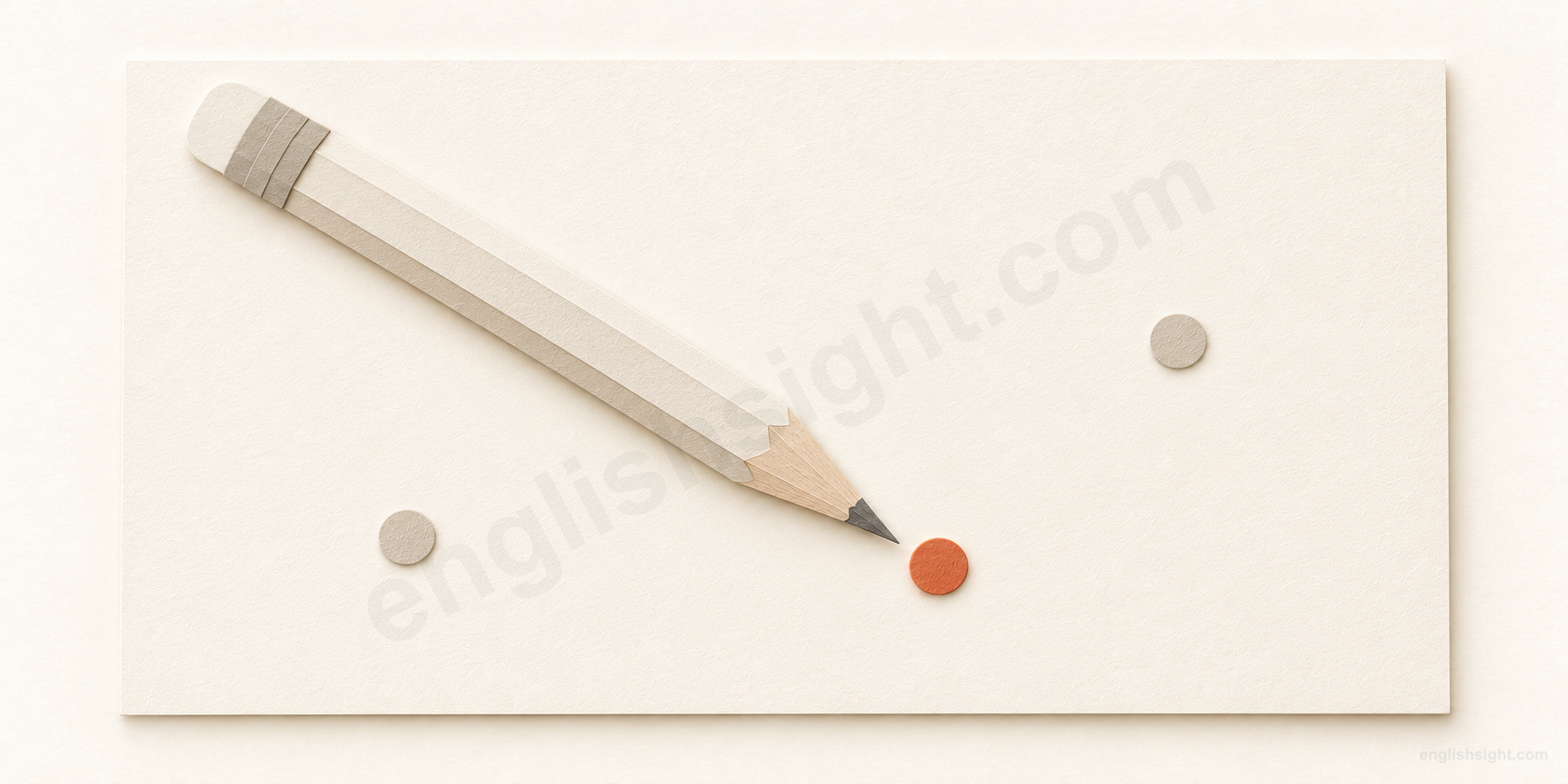
The pencil’s sharp end points toward the orange spot.
The sharp tip singles out one spot within a wider field.
A point identifies a particular spot or focus; pointing directs attention or an object’s end toward a target.
The pencil and selected spot illustrate a physical tip, a location, and directed orientation. They provide a teaching connection for ideas and stages, not a literal picture of purpose, scoring, or every idiom.
A point can be a particular place, a stage in time, a sharp tip, an item in an argument, or a scoring unit. As a verb, point often gives something a direction or brings a target to someone’s attention.
A useful teaching connection is precision and focus: one location or issue is picked out from a wider field. This connection helps organize several uses, but fixed expressions and measuring units still need to be learned in context.
01
Places, times, tips, and units
As a noun, point can identify a location, a stage, a sharp end, or one unit. Read the surrounding words to choose the branch.
01
a point on/in something; at a point; the point where/at which…
a point on a map
a particular position or place
Situation / context
A route contains several possible meeting places.
Meaning in this context
One exact meeting location is identified.
A point locates something within a wider space.
Use a point on a map, at a meeting point, or the point where two paths meet. Point emphasizes a specific location; place is a more general word for somewhere.
In geometry a point specifies a position without size; its drawn dot is only a representation. In ordinary travel, a meeting point can be a small area. A starting point can also be the initial idea for a discussion.
Original example
We agreed to meet at the point where the two paths join.
Watch the difference Use at the meeting point, not in the meeting point for an ordinary meeting location.
02
at this/that/one/some point; up to that point; from this point on
at this point / at some point
a particular time or stage
Situation / context
A conversation or process is unfolding.
Meaning in this context
You identify one stage within it.
The surrounding preposition places an event relative to a stage.
At this point means at the present stage or at the stage just mentioned. At one point picks out one moment or stage, often in a past sequence, but is not restricted to past time; at some point leaves the time unspecified.
Up to that point describes the period before a named stage. From this point on means beginning now and continuing afterwards; at any point allows any moment within the relevant period. These are time expressions, not claims about a physical dot.
Original example
At one point I wanted to cancel, but later I changed my mind.
Watch the difference At some point does not specify exactly when; at one point does not mean once and for all.
03
reach/get to the point where + clause; to the point of + noun/-ing
reach the point where…
reach a significant stage or limit
Situation / context
Small problems accumulate.
Meaning in this context
A new response becomes necessary.
A stage can become a threshold at which the situation changes.
Reach/get to the point where… introduces a stage and explains what is true there. In We worked to the point of exhaustion, to the point of names the extent or result, not an action about to begin.
A turning point changes the later course of events. Breaking point is the limit of what someone or something can withstand. The point of no return is a stage after which going back is no longer possible. These are distinct established combinations.
Boiling point and freezing point name temperatures at which a change occurs under the relevant conditions. A high point is an especially good moment; a low point is an especially bad one, rather than necessarily a measured height. Figuratively, anger reaching boiling point means it is becoming extremely intense.
Original example
The noise reached the point where we could no longer hear each other.
Watch the difference To the point of exhaustion expresses degree/result; on the point of leaving means about to leave.
04
the point of + object; a sharp/fine/blunt point
the point of a pencil
the narrow, sharp end of an object
Situation / context
A pencil has a long body and a tapered end.
Meaning in this context
The sharp end is the part being discussed.
Here point names a physical tip, not an idea or a unit.
The point of a pencil, pin, or knife is its sharp end. A fine point is thin and precise; a blunt point has lost its sharpness. Tip is broader: a finger has a tip without needing to be sharp.
This physical branch provides a useful memory link to precision. It does not make every abstract use of point a literal sharp object. A coastal point is a projecting piece of land, often appearing in place names.
Original example
The point of my pencil snapped while I was drawing.
Watch the difference The point of the lesson asks about purpose; the point of the pencil normally names a physical part.
05
number + point + digit(s); a point of light; bullet points
three point six
a small mark, especially the decimal separator
Situation / context
You read a number containing a decimal mark.
Meaning in this context
You say the whole number, point, then the decimal digits.
A visible point can be a dot; its reading depends on context.
Read 3.6 as three point six and 3.06 as three point zero six. After the decimal point, read digits separately: 3.14 is three point one four.
Points of light are tiny visible spots, such as distant lights. A bullet point is a marked item in a list; point by point means dealing with items individually. For a sentence-ending mark, the usual terms are full stop in British English and period in American English.
Original example
The display read three point zero six.
Watch the difference Three point six is 3.6, not 36; ordinary web addresses use dot rather than point.
06
score/earn/lose + number + point(s); win by/on points
score / earn points
units added to a score or reward total
Situation / context
A game or reward system awards credit.
Meaning in this context
The total rises by a stated number of units.
Points count under the rules of a particular system.
Score a point, lose two points, and win by one point concern scoring units. Points can also be awarded in a quiz or collected through a store’s rewards program; they are not automatically money.
A team winning on points wins through its score under the sport’s rules. Figuratively, score points off someone means gain an advantage in an argument, often by making the other person look bad; it is not necessarily sincere discussion.
Original example
You earn five points for each correct answer.
Watch the difference A goal and a point are not interchangeable: each sport determines what earns points.
07
number + percentage points; number-point + noun; number + points
percentage points / 12-point type
units on a specified scale
Situation / context
A percentage rate rises from 20% to 25%.
Meaning in this context
The difference is five percentage points.
A point is a unit whose size comes from the named scale.
A rise from 20% to 25% is five percentage points, but a 25 percent increase relative to the old value. Percentage points subtract the two percentage figures; percent change compares the difference with the starting value.
An index may also rise several points; its scale defines those units. In document settings, point measures type size: use 12-point text or a font size of 12 points. It is not a count of the letters.
Original example
The rate rose from twenty to twenty-five percent, an increase of five percentage points.
Watch the difference Do not call this a five percent relative increase; name the scale when points alone would be unclear.
08
a power/charging point; the points on a railway
a power point / railway points
British terms for a connection or track-switching equipment
Situation / context
You read British travel or building vocabulary.
Meaning in this context
Context identifies an electrical connection or movable rails.
These regional noun uses need their own context.
In British English, a power point is a place where equipment connects to electricity, commonly a socket. A charging point supplies a connection for charging. PowerPoint, the software name, is a different expression.
Railway points are movable track parts that direct trains onto one line or another. This use is plural in British English; switch is the usual North American term. Neither use means an opinion in this context.
Original example
The train waited while the points were checked.
Watch the difference Railway points is plural even when referring to one switching arrangement in British usage.
02
Ideas, features, and reasons
In a discussion, a point may be one contribution, the central message, a useful reason, or a feature being assessed.
09
raise/explain/discuss a point; the main/finer points; point by point
a point in a report
one fact, issue, or item for consideration
Situation / context
A report contains several separate issues.
Meaning in this context
You discuss or clarify one of them.
A discussion can be divided into individual points.
Raise a point introduces an issue; explain a point makes it clearer. The main points are the most important items, while the finer points are small or complicated details.
You can respond point by point, dealing with each item in turn, or use bullet points to present a list. These expressions do not require each item to be the single central message of the entire text.
Original example
Could you explain the second point in your report?
Watch the difference One report can contain several points; the point of the report can instead mean its overall message or purpose.
10
someone’s strong/weak point; a selling/plus point
a strong point / a selling point
an ability or feature used in an assessment
Situation / context
You compare a person’s abilities or a product’s features.
Meaning in this context
One strength or weakness stands out.
Point can pick out a feature that matters in an evaluation.
A strong point is something someone does well; a weak point is a weakness. Good points and bad points are favorable and unfavorable features of a person, place, plan, or thing.
A selling point is a feature that makes something attractive to buyers. This does not mean the feature is a physical point, a place to pay, or a guarantee that everyone will buy it.
Original example
The long battery life is this laptop’s main selling point.
Watch the difference My strong point is cooking describes an ability; a strong argument describes the quality of an argument.
11
from someone’s/a(n) adjective + point of view
from my point of view
an opinion or perspective for judging something
Situation / context
Two people assess the same plan differently.
Meaning in this context
You identify whose perspective or which criterion you mean.
A point of view is a standpoint, not necessarily a visible location.
From my point of view frames a judgment as mine. A different point of view is another opinion. The plural is points of view, with points carrying the plural ending.
From a financial point of view means when judged financially; it need not name a person. Compare in my view, which also introduces an opinion. The phrase identifies a standpoint for assessment rather than a physical dot.
Original example
From a practical point of view, the smaller table is better.
Watch the difference Say from my point of view or in my view, not in my point of view.
12
the point is (that) + clause; get/see/miss the point
the point is… / miss the point
the central idea that matters
Situation / context
Someone focuses on a minor detail.
Meaning in this context
You identify the central message or issue.
The point is the focus of the message, not every detail in it.
The point is (that)… states the central claim. Get/see the point means understand it; miss the point means fail to understand it. That’s not the point redirects attention to the issue that matters.
The point of a joke can be what makes it meaningful or funny. Understanding a speaker’s point does not automatically mean agreeing with it. A discussion may have several points but one main point.
Original example
The point is that everyone needs access, not just those who can pay.
Watch the difference Miss the point is about understanding, not failing to earn a score.
13
make a point about something; prove a/your point
make / prove a point
state an idea or show that an idea is valid
Situation / context
You have a claim to contribute to a discussion.
Meaning in this context
You express it, or demonstrate why it is right.
Making a point and proving it are different actions.
Make a point means express an idea or argument. Make a point about the cost identifies its subject. Prove a point means demonstrate that a claim is correct, often through an example or action.
You’ve made your point can acknowledge that an idea is now clear, sometimes implying that the speaker should stop repeating it. It does not necessarily concede that the whole argument has been proved.
Original example
She made a useful point about the cost of repairs.
Watch the difference Make a point of checking is a separate pattern meaning deliberately ensure you check; it is not simply stating an opinion.
14
get/put + possessive + point across
get your point across
make an idea understood by another person
Situation / context
Your explanation is not reaching the listener.
Meaning in this context
The listener understands what you are trying to say.
Across belongs to get across; point is the idea communicated.
Get your point across means communicate your intended idea successfully. Put your point across has a similar function. In these patterns, point is the noun object, not a verb followed by a particle.
The listener may understand and still disagree. For example, I got my point across, but they rejected my proposal separates successful communication from persuasion.
Original example
A quick sketch helped me get my point across.
Watch the difference Getting a point across does not mean winning a debate or getting permission.
15
have a point; take someone’s point; point taken
You have a point. / Point taken.
acknowledge a reasonable observation or criticism
Situation / context
Someone raises a concern you had overlooked.
Meaning in this context
You accept that this concern deserves consideration.
You acknowledge the force of an idea without promising total agreement.
You have a point and That’s a good point recognize a valid or relevant observation. I take your point explicitly accepts what someone is saying; Point taken is a compact response, especially to criticism.
In “The shortcut is dark.” “Good point; let’s use the main road,” the reply recognizes a useful consideration. It does not award a game score or necessarily endorse every other claim the person has made.
Watch the difference I see your point can emphasize understanding; I take your point more clearly acknowledges its force.
16
the point of + noun/-ing; the point is to + verb
the point of something
the purpose or useful result of an activity
Situation / context
An activity takes time and effort.
Meaning in this context
You ask what it is intended to achieve.
Purpose is the goal that makes an activity worthwhile.
The point of this exercise is to… explains its aim. What’s the point of doing that? can be a genuine question, but often challenges whether the action serves any useful purpose.
Compare the point of the pencil, which identifies a physical tip. In an activity context, of introduces the activity whose purpose is in question. The purpose can be useful even when no physical target is involved.
Original example
The point of the rehearsal is to find problems before the show.
Watch the difference Point meaning purpose is often singular or uncountable; useful purpose does not mean a score.
17
there is no/little point (in) + -ing; see no point in + -ing
There’s no point in doing…
an action would have no useful result
Situation / context
The shop has already closed for the night.
Meaning in this context
Going there now would not help you buy anything.
No point questions usefulness, not physical possibility.
There is no point in waiting means waiting will not help. There’s little point in… is less absolute. The in can be omitted in familiar usage: There’s no point waiting.
After in use an -ing form, not a to-infinitive. Compare I can’t wait, which concerns ability or impatience; I see no point in waiting judges waiting unnecessary or ineffective.
Original example
There’s no point in going now; the shop has already closed.
Watch the difference Use no point in going, not no point in to go.
03
Focus and intention in familiar expressions
These whole expressions manage relevance, agreement, deliberate action, and limits. Their articles and prepositions matter.
18
get/come (straight) to the point
get / come to the point
say the central thing without more delay
Situation / context
A speaker has given a long introduction.
Meaning in this context
You want to hear the actual message.
The fixed expression moves the conversation toward its focus.
Get to the point and come to the point mean start saying what matters most. I’ll come straight to the point introduces a direct message. This is a conversational expression, not travel to a marked location.
Get to the point! can sound impatient or rude. Could you get to the point? softens the grammar, but may still sound critical; What are you asking us to decide? can make the request more specific.
Original example
I’ll come straight to the point: we need a new meeting time.
Watch the difference Get the point means understand; get to the point means state the important message.
19
be beside the point
beside the point
irrelevant to the issue under discussion
Situation / context
A discussion about safety shifts to decoration.
Meaning in this context
You return attention to the safety issue.
A true fact can still be irrelevant to the present question.
That’s beside the point means that detail does not bear on the issue being discussed. It does not necessarily call the detail false, foolish, or unimportant in every situation.
The fixed form uses beside, meaning conceptually away from the focus here. Besides means in addition and does not replace beside in this expression.
Original example
The paint color is beside the point; we are discussing whether the ladder is safe.
Watch the difference Write beside the point, not besides the point.
20
be to the point; a to-the-point + noun; more to the point, + clause
to the point / more to the point
relevant and direct; introducing a more important consideration
Situation / context
You assess a reply or compare two considerations.
Meaning in this context
You identify what directly addresses the issue.
To the point keeps attention on what matters.
A short, to-the-point reply addresses the subject clearly without unnecessary detail. To the point can also simply mean relevant. The hyphens help when the phrase modifies a following noun; her reply was to the point needs none.
More to the point introduces something more relevant or important: The room is cheap and, more to the point, available tonight. It shifts priority rather than increasing a numerical point total.
Original example
Her answer was brief and to the point.
Watch the difference To the point describes a statement; get to the point asks someone to state the central thing.
21
be on point; an on-point + noun
on point
relevant, or informally exactly right
Situation / context
You assess a comment or give enthusiastic praise.
Meaning in this context
Context tells you whether the praise concerns relevance or quality.
On point has more than one established use.
An on-point comment is relevant to the topic. In informal speech, especially associated with American English, on point can praise something as excellent, well judged, or stylish: Your presentation was on point.
Read the context rather than translating every case as relevant. The outfit is on point can praise style. These uses do not require a literal point or a numeric score.
Original example
Her questions were on point and helped us identify the problem.
Watch the difference On point can express informal praise; it is not a universal substitute for accurate in technical writing.
22
something is a case in point; a case in point is + noun
a case in point
a specific example that illustrates a claim
Situation / context
You have stated a general observation.
Meaning in this context
You offer a concrete example that supports it.
The case connects the general claim with a relevant instance.
Introduce the general idea before or with the example. Some repairs cost more than replacement; this old printer is a case in point makes the printer an instance of that pattern.
This phrase is useful in explanation and argument. It does not itself prove that the generalization is always true, and it is not an instruction to put something in a box.
Original example
Small changes can save time; the new booking form is a case in point.
Watch the difference Keep in: a case in point, not a case on point in this familiar expression.
23
make a point of + -ing
make a point of doing…
deliberately ensure an action is done because it matters
Situation / context
A host considers personal welcomes important.
Meaning in this context
The host makes sure every newcomer is welcomed.
The whole construction expresses deliberate attention to an action.
Make a point of doing something can describe a firm habit or a deliberate action on one occasion. It may also imply making the action noticeable, depending on context: He made a point of thanking the cleaners publicly.
Of is a preposition, so an action follows in the -ing form. This differs from make a point about something, which means contribute an observation or argument about it.
Original example
I make a point of learning each new colleague’s name.
Watch the difference Use make a point of learning, not make a point of learn.
24
be on the point of + -ing/noun
on the point of doing…
about to begin an action
Situation / context
You have your coat on and are ready to leave.
Meaning in this context
A call interrupts you immediately before departure.
The expression locates you just before an action begins.
Be on the point of leaving means be about to leave. The action may then happen or be interrupted. I was on the point of leaving when you called does not state that I actually left.
Of takes an -ing form for an action. On the point of tears similarly describes being very close to crying. Do not confuse this expression with making a deliberate habit.
Original example
We were on the point of leaving when the lights came back on.
Watch the difference On the point of leaving is not the same as at some point, which leaves the time unspecified.
25
up to a (certain) point
up to a point
partly or within limits
Situation / context
You agree with part of an argument.
Meaning in this context
You explain where your agreement stops.
The point is a figurative limit rather than a precise time here.
I agree up to a point accepts something only to a limited extent. The limitation may follow explicitly: The plan is cheaper, up to a point, but maintenance is expensive.
Compare up to that point, which commonly means until that time. A and that change the interpretation; surrounding context still matters. This phrase does not mean completely.
Original example
I agree up to a point, but we still need a backup plan.
Watch the difference Do not read up to a point as full agreement or automatically as a deadline.
26
be a sore point with/for someone; a sticking point in negotiations
a sore point / a sticking point
an upsetting subject; an obstacle to agreement
Situation / context
A discussion reaches a difficult topic.
Meaning in this context
You distinguish emotional sensitivity from a practical disagreement.
Different modifiers specify different kinds of trouble.
A sore point is a subject that upsets or angers someone when mentioned. A sticking point is an issue that prevents progress or agreement. Something can be both, but one expression does not automatically mean the other.
A sore point might be a disappointing exam result. A sticking point in a contract might be who pays for repairs. Learn these as noun combinations rather than guessing that point itself means pain or obstruction.
Original example
The delivery date remains the main sticking point in our talks.
Watch the difference A sore point concerns feelings; a sticking point concerns blocked progress or agreement.
04
Gestures, orientation, and guidance
As a verb, point can direct someone’s attention or orient an object. The subject may be a person, a sign, or a tool.
27
point at/to/towards + target; point with + object
point at / to / towards something
direct attention with a finger or a held object
Situation / context
A friend cannot identify the item you mean.
Meaning in this context
You indicate it with an extended finger.
A person points; at/to/towards introduces the indicated target.
Point at the sign and point to the sign can both describe a showing gesture. At often foregrounds a target; to often fits showing a location or direction. These are tendencies, not a rule that at is always rude and to always polite.
Towards emphasizes orientation toward a person, place, or direction. Point with a pen names the tool used. You can also say Don’t point when the gesture itself is the issue; the target need not always be stated.
Original example
Maya pointed to the empty seat beside her.
Watch the difference Point the seat is not the ordinary way to say indicate the seat; use point to/at it or point it out.
28
point + object + at/towards + target; be pointed at
point something at something
aim or orient an object toward a target
Situation / context
A camera is facing the floor.
Meaning in this context
You direct its lens toward the stage.
The object after point is what you aim; the at-phrase gives the target.
Point the camera at the stage makes camera the direct object. Point your finger at the diagram names the body part extended. A camera or weapon can be pointed at something in the passive.
Compare She pointed at the camera: now the camera is the thing indicated, not necessarily the tool being aimed. The presence or absence of a direct object changes the participants.
Original example
Please point the camera at the stage, not at the ceiling.
Watch the difference Point at a camera and point a camera at something describe different relationships.
29
point + north/down/straight ahead; point in + direction; point to + place
point north / point down
face or indicate a direction
Situation / context
You inspect a compass or a sign.
Meaning in this context
Its orientation identifies a direction.
The subject may be an object that remains still.
The needle points north describes orientation, not travel north. The sign points to the station indicates its direction. Points of the compass are named directions such as north, south, east, and west.
North, down, and straight ahead can follow without a preposition. Use in with a noun phrase such as in the wrong direction. The needle is pointing north is also possible when describing its present orientation.
Original example
The arrow on the sign points left.
Watch the difference Pointing in a direction does not mean moving in that direction.
30
point + person + in the right direction; point the way (to…)
point someone in the right direction
show where to go or how to start getting help
Situation / context
You do not know where to find the information.
Meaning in this context
Someone identifies a useful next place or action.
Guidance can be physical or figurative; it does not mean pushing someone.
Could you point me in the right direction? can ask for directions to a place or for advice on finding a resource. The person after point is the one receiving guidance.
Point the way to the station identifies a route. Point the way to better results can figuratively indicate a promising approach. It does not guarantee that the results will follow.
Original example
I need the old records. Could you point me in the right direction?
Watch the difference This pattern permits a person object; ordinary point at me merely indicates me as a target.
31
point at + screen target; point and click; point a browser to/at + address
point and click
position the pointer, then select something
Situation / context
An icon is visible on a computer screen.
Meaning in this context
You position the pointer and click it.
Pointing at an icon and clicking it are separate actions.
In a computer interface, point directs the cursor toward a target on screen. Point and click combines that positioning with selecting by clicking. Pointing alone need not open or activate anything.
Point your browser to an address is an instruction to navigate there. A link can point to a page without anyone opening it. These are computer-specific uses of direction or reference.
Original example
Point at the folder, then click once to select it.
Watch the difference Do not assume pointing means clicking; hover behavior and click behavior can differ.
32
point + your/the + toes
point your toes
extend the foot and toes into a long line
Situation / context
A dancer is following a movement instruction.
Meaning in this context
The foot extends so the toes continue the line of the leg.
This is a particular body-position instruction.
Point your toes is common in dance, gymnastics, and exercise instructions. The toes are the direct object; the phrase concerns their extended position rather than pointing at them with a finger.
Compare point at your toes, which tells someone to indicate them. The adjective pointed can describe a shape, but a pointed remark is a separate figurative use meaning deliberately sharp or critical.
Original example
She stretched her legs and pointed her toes.
Watch the difference Point your toes is not an instruction to touch or identify your toes.
05
Evidence, explanation, and highlighting
Point to, point out, and point up have different grammar and communicative jobs. Physical pointing is only one starting comparison.
33
evidence/signs/results + point to + noun/-ing/the fact that…
evidence points to…
evidence suggests a conclusion or likely development
Situation / context
You compare several clues about a failure.
Meaning in this context
They support one explanation.
The clues are the subject; the conclusion follows to.
The evidence points to a loose cable means the evidence supports that explanation. It may be strong evidence, but the expression alone does not make the conclusion certain.
To is a preposition here: point to a fault, point to overheating, or point to the fact that the cable is loose. It is not the infinitive marker in a construction such as want to repair.
Original example
The test results point to a problem with the cable.
Watch the difference Use points to a problem or points to the cable overheating, not points to be broken.
34
point to + evidence; point to something as + reason/example
point to something as evidence
mention an example or fact to support a claim
Situation / context
A speaker wants to justify a proposal.
Meaning in this context
The speaker cites a relevant example.
A person points to the evidence; the evidence can then point to a conclusion.
We point to the successful trial as evidence that the plan can work means we cite the trial in support. No physical finger gesture is necessary.
Compare The trial points to future success: the trial itself is now the grammatical subject suggesting a conclusion. In both patterns, keep the object after to: They pointed to it, not They pointed it to in this citing sense.
Original example
The team pointed to the successful trial as a reason to continue.
Watch the difference Citing evidence is not identical to proving a claim; others may challenge its relevance or strength.
35
point + person/thing + out (to someone); point out + noun
point someone / something out
show which person or object is meant
Situation / context
Several similar buildings are in view.
Meaning in this context
A guide identifies the particular one you need.
Out helps pick the target out from the surrounding possibilities.
Point out the entrance and point the entrance out can both identify it. With a pronoun, put it before out: point it out. Add to someone to name the person receiving the information.
This separable phrasal verb need not mean moving an object out of a building. Compare point at the entrance, which foregrounds the gesture, with point the entrance out, which foregrounds identifying it for someone.
Original example
Could you point her out to me when she arrives?
Watch the difference Say point her out, not point out her when her is a pronoun.
36
point out + noun/that-clause; point something out to someone; point out to someone that…
point out a fact / point out that…
draw attention to information someone may have missed
Situation / context
A colleague overlooks a detail in the schedule.
Meaning in this context
You bring that detail to the colleague’s attention.
Point out can be entirely verbal; it is not limited to gestures.
Point out an error means mention or identify it. Point out that the office is closed states the overlooked fact in a clause. The intention is to make the information noticed; it does not automatically sound rude, though context and tone matter.
You can point a mistake out to someone or point out to someone that there is a mistake. In the passive, The error was pointed out is natural. Avoid treating the person receiving the information as a direct object before that.
Original example
Ravi pointed out that the last bus leaves before the concert ends.
Watch the difference Use pointed out to me that…, not pointed out me that…. With a pronoun, use pointed it out.
37
point the/a finger at + person; point fingers at + person
point the finger at someone
accuse someone or assign blame
Situation / context
Something has gone wrong.
Meaning in this context
People identify someone they believe responsible.
The whole expression attributes blame; it need not describe a physical gesture.
Point the finger at someone and point an accusing finger at someone mean blame or accuse. People may point fingers at each other during an argument without actually extending their hands.
Compare point to someone’s experience, which can cite a positive reason for choosing them. Pointing at someone in a photograph is also not automatically an accusation; the idiomatic wording and context supply blame.
Original example
Instead of pointing fingers at each other, let’s find out what happened.
Watch the difference An accusation is not proof that the person is responsible.
38
point up + noun; point + noun/pronoun + up
point something up
make an issue or difference more noticeable
Situation / context
A comparison reveals an overlooked weakness.
Meaning in this context
The weakness becomes particularly clear.
In this formal phrasal verb, up adds emphasis rather than upward movement.
The comparison points up a weakness means it highlights that weakness. This is more formal than the everyday point out, which often describes someone mentioning a fact.
Point up a difference and point a difference up are possible noun-object orders; use point it up with a pronoun. Compare The sign points up, where up literally gives the direction and there is no object being highlighted.
Original example
The failed delivery pointed up a weakness in our tracking system.
Watch the difference Point something up means highlight it; point up without that object may simply describe upward orientation.
Keep the focus, but check the whole expression
Noun or verb?
A point / two points are nouns; I point / she points / we pointed are verbs. The verb forms are point, points, pointed, pointed, pointing. Pointed ends in a separate /ɪd/ syllable. Most noun senses are countable; purpose often uses singular or uncountable point, as in little point in waiting.
Objects and passives depend on the sense
Point at the camera indicates a target; point the camera at the stage aims a tool. The aiming sense permits The camera was pointed at the stage. In an ordinary finger-gesture description, prefer She pointed at me rather than I was pointed at by her. The error was pointed out is a natural passive of point out.
Prepositions and particles do different work
At, to, and towards can introduce a target; they are not all separable particles. Point out and point up allow an object between verb and particle. Point to evidence keeps the evidence after to. There is no general rule that changing the little word preserves the same meaning.
Learn established combinations as combinations
Make a point of doing, on the point of doing, no point in doing, and up to a point do different jobs. Point alone does not mean deliberate habit, imminent action, uselessness, and partial agreement all at once.
Coverage boundary
This lesson covers modern everyday noun and verb families, common conversational expressions, and selected regional or formal extensions. Specialist masonry pointing, gun-dog pointing, technical sailing, animal markings, ballet pointe terminology, and detailed sport or finance rule systems are not expanded. The lesson is not a frequency ranking or a complete dictionary.
Choose the relationship
Read the participants, the construction, and what the speaker is trying to do.
1. You want the camera lens directed toward the stage. Which instruction fits?
2. The office is closed and waiting outside will not help. Which sentence expresses that judgment?
3. You want someone to identify a particular entrance. Replace the entrance with it.
4. You always ensure that you thank the volunteers. Which sentence describes that deliberate practice?
5. A colleague says I agree up to a point. What should you understand?
6. A rate rises from 10% to 12%. Which statement names the difference on the percentage scale?
Sources and teaching notes
Usage was checked against the dictionary pages below. Explanations and examples are original; the focus model is a teaching interpretation, not an etymological claim.
The diagram illustrates a useful connection; individual speakers do not all visualize point in the same way.