Follow poison from physical harm to damaged trust, then learn the fixed expressions.
What carries the harm?
What carries the harm, and what is affected?
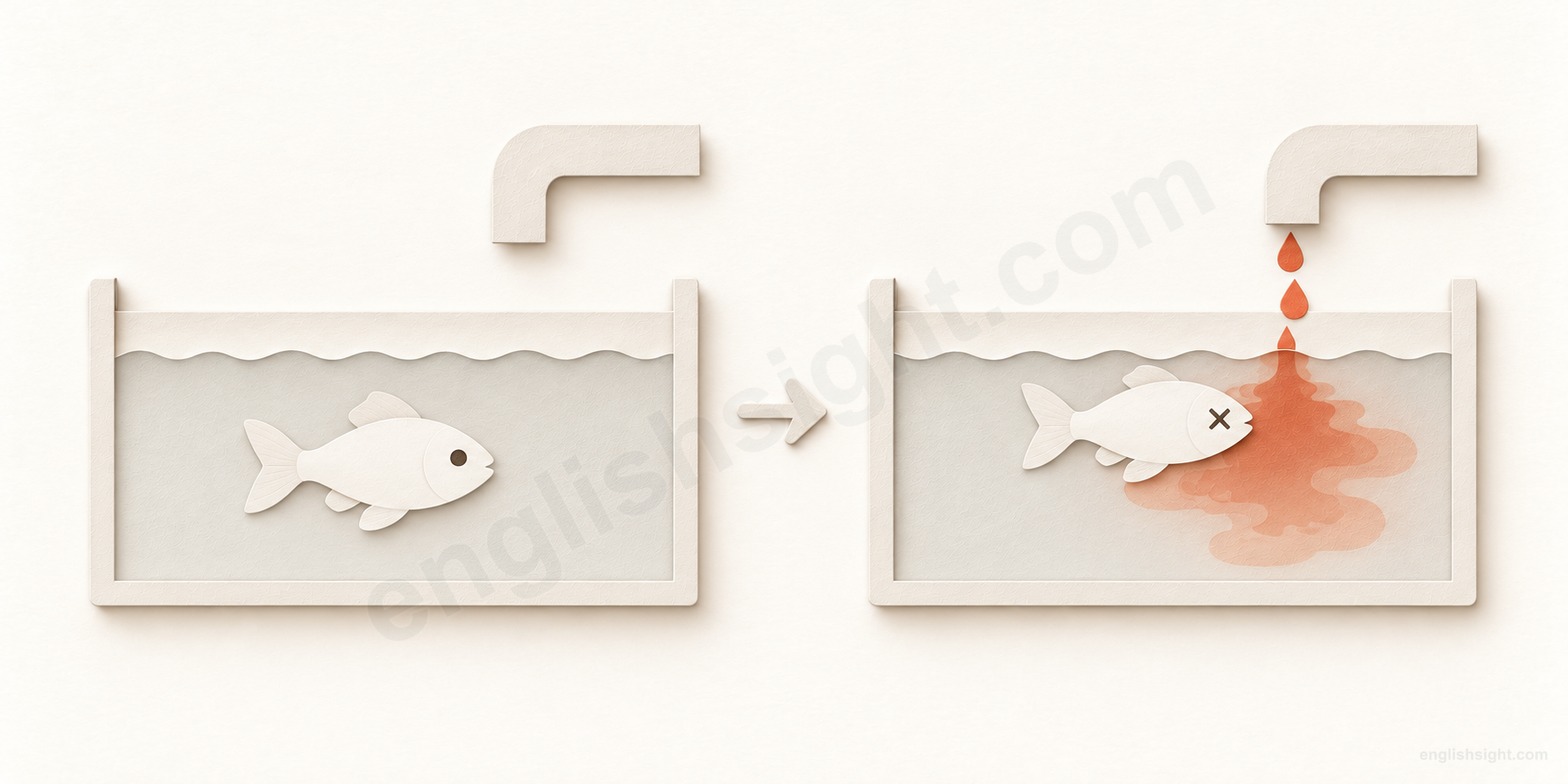
A fish swims in the water beneath a dry pipe.
poison
The water is contaminated, and the fish’s crossed eye indicates death.
A harmful substance drips from the pipe and spreads through the water.
The added substance poisons the water and kills the fish in this example; poisoning need not be fatal.
A poison can harm living things; to poison is to harm with it or contaminate something with it. Figuratively, a damaging influence affects trust, thought, or a shared situation.
The two-state sketch uses one environmental example. It does not show how every poison works or predict the meanings of fixed phrases.
Poison can be a noun naming a harmful substance or a verb describing harm and contamination. The object of the verb tells you whether a living thing is affected or something has had poison added to it.
English also uses poison for harmful ideas and influences. This connection helps organize the uses; individual idioms still need to be learned as complete expressions.
01
The substance and the words around it
Name something harmful, recognize established compounds, and distinguish a dangerous property from contamination.
01
poison (uncountable); a poison; different poisons
poison / a poison / poisons
a substance that can injure or kill a living thing
Situation before
A substance is being identified.
What changes or is meant
Its harmful character is named.
Poison names the substance; it does not necessarily mean a manufactured drug.
Use uncountable poison for the material in general: There was poison in the bottle. Use a poison when identifying one harmful substance, and poisons for different kinds.
Rat poison names a substance intended to kill rats. A deadly poison is one that can cause death; deadly adds that emphasis. A poison can cause injury or illness without causing death.
Poison is the general word. Venom usually refers to poison delivered by an animal’s bite or sting; toxin refers to a poisonous substance produced by a living organism. They are not interchangeable in every context.
In a sentence
The laboratory identified two poisons in the sample.
Watch the difference Use some poison for an unspecified amount; two poisons normally means two kinds, not two drops.
02
rat poison; poison + noun
rat poison / poison gas / a poison arrow
recognize different relationships in compound expressions
Situation before
You read poison next to another noun.
What changes or is meant
The whole combination identifies its purpose or harmful content.
Rat poison targets rats; poison gas is harmful gas.
The order changes the relationship. Rat poison is poison for rats. Poison gas names gas that acts as poison. A poison arrow is an arrow carrying poison, not poison intended to kill arrows.
Some dictionaries label poison before a noun as an adjective; others present the combinations under the noun. Learn the established expression rather than treating poison as a freely interchangeable adjective.
In a sentence
The museum display includes a poison arrow.
Watch the difference For a general property after be, normally choose poisonous: The gas is poisonous. The gas is poison instead identifies it as a harmful substance.
03
poisonous + noun; be poisonous; poisoned + noun; be poisoned
poisonous / poisoned
distinguish a harmful property from exposure or added poison
Situation before
One mushroom is naturally dangerous; another food has been contaminated.
What changes or is meant
Different descriptions explain why each is dangerous.
Poisonous describes a property; poisoned often points to what happened.
A poisonous mushroom can harm you if eaten. A poisoned meal has had poison put into it. Poisoned is also the participle used for an affected person or animal: a poisoned fish.
Compare The mushrooms are poisonous with The soup has been poisoned. The first describes a harmful property; the second describes an action affecting the soup. Poisonous does not automatically mean somebody deliberately added anything.
Poisonous can also describe an extremely hostile atmosphere or person. It belongs to the same figurative family, but its adjective grammar differs from the verb poison.
In a sentence
The mushrooms are poisonous, but nobody has poisoned them.
Watch the difference A poisonous person suggests someone harmful or hostile; a poisoned person has suffered exposure to poison.
02
Who or what is poisoned?
The object matters: a living thing is harmed, food receives poison, and a river becomes contaminated. Poisoning can also name the event or condition.
04
poison + person / animal; be poisoned by + cause; poison someone with + substance
poison someone / be poisoned
harm a person or animal with poison
Situation before
An animal is exposed to a harmful substance.
What changes or is meant
The substance injures it.
A living object receives the harm; death and deliberate intent are not required.
The verb normally takes an object: the fumes poisoned the workers. The cause can be a person, an object, or a substance. Passive be poisoned puts the affected person or animal first.
With names the substance used: poisoned with a chemical. By can name the agent or cause: poisoned by fumes. An accident can poison someone, so the verb alone does not prove an intention to kill.
The fish were poisoned says they were harmed by poison; it does not necessarily say they died. The stronger sentence The poison killed the fish makes death explicit.
In a sentence
Several fish were poisoned by the chemical leak.
Watch the difference Use a direct object in the active form: The fumes poisoned them, not The fumes poisoned to them.
05
poison + food / drink; poison something with + substance
poison the food / drink
put poison into or onto something
Situation before
A story describes a meal before anyone eats it.
What changes or is meant
Poison has been added to it.
The food is contaminated; nobody needs to have eaten it yet.
When the object is food or drink, poison means put poison into it. In a mystery, Someone poisoned the tea describes the action affecting the tea, even if the cup is discovered untouched.
Compare poison the guest, where the person is harmed, with poison the guest’s drink, where the drink receives the substance. With can specify what was added. A poisoned arrow similarly has poison on it.
In a sentence
In the story, someone had poisoned the tea before the guests arrived.
Watch the difference Poison the tea does not mean the tea itself became ill. The object selects the interpretation.
06
poison + water / air / land; be poisoned by + pollutant
poison the water / air / land
contaminate an environment with harmful substances
Situation before
Waste enters a river.
What changes or is meant
The river becomes harmful to living things.
The environment is damaged; a deliberate attack is not implied.
Use poison for serious contamination of water, air, or land. The object is the affected environment rather than the individual animal or person.
Pollute is a broader environmental word. Poison emphasizes toxic harm; it is stronger and more specific than merely saying that a place is dirty. The sketch illustrates a case in which contaminated water kills a fish, not a rule that all exposure is fatal.
In a sentence
Waste from the factory was poisoning the river.
Watch the difference Poisoned water may be dangerous even before any harm to people has been reported.
07
have / get food poisoning; lead / carbon monoxide poisoning; a case of poisoning
food poisoning / lead poisoning
name illness, exposure, or an act involving poison
Situation before
You need a noun for what happened.
What changes or is meant
Poisoning names the condition or event.
Poison is the substance; poisoning is the condition or action.
Food poisoning is illness after eating contaminated food; it does not imply that somebody deliberately put a chemical into a meal. Lead poisoning and carbon monoxide poisoning name the harmful substance involved.
Usually say She has food poisoning without a or plural -s. Poisoning can also name an act, as in The police investigated the poisoning. Separate incidents can be called poisonings.
In The waste is poisoning the river, poisoning is part of the verb. In a case of poisoning, it is a noun. The surrounding grammar tells you which role it has.
In a sentence
Nina missed the trip because she had food poisoning.
Watch the difference Food poisoning is the established illness name. Food poison is not the standard term for that condition.
03
Damage to trust and thought
Figurative uses carry the idea of a damaging influence into relationships and judgment. They are stronger than simply saying something is unpleasant.
08
the poison of + harmful idea / feeling; be poison to / for + affected thing
the poison of hatred
an idea or feeling presented as deeply destructive
Situation before
Hatred spreads in a group.
What changes or is meant
Trust and goodwill are damaged.
The noun can describe an influence rather than a physical substance.
Poison can name something the speaker considers very harmful, such as hatred. Calling a feeling poison is an evaluative metaphor, not a statement that it contains a toxic chemical.
The poison of hatred treats hatred as a destructive force. In Constant suspicion is poison to a friendship, the noun similarly emphasizes damage. This is forceful language rather than a mild description of disagreement.
In a sentence
The story shows how the poison of hatred divides a family.
Watch the difference Do not interpret every figurative poison as a medical claim; identify what the speaker believes is being damaged.
09
poison + relationship / atmosphere; be poisoned by + harmful influence
poison a relationship / the atmosphere
make a relationship or shared situation hostile
Situation before
People can work together.
What changes or is meant
Suspicion makes cooperation difficult.
The object can be a social relationship or the mood of a place.
A lie can poison a friendship, and an accusation can poison the atmosphere at a meeting. The atmosphere here is the social mood, not the air people breathe.
The metaphor links harmful exposure with damage to trust or goodwill. It does not mean every relationship must already be completely destroyed. Poisoned by suspicion can describe an ongoing damaged state.
In a sentence
Repeated accusations poisoned the atmosphere at work.
Watch the difference Read the context: fumes can poison physical air; accusations poison the social atmosphere.
10
poison + someone’s mind + against + person
poison someone’s mind against someone
influence someone to think badly of another person
Situation before
A person has not formed a hostile opinion.
What changes or is meant
Malicious stories create dislike or distrust.
Against names the target of the hostility.
Poison someone’s mind against another person means turn their attitude against that person, often through false or malicious information. The mind is the affected object; the person after against is the target of the resulting hostility.
Against is a preposition introducing the target of the hostility. Keep it before that person’s name or pronoun: against her, not her against. Poison someone’s mind against someone is not a separable phrasal verb. The metaphor concerns judgment rather than a substance entering the brain.
In a sentence
The rumours poisoned his mind against his new neighbour.
Watch the difference Keep the roles clear: his mind is affected; his neighbour is the person he now distrusts.
04
Learn the whole expression
These sayings and set phrases have their own meanings and registers. Some are useful mainly for recognizing dialogue or news.
11
What’s your poison?
What’s your poison?
ask what alcoholic drink someone would like
Situation before
A host offers a drink.
What changes or is meant
The guest names a preferred drink.
This is a humorous, old-fashioned informal question.
The whole question asks for a choice of alcoholic drink. In a suitable conversation, poison is playful rather than a literal warning about a dangerous substance.
It can sound dated or overly familiar. What would you like to drink? is a neutral alternative. Do not assume the same idiomatic meaning when a speaker is actually discussing toxic substances.
In a sentence
“What’s your poison?” the host asked. “A small glass of wine, please.”
Watch the difference This is not a neutral way to ask about any preference in every setting.
12
pick / choose your poison
pick / choose your poison
choose between unwelcome alternatives
Situation before
Every available option has a disadvantage.
What changes or is meant
You select the disadvantage you prefer.
The choice is real; poison humorously names an unwanted option.
Pick your poison and choose your poison acknowledge that none of the options is attractive. The phrase can be a joking response to a difficult decision.
Compare What’s your poison?, which conventionally offers an alcoholic drink. The choosing expression often concerns schedules, tasks, or other awkward alternatives; it does not require drinks.
In a sentence
We can take the crowded train or sit in traffic—pick your poison.
Watch the difference Do not use this as an entirely positive invitation without expecting an ironic tone.
13
one man’s meat is another man’s poison
one man’s meat is another man’s poison
people can have very different tastes
Situation before
One person enjoys something.
What changes or is meant
Another person strongly dislikes the same thing.
The proverb contrasts preferences, not actual food safety.
This traditional saying means that what pleases one person may repel another. Meat stands for something desirable to one person; poison supplies the opposite evaluation.
The wording is traditional and uses man generically. In ordinary conversation, We all like different things gives the idea directly. Learn the complete saying rather than trying to predict it from meat alone.
In a sentence
I love crowded cities, but Eva avoids them: one man’s meat is another man’s poison.
Watch the difference It does not claim that every disagreement is dangerous or that one preference is objectively wrong.
14
a poisoned chalice; turn out to be a poisoned chalice
a poisoned chalice
an attractive offer or role that brings serious trouble
Situation before
A promotion looks desirable.
What changes or is meant
Taking the role exposes the person to difficulty.
The apparently valuable gift has a damaging downside.
A chalice is a ceremonial drinking cup. A poisoned chalice uses the image of a valuable cup holding something harmful to describe an opportunity that turns out badly.
The expression is especially British. It often describes a prominent job with inherited problems or blame attached. It is not simply another name for any demanding task; the contrast with apparent desirability matters.
In a sentence
The promotion turned out to be a poisoned chalice when the department’s debts emerged.
Watch the difference Keep poisoned in this fixed expression; a poisonous chalice is not its usual idiomatic wording.
15
a poison pen letter; send / receive poison pen letters
a poison pen letter
an unsigned malicious letter intended to upset someone
Situation before
A person writes without identifying themselves.
What changes or is meant
The recipient receives a deliberately hurtful message.
The harm comes through the message; the pen contains no literal poison.
A poison pen letter is an anonymous letter written to cause distress, often with hostile allegations. The established compound identifies a malicious communication, not a writing instrument coated in a substance.
You may also see poison-pen letter with a hyphen. A critical letter with a named author is not automatically a poison pen letter: anonymity and an intention to hurt are central to this expression.
In a sentence
The mayor received a poison pen letter with no signature.
Watch the difference Do not shorten the phrase to a poison letter and expect the same established meaning.
16
adopt / introduce a poison pill; a poison pill defence
a poison pill
a business defence against an unwanted takeover
Situation before
Another company wants to take control.
What changes or is meant
The target company adopts a measure to resist it.
The business expression names a defence, not a medicine.
In business reporting, a poison pill is a company’s defensive measure against an unwanted takeover. The damaging element makes the takeover less attractive or harder to carry out.
The exact arrangements depend on the case; the phrase alone does not specify the legal mechanism. This is a recognition use for news, not a claim that every difficult contract clause is technically a poison pill.
In a sentence
The company adopted a poison pill to resist the takeover.
Watch the difference Read the business context before interpreting pill as a physical tablet.
Keep the substance, the action, and the expression distinct
Forms and object grammar
The forms are poison, poisons, poisoned, and poisoning. The ordinary verb is transitive; an understood object may be omitted in context. Use The fumes poisoned them or They were poisoned by fumes. There is no everyday family of separable poison + particle verbs, and poison does not take a person + to-infinitive causative pattern.
Poisonous, poisoned, and poison
Use poisonous for a harmful property and poisoned for exposure or added poison. Poison before a noun occurs in established combinations such as poison gas and poison arrows; it is not a universal replacement for poisonous.
Plant names are established names
Poison ivy and poison oak name North American plants associated with skin reactions on contact. They are not names for all dangerous ivy or oak plants. These names broaden recognition beyond the idea that poison must be swallowed.
Strong figurative language
Poison a relationship and the poison of hatred make strong negative judgments. The metaphor expresses damage; it does not diagnose a medical condition or prove that someone acted deliberately.
Choose by the object and context
Distinguish the substance, the affected thing, and the whole expression.
1. In a mystery, the tea is discovered untouched after poison was added. Which sentence reports that action?
2. A mushroom naturally contains a harmful substance. Nobody added anything. Which description directly names its property?
3. Nina cannot travel because contaminated food made her ill. Which noun phrase is the usual name for the illness?
4. Rumours poisoned Leo’s mind against Maya. Who is the target of Leo’s resulting distrust?
5. A friend offers a crowded train or a long traffic jam and says Pick your poison. What does the friend mean?
Sources and teaching notes
Dictionary entries support the uses and register notes below. Explanations and examples are original; the diagram is a teaching illustration of one case, not evidence about every speaker’s mental imagery.
This diagram helps explain a connection; it is not a picture shared by every native speaker.