From a brighter surface to more refined work—and expressions that need a meaning of their own.
Improve the finish
Improve the finish of something already there
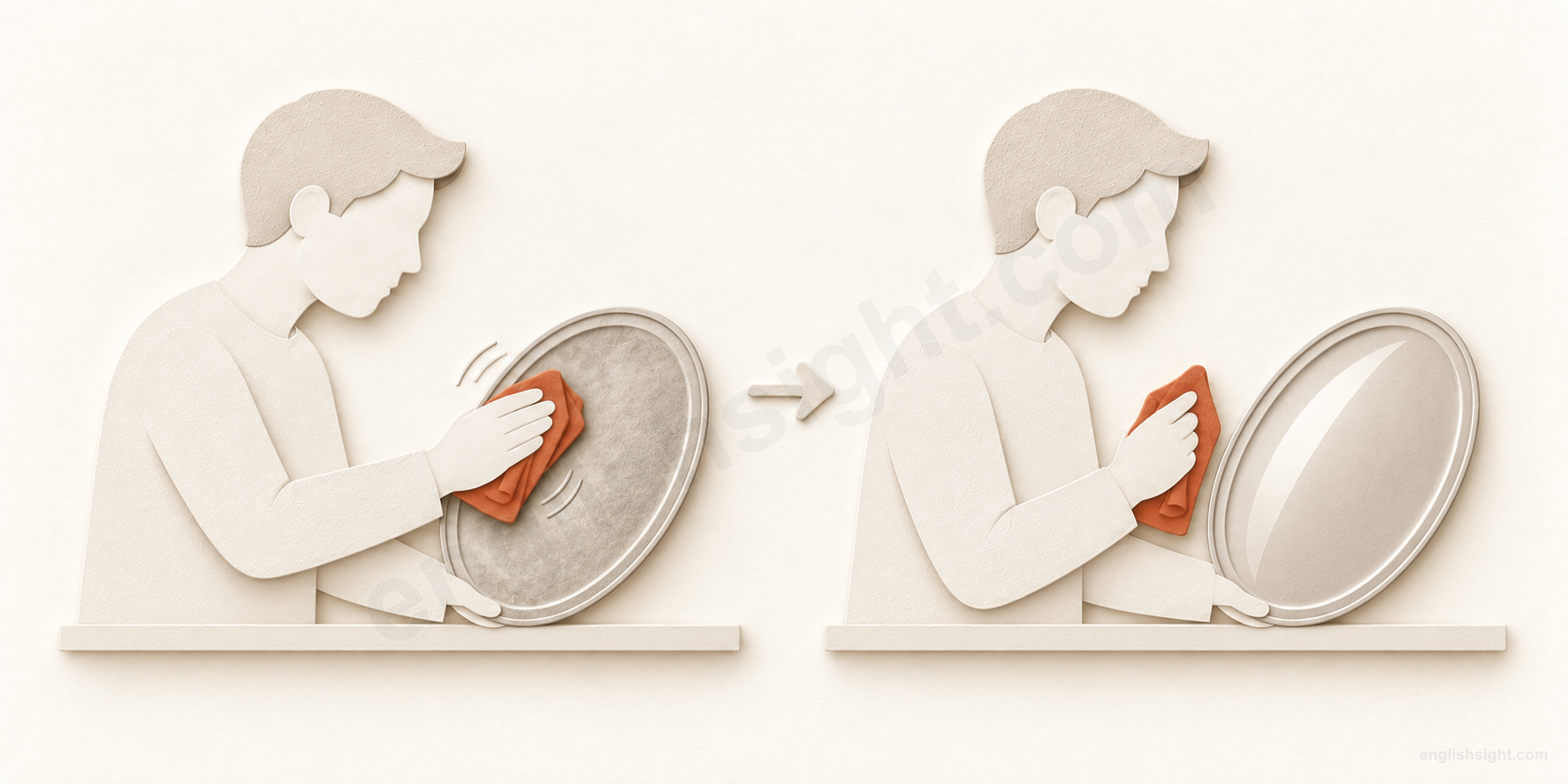
The existing metal plate has a dull finish.
polish
The same plate has a brighter, smoother-looking finish.
A person rubs its surface with a cloth.
Rubbing improves the same plate’s finish; figurative polish refines existing work or performance.
Work over an existing surface or piece of work to make its finish smoother, brighter, or more refined.
The plate illustrates physical polishing. Refining a draft or performance is a useful extension of the model; polish off and Polish are outside it.
Polish can mean rubbing something to improve its surface, or refining work and skills so they come across better. As a noun, it can name the product, the action, or the resulting finish.
Use that connection as a learning aid. Polish off and capitalized Polish need separate explanations; no single picture predicts every use, and English speakers do not all share one mental image.
01
Surfaces, substances, and shine
Separate the action of rubbing, the product used, and the finish that results. The noun can name any of these, so read its surrounding words.
01
polish + object; polish + object + with + tool / substance; polish (without an expressed object)
polish the silver
rub a surface to improve its shine or smoothness
Starting situation
A silver tray looks dull.
Result or meaning
Rubbing brings out a brighter finish.
The object stays the same; its surface is worked on.
The person polishing acts on the tray, shoes, glass, or another surface. A cloth, brush, or suitable product may help. With names the tool or material: polish the tray with a soft cloth.
Cleaning removes dirt; polishing aims at a better finish. The two can happen together, but cleaning a muddy boot is not necessarily polishing it. Polish does not itself mean repair a broken object.
The object can be left unstated when it is understood: We spent the afternoon cleaning and polishing. The verb forms are polish, polishes, polished, and polishing; polished ends with a /t/ sound.
In a sentence
Maya polished the silver tray with a soft cloth.
Watch the difference The tray is the object; the cloth belongs after with. A special polishing product is not required by the verb’s meaning.
02
polish + object + result adjective; be polished; need polishing / need to be polished
be polished smooth
describe a polishing process or its result
Starting situation
A stone has a rough surface.
Result or meaning
Work leaves it smooth.
A result adjective says what the surface becomes.
Workers polished the stone smooth describes an action and its outcome. In The stone was polished smooth, the stone becomes the subject of a passive clause; the workers need not be named.
The stone is being polished describes work in progress. The stone is polished can instead describe its finished condition. Context distinguishes an action from a state.
The stone needs polishing means someone needs to polish it; needs to be polished makes the passive relation explicit. Neither sentence says the stone carries out the action itself.
In a sentence
The stone was polished smooth before it was set in the ring.
Watch the difference Polish someone to do something is not a pattern meaning persuade or arrange for them to do it.
03
some + polish; shoe / furniture / floor / silver + polish; a + type of polish
shoe / furniture polish
name a substance used for a surface finish
Starting situation
You have a pair of dull shoes.
Result or meaning
You choose the product used on their surface.
The noun names a product, not the rubbing action.
Shoe polish, furniture polish, floor polish, and silver polish name products for particular surfaces. You can apply some polish, buy a tin of polish, or remove old polish. The material name normally has no a.
A polish can mean a particular product or type: This is a water-based polish. Several polishes can mean several types or products, rather than several individual rubbing movements.
In a sentence
We need a tin of black shoe polish.
Watch the difference A polish is not normally one portion of the material. Use a tin, bottle, or another suitable container when counting purchases.
04
apply / wear / remove + nail polish; a coat / bottle of nail polish
nail polish
name the decorative coating painted on nails
Starting situation
You choose a colour for your nails.
Result or meaning
A thin coating covers their surface.
This established compound names a coating, not a rubbing treatment.
Nail polish is a clear or coloured liquid painted on fingernails or toenails. British English also uses nail varnish. Apply nail polish describes putting it on; wear nail polish describes having it on.
Nail polish remover names a product used to take the coating off. A coat of nail polish is one layer; a bottle of nail polish is a container of the liquid. The compound is useful even when the chosen finish is not shiny.
In a sentence
Nora applied a second coat of clear nail polish.
Watch the difference Do not infer from the noun that Nora rubbed her nails. Applying nail polish and polishing a surface are different actions.
05
give + object + a (good / quick) polish
give something a polish
do an act of polishing
Starting situation
The tray could look brighter.
Result or meaning
You spend a little time polishing it.
A polish counts an occasion of the action.
Give the tray a polish means polish the tray. Here a polish is an action noun, unlike the material in Put some polish on the tray. Good or quick can describe the thoroughness or duration of the job.
Give is a light verb in this pattern: no substance is necessarily being handed to anyone. The tray receives the treatment.
In a sentence
I gave the tray a quick polish before the guests arrived.
Watch the difference Compare give it a polish, an action, with apply some polish, use a substance.
06
bring / rub + object + to a high polish; a highly polished + noun
a high polish
describe a very shiny surface finish
Starting situation
The wooden surface is dull.
Result or meaning
Careful work leaves a strong shine.
Polish can name the finish rather than the product.
Bring a surface to a high polish and rub it to a high polish focus on the resulting shine. The adjective high describes the degree of finish; it does not refer to the surface’s height.
A highly polished table describes the table. The polish on the table can instead mean its shine or a coating, depending on context. Look for verbs such as apply, remove, or bring to when deciding.
In a sentence
The craftsperson rubbed the wood to a high polish.
Watch the difference A high polish describes gloss, not a large quantity of polishing liquid.
02
Refine work, skills, and presentation
A draft, skill, or performance can be treated as something whose finish needs attention. This is improvement of something already present, not literal rubbing.
Polish a report, speech, or draft suggests attention to wording, organization, or presentation. The surface in the physical model becomes the way a piece of work comes across to its audience.
This is not a promise that only tiny changes are needed, or that the result is perfect. The point is refinement rather than starting the whole task from nothing. The report needs polishing can mean it still needs this work.
In a sentence
I will polish the introduction after we agree on the main argument.
Watch the difference Polish the report means improve its finish; polish off the report means finish the task, often quickly.
08
polish (up) + skill; polish + object + up; polish up on + subject
polish up your skills
improve an existing skill through practice or study
Starting situation
You know some Spanish but need practice.
Result or meaning
Practice makes your use of it more fluent.
Up belongs to an improvement expression, not an upward movement.
Polish your technique and polish up your technique both describe refinement. Polish up your Spanish can involve refreshing something previously learned. Polish up on your Spanish is also used, with on introducing the subject studied.
With a direct noun object, polish up your skills and polish your skills up are possible. A pronoun goes between verb and particle: polish them up. In polish up on it, it follows the preposition on instead.
Polish up can also be literal: polish the brass up. Read the object to decide whether the activity is rubbing a surface or improving ability. Practising a language is not physically shining it.
In a sentence
I am polishing up my Spanish before the trip.
Watch the difference Say polish it up for a direct object, or polish up on it for a study subject; do not put a direct-object pronoun after up.
09
a polished + performance / presentation / speaker; have / lack + polish
a polished performance
show skill, confidence, and a finished presentation
Starting situation
A group rehearses the timing and transitions.
Result or meaning
The performance looks assured and well prepared.
Polished evaluates how accomplished the result appears.
A polished performance, presentation, or speaker displays skill and assurance. There is no actual shiny surface. The adjective connects with the refined finish of well-prepared work.
The noun works too: The performance has polish, or It lacks polish. These comments evaluate execution. They do not automatically judge whether the ideas are original or the speaker is sincere.
In a sentence
Her presentation was polished, with clear explanations and well-timed pauses.
Watch the difference Polished does not by itself mean honest, friendly, or original. It concerns the quality of the presentation.
10
have / lack + (social) polish; polished manners
social polish
describe refined or assured social behaviour
Starting situation
A person feels awkward in formal company.
Result or meaning
Their manners become more assured.
This is a judgment of social style, not physical shine.
Someone with social polish knows how to behave smoothly and confidently in social situations. Polished manners describes a similar quality. The noun is uncountable: She has polish, not She has a polish, for this meaning.
This is an evaluative expression, often concerned with formal social expectations. Lacks polish may sound critical or socially judgmental; it does not establish that someone is unkind or unintelligent. Merriam-Webster marks the related refinement-of-manners noun sense somewhat old-fashioned.
In a sentence
He handled the formal introductions with considerable social polish.
Watch the difference A polite person and a polished person are not identical descriptions: polish adds a sense of practised social style.
03
Learn the whole expression
Polish off has conventional meanings involving completion or defeat. Spit and polish concerns careful neatness. These expressions need their own contexts.
11
polish off + food / drink; polish + object + off
polish off the cake
finish eating or drinking something, often quickly
Starting situation
Some cake is still on the plate.
Result or meaning
The remaining cake is eaten.
The whole phrasal verb means consume completely.
Polish off a sandwich, the cake, or a drink is informal. It commonly suggests an eager or quick finish. No shining or rubbing is involved: the meaning belongs to polish off as a whole.
A noun object can come after off or between the verb and off. A pronoun must come between: They polished it off. Compare polish the plate, which means work on the plate’s surface.
In a sentence
The children polished off the last of the cake after lunch.
Watch the difference Polish it off is the normal pronoun order, not polish off it.
12
polish off + job / task; polish + task pronoun + off
polish off a task
complete a piece of work, often quickly or easily
Starting situation
Two short jobs remain on your list.
Result or meaning
You finish them and can move on.
Off marks completion within this conventional expression.
Polish off the last emails or a small job describes getting the work finished. It is informal and can suggest the task is handled without much difficulty.
Polish a speech is about improving its quality. Polish off a speech can be about completing the work on it. Finishing quickly does not guarantee a carefully polished result; the object and context determine the intended sense.
In a sentence
I can polish off these two emails before the meeting.
Watch the difference Do not replace polish with polish off when the intended meaning is refine rather than complete.
13
polish off + opponent; polish + person / pronoun + off
polish off an opponent
defeat an opponent decisively or with apparent ease
Starting situation
A player faces another competitor.
Result or meaning
That competitor is beaten.
A human object changes the interpretation from finishing food.
Sports reporting may say a player polished off an opponent. Collins labels this defeat use mainly journalism. It is vivid, informal wording rather than a neutral description of meeting a person.
In a crime story, polish somebody off can instead mean kill them; Oxford marks that use especially North American and informal. Context must distinguish sporting defeat from violence. The surface-polishing diagram does not explain either sense.
In a sentence
In the final, she polished off her opponent in under an hour.
Watch the difference Avoid this expression when you simply mean help someone finish their work; a person as object can suggest defeat or killing.
14
(a bit of) spit and polish; give + object + some spit and polish
spit and polish
careful attention to cleaning, neatness, and smart appearance
Starting situation
A room needs to look smart for inspection.
Result or meaning
Careful cleaning and tidying improve its appearance.
The fixed noun phrase emphasizes outward neatness.
A bit of spit and polish can mean a thorough clean and shine. The phrase can also evoke strict standards of neatness and discipline, particularly in military settings.
The words form an informal expression; they are not an instruction to spit on something. Depending on context, the phrase may praise a smart appearance or suggest too much attention to appearances.
In a sentence
The hall needs a bit of spit and polish before inspection.
Watch the difference Learn the phrase together. It is not another particle form of the verb polish.
04
A capital letter and a different vowel
Polish, relating to Poland, is a separate word. Its spelling can look identical at the beginning of a sentence, but its meaning and pronunciation differ.
distinguish surface finishing from the word relating to Poland
Starting situation
You see the same letters with a capital P.
Result or meaning
Context and the first vowel identify the word.
Polish has a different meaning and a different first vowel.
Lower-case polish, noun or verb, is /ˈpɒlɪʃ/ in standard British pronunciation and /ˈpɑːlɪʃ/ in standard American pronunciation. Capitalized Polish is /ˈpəʊlɪʃ/ or /ˈpoʊlɪʃ/. Both have first-syllable stress.
Polish can be an adjective, as in Polish music, or the language name, as in learn Polish. It is a separate word, not the figurative result of polishing. At the start of a sentence even the verb takes a capital: Polish the shoes before you leave.
In a sentence
I am learning Polish, and I need some shoe polish.
Watch the difference Do not pronounce the language name like the shoe-care word. A capital letter alone cannot settle a sentence-initial occurrence.
Read the noun, the object, and the particle
One spelling, several jobs
Some polish is usually a substance; a quick polish is an action; a high polish is a shiny finish; social polish is refined behaviour. The grammar around the noun helps you choose.
Refine is different from finish
Polish a report concerns its quality and presentation. Polish off a report concerns completing it. Neither expression proves that the report is perfect.
Forms and limits
The regular verb has polishes, polished, and polishing. Progressive and passive forms are possible for actions. A material may also polish well, meaning it takes a good finish. This is not a productive verb + person + to-infinitive causative pattern. French polish and technical industrial methods are not expanded here.
Choose the intended use
Decide whether the speaker means a substance, refinement, completion, or the language of Poland.
1. You want someone to rub a dull tray until it shines. Which request names the action?
2. The report is written, but the wording is awkward. You want to improve its presentation. Which expression is more precise?
3. You are talking about the last slice of cake. Which is the usual pronoun order?
4. Which word names the language of Poland?
5. You already know some French and want to practise it before a holiday. Which sentence fits?
Sources and teaching notes
Dictionary entries below were read to check meanings, constructions, and usage labels. The explanations, examples, and visual model were created for this lesson; the model is a teaching interpretation.
The visual model is a learning aid, not a mental image shared by all English speakers.