Connect physical places with roles, circumstances, and stated views—and learn the verb that arranges them.
A position needs a reference
The reference makes the position clear
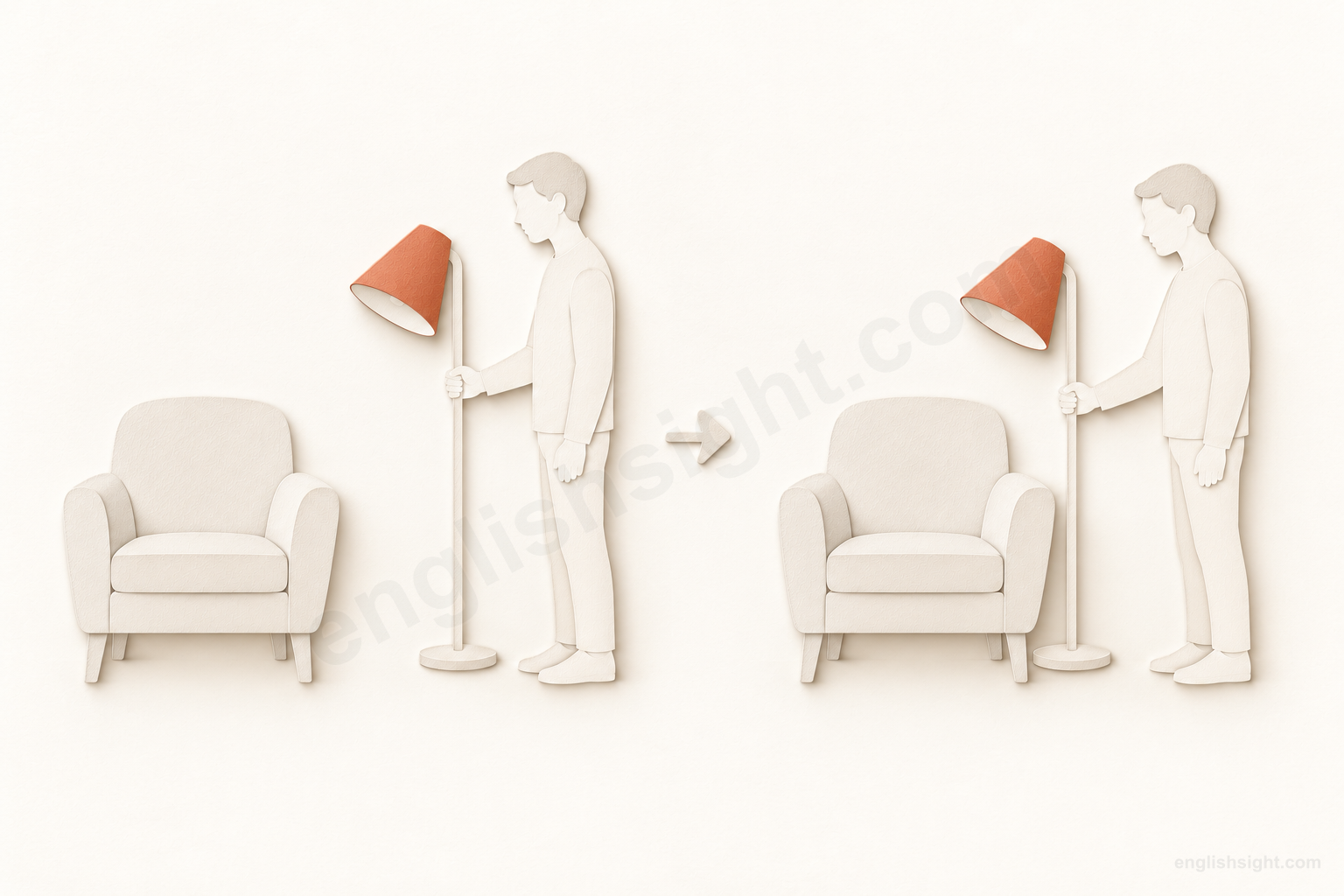
The lamp stands apart from the chair.
position
The lamp is now beside the same chair.
The person places the same lamp beside the chair.
The chair is the reference: the lamp’s position changes relative to it.
A position is where or how someone or something is situated relative to a reference; to position something is to arrange that relation deliberately.
Physical position can be a location or an arrangement. Jobs, rank, circumstances, and views extend the idea in different ways; they are not all literal locations or movements.
Position often locates someone or something within a frame of reference: a room, an organization, a competition, or a set of circumstances. Ask both “What has a position?” and “Relative to what?”
This is a teaching connection, not a rule that generates every meaning. A job, an opinion, and the ability to act have their own established constructions. The diagram illustrates the physical relation; the lesson explains the extensions.
01
Where something is and how it is arranged
A position can locate an object, describe a posture, or identify the place needed for an activity. The surrounding words tell you which relationship matters.
01
the position of + noun; someone’s / something’s position; from + possessive + position
the position of something
where someone or something is relative to a reference
Situation / starting point
You need to find a small island on a chart.
Relation / outcome
You identify its place relative to the coast.
The reference makes the location meaningful.
The position of an island, a cursor, or a camera answers a where-question. Exact position emphasizes precision; relative position compares one thing with another. Position does not itself mean north, near, high, or central: those details come from the context.
The island’s position is a noun phrase, not an action. From my position at the window describes the place from which I see something. Position and location overlap here; place is a more general everyday word.
In a sentence
The chart shows the island’s position just east of the coast.
Watch the difference Position can describe a temporary or permanent location; it does not by itself imply movement.
02
in a/an + adjective or -ing form + position; change / shift (your) position
in an upright / sitting position
how a body or object is arranged or oriented
Situation / starting point
A box is lying on its side.
Relation / outcome
You turn it so that its top faces upward.
How it is arranged differs from where it is.
A sitting, standing, or kneeling position describes the arrangement of a person’s body. An upright or horizontal position can describe an object’s orientation. The adjective or -ing word supplies the particular arrangement.
Change position and shift your position can mean adjusting your posture without going to a different place. The same box can remain beside the door while changing from a horizontal to an upright position. Posture is especially about the body; position has a wider range.
In a sentence
Keep the box in an upright position during the journey.
Watch the difference Use in an upright position, not in upright position. The fixed expression in position has a different article pattern.
03
be in position; hold + object + in position; move / get into position; be out of position
in / into / out of position
in, moving to, or away from the required place or arrangement
Situation / starting point
A camera has not yet been placed for filming.
Relation / outcome
It is set in the required spot and ready to use.
The activity supplies a required position.
The camera is in position means it is where it needs to be. Move the camera into position describes reaching that arrangement. Out of position means away from the correct or intended arrangement, not necessarily outside a room.
This is a fixed noun expression without an article. In a good position describes a particular favorable location or situation; in position focuses on being properly placed. Hold or lock something in position means keep it there. None of these is a phrasal verb headed by position.
In a sentence
Once the camera is in position, we can start filming.
Watch the difference In position does not automatically mean able or authorized: compare in a position to approve the plan.
04
take up a/your position + place phrase; hold your position
take up / hold a position
occupy or remain at a particular place for a purpose
Situation / starting point
An event organizer assigns someone to the entrance.
Relation / outcome
That person goes there and stays ready to help.
The noun names the place; take up describes occupying it.
Take up a position by the entrance means go to that spot and occupy it. Hold your position means stay where you are. Position itself does not say what work you will do there; the situation supplies the purpose.
In reports about conflict, positions can mean sites occupied by troops or weapons. That is a specialized spatial use. Take up a position can also mean start a job, and hold a position can mean have a job or maintain an opinion. Read the following words and the wider context.
In a sentence
Two volunteers took up positions beside the entrance.
Watch the difference Do not assume take up a position always means physical movement: a position as treasurer is a job.
02
Jobs, standing, and places in competition
A place can belong to a person within an organization, a social order, a ranking, or a sports team. These are related ideas, but they are not interchangeable meanings.
05
apply for / hold / fill a position; a position as + role; the position of + title
apply for / hold a position
a particular job in an organization
Situation / starting point
A museum needs someone to manage its accounts.
Relation / outcome
An applicant seeks that job.
The place is a role in an organization.
A position can be a paid job, especially in applications, advertisements, and professional descriptions. Apply for a position means ask to be considered; hold a position means have that job; fill a position means appoint someone to it. An open or vacant position is one that needs a worker.
The position of director identifies the job title. A position as an assistant describes the role, and a position with or at a company identifies the employer. Position is more formal than job. It does not imply that every position is senior or managerial.
In a sentence
Maya applied for a part-time position as an accounts assistant at the museum.
Watch the difference An application is not an appointment: applying for a position does not mean you already hold it.
06
someone’s position in + group; a position of authority / power / trust
a position of authority
standing, influence, or importance relative to others
Situation / starting point
A team gives one person responsibility for decisions.
Relation / outcome
That person has influence within the organization.
This is social standing rather than a map location.
Someone’s position in society or within an organization can mean their standing or importance. A position of authority, power, or trust highlights the influence or responsibility attached to that standing. A person can misuse or abuse their position by using that influence improperly.
A senior position may refer both to a job and to high standing, depending on the point being made. The literary or formal phrase wealth and position uses position without an article to mean high social status. Social standing is not necessarily a paid job.
In a sentence
As club president, Leo is in a position of trust.
Watch the difference A position of trust names a responsibility; it does not prove the person behaves honestly.
07
be / finish in + ordinal + position; move up / drop a position
in first / third position
a place in an ordered comparison or competition
Situation / starting point
Several runners are being compared during a race.
Relation / outcome
One runner is ahead of all but two others.
Position depends on the other competitors.
A position in a race, league, test, or ranking tells us how someone compares with others. In third position means third in the order being discussed. Move up or drop a position describes a change in rank, which may be temporary.
A race position can refer to the current order, not only the final result. Finish in third position makes the result explicit. Third place is another natural expression. The ordinal supplies the rank; position does not itself mean winning.
In a sentence
Nora was in third position when the final lap began.
Watch the difference In third position needs no a before third. Do not infer that she finished third.
08
play + position name; play out of position; be out of position
play a position / play out of position
a role and usual area in a team sport
Situation / starting point
A football team assigns players different responsibilities.
Relation / outcome
One player normally works in defense.
A team position includes a task as well as a place.
What position do you play? asks about your role on the team, such as goalkeeper or defender. A position includes responsibilities and a usual area of play; it is not a player’s rank from best to worst.
Play out of position can mean play in a role other than your usual one. A defender is out of position can instead mean the defender is in the wrong place during a particular move. The verb and situation help distinguish a temporary tactical error from an unfamiliar assigned role.
In a sentence
Our usual defender played out of position as a striker.
Watch the difference Do not answer What position do you play? with a league ranking such as third.
09
take / claim pole position; be in pole position (to + verb)
in pole position
at the front of a starting grid, or in a leading competitive situation
Situation / starting point
Qualifying determines where racing cars will start.
Relation / outcome
One driver gets the front starting place.
The established phrase can also describe an advantage.
In motor racing, pole position is the leading starting position. It is about the start, not a guarantee of the finishing order. Take or claim pole position means obtain that starting place.
Outside racing, a candidate or organization in pole position is leading a contest or has an advantage in it. For example, The local firm is in pole position to win the contract describes a favorable competitive situation. This is a conventional extension; it does not mean the contract has already been awarded.
In a sentence
Inez started in pole position but finished fourth.
Watch the difference Keep the whole expression pole position; pole is not a general synonym for first.
03
Circumstances and what they allow
Your position can mean the circumstances that affect your choices. Learn the whole patterns for ability, lack of authority, and bargaining advantage.
10
be / find yourself in a/an + adjective + position; put + someone + in a/an + adjective + position
put someone in a difficult position
cause circumstances that make someone’s choices difficult
Situation / starting point
Two friends ask you to support opposite plans.
Relation / outcome
Whichever answer you give may upset one of them.
The position is a set of pressures and choices.
Be in a difficult, awkward, or embarrassing position describes circumstances affecting what you can do. Put someone in that position means cause those circumstances. No physical placement is required. The adjective explains what makes the situation significant.
A company’s financial position describes its financial circumstances rather than its office location. Find yourself in a position means discover that you are in that situation; it need not mean you deliberately chose it. Situation is a useful general alternative here.
In a sentence
Asking me to choose between my two friends puts me in an awkward position.
Watch the difference Use an article with the adjective: in an awkward position, not in awkward position.
11
if I were in your position, I would + verb; in my / your / their position
in your position
with your circumstances and choices
Situation / starting point
A friend asks whether to accept a demanding new job.
Relation / outcome
You consider what you would do in that friend’s circumstances.
The speaker imagines sharing the other person’s situation.
If I were in your position, I would… introduces advice by imagining the other person’s circumstances. In my position can ask someone to consider your constraints: What would you do in my position? This is not normally about sitting in someone’s chair.
The possessive your or my determines the noun, so there is no a. If I were is a standard form for an imagined situation. The advice may still be wrong: the phrase frames a viewpoint rather than proving that the speaker fully understands.
In a sentence
If I were in your position, I would ask about the working hours first.
Watch the difference Use in your position for someone’s circumstances; your position on the job offer would ask about their view of it.
12
be (not) in a position to + base verb; be in a good / better position to + base verb
be in a position to do something
have circumstances, resources, information, or authority that make an action possible
Situation / starting point
Your team is waiting for the final cost figures.
Relation / outcome
With the figures available, it can give a reliable answer.
The situation enables an action; the action need not happen.
We are in a position to answer means our circumstances allow us to answer. Depending on context, the enabling factor may be money, information, access, or authority. This often sounds more formal or cautious than can.
We are not in a position to comment can politely withhold a comment because information or authorization is missing. To introduces a verb, not a topic. Compare in a good position to win, which describes favorable chances rather than certainty of success.
In a sentence
Once we have the final costs, we will be in a position to give you a quote.
Watch the difference Being in a position to act means being able in the circumstances; it does not mean that you have acted or promised to act.
13
be in no position to + base verb
be in no position to do something
lack the means, knowledge, standing, or entitlement to act
Situation / starting point
A person who repeatedly arrives late criticizes another late arrival.
Relation / outcome
Someone challenges that person’s standing to criticize.
No can deny practical ability or a reasonable basis for judgment.
In no position to pay can mean lacking the money or practical ability to pay. In no position to judge or criticize can instead challenge someone’s knowledge, authority, or moral standing. The person may physically be able to speak; the objection is that their criticism lacks a proper basis.
You are in no position to complain can sound forceful or reproachful. I’m not in a position to comment is often a more restrained professional reply. Context, rather than position alone, tells us whether inability, authority, or entitlement is at issue.
In a sentence
You missed three deadlines yourself, so you are in no position to criticize her delay.
Watch the difference Do not reduce this expression to physical inability. Also avoid in a no position: no replaces the article.
14
be in a strong / weak position; improve your bargaining position; from a position of strength; jockey for position
a strong / bargaining position
circumstances that give leverage relative to other people
Situation / starting point
A buyer has several acceptable offers.
Relation / outcome
The buyer can negotiate without depending on one seller.
Relative circumstances affect negotiating power.
A strong or weak position concerns the advantages or disadvantages available to someone. A bargaining position is the strength from which someone negotiates. Bargain from a position of strength emphasizes having useful alternatives, resources, or influence.
Jockey for position means maneuver to gain an advantage over others. It can describe competitors in a race or organizations trying to gain influence. The competition comes from jockey and the context; position names the favorable place or standing being sought. Neither expression guarantees success.
In a sentence
Having three other offers puts us in a strong bargaining position.
Watch the difference A bargaining position is not necessarily the opinion you state during the negotiation; it can mean the leverage behind it.
04
Where someone stands on an issue
In discussions and official statements, position names a view that someone takes, explains, defends, or changes. No physical movement is required.
15
a/your position on + issue; take / state / defend / change a position; the position that + clause
a position on an issue
a view or policy that someone holds or states
Situation / starting point
A council discusses whether cars should enter the town center.
Relation / outcome
The council states which policy it supports.
The issue is the reference; position is the view taken toward it.
Your position on an issue is your view or attitude toward it. Take or adopt a position means choose a stance; state or make your position clear means communicate it; defend or maintain your position means continue supporting it; change or reconsider your position means revise or review it.
The position that… introduces the content of the view: Their position is that the rules should stay. This use is common in formal debate, policy, and public statements. Opinion is a more everyday alternative. A position paper is a report that sets out an organization’s view or recommendations for action.
The party changed its position on parking describes a changed policy, whereas the driver changed position can describe movement or posture. On introduces the subject under discussion, not a surface someone stands on.
In a sentence
The council has changed its position on cars in the town center.
Watch the difference Position on the issue names a view; position in the organization can name a role or standing.
05
The verb: put, prepare, and present
Position is also a transitive verb. It can describe careful placement, strategic preparation, or the way a product or person is presented in relation to others.
16
position + object + adverb or place phrase; be positioned + place phrase
position something beside / above / between…
put someone or something carefully in a chosen place or arrangement
Situation / starting point
A lamp is not yet placed for reading.
Relation / outcome
You put it beside the chair where its light is useful.
The verb describes deliberate placement; the following phrase says where.
Position the lamp beside the chair is a transitive instruction: the lamp is the object being placed, and beside the chair gives the location. Position is more precise and deliberate in tone than the everyday put. The verb does not itself specify a direction.
The lamp was positioned beside the chair is a normal passive. It focuses on where the lamp was placed and may leave out who placed it. Position your hands correctly on the handle can concern bodily arrangement, and position the cursor before the word applies the same placement idea on a screen.
In a sentence
Position the lamp beside the chair so that the page is easy to see.
Watch the difference For ordinary whereabouts, say The lamp is beside the chair or The lamp is positioned beside it; avoid The lamp positions beside it.
17
position + reflexive pronoun + place phrase; position yourself for + opportunity
position yourself
choose a place for yourself, literally or strategically
Situation / starting point
You want to see a presentation without blocking anyone.
Relation / outcome
You choose a spot near the side of the room.
The person placing and the person placed are the same.
Position yourself near the door means put yourself in that location. The reflexive yourself is the object of the verb. Change it with the subject: I positioned myself; they positioned themselves. Purpose may be given by a to-infinitive: position yourself to see the screen.
Position yourself for promotion extends this to preparing an advantageous career situation, for example by gaining relevant experience. It does not mean stand at a place called promotion. For names the opportunity being prepared for; the reflexive construction is not a special separable particle verb.
In a sentence
I positioned myself near the side of the room to see the screen clearly.
Watch the difference Use a reflexive object when the subject places itself: She positioned herself, not She positioned her when you mean the same person.
18
be well / poorly positioned to + base verb; be well positioned for + noun
be well positioned to do something
have an arrangement or advantage that creates favorable prospects
Situation / starting point
A firm already has a local network and experienced staff.
Relation / outcome
It has favorable conditions for expanding its service.
Positioned describes a resulting situation, not completed success.
A company well positioned to expand has circumstances that make expansion feasible or promising. Well adds a favorable evaluation; poorly positioned gives the opposite evaluation. Physically well positioned can describe a camera with a clear view, but the business use need not concern an office location.
The form is be + positioned, not the simple present active verb. Compare We are in a position to help, which emphasizes that help is possible, with We are well positioned to help, which emphasizes a particular advantage or suitability. Neither sentence says that help has already been provided.
In a sentence
With its local network, the firm is well positioned to expand the service.
Watch the difference Keep to with a base verb and for with a noun: positioned to expand; positioned for expansion.
19
position + object + as + noun phrase; be positioned as + noun phrase
position something as…
present a product, organization, or person as having a particular role or identity
Situation / starting point
A company decides how customers should understand its new service.
Relation / outcome
It presents the service as a lower-cost alternative.
The chosen place is in an audience’s comparison, not on a shelf.
Position a service as an affordable alternative means shape its offer or presentation so that customers see it that way. The service is the object; as introduces the desired identity. Position a company as a market leader uses the same professional or marketing pattern.
The passive is also possible: The service is positioned as an affordable alternative. This reports the intended presentation, not proof that it really is the cheapest or best. Compare position the product on the top shelf, which describes physical placement; the construction and context distinguish the meanings.
In a sentence
The company positions its repair service as an affordable alternative to replacement.
Watch the difference As gives the identity being promoted. It does not automatically confirm that the identity or claim is true.
Read the noun pattern and the reference
Articles change with the expression
Compare in position, in a position to help, in an awkward position, in your position, in no position to judge, and in third position. Learn these patterns together with their meanings; do not delete or insert a mechanically.
The following word is a clue
A position on an issue is a view; a position in a company may be a job or standing; in a position to act concerns enabling circumstances. These are useful clues rather than a rule that one preposition always has one meaning.
Forms and word class
Pronounce the first syllable weakly and stress the second: /pəˈzɪʃən/. The noun plural is positions. The verb forms are position, positions, positioned, positioning. The verb normally takes an object, including a reflexive pronoun; passive and progressive forms are possible: The technician is positioning the camera.
Coverage boundary
This lesson covers modern general uses and selected work, news, and sports expressions. Technical uses in trading, music, and dance, specific named postures, the rare verb meaning ascertain a location, and the specialized noun meanings of positing or a proposition are not developed here. The model is a memory aid, not evidence that all speakers picture the same thing.
Choose the relation that fits
Use the situation, construction, and reference to decide.
1. The camera is now in the exact spot needed for filming. Which sentence expresses this?
2. You lack the final figures and cannot yet offer a reliable price. Which reply fits?
3. A group now supports a policy it previously opposed. What has changed?
4. Someone who also broke the rule is told, “You are in no position to criticize.” What is being challenged?
5. A defender is assigned to play as a striker for one match. Which expression fits that role change?
6. An advertisement presents a repair service as an inexpensive alternative. Which interpretation fits positioned as?
Sources and teaching notes
Modern noun and verb uses were checked against Oxford and Collins, including relevant expression entries. The explanations and examples are original; the visual connection is a teaching interpretation.
The diagram illustrates a relation that helps connect uses; speakers do not all share one mental picture.