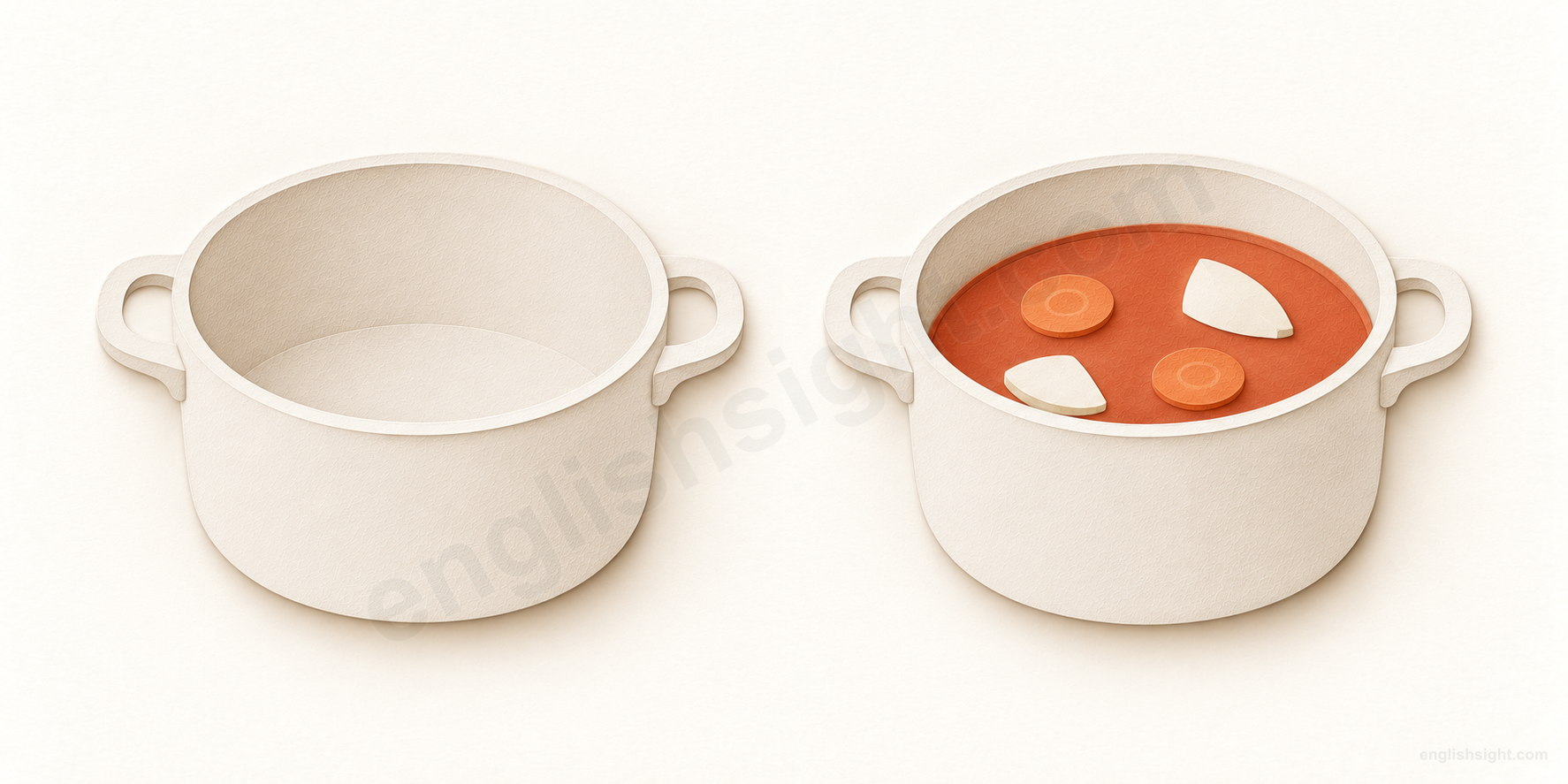
A vessel, its contents, and the expressions around it.
Use pot for containers and amounts, then recognize the meanings carried by whole combinations.
A vessel and what it holds
A container holds its contents together
The same deep, round pot is shown empty.
pot
The pot is shown holding soup and vegetable pieces.
Its sides hold the soup together.
Pot can name the vessel; a pot of soup can name its contents or their amount.
In its main everyday uses, a pot is a fairly deep, usually round container that holds something for cooking, storing, serving, or growing.
The sketch uses a cooking pot to show the vessel–contents relation. Other pots have other shapes and purposes. Money uses can suggest a collected amount; fixed expressions and the drug name need separate learning.
A pot often brings together two things: a container and something held inside it. That helps connect a cooking pot, a plant pot, and a pot of soup. Context may foreground the object or its contents.
Other uses need their own context: pot a ball belongs to a game, and go to pot is an idiom. The container model is a teaching aid, not a rule for inventing meanings or a picture shared by every English speaker.
01
Containers and their contents
Begin with the object. Its purpose, material, and contents help you choose the right kind of pot.
01
a pot; cook + food + in a pot; put + food + into the pot
a cooking pot
a deep vessel for cooking food
Situation
You are choosing cookware for soup.
Result or interpretation
You choose a vessel that can hold the soup while it cooks.
Pot names the vessel; the food is inside it.
For soup, rice, or a stew, a pot gives the food a deep container. Say cook something in a pot or put something into the pot. In describes location; into highlights movement to the inside.
Pots and pans is a familiar collective expression for cookware. A frying pan is usually shallower and broader than a cooking pot, but pan can also be a broader cookware term, especially in British English. Do not treat the names as a rigid scientific classification.
In a sentence
Add the beans to a large pot and cover them with water.
Watch the difference Pot is countable here: use a pot, the pot, or two pots; not I need pot.
02
a pot of + substance; substance / purpose + pot
a pot of paint
a container holding a substance
Situation
You need a small amount of paint for a repair.
Result or interpretation
You open the container and use what is inside.
The material does not have to be food.
A pot may hold paint, cream, yogurt, jam, or another substance. Especially in British English, pot is used for various small food containers. It does not imply that the contents are being cooked.
A paint pot names a kind of container or its purpose; a pot of paint foregrounds what it holds. A glass container with a lid may also be called a jar. Choose the established name for the particular object rather than replacing every container word with pot.
In a sentence
We bought a small pot of blue paint for the door.
Watch the difference The of phrase gives the contents; it does not mean the pot is made of paint.
03
a coffee pot / a teapot; make / put on + a pot of coffee
a coffee pot / a teapot
a vessel for making or serving a drink
Situation
The coffee is ready to serve.
Result or interpretation
People pour it from the shared vessel into cups.
The pot holds the drink; each cup holds a serving.
Coffee pot and teapot name particular vessels. Once the drink is clear from context, the shorter the pot is enough: There is still coffee in the pot. A pot need not always be a plain open bowl.
Make a pot of coffee describes preparing an amount to share. Put a pot of coffee on can describe starting its preparation. The surrounding verbs supply those actions; pot itself is a noun in these expressions.
In a sentence
I’ll make a fresh pot of coffee while you set out the cups.
Watch the difference A kettle normally heats water; it is not automatically the vessel in which tea is brewed or coffee is served.
04
number + pot(s) of + substance; a whole pot of + substance
two pots of soup
an amount measured by what a pot holds
Situation
One batch is not enough for all the guests.
Result or interpretation
You prepare two pot-sized batches.
Count the containers or batches, not individual pieces of soup.
Pot can stand for its contents or for the amount inside. In We ate a whole pot of soup, ate makes it clear that the soup was eaten, not the vessel. The container-to-contents link is useful well beyond this word.
Compare two pots for soup, which identifies two vessels intended for soup, with two pots of soup, which normally includes the soup. A pot is not a fixed unit like a litre: its capacity depends on the actual vessel.
In a sentence
We made two pots of soup for the volunteers.
Watch the difference Keep of before the contents: two pots of soup, not two pots soup.
05
a plant pot / flowerpot; grow + plants + in pots
a plant pot / a flowerpot
a container in which a plant grows
Situation
The herbs need a place to grow indoors.
Result or interpretation
Their roots grow in soil held by containers.
A plant pot holds soil and roots rather than a cooked meal.
A plant pot or flowerpot is made for growing plants. Grow herbs in pots describes their location; put the herbs in pots describes placing or planting them there. The noun pot stays countable.
Potted plants is a widely understood expression for plants grown in containers. In British English, a pot plant is a plant grown in a pot indoors. A plant pot names its container; a clay pot identifies a container by its material.
In a sentence
We grow basil in pots beside the kitchen window.
Watch the difference A plant pot is the container; a pot plant is an indoor plant grown in one, in British English.
06
make / shape / fire + pots; a clay / ceramic pot
make clay pots
a piece of pottery shaped as a vessel
Situation
A learner shapes wet clay in a class.
Result or interpretation
The finished objects can be dried and fired.
Here pot names the crafted object, not the material itself.
In a pottery class, making pots means shaping vessels such as bowls or similar containers. Pots can be decorative as well as useful; a lesson about pottery may use the word more broadly than a cooking recipe does.
Compare She makes pottery with She made three pots. Pottery can name the craft or its products collectively; pots counts individual objects. A potter is the person, not another name for the pot.
In a sentence
At the workshop, Lena shaped two small clay pots.
Watch the difference Do not use pot for all ceramic objects: a ceramic plate is still a plate.
02
Planting, playing, and a related adjective
As a verb, pot usually takes an object. The gardening and ball-game uses describe different actions; potted also has a separate adjective use.
07
pot + plant; be potted; pot / pots / potted / potting
pot a plant
put a plant in a container with soil
Situation
A rooted cutting needs its own growing container.
Result or interpretation
It is planted in soil inside a pot.
The verb describes placing the plant, not manufacturing the pot.
Pot takes the plant as its object: pot the cuttings, then water them. The noun supplies the destination idea, so pot a plant means establish it in a pot, not turn it into one.
The forms are pot, pots, potted, and potting: double the final t before -ed and -ing. The passive works naturally: The seedlings were potted yesterday. Repot means move a plant into another pot, often because it needs more root space.
Pot up can also mean establish a plant or a newly separated piece in a pot: We potted up the small plants separately. Up does not describe moving them to a high shelf. The Royal Horticultural Society uses pot up this way in propagation instructions.
In a sentence
We potted the rooted cuttings in small containers.
Watch the difference Write potted and potting, not poted and poting.
08
pot + plant + on; pot on + plant; pot it / them on
pot a plant on
move a growing plant to a larger pot
Situation
The roots have filled the present container.
Result or interpretation
The plant has more room in a larger one.
On marks a further growing stage in this gardening expression.
In gardening, especially British usage, pot on means transfer a plant into a larger pot. The plant is already growing; this is a more specific instruction than simply pot it.
This particle construction can be separated: pot the seedlings on or pot on the seedlings. With an object pronoun, say pot them on. Compare put the pot on the stove: there put is the verb and pot is the object.
Pot up is also used for moving an existing potted plant into a larger container; the Royal Horticultural Society uses it this way in its overpotting guide. Compare this with potting up newly separated plants: the starting situation tells you whether there is an old pot to replace.
In a sentence
These seedlings need more room, so we’ll pot them on tomorrow.
Watch the difference Say pot them on, not pot on them, for this object-pronoun pattern.
09
pot + ball; a difficult / easy pot
pot a ball
send a ball into a pocket in a cue sport
Situation
A player lines up a shot on the table.
Result or interpretation
The struck ball drops into a pocket.
The ball is the object of pot; no cooking vessel is involved.
In snooker, pool, or billiards, pot a ball means successfully hit it into a pocket. The verb pocket expresses the same basic result. Pot the red means pot the red ball when the sport makes that reference clear.
You may also hear a difficult pot, where pot is a countable noun for the shot. A difficult pot and a difficult cooking pot have entirely different meanings because the setting changes the interpretation.
In a sentence
She potted the red ball and prepared for her next shot.
Watch the difference This is a specialist sporting use, especially familiar in British English; do not infer that pot means hit any object anywhere.
10
a potted + history / biography / account
a potted history
a short account containing selected main points
Situation
A guide has only a few minutes to introduce a place.
Result or interpretation
Listeners receive a brief outline rather than a full history.
Potted is an adjective here, not a request to put a book in a pot.
Especially in British English, a potted history or potted biography is a condensed account. The short form selects and compresses information; it does not mean the account is necessarily false.
Keep this established adjective separate from potted plants. Potted meat is another expression: it describes meat cooked and preserved in a small container. The noun after potted determines which interpretation fits.
In a sentence
The guide gave us a potted history of the old station.
Watch the difference For an international audience, a brief history is often a clearer choice.
03
Money gathered or imagined
A pot can be an amount available for a purpose. Some expressions preserve that idea; others describe abundance or a hoped-for reward.
11
put money into + a common pot; money from + the pot; a pot of money for + purpose
a common pot
money available together for a purpose
Situation
Several people contribute towards shared costs.
Result or interpretation
Payments can be made from the combined fund.
The pot can be money in an account, without a physical vessel.
Put money into a common pot treats contributions as one available fund. Take money from the pot describes spending from it. A clear practical link is that separate contributions are considered together, like contents gathered in one vessel.
Context can identify the purpose: a pot of money for repairs. A pension pot similarly refers to money accumulated for retirement. These expressions name funds, not necessarily cash stored in a container.
In a sentence
We each put ten dollars into a common pot for lunch.
Watch the difference The money belongs to the stated arrangement; pot alone does not tell you who may spend it.
12
the pot; add to / win + the pot
win the pot
win the money or chips staked in a round
Situation
Players have placed bets during a hand of cards.
Result or interpretation
The winner receives the combined stake.
The pot is the stake being contested, not the winner’s total wealth.
In poker and related card games, the pot is the accumulated money or chips that players are competing for. Add to the pot and win the pot use the same noun in different actions.
The shared-fund use and the betting use are related but not interchangeable. A group can have a common lunch pot without playing a game, and winning a pot does not mean winning every hand in a session.
In a sentence
The final bet made the pot much larger.
Watch the difference Use context to distinguish a betting stake from a fund for shared expenses.
13
have / earn / spend + pots of money
pots of money
a very large amount of money
Situation
Someone can afford a very expensive house.
Result or interpretation
A speaker informally comments on their wealth.
Pots exaggerates the amount; it does not count literal vessels.
Pots of money is an informal expression, particularly associated with British English. It means lots of money, without specifying a sum. Learn the full plural expression rather than treating pot as a standard money unit.
Compare a pot of money for repairs: that can mean a particular allocated fund, not necessarily a huge one. Pots of money foregrounds abundance; a pot of money can foreground money set aside.
In a sentence
They must have pots of money to afford that house.
Watch the difference In formal writing, use a large amount of money or give the actual amount.
14
sweeten the pot + by + -ing; sweeten the pot + with + benefit
sweeten the pot
make a proposition more attractive by adding something
Situation
A customer is still unsure about an offer.
Result or interpretation
An extra benefit makes accepting it more appealing.
The extra benefit improves what is on offer.
Sweeten the pot can mean adding an incentive. A seller might include free delivery or an extra service to encourage agreement. The improvement can be something other than money.
In poker, sweetening the pot concerns adding to the stakes. Outside games, the whole expression is figurative; sweeten the deal is a close alternative. It does not mean that the original offer involved food or sugar.
In a sentence
The shop sweetened the pot by including free delivery.
Watch the difference Do not infer that a better offer has already been accepted: the phrase describes the incentive.
15
a pot of gold; a pot of gold at the end of the rainbow
a pot of gold
a hoped-for large reward or success
Situation
Someone hopes a new project will make them rich.
Result or interpretation
The hoped-for reward may or may not appear.
A promised treasure is a metaphor for the hoped-for payoff.
A pot of gold may be literal in a story, but in conversation it can mean hoped-for wealth or a wonderful reward. At the end of the rainbow extends the familiar treasure image.
The expression often leaves room for doubt or wishful thinking. It is different from pots of money: someone can hope for a pot of gold while having very little money now.
In a sentence
She hoped the invention would bring her a pot of gold.
Watch the difference The phrase expresses an imagined payoff; it does not establish that the reward exists.
04
Learn the whole expression
These established combinations express decline, trouble, criticism, waiting, change, and chance. A drawing of a container cannot supply all their meanings.
16
go / goes / went / has gone + to pot
go to pot
decline badly, often through lack of care
Situation
A once-tidy place is no longer maintained.
Result or interpretation
Its condition becomes much worse.
This fixed expression describes deterioration, not movement to a vessel.
A garden, a building, or an organization can go to pot when it is neglected or no longer run well. This informal phrase evaluates a change in condition.
Inflect go: goes to pot, went to pot, has gone to pot. Pot stays unchanged and has no article in this idiom. Compare The sauce went into the pot, which describes literal movement and uses a different construction.
In a sentence
The garden went to pot while the house stood empty.
Watch the difference Keep the idiom as to pot, not to a pot or to pots.
17
stir the pot; keep the pot boiling
stir the pot
provoke trouble or controversy
Situation
An argument has begun to calm down.
Result or interpretation
Someone brings up an inflammatory detail and tensions rise again.
The idiom concerns social disturbance rather than cooking.
Stir the pot often suggests deliberately encouraging conflict. Mentioning an old grievance just as people calm down can be described this way. Literal stirring moves the contents of a cooking pot; the idiom transfers that disturbance to a social situation.
Keep the pot boiling is a different expression: keep a process or activity going. For example, We asked another question to keep the pot boiling describes continuing a discussion, not necessarily causing an argument.
In a sentence
Bringing up that old complaint will only stir the pot.
Watch the difference The is part of the familiar idiom. Do not assume every animated discussion is malicious pot-stirring.
18
that is / that’s + the pot calling the kettle black
the pot calling the kettle black
criticize another person for a fault you share
Situation
A person who is often late criticizes someone else’s lateness.
Result or interpretation
A listener points out the same fault in the critic.
The criticism rebounds on the person making it.
This saying points to a double standard: the accuser has the very fault they complain about. It is not simply a way to say that two people disagree or both have unrelated problems.
A natural response is That’s the pot calling the kettle black. The household objects belong to the fixed saying; replacing them with other containers loses the familiar expression. It can sound pointed or confrontational.
In a sentence
You call me untidy? That’s the pot calling the kettle black!
Watch the difference Use it only when the critic shares the relevant fault, not whenever a complaint seems unfair.
19
a watched pot never boils
a watched pot never boils
waiting anxiously makes time feel slow
Situation
You keep checking for a message every few seconds.
Result or interpretation
The wait seems to last longer and longer.
The saying describes the experience of waiting.
The proverb compares anxious waiting with watching water heat. It suggests turning your attention elsewhere rather than checking constantly. It is a traditional saying; Collins labels it old-fashioned.
Never boils is deliberate exaggeration, not a claim about physics. People can use the saying about a reply, a delivery, or another expected event, even when there is no real pot.
In a sentence
Stop checking the delivery tracker every minute—a watched pot never boils.
Watch the difference Do not present this proverb as a guarantee about when the expected event will happen.
20
a melting pot of + cultures / ideas / influences
a melting pot
a place or situation where different people or ideas mix
Situation
People with different backgrounds meet in one place.
Result or interpretation
Their experiences and ideas interact.
Mixing is figurative here; people are not literally melted.
A city can be called a melting pot of cultures; a workshop can be a melting pot of ideas. The expression presents different influences meeting and combining in a shared setting.
This is a metaphor, not a claim that all differences disappear or that everyone has the same experience. Of identifies what mixes. Learn it separately from in the melting pot, which can describe an unsettled situation.
In a sentence
The port became a melting pot of languages and traditions.
Watch the difference Do not interpret melting pot as a claim that people literally lose every aspect of their identity.
21
be + in the melting pot
in the melting pot
unsettled and liable to change
Situation
Several plans are being reconsidered.
Result or interpretation
Their final form has not been decided.
The fixed prepositional expression emphasizes change or uncertainty.
Especially in British English, plans or arrangements that are in the melting pot are changing or may change. This is useful when a decision has not settled into a final form.
Compare a melting pot of cultures, which describes mixing. The fixed in the melting pot expression can concern a single timetable or project; it does not require a mix of cultures or nationalities.
In a sentence
Our travel arrangements are still in the melting pot.
Watch the difference Keep the definite article in the fixed expression in the melting pot; in a melting pot normally gives a different, more literal or descriptive reading.
22
take pot luck; it is pot luck whether + clause
take pot luck
accept what happens to be available
Situation
You arrive without booking a particular option.
Result or interpretation
You accept the available choice without knowing how good it will be.
Luck belongs to the whole expression, not to the container noun alone.
Take pot luck means accept an uncertain outcome or whatever is available. With food, Come for supper, but you’ll have to take pot luck means there is no specially planned menu for you.
The expression also works outside meals: We did not book a room; we took pot luck. This describes accepting chance, not choosing the lucky option in advance. Potluck is also written as one word, especially for the shared-meal meaning in North America.
In a sentence
We hadn’t booked a table, so we took pot luck at a café nearby.
Watch the difference Taking pot luck does not guarantee either a good or a bad result.
23
a potluck; a potluck dinner / supper
a potluck dinner
a shared meal to which guests contribute food
Situation
Friends arrange to eat together.
Result or interpretation
Each guest brings food for everyone to share.
Potluck names the meal arrangement, not a cooking technique.
In North American English, a potluck is a meal where guests bring dishes to share. You can have a potluck or organize a potluck dinner. The food need not be cooked in a pot.
A potluck can be carefully organized, with people agreeing who brings what. That differs from take pot luck, where uncertainty is the point. The related words do not force the same meaning in every construction.
In a sentence
We’re having a potluck on Friday, and I’m bringing a salad.
Watch the difference A potluck invitation usually asks you to contribute food; it does not simply promise a randomly chosen restaurant.
05
A separate informal meaning
Context and countability distinguish the drug name from the ordinary container.
24
pot as an uncountable noun; some pot
pot (informal)
an informal name for cannabis
Situation
A conversation concerns drugs rather than cookware.
Result or interpretation
Pot refers to a substance, not a vessel.
This uncountable noun is a separate lexical meaning.
In informal speech, pot can mean cannabis or marijuana. A sentence such as They were talking about pot may therefore be about a drug. The setting supplies the distinction.
In this meaning, pot is normally uncountable: some pot. A pot in an ordinary household conversation means a container. The container diagram does not explain the drug name, and this lesson does not force a connection between them.
In a sentence
The article discusses how films portray pot use.
Watch the difference For neutral or formal writing, cannabis is a more explicit term.
Let grammar and context guide you
Forms and sound
Pot is usually /pɒt/ in British English and /pɑːt/ in American English. Container nouns have a regular plural, pots. The verb has pots, potted, and potting, with a doubled t in the last two forms.
A useful connection has limits
Container, contents, and amount are a useful teaching link. It does not prove a single origin for every meaning. Pot on is a gardening particle verb; a pot of soup is a noun phrase; go to pot is a fixed idiom with go as its verb. Do not call them all phrasal verbs.
Recognize more specific names
A chamber pot is a vessel used as a toilet; for a small child, potty is a familiar everyday word. Pot can also informally mean a protruding belly, often called a pot belly. Both need context and are recognition notes here.
Scope of this lesson
Compounds such as lobster pot, chimney pot, pot roast, and pot pie have particular referents beyond the main lesson. Technical electronics, historical measures, dialectal holes, trophies, and hunting uses are not expanded. This is a practical selection, not every recorded meaning or a frequency ranking.
Choose the meaning that fits
Use the situation, the grammar, and the complete expression.
1. Someone says, “We ate a whole pot of soup.” What did they eat?
2. The roots have filled their small containers. Which instruction means move the plants to larger pots?
3. Friends each contribute money for a picnic. What is their common pot?
4. A neglected park has gone to pot. What has happened?
5. A North American friend invites you to a potluck dinner. What arrangement should you expect?
6. Someone who is always late complains that you are late. Which saying points to the shared fault?
Sources and teaching notes
Usage was checked against the publisher pages below. Explanations and examples are original. The vessel–contents model is a teaching interpretation, not a dictionary claim that every meaning has one origin.
The diagram explains the container–contents relation; it does not represent every meaning of pot or every speaker’s mental image.