Count potatoes, name dishes, and recognize the expressions that go beyond food.
An underground tuber used as food
An underground tuber used as food
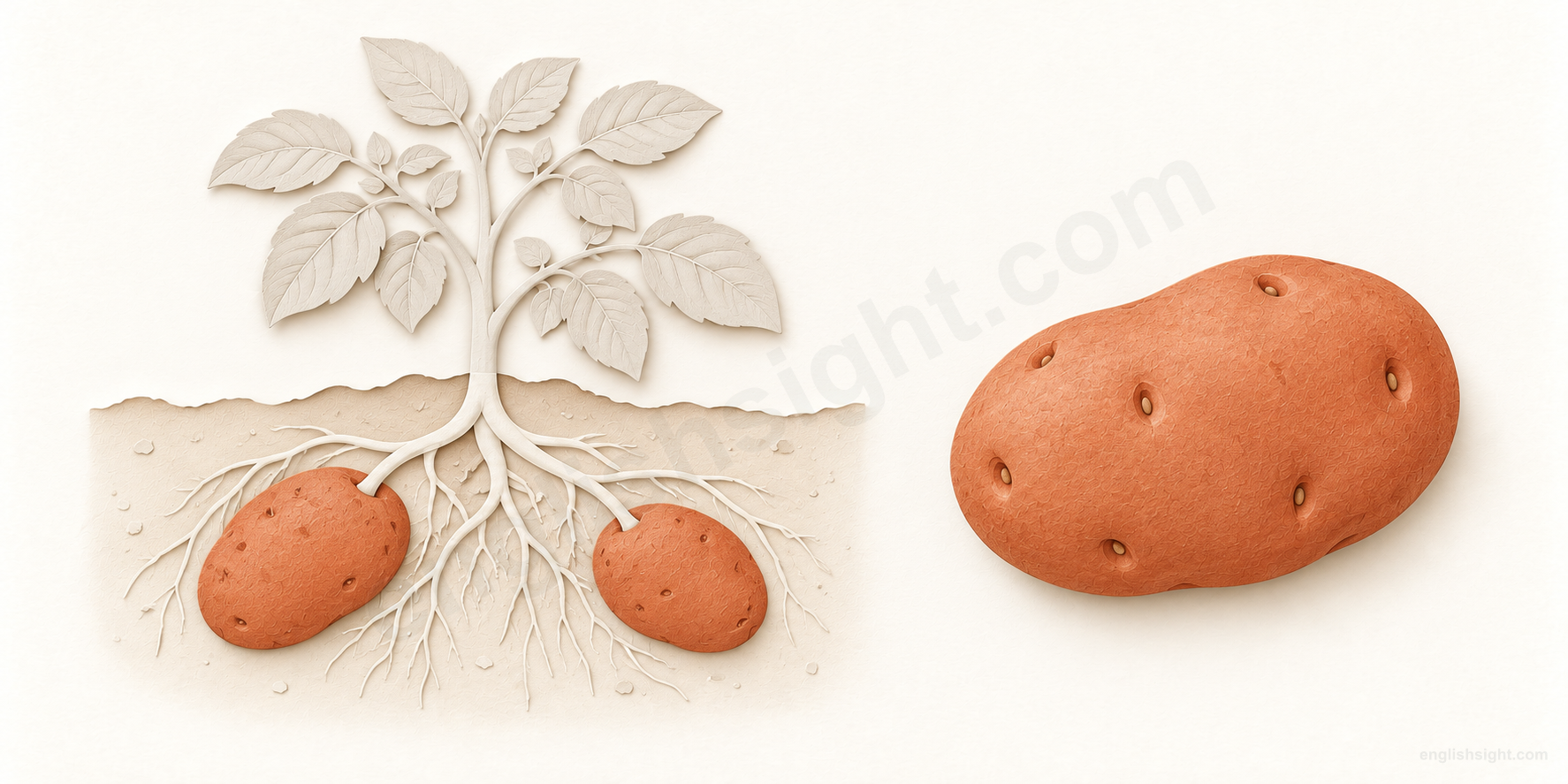
The potato plant has leaves above the soil.
potato
The harvested tuber is the familiar potato used as food.
Its underground stems form potato tubers.
Potato can name the plant and its edible underground tuber.
A potato is an underground tuber of the potato plant that people use as food; the word can also name the plant itself.
The picture links the plant to its tuber. It does not explain every dish name or fixed figurative expression, which must be learned in context.
A potato is usually a familiar vegetable: the underground tuber of a potato plant, used as food. The word can also name the plant or potato as an ingredient.
Begin with the real object, then notice what grammar and complete expressions contribute. A potato salad, a couch potato, and a political hot potato do not all name the same kind of thing.
01
The vegetable, the food, and the plant
First decide whether you mean individual potatoes, an amount of potato as food, or the growing crop.
01
a / one potato; two / some potatoes; a kilo of potatoes
a potato / potatoes
name one vegetable or several individual vegetables
Situation
You need three whole vegetables for a recipe.
What you mean
You count them as three potatoes.
A potato is an individual underground tuber used as food.
Potato is a noun. In its everyday food sense, it names the starchy underground part of a potato plant. It need not be perfectly round; familiar potatoes are often oval and have brown or red skins.
Use a potato for one whole item and potatoes for more than one. A kilo of potatoes measures a collection; three potatoes counts the individual items. The plural ends in -oes: potatoes, not potatos.
In a sentence
Could you put three potatoes in the basket?
Watch the difference A singular count noun needs a determiner: I bought a potato, not I bought potato when you mean one whole item.
02
some potato; potato in + dish
some potato
refer to potato as food or an ingredient
Situation
You taste a thick vegetable soup.
What you mean
You identify potato among its ingredients.
The same noun can refer to food without counting whole tubers.
Potato can be uncountable when the concern is an amount of food or an ingredient, rather than separate vegetables. There is some potato in this soup identifies the ingredient.
Compare I need two potatoes with I need some potato for the filling. The first counts vegetables; the second asks for an amount. This is a change in how we view the food, not a different plant.
In a sentence
There is some potato in the filling.
Watch the difference Do not infer that every food context requires singular potato: We had potatoes with dinner is also natural.
The name can refer to the plant as well as its edible tuber.
Potato also names the plant that produces the tubers. We grow potatoes can describe cultivating the crop; dig up potatoes directs attention to harvesting the underground tubers.
A potato plant makes the plant reference explicit. The edible potato is a tuber, a swollen underground stem, rather than simply any root vegetable. This botanical distinction is useful for understanding the picture; it is not needed to order lunch.
In a sentence
We grow potatoes in the bed beside the fence.
Watch the difference The same word can name the crop and the food. Use potato plant if the living plant needs to be distinguished from a harvested potato.
02
Cooking and choosing food
Cooking verbs, ingredient compounds, and established food names tell you how potato is prepared and served.
A verb specifies the preparation or cooking method.
Preparation verbs describe actions done to potatoes.
Peel the potatoes means remove their skins. Boil, roast, bake, and fry describe different cooking methods. The potato is the food being acted on; these verbs supply the action.
Boiled potatoes, roast potatoes, and fried potatoes name the resulting food. Roast potatoes is an ordinary dish name; roasted potatoes is possible too. These are food collocations, not phrasal verbs or new meanings of potato.
In a sentence
Peel the potatoes, then boil them until they are soft.
Watch the difference Peel and boil are different actions: boiling does not itself mean taking the skin off.
05
a baked / jacket potato with + topping
a baked potato / a jacket potato
name a whole potato baked in its skin
Situation
You want a whole oven-cooked potato for lunch.
What you mean
You choose a baked potato with a filling.
Jacket refers to the skin left on during baking.
A baked potato is cooked in the oven in its skin. Jacket potato is the British name for this food; baked potato is used in both British and North American English.
The jacket is the potato’s skin in this established food name, not clothing added to it. A jacket potato with beans names the potato and its accompaniment or topping. It remains countable: two jacket potatoes.
In a sentence
I ordered a jacket potato with beans.
Watch the difference Jacket potato is a particular dish; it is not the name for every potato that still has its skin.
06
some mashed potato / mashed potatoes; a spoonful of mashed potato
mashed potato / mashed potatoes
name potatoes cooked and crushed into a soft food
Situation
Boiled potatoes are still in pieces.
What you mean
They are crushed into a soft mass.
The preparation changes the texture; both names identify the dish.
Mashed potato is made by crushing cooked potatoes into a soft mass, often with milk or butter. Mashed potato and the short name mash are especially British; mashed potatoes is used in Britain and North America.
The plural dish name does not mean that separate whole potatoes are still visible. You can ask for some mashed potatoes or a spoonful of mashed potato. Learn the dish name together with its normal number pattern.
In a sentence
Would you like some mashed potatoes with your dinner?
Watch the difference Use mashed with -ed. Mash potato can be an instruction to crush potato, rather than the usual full name of the dish.
Before another noun, potato normally stays singular.
In potato soup and potato salad, potato is a noun used before another noun to identify an ingredient. The second noun names the dish. Potato skins, potato starch, and potato wedges follow the same broad naming pattern.
Number normally appears on the head noun where needed: two potato salads, not two potatoes salads. Potato wedges are wedge-shaped pieces; potato skins can mean the outer coverings or a dish made with them, depending on the menu.
In a sentence
We brought potato salad to the picnic.
Watch the difference Potato usually stays singular as a noun modifier even when the dish contains several potatoes.
08
a bag of potato chips / crisps; a portion of chips / fries
potato chips / crisps; chips / fries
choose the regional food name
Situation
You want either a bag of crisp slices or hot fried strips.
What you mean
The regional word helps distinguish the foods.
American chips and British chips normally name different potato foods.
Potato chips, or chips in North American English, are thin crisp slices commonly sold in bags. British English normally calls these crisps or potato crisps.
British chips are fried strips of potato, often served hot with a meal; fries or French fries is the usual North American term. Read the food and regional context: a British menu offering fish and chips is not normally offering a bag of crisps.
In a sentence
She packed a bag of potato chips for the journey.
Watch the difference Do not treat chips as an identical food name in every English-speaking region.
09
new potatoes; serve / boil new potatoes
new potatoes
name potatoes harvested early
Situation
A market sells potatoes harvested early in the season.
What you mean
You choose small new potatoes for a meal.
New describes an early harvest, not a recent purchase.
New potatoes are small potatoes taken from the ground early in the growing season. The food name is usually plural: new potatoes. A single early-harvest potato can be called a new potato.
The expression is more specific than newly bought potatoes. Buying a bag today does not make its contents new potatoes in the food-name sense.
In a sentence
We served new potatoes with the fish.
Watch the difference Small size alone does not explain the name: the early harvest is part of its meaning.
10
a sweet potato; sweet potatoes; sweet potato + noun
a sweet potato
name a different sweet-tasting vegetable
Situation
A recipe offers a choice of vegetables.
What you mean
You choose sweet potato rather than ordinary potato.
Sweet potato is an established vegetable name.
Sweet potato names a sweet-tasting root vegetable. Treat it as a complete food name, rather than assuming it means an ordinary potato with sugar added.
Like potato, it can count individual vegetables or name an ingredient: two sweet potatoes; sweet potato soup. The modifier form normally stays singular: sweet potato wedges.
In a sentence
This soup is made with sweet potato and ginger.
Watch the difference A sweet potato is not simply a cooked ordinary potato that tastes sweet.
03
Familiar expressions beyond food
Learn these whole expressions with their tone and context. They have conventional meanings that the vegetable picture alone cannot supply.
11
a hot potato; a political hot potato
a hot potato
describe an awkward or controversial issue
Situation
A proposed closure causes arguments in the town.
What you mean
People are reluctant to take responsibility for the issue.
The complete expression likens a difficult issue to something uncomfortable to hold.
A hot potato is an informal name for a difficult, sensitive, or controversial issue that people do not want to handle. Political hot potato is a familiar combination.
The heat belongs to a metaphor: handling the issue may cause trouble. A hot potato on a plate can also be literal food; the topic and surrounding sentence decide. This idiom is not predicted by the plant diagram.
In a sentence
The proposed school closure has become a political hot potato.
Watch the difference Hot here does not merely mean popular or exciting, and potato alone does not mean problem.
12
drop + someone / something + like a hot potato
drop someone / something like a hot potato
abandon someone or something very quickly
Situation
A sponsor supports a project.
What you mean
After bad publicity, the sponsor immediately withdraws.
The simile highlights a rapid rejection or withdrawal.
Drop someone or something like a hot potato means quickly get rid of, stop supporting, or stop dealing with them because they are difficult or no longer wanted. The comparison suggests releasing something that is uncomfortable to hold.
The object goes after drop: dropped the project like a hot potato; dropped it like a hot potato. Unlike a hot potato, which labels an issue, this longer expression describes how abruptly a person acts.
In a sentence
After the scandal, the sponsor dropped the project like a hot potato.
Watch the difference This is a fixed simile with ordinary transitive drop, not a separable phrasal verb.
13
be / become a couch potato; couch potatoes
a couch potato
informally describe someone who watches a lot of television and is inactive
Situation
Someone spends much of their free time on the sofa watching television.
What you mean
You jokingly or critically call that person a couch potato.
The phrase labels a person and often carries disapproval.
A couch potato is someone who spends a lot of time watching television and takes little exercise. It is informal and can sound critical, even when used jokingly about yourself.
It is countable: a couch potato, two couch potatoes. The person is the referent; there is no actual vegetable on the sofa. Potato by itself is not the ordinary standard name for this habit.
In a sentence
I was a couch potato all weekend, so today I’m going for a walk.
Watch the difference Use care when labeling another person: the expression can imply laziness.
14
be small potatoes (compared with / to + something)
small potatoes
describe something as relatively unimportant or of little value
Situation
You compare a small fee with a much larger cost.
What you mean
The fee seems insignificant by comparison.
The fixed plural expression evaluates importance or value.
Small potatoes is informal, especially North American English, for a person or thing of little importance or value, particularly in comparison with something larger. It can dismiss a sum of money, a business, or an issue.
In The fee is small potatoes, agreement follows the singular subject fee; the idiom keeps its plural form. In a food context, small potatoes may simply mean small vegetables. Comparison and context signal the figurative reading.
In a sentence
The repair bill is small potatoes compared with the cost of a new car.
Watch the difference Keep potatoes plural in the idiom; a small potato ordinarily names one small vegetable.
15
the meat and potatoes of + noun; a meat-and-potatoes + noun
the meat and potatoes of something
identify the basic, important parts
Situation
A training course has many optional extras.
What you mean
You identify the practical skills at its center.
A familiar meal becomes a metaphor for the essential substance.
The meat and potatoes of something means its most basic and important parts, especially in North American English. It is an established expression; potato alone does not mean essentials.
The related adjective meat-and-potatoes can describe work or an approach that concentrates on basics: a meat-and-potatoes approach. It can also describe someone who likes plain, simple things: a meat-and-potatoes sort of person. Use it before a noun in these senses.
In a food conversation, meat and potatoes can simply name a meal. In the figurative expressions, learn the whole combination; hyphens mark the compound adjective before a noun.
In a sentence
Practical skills are the meat and potatoes of this course.
Watch the difference Do not replace potatoes with singular potato in this expression.
Keep the object and the expression distinct
Spelling and pronunciation
The noun has the plural potatoes. The main stress is on the middle syllable: puh-TAY-toh. British /pəˈteɪtəʊ/ and American /pəˈteɪtoʊ/ differ in the final vowel; this does not change the meaning.
A tuber, not every underground vegetable
The everyday word refers to the familiar potato plant or its edible tuber. Sweet potato is a separate established food name. Specialist plant names and regional extensions are outside this introductory lesson.
Noun constructions
Potato is taught here as a noun, including its use before another noun. Passive, causative, and particle-verb patterns are not relevant families of potato itself. Verbs such as peel and roast have their own grammar.
A model with limits
The plant-and-tuber picture provides a concrete starting point. Idioms such as couch potato and small potatoes are learned as whole expressions; the picture cannot reliably predict them.
Choose the meaning that fits
Use the situation, the number pattern, and the whole expression.
1. You want three individual vegetables. Which request is correct?
2. You want to name a soup by its ingredient. Which name fits?
3. A British menu offers a jacket potato. What food should you expect?
4. A disputed policy is called a political hot potato. What does the speaker mean?
5. A fee is small potatoes compared with the whole budget. How is the fee being described?
Sources and teaching notes
Dictionary entries were used to check the uses below. Explanations and examples are original; the diagram is a teaching aid.
This picture offers a teaching connection, not an image shared by every native speaker.