Recognize the material, the coating action, and the expressions that need their own context.
From a larger piece to fine particles
The material remains; its pieces become fine.
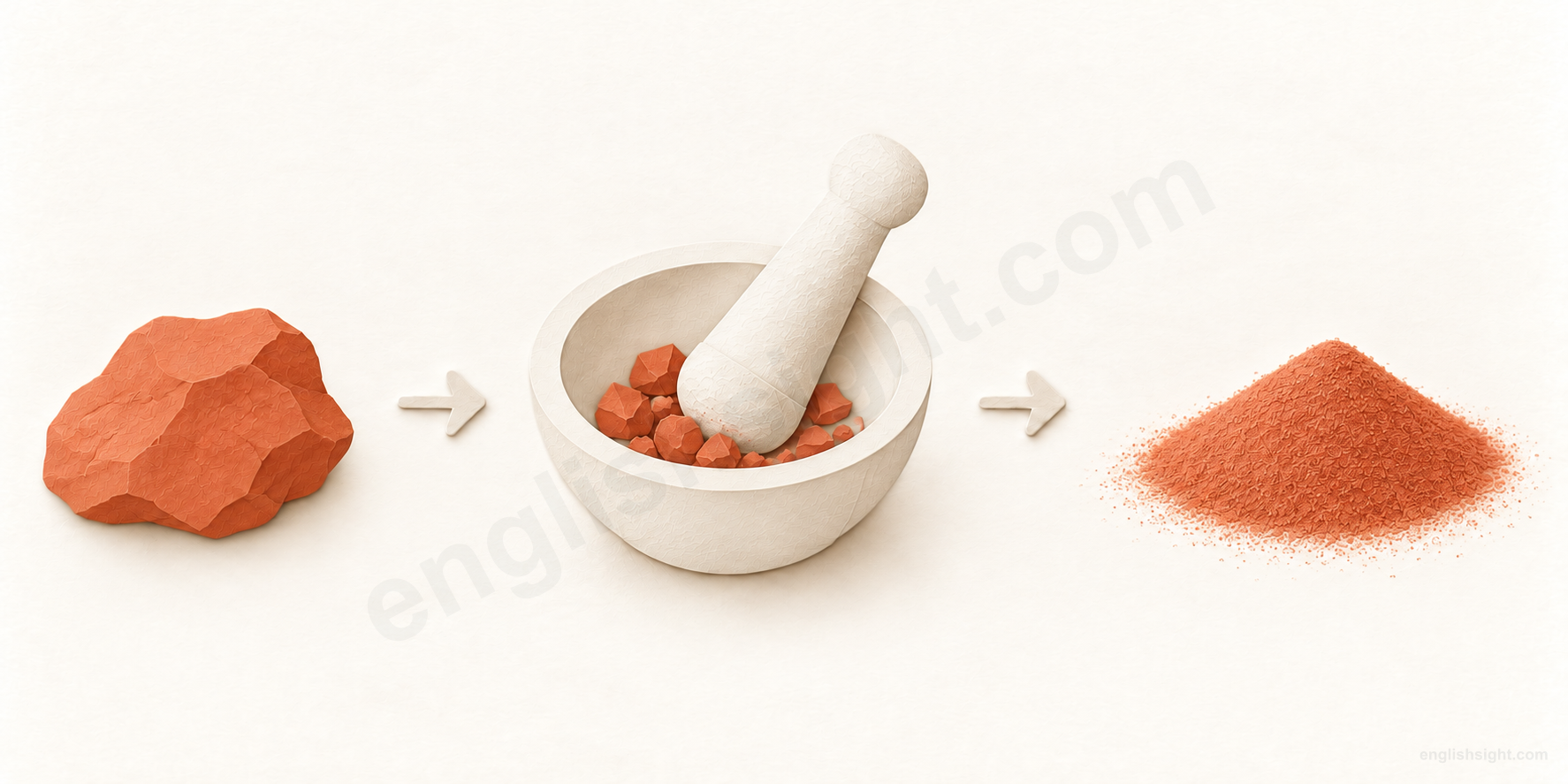
One larger piece of solid material.
powder
The same material is now a mound of fine, loose powder.
A mortar and pestle crush and grind the pieces.
One solid piece becomes fine, loose particles. Grinding is one way to make powder.
Powder is solid material in the form of very small, loose, dry particles. Crushing a larger piece into fine particles is one way to make it.
The before-and-after model illustrates reduction to powder. Powder can also be produced by drying or other processes; the noun does not require a grinding event. Applying powder changes a surface’s coating instead of breaking that surface up. Fixed idioms need separate explanations.
Powder usually brings attention to the form of a material: many tiny, loose, dry particles rather than one solid piece. The product name tells you what the particles are or what they are used for.
As a verb, powder can put particles onto something or reduce material to particles. Snow, cosmetics, and fixed expressions add conventional meanings. The diagram is a teaching aid, not a claim that every English speaker pictures the same thing.
01
A material in fine particles
Start with physical form, then learn how to describe an amount, a change, and a powdered product.
01
some / a little powder; a + adjective + powder; different powders
a fine powder / some powder
solid material in many tiny loose particles
Starting situation
There is a little loose material in a bowl.
What changes or is meant
You describe its fine, dry form rather than one solid piece.
Powder names the material as a mass; it does not name each grain.
Use some powder or a little powder for an amount. A fine white powder describes a particular material with these properties; a does not count one tiny particle.
Two powders can mean two kinds or preparations, for example two cleaning products. For a measured quantity, say two spoonfuls of powder. Fine describes small particles here, not high quality.
In a sentence
There was a little yellow powder at the bottom of the jar.
Watch the difference Use a grain or particle of powder for one tiny piece; two powders normally means kinds or preparations.
02
grind / crush + material + into a powder; turn to powder; powder + material
grind something into a powder
change larger solid pieces into fine particles
Starting situation
The spice is in larger pieces.
What changes or is meant
Grinding leaves a fine loose material.
Into or to introduces the resulting physical form.
Grind, crush, or pound something into a powder describes the action and its result. The material is the object; powder names what it becomes. A brittle substance can also turn to powder.
Powder is itself a verb meaning reduce to powder: The machine powders the mineral. This use is useful to recognize in process descriptions; grind into a powder makes the action and result explicit.
In a sentence
We ground the dried spice into a fine powder.
Watch the difference Powder the mineral means reduce it to particles; powder a surface can mean put particles onto it.
03
in powder form; powdered + noun; powdery + noun
in powder form / powdered / powdery
describe a product’s form or a powder-like texture
Starting situation
You compare a dry product with a liquid version.
What changes or is meant
You specify its form, or describe how a surface feels.
Powdered describes material made into or covered with powder; powdery can describe resemblance.
Sold in powder form means supplied as fine dry material. Powdered milk is a dry form of milk; powdered chalk has been reduced to particles. Powdered cheeks instead have powder on them. The noun and context decide which meaning fits.
Powdery means like powder or covered with it: a powdery surface feels or looks fine and dusty. It need not mean someone deliberately ground the object. Powdered sugar is the US name for the fine sugar called icing sugar in Britain.
In a sentence
The shop sells milk in powder form as well as in cartons.
Watch the difference Powdered milk means milk made into powder, not milk with cosmetic powder sprinkled over it.
02
Ingredients, cleaning, and cosmetics
The other word tells you which material or purpose is intended. Sharing the form does not make products interchangeable.
04
ingredient name + powder; a spoonful of + ingredient + powder
cocoa powder / chilli powder / curry powder
name a food ingredient by material or type
Starting situation
You need a particular dry ingredient for a recipe.
What changes or is meant
You name the product rather than just saying powder.
The first word identifies the ingredient; powder identifies its physical form.
Cocoa powder names cocoa in a fine dry form. Chilli powder and curry powder are established ingredient names; follow the full product name and recipe rather than treating all powders as the same ingredient.
In these noun combinations, powder is the head noun. A spoonful of cocoa powder measures the ingredient; it does not count separate cocoa grains. British chilli is also spelled chili in American English.
In a sentence
Maya added a spoonful of cocoa powder to the mixture.
Watch the difference Flour is itself a powder, but ordinary recipes call it flour, not flour powder.
05
some baking powder; a teaspoon of baking powder
baking powder
a powder mixture used to help cakes rise
Starting situation
You prepare cake batter with the ingredients specified by a recipe.
What changes or is meant
The baking ingredient helps the cake become light as it bakes.
This is the name of a particular product, not every powder used in baking.
Baking powder is an established compound noun for a mixture used to make cakes rise. Baking tells you its purpose, but the whole expression identifies a specific ingredient.
Use the recipe’s full ingredient name. Cocoa powder adds a cocoa ingredient; baking powder serves a different function. Powder alone cannot tell you what a product does.
In a sentence
The recipe calls for two teaspoons of baking powder.
Watch the difference Do not use baking powder as a general name for flour, sugar, or any dry baking ingredient.
06
washing powder; a box of washing powder
washing powder
detergent in powder form for washing clothes
Starting situation
You choose a product for the laundry.
What changes or is meant
You choose a dry detergent rather than a liquid one.
Washing supplies the purpose; powder supplies the form.
Washing powder is a British English name for a powder detergent used on clothes. In a shop or at home, the compound tells the listener which kind of powder you mean.
A box of washing powder counts the container. Two washing powders can compare two kinds of product, while some washing powder refers to the material itself.
In a sentence
We need another box of washing powder for the laundry.
Watch the difference Washing powder is a laundry product, not a general name for every powder used to clean any surface.
07
face powder; apply / put powder on + face
face powder / a little powder
a fine cosmetic used on the face
Starting situation
Someone prepares makeup before a photograph.
What changes or is meant
A small amount of cosmetic powder is applied.
In a makeup context, powder alone can mean face powder.
Face powder names the cosmetic. When the context already concerns makeup, I use a little powder is clear without face. Apply powder to your face names the substance as the object and the face as its destination.
The word powder still refers to a fine material, but the cosmetic use is conventional. Other powders are named separately, such as talcum powder; the word alone does not identify a product outside its context.
In a sentence
She put a little face powder on before the photograph.
Watch the difference A powder brush is a brush used to apply powder; it is not a brush made of powder.
03
Putting powder onto something
As a verb, powder can put fine material on a surface. Read the object carefully: the surface receiving powder is different from material being ground.
08
powder + face / skin; be powdered
powder your face
put cosmetic powder onto your face
Starting situation
An actor’s face has not yet had powder applied.
What changes or is meant
The face has a light coating of makeup powder.
The object receives powder; it is not broken into powder.
To powder your face is to put powder on it. The face is the object of the verb. Compare apply powder to your face, where powder itself is the object and the receiving surface follows to.
The verb has regular forms: powder, powders, powdered, powdering. The makeup artist is powdering his face describes an action in progress; his face was powdered presents the receiving surface in the passive.
In a sentence
The makeup artist powdered the actor’s face before filming.
Watch the difference Do not interpret powder someone’s face as crushing it; the body-part object selects the application sense.
09
powder + surface + with + material; be powdered with + material
powder something with…
cover or sprinkle a surface with a fine material
Starting situation
A surface has no fine coating.
What changes or is meant
Fine material is distributed across it.
With introduces the coating material, while the object names the coated thing.
Powder a surface with something means scatter a fine coating over it. The verb can also describe a light covering that resembles powder, as when fresh snow powders a landscape.
Compare powder the chalk, which can mean grind the chalk, with powder the surface with chalk, which puts chalk onto the surface. The full construction resolves the difference; with is an ordinary preposition, not a phrasal-verb particle.
In a sentence
The dark cake was lightly powdered with sugar.
Watch the difference The cake is the coated object; sugar names the coating. The sentence does not say the cake was ground up.
04
Snow and established expressions
Texture connects the snow use to ordinary powder. Gunpowder, idioms, room names, and a color name require their own context and conventions.
10
fresh / deep powder; powder snow; powder skiing
fresh powder / powder snow
fine, dry, light snow, especially in skiing
Starting situation
Fresh snow lies loose on a mountain slope.
What changes or is meant
Skiers describe its light, dry texture as powder.
The snow use selects a texture and condition, not any snow whatsoever.
In a skiing conversation, fresh powder refers to fine loose snow. Powder snow and powder skiing use the noun before another noun. The shared fine texture links this use to powder as a material.
The word does not mean that someone ground snow into particles. Wet, packed snow is not normally what skiers mean by powder. The context tells you this is snow rather than a food or cosmetic.
In a sentence
The skiers found fresh powder on the upper slopes.
Watch the difference Do not use powder for every kind of snow or ice regardless of its texture.
11
powder; gunpowder; powder and shot
powder meaning gunpowder
an explosive material in a historical or weapons context
Starting situation
A museum display describes old weapons.
What changes or is meant
Powder refers to an explosive material used with them.
This specialized noun meaning needs the right context.
Powder can mean gunpowder or another explosive powder. In an account of old weapons, powder and shot refers to explosive material and the projectiles. It does not mean cosmetic powder.
Collins marks the standalone explosive use old-fashioned. Gunpowder is a clearer specific word outside an established context. Ordinary powder is not automatically explosive.
In a sentence
The museum label mentions powder and shot used by soldiers.
Watch the difference The explosive meaning belongs to the context; it is not a property of every material called powder.
12
be / become a powder keg; sit on a powder keg
a powder keg
a tense situation that could turn violent suddenly
Starting situation
Anger and conflict are building in a place.
What changes or is meant
A speaker warns that violence could break out.
The compound is a metaphor for potential explosive violence.
A powder keg describes a dangerous situation that may suddenly become violent. The image is of a container of explosive powder, but the figurative statement need not concern a real container or explosive.
Sitting on a powder keg emphasizes being in such a situation. This is stronger than simply having a minor disagreement or an inconvenient problem.
In a sentence
After weeks of unrest, the district had become a powder keg.
Watch the difference Do not treat powder keg as a neutral synonym for any small everyday difficulty.
13
keep + my / your / our / their + powder dry
keep your powder dry
stay ready to act when needed
Starting situation
You wait while a difficult situation develops.
What changes or is meant
You remain prepared for action rather than using your options immediately.
The whole idiom means readiness; it need not involve physical powder.
Keep your powder dry tells someone to remain ready for possible trouble or a later need to act. In a discussion, it can advise holding back while staying prepared.
The possessive changes with the subject: We kept our powder dry. Oxford labels the idiom old-fashioned. It is useful in reading and commentary, but be ready is a straightforward everyday alternative.
In a sentence
We kept our powder dry while we waited for the final decision.
Watch the difference Do not interpret this as ordinary advice about drying any household powder, or as a guarantee that action will occur.
14
go to powder + my / your / her + nose
powder your nose
an old-fashioned polite way to refer to going to the toilet
Starting situation
Someone briefly leaves a social gathering.
What changes or is meant
They use an indirect expression for a toilet visit.
The idiomatic purpose is conventional; applying makeup is not required.
I’m going to powder my nose can politely refer to going to the toilet. The words can also be literal if the person is actually applying makeup to their nose; the setting determines which reading is intended.
Oxford marks the toilet expression old-fashioned. Learn it for recognition rather than as the only polite way to excuse yourself. It is an idiom with an object, not a phrasal verb.
In a sentence
“Excuse me, I’m going to powder my nose,” she said as she left the table.
Watch the difference In this social context, the sentence does not promise that she will apply cosmetics.
15
the powder room; a house with a powder room
powder room
a polite toilet-room name; also a small guest toilet in North America
Starting situation
A visitor asks where to go, or reads a house description.
What changes or is meant
Powder room identifies a toilet room rather than a powder store.
The established compound has public-building and domestic uses.
In a public building, powder room is a polite name for a women’s toilet. The name is associated with the makeup use of powder, but it identifies the room by convention.
In North American house descriptions, a powder room is a small room with a toilet and washbasin, often for guests. It does not require a bath or shower, and this domestic use is not limited to women.
In a sentence
The house has a small powder room near the front door.
Watch the difference Read the context: a domestic powder room is not necessarily a women-only public restroom.
16
be powder blue; a powder-blue + noun
powder blue
a very pale blue color
Starting situation
You describe the color of a piece of clothing.
What changes or is meant
The listener understands a pale shade of blue.
This is a fixed color name, not a description of loose material.
Powder blue describes a very pale blue. A powder-blue shirt has that color; it need not have powder on its surface. The whole expression supplies the shade.
You can say The shirt is powder blue or use powder-blue before a noun. Compare a shirt powdered with something: powdered describes a coating, while powder blue names a color.
In a sentence
He chose a powder-blue shirt for the photograph.
Watch the difference Powder blue does not mean blue in powder form, and powder alone does not specify a color.
17
take / took / taken a powder
take a powder
leave suddenly or run away, in North American informal usage
Starting situation
A character is present before trouble starts.
What changes or is meant
The character leaves abruptly.
This idiom’s meaning cannot be calculated from taking a material.
Take a powder means leave suddenly or run away. It is an informal North American expression to recognize in dialogue. The article a belongs to the idiom.
The phrase does not mean swallow medicine, and powder here is not the object someone carries away. For a direct neutral statement, use left suddenly or ran away.
In a sentence
In the story, the driver took a powder before anyone could question him.
Watch the difference Read this as a whole idiom; taking some powder would normally refer to an actual substance.
Keep the material, action, and fixed expression distinct
Form does not identify the substance
Powder does not inherently mean white, edible, cosmetic, or explosive. A product name and context supply that information. Cocoa powder is an ingredient; dust on furniture is usually described as dust. Similar particle size does not make every name interchangeable.
The verb has two directions of meaning
Powder the chalk can reduce chalk to particles. Powder a face puts particles onto the face. With can name the coating material; into or to can name a resulting form. Context and the object matter more than one memorized translation.
Grammar follows the chosen use
The noun is usually uncountable for an amount, but countable for a kind or preparation. The regular verb allows progressive and passive forms when an action is meant. Powder has no everyday productive phrasal-verb family to memorize here. Powder your nose and take a powder are fixed expressions with ordinary objects.
Coverage boundary
This lesson covers modern material and cosmetic uses, key product names, application and reduction, skiing snow, explosive context, and selected fixed expressions. Old dialect senses meaning rush, specialized industrial terminology, and slang hitting senses are not developed. The uses are grouped for learning, not ranked by measured frequency.
Choose the form and meaning
Use the object and the situation to decide what the whole expression means.
1. You need an amount of cocoa for a recipe. Which expression names a measured quantity?
2. The makeup artist powdered the actor’s face. What happened?
3. The machine powdered the chalk. Which result fits the processing context?
4. A North American house listing mentions a powder room. What should you expect?
5. The team kept its powder dry while waiting for a decision. What does the idiom communicate?
6. A skier says there is fresh powder on the mountain. What is meant?
Sources and teaching notes
Usage was checked against the publisher pages below. Explanations and examples are original. The diagram illustrates a teaching connection; it is not evidence that every use comes from the same picture.
The diagram illustrates fine particles and one way to produce them. It is not a picture shared by every English speaker.