Follow power from what can act to who can decide and what makes machines work.
Capacity makes an effect possible
Capacity makes an effect possible
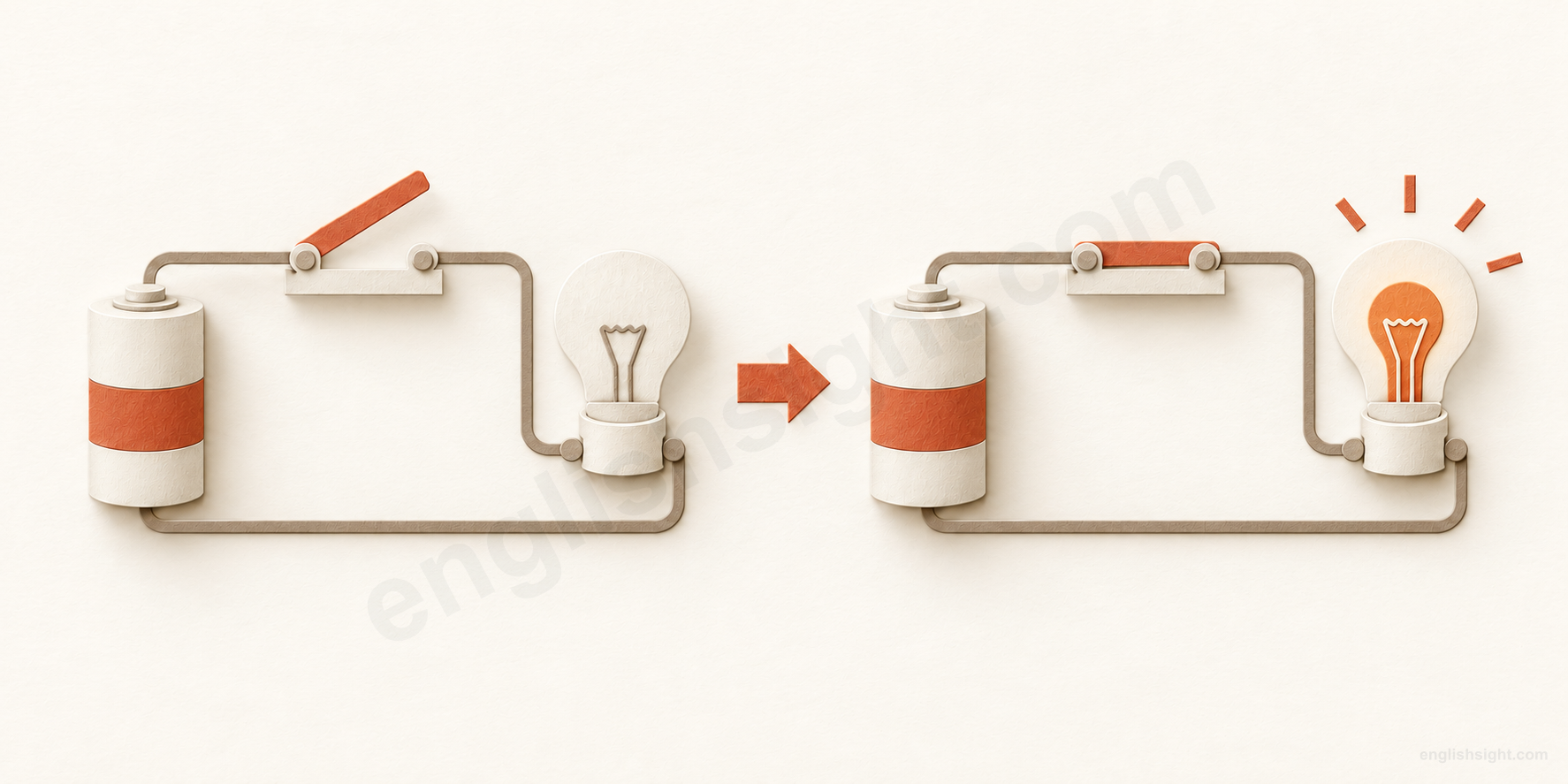
The switch is open, so the battery cannot supply the lamp through a complete circuit.
power
With the circuit closed, the battery powers the lamp and the bulb gives light.
Closing the switch completes the connection from the battery to the lamp and back.
The battery powers the lamp when the circuit is closed.
Power is often the capacity, authority, or supply that enables an action or effect.
A battery connected to a lamp makes the relation concrete: a usable supply enables light. Having power does not guarantee that it is used, and political or personal power need not involve a physical transfer.
Power often points to a capacity to act or produce an effect. That capacity may come from a person’s abilities, a position of control, or an energy supply. The surrounding words tell you which kind matters.
This is a teaching connection, not a single definition that predicts every expression. Mathematics and several fixed compounds have their own conventions. The picture illustrates the energy branch; it does not claim that all English speakers imagine the same scene.
01
What someone or something can do
Power can name a capacity to act, a particular faculty, or strength that produces an effect. The following words tell us what kind of capacity matters.
01
have / possess the power + to-infinitive
have the power to change something
have the capacity to bring about an action or result
Situation / available capacity
The team can choose a different design.
Action / possible effect
A change is possible if the team acts.
Having a capacity does not mean using it.
The to-infinitive names the action that is possible: the power to change, help, or destroy. The subject can be a person, a group, or a thing. A small component can have the power to stop a whole system.
Power often emphasizes the possibility of producing a significant effect. Ability is a more neutral choice for a learned skill: She has the ability to read music. Having the power to act does not say that the action happened.
In a sentence
Together, we have the power to change how this office works.
Watch the difference Read the context: power to can describe practical ability or official authority, as in the authority section.
02
the power of + noun; possessive + powers of + noun; at the height of one’s powers
powers of observation / the power of speech
a particular mental or bodily ability
Situation / available capacity
A small detail is easy to miss.
Action / possible effect
A person notices it by using a mental ability.
Power or powers can identify a particular faculty.
The power of speech is the capacity to speak. Powers of observation, concentration, or persuasion name abilities people can exercise. Of introduces the faculty; it does not mean ownership by a person called observation.
Plural powers can also refer to someone’s abilities as a whole: at the height of her powers means at her best. In a fantasy story, magical powers are special abilities, not electrical supplies.
In a sentence
Her powers of observation helped her notice the missing signature.
Watch the difference Do not interpret every occurrence of powers as electricity; faculties and special abilities allow the plural.
03
it is in / within / beyond someone’s power to do; do everything in one’s power to do
within my power / beyond my power
within or outside what someone can achieve or arrange
Situation / available capacity
A customer asks you to change a company rule.
Action / possible effect
You explain the limits of your ability or authority.
The boundary concerns available means, opportunity, or authority.
It is within my power to help means I can do or arrange it. Beyond my power and not in my power mark a limit. That limit may be practical or institutional, rather than a lack of personal effort.
I will do everything in my power to help promises all the action I can take. Compare You are in my power, which puts you under my control; the complement and context change the relationship.
In a sentence
I’ll do everything in my power to find you another room.
Watch the difference Everything in my power is an established promise of effort; it does not guarantee success.
04
the power of + noun; have / show great power
the power of words
the capacity of something to affect people or events
Situation / available capacity
A brief message reaches someone who is struggling.
Action / possible effect
The message changes how that person feels.
An effect can be emotional, persuasive, or destructive.
In the power of words, music, or an argument, power concerns effectiveness. The thing after of is the source of the effect. A message need not issue an order to have power.
This connects to capacity, but the effect need not be physical. The power of a storm can be destructive; the power of a performance can be emotional. Choose a context that makes the kind of effect clear.
In a sentence
The letter reminded me of the power of a few kind words.
Watch the difference Power here does not mean an official right to control the listener.
05
physical power; do something with power
hit with power
use physical strength forcefully
Situation / available capacity
A player prepares to strike the ball.
Action / possible effect
The strike sends the ball a long way.
Physical power is strength available or used in action.
With power describes the force of an action. A powerful strike has a strong effect; it does not have to be accurate. In this use power is uncountable.
Strength often describes a person’s physical capacity, while power can emphasize how that capacity is expressed in movement. This is an everyday comparison, not a rule that the two words never overlap.
In a sentence
She hit the ball with enough power to send it over the fence.
Watch the difference Do not infer skill or precision from power alone.
06
have / show / need staying power
staying power
the ability to keep going through difficulty or tiredness
Situation / available capacity
The course demands work over many months.
Action / possible effect
A learner keeps working instead of giving up.
The compound emphasizes persistence over time.
Staying power concerns endurance: continuing when an activity is tiring or difficult. It can describe the persistence needed for a demanding project, not merely remaining in one location.
The whole compound names a lasting capacity. Someone may start fast but lack staying power. Stamina is a useful comparison when physical or mental endurance is the point.
In a sentence
Finishing this year-long course will take staying power.
Watch the difference Staying does not simply mean living or sleeping somewhere in this compound.
02
Who can decide or influence events
Social power concerns control and influence. Keep practical influence, official authority, a governing position, and a powerful country distinct.
07
have / wield / exercise power over + person or thing; be in someone’s power
power over someone or something
the ability to direct or control people or events
Situation / available capacity
Someone else can determine your work schedule.
Action / possible effect
That person can affect your choices.
Over identifies the person or area subject to control.
Have, hold, wield, and exercise power describe possessing or using influence or control. Power over staff is a relationship: the staff are affected by decisions.
Abuse of power is misuse of a position or authority. A power struggle is a contest for control. These are noun combinations, not phrasal verbs. Being in someone’s power means being under that person’s control, often in a troubling way.
Power can also mean social influence without direct command. Star power is the influence or appeal of a famous person; people power is influence exercised by ordinary people acting together. For example, People power helped stop the closure describes collective action affecting a decision, without saying those people held government office.
In a sentence
The supervisor has too much power over who gets the best shifts.
Watch the difference Use over for the target of control; to in power to decide introduces an action.
08
have / grant the power to do; grant / exercise powers; the power of + noun
the power to approve / emergency powers
an official right to take a particular action
Situation / available capacity
A request needs an authorized decision.
Action / possible effect
The person with the relevant authority can approve it.
Permission from an office or rule differs from practical skill.
Has the power to approve means is authorized to approve. Here someone may understand the task perfectly but lack the power to do it. Context distinguishes this from the general capacity pattern.
Powers often names several specific official rights, as in emergency powers. Authorities may grant or exercise powers. Use power of in established combinations such as the power of veto.
In a sentence
Only the director has the power to approve this payment.
Watch the difference Specific powers can be plural; general authority is often uncountable.
09
grant / have power of attorney; a power of attorney; powers of attorney
power of attorney
authority to act for someone in specified matters, or the document granting it
Situation / available capacity
A person needs a representative for financial affairs.
Action / possible effect
Another person receives formal authority to act for them.
This is a fixed legal noun phrase.
Power of attorney names a form of authorization to represent another person, commonly in business or financial matters. It can also name the document that grants that authority.
The plural is powers of attorney. Learn the phrase as a unit: attorney does not make power mean physical strength. The phrase alone does not tell you the authorization’s scope or conditions.
In a sentence
Maya gave her brother power of attorney to manage her financial affairs.
Watch the difference This lesson explains the expression; its wording alone does not establish which acts a particular document permits.
10
be / remain in power; come / rise / return to power; take / lose power
be in power / come to power
hold or gain political control
Situation / available capacity
An election changes which party governs.
Action / possible effect
The new party now runs the government.
In names a governing state; to marks entering that state.
Be in power describes governing. Come to power, take power, and gain power describe acquiring control; lose power and fall from power describe losing it. Return to power describes governing again.
These expressions do not by themselves explain how control was gained. Seize power suggests taking it forcefully or abruptly. A party swept to power wins a decisive electoral victory; the election context supplies the meaning of sweep.
In a sentence
The party came to power after the election and remained in power for eight years.
Watch the difference Say in power for holding political control; in the power of someone means under that person’s control.
11
a major / world / economic power; the major powers
a major power
a country with considerable international influence or strength
Situation / available capacity
Several countries attend international talks.
Action / possible effect
One country can strongly influence the outcome.
A countable power can name a country, not just its influence.
A world power or an economic power is a country with considerable influence in that field. A major power can have political, economic, or military strength.
Compare The country has economic power, where power is an uncountable quality, with The country is an economic power, where it identifies the country. The plural powers can therefore refer to several countries.
In a sentence
The country became a major economic power as its industries expanded.
Watch the difference A before power signals a countable entity in this use, not an amount of electricity.
12
have / gain / increase bargaining power
bargaining power
influence over the terms of an agreement
Situation / available capacity
A worker has several attractive job offers.
Action / possible effect
The worker can negotiate better conditions.
Alternatives can strengthen someone’s position in negotiation.
Bargaining power is the influence a person or group has when negotiating an agreement. A buyer with many possible suppliers may have more bargaining power than a buyer with only one.
The compound specifies the field in which power operates. It does not mean physical force or a guaranteed victory: negotiation still involves another side.
In a sentence
Having two other offers gave Lena more bargaining power over her salary.
Watch the difference Bargaining power concerns agreement terms; purchasing power concerns the ability to buy.
13
consumers’ purchasing power; the purchasing power of + money or income
purchasing power
the means to buy, or how much money can buy
Situation / available capacity
Prices rise while a salary stays unchanged.
Action / possible effect
The same salary buys fewer goods.
Buying capacity depends on money and prices.
Purchasing power can describe people’s available means for buying goods. It also describes how much a particular amount or unit of money can buy. These are related but distinct viewpoints.
A family may gain purchasing power when its income rises, provided prices do not cancel the gain. A currency’s purchasing power falls when the same amount buys less. This is buying capacity, not influence over a seller’s decisions.
In a sentence
Rising food prices reduced the purchasing power of our weekly budget.
Watch the difference More purchasing power does not necessarily mean more bargaining power.
14
The powers that be + plural verb
the powers that be
the people who control an institution or organization
Situation / available capacity
Staff want to change a rule.
Action / possible effect
Those with authority must decide whether to allow it.
The fixed expression refers to decision makers, often with an ironic tone.
The powers that be is a conventional phrase for those in charge. It often creates a little distance, suggesting that the speaker doubts or dislikes their decisions, although context determines the tone.
Be is preserved inside the fixed phrase. Do not modernize it to the powers that are. The phrase is plural: The powers that be have decided.
In a sentence
The powers that be have decided to keep the old booking system.
Watch the difference It can sound ironic or critical; name the relevant managers for a more neutral, precise tone.
15
be the (real) power behind the throne; in the corridors of power
the power behind the throne / the corridors of power
real influence behind a formal leader, or the high levels where government decisions are made
Situation / available capacity
A formal leader receives important advice.
Action / possible effect
Someone without the top title may shape the decisions.
These political images also apply figuratively to organizations.
The power behind the throne is the person who really directs affairs while someone else formally leads. The throne is a metaphor when there is no monarch: Her deputy is the power behind the throne.
The corridors of power refers to high levels of government where major decisions are made. A person with contacts there has access to influential officials; the phrase need not describe literal hallways. For example, She has contacts in the corridors of power means she knows people at those high levels.
In a sentence
Although Eva holds the top job, her adviser is the real power behind the throne.
Watch the difference The power behind the throne names a person; the corridors of power names a sphere of influence.
16
the balance of power between A and B; shift / change the balance of power; hold the balance of power
the balance of power / hold the balance of power
the distribution of strength, or a smaller group’s decisive influence
Situation / available capacity
Two large groups have similar strength.
Action / possible effect
A smaller group can tip a decision by choosing whom to support.
Relative strength can give a small group a decisive role.
The balance of power describes how political or military strength is distributed among countries or groups. A shift in the balance of power changes their relative positions; balance does not require exact equality.
To hold the balance of power has a more specific use: a smaller group can decide which of two similarly strong larger groups gains the advantage. For example, A small party holds the balance of power because either large party needs its support. This is more than merely being one participant.
In a sentence
The small party holds the balance of power because neither major party has a majority.
Watch the difference A balance of power is a relationship between groups, not a separate supply of energy.
03
What makes machines work
In everyday energy language, power runs equipment. Talk about its source, its availability, a machine’s output, and the verb that connects a source to a device.
17
solar / wind / nuclear power; generate / supply power; power for + equipment
solar power / generate power
usable energy for operating equipment or producing electricity
Situation / available capacity
A community needs energy for its buildings.
Action / possible effect
A source supplies energy that equipment can use.
The source word identifies where usable power comes from.
Solar, wind, water, and nuclear power identify sources or forms of usable energy. Generate power focuses on production; supply power focuses on provision. A power station or power plant produces electricity.
The lamp picture shows one concrete branch: an energy supply lets a device operate. Social power does not require electricity, and the mathematical meaning follows a separate convention.
In a sentence
The village uses wind power to generate electricity for its homes.
Watch the difference Power is usually uncountable here: some power or enough power, not three powers.
18
the power goes out / off; restore power; a power cut / outage / failure
the power went out / a power cut
the electricity supply stops reaching a place
Situation / available capacity
The lights and appliances are working.
Action / possible effect
A supply failure stops them until electricity returns.
The power can name the electricity supply itself.
The power went out or went off reports a loss of supply. The power is back on says supply has returned. Restore power describes re-establishing it, while cut off the power describes interrupting it.
A power cut is especially British wording; power outage is especially North American wording. Power failure also names a loss of electricity. Compare turn off the power, which describes an action rather than merely reporting a failure.
In a sentence
The power went out during dinner, but it came back on an hour later.
Watch the difference In The power went out, went out is the past form of go out. Power is a noun here, not part of a phrasal verb power out.
19
at full / reduced power; engine / processing / computing power
at full power / computing power
the operating strength or capacity of a machine or system
Situation / available capacity
A machine can work at different levels.
Action / possible effect
A higher setting supplies greater output.
Capacity, output, and energy consumption depend on the context.
An engine running at full power is working at its maximum operating output. A computer with more processing or computing power can do more demanding computation. The modifier tells you which kind of performance matters.
In physics and engineering, power measures the rate of doing work or transferring energy and is measured in watts. Energy is a total quantity; power is a rate. Everyday power can also mean an energy supply, so technical precision depends on the context.
In a sentence
The motor was running at full power, but the boat barely moved.
Watch the difference High power does not by itself guarantee useful movement or efficiency.
20
source + power + device; device + be powered by + source; source-powered + noun
power a device / be powered by
provide the energy that makes something work
Situation / available capacity
A lamp needs energy to produce light.
Action / possible effect
A connected battery supplies the energy it needs.
The source powers the device; the device is powered by the source.
In The battery powers the lamp, battery is the energy source and lamp is the object receiving the supply. The passive reverses the information order: The lamp is powered by a battery.
Battery-powered and solar-powered identify the source before a noun: a battery-powered radio. Powering can describe an ongoing supply. In this literal use the verb supplies energy; it does not mean giving a person permission.
The same pattern can describe a driving cause figuratively: Strong demand powered the company’s growth. Demand helps produce growth rather than supplying electricity. Context identifies the enabling cause; this extension does not create a normal power someone to do pattern meaning authorize them.
In a sentence
A small battery powers the lamp on my desk.
Watch the difference Power the lamp and power up the lamp differ: the first supplies energy; the second focuses on starting it.
21
power + noun: power tools, power drill, power steering, power lines, power supply
power tools / power lines
equipment driven by power, or things used in supplying it
Situation / available capacity
A task could be done by hand or with a motorized tool.
Action / possible effect
The chosen tool uses electricity or another powered mechanism.
Before a noun, power can classify a device or its role.
Power tools are driven by electricity or an engine rather than only by hand effort. A power drill is one example. Power steering uses an assisting mechanism to make steering easier.
Power lines carry electricity; a power supply provides it. Do not assume every power + noun has the same relation: tools use power, while lines carry it. Some dictionaries call these uses adjectives and others treat them as noun modifiers.
In a sentence
We used a power drill to make the holes in the wooden frame.
Watch the difference Powerful means having great strength or effect; power in power drill names the type of tool.
04
Starting, stopping, and moving strongly
With particles or direction phrases, the verb describes starting equipment, shutting it down, or moving forcefully. The whole construction determines the meaning.
22
power something up / on; power it up / on; a machine powers up / on
power up / power on
start equipment or cause it to start
Situation / available capacity
The computer is switched off.
Action / possible effect
It starts receiving power and begins operating.
Up and on mark startup, not a greater amount of power.
Power up the computer and power the computer up both describe starting it. The machine can also be the subject: The computer won’t power up. Power on is used in the same startup sense.
With a pronoun object, put it between the verb and particle: power it up, power it on. These are separable phrasal verbs. They do not normally mean charging the battery or upgrading the computer.
In a sentence
Plug in the monitor, then power it on.
Watch the difference Say power it up, not power up it. Supplying power is distinct from increasing performance.
23
power something down / off; power it down / off; a machine powers down / off
power down / power off
stop equipment by shutting off its power
Situation / available capacity
A computer is operating.
Action / possible effect
It shuts down and stops operating.
Down and off mark stopping in these device expressions.
Power down the system, power the system down, and power it down describe stopping it. Power off is a close alternative. A machine can also power down without an expressed object.
These separable phrasal verbs focus on shutdown. They do not necessarily mean physically removing a plug, and down is not simply an instruction to lower brightness or volume. Follow the device’s actual shutdown procedure.
In a sentence
Save your work before you power the computer down.
Watch the difference Power it down has the pronoun between verb and particle; power down it is not the usual order.
24
power + direction phrase; power + object + direction phrase; power one’s way + direction phrase
power through the water / power something past
move, or send something, forcefully in a direction
Situation / available capacity
A swimmer pushes against the water.
Action / possible effect
Strong movement carries the swimmer forward.
The verb contributes forceful movement; the following phrase gives its course.
Power can be intransitive: The swimmer powered through the water. It can also take an object that is driven forcefully: She powered the ball past the goalkeeper. Direction phrases supply through, past, or into.
Power your way into the lead emphasizes forceful progress. These motion constructions are not all separate fixed phrasal verbs; their directional complements retain much of their ordinary meaning.
In a sentence
The swimmer powered through the water and caught the leader.
Watch the difference In this use, power does not mean supplying the water with electricity.
25
company / economy / market + power ahead
power ahead
make strong progress or become more successful
Situation / available capacity
A business is expanding after a difficult start.
Action / possible effect
It continues to grow strongly.
Ahead frames growth as forward progress.
In business or economic reporting, power ahead presents strong progress or growth. A company or economy is the subject; no physical journey is necessary.
This is an established extension of forceful movement. The phrase is more vivid than grow or improve and should fit evidence of strong progress, rather than any small change.
In a sentence
The company powered ahead as demand for its new product grew.
Watch the difference This intransitive expression has no object to place between power and ahead.
26
power (on) through + task / difficulty; power (on) through
power through a difficult task
continue with determination despite difficulty until the end
Situation / available capacity
A demanding task remains unfinished.
Action / possible effect
You keep working strongly despite the difficulty.
Through treats difficulty as something to continue through to completion.
Power through something describes determined continuation when the task or period is difficult. You can power through a long report or power through a difficult week. In We just have to power through, the difficulty is understood and need not be named.
Power on through is a variant. Here through introduces the task or difficulty: power through it, not power it through in this meaning. Compare powered through the water, where through gives a literal course of strong movement.
In a sentence
We powered through the last section of the report despite the confusing figures.
Watch the difference This persistence expression differs from separable power it up: say power through it.
05
Established meanings beyond the main picture
Mathematics, optics, religious language, a sleep compound, and a supportive formula have their own conventions. Learn their precise meanings instead of forcing them into an electrical picture.
27
base + to the power of + exponent; base + to the third power
to the power of three
use an exponent to indicate repeated multiplication
Situation / available capacity
A calculation contains 3³.
Action / possible effect
The expression means 3 × 3 × 3, which is 27.
Power has a conventional mathematical meaning here.
Three to the power of three means multiplying three by itself to make three factors. The first three is the base; the second is the exponent. The expression is not three multiplied by three just once.
You can also say to the third power. The second and third powers are often called squared and cubed: three cubed is twenty-seven. This introductory example uses positive whole-number exponents; other exponents require further mathematical rules.
In a sentence
Three to the power of three is twenty-seven.
Watch the difference Power here follows a mathematical convention; the battery picture does not explain the calculation.
28
magnifying power; the power of a microscope / telescope
the power of a microscope
how much an optical instrument magnifies
Situation / available capacity
An object is too small to inspect easily.
Action / possible effect
A microscope makes its details appear larger.
Optical power in this use concerns magnification.
The power of a microscope or telescope can describe how much it enlarges the apparent image. Higher magnifying power means a greater apparent enlargement, not automatically a better image.
This is distinct from the electrical power a microscope’s lamp uses. Technical optics also uses power for lens strength measured in dioptres; that specialized calculation is outside this introductory lesson.
In a sentence
At this magnifying power, the tiny scratches are easy to see.
Watch the difference Use context to distinguish magnification, lens strength, and electricity consumption.
29
believe in a higher power; have supernatural / magical powers
a higher power / supernatural powers
a divine or spiritual being, or extraordinary abilities
Situation / available capacity
A person describes a religious or fantasy belief.
Action / possible effect
Power refers to something beyond ordinary human capacities.
A power can name a being; powers can name extraordinary abilities.
In religious language, a higher power can refer to a divine or spiritual being. The phrase reports a belief or viewpoint; it is not a claim about electricity or an official government.
In stories, supernatural powers can instead be unusual abilities that a character has. Compare She believes in a higher power with The character has strange powers: the first names a being, the second names capacities.
In a sentence
She said that belief in a higher power gave her comfort.
Watch the difference The singular countable power may name a being; powers does not always name beings.
30
take / have a power nap
a power nap
a brief daytime sleep intended to restore energy
Situation / available capacity
A person feels sleepy during the day.
Action / possible effect
A short rest is intended to help the person feel refreshed.
The compound names a particular kind of short sleep.
A power nap is a short daytime sleep taken to recover energy. The phrase suggests a refreshing pause, not sleeping forcefully or using an electrical device.
Use take or have a power nap. A before the compound counts the nap, while power modifies it. The phrase does not by itself promise a particular result or specify one exact length.
In a sentence
I took a power nap before the afternoon workshop.
Watch the difference Learn power nap as a compound; it is not the verb phrase power up.
31
more power to + person / object pronoun
More power to you!
express approval and wish someone success
Situation / available capacity
Someone tells you about a challenging plan.
Action / possible effect
You express encouragement and support.
The whole phrase gives encouragement rather than literal energy.
More power to you! is an informal expression, especially associated with US usage, that approves of what someone is doing and wishes them success. The person can change: more power to her or more power to them.
This is a fixed supportive formula, not an instruction to increase voltage or grant official authority. It works naturally as a response to someone’s initiative; tone and context still matter.
In a sentence
“I’m starting a free evening class for new arrivals.” “More power to you!”
Watch the difference Use an object pronoun after to: more power to her, not more power to she.
Choose the kind of power before the construction
Capacity, authority, strength, and energy overlap without being identical
Can she do it? may concern skill, permission, influence, or energy. Ability is neutral for a skill; authority emphasizes an official right; strength emphasizes force. Power can fit several of these, so read the complement and situation.
Countability carries meaning
General control, electricity, physical strength, and capacity are usually uncountable. A major power names a country; powers can name official rights or faculties; a power in mathematics is countable. Do not choose a plural merely because a supply is large.
Forms and grammar
The noun and verb share the pronunciation /ˈpaʊə(r)/. Verb forms are power, powers, powered, powered, powering. Power the lamp is transitive and allows The lamp is powered by a battery. Power through the water describes motion; power it up is a separable startup phrasal verb. There is no general power someone to do pattern meaning authorize them.
Learn established combinations with their boundaries
Power over identifies a target of control; power to introduces an action; power of can identify a faculty, source of influence, or a fixed term. These prepositions are not freely interchangeable. The lesson organizes common uses, not a frequency ranking or every technical compound.
Choose what power contributes
Use the situation, the complement, and the whole expression.
1. A clerk knows how to approve a refund, but only a manager is authorized to do so. What does the clerk lack?
2. The party already governs and has done so for six years. Which describes its present position?
3. You want someone to start a computer. Which instruction uses the pronoun in the normal position?
4. A battery provides energy to a lamp. Which sentence identifies the source correctly?
5. Your income is unchanged, but prices rise and it buys less. Which expression describes the change?
6. What is three to the power of three?
Sources and teaching notes
The sources below support the uses and constructions in this lesson. The explanations and examples are original; the capacity connection and lamp picture are teaching aids.
The lamp picture illustrates an enabling supply. It does not represent every meaning or every speaker’s mental image.