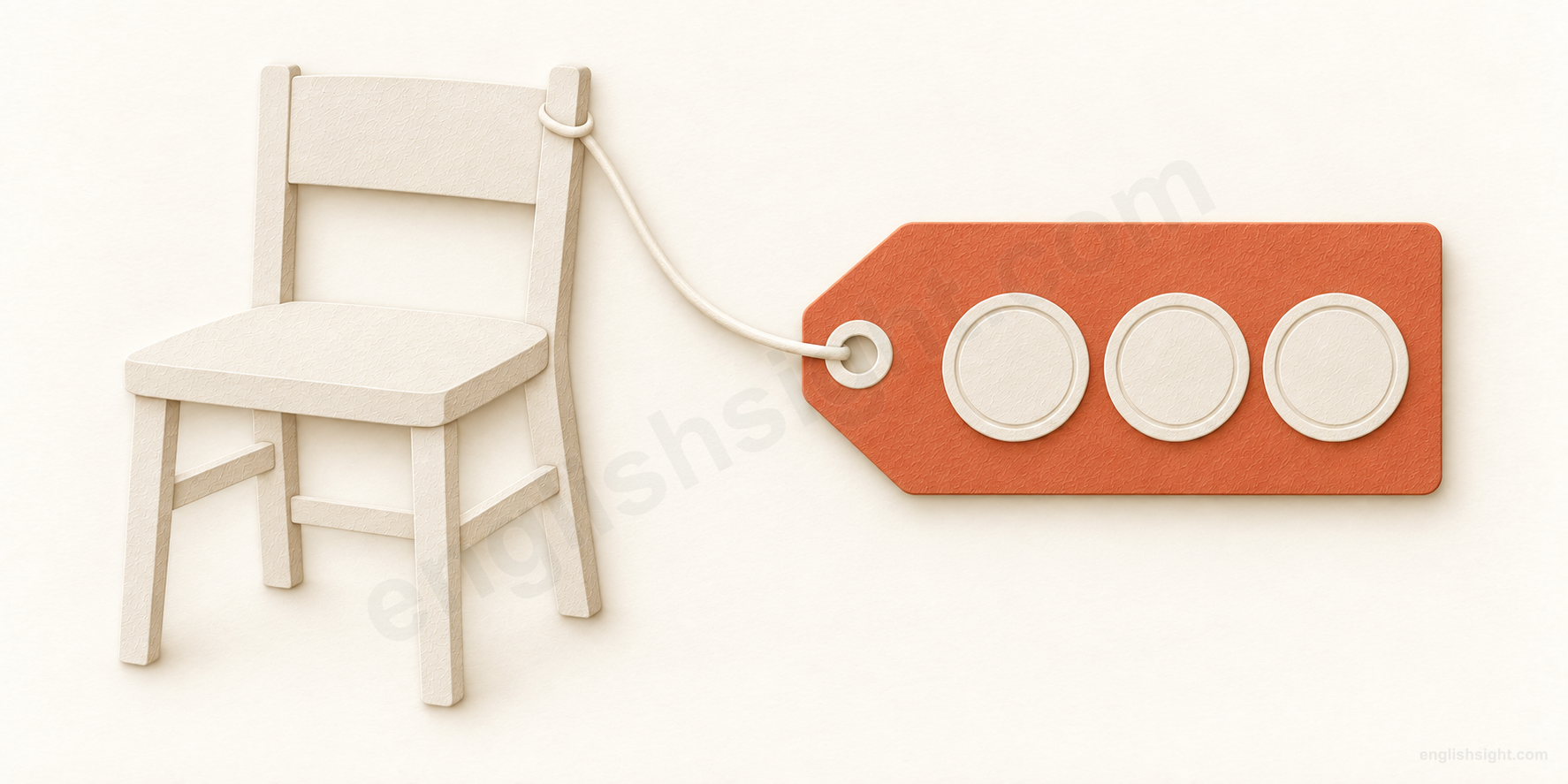
Connect an offer with its payment, then recognize the costs that are not money.
An offer linked to a payment
An offer linked to a payment
The chair offered
price
The payment asked
A cord links the chair to its asking amount.
The tag links this chair to the amount asked for it.
A price connects what is obtained with the amount asked or paid for it. Figuratively, the payment can be something you give up or suffer.
The tag shows an asking amount, so the picture does not require a completed purchase. It does not measure the chair’s quality, the buyer’s feelings, or every later cost. The figurative and idiomatic branches need their full contexts.
A price links something obtainable with an amount asked or paid for it. In a shop, ask how much, compare offers, and check what the amount covers.
English also uses price for a sacrifice or unwanted consequence. These uses share a payment comparison, but fixed expressions have their own meanings and tones. The diagram is a teaching aid, not a claim that every speaker imagines the same picture.
01
Ask, compare, and buy
Identify the amount, who pays or receives it, and what is included. A price belongs to a particular offer; it is not automatically the same as value or total cost.
01
the price of + thing; a/the price for + thing or service; What’s the price of…?
the price of / for something
the amount asked or paid to obtain something
Offer / situation
You want a lamp but do not know the amount to pay.
Amount / consequence
A price identifies that amount.
Price names the payment connected with the item or service.
Ask What’s the price of this lamp? or simply How much is this lamp? The price of points to the thing whose price you mean; a price for often connects an amount or offer with what it buys: a price for the repair.
The noun can be singular or plural: a price, the price, different prices. Expressions such as in price treat price as a dimension for comparison. A stated price can exist before anyone agrees to buy.
In a sentence
What’s the price of the lamp by the window?
Watch the difference For an ordinary money question, ask What’s the price? or How much is it? Avoid How much is the price? as your default wording.
02
a high/low/fair/reasonable/good price; the right/best price
a high / low / fair / good price
describe an amount or judge whether an offer suits someone
Offer / situation
Two sellers ask different amounts for similar chairs.
Amount / consequence
You judge one offer reasonable.
High and low describe the amount; good depends on the person and context.
A high price requires a lot of money; a low price requires less. A fair or reasonable price seems appropriate. The right price is one acceptable for your purpose, and the best price can mean the most favorable available offer.
A buyer getting a good price often pays relatively little. A seller getting a good price often receives relatively much. Say an expensive chair or a high price as useful neutral combinations; this does not mean every use of cheap price is impossible.
In a sentence
The chair is well made, and £35 seems a fair price.
Watch the difference A good price does not always mean a low number: check whose point of view is being expressed.
03
pay/charge + price + for something; get + price + for something; something fetches + price
pay / charge / get / fetch a price
describe the same transaction from different positions
Offer / situation
A shop asks £24 for a jacket.
Amount / consequence
The buyer pays the amount and the seller receives it.
The accompanying verb identifies who gives or receives the money.
The buyer pays a price for something; the seller charges a price for it. A seller gets a price for an item, while the item itself can fetch a price when sold: The old guitar fetched £200.
I got it at a good price describes buying favorably. I got a good price for it usually describes selling favorably. The preposition and object help establish the direction of the transaction.
In a sentence
The shop charged a fair price, so I paid it without bargaining.
Watch the difference The buyer pays; the seller charges. A price is an amount, not the act of paying.
04
at + a/the price (of + amount); for + amount/that price; in price
at a price / for that price / in price
use a price as a selling level, an exchange amount, or a comparison dimension
Offer / situation
A seller offers a desk for £70.
Amount / consequence
You can describe its selling level or the amount exchanged.
At, for, and in do different jobs around the noun.
At a price of £70 states a level; buy or sell something for £70 states the exchange amount. At that price and for that price can both refer to a particular offer, so this is a guide to typical uses rather than an absolute division.
A difference in price compares amounts. The desks differ in price does not say that one desk moves anywhere. At a low price is a literal amount phrase; the idiom at a price, without a specified amount, can suggest expense or a drawback.
In a sentence
The desk is on sale at a price of £70; I wouldn’t buy it for £100.
Watch the difference Do not impose a rigid at-versus-for rule on every sentence. In price marks the dimension, as in a difference in price.
05
give/quote + someone + a price; quote/set + a price + for something
give / quote / set a price
state or decide the amount to be charged
Offer / situation
You need a window repaired and ask the repairer about payment.
Amount / consequence
The repairer gives you an amount for that work.
Quoting communicates an amount; setting decides it.
Give me a price for the work asks what the person would charge. Quote someone a price or quote a price for something states an offered amount. Setting a price means deciding the amount, whether or not you have told a buyer yet.
You can negotiate the price if bargaining is possible, but a price quotation is not itself a completed sale. Whether taxes, parts, and labor are covered must be checked in the offer.
In a sentence
Could you quote me a price for replacing this window?
Watch the difference The price may be quoted before work starts. Quote does not mean the customer has already paid.
06
compare prices; a price comparison; the difference in price between A and B
compare prices
check how much different offers require
Offer / situation
Several shops sell the same headphones.
Amount / consequence
You compare their amounts before choosing.
Comparing prices checks offers; it does not change their amounts.
Compare prices means examine two or more amounts. A price comparison can involve different shops or different products, but the result is only useful if the offers cover comparable things.
The difference in price is the gap between amounts. If one pair costs £40 and another £55, the difference is £15. A lower price alone does not prove better quality or better value.
In a sentence
I compared prices online before ordering the headphones.
Watch the difference Compare equivalent packages, including delivery where relevant. The advertised item price may not be the total you pay.
07
match + a competitor’s price; price-match + something
match a price / price-match
offer a price no higher than a competitor’s
Offer / situation
A customer finds the same product cheaper at another shop.
Amount / consequence
This seller offers to match the competing amount.
The seller aligns an offer with a competitor’s amount.
Can you match that price? asks a seller to offer the item for the competing amount. A business that price-matches promises prices no higher than its competitors’ for the offers covered by its policy.
Comparing prices is checking the amounts; matching a price is responding with an equally favorable amount. An ordinary customer can compare offers without changing any seller’s price. Check the matching policy to know which products and offers qualify.
In a sentence
The other shop sells it for £45. Can you match that price?
Watch the difference A price-match promise is not a promise to beat every competitor by charging less. The scope depends on the stated policy.
08
pay (the) full price; at/for half price; a half-price + noun; at a reduced price
full price / half price / a reduced price
relate an offer to its normal selling amount
Offer / situation
A coat normally sells for £80.
Amount / consequence
A half-price offer asks £40.
A discount is measured against a reference price.
Pay full price means pay the normal amount without a discount. At or for half price means half the usual amount. A reduced price is lower than a previous or usual price, but need not be exactly half.
Before a noun, use the compound adjective in a half-price ticket. You can also say The tickets are half price. A special price is an offered deal; check the amount rather than assuming a particular percentage reduction.
In a sentence
I bought the coat for half price and paid £40 instead of £80.
Watch the difference Half price means 50% of the reference price, not a reduction by any unspecified amount.
09
within/in/out of + someone’s price range; prices start at…; range in price from…to…
within / out of my price range
fit or exceed the amounts someone is prepared to pay
Offer / situation
Your budget for a phone is £150 to £250.
Amount / consequence
A £400 model is beyond what you plan to spend.
My price range connects available offers with my budget.
Something within or in your price range fits the amounts you can or will pay. Something out of your price range is too expensive for that budget. It need not be expensive for everyone.
A shop’s price range can also describe its spread of offers. Prices start at £150 gives a lower end; phones range in price from £150 to £600 gives both ends. These are ranges, not a promise that every model has the lowest price.
In a sentence
This phone is out of my price range; do you have one under £250?
Watch the difference My price range concerns my budget. It does not state the value or quality of the product.
10
a price tag on something; a + amount + price tag; a price list
a price tag / a price list
find the amount on a label or in a list of offers
Offer / situation
You see a table in a shop and want its amount.
Amount / consequence
A tag identifies its price; a list gives prices for several offers.
A tag displays one amount; a list organizes several prices.
A price tag is the label showing what an item costs. Price tag can also name a stated amount without a physical tag: The new kitchen comes with a £9,000 price tag.
A price list gives a company’s prices for goods or services. Word order matters: a price list is the document, while a list price is an advertised selling amount.
In a sentence
Could you send me a price list for your printing services?
Watch the difference The £9,000 price tag describes a money amount without requiring a literal hanging label. Do not infer a physical tag from this use.
11
the asking price for/of something; the list price; below/off the list price
the asking price / the list price
identify an amount requested or advertised before any discount or negotiation
Offer / situation
A seller advertises a used piano for £600.
Amount / consequence
A buyer may agree on a different final amount.
The stated starting offer need not equal the eventual payment.
The asking price is what a seller wants for something, often a house, car, or other item open to negotiation. The list price is the advertised amount, for example in a manufacturer’s catalogue.
Neither phrase guarantees that the buyer actually pays that figure. You might offer less than the asking price or receive a discount off the list price. These labels tell us which stage or reference amount we mean.
In a sentence
The asking price for the piano was £600, but the owner accepted £550.
Watch the difference A price being advertised does not establish what a completed sale brought.
12
the retail/wholesale/market price of something; sell something at cost price
retail / wholesale / cost / market price
identify a trading stage, a cost basis, or a current market amount
Offer / situation
A shop buys goods and then sells individual items to customers.
Amount / consequence
Different labels identify the relevant trading stage or cost basis.
The same product can have several meaningful price figures.
The retail price is the amount charged to the final customer in a shop. A wholesale price concerns selling goods in quantity, usually to businesses that will resell them. Quantity and trading arrangements matter; wholesale does not simply mean any cheap offer.
Cost price refers to production cost or a selling amount that allows no profit. Selling at cost price therefore emphasizes the cost basis rather than the usual markup. Do not assume that every retail price or wholesale price is a seller’s cost price.
The market price is the amount buyers are willing to pay at a particular time. A seller’s asking price can be above the market price, so an advertised request is not proof that buyers will accept it. Market price is not limited to buying at an outdoor market.
In a sentence
The shop sold the remaining chairs at cost price to clear some space.
Watch the difference Cost price and retail price are not interchangeable names for every amount paid.
02
Describe prices and their changes
Distinguish the amount changing from someone changing it. Check the unit, the difference, and the contents of the offer.
13
prices rise/fall/go up/come down; something goes up/comes down in price; a rise/drop in price
prices rise / fall / go up / come down
say that the amounts become higher or lower
Offer / situation
Milk used to cost £1.20 a bottle.
Amount / consequence
It now costs £1.35.
The price itself is the subject of the change.
Prices rise or go up when the required amounts increase. They fall, go down, or come down when the amounts decrease. Come down in price and go up in price can have the product as subject: The phone has come down in price.
A price rise or price increase names an upward change; a price fall or drop names a downward one. Prices soar suggests a large, rapid upward movement. These movement verbs describe changing numbers, not money physically traveling.
In a sentence
The price of milk has gone up twice this year.
Watch the difference Use Prices rose for the change itself, Prices were raised for the passive, or The shop raised prices when naming the cause.
14
raise/increase + prices; lower/reduce/cut/slash + prices; a price cut
raise / lower / cut prices
make the amounts higher or lower
Offer / situation
A café chooses a new menu.
Amount / consequence
It increases one amount and reduces another.
A person or organization changes the price of an offer.
The café raises its prices means the café makes them higher. Lower, reduce, or cut prices means make them lower. Slash prices suggests cutting them sharply; a price cut is the reduction.
Compare The café raised prices with Prices rose. Raise takes an object here; rise does not. Put prices up and bring prices down are also ordinary ways to describe causing the change.
A price war is competition in which sellers repeatedly lower their amounts to win customers from one another. The two stores are in a price war, cutting prices every week describes competitive reductions, not a physical battle.
In a sentence
The café raised the price of coffee but cut the price of soup.
Watch the difference Say They raised the price or The price rose, rather than They rose the price.
15
a price of + amount + per unit; the price includes…; something is included in the price
the price per person / the price includes…
specify the unit of an amount and what it covers
Offer / situation
A hotel advertises £90 beside a room photograph.
Amount / consequence
You check whether that is per room and whether breakfast is covered.
A number needs a unit and a clear offer to be useful.
The price per person, per night, or per kilogram tells you what one stated amount buys. A price of £90 per room per night differs from £90 per person. Each similarly marks one item in Tickets are £12 each.
The price includes breakfast says breakfast is covered by that amount. Delivery is not included in the price means it needs separate payment. Price is not automatically the whole cost of using or maintaining a purchase.
In a sentence
The price is £90 per room per night and includes breakfast for two.
Watch the difference Check the unit and included items before comparing the numbers. A room price and a per-person price may describe different offers.
03
Use price as a verb
A seller can set or mark a price; a shopper can find one out. The object and situation show which action is meant. High prices can also exclude sellers or buyers from a market.
16
price + object + at + amount; be priced at/from/between…; be reasonably/competitively priced
price something at… / be priced at…
set the amount someone must pay
Offer / situation
A maker decides how much to ask for a bowl.
Amount / consequence
The bowl is offered for £18.
The seller sets the amount; the product receives the pricing decision.
The maker priced the bowl at £18 describes setting its selling amount. The bowl is priced at £18 gives the resulting offer, often without naming the seller. Priced from £18 gives a starting amount, not necessarily the amount for every version.
Reasonably priced means offered at a reasonable amount; competitively priced compares the offer favorably with competing ones. These use adverbs with priced. Businesses can also use price without an object when discussing strategy: We price competitively.
In a sentence
The handmade bowls are priced at £18 each.
Watch the difference For setting an amount, use priced at £18. To state what the item costs, say It costs £18; It prices £18 is not the ordinary equivalent.
17
price + goods; price + goods + up; price them up
price the goods (up)
put labels on goods to show their selling amounts
Offer / situation
New goods have arrived without labels.
Amount / consequence
A worker attaches labels showing how much to pay.
Here the task is marking the goods, not necessarily changing the amount.
Price the goods can describe writing or attaching their prices. Oxford also records price something up in this marking sense. The worker may use amounts already decided by someone else.
Do not assume that up always means an increase. We priced up the new stock can mean labeling it, while We put the prices up explicitly describes raising the amounts. With a pronoun in the marking pattern, use price them up.
In a sentence
We priced up the new notebooks before opening the shop.
Watch the difference In this labeling use, priced up does not by itself say that the notebooks became more expensive.
18
price + goods/models + before buying; check/compare the prices of…
price different models
find out what things cost before deciding
Offer / situation
You are choosing an oven and visit several shops.
Amount / consequence
You know the amounts for the models you considered.
A prospective buyer investigates prices rather than setting them.
Price can also mean find out or compare the amounts asked for things. We priced several ovens can describe shopping research; it need not mean we were the sellers.
The same direct-object grammar occurs in the setting sense. Context decides: a shop manager may price an oven for sale, while a customer may price ovens before buying. Use check or compare prices if you want to make the buyer’s meaning explicit.
In a sentence
We priced three ovens at local shops before choosing this one.
Watch the difference The verb alone does not identify the seller. Ask who is doing the pricing and why.
19
price + yourself/itself/a product + out of the market
price yourself out of the market
ask so much that customers choose other sellers
Offer / situation
A repairer charges much more than competitors.
Amount / consequence
Customers stop choosing that repairer.
The seller loses business through an uncompetitive price.
A business prices itself out of the market when its own high asking amounts make its goods or services unattractive to buyers. It can also price a product out of the market.
Out of the market describes the loss of a competitive position, not physical movement out of a building. The expression concerns an amount that is too high for the relevant customers, not simply an increase of any size.
In a sentence
By charging twice as much as nearby garages, they priced themselves out of the market.
Watch the difference The reflexive form themselves refers to the seller causing its own competitive problem.
20
price + someone + out of a market; be priced out of the housing market
be priced out of the market
be unable to buy because the amounts are too high
Offer / situation
A family plans to buy its first home.
Amount / consequence
Local house prices rise beyond its budget.
The buyer is excluded by unaffordable prices.
Buyers can be priced out of a market when the requested amounts exceed what they can afford. The passive puts the affected people first; rising prices or high asking amounts cause the exclusion.
Compare They priced themselves out of the market: those people are sellers asking too much. They were priced out of the housing market usually concerns buyers unable to pay. The grammatical roles and situation distinguish them.
In a sentence
Many first-time buyers have been priced out of the local housing market.
Watch the difference Being priced out does not mean being sold cheaply or getting a price quotation.
04
Talk about what a gain costs
The payment can be figurative: lost time, discomfort, or an unwanted consequence. The full expression tells us whether the speaker accepts, rejects, or questions the trade-off.
21
pay the/a price for + noun/-ing; the price of + noun/-ing; a price to pay
pay the price for… / the price of…
experience an unwanted consequence of an action or gain
Offer / situation
You skip sleep to finish a project.
Amount / consequence
You feel exhausted the next day.
The price is the harm or sacrifice, even when no money is paid.
Pay the price for something or for doing something means suffer a consequence. The price of success can be lost privacy or free time. This extends the payment idea to what a result costs someone; it does not require a deliberate bargain.
A price to pay points to a consequence that may follow: There may be a price to pay for ignoring the warning. Pay a heavy or high price emphasizes serious harm, not necessarily a large bill.
In a sentence
I stayed up to finish the project, and I’m paying the price for it today.
Watch the difference The consequence may be unintended. Do not infer that someone willingly accepted it beforehand.
22
something is a small/high price to pay for…; a price worth paying for…
a small price to pay / a price worth paying
judge a drawback acceptable compared with a benefit
Offer / situation
A quieter home requires a slightly longer walk.
Amount / consequence
You accept the extra walking for the peace.
The speaker weighs what is lost against what is gained.
A small price to pay for something presents a cost or inconvenience as minor beside the benefit. Small is the speaker’s judgment; the cost need not be small for everyone.
A price worth paying says the benefit justifies the cost. The price can be money, effort, discomfort, or a loss. The opposite judgment is too high a price to pay; this says the sacrifice is not acceptable.
In a sentence
The extra walk is a small price to pay for a quiet place to live.
Watch the difference Worth paying evaluates the trade-off. It does not say the drawback disappears.
23
something is available/possible, but at a price; come at a price
at a price
available with a high money cost or an unwelcome condition
Offer / situation
A useful service is available.
Amount / consequence
You discover that obtaining it requires a costly payment or concession.
The unspecified price draws attention to the drawback.
You can get same-day delivery, but at a price suggests that it is expensive. The phrase does not name an exact amount. Compare at a price of £12, which simply states a specified amount.
The price can also be a nonfinancial condition: He offered to help, but at a price: I had to do all his weekend shifts. The offer comes with something unwelcome. Context distinguishes expense from a broader drawback.
In a sentence
We can have the furniture delivered tonight, but at a price.
Watch the difference The idiomatic phrase suggests expense or a drawback. It does not merely state that something has any price at all.
24
want/seek something at any price; would not do/sell something at any price
at any price / not at any price
express complete determination or an absolute refusal
Offer / situation
Someone strongly wants an outcome or rejects a proposal.
Amount / consequence
They say that the amount or sacrifice will not change their position.
Negation reverses willingness: whatever it costs versus under no circumstances.
Want something at any price means want it regardless of the cost or difficulty. The payment can be literal or figurative, and the expression can sound forceful or extreme.
I wouldn’t sell it at any price means no offer would persuade me. Not at any price! can stand alone as a firm refusal. This is stronger than I can’t afford that price, which concerns ability to pay.
In a sentence
I wouldn’t sell my grandmother’s letters at any price.
Watch the difference Do not interpret the negative as merely waiting for a better offer: it expresses refusal even if more is offered.
25
put a price on + thing; cannot put a price on + valued thing
put a price on something / can’t put a price on…
assign a money value, or say money cannot adequately measure the value
Offer / situation
Someone tries to express an object’s or experience’s value as money.
Amount / consequence
They either give an amount or reject that kind of measurement.
A price can be assigned; some things resist an adequate money comparison.
Put a price on a business means say what money value it has. The business need not actually be sold. This connects price with a proposed valuation.
You can’t put a price on trust means trust is too important to measure adequately in money. It does not say trust is free or has no value. The inability here is an evaluation, not simply missing a label or calculation.
In a sentence
You can’t put a price on the trust between close friends.
Watch the difference No adequate price is different from a price of zero. Do not read the negative as saying the thing is worthless.
26
something is beyond price; a thing of value beyond price
beyond price
so valuable or important that money is an inadequate measure
Offer / situation
A family treasures a record of its past.
Amount / consequence
Its importance is greater than a useful money valuation.
Beyond rejects the adequacy of a money scale.
Beyond price is a formal or literary way of saying extremely valuable or important. It can describe something with personal, historical, or human importance rather than an unusually expensive shop item.
This belongs with can’t put a price on in the teaching model. The value cannot be captured adequately by naming an amount. In ordinary conversation, incredibly valuable or can’t put a price on may sound less elevated.
In a sentence
To our family, that recording of her voice is beyond price.
Watch the difference Use out of my price range for an item you cannot afford. Beyond price describes value, not your budget.
27
something is cheap at the price; cheap at twice the price
cheap at the price
worth the amount because it is so useful or good
Offer / situation
A reliable repair costs more than a temporary fix.
Amount / consequence
You decide its lasting benefit justifies the payment.
The amount is judged acceptable in light of the value obtained.
Cheap at the price means sufficiently good or useful that the amount does not seem too much. It can describe an initially expensive purchase; the speaker is evaluating value rather than merely reporting a low number.
Cheap at twice the price makes the judgment stronger: even twice as much would still seem good value. Learn this as an established evaluative expression, not a formula for calculating the actual bill.
In a sentence
The repair wasn’t cheap, but with a five-year guarantee it was cheap at the price.
Watch the difference Cheap at the price does not necessarily mean cheap compared with every competing offer.
05
Recognize established expressions
These sayings and idioms have conventional meanings and tones. Learn their situations rather than trying to calculate their meanings from the noun alone.
28
everyone/everybody has their price
everyone has their price
a cynical saying that a sufficient reward can persuade anyone
Offer / situation
A character claims that nobody can be bought.
Amount / consequence
Another character says a large enough offer would change that.
The saying treats cooperation or principles as something that could be bought.
Everyone has their price suggests that anyone can be persuaded to do something if offered enough money or another desired reward. It often implies corruption or the abandonment of principles.
This is a cynical saying, not a fact about all people. Their can refer back to everyone. It does not mean that people literally carry price tags or that every paid job is dishonest.
In a sentence
“He would never reveal the secret.” “Everyone has their price,” she replied.
Watch the difference Present this as someone’s attitude. The expression does not establish that a particular person accepts bribes.
29
someone has a price on their head; put a price on someone’s head
a price on someone’s head
a reward offered for capturing or killing a person
Offer / situation
Someone offers a reward to have a wanted person caught.
Amount / consequence
Others may try to capture the person for that reward.
The price is a promised reward concerning a person’s capture or death.
Have a price on your head means a reward has been offered for your capture or killing. Put a price on someone’s head describes arranging or announcing such a reward.
This is an idiom encountered in crime reports, history, and adventure stories. Head stands for the targeted person in the expression; it is not the price of medical treatment or a literal price label on a body part.
In a sentence
In the story, the escaped prisoner has a price on his head.
Watch the difference The phrase concerns a reward for targeting the person. It does not describe the person’s personal worth.
30
What price + noun phrase/-ing clause?
What price…?
question whether a gain is worth its cost, or suggest an outcome now looks unlikely
Offer / situation
A promised benefit brings serious problems or becomes doubtful.
Amount / consequence
A speaker challenges its value or likelihood.
The idiomatic question is rhetorical rather than a normal request for a shop amount.
In informal British English, What price convenience? can question whether convenience is worth the trouble it brings. For example, a convenient new road may remove a community’s only park.
The expression can also cast doubt on a result: after two defeats, What price a place in the final now? suggests that reaching the final looks unlikely. Context distinguishes a question about value from one about prospects.
In a sentence
The new road destroyed the only park. What price convenience?
Watch the difference For an ordinary amount, use What’s the price of…? The regional rhetorical idiom does not need a numerical answer.
Check the amount, the roles, and the whole expression
Price, cost, and value
Price usually identifies the amount asked or paid for an item or service. Cost can include the resources needed to make, obtain, run, or maintain it. Value concerns what something is worth or how useful it is for the money. A low price does not guarantee good value.
A noun or a verb?
The noun is price, with plural prices. The verb forms are price, prices, priced, and pricing. Price is pronounced /praɪs/; prices has an extra syllable, /ˈpraɪsɪz/, and priced ends in /st/, /praɪst/. For an item’s cost, say It costs £20; a seller prices it at £20.
Actions, passives, and particles
They are pricing the new stock is an ordinary ongoing action, and The tickets are priced at £12 is an ordinary passive. The intransitive We price competitively belongs to business strategy. Price up in the labeling use is not automatically a price increase. Price out of the market is a conventional result pattern; not every preposition near price makes a phrasal verb.
A teaching connection with limits
Money payment provides a useful comparison for lost sleep, privacy, or opportunity. That connection does not turn every idiom into a predictable calculation. Everyone has their price expresses a cynical attitude; it is not a statement the lesson asks you to accept.
Scope and register
This lesson covers everyday noun and verb uses, shopping compounds, figurative costs, and useful expressions to recognize. Beyond price is formal or literary; What price…? is informal British usage. Betting odds, historical value senses, and technical financial pricing expressions are outside the main lesson.
Choose the meaning that fits
Check who sets or pays the amount, and whether the cost is money or a consequence.
1. You want to know how much a lamp costs. Which question is the ordinary choice?
2. The café made coffee more expensive. Which sentence gives the café as the cause?
3. A customer priced several ovens before buying one. What did the customer most likely do?
4. A worker priced up the new notebooks by attaching labels. What does this sentence establish?
5. Young buyers were priced out of the housing market. Which interpretation fits?
6. After skipping sleep, you are paying the price today. What is the price here?
7. You can’t put a price on close friendship. What does this normally mean?
Sources and teaching notes
The sources below were used to check meanings, grammar, expressions, and register. The explanations and examples are original; the diagram presents a teaching connection rather than evidence about every speaker’s mental imagery.
The diagram links an offer to its payment as a teaching aid.