Connect printing, printed results, and the expressions built around them.
A form reproduced on a surface
A recognizable form appears on a surface
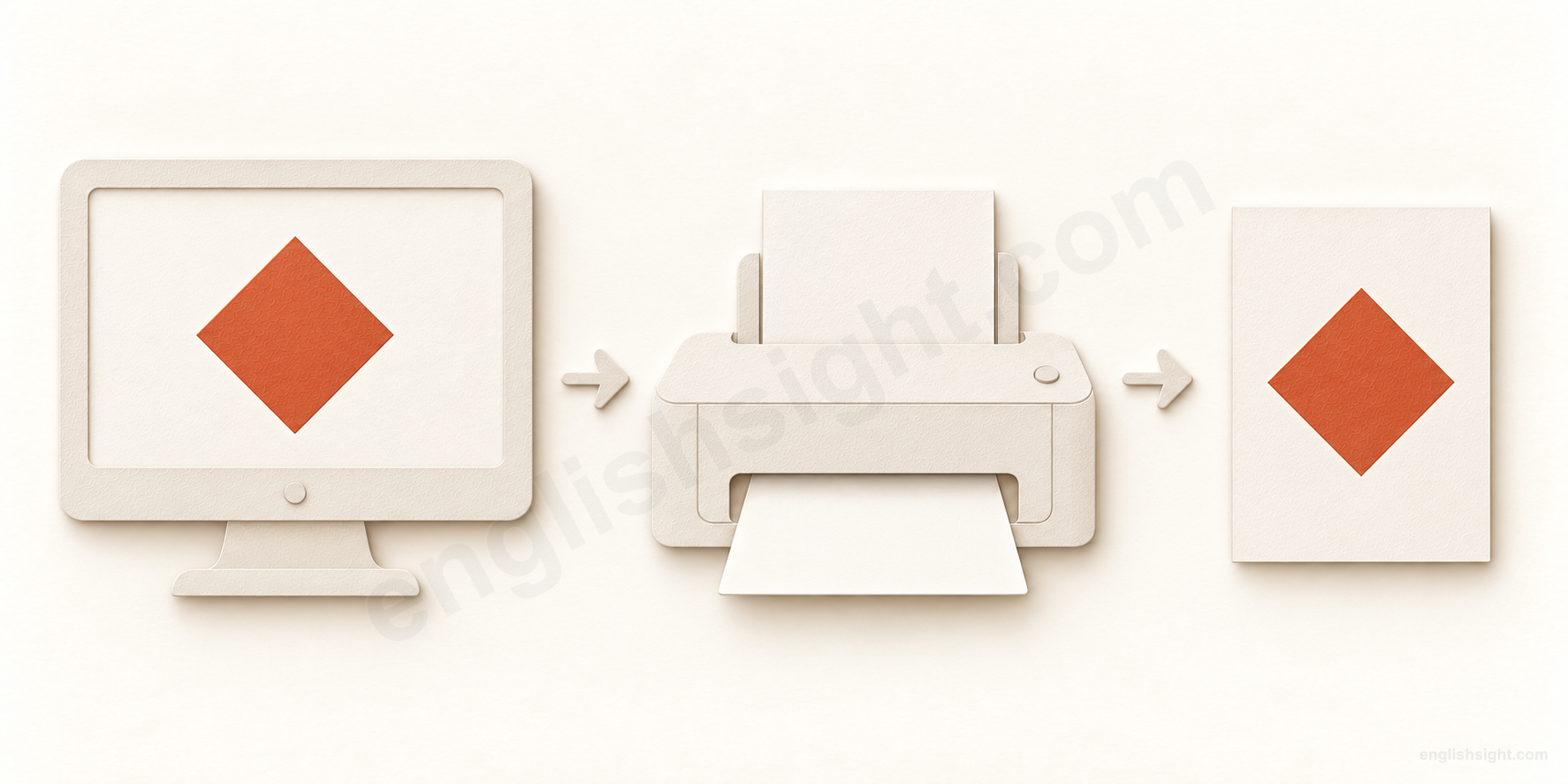
A terracotta diamond is visible on a screen, and blank paper is loaded in the printer.
print
A separate sheet carries a matching diamond while the source design remains on the screen.
Printing reproduces the screen’s design on paper.
The same design becomes a visible paper copy.
In printing, text or a design is reproduced as visible marks on a surface; print can also name a resulting copy or impression.
The sketch follows a design from a screen through a printer to a sheet. It illustrates reproduction; it does not say that all printing uses a computer, or that a physical paw print needs a machine.
Print often connects a design, image, or text with a visible result on a surface. A printer reproduces a document; a paw leaves a shaped mark. As a noun, print can name the result, the lettering, or the medium.
This connection is a teaching model. Handwritten print concerns letter style, and established expressions such as out of print must be learned in context. No single picture predicts every use or represents every speaker’s mental image.
01
Put words and designs onto a surface
Start with producing a copy, then notice the object, the surface, and whether a machine or a person makes the marks.
01
print + document / copy; print; be printed
print a document
produce text or pictures on paper
Starting situation
A document is stored on a computer.
Result or intention
A machine makes a paper copy.
The document is reproduced; it need not be written again.
Print can take an object: print the map. It can also stand alone when the task is understood: Is it ready to print? A user, a business, or the machine itself can be the subject.
In The printer is printing, the action is in progress. The map was printed yesterday is passive: the map receives the action. Printed is the regular past form and past participle; printing keeps the t.
Printing produces an output. Typing enters characters; copying may reproduce a file without producing any paper. Choose the verb for the task you mean.
In a sentence
Could you print a copy of the timetable for me?
Watch the difference A printer is the machine or a person in the printing trade; a print is not the machine.
02
print out / off + noun; print + noun / pronoun + out / off
print out / print off
make a paper output from a computer
Starting situation
You can read the booking details on a screen.
Result or intention
You also have them on paper.
Out and off form familiar particle combinations with print.
Print out the details and print the details out mean the same thing here. A pronoun goes between the verb and particle: print them out, not print out them.
Print off is another established expression for this task: I’ll print it off before we leave. Neither expression requires you to move the document out of a room.
The noun printout names the resulting paper output: Bring a printout. The verb is two words, print out. Simply print is often sufficient in a computer instruction.
In a sentence
I’ll print the booking details out before we leave.
Watch the difference Keep a pronoun in the middle: print it out or print it off.
03
print + number + copies; have / get + object + printed; print up + noun
have leaflets printed / print up leaflets
produce copies, or arrange for someone to produce them
Starting situation
An event needs a supply of leaflets.
Result or intention
A print shop produces the copies.
Have something printed names an arranged service, not personal ownership.
We printed five hundred leaflets focuses on producing a batch. We had five hundred leaflets printed says that we arranged the printing; we may not have operated the equipment ourselves. Get the leaflets printed is also natural.
Print up is used especially in American English for producing printed material: We’ll print up some leaflets. It does not mean printing toward a higher position. You can say get them printed up.
A print run is the number of copies produced at one time. A second print run does not necessarily mean a revised edition: the content may be unchanged.
In a sentence
We had five hundred leaflets printed for the school fair.
Watch the difference In have them printed, them receives the printing; this is not have someone print, where someone performs it.
04
print A on B; print B with A; be printed in + colour / style
print a design on a shirt
put a design onto a material
Starting situation
A shirt has no logo.
Result or intention
Its surface carries the chosen logo.
The design is the content; the shirt is the surface.
Print a logo on a shirt puts the design first. Print a shirt with a logo puts the material first. The corresponding passive is The shirt is printed with a logo, or A logo is printed on the shirt.
On identifies the surface; with introduces what it carries. In identifies colour or style in combinations such as printed in red or printed in capital letters. These are prepositional patterns, not separate phrasal verbs.
You can print words on a label or patterns on cloth. The shared idea is a reproducible visible form on a surface; the material need not be paper.
In a sentence
The bags are printed with the school’s logo.
Watch the difference Compare a logo printed on a bag with a bag printed with a logo. Do not swap the two objects without changing the preposition.
05
print + name / address; print in capitals; learn to print
print your name
write using separate, unjoined letters
Starting situation
A form asks for a readable name.
Result or intention
You write the name clearly by hand.
Print can describe a handwriting style without any machine.
On a paper form, Please print your name usually asks you to write separate letters rather than joined handwriting. It contrasts with signing: a signature is your personal identifying mark.
Printing does not itself require every letter to be a capital. If the form says PRINT IN CAPITALS or use block capitals, that additional instruction specifies uppercase letters.
Children can learn to print before learning joined handwriting. The visual link is to the form of printed letters, not to mechanical copying.
In a sentence
Please print your name, then sign on the line below.
Watch the difference Do not assume that print your name means use a computer or provide only a signature.
02
Publish information and produce pictures
A printed page can carry a public statement, a photograph, or an artwork. The kind of result matters.
06
publication + print + text / image; be printed in + publication
print a letter in a newspaper
include writing or an image in a publication
Starting situation
A reader sends a letter to an editor.
Result or intention
The newspaper includes it for readers.
Printing can involve an editorial decision, not just operating a machine.
The newspaper printed my letter means it published the letter. The newspaper is the institution making it public, even though staff and machinery do the physical work.
In names the publication: The letter was printed in Friday’s paper. This differs from I printed the letter at home, which says nothing about publication.
Publish is broader: a website can publish an article online without making a paper edition. In this sense, print keeps the connection to printed publication.
In a sentence
The local paper printed her letter about the park.
Watch the difference Printing a private copy of a letter does not by itself mean publishing it.
07
print + photo + from + source; a print of + subject
print a photo / a photographic print
make or name a physical photographic copy
Starting situation
A photograph exists as a file or on film.
Result or intention
You have a copy you can hold.
Taking the photo and printing it are different stages.
Print a photograph from a file or a negative describes producing the paper picture. A print is that physical copy, so two prints can show the same photograph.
You take a photograph with a camera; you print it later. A photo stored only on your phone is not normally called a print in this physical-copy sense.
The verb focuses on making the copy; the countable noun focuses on the result. A colour print and a black-and-white print describe its appearance.
In a sentence
I printed two copies of the photo, one for each grandparent.
Watch the difference Say take a photo for using a camera, and make or order a print for obtaining the paper copy.
08
a print of + picture; a print by + artist; a set of prints
a framed print
a picture produced through a printing or reproduction process
Starting situation
An image can be reproduced from a prepared surface or original picture.
Result or intention
A paper artwork is displayed in a frame.
A print is a kind of picture, not necessarily an original painting.
A print may be made by an artist from a prepared block or plate, or it may reproduce an existing picture. Both uses involve a process that can produce copies.
Do not assume that every print is a cheap reproduction: an artist’s original print can itself be an artwork. Equally, a framed print of a painting is not the painted original.
The noun is countable: one print, three prints, a set of prints. This differs from uncountable print meaning lettering or the printed medium.
In a sentence
We bought a framed print of a mountain landscape.
Watch the difference Picture is general; painting names a work made with paint; print identifies a printing or reproduction process.
03
Read the result: marks, lettering, and patterns
As a noun, print can name a visible trace, the lettering you read, or a design on cloth. Countability changes with the meaning.
09
leave + prints; prints on / in + surface; tracks + be printed in + material
paw prints / fingerprints
marks left by contact with a surface
Starting situation
A cat crosses a wet path.
Result or intention
The paws leave visible traces.
The print is what remains after contact.
A paw print, boot print, or handprint preserves something of the shape that touched a surface. In this noun use, no printing machine is involved.
In a crime report, prints often means fingerprints: The police found prints on the window. Context supplies which kind of mark is meant.
The verb also occurs in descriptions such as tracks printed in the mud, though leave prints is an easy everyday choice. On suggests a surface; in fits an impression in soft material.
In a sentence
The cat left muddy paw prints across the kitchen floor.
Watch the difference A footprint is a foot-shaped trace; a printout is computer output. The shared result idea does not make the nouns interchangeable.
10
in + large / small / bold + print; the print + be + adjective
in large print
the printed lettering, especially its size or style
Starting situation
A reader finds small letters difficult.
Result or intention
A version uses larger lettering.
Print here is an uncountable way to refer to the visible text.
Large print, tiny print, and bold print describe the appearance of lettering. A book in large print uses bigger characters; bold print uses heavier strokes.
Compare The print is hard to read with I ordered two prints. The first concerns text as a whole; the second counts physical pictures or copies in an appropriate context.
In large print describes a format, unlike in print meaning published or commercially available. Read the entire phrase rather than attaching one fixed meaning to in.
In a sentence
Is this guide available in large print?
Watch the difference Do not use a large print for large lettering in general; that phrase can instead refer to one large printed picture.
11
a floral / animal print; fabric with a print; a print dress
a floral print
a printed fabric pattern or material bearing it
Starting situation
A fabric receives a repeated design.
Result or intention
The design becomes a feature of the cloth or clothing.
Print can name the pattern, not just an individual picture.
A floral print is a flower design; an animal print imitates markings such as spots. In a dress with a bright print, print names the design.
Print can also refer to fabric carrying a printed pattern, and it appears before clothing nouns in combinations such as a cotton print dress. Separate patterns can be counted as prints.
This is connected to printing designs onto cloth. The noun does not by itself identify a garment: use the surrounding words to tell whether the speaker means a pattern, material, or clothing.
In a sentence
She chose curtains with a small floral print.
Watch the difference Print does not mean every possible fabric texture; here it concerns a patterned design.
04
Printed media and established expressions
Learn publication, availability, contract details, and figurative expressions as complete combinations.
12
print + media / edition / advertising; the printed word
print media / the printed word
books, newspapers, and magazines as a medium
Starting situation
Information can reach people through different media.
Result or intention
The speaker selects the printed form.
Print before another noun identifies the medium or industry.
Print media usually means publications such as newspapers and magazines, considered alongside television, radio, or online media. A print edition is a publication’s paper version.
The printed word or the printed page refers collectively to writing published in books and other printed material. These expressions do not mean just one word or page.
Collins labels print in print media as an adjective; Oxford treats the medium or industry use under the noun. For practical use, learn print + media / edition / advertising as combinations.
In a sentence
The magazine has both a print edition and an online edition.
Watch the difference Print media describes a medium, not a plural collection of photographic prints.
13
appear in print; see + object + in print; get into print
appear in print / get into print
be published in a book, newspaper, or magazine
Starting situation
A writer has work that readers have not yet seen in a publication.
Result or intention
The work appears in published form.
The expression concerns publication, not the size of lettering.
Seeing your name in print means seeing it in a publication. Appearing in print can refer to your work or to information about you; it does not necessarily mean you wrote the text.
Get into print highlights reaching publication: an unpublished piece finally becomes available to readers. Into belongs to the publication expression, not to a phrasal verb print into.
Contrast a book that is still in print: that use concerns continuing availability from its publisher. A sentence about seeing a name in print is not normally about stock or new copies.
In a sentence
It was exciting to see my first poem in print.
Watch the difference In print is not one indivisible meaning: the subject and context distinguish publication from continuing availability.
14
be / remain in print; be / go out of print; an out-of-print + noun
in print / out of print
still available, or no longer available, from the publisher
Starting situation
A reader wants to buy a particular edition.
Result or intention
The publisher can supply it, or no longer offers it.
Out of print is a publishing status, not the disappearance of every copy.
A book that is in print remains available from its publisher. Out of print means the publisher no longer supplies it; used copies or library copies may still exist.
Out of stock is different: a seller may temporarily have no copies of a book that remains in print. Ask which edition is meant, since editions can have different publication status.
Before a noun, hyphens connect the phrase: an out-of-print guide. After the verb, write The guide is out of print. This is a fixed prepositional expression, not print out in reverse.
In a sentence
That edition is out of print, but the library has a copy.
Watch the difference Out of print does not mean that nobody can read, borrow, or buy a used copy.
15
read / check + the fine print / the small print
the fine print / the small print
detailed conditions that are easy to overlook
Starting situation
An offer looks attractive in its headline.
Result or intention
The details reveal conditions or limits.
The whole expression points to important, less noticeable terms.
Read the fine print asks someone to examine the details of an agreement or offer carefully. The small print is especially British; the fine print is the usual North American expression.
The connection is to terms set in small lettering, but the practical point is their content. A warning about the fine print directs attention to conditions that the main message may not emphasize.
Fine here concerns small type, not excellent quality and not a financial penalty. Print is uncountable in both expressions.
In a sentence
Check the fine print before you choose the membership offer.
Watch the difference Do not understand fine print as beautiful printing or as a penalty printed on a page.
16
be / seem like + a licence / license to print money
a licence to print money
a business opportunity that makes money unusually easily
Starting situation
A business faces little difficulty in earning large profits.
Result or intention
Someone comments critically on that advantage.
This is an evaluative idiom, not permission to manufacture banknotes.
Calling an activity a licence to print money suggests it allows large earnings with little effort. It often sounds disapproving, as if the advantage is excessive or unfair.
The image compares easy earnings to producing money on demand. That is a teaching link for remembering the idiom, not a literal description of the business.
British English writes the noun licence; American English writes license. Learn the complete phrase rather than using print as a general replacement for earn.
In a sentence
With no nearby rivals, the car park seemed like a licence to print money.
Watch the difference This phrase is usually a critical comment, not neutral praise or actual financial permission.
17
document + be + not worth the paper it is printed / written on
not worth the paper it is printed on
a document or promise has no practical value
Starting situation
A promise looks official on paper.
Result or intention
The person making it refuses to honour it.
A printed document can exist without providing meaningful protection.
This dismissive expression is used about documents such as agreements or guarantees. It says that their content cannot be relied on, for example because someone will not carry out a promise.
Written can replace printed: not worth the paper it’s written on. The wording deliberately values the promise below even the paper carrying it.
The expression is an emphatic judgment. It is not, by itself, proof of a document’s legal status, and it does not describe a fault in the printer.
In a sentence
If the seller refuses to honour it, that guarantee is not worth the paper it’s printed on.
Watch the difference The criticism targets the value of the promise, not the quality or price of the paper.
Read the object, the result, and the whole expression
Regular forms and pronunciation
Print /prɪnt/ is both a noun and a verb. Verb forms are print, prints, printed, printed, printing. Printed ends in an extra syllable, /ˈprɪntɪd/. Ordinary printing actions can be progressive, passive, or arranged through have/get something printed.
Countable and uncountable results
Use a print or two prints for individual pictures or marks. Print meaning lettering or a medium is normally uncountable. The surrounding noun phrase decides which meaning you are using.
Particles and prepositions do different jobs
Print it out and print it off use separable particle combinations. Print a logo on a bag uses on to identify the surface. In print and out of print are established expressions about publication or availability.
Boundaries of this lesson
The core diagram is a teaching connection, not a literal process for every sense. Specialist film prints, programming output, 3D printing, detailed printmaking methods, and technical monetary uses are not developed here. Literary printed on the memory is a figurative extension, not an ordinary substitute for remember.
Choose the meaning in context
Notice what is being made, read, or described.
1. A paper form says “Please print your name, then sign.” What should you do?
2. You want a paper copy of the file. Which instruction has the ordinary pronoun position?
3. A bag carries a school logo. Which sentence describes the bag as the surface?
4. The publisher says an edition is out of print. What follows?
5. A friend says “Read the fine print before choosing the offer.” What should you check?
6. A camera has saved a photo on your phone. You now want a copy for a frame. What should you ask for?
Sources and teaching notes
The publisher pages below were used to check meanings and constructions. Explanations, examples, and the visual teaching model were created for this lesson.
The diagram is a teaching aid, not a shared mental picture of every English speaker.