Learn prison as a place, a state of custody, a system, and a strong image of confinement.
Confinement under authority
Confinement under authority
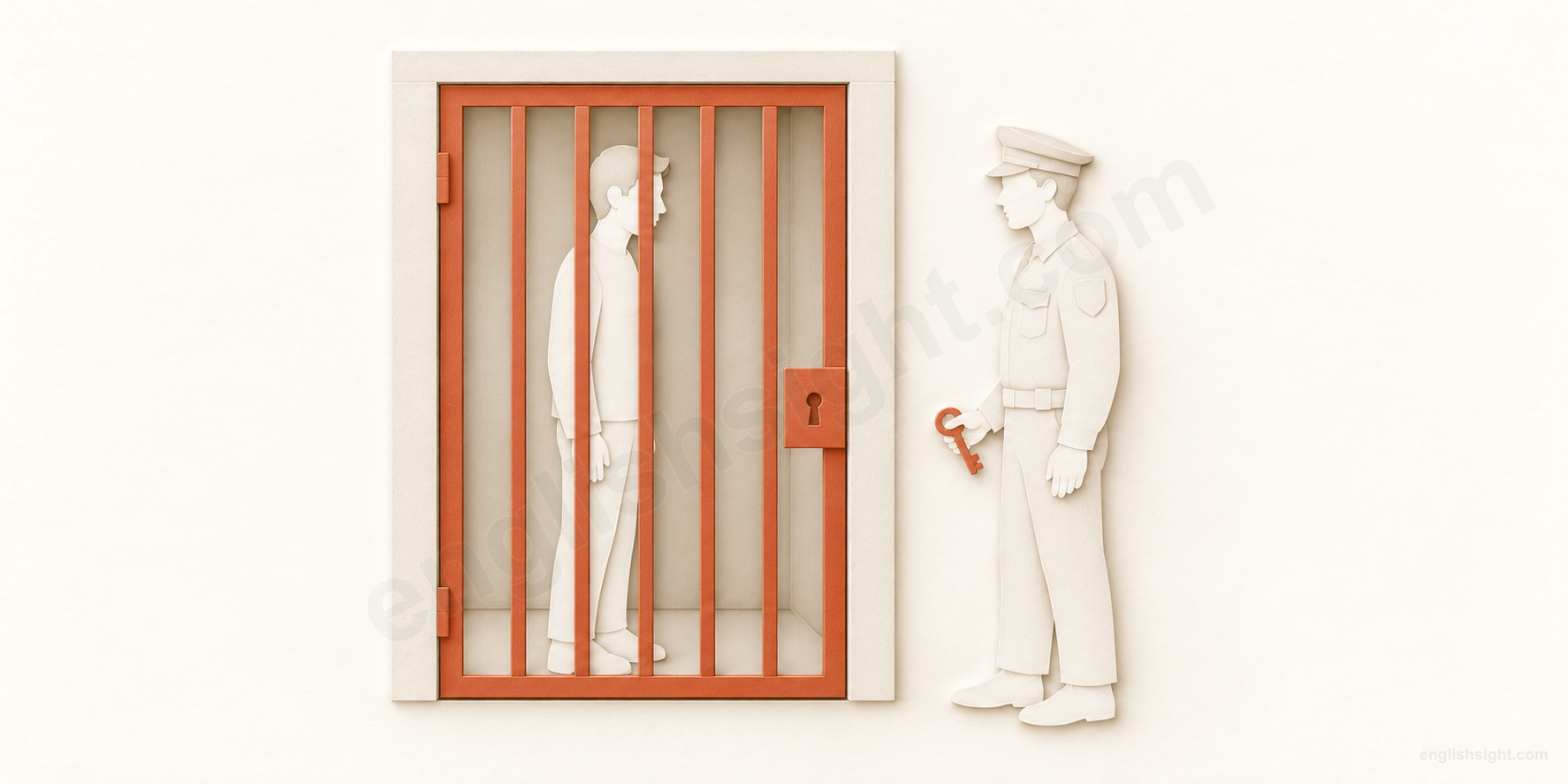
A person stands inside a prison cell.
prison
The person remains confined; the officer holds the key outside.
A closed, locked gate separates the person from an officer outside.
The person is held inside and cannot simply choose to leave.
A person is held within an institution and cannot simply choose to leave.
The model explains controlled confinement. It does not establish guilt, tell us the length of a sentence, or mean that every prison has bars. Figurative uses borrow the restriction without requiring legal custody.
A prison holds people under authority, so they are not free to leave. That relation helps connect a physical prison, time in prison, and the feeling that a situation is a prison.
English also uses grammar to distinguish custody from location: in prison and in the prison can answer different questions. This lesson explains common uses, not a claim about one mental picture shared by all English speakers.
01
The place and being held there
Start with the institution, then distinguish a building’s location from someone’s status in custody.
01
a / the + prison; plural prisons
a prison / the prison / prisons
a place where people are kept in legal custody
Situation / question
You are identifying a building on a map.
Meaning in context
The building is used to hold people in custody.
Prison can name a countable institution or building.
Use a prison when introducing one institution and the prison when the listener can identify it. Prisons is the plural: The city has two prisons. The noun names the place, not the people inside it.
A prison may hold people serving a punishment or people awaiting trial. The idea of controlled confinement links these uses; the building alone does not tell you each person’s legal status.
In a sentence
The old prison near the station is now a museum.
Watch the difference Prison is the place; a prisoner is a person. Do not call someone a prison.
02
be in prison; be in / at the prison
in prison / in the prison
being confined versus being inside a particular building
Situation / question
You need to distinguish a person in custody from a visitor.
Meaning in context
Your choice of article helps show what you mean.
In prison normally describes custody; in the prison identifies a physical location.
He is in prison normally means he is held there as a prisoner. No article is needed when prison refers to the institution and the person’s position within it. A doctor or visitor is not automatically in prison in this sense.
He is in the prison can simply locate him inside an identified building. A prisoner can also be in the prison: the article does not prove that someone is a visitor. At the prison treats the establishment as a location, without saying whether someone is inside.
In a sentence
Her brother is in prison, and she visits him at the prison on Fridays.
Watch the difference Do not teach the article as a strict prisoner/visitor rule: the contrast is institutional status versus a particular place.
03
go / be sent to prison; send + person + to prison; put + person + in prison
go to prison / send someone to prison
enter custody or cause someone to be placed there
Situation / question
A court decides that a person will be confined.
Meaning in context
The person goes into prison custody.
Go describes the person’s outcome; send names the action leading to it.
Go to prison usually means become a prisoner, not choose a destination for an outing. Send someone to prison puts the person after send; be sent to prison is the passive form when the person in custody is the subject.
Put someone in prison and be put in prison express a similar result. To marks the destination after send, while in marks the resulting position after put. By contrast, go to the prison can describe a visit to an identified place.
In a sentence
The judge sent him to prison for fraud.
Watch the difference Say sent him to prison or put him in prison; do not copy the preposition from one verb onto the other.
04
be held in prison + awaiting trial; in prison for + noun / -ing
be held in prison awaiting trial
be kept in custody before the trial has taken place
Situation / question
A person is accused, and the trial has not yet happened.
Meaning in context
The person is being held while waiting for trial.
Being in prison does not by itself mean a court has found someone guilty.
Be held in prison describes continued custody. Awaiting trial identifies the stage of the legal process: the trial is still ahead. It is not another way to say serving a sentence, which concerns punishment imposed after conviction.
For can identify the offence connected with custody: in prison for fraud, or in prison for stealing money. Here for stealing gives a reason, not a future purpose. Read the wider report before deciding whether it describes an accusation or a conviction.
In a sentence
She was held in prison while she waited for her trial.
Watch the difference An accusation, a conviction, and a prison sentence are different things; prison alone does not identify all three.
02
Sentences, time, and leaving custody
The surrounding verb tells us whether imprisonment is possible, imposed, being served, ended by release, or escaped.
05
spend / serve + time or duration + in prison; be in prison for + duration
spend / serve time in prison
describe time lived in custody or served as punishment
Situation / question
You want to describe a period in custody.
Meaning in context
You name the duration or the time served.
Spend reports time passed; serve connects the period with a sentence.
Spend two years in prison tells us where someone spent that period. Serve two years in prison presents those years as time served under a sentence. Serve time in prison works without a number; do time is a more informal alternative.
In prison identifies the setting, while for two years gives a duration. Compare in prison for theft: for now introduces the offence. The words following for tell you which relation is intended.
In a sentence
He served eighteen months in prison before his release.
Watch the difference A two-year sentence is the punishment imposed; two years actually served is the time spent. Do not assume they are always identical.
06
a + duration + prison sentence / term; be sentenced to + duration + in prison
a prison sentence / a prison term
a punishment of imprisonment and its length
Situation / question
A court specifies a punishment.
Meaning in context
You describe the sentence imposed or its duration.
Prison modifies sentence or term; it is not a verb here.
A prison sentence is a court’s punishment requiring imprisonment; a prison term refers to a period of imprisonment. Receive a prison sentence describes what is imposed, while serve a prison sentence describes carrying it out.
Be sentenced to three years in prison gives the length after to. Life in prison and a life sentence refer to life imprisonment. They do not tell you a universal release date; arrangements differ. In a three-year prison sentence, year stays singular inside the compound description.
In a sentence
She received a three-year prison sentence for fraud.
Watch the difference Say a three-year prison sentence, not a three-years prison sentence. A sentence here is a punishment, not a set of words.
07
face / avoid / escape + prison
face / avoid / escape prison
be at risk of imprisonment or avoid that punishment
Situation / question
A court case could lead to imprisonment.
Meaning in context
You describe the risk or whether that punishment is avoided.
Prison can stand for imprisonment as a possible punishment.
Face prison means have the possibility of imprisonment ahead of you. It does not mean stand looking at a building. Avoid prison means not receive that punishment. Neither expression requires a or the.
Escape prison can also mean avoid being sent there, particularly in reporting about sentencing: He escaped prison and received a fine. This differs from escape from prison, which normally means get away after being confined. The verb and context determine the reading.
In a sentence
He faced prison, but the court gave him a fine instead.
Watch the difference Face prison expresses a risk, not a certain future result; escape prison can describe avoiding the punishment.
08
release + person + from prison; be released from prison; get / be out of prison
be released from prison / get out of prison
leave prison custody
Situation / question
A person is being held in prison.
Meaning in context
The person is no longer held there.
Release describes being allowed to leave; get out focuses on leaving custody.
The authorities released her from prison is active; she was released from prison is passive. From identifies the place or state left behind. The noun phrase her release from prison refers to the same event.
Get out of prison is an everyday way to describe leaving custody. Be out of prison describes the resulting state. These expressions do not by themselves explain why the person left, and get out does not automatically mean escape without permission.
In a sentence
After he was released from prison, he found a job at a bakery.
Watch the difference Release does not by itself prove innocence or say that the full original sentence was served.
09
escape from prison; break out of prison
escape from prison / break out of prison
get away from confinement without permission
Situation / question
A person is being held and is not allowed to leave.
Meaning in context
The person gets away without permission.
Escaping confinement differs from an authorized release.
Escape from prison names the place the person gets away from. Break out of prison is another established way of describing this kind of escape; break out here does not require literally breaking a wall.
Compare be released from prison, where the person is allowed to leave. Escape prison can mean avoid imprisonment, but it can also mean get away from confinement: They escaped prison during the night. The presence or absence of from is not a complete rule; the surrounding events determine the reading.
In a sentence
In the film, two prisoners escape from prison during a storm.
Watch the difference Do not use escape from prison for an ordinary authorized release.
03
Life, people, and the system
Prison before another noun identifies a connection with the institution. The second noun supplies the specific thing, person, or organization.
10
prison + cell / life / conditions
a prison cell / prison life
a room in a prison and life within that institution
Situation / question
You are describing where prisoners live and their daily routines.
Meaning in context
The phrase identifies part of the prison or life inside it.
Prison before another noun tells us which institution the noun relates to.
A prison cell is a room where a prisoner is kept, not the whole institution. Prison life describes living within the institution; prison conditions refer to what that life and environment are like.
In these combinations the second noun is the main noun: one prison cell, two prison cells. Prison normally stays singular as a noun modifier. Learning the full combination is more useful than treating prison as a new adjective meaning bad or unpleasant.
In a sentence
The report describes crowded prison cells and poor living conditions.
Watch the difference A cell is one room; a prison usually contains many rooms and other facilities.
11
a prison officer / guard; a prisoner; plural prisoners
a prison officer / a prison guard / a prisoner
distinguish staff from people held in custody
Situation / question
You need to identify a person connected with the prison.
Meaning in context
Your noun identifies their role.
An officer or guard works there; a prisoner is held there.
Prison officer is the usual British job term; prison guard is a common North American term. Prisoner names someone held in custody. Inmate is another word used for a person living in a prison, though it also occurs for some other institutions.
In prison officer, prison describes the officer’s workplace. In prisoner, the ending forms a different noun referring to a person who is confined. Prisoner does not tell you by itself whether the person is awaiting trial or serving a sentence.
In a sentence
A prison officer helped the new prisoner contact his family.
Watch the difference A prisoner is not a staff member. Do not use prison by itself to name either person.
12
a maximum-security / minimum-security prison; an open prison
a maximum-security prison / an open prison
describe the degree of security and control
Situation / question
You are comparing two kinds of prison.
Meaning in context
The description tells you how tightly confinement is controlled.
A prison need not have the same physical barriers or rules as another prison.
Maximum-security describes a prison with a very high level of security. An open prison, especially in British English, allows prisoners more freedom than an ordinary prison; the North American counterpart is minimum-security prison.
Open does not mean that the public can simply enter, or that a prisoner has been released. The confinement relation remains, but the way it is maintained differs. The closed barred exit in our sketch illustrates restriction, not the architecture of every prison.
In a sentence
He was moved to an open prison before his release.
Watch the difference Open prison is an established type of institution, not a prison that has just opened for business.
13
the prison system / service / population; prison reform; prison + general statement
the prison system / the prison population
talk about imprisonment as a system and the people within it
Situation / question
You are discussing institutions collectively.
Meaning in context
You describe the system or the number of people it holds.
Prison can refer to an institutional system, not just one building.
The prison system means the institutions and arrangements for holding people in prisons. The prison service refers to the organization that runs prisons, particularly in British usage. Prison reform means changes intended to improve that system.
The prison population is the number or group of people held in prisons in a stated area. It does not mean everyone who works in or visits them. In a claim such as Prison should be a last resort, prison refers generally to imprisonment as a response to crime.
In a sentence
The report calls for prison reform to reduce overcrowding.
Watch the difference A country’s prison population counts prisoners, not the number of prison buildings.
04
A feeling of confinement
The figurative use carries the loss of freedom into other places and situations.
14
feel like a prison; become a prison
feel like a prison / become a prison
describe a place or situation as severely confining
Situation / question
Someone feels trapped in a place or way of life.
Meaning in context
They compare its restrictions with confinement in prison.
The metaphor transfers lack of freedom, not necessarily crime or locked doors.
A room, home, or situation can feel like a prison when someone feels unable to leave or live freely. It can also be described directly as a prison. The speaker is making a strong comparison, not necessarily alleging literal imprisonment.
Like explicitly marks the comparison; become a prison presents the place or situation as having taken on that restrictive character. This extension connects with the core relation, but it does not make every inconvenience a prison in ordinary neutral description.
In a sentence
After months of isolation, the apartment began to feel like a prison.
Watch the difference A figurative prison need not be a place where anyone is legally held; this is strong, subjective language.
Keep the distinctions clear
Noun, sound, and forms
Prison is normally a noun in modern everyday English. It is pronounced /ˈprɪzən/ (also written /ˈprɪzn/), with first-syllable stress and a /z/ sound. The plural is prisons. Use imprison or send to prison for the action; the old verb prison is outside this lesson.
Prison and jail overlap
Both words can describe confinement. In US institutional usage, a jail typically holds people awaiting trial or serving shorter sentences, while a prison typically holds people serving longer sentences. Everyday usage overlaps, and British English also uses jail for prison. Do not turn this tendency into a universal rule about every country.
The whole phrase supplies the relation
Prison is not a verb in go to prison, and these are not phrasal verbs formed from prison. Send, put, serve, release, and escape contribute different actions. Their passive forms belong to those verbs, not to the noun prison.
Scope of this lesson
The selection covers the main modern noun uses and practical combinations. Slang, specialist categories of institutions, historical senses, and every legal procedure are not expanded. These are language distinctions, not a description of one country’s complete justice system.
Choose what the phrase tells you
Use the context, the article, and the surrounding verb. No single picture supplies every answer.
1. A nurse is working inside a particular prison today. Which sentence locates her without normally calling her a prisoner?
2. A person is held in prison awaiting trial. What does this sentence establish?
3. The authorities allow a prisoner to leave. Which report describes that event?
4. A report says, “He escaped prison and received a fine.” Which reading fits?
5. The court imposes three years of imprisonment. Which noun phrase has the usual form?
6. Someone says their isolated apartment feels like a prison. What are they most likely emphasizing?
Sources and teaching notes
The dictionary pages below support the uses and distinctions. The explanations, examples, and diagram are original teaching material; the confinement model is a teaching aid.
This diagram shows a useful relation; it is not a mental picture shared by every English speaker.