A process is a series of connected actions or changes, or an ongoing activity; to process something is to carry out operations on it.
Connected stages, not just an endpoint
Follow the connected actions or changes
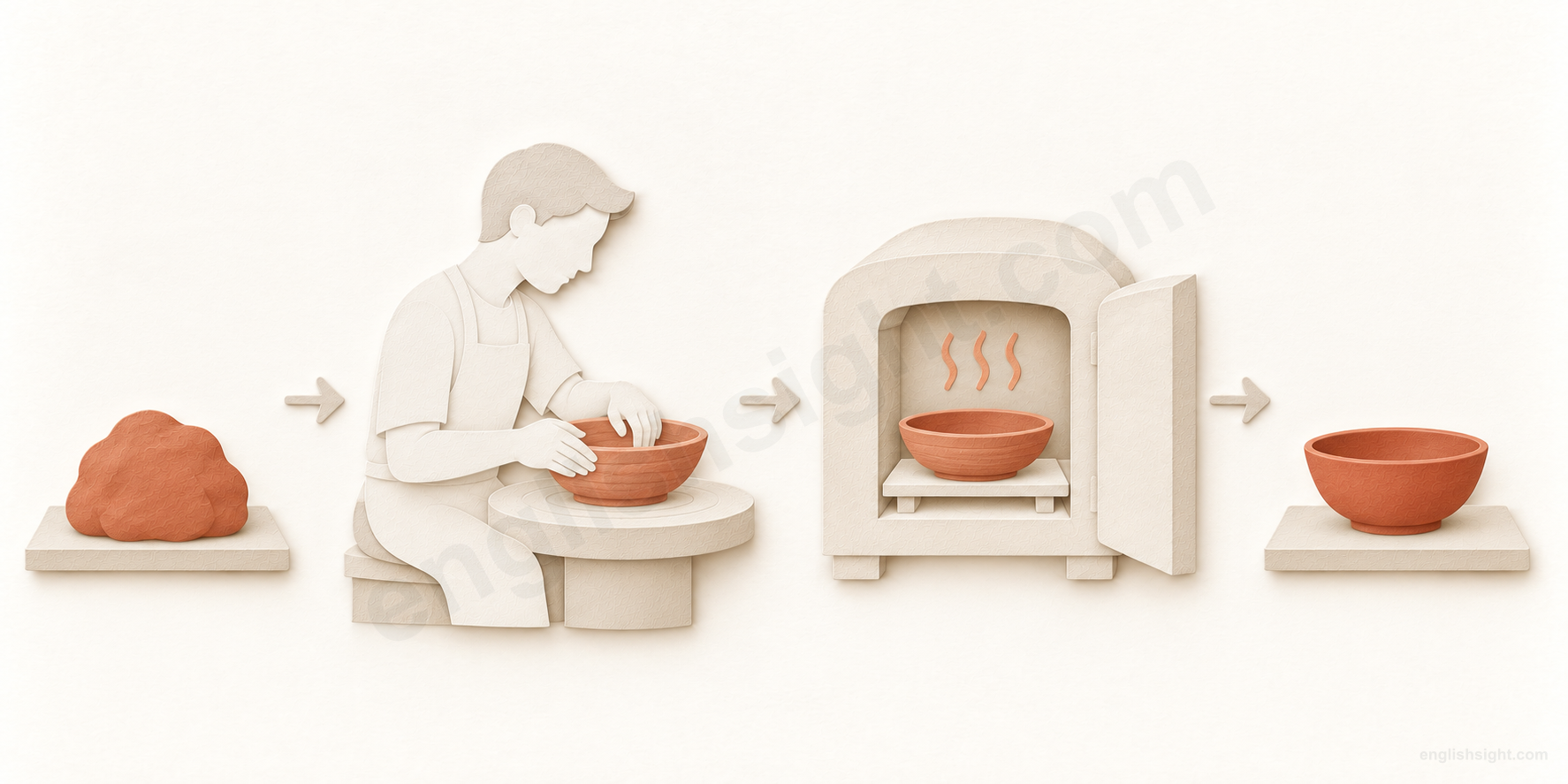
A lump of clay
process
A finished fired bowl
Shape the clay, then fire the bowl
The process includes shaping and firing, not only the finished bowl.
A process consists of connected actions or changes through which something develops or a result is produced.
The sketch follows clay from a lump to a shaped bowl and then a fired bowl. It illustrates successive stages. Natural processes need no deliberate maker, and a process can be unfinished or unsuccessful.
When you ask about a process, you often want the steps or changes, rather than just the final answer. The steps may be planned, like making a pot, or natural, like healing.
As a verb, process takes objects such as applications, materials, and information. Their different needs tell us what kind of work is involved. The diagram offers one teaching connection; it does not represent a picture shared by all speakers.
01
A series of steps or changes
Name the whole course of an activity, a way of doing it, or changes that happen naturally. Process can focus on what happens between the starting point and the outcome.
01
the process of + noun / -ing; a process for + noun / -ing
the process of making / a process for making
the connected steps involved in an activity
Starting situation
A community group wants to publish a small book.
What happens or results
They write, edit, and print it.
Process names the whole sequence, not just one step or the finished book.
The process of making a book looks at the activity as a sequence. A process for making books can describe a method designed for that purpose. Of identifies the activity; for introduces what the method is intended to accomplish.
You can describe the application process, the hiring process, or a decision-making process. A step in the process is one part of the whole. A simple process may have only a few steps; a complicated process may involve several people.
In a sentence
Can you explain the process of publishing our book?
Watch the difference Use a process, the process, or processes in this countable sense: Publishing is a long process, not Publishing is long process.
02
the + noun / -ing modifier + process; a natural / chemical process
the ageing / healing process
changes that develop naturally over time
Starting situation
A small cut has just begun to close.
What happens or results
Over the following days, the skin repairs itself.
A process need not be planned or controlled by a person.
The healing process presents recovery as development over time. The ageing process, digestion, and other biological or chemical processes can be continuous, with no tidy list of deliberate instructions. The plural expression life processes also covers continuing functions such as breathing; a process need not have one final endpoint.
A gradual process emphasizes the pace of change. A manufacturing process emphasizes an organized operation. The shared idea is connected activity or change; a human decision-maker is not part of every use.
In a sentence
The nurse explained the healing process to us.
Watch the difference Do not assume process means improvement: decay is a process too.
03
go through / start / complete / repeat / simplify + a / the process
go through / start / repeat a process
participate in or manage a sequence of steps
Starting situation
A registration system requires several checks.
What happens or results
You complete the checks before receiving your card.
The accompanying verb tells us how someone relates to the process.
Go through a process means experience or carry out its stages. Start the process and complete the process mark its boundaries. Repeat the process asks for the sequence to be done again, rather than just repeating its last action.
Simplify or streamline a process means make its operation less complicated or more efficient. These are ordinary verb-and-noun combinations, not phrasal verbs built from process. Process itself does not say whether the steps are sensible or successful.
In a sentence
You must go through the registration process before you receive a card.
Watch the difference Go through the process names participation; make progress says that you are advancing. The nouns process and progress are different.
04
by a process of elimination
by a process of elimination
find an answer by ruling out alternatives
Starting situation
Four keys might fit the lock.
What happens or results
After excluding three, you identify the remaining key.
Elimination supplies the method: remove possibilities that do not fit.
By a process of elimination explains how you reach a choice. You reject unsuitable candidates or answers until the remaining option is the one you select. The reasoning may involve checking evidence rather than trying every object physically.
This is a familiar named method, not a special verb sense of process. Of elimination names the activity within the process; by makes the whole phrase explain the means of reaching the answer.
In a sentence
By a process of elimination, we worked out which key belonged to the cupboard.
Watch the difference Elimination does not mean that every remaining guess must be correct; your original possibilities and exclusions still matter.
02
Something underway, or something that happens along the way
Read the complete expression: in the process of doing names an unfinished activity; in the process can link another event to that activity.
05
be in the process of + -ing; be in the process of being + past participle
be in the process of doing
have begun an activity that is still underway
Starting situation
The old website is still online.
What happens or results
Work on its replacement has started but is unfinished.
The phrase locates someone or something within an ongoing activity.
We are in the process of replacing the website gives a status update. We are replacing the website is often a shorter way to say this. The longer expression can emphasize that work is already underway.
Of is a preposition, so use replacing rather than replace. The website is in the process of being replaced uses being plus a past participle: the website receives the action. This construction does not promise a completion date.
In a sentence
We are in the process of replacing our website.
Watch the difference Say in the process of replacing, not in the process to replace.
06
clause + and + clause + in the process; in the process, + clause
and in the process…
something else happens as part of, or while doing, another activity
Starting situation
You move a heavy shelf to clean behind it.
What happens or results
The cleaning happens, and the wall gets scratched.
The earlier activity provides the setting for another event or consequence.
In the process can look back to an activity already mentioned. It connects an additional event with carrying out that activity. The extra event may be beneficial or unfortunate; the phrase itself does not make it an accident.
Compare We are in the process of moving the shelf: that reports unfinished work. We moved the shelf and scratched the wall in the process adds what happened while we did the work.
In a sentence
We moved the shelf and scratched the wall in the process.
Watch the difference Do not automatically read in the process as after finishing. It links the event to carrying out the activity.
07
be + in process
be in process
be underway or being worked on
Starting situation
A team has submitted a draft.
What happens or results
The review has begun and is not complete.
This shorter expression reports an unfinished operation.
The review is in process says that work is underway. In progress is another familiar choice in this situation. In process is useful to recognize in administrative and production contexts.
Compare The review process is slow: here process is the head of a noun phrase, and slow describes the sequence. In The review is in process, the whole prepositional phrase describes its current status.
In a sentence
The review is already in process.
Watch the difference Keep in the process of reviewing when naming the activity with that longer pattern; avoid in process to review.
03
Process something: carry out the relevant operations
The object determines the work: an application needs administrative handling, clay needs treatment, and information needs analysis or understanding.
08
process + application / claim / payment / order; be (being) processed
process an application / payment / order
perform the operations needed to handle a request or transaction
Starting situation
A customer has sent a refund request.
What happens or results
Staff check the details and carry out the required actions.
The organization handles the item according to its system.
The office processes applications; a bank processes payments; a shop processes orders. Process is a transitive verb here: the application, payment, or order is its object. The relevant steps depend on the institution.
Your request is being processed puts the request first and uses the passive because the worker may be unknown or unimportant. Processing does not by itself mean approving: a request can be processed and then refused.
In a sentence
Your refund request is being processed by our accounts team.
Watch the difference Submitting a request starts your part; processing it is the organization’s handling. Neither word guarantees approval.
09
process + people; people + be processed
process passengers / be processed
carry out official checks or registration for people
Starting situation
Passengers arrive at the terminal.
What happens or results
Officials check their documents before they continue.
People are the object of administrative handling, not physical material being changed.
Officials may process passengers, recruits, or patients by carrying out registration and checks. The passive is common because the people receiving the checks are the topic.
This wording belongs to institutional descriptions and can sound impersonal. Staff checked our documents is more specific in a personal account. The verb does not tell us which checks were required.
In a sentence
The passengers were processed at the temporary arrivals desk.
Watch the difference With a person as object, context is essential. Do not interpret this administrative sense as manufacturing or changing the person.
10
process + material + into + product; be processed into + product
process material into something
treat material to prepare it or change its form
Starting situation
A workshop receives used glass.
What happens or results
It treats the glass and turns it into new tiles.
Into names the resulting material or product; process names the treatment.
The factory processes glass into tiles specifies both the input and output. Without into, The factory processes glass tells us what material it treats but leaves the outcome unstated.
The glass is processed into tiles is passive. By can identify the agent, as in processed by the factory; into identifies the result. This productive pattern is not a separable phrasal verb.
In a sentence
The workshop processes used glass into decorative tiles.
Watch the difference Distinguish the result from the operator: into tiles, but by the workshop.
11
process + food; processed + food; process + ingredient + until + adjective
process food / processed food
prepare food by treatment; food that has undergone such treatment
Starting situation
Food ingredients arrive before preparation.
What happens or results
They are treated or prepared for use, storage, or sale.
Processed describes the food after treatment; the exact treatment varies.
Processed food uses the past participle before a noun. The phrase is broad: it does not by itself identify one recipe or one manufacturing method. Processing is the activity, as in food processing.
In a recipe, Process the nuts until smooth tells you to use a food processor. Until smooth supplies the desired texture. This kitchen instruction is more specific than saying that a factory processes food.
In a sentence
Process the nuts until smooth, then add the oil.
Watch the difference Processed does not automatically mean the same thing as cooked, and the word alone does not give a nutritional judgment.
12
process + film; have + film + processed
process photographic film
develop exposed film through the required treatments
Starting situation
A roll of exposed film holds images that are not yet ready to view.
What happens or results
A lab develops the film so its images can be viewed or printed.
Here process refers to a photographic treatment, not editing a digital file.
A shop that processes film provides development services. In this context the object film selects a conventional application of the treatment sense.
I had the film processed means I arranged for someone to do the work. The arrangement comes from have + object + past participle, not from a separate causative meaning of process.
In a sentence
We had the film processed at a small photo lab.
Watch the difference Process film and edit a photograph refer to different work; check whether the context is film development or digital editing.
13
process + data / information / signals; data / information / word processing
process data / information
carry out operations on information
Starting situation
A device has collected thousands of readings.
What happens or results
Software analyzes them and produces a useful summary.
In this example, processing includes analyzing the readings to produce a summary.
A computer processes data when it performs operations on it. Processing may include organizing, calculating, or analyzing, depending on the task. Data processing and information processing name this work.
Our brains also process information, including sounds and visual input. A machine is not required as the subject. In word processing, the established compound refers to creating and editing text documents with software.
In a sentence
The program processes the readings and produces a daily summary.
Watch the difference Saying that a file was saved does not by itself tell us whether its contents were analyzed. Processing is broader than analysis, so use the context to identify the operations involved.
14
process + news / information / what-clause; need time to process + object
process the news / what happened
take in and work through information mentally
Starting situation
You have just heard unexpected news.
What happens or results
You need time to understand it and deal with its implications.
The speaker describes mental work rather than a computer operation.
I need time to process this is a natural response to information that is difficult to take in. This can point back to news just received. What happened can also be the object: She is still processing what happened.
The expression can include an emotional response, but it does not mean forgetting the event or agreeing with it. I understand the words describes one level of comprehension; I am still processing the news can describe the work that remains.
In a sentence
I need a moment to process what you have just told me.
Watch the difference Process someone’s words means work through their content; it does not mean process the speaker as an administrative case.
04
Recognize the domain
A computer process and due process are established terms. Learn their particular meanings rather than trying to predict them from the pottery sketch.
15
a background process; a process runs; stop / end a process
a background process
a computer task operating as a distinct unit
Starting situation
Several tasks are running on a computer.
What happens or results
One continues while you work in another application.
This noun identifies a computing task, not the data that a verb acts on.
A background process can run without being the task you are currently interacting with. Here a process is a distinct computing task; there can be several processes running at once.
Compare The program processes data: processes is a verb there. In Three processes are running, processes is a plural noun. The surrounding grammar identifies the role.
In a sentence
A background process is using a lot of memory.
Watch the difference A computer process is not necessarily a visible app window. This lesson introduces the term without teaching operating-system internals.
16
due process; due process of law; be denied due process
due process / due process of law
an established legal term concerning lawful, fair treatment
Starting situation
A report questions how an official decision was made.
What happens or results
It asks whether required protections were respected.
Due process is a legal expression, not any procedure that is scheduled or overdue.
News and legal writing use due process when discussing safeguards governing the exercise of official power. In due process of law, of law identifies the legal setting. A claim that due process was denied alleges a failure of those protections.
The term includes questions of proper procedure and, in some legal contexts, limits on laws that treat people arbitrarily or unfairly. It cannot be reduced to finishing a checklist. This is a language introduction, not an account of legal rights in a particular case.
In a sentence
The report argues that the workers were denied due process.
Watch the difference Due here does not mean due tomorrow. Learn due process as a term; its precise legal scope depends on context.
Choose the sense from the object and construction
Process, procedure, and progress
A process presents connected actions or changes. A procedure often specifies an established way of carrying out a task, especially formal steps; the words can overlap. Progress focuses on advancement. A slow process can still be making progress.
Forms and pronunciation
The noun is usually countable in the general sequence sense: one process, two processes. The verb forms are process, processes, processed, processing. The ordinary noun and treatment verb have first-syllable stress: British /ˈprəʊ.ses/, American /ˈprɑː.ses/. Do not shift the treatment verb to final-syllable stress by analogy with other noun–verb pairs.
Grammar follows the intended work
The main verb uses an object: process it, process an order. Passives and progressives are natural: it was processed; we are processing it; it is being processed. Have something processed adds an arrangement construction. Into a product supplies a result. None of these is a separable particle-verb pattern.
Where the model stops
Legal process can refer to proceedings or a document such as a summons; serve process uses that specialist document sense. Anatomical process means a projecting body part, outside the steps model. Specialist printing, film-effects, and hair-treatment uses are not expanded here. A separate, less everyday verb process, with final-syllable stress, means move in a procession; do not confuse it with processing information.
Read the whole expression
Choose the sentence that fits the intended meaning.
1. Your move has started but is not complete. Which status update fits?
2. You cleaned a shelf and broke a small vase while doing so. Which sentence links the extra event to the cleaning?
3. A service says your request is being processed. What can you safely understand from that wording alone?
4. A workshop treats old glass to make tiles. Which sentence names both the input and output?
5. Unexpected news is hard to take in. Which sentence expresses a need to work through it mentally?
Sources and teaching notes
Usage and coverage were checked against the dictionary pages below. Explanations, examples, practice, and the visual connection were created for this lesson; the diagram is a teaching illustration.
This diagram helps explain a connection; it is not a picture shared by every native speaker.