Use prose to talk about writing form, a writer’s style, and familiar literary combinations.
Follow the sentences
Follow the sentences
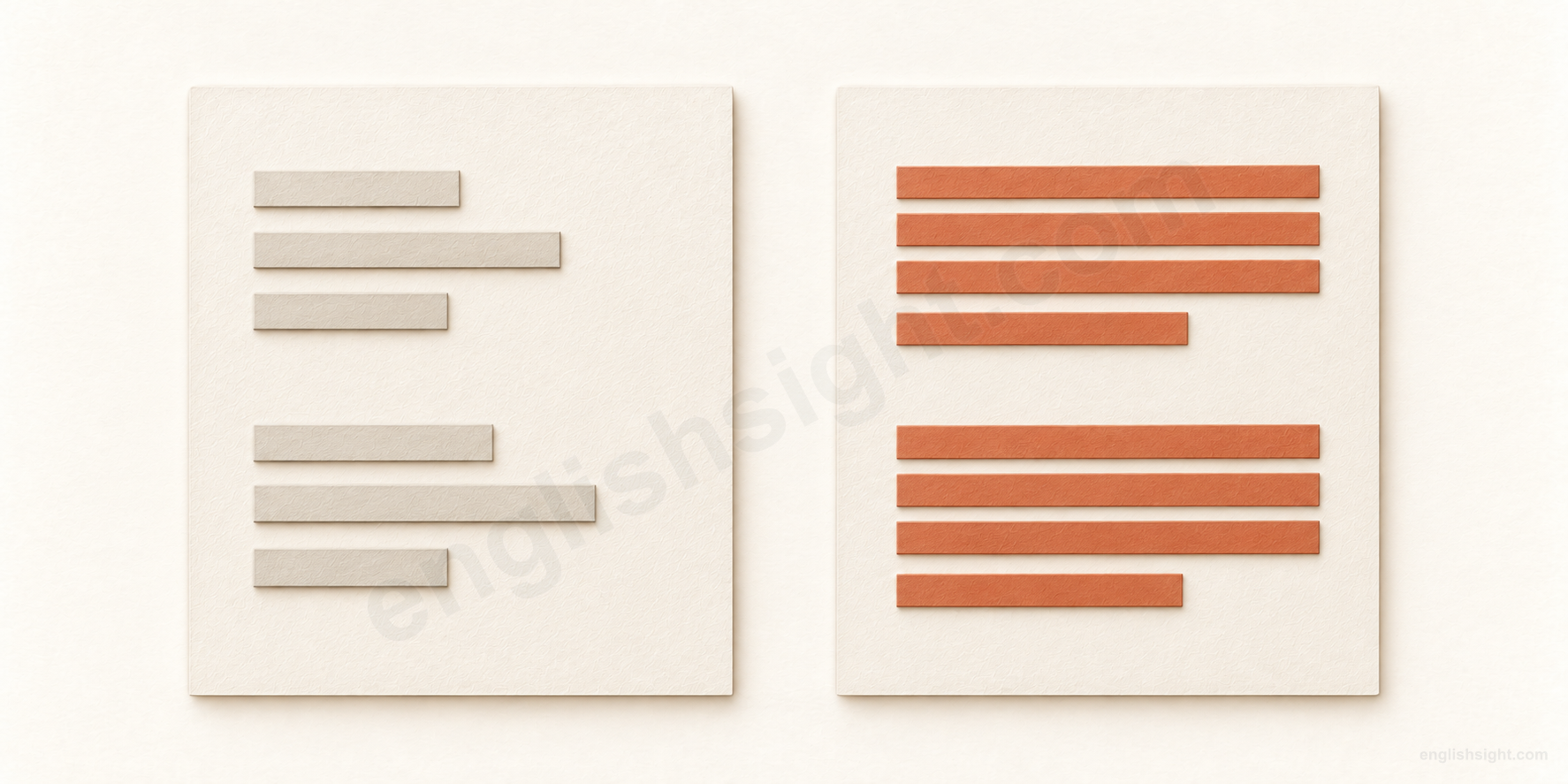
Left: short lines grouped as verse.
prose
Right: connected sentences arranged in paragraphs.
Compare two forms, not stages of a change.
Prose uses connected sentences, usually in paragraphs. This contrasts forms; prose can still be poetic.
Prose presents language in ordinary sentence form, usually in paragraphs, rather than organizing it as verse.
The two pages contrast forms, not earlier and later events. Prose can be imaginative and rhythmic; the prose poem shows that prose form and poetic effect can coexist.
An email, an essay, and a novel can all use prose. Start with how the language is organized, then ask what the writing says and how it sounds.
This lesson focuses on the modern uncountable noun and useful combinations for reading, study, and writing. The page comparison is a teaching aid, not a claim that all English speakers share one mental picture.
01
Recognizing the form
Prose names a way of organizing language. Start with the contrast with verse, then use it in writing instructions.
01
write / tell / be written + in prose; contrast: in verse
in prose / in verse
in ordinary sentence form rather than verse form
Situation / starting point
A class compares two versions of a story.
Meaning / result
One version uses paragraphs; the other uses poetic lines.
In identifies the form in which the language is presented.
Use in prose when the form matters: a story can be told in prose or in verse. In this pattern, in does not mean inside a physical object.
Picture sentences continuing through a paragraph, beside verse arranged in poetic lines. This is a useful starting contrast, not a complete test for every literary work. Prose can have rhythm; free verse need not rhyme or follow a regular beat.
In a sentence
The story is written in prose, but the song is in verse.
Watch the difference A line ending at the edge of a screen is not automatically a poetic line. Prose wraps onto new lines too.
02
write / explain / answer + in continuous prose
write in continuous prose
use connected sentences rather than a list of notes
Situation / starting point
An answer consists only of headings and bullet points.
Meaning / result
The ideas are developed into connected sentences and paragraphs.
Continuous describes connected writing, not writing without stopping.
In a school or work instruction, continuous prose contrasts with note form or bullet points. You develop the ideas as sentences and connect them into paragraphs.
Compare Write three reasons, which could invite a list, with Explain your reasons in continuous prose, which specifies the form of the answer. Paragraph breaks are still allowed.
In a sentence
Explain your choice in continuous prose rather than bullet points.
Watch the difference Continuous prose does not mean one very long sentence or one paragraph without breaks.
02
Talking about a piece and its style
Count pieces rather than proses, describe a writer’s language, and recognize an established critical expression.
03
a piece / passage of prose; two pieces / passages of prose
a piece / passage of prose
one text or a section of prose writing
Situation / starting point
You want to select two texts for a reading task.
Meaning / result
You count two pieces of prose.
Piece and passage provide the countable units.
In the main modern use, prose is uncountable. Say some prose, a piece of prose, or two pieces of prose. A passage of prose normally means a section selected from a longer text.
Prose takes singular agreement: The prose is clear. In Two pieces of prose are included, pieces is plural and controls are. The countable noun changes; prose does not.
In a sentence
Choose a short passage of prose and read it aloud.
Watch the difference For ordinary writing tasks, use two pieces of prose, not two proses.
A possessive or adjective directs attention to the writing and its style.
Her prose can refer to the language she writes, viewed as a body of writing or a style. Clear or plain prose is easy to follow; vivid prose makes a description feel lively. These adjectives evaluate the language rather than change its form.
A novel may have lyrical prose, while a report may use plain prose. The core noun alone does not tell you whether the writing is beautiful, simple, boring, or difficult. The surrounding words and context do that work.
In a sentence
Her prose is vivid, even when she describes an ordinary kitchen.
Watch the difference Prose is not a synonym for boring writing. In a review, explain the quality with an adjective or a specific observation.
05
purple prose; full of purple prose; cut the purple prose
purple prose
writing criticized as excessively showy or emotional
Situation / starting point
A description uses so much elaborate language that it distracts.
Meaning / result
An editor criticizes the writing as purple prose.
The established expression judges the effect of the writing.
Purple prose is a critical label for writing whose elaborate effects or exaggerated emotion draw too much attention to themselves. Purple is figurative here; it is not the color of the page or ink.
This expression is usually disapproving. Lyrical prose can praise musical or imaginative writing, whereas purple prose suggests that the writer has overdone it. An editor might say, “Cut the purple prose and tell us what happened.”
In a sentence
The editor asked me to cut the purple prose from the opening paragraph.
Watch the difference Calling someone’s writing purple prose is criticism, not a neutral way to say that it is poetic.
03
Combining form with a literary category
Prose fiction and prose poem combine a form with another classification. The second word supplies an important part of the meaning.
fiction in prose form, or a person who writes prose
Situation / starting point
A reading course classifies works by both form and subject matter.
Meaning / result
Novels and short stories appear under prose fiction.
Prose specifies form; fiction specifies invented people or events.
Prose fiction includes familiar forms such as novels and short stories. Fiction concerns imagined people or events; prose concerns the way language is organized. Neither word by itself supplies both ideas.
Prose also appears before nouns in prose writing, prose works, and prose writer. A prose writer may write fiction or nonfiction. An essay and a novel can both be prose, although only the novel is normally fiction.
In a sentence
The course covers prose fiction, including novels and short stories.
Watch the difference Do not restrict prose to essays or nonfiction. Also, prose fiction does not mean every possible kind of fiction; stories can be told in verse.
07
a prose poem; write / read a prose poem; prose poems
a prose poem
a poem using prose form rather than verse form
Situation / starting point
A short text has concentrated images and a poetic effect.
Meaning / result
It is presented as prose and described as a prose poem.
Poem names the kind of work; prose names its form.
A prose poem uses poetic language or ideas without being arranged in verse form. It explains why the beginner contrast “prose versus poetry” needs a boundary: poetry can sometimes take prose form.
The phrase is not a contradiction to correct. Learn it as a literary term. Here poem is countable: one prose poem, two prose poems. The plural ending belongs to poem, not prose.
In a sentence
For the workshop, she wrote a prose poem about the empty station.
Watch the difference A prose poem is not simply any paragraph with no rhyme. Its poetic language and effect matter too.
Keep form, genre, and judgment apart
Say it with a final /z/
Prose is one syllable: /prəʊz/ in British English and /proʊz/ in American English. The final sound is /z/, not /s/. It is not the two-word legal expression pro se.
Ordinary form does not mean poor quality
A neutral use of prose identifies a form of language. Some larger dictionaries also record a dull or commonplace sense, and verbs meaning to write prose or talk tediously. Those are outside this practical noun lesson; do not apply them automatically to a novelist’s prose.
Use the whole combination
Write prose takes prose directly as its object. Write in prose specifies the form with in. Neither is a phrasal verb. Prose fiction, prose writer, and prose poem use prose before a noun; dictionaries may call this a modifier or adjective use.
A helpful contrast has limits
Printed layout alone cannot classify every text. Free verse need not have regular meter or rhyme, and a prose poem combines prose form with poetry. The diagram shows a starting contrast, not a rule for judging every work.
Choose the useful expression
Check whether you need a form, a countable unit, or a judgment about style.
1. You want a student to select two short prose texts. Which instruction fits ordinary modern usage?
2. A novel tells an invented story in paragraphs. Can you describe it as prose fiction?
3. An editor thinks a paragraph is overloaded with elaborate, exaggerated language. Which comment expresses that criticism?
4. A poetic work is written in prose form rather than verse. Which literary term can describe it?
Sources and teaching notes
Dictionary entries support the meanings and patterns below. Explanations and examples are original; the page comparison is a teaching model.
The diagram offers a way to understand the contrast, not a picture shared by every native speaker.