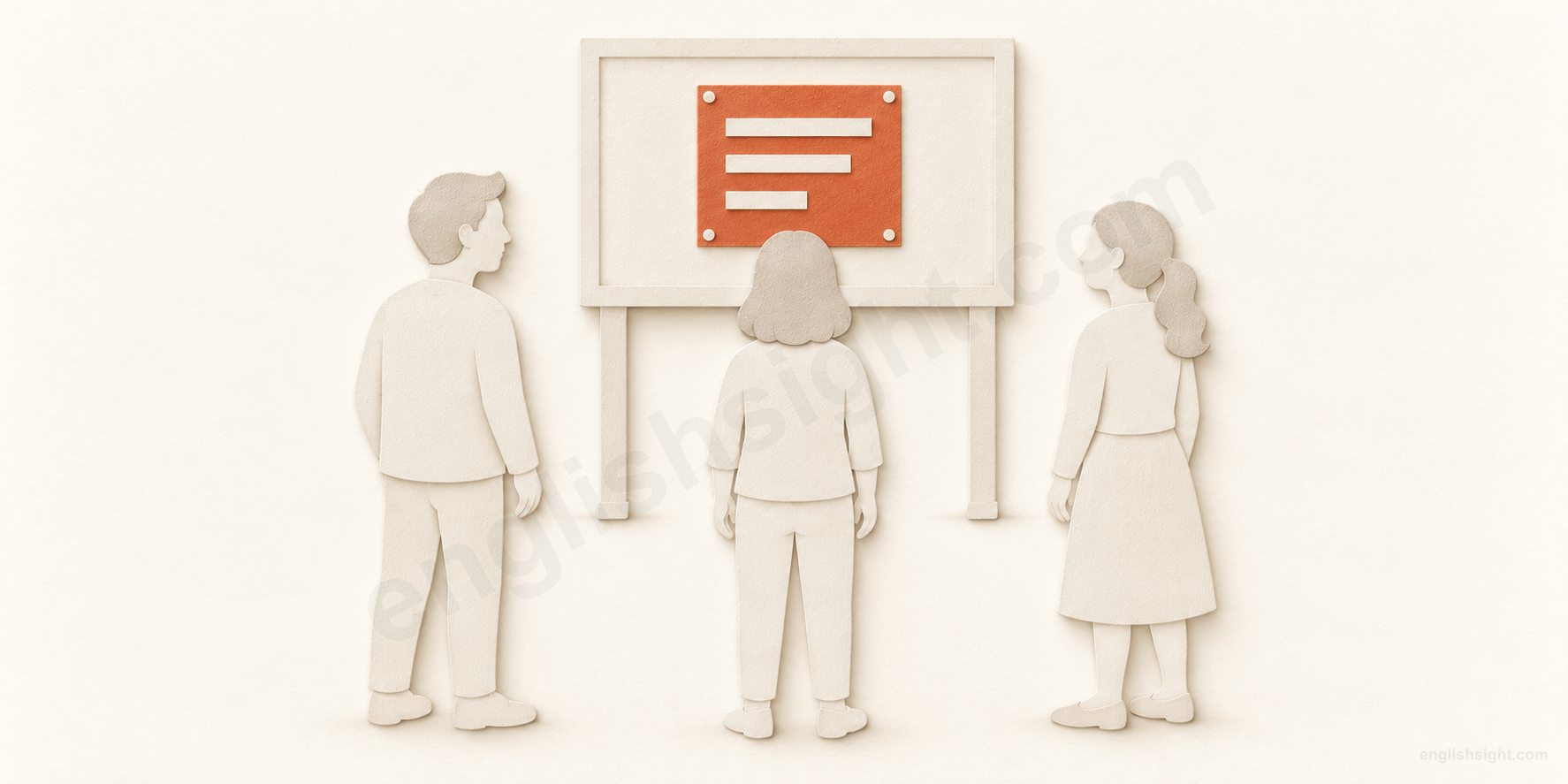
Connect places, information, and shared affairs with people generally.
Connected with people generally
Connected with people generally
One posted notice
public
People beyond a private circle
Open to general view
A notice open to general view illustrates one use of public.
Public connects something to people beyond a private individual or closed group: it may be for their use, concern their shared life, or be open to their notice.
The notice board illustrates general visibility. It does not explain government ownership by itself. Public school and the business meaning of go public need their own established meanings.
Public connects something with people beyond one individual or a closed group. Depending on the noun and context, the connection may be general use, community concern, government provision, or open visibility.
Ask three practical questions: Who may use it? Whose shared affairs does it concern? Who can see or know about it? These related questions help organize the word without making every combination mean exactly the same thing.
01
Places and services people can use
Ask who may use a place or service. General access and government ownership often overlap, but they are different questions. Established names can also have regional meanings.
01
public + place / area / space; be too / more / less public
a public place
a place where people generally may be present
Situation / participants
You need somewhere to meet a new customer.
Use / status / audience
You choose a busy café rather than your home.
Access and visibility matter; ownership is a separate question.
A public place can be a square, station, or café. A café can be privately owned and still be a public place in ordinary conversation. In contrast, a private room is reserved for particular people.
This table is too public means people nearby can see or hear you too easily. Here public follows is and can have too or more before it. You are judging privacy, not describing who paid for the furniture.
In a sentence
Could we find a less public place to talk?
Watch the difference Public does not mean outdoors: an indoor station can be public, and a private garden can be outside.
02
a public + facility; public access to + place / information
a public library
a facility provided for general use
Situation / participants
Residents need somewhere to read and borrow books.
Use / status / audience
They use a library serving the community.
Public identifies the intended users, often with public provision.
Compare a public library with a company’s private library for staff. The noun identifies the facility; public connects its use to the wider community. Public parks, public toilets, and public access follow a similar general-use idea.
Do not infer every practical condition from the adjective. A public swimming pool may charge admission, and a library may require a card to borrow books. Public does not by itself promise free use or access at every hour.
In a sentence
The public library has a quiet room for studying.
Watch the difference General use is compatible with opening hours, fees, and ordinary access rules.
03
be open / closed to the (general) public
open to the public
available for people generally to visit or attend
Situation / participants
A building usually admits only staff.
Use / status / audience
Visitors generally may enter during the advertised hours.
The public is the group admitted; to introduces that group.
In open to the public, public is a noun and normally has the. Compare a public exhibition, where public is an adjective before exhibition. Both can describe general access using different grammar.
An event open to the general public is not restricted to members or invited guests. General emphasizes the wider group. Closed to the public reverses the access condition; it does not necessarily mean that nobody is inside.
In a sentence
The garden is open to the public on Sunday afternoons.
Watch the difference Say open to the public, not open for public, when naming who is allowed in.
04
use / take public transport; travel by public transport; public transportation / transit
public transport / public transportation
shared transport services available to travelers
Situation / participants
You decide how to get across town.
Use / status / audience
You use the bus or train instead of your own car.
Public describes the service offered to travelers, not necessarily its owner.
Public transport is the usual British term; public transportation is usual in North American English, where public transit is also common. The operators may be government bodies or private companies.
Use take or use public transport, or travel by public transport. The expression names a system, so it is normally uncountable: good public transport, not a good public transport. A particular vehicle is a bus or a train.
In a sentence
We can get to the museum by public transport.
Watch the difference Public transport is not automatically free, and transport does not mean only buses.
05
attend / go to a public school; a state school (British English)
public school
a school name whose meaning depends on region
Situation / participants
Two people from different countries describe their schools.
Use / status / audience
You check whether they mean state education or a fee-paying school.
Learn the regional expression rather than predicting the school’s funding.
In the US and several other countries, a public school is a government-funded local school. In Britain, especially England, public school can mean a traditional fee-paying private secondary school, often a boarding school. It does not mean every British private school.
For the British government-funded meaning, state school is a useful clear term. Ask about the country and context before assuming that public school and private school are opposites.
In a sentence
In the US, Maya’s children attend a public school near their home.
Watch the difference The British public-school meaning is an established historical label; the general access picture cannot predict it.
06
a public holiday; on a public holiday
a public holiday
a generally observed day away from work or school
Situation / participants
You choose a day to visit an office.
Use / status / audience
You notice that the office will be closed for a holiday.
The holiday belongs to the community’s calendar, not one person’s vacation.
A public holiday is a recognized holiday when many people do not go to work or school. It often marks a national or religious celebration. It is a countable expression: a public holiday, two public holidays.
My holiday can mean my personal vacation. A public holiday is shared on a calendar, although some people still work. In British contexts you will also meet bank holiday; do not assume every country uses identical terms or dates.
In a sentence
The office will be closed because Monday is a public holiday.
Watch the difference Public does not promise that every business closes or every worker has the day off.
02
Community concerns and government
Here public points to society’s needs, views, resources, or institutions. Read the following noun: opinion, money, service, and office each select a different relationship.
07
public opinion on / about + issue; public support for + proposal; public awareness of + issue
public opinion / public support
what people in society think or favor
Situation / participants
Residents discuss a proposal for a new road.
Use / status / audience
Their views influence the decision.
Public identifies whose views or reactions are involved.
Public opinion summarizes views across a community; public support names approval, and public pressure names demands for action. Raising public awareness instead concerns what people know about an issue.
Public opinion can be divided. It does not require everyone to think alike. Compare my opinion, which identifies one speaker’s view. Use public opinion about or on an issue, and public support for a plan.
In a sentence
Public opinion on the new road is divided.
Watch the difference Do not read public opinion as an official government position or a unanimous vote.
08
public health / safety; a risk to public health
public health / public safety
the health or safety of people across a community
Situation / participants
You consider a problem affecting many residents.
Use / status / audience
The discussion concerns community welfare.
The concern extends beyond one individual.
Public health directs attention to the health of a population, for example when discussing clean water. Public safety directs attention to people’s protection from danger. These are useful combinations of the community-related adjective with different nouns.
A public-health discussion is not necessarily a discussion held in front of an audience. Here public tells you whose health is involved. Contrast her health, which focuses on an individual.
In a sentence
Clean drinking water is important for public health.
Watch the difference Read the noun: public health concerns a population, while a public statement concerns visibility.
09
be / act in the public interest; public interest in + topic
in the public interest
for the benefit of society generally
Situation / participants
A choice affects both one company and the wider community.
Use / status / audience
You judge what serves people generally.
Interest here concerns benefit, not merely curiosity.
In the public interest evaluates a decision by its benefit to people generally. It can contrast with someone’s private or commercial interests. The preposition in belongs to this established expression.
Compare There is public interest in the story: people are interested in it. Something can attract attention without necessarily benefiting society. The surrounding grammar helps distinguish these uses of interest.
In a sentence
The council said the change was in the public interest.
Watch the difference Keep the in in the public interest. Public interest in a celebrity’s holiday may simply mean curiosity.
10
public money / funds; public spending / expenditure; the public purse (British English)
public money / public spending
money available to or spent by government for public purposes
Situation / participants
A council prepares a budget.
Use / status / audience
It decides how to use shared public funds.
Public identifies the source or institutional responsibility of the money.
Public money and public funds refer to government financial resources. Public spending or public expenditure describes their use. The money is not an individual official’s personal money.
Use money as an uncountable noun: a large amount of public money. Funds can be plural. In British news, the public purse is a figurative name for these resources; there is no literal purse that everybody carries.
In a sentence
The project will receive public funding.
Watch the difference A statement about public funding does not tell you that entry or use will be free.
11
be in / under public ownership; public property
public ownership / public property
ownership by the state or community rather than a private owner
Situation / participants
You ask who owns a building or resource.
Use / status / audience
The answer is the state or local community.
Ownership and permission to enter are different relationships.
In public ownership, ownership belongs to the state or community. Public property similarly contrasts with private property. This is an ownership branch of the word, not a promise of unrestricted access.
A privately owned café may be open to the public. Conversely, a government building may contain staff-only rooms. These examples separate who owns something from who may enter or use it.
In a sentence
The building remains in public ownership, but its offices are not open to visitors.
Watch the difference Public property does not mean that anyone may take it home.
12
work in the public sector; public-sector + noun
the public sector
the government-controlled part of the economy
Situation / participants
You compare types of employment.
Use / status / audience
You distinguish government institutions from private businesses.
Sector classifies institutions; public specifies government ownership or control.
Work in the public sector normally refers to work in organizations owned or controlled by government. The private sector refers to privately controlled businesses. An organization serving customers is not automatically part of the public sector.
The phrase usually has the when it names the sector. Before another noun, you may see public-sector jobs or public sector workers. The compound describes the kind of job or worker.
In a sentence
She moved from a private company to a job in the public sector.
Watch the difference Serving the public and belonging to the public sector are not the same test.
13
improve public services; work in public service; do / perform a public service
public services / a public service
services for society, or an act that benefits people
Situation / participants
You discuss local transport, education, or helpful community work.
Use / status / audience
You identify a service or contribution for the wider public.
The surrounding words distinguish an institution from a helpful act.
Public services can mean services such as education or transport provided by government or an official organization. Improve public services discusses that system. Work in public service can refer to government employment.
Do someone a favor is personal; do or perform a public service describes a contribution made to help people rather than to make a profit. A privately produced guide can be provided as a public service. This use does not require the producer to be a government employee.
In a sentence
By publishing a free map of the footpaths, the walking club performed a public service.
Watch the difference A public service can be a helpful act; public service is not always the name of a government department.
14
hold / seek public office; a public official
hold public office / a public official
have an official role in government
Situation / participants
Someone takes responsibility in local government.
Use / status / audience
They act in an official capacity for the community.
Office can mean a position, rather than a room.
Hold public office means occupy a government position. A public official is someone with an official government role. The public connection concerns the responsibilities of that position.
In She has never held public office, office is not a building you can enter. Compare a public office in a visitor’s directions, where office may mean a workplace. Let the verb and context guide the interpretation.
In a sentence
Before becoming mayor, he had never held public office.
Watch the difference A public official is not simply a person who is famous; public figure has a wider meaning.
03
Open to people’s notice
A public event is presented to an audience; public information is available beyond a private circle. The verb distinguishes an open status, a change of status, and the action that causes information to become public.
15
a public meeting / performance / statement / apology; on public display
a public meeting / a public apology
an event or act intended for people generally to see or hear
Situation / participants
A decision or performance could remain within a small group.
Use / status / audience
It is presented openly to a wider audience.
Public describes the audience or visibility of the act.
A public meeting invites general attendance; a public performance is presented to an audience. On public display describes something placed where visitors can see it. The precise access conditions still depend on the event.
A public statement or public apology is made openly, so people beyond a private conversation can hear or read it. Compare a private apology to the person concerned. Public changes the audience, not the sincerity of the apology.
In a sentence
The manager issued a public apology for the cancelled concert.
Watch the difference Public does not guarantee a large actual audience or tell you whether an apology is sincere.
16
make + something + public; something + be made public
make something public
cause information to become available or known to people generally
Situation / participants
Only the committee has read the results.
Use / status / audience
The committee releases them for wider knowledge.
The object acquires the description public.
In make the results public, make is the verb, the results is its object, and public describes the resulting status. Make them public keeps the pronoun before the adjective. Make public the results is also possible with a noun phrase, especially in formal wording.
The results were made public uses the passive: the information receives the action. Public has not become a verb. Making information public is often deliberate, but it can also happen accidentally: A mistake made their email addresses public. Make identifies a cause; it does not by itself guarantee an intention.
In a sentence
The committee will make its findings public next week.
Watch the difference Say make it public, not make public it. The result is public availability or knowledge, not necessarily a printed publication or proof that everyone has read it.
17
information becomes / is public; it is public knowledge that + clause
become public / public knowledge
information comes to be widely known
Situation / participants
An arrangement is known to only a few people.
Use / status / audience
News of it reaches the wider community.
Become describes a change without naming who disclosed the information.
The news became public describes its change of status. Compare We made the news public, which identifies people causing that change. Keep the details public describes maintaining an already open status.
It is public knowledge that… says something is generally known, often within the relevant community. This is close to common knowledge. Public knowledge does not mean that every person in the world has actually heard the news.
In a sentence
The agreement became public after the meeting.
Watch the difference Become public does not by itself say whether someone released the information deliberately or leaked it.
18
someone + go public with + information; go public about + issue
go public with something
openly disclose something previously kept private
Situation / participants
You have tried discussing a problem privately.
Use / status / audience
You decide to tell people about it openly.
The person or organization chooses public disclosure.
Go public with a story, complaint, or concern means disclose it openly. With introduces what is disclosed. You can also say She went public about the problem. Go public does not require walking into a public square.
The organization went public with its concerns describes disclosure. The organization went public can also have a business meaning about shares; context must distinguish the two. These are established uses of go plus the adjective public, not a separable particle verb.
In a sentence
After several private meetings, the residents went public with their concerns.
Watch the difference Do not assume that every company going public is merely making an announcement; check for share-sale context.
19
a public figure; in public life; be / remain in the public eye; someone’s public image
a public figure / in the public eye
a person whose role or life attracts wide public attention
Situation / participants
A performer becomes widely recognized.
Use / status / audience
Their life receives attention beyond their private circle.
The connection is public recognition and attention.
A public figure is widely known through a prominent role, such as an entertainer or politician. Public life often refers to activities and roles involving public attention, especially political or social responsibilities. It contrasts with someone’s private life.
In the public eye means receiving public attention. Her first public appearance describes her being seen at an event. Public image means how people generally perceive her, which may differ from how close friends know her.
In a sentence
He enjoys acting but dislikes being in the public eye.
Watch the difference A person can appear in public without becoming a public figure. Being famous does not make every aspect of a life public.
20
be in the public domain; enter the public domain; place + something + in the public domain
in the public domain
in general circulation; also a specific status for creative works
Situation / participants
You ask whether information is confidential or whether a work has protected rights.
Use / status / audience
You distinguish general availability from the expression’s rights-related meaning.
Public availability and public-domain status are different questions.
In everyday information contexts, in the public domain can mean available for people to know or discuss. The report is already in the public domain can contrast with a report still kept confidential.
For creative works, public domain has a distinct established meaning concerning material unprotected by copyright. A photograph being publicly visible on a website does not by itself establish that status. Learn this as a separate expression rather than treating visible as permission to reuse.
In a sentence
The report is already in the public domain, so its conclusions are no longer confidential.
Watch the difference Public domain is not a name for everything accessible on the internet. The government-land sense is outside this lesson.
04
The public and being in public
Public can name people collectively. Learn the articles and prepositions: the public names a group; in public describes the circumstances of an action.
21
the (general) public; inform / protect / serve the public; the public’s + noun
the public / the general public
people considered collectively as a community
Situation / participants
An announcement needs an audience beyond staff.
Use / status / audience
It is addressed to people generally.
The names a collective group rather than an individual.
The public is a collective noun. Inform the public, protect the public, and the public’s response refer to people generally in the relevant community. The general public emphasizes ordinary people beyond a restricted group such as specialists or members.
The public is interested is usual American agreement. British English also uses The public are interested when focusing on the people as individuals. Use a consistent style; neither pattern turns public into a countable word for one person.
In a sentence
The notice explains the changes to the general public.
Watch the difference Say the public when naming people generally; a public is not the ordinary expression for one person.
22
a member / members of the public
a member of the public
one person from the wider community
Situation / participants
One passerby supplies useful information.
Use / status / audience
You refer to that person without naming a special role.
Member gives a countable way to name an individual.
A member of the public names an ordinary individual in the wider community. Members of the public gives a clear plural subject: Members of the public were invited. You do not need the person to belong to a formal membership organization.
Compare a member of staff, which identifies a work role, with a member of the public approaching the staff desk. The phrase is useful in notices and reports when the distinction matters.
In a sentence
A member of the public handed the lost wallet to the station staff.
Watch the difference Do not call one person a public or use publics as the everyday plural of people.
23
the reading / viewing / voting public; someone’s public; a wider public
the reading public / a wider public
an audience united by an activity or interest
Situation / participants
A writer considers who reads the books.
Use / status / audience
The focus is the relevant audience rather than everyone.
A modifier narrows which public is meant.
The reading public, the viewing public, and the voting public identify groups sharing an activity. A writer’s public can mean the writer’s readers. Public still groups people, but the group is narrower than society as a whole.
Reach a wider public means reach a broader audience. This supports a public when describing an audience of a particular kind. The plural publics exists in specialist discussion of different audiences; it is not the normal plural for individual people.
In a sentence
The translation brought her stories to a wider public.
Watch the difference The viewing public need not include everyone living in a country; it means the relevant viewers.
24
verb + in public; in private; speak to the public
in public / in private
where other people can see or hear what happens
Situation / participants
You need to decide where to discuss a personal matter.
Use / status / audience
You choose whether others may witness it.
In public describes the circumstances of an action.
Speak, argue, or appear in public describes doing so with other people able to see or hear. It contrasts with in private. The phrase normally has no the: in public, even though the noun naming people is the public.
Compare speaking to the public, which identifies the audience, with speaking in public, which describes the setting. A loud private call in a café can be heard in public even if it is not addressed to the public.
In a sentence
I would rather discuss the problem in private than argue in public.
Watch the difference Say in public for the open setting; in the public is not the ordinary form for this meaning.
05
Established expressions in work and conversation
These combinations have their own conventional meanings. Use the general connection to people as a memory aid, then learn what the whole expression actually means.
25
practice / learn public speaking; a course in public speaking
public speaking
giving speeches, and the skill of addressing an audience
Situation / participants
You prepare to present a project to a room of listeners.
Use / status / audience
You practice organizing and delivering your talk.
The whole expression names an activity or skill.
Public speaking is used for making speeches and for the skill of communicating effectively with an audience. A class in public speaking can teach planning, clear delivery, and handling listeners’ questions.
Speaking in public may describe the broader circumstance of being heard by others. Public speaking usually focuses on addressing an audience. Public is an adjective in the noun phrase, not an adverb modifying speak.
In a sentence
Her public speaking improved after she joined the debate club.
Watch the difference For a verb, use speak publicly or speak in public, not speak public.
26
work in public relations / PR; be good / bad for public relations
public relations / PR
work on an organization’s communication and relationship with people
Situation / participants
An organization wants to explain its work and maintain trust.
Use / status / audience
Staff communicate with people outside it.
Relations names the organization–public connection.
Public relations, often shortened to PR, names work intended to inform people and shape their impression of a person or organization. Work in public relations treats the field as uncountable.
Good for public relations can also concern the state of that relationship. Giving useful information and responding to concerns may affect it. Public relations is an established expression; do not replace relations with relationships when naming the profession.
In a sentence
The museum hired a public relations officer to explain the renovation plans.
Watch the difference Public relations is broader than simply placing an advertisement, and PR does not guarantee that an impression is accurate.
27
a company + go public; a public company; publicly traded shares
a company goes public
a company begins offering its shares to the public
Situation / participants
Ownership is held privately.
Use / status / audience
Shares become available for public investors to buy.
This is the established business meaning of the whole expression.
When a company goes public, it begins selling shares to public investors. A public company has shares available to the public. The word public concerns investment ownership here; it does not mean that the government owns the company.
Compare public ownership in a government context and a company that goes public with news of a problem. The first concerns state ownership; the second concerns information disclosure. The business context supplies the share-related interpretation.
In a sentence
The founders plan to take the company public next year.
Watch the difference Take a company public causes the business change. It does not mean taking its staff outdoors.
28
wash / air + possessive + dirty linen / laundry + in public
wash your dirty linen / laundry in public
discuss embarrassing private affairs openly
Situation / participants
People disagree about a personal or family problem.
Use / status / audience
They discuss the embarrassing details where outsiders can hear.
The laundry is a metaphor for private problems.
Wash or air your dirty linen or laundry in public describes exposing private, often embarrassing matters. The expression usually conveys disapproval. Both linen and laundry occur; it is not a statement about actual clothes.
Compare discuss the issue in public, which can be neutral. The idiom adds a judgment that the issue should have remained private. You may hear the warning Let’s not wash our dirty laundry in public.
In a sentence
They agreed to settle the family dispute privately rather than wash their dirty laundry in public.
Watch the difference Use the idiom carefully: it can sound critical of the people involved.
Keep the dimensions separate
Access, ownership, and visibility
A privately owned place may be open to the public. A public institution may have restricted rooms. Public information may be online without being free to reuse. Read the whole phrase before drawing conclusions.
Adjective, noun, and adverb
Public is commonly an adjective (a public meeting) or a collective noun (the public). Many community and government uses normally precede a noun. Open/known status can follow a verb: The report is public; the room is too public. Use publicly for the adverb: speak publicly, publicly available, publicly funded. The standard spelling is publicly, without an added al.
Read the verb’s job
Make the report public is make + object + adjective. The report was made public is the passive of make. Go public and become public use public as an adjective after a verb. Public itself has no ordinary everyday passive, causative, or particle-verb family to learn.
A useful model with limits
The shared board illustrates public visibility, rather than a required mental image for every English speaker. Regional school names, share ownership, and longer idioms are learned from established usage. This is a selection of common modern uses, not every specialist use or a frequency ranking.
Choose the right connection
Check the noun, verb, and setting. Decide whether public concerns people, access, government, or information.
1. A café is privately owned, but ordinary customers may enter. Which description can still fit?
2. You want to say that a museum admits visitors generally. Which expression is natural?
3. Only staff could read a report yesterday. Today the manager releases it for everyone to read. Which sentence describes that action?
4. A company plans to go public and sell shares. What change is being discussed?
5. A speaker in England describes an expensive traditional boarding school as a public school. What should you infer?
6. A decision is said to be in the public interest. What is being claimed?
7. One ordinary visitor finds a wallet. Which phrase can identify that individual?
Sources and teaching notes
The linked publisher entries were read to check meanings, constructions, idioms, and regional limits. Explanations and examples are original; the notice-board connection is a teaching model.
The diagram illustrates one connection with people generally; it is not a picture every English speaker must share.