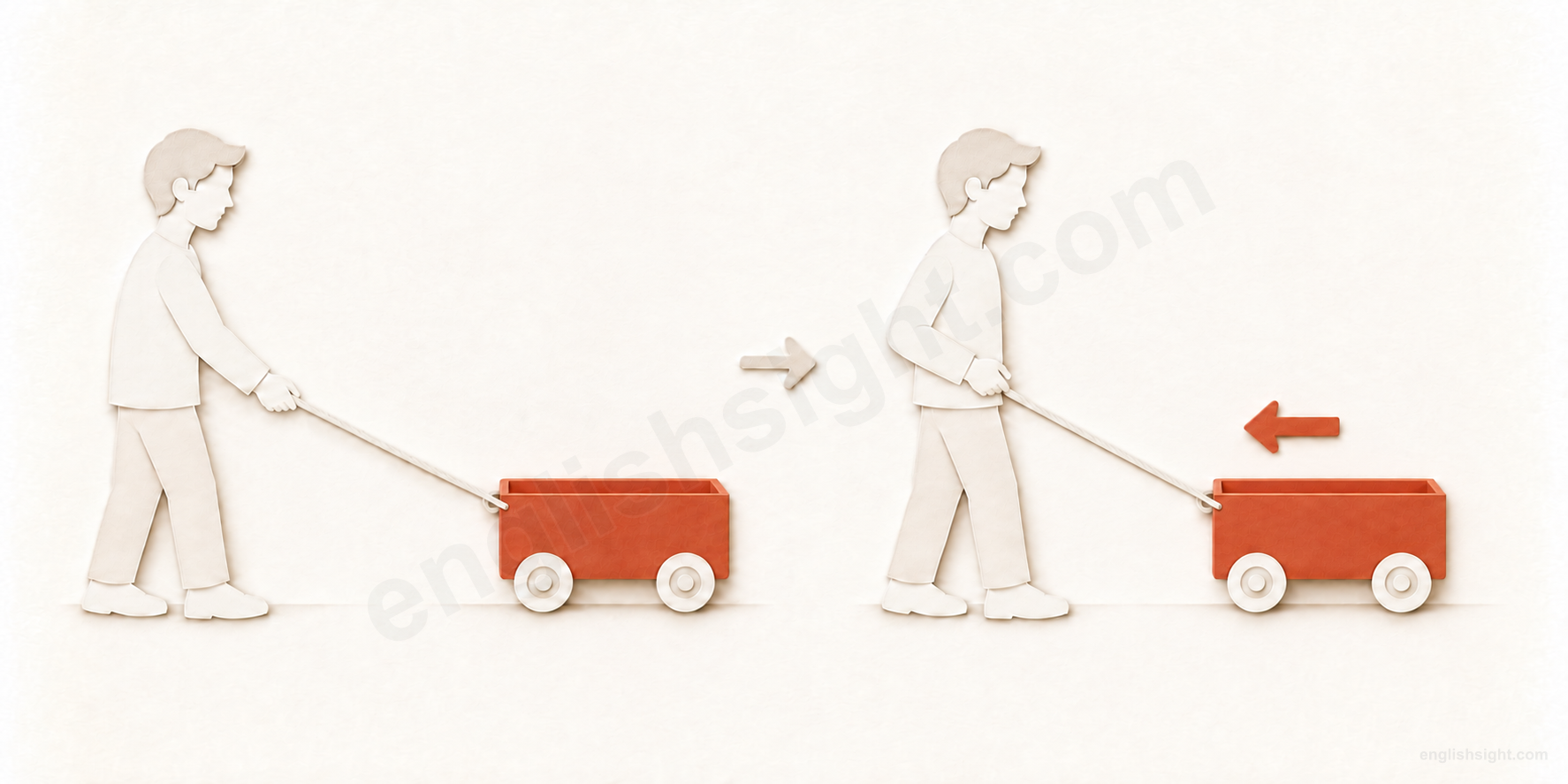
Follow the force, then let the construction specify movement, effort, or an established meaning.
A connection transmits a drawing force
A connection transmits a drawing force
The cart is farther away as the man grips the taut rope with an extended arm.
pull
The same cart is closer to him, with its wheels still on the ground.
He draws his gripping hand back toward his waist.
The taut rope transmits a drawing force; here the cart rolls toward the puller.
Apply force through a grip or connection so something tends to move toward the source of the force or follow it.
The cart illustrates physical pulling. A pull may fail to move a stuck object; vehicle expressions and fixed idioms need their own context and grammar.
A useful starting point for pull is a drawing force: a hand or another source acts on something so it tends to move toward that source or follow it. The object may resist, so pulling does not guarantee movement.
Directions and result words matter: pull a door open, pull a cart along, and pull out of a project express different relations. Some familiar combinations, such as pull off an achievement, must be learned as established expressions.
This lesson covers modern verb and noun uses, with everyday patterns and marked expressions to recognize. The visual model is a teaching aid; it is not a claim about a picture shared by all English speakers.
01
Force, movement, and the body
Start with physical pulling. Notice what is held, what moves, and what the following direction or result adds.
01
pull + object; pull at / on + object; pull without an object
pull; pull at / on
apply a drawing force
Starting situation
Your hand grips a rope attached to a cart.
What changes or is meant
You draw the rope toward you; the cart may move.
Pull describes the force or effort; movement is not guaranteed.
Pull the rope names the object directly. Pull on the rope and pull at the rope put attention on the effort applied to it; at often suggests tugging or repeated attempts.
You can simply say Pull! when the object is understood. Compare push: the force presses something away. Drag usually adds movement along a surface; tug suggests a distinct, often sharp pull. A stuck object can resist your pulling or tugging.
To operate a mechanism, you can pull a lever, a cord, or a trigger. The action moves the control; what it activates depends on the device. For example, Pull the cord to ring the bell specifies both the control and its purpose.
In a sentence
I pulled on the rope, but the cart did not move.
Watch the difference With the preposition, say pull on it, not pull it on: the latter can mean put it on.
02
pull + object + adjective
pull open / shut / tight
cause a specified position or condition by pulling
Starting situation
A drawer is closed.
What changes or is meant
The drawer opens as you draw it toward you.
The word after the object states the result.
In pull the drawer open, the drawer receives the force and open describes its resulting state. Pull the straps tight works in the same way. Pull does not itself mean open: a suitable door can also be pulled shut.
Pull the curtains can mean open or close them according to the situation. Add open or closed when the intended result might be unclear. This is an object-plus-result construction, not a separate phrasal verb for each adjective.
In a sentence
Nora pulled the drawer open to find a spoon.
Watch the difference Keep the object before the result: pull it open, not pull open it.
03
pull + object + out (of + place); pull + object + from + place; pull up + plant; pull + plant / pronoun + up
pull out / out of / from; pull up weeds
remove something by drawing it out
Starting situation
A key is deep in your pocket.
What changes or is meant
You bring the key out with your hand.
Out gives the exit; of or from identifies the starting place.
Pull out a key and pull a key out describe removal. Pull it out is the order with a personal pronoun. Pull the key out of your pocket adds the container; pull the key from your pocket is another natural pattern.
The object need not be stuck: you can pull a note from a bag. Pull a tooth means extract it, often in the passive have a tooth pulled. The informal expression pull a gun on someone means take out a gun and threaten them, not tug at the gun.
Pull up weeds means remove them with their roots: We pulled the weeds up before planting. Here up specifies extraction from the ground. With a pronoun, say pull them up. This is different from a car pulling up to stop.
In a sentence
I pulled the key out of my coat pocket.
Watch the difference Do not confuse pull it out, removing it, with pull out of the race, withdrawing from participation.
04
pull on / off + clothing; pull + clothing + on / off
pull on / pull off clothes
put clothing on or remove it with a pulling action
Starting situation
Your boots are beside you.
What changes or is meant
You draw the boots onto your feet.
On and off distinguish wearing from removal.
Pull on your boots focuses on drawing them onto your feet. Pull your boots off describes removing them. Both allow a noun between verb and particle: pull your boots on; pull off your boots.
With a pronoun, put it between them: pull them on or pull them off. Compare pull on the boot when someone is already wearing it: on can instead be a preposition naming what receives a tug. The situation resolves the ambiguity.
In a sentence
It was cold, so I pulled my boots on before going outside.
Watch the difference Put on and take off are more general; pull emphasizes the movement of the fabric or footwear.
05
person / animal / vehicle + pull + load; load + be pulled + by + source
pull a cart / trailer
draw an attached load behind a moving source
Starting situation
A trailer is attached to a car.
What changes or is meant
It follows the car along the road.
The load can remain behind the puller rather than enter their hands.
The car pulls the trailer because the connection transmits force as the car moves. Pull is the broad verb; tow is more specific for drawing a vehicle or boat behind another vehicle.
The load can be the subject of a passive: The trailer is pulled by a small car. There is no transfer of ownership here. The connection and direction of force matter more than reaching a final destination.
In a sentence
A small tractor pulled the loaded cart across the field.
Watch the difference Carry supports a load; pulling a cart normally leaves its wheels supporting it.
06
pull + reflexive pronoun / body part + direction or result; pull away
pull yourself up / free; pull back
move your own body with effort
Starting situation
You grip the rail at the top of the steps.
What changes or is meant
You use it to raise your body.
A reflexive object makes the actor and the moving person the same.
Pull yourself up uses your own effort, often with a support. Pull yourself free describes escaping a grip or obstruction. Yourself is an object; it is not a command for another person to lift you.
She pulled her hand back names the body part. She pulled away can mean she moved away from contact. These physical uses do not require an object when the moving body is understood.
In a sentence
Holding the rail, Ava pulled herself up the last step.
Watch the difference Use the matching reflexive: I pulled myself up; they pulled themselves free.
07
pull + a muscle / hamstring; a pulled muscle; a muscle pull
pull a muscle
injure a muscle by excessive strain
Starting situation
A runner makes a sudden, forceful movement.
What changes or is meant
A calf muscle is injured.
This established use names an injury, not moving a muscle toward your hand.
Pull a muscle describes straining it enough to cause injury. A pulled muscle is a common description of the resulting injury; a muscle pull can also name it.
I pulled a muscle in my back identifies the injured muscle and its location. It does not mean somebody physically tugged on your back. For pain without specifying the injury, hurt is a broader word.
In a sentence
I pulled a calf muscle during the game.
Watch the difference A pulled muscle and a sprained ankle describe different kinds of injury; do not interchange the expressions.
08
pull + object + apart; pull apart + noun
pull apart
separate things or people by pulling
Starting situation
Two joined pieces are stuck together.
What changes or is meant
You draw them in opposite directions until they separate.
Apart supplies separation; the object tells you what is separated.
Pull the pieces apart and pull apart the pieces both work. With a pronoun, use pull them apart. The same expression can describe separating people or animals that are fighting.
In a repair, pulling a device apart means dismantling it. That may be careful work rather than violent destruction. The later figurative use for criticism is treated separately.
In a sentence
We pulled the two wooden pieces apart.
Watch the difference Pull together aims at combination; pull apart aims at separation.
09
pull up + a chair; pull + a chair + up + beside / to…
pull up a chair
bring a chair closer so you can sit nearby
Starting situation
A chair stands away from the table.
What changes or is meant
You move it over and join the others.
This invitation concerns approach and sitting, not lifting a chair into the air.
Pull up a chair is a familiar invitation to sit with someone. In context it normally includes moving the chair into position, then sitting down.
You can also say pull a chair up beside me. Up here helps form the established approach expression; it does not require vertical movement.
In a sentence
Pull up a chair and tell us about your trip.
Watch the difference A car pulled up uses the same surface words for stopping; it has no chair as object.
02
Vehicles, arrivals, and departures
With a vehicle or driver as subject, pull often describes controlled movement. Nobody needs to be towing the vehicle.
10
vehicle / driver + pull away (from + place)
pull away
start driving away
Starting situation
The bus is waiting at the stop.
What changes or is meant
It starts moving away from the stop.
The vehicle itself moves; there is no object being dragged.
The bus pulled away reports departure. The driver pulled away is also natural because the driver controls the bus. From can name the starting point.
This vehicle use is established. Do not assume that an external rope or person is pulling the bus merely because the verb is pull.
In a sentence
The bus pulled away before I reached the stop.
Watch the difference Pull over describes moving to the side, usually to stop; pull away describes setting off.
11
pull out (into + road / traffic); pull off + road
pull out; pull off the road
move out into traffic, or leave the road
Starting situation
A car waits at the edge of the road.
What changes or is meant
The driver moves out into the traffic.
Out and off locate different movements relative to the road.
Pull out can mean move from a side position into the road, or move farther toward its centre to overtake. Into names the space entered: pull out into traffic.
Pull off the road instead means leave the main road, often for a short stop. Here the road is the complement of off: pull off it. Compare pull it off in the success expression, where it is the thing achieved.
In a sentence
We waited for a gap before pulling out into traffic.
Watch the difference Pull out of a competition is withdrawal, not a traffic manoeuvre.
12
vehicle / driver + pull in; pull into + place
pull in / into
arrive and stop at a place
Starting situation
A train approaches the station.
What changes or is meant
It enters the station and stops.
In gives arrival; into introduces a named destination.
The train pulled in announces arrival. The train pulled into the station names the destination. In British usage, a driver can also pull in at the side of the road to stop.
Pull in has other meanings when it takes an object: a show pulls in viewers, and the police pull someone in for questioning. Keep the arriving vehicle pattern distinct from those uses.
In a sentence
Our train pulled into the station just after nine.
Watch the difference Say pulled into the station, not pulled in the station when you mean entry and arrival.
13
pull over; pull + driver / vehicle + over; be pulled over
pull over; be pulled over
move to the roadside, or be made to do so
Starting situation
An ambulance approaches from behind.
What changes or is meant
The driver moves aside to let it pass.
The subject may move voluntarily or be directed by the police.
We pulled over describes our own driving. The police pulled us over means they required us to move to the side. The passive We were pulled over keeps the stopped driver as subject.
With a pronoun object, say pulled us over, not pulled over us for the police meaning. Over does not mean the vehicle turns upside down.
In a sentence
We pulled over to let the ambulance pass.
Watch the difference Being pulled over does not itself state that a fine or arrest followed.
14
vehicle / driver + pull up + at / outside / beside…; pull to a stop / halt
pull up; pull to a halt
slow and stop a vehicle
Starting situation
A taxi is approaching your building.
What changes or is meant
It comes to a stop outside.
Up can be part of a stopping expression, with no upward movement.
The taxi pulled up outside the building means it approached and stopped there. Pull to a stop or pull to a halt makes the stopping point explicit.
A driver can be the subject too: I pulled up beside the gate. Pull over emphasizes movement to the roadside; pull up emphasizes coming to a stop, wherever the context places it.
In a sentence
A taxi pulled up outside our building.
Watch the difference Pull up does not automatically mean park for a long time.
15
pull ahead of + rival; pull away from + rivals
pull ahead / away from rivals
gain a lead or increase the gap
Starting situation
Two runners are level.
What changes or is meant
One moves ahead and opens a gap.
The comparison concerns position in a race or contest.
Pull ahead of someone means move into a leading position. Pull away from the others can emphasize an increasing gap once you are moving faster.
These expressions also work for competition beyond physical racing. Ahead of and away from introduce the rival; the rival is not a direct object being physically pulled.
In a sentence
Lena pulled ahead of the other runners on the final bend.
Watch the difference Pull away from a friend can instead describe emotional distance; use the context.
16
vehicle + pull + to one side; driver + pull + vehicle + to one side
pull to the left / right
move or tend to move sideways
Starting situation
You are trying to drive straight.
What changes or is meant
The car keeps tending toward one side.
A vehicle can pull in a direction without a direct object.
The car pulls to the left describes its tendency to drift or veer that way. I pulled the car to the right describes a driver directing it.
This contrast changes who controls the movement. Neither pattern describes somebody standing outside and dragging the car by hand.
In a sentence
The car kept pulling to the left on the straight road.
Watch the difference Do not read every pull + vehicle sentence as towing: check whether the vehicle is the subject or object and whether a direction follows.
03
Tasks, support, and changing commitments
Some combinations extend movement to cooperation or withdrawal; others have established meanings that need to be learned as whole expressions.
17
pull out (of + activity / place); pull + person / group + out of…
pull out of; pull someone out
withdraw participation or remove a participant
Starting situation
A company plans to join a project.
What changes or is meant
It decides to stop participating.
Out of marks the activity or arrangement being left.
Pull out of a project, agreement, or contest means withdraw from it. You can omit the complement when everyone knows the arrangement: One sponsor pulled out.
Pull the team out of the competition instead makes someone cause the team’s withdrawal. The same leave-a-situation pattern describes troops leaving a place. Pull an economy out of recession describes recovery rather than a decision to abandon an agreement.
In a sentence
The company pulled out of the project after costs rose.
Watch the difference With withdrawal, keep of: pulled out of the agreement, not pulled out the agreement.
18
pull back (from + plan / position); pull + troops + back; pull a goal back
pull back
retreat or step away from a plan
Starting situation
A sponsor is considering a risky expansion.
What changes or is meant
It reduces its commitment instead.
Back suggests movement away from an advanced position or commitment.
Pull back can describe an army retreating or someone deciding not to continue an intended action. From can specify the plan or position being left.
Pull the troops back is the transitive version: someone orders the retreat. In sports reporting, pull a goal back means reduce a deficit by scoring, not remove a goal from the score.
In a sentence
The sponsors pulled back from the expansion plan.
Watch the difference Pull back can describe a retreat from commitment without the complete exit suggested by pull out; the context decides how far.
19
pull off + achievement; pull + achievement / pronoun + off
pull off
manage a difficult achievement
Starting situation
A small team attempts a difficult launch.
What changes or is meant
The launch succeeds.
The whole expression means achieve; off is not a literal exit route.
Pull off a difficult task means manage to accomplish it, often despite doubt or obstacles. Pull off the launch and pull the launch off both work.
With a pronoun, say pull it off. This informal expression assesses success; it does not explain how the task was done. Literal pull your boots off is a separate clothing use.
In a sentence
Nobody expected us to finish in time, but we pulled it off.
Watch the difference Do not use pull off to mean merely try: We tried, but did not pull it off reports failure.
20
pull through (a crisis); pull + person + through (a crisis)
pull through
survive a serious difficulty or recover
Starting situation
Someone is seriously ill.
What changes or is meant
They survive the crisis and begin to recover.
Through places the person beyond a difficult period; success is the established meaning.
She pulled through can describe surviving a serious illness or operation. The team pulled through a difficult year describes getting through a crisis successfully.
Her friends pulled her through makes the friends the source of help. Pull her through the crisis names both the person helped and the difficulty. These are figurative uses, not a claim that someone was physically dragged through a passage.
In a sentence
Their support helped me pull through a very difficult year.
Watch the difference Pull through is not a promise of complete or immediate recovery.
21
people + pull together; pull in different / opposite directions
pull together
work as a coordinated group
Starting situation
People have separate jobs and competing priorities.
What changes or is meant
They coordinate their efforts toward the shared task.
With no object, together describes cooperation.
If we pull together, each person contributes to a common effort. No rope is necessary; coordinated effort offers a useful link to physical pulling.
Pull in different or opposite directions describes conflicting aims that hinder one another. It is not just having different jobs: different jobs can still support one goal.
In a sentence
If we pull together, we can get the hall ready by noon.
Watch the difference Do not confuse pull together with pull yourself together, which concerns emotional control.
22
pull together + material; pull + material / pronoun + together
pull together information
collect and combine material into a whole
Starting situation
Useful notes are scattered across several documents.
What changes or is meant
You combine them into a coherent report.
With an object, the expression concerns organizing material.
Pull together the evidence means collect relevant material and connect it so it can be used. Pull a report together can describe producing a coherent whole from its parts.
This differs from the team pulled together: there the team is cooperating, with no material as a direct object. With a pronoun object, say pull it together.
In a sentence
I pulled the notes together into a short report.
Watch the difference Together signals combination, not merely moving every document into the same physical location.
23
pull + matching reflexive pronoun + together
pull yourself together
regain enough emotional control to act calmly
Starting situation
You are upset before speaking.
What changes or is meant
You steady yourself and continue.
The reflexive expression concerns composure, not assembling a team.
I need a moment to pull myself together means I need to settle my feelings so I can function calmly. The reflexive changes with the person: she pulled herself together.
The command Pull yourself together! can sound impatient or unsympathetic to someone in distress. A self-description is often gentler. This is an established expression rather than a literal instruction to join body parts.
In a sentence
I took a quiet minute to pull myself together before the call.
Watch the difference Use yourself when talking to one person; do not replace it with you in this expression.
24
pull down + building; pull + building / person + down
pull down
demolish a building; weaken a person
Starting situation
An unused warehouse is still standing.
What changes or is meant
Workers demolish it.
With a building as object, down describes destruction.
Pull down the warehouse means demolish it; the method need not be a single literal tug. Pull it down is the pronoun order.
Pull somebody down can instead mean harm their happiness, health, or success, especially in American English: The constant criticism pulled her down. That is a different figurative use. Literal pull the blind down simply specifies a downward position.
In a sentence
They pulled the old warehouse down last summer.
Watch the difference Pull down a building is not the opposite of pull up a car: the objects select different meanings.
25
pull in / down + amount (+ a month / year)
pull in / down money
earn a stated amount
Starting situation
A consultant has several major clients.
What changes or is meant
Her work brings in a large income.
The amount is money earned, not cash physically being pulled.
Pull in or pull down an amount is an informal way to describe earning it, often emphasizing that the sum is large. A time expression sets the rate: a month or a year.
This use has an object, the amount earned. The train pulled in has no such object and means arrived; the old building was pulled down concerns demolition.
In a sentence
She pulls in more from consulting than from teaching.
Watch the difference Use earn in neutral formal writing when you do not want the informal tone.
The people come because of the attraction, rather than being moved by force.
Pull a crowd and pull in a crowd describe attracting an audience. The band pulled the crowds in is also possible; with a pronoun, pull them in puts the pronoun before the particle.
This informal use can concern viewers or voters as well as people at a venue. The physical diagram offers an analogy for attraction, but nobody needs to grab the audience.
In a sentence
The free concert pulled in a large crowd.
Watch the difference The object helps distinguish pull in viewers from a train pulling in.
The object is taken out of circulation or a schedule.
Pull an advertisement means stop showing or publishing it. Pull an event means cancel it. Informal news reports also use pull a product for removing it from sale.
The passive is natural: The advertisement was pulled after complaints. From can specify the outlet or market: pulled from sale. Pull does not explain the reason; the surrounding sentence must provide that.
You can also pull support or funding, meaning withdraw it: The sponsor pulled its funding after the delay. The object names what is no longer being provided.
In a sentence
The company pulled the advertisement after customers complained.
Watch the difference Pull a show may mean cancel or stop showing it; it does not mean draw a picture of it.
28
pull up + file / record / information; pull + it + up
pull up a file
retrieve information for display
Starting situation
A record is stored but not visible.
What changes or is meant
You open it so it appears on the screen.
The information becomes available to view; nothing needs to move physically upward.
Let me pull up your record is an ordinary way to say you will retrieve and display it. Pull the record up also works; with a pronoun, use pull it up.
This established computer use differs from looking up information, which emphasizes searching for it. You may look up an address and then pull up a map to show it.
In a sentence
Let me pull up the booking details on my screen.
Watch the difference Do not say pull up it. Up is a particle here, not a preposition introducing the screen.
29
pull + person + in (for questioning); be pulled in
pull someone in
bring someone to the police station for questioning
Starting situation
The police want to question a suspect.
What changes or is meant
They take the person to the station.
This informal expression concerns police questioning.
The police pulled him in means they brought him to the station to ask questions about a crime. In We were pulled in for questioning, the passive focuses on the people questioned.
It is not the same as pull someone over, which makes a driver stop at the roadside. The expressions do not by themselves tell us whether the person is later charged.
In a sentence
The police pulled him in for questioning about the missing van.
Watch the difference Use brought in for questioning if you want a more neutral description.
30
person + pull away from + person / relationship
pull away from someone
become less emotionally close
Starting situation
A friend used to talk openly with you.
What changes or is meant
They start avoiding close contact.
Distance can describe a relationship rather than body movement.
She is pulling away from me may describe a gradual reduction in emotional closeness. Context matters: the same words can describe a physical movement away from a touch.
From names the person or connection left at a distance. This figurative use suggests withdrawal, but does not alone explain the reason or prove that the relationship has ended.
In a sentence
Since the argument, he has been pulling away from his friends.
Watch the difference Do not confuse pulling away emotionally with pulling for someone, which expresses support.
31
pull + argument + apart; pull + person + up + on / for + issue
pull an argument apart; pull someone up
criticize in detail, or point out wrongdoing
Starting situation
A proposal contains several weak claims.
What changes or is meant
A reviewer examines and criticizes them.
An argument can be treated as a structure whose weaknesses are exposed.
Pull an argument apart means criticize it closely, often severely. Pull the report to pieces is a related established expression. The report need not be physically torn.
Pull someone up on or for something instead means challenge or criticize a specific mistake or action, especially in British informal English: She pulled me up on my spelling. Keep the person before up.
In a sentence
The reviewer pulled the argument apart in her response.
Watch the difference Criticizing an argument is different from pulling two fighting people apart.
32
person + pull up (short); something + pull + person + up short
pull up short; pull someone up short
stop suddenly, or make someone pause abruptly
Starting situation
You are explaining a plan without considering its full cost.
What changes or is meant
A colleague’s question makes you stop mid-sentence.
The subject can be the person stopping or what makes them stop.
A person can pull up short: a runner may stop suddenly on seeing an obstacle. This is an established stopping use of up, not an instruction to pull the body upward.
A question, remark, or thought can pull someone up short by interrupting what they are doing. Her question pulled me up short can mean it made me stop speaking and reconsider. Nobody has to grab or physically move the person.
In a sentence
Her question about the cost pulled me up short.
Watch the difference Pull me up on my spelling describes criticism; pull me up short describes a sudden interruption. Criticism may cause a pause, but the meanings are distinct.
33
pull + a stunt / trick (on + person); pull an all-nighter
pull a stunt / trick; pull an all-nighter
carry out an action in an informal expression
Starting situation
Someone plans a dramatic or demanding action.
What changes or is meant
They carry it out.
The noun supplies the type of action; this is not a physical pull.
Informal pull a stunt or pull a trick means carry out the stunt or trick. A stunt may be a dramatic, foolish, or attention-getting action rather than deception: Don’t pull that stunt again warns against repeating the behavior.
Pull an all-nighter means stay up through the night, for example to study or finish a task. In this established expression, pull contributes a do-or-perform meaning; the noun supplies the overnight activity.
These are familiar informal combinations, not permission to replace do or perform with pull before any action noun. Use the ordinary verb when you do not know that the combination is established.
In a sentence
I had to pull an all-nighter to finish the report.
Watch the difference Pulling a stunt does not necessarily succeed at its aim; pulling something off explicitly presents an achievement.
04
Familiar expressions in conversation
These expressions serve different purposes: joking, asking for effort, describing influence, or criticizing. Their wording and tone matter.
34
pull + someone’s + leg
pull someone’s leg
tease someone with an untrue claim
Starting situation
A friend tells you an implausible story.
What changes or is meant
They admit it was a joke.
The joke depends on what is said, not on touching a leg.
I’m only pulling your leg tells someone that the surprising statement was playful teasing. Are you pulling my leg? checks whether they are joking.
Keep the possessive tied to the person teased: pull my leg, pull her leg. This informal idiom usually suggests a joke, rather than serious deception for profit.
In a sentence
I didn’t really win a boat—I was just pulling your leg.
Watch the difference Use the singular leg in the familiar expression; do not interpret it as an instruction to grab someone.
35
pull (a few) strings; pull the strings
pull strings; pull the strings
use connections, or control events
Starting situation
You need help obtaining a scarce ticket.
What changes or is meant
Someone uses a personal contact to arrange it.
The article changes the familiar expression’s focus.
Pull strings means use personal influence or contacts to obtain an advantage: pull a few strings to get a ticket. It can suggest special treatment rather than an open process.
Pull the strings means control events or other people, often behind the scenes: Who is really pulling the strings? Learn that wording separately. A puppet’s strings offer a memory comparison, not proof of either expression’s full meaning.
In a sentence
Mia pulled a few strings and found us two tickets.
Watch the difference Do not treat pull strings and pull the strings as interchangeable in every sentence.
36
pull + possessive + weight
pull your weight
do your fair share of a shared task
Starting situation
Other people keep finishing your part of the work.
What changes or is meant
You begin contributing your share.
Weight represents your share of the effort, not body mass.
Everyone must pull their weight asks each person to contribute adequately. Alex isn’t pulling his weight criticizes Alex for leaving others with too much work.
The possessive follows the contributor: my weight, her weight, our weight. This is an established teamwork expression; it does not require equal physical strength or identical jobs.
In a sentence
We can finish today if everyone pulls their weight.
Watch the difference Pulling your weight concerns contribution; pulling yourself together concerns composure.
37
pull out all the stops + to-infinitive
pull out all the stops
make every possible effort
Starting situation
A team has a very tight deadline.
What changes or is meant
It uses every available resource to meet it.
The whole expression describes maximum effort.
Pull out all the stops means do everything you reasonably can to achieve the goal. A following to-infinitive can state that goal.
This does not mean remove traffic stops or stop working. It describes effort, and does not guarantee success. Keep all the stops together as part of the idiom.
In a sentence
We pulled out all the stops to get the exhibition ready.
Watch the difference Do not confuse it with pull out of the exhibition, meaning withdraw from participation.
38
pull the plug on + project / activity
pull the plug on
stop an activity or project
Starting situation
A project depends on continued funding.
What changes or is meant
The funder ends that support and the project stops.
A familiar power-supply comparison helps explain ending the activity.
Pull the plug on a project means make it stop, often by withdrawing support or permission. It does not have to involve electrical equipment.
Literal pull the plug out means remove an actual plug. In the idiom, on introduces the project or activity being ended. The whole expression, not pull alone, carries that meaning.
In a sentence
The owners pulled the plug on the expansion after costs doubled.
Watch the difference Pull the plug on a project is stronger than merely delaying it.
39
not pull any punches; pull no punches; not pull one’s punches
not pull any punches
speak or criticize very directly
Starting situation
A review could soften unpleasant criticism.
What changes or is meant
The writer states the criticism plainly.
The negative expression says the criticism is not held back.
Pull your punches means reduce the force of what you say or do. In conversation about reviews or criticism, the phrase often appears negatively: She doesn’t pull her punches; The review pulled no punches.
This does not require physical boxing. The familiar comparison concerns holding back force; it says nothing by itself about whether the criticism is fair.
In a sentence
The review pulled no punches about the film’s weak ending.
Watch the difference With no or not, the meaning is directness, not gentleness.
40
pull rank (on + person)
pull rank
use higher status to get your way
Starting situation
Colleagues disagree about a decision.
What changes or is meant
A senior person insists because of their position.
The power comes from status rather than the strength of the argument.
Pull rank on someone means invoke your higher position to make that person comply. It often expresses disapproval of how authority is being used.
It is not simply another way to say manage or lead. A manager can lead without pulling rank. Rank here names status; it is not a physical object being moved.
In a sentence
He pulled rank and insisted that the meeting start without us.
Watch the difference Do not add a possessive as if it were pull your weight: the familiar form is pull rank.
41
pull + possessive + socks + up
pull your socks up
improve your effort or performance
Starting situation
Your recent work has been careless.
What changes or is meant
Someone tells you to do better.
The clothing expression has a separate established figurative meaning.
Pull your socks up is a British informal way to tell someone to work harder or improve. It can sound like a reprimand rather than friendly encouragement.
He needs to pull his socks up changes the possessive to match the person. Actual loose socks would make the same words literal; a conversation about poor work normally makes the figurative meaning clear.
In a sentence
I need to pull my socks up before the next exam.
Watch the difference The socks remain plural in the familiar idiom.
42
pull / make a face; pull faces at + person
pull a face
make an expressive face
Starting situation
A child tastes a sour lemon.
What changes or is meant
Their expression shows dislike.
The action is changing your expression, not pulling skin with your hands.
Pull a face can express dislike or be intended to make someone laugh. Pull faces at someone describes directing those expressions toward them.
Make a face is another widely used form. Unlike pull someone’s leg, this expression concerns a visible expression rather than a false statement.
In a sentence
Ella pulled a face when she tasted the sour sauce.
Watch the difference Do not infer that a face must be touched or stretched by hand.
43
pull a fast one (on + person); pull the wool over + someone’s + eyes
pull a fast one; pull the wool over someone’s eyes
trick someone or hide the truth
Starting situation
A seller conceals a defect.
What changes or is meant
The buyer is led to believe the item is fine.
These expressions usually suggest deception, rather than harmless teasing.
Pull a fast one on someone means cheat or trick them. The expression is informal and often accusatory: Don’t try to pull a fast one on me.
Pull the wool over someone’s eyes means deceive them so they do not see the truth about your actions or intentions. Compare I’m pulling your leg, which usually frames the false claim as a joke.
In a sentence
The seller tried to pull the wool over our eyes about the repairs.
Watch the difference Keep on after a fast one when naming the person tricked; keep over in the wool idiom.
44
doing something + be + like pulling teeth
like pulling teeth
extremely difficult and frustrating
Starting situation
You keep asking for a simple answer.
What changes or is meant
Getting it takes much more effort than expected.
The comparison emphasizes resistance or difficulty.
Getting an answer was like pulling teeth complains that it was very hard to obtain one. No dental procedure is involved in this figurative use.
It often appears when someone will not cooperate, but the comparison can also describe other frustrating tasks. Use it informally; it adds the speaker’s reaction rather than a precise measure of difficulty.
In a sentence
Getting a clear answer from them was like pulling teeth.
Watch the difference Getting a tooth pulled is a literal dental expression; like pulling teeth usually introduces a comparison.
45
pull for + person / team
pull for someone
hope for or support someone’s success
Starting situation
A friend faces a difficult competition.
What changes or is meant
You want them to do well and encourage them.
For identifies the person supported.
We’re all pulling for you means we hope you succeed and are on your side. The expression is informal, especially American.
You need not be a participant or provide practical help; the phrase can express encouragement. It is different from pulling someone through a crisis, where the subject’s help enables recovery or success.
In a sentence
We’re all pulling for you in tomorrow’s final.
Watch the difference Keep for before the person: pulling you describes a physical action unless another construction changes it.
05
Pull as a noun and uses to recognize
A pull can be an action, a force, an attraction, influence, or a handle. A few marked uses are useful to recognize without treating them as neutral everyday choices.
46
give + object + a pull; the pull of + force / source
a pull; the pull of gravity
a pulling action or a drawing force
Starting situation
A handle resists your first attempt.
What changes or is meant
One stronger pull moves it.
A countable action and a continuing force are related noun uses.
Give the handle a pull names one act of pulling. The noun allows descriptions such as a gentle pull or two quick pulls.
The pull of gravity names a physical force, rather than one person’s action. Here no hand or rope is needed. The diagram’s connection is one physical example, not the only way a pulling force can act.
In a sentence
I gave the handle a gentle pull.
Watch the difference A pull is countable for an action; do not assume every noun use takes a or a plural.
47
the pull of + attraction; have (a lot of) pull with + people; something + pull + person + direction; feel pulled in two directions
the pull of something; have pull; feel pulled in two directions
attraction, influence, or competing pressures
Starting situation
Home feels increasingly attractive to you.
What changes or is meant
You feel drawn to return.
Pull can name attraction without literal movement.
The pull of home describes its emotional attraction. A place, activity, or memory can have a strong pull even when you do not act on it.
Have a lot of pull with someone instead means have influence over them, informally: She has pull with the organizers. This influence use is uncountable. Compare the verb phrase pull strings, which describes using contacts to arrange an advantage.
The verb can describe attraction too: Family ties pulled her back home. In I feel pulled in two directions, competing wishes or duties seem to draw you toward different choices. No literal movement is required; the context identifies the pressures.
In a sentence
After years abroad, I began to feel the pull of home.
Watch the difference In the influence sense, say a lot of pull, not many pulls.
48
door / drawer / bell + pull
a door / drawer pull
a handle used for pulling
Starting situation
A drawer has a small metal handle.
What changes or is meant
You grip it to open the drawer.
The noun can name the part designed to be pulled.
A door pull or drawer pull is a fitting used to pull the door or drawer. In a compound, the first noun tells you what it belongs to.
The word can therefore label hardware in a shop rather than an action. The sentence The pull is loose usually concerns the handle, while Give it a pull asks for an action.
In a sentence
One of the drawer pulls is loose.
Watch the difference Read the noun phrase and situation: a pull can be the handle or an act of pulling it.
49
pull (someone); be on the pull; take a pull at / on + drink or cigarette
pull someone; on the pull; take a pull
recognize informal attraction and drink or smoke uses
Starting situation
You hear pull in a social or literary description.
What changes or is meant
The surrounding phrase selects a marked meaning.
These uses need their context and register.
In British informal English, pull someone can mean succeed in attracting a sexual partner. On the pull is British slang for looking for a sexual partner. These are not neutral substitutes for meet someone or make a friend.
Take a pull at or on a drink means take a deep drink; a pull on a cigarette means an inhalation of smoke. The verb pull on or at a cigarette has the related smoking sense. Compare pull on a rope, where on introduces the object receiving force.
In a sentence
In the novel, the sailor took a long pull at his flask.
Watch the difference These meanings cannot be identified from pull alone. Do not interpret pull a person automatically as sexual attraction.
Follow the object and the whole construction
Forms and pronunciation
Pull is pronounced /pʊl/, with the vowel of full, not pool. The regular forms are pull, pulls, pulled, pulling; the past participle is pulled. Progressive forms describe ongoing actions: I’m pulling the rope. A pulled muscle uses the participle to describe an injury.
A force does not guarantee success
I pulled, but it would not open is natural. In pull it open, however, open presents the result. Do not make the successful cart movement in the sketch a rule for every pull sentence.
Objects, particles, and prepositions
Separable object–particle uses put personal pronouns between the verb and particle: pull it out, pull them apart, pull it off. A preposition keeps its complement after it: pull on it, pull out of it, pull for them. Read the pattern instead of calling every verb-plus-small-word combination the same kind of phrasal verb.
Passive and causing movement
The cart was pulled by a tractor, We were pulled over, and The advertisement was pulled are natural passives of transitive uses. In The train pulled in, no object is being acted on, so an arrival passive such as The station was pulled in is not available. Pull him to safety and pull the door shut describe causing movement or a result; ordinary pull does not use a general pull someone to do something pattern meaning persuade.
Marked uses and boundaries
Not every combination is neutral or equally useful. Slang, regional labels, and reprimanding idioms are identified in their entries. Specialized rowing, ball-sport, horse-racing, printing, and old senses are not developed here. A steep walk called a long pull and less central idioms remain outside the main learning selection.
Choose what the pattern means
Use the subject, object, and words following pull to choose the intended meaning.
1. You pull a stuck handle, but it stays still. Which statement is accurate?
2. You managed a difficult task. Replace the task with it.
3. The police made your driver stop at the roadside. Which fits?
4. A sponsor stops participating in the project. Which expression fits?
5. You want colleagues to cooperate. Which request addresses that?
6. Someone quietly controls the decisions behind an event. Which wording fits?
7. You apply force to a rope called it. Which is the pull on construction?
Sources and teaching notes
Usage and coverage were checked against publisher dictionary material listed below. The explanations, examples, and visual model were written for this lesson. Source-access details and the limits of the selection are recorded in the coverage inventory.
The diagram is a teaching model for one relationship, not a shared mental picture of every English speaker.