From pumps and pumping to increased energy, abundant output, persistent questions, and a separate shoe noun.
Force produces a flow
Force produces a flow
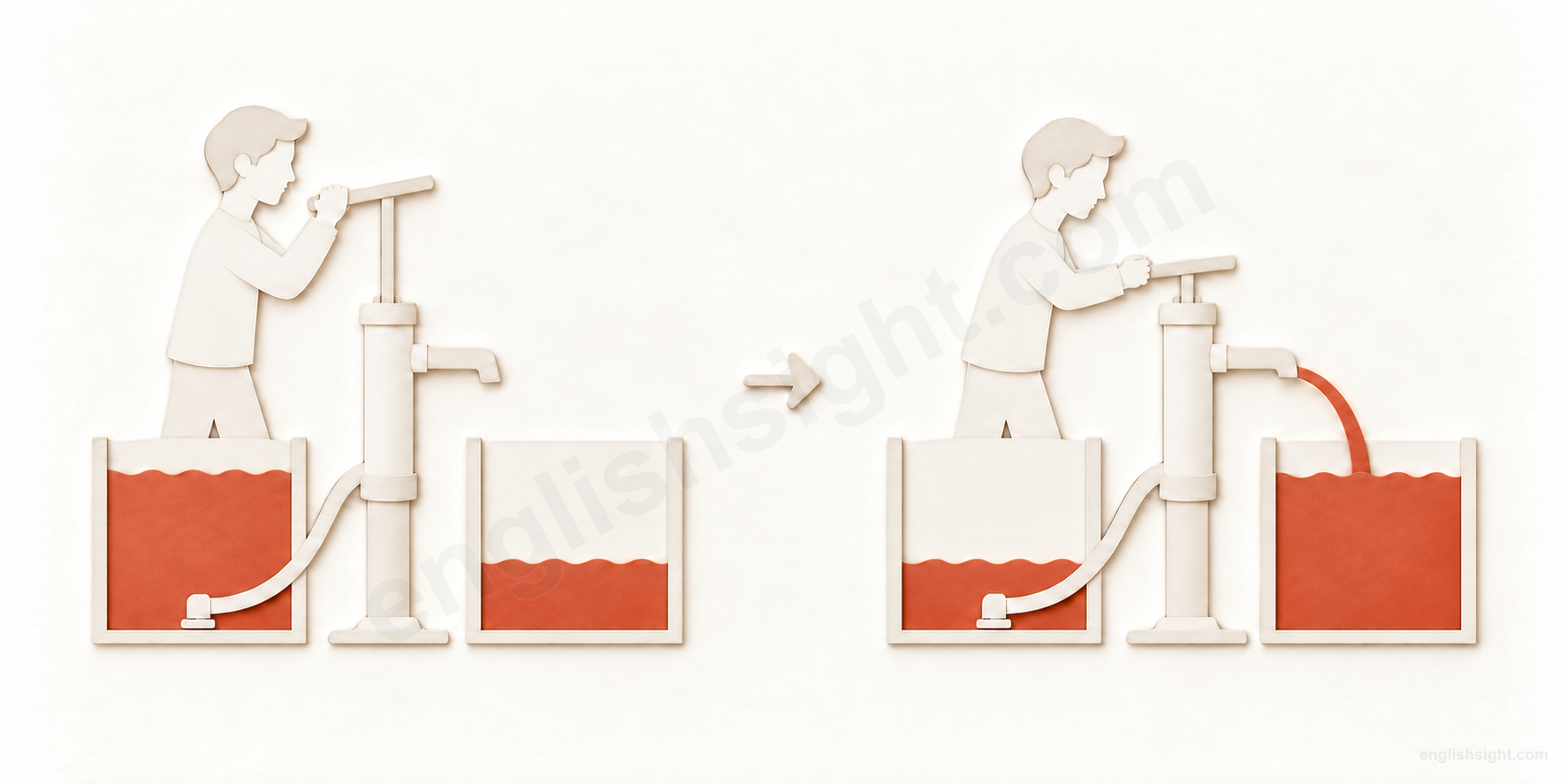
The handle is raised; the source tank holds more water than the receiving tank.
pump
The handle is lower; the source level has fallen and the receiving level has risen.
Repeated strokes drive water from the source through the pump into the receiving tank.
Pumping supplies the force that moves water from one tank to the other.
A pump applies force to move liquid or gas into, out of, or through something.
A hand-operated piston pump illustrates the relationship; not all pumps have this shape or work in visible strokes. Figurative expressions reuse aspects of force, repetition, input, or output, while the shoe noun is separate.
A pump supplies force to move liquid or gas. The verb can name that action, the repeated movement of a handle or body part, and familiar extensions involving forceful input or output.
Use this connection as a learning aid, then check the object and the whole expression. Shoes called pumps form a separate branch; not every expression can be predicted from one picture.
01
Machines, flow, and repeated movement
Start with equipment and the action it performs. Notice whether the subject is the operator, the pump, the heart, or the moving liquid.
01
a / the + pump; type or purpose + pump
a pump; a hand / bicycle / water pump
a device that moves liquid or gas by applying force
Situation / source
Water must be raised, or air must enter a tyre.
Action / result
A suitable device supplies the force.
The noun names the equipment; the verb names its action.
A pump is a countable device: a pump, two pumps. The word before it often identifies its purpose or how it is operated: a water pump moves water; a hand pump is operated by hand.
A bicycle pump is one familiar example, not the definition of every pump. Some pumps use a piston; others use rotating parts. A pump need not visibly move up and down.
Compare a pipe, which provides a route. A pump supplies the driving action; a pipe alone does not perform that job.
In a sentence
There is a small water pump beside the tank.
Watch the difference Use an article with a singular countable noun: We need a pump, not We need pump.
02
petrol / gas + pump; pump gas; at the pump
a petrol pump / gas pump; pump gas
fuel-dispensing equipment, or the action of dispensing fuel
Situation / source
A driver stops at a filling station.
Action / result
Fuel passes from the dispenser into the vehicle.
Petrol pump and gas pump name the same kind of station equipment.
Petrol pump is British wording; gas pump is North American wording. Gas here is short for gasoline, so it does not mean that the fuel must be gaseous.
In American English, pump gas means dispense gasoline, often while filling a car. At the pump refers to the point of purchase: prices at the pump are retail fuel prices.
The driver can be the subject of pump even when an electric mechanism supplies the pressure. The sentence describes operating the equipment, not necessarily moving a handle.
In a sentence
We stopped at the next gas pump, and I pumped gas while Leo cleaned the windshield.
Watch the difference Do not interpret American gas in this context as British gas used for heating.
03
pump + liquid / gas + into / from / through / around + place
pump water into / from / through…
make a liquid or gas flow along a specified route
Situation / source
Water is in an underground tank.
Action / result
A pump drives it to the garden.
The object names the substance; the preposition supplies its route.
Pump water into a tank gives a destination; pump water from a well gives a source; pump water through a filter gives a route. Pump itself does not mean only inward or only outward movement.
A person or a machine can be the subject. We are pumping water describes an activity in progress. Water is pumped through the filter is a natural passive when the process matters more than the operator.
Compare pour, which describes making a liquid flow, typically by tipping a container. Pump specifies a pumping mechanism or a similar driving force, not simply any movement of liquid.
In a sentence
The machine pumps water from the tank through a filter.
Watch the difference Keep the route clear: into marks entry, from marks origin, and through marks passage.
04
pump + liquid / place + out; pump out + liquid / place; pump + place + dry
pump out the water; pump the cellar dry
remove liquid by pumping, or describe the emptied place
Situation / source
Floodwater covers the cellar floor.
Action / result
Pumping removes it, eventually leaving the cellar dry.
The object can be the liquid removed or the place cleared.
Pump the water out focuses on the water. Pump out the cellar focuses on the place: it means remove the water from it, not move the cellar.
Pump the cellar dry adds a result adjective. Pumping alone describes the activity; dry states the achieved condition. The cellar was pumped dry is the corresponding passive.
With a pronoun in the separable out pattern, say pump it out. The noun can occur on either side: pump out the water or pump the water out.
In a sentence
They pumped the cellar dry before repairing the floor.
Watch the difference Do not assume every sentence with pump out promises complete dryness; dry adds that result.
05
heart + pump + blood; heart + be pumping + fast / hard
the heart pumps blood; my heart is pumping
the heart drives blood, or beats strongly
Situation / source
A runner begins climbing a hill.
Action / result
The heart works harder to circulate blood.
A living organ performs the fluid-moving function.
In The heart pumps blood, blood is the object and the heart supplies the force. Around the body can identify the circulation route.
My heart was pumping fast uses pump without an object. It draws attention to the beating or working heart, often during effort or excitement. It need not name a machine.
Beat is the ordinary general verb for a heart’s repeated action. Pump highlights the forceful working or circulation; neither verb alone diagnoses a medical problem.
In a sentence
My heart was pumping hard after the steep climb.
Watch the difference The heart pumps blood; it does not pump a person in this sense.
06
liquid + pump + out of / from / through + place
liquid pumps out of / through…
liquid flows forcefully, as if driven by a pump
Situation / source
A pipe is open while the system is running.
Action / result
Water flows strongly from the opening.
The liquid itself can be the grammatical subject.
Water was pumping out of the pipe describes the flow, with no direct object after pump. Compare The machine was pumping water out of the pipe: the machine now causes the flow.
The expression can emphasize a strong or surging flow without identifying a visible pump. Context supplies the actual cause.
Out of and through still describe direction. They do not automatically make this an idiom; the sentence can be a straightforward description of fluid movement.
In a sentence
Water was pumping out of the broken pipe.
Watch the difference Do not add an object when the subject is the liquid flowing: Water pumped out is complete in this context.
07
pump + handle / arms / someone’s hand; body part + be pumping
pump a handle / your arms; legs pumping
move something repeatedly back and forth or up and down
Situation / source
An athlete accelerates, or an operator works a lever.
Action / result
The arms, legs, or handle move in repeated strokes.
Repeated movement can be described even without liquid.
Pump the handle describes repeated operating strokes. Pump your arms describes vigorous repeated arm movement while running; it does not mean fill your arms with air.
Her legs were pumping has no direct object: the legs themselves move. The runner pumped her arms has an object: she moves her arms.
He pumped my hand describes an energetic repeated handshake. The object and context distinguish greeting, exercise, and operating machinery.
In a sentence
She ran up the final slope, her arms pumping.
Watch the difference Pump suggests repeated vigorous movement here, not every slow or single movement.
02
Pump up and pump out
Up can indicate inflation or an increase; out can indicate removal or a strong stream of output. The object and situation select the meaning.
08
pump up + tyre / ball; pump + tyre / ball / it + up
pump up a tyre / ball
fill something with air using a pump
Situation / source
A ball is soft because it contains too little air.
Action / result
Pumping adds air and makes it firmer.
Up marks inflation, not a change in location.
Pump up the ball and pump the ball up mean inflate it with a pump. With a pronoun, use pump it up, not pump up it.
Compare pump air into the ball: air is the substance being moved, whereas the object of pump up is the thing being inflated.
Inflate is a more general verb that can describe other ways of filling with air or gas. Blow up a balloon often means use your breath; pump up specifies a pump in this physical use.
In a sentence
Could you pump this ball up before the game?
Watch the difference Up does not mean lift the ball higher; the change is inflation.
09
pump up + amount / value / volume; pump + it + up
pump up the volume / prices
increase an amount, level, or value
Situation / source
The music is quiet.
Action / result
Someone makes it louder.
The inflation image extends to an increase on a scale.
Pump up the volume is an informal way to say increase the volume. The object is a level, not a container filled with air.
With prices, figures, or a story, pump up can suggest making something bigger or more impressive, sometimes with a critical tone. It does not automatically prove dishonesty.
Turn up the volume is a neutral everyday alternative for sound. Choose increase or raise for many formal descriptions; do not replace every instance of increase with pump up.
In a sentence
The DJ pumped up the volume for the last song.
Watch the difference Read the object: pump up a tyre is inflation; pump up the volume is an increase in sound level.
10
pump + someone / yourself + up; be pumped (up) + for + event
pump someone up; be pumped (up)
make someone excited, confident, or ready for effort
Situation / source
The players feel flat before a match.
Action / result
A speech raises their energy and determination.
The added energy is emotional rather than compressed air.
Pump someone up is informal. A coach can pump the players up, and a player can pump herself up. The reflexive form says she prepares her own state of mind.
I’m pumped for the match and I’m pumped up for the match describe enthusiasm. Pumped can work as an adjective; it need not describe a specific action performed on you.
With a pronoun, say The music pumps me up. Compare calm me down: that lowers excitement, whereas pump me up raises it. Excited is a useful neutral alternative.
In a sentence
That song always pumps me up before a race.
Watch the difference This is informal enthusiasm, not necessarily anger, physical inflation, or drug use.
11
pump out + products / emissions / information; pump + them + out
pump out products / fumes / news
produce or emit a large or continuous amount
Situation / source
A source keeps operating.
Action / result
A stream of products, emissions, or information comes from it.
Out presents a strong stream of output, not just removal.
A factory pumps out products; an engine pumps out fumes; a service pumps out news. The subject produces or sends out the object in quantity.
This informal expression emphasizes the rate or amount. With articles or products it can sound critical of mass production, though it does not necessarily mean the results are poor.
Compare pump water out of a cellar, which describes physical removal. In pump out news there is no literal fluid, and the news is output rather than something removed from a flooded place.
In a sentence
The old engine was pumping out thick smoke.
Watch the difference Pump out does not mean turn a machine off; out describes what comes from the source.
12
source + pump out + music; music + pump out (of + place)
pump out music; music pumps out
play or send out loud music
Situation / source
A venue’s speakers are switched on.
Action / result
Loud music comes from the venue.
The speakers can be the subject, or the music can be the subject.
The speakers were pumping out music describes the source sending out sound. Music was pumping out of the club describes the sound coming out, without a direct object.
This is an energetic description of loud output. It does not mean that a liquid pump is attached to the speakers.
Compare pump up the music or volume, which focuses on making the level higher. Pump out music focuses on the sound being emitted; it does not require a change from quiet to loud.
In a sentence
Dance music was pumping out of the café.
Watch the difference Do not confuse out, which presents output, with up, which can present an increase.
03
Resources and information
These extensions treat money, facts, or answers as something supplied or drawn out. They need their own familiar constructions.
13
pump + money / resources + into + project; pump + money / it + in
pump money into a project; pump money in
put a substantial amount of money or resources into something
Situation / source
A project needs funding.
Action / result
An investor supplies a large amount.
The destination receives resources as a tank receives a flow.
Pump money into a project emphasizes substantial input. It can describe support, expansion, or repeated spending on a struggling activity; success is not guaranteed.
Into is followed by the destination: They pumped cash into it. When the destination is understood, in can stand alone: They kept pumping money in. With a pronoun object in that particle pattern, use pump it in.
Invest is often more neutral and can suggest an expected return. Pump money into highlights the amount or effort of supplying funds, whether or not the spending is wise.
In a sentence
The owners pumped more money into the small theatre.
Watch the difference Keep the destination after into: pump money into it, not pump money it into.
14
pump + facts / information + into + person
pump facts into someone
try to supply someone with a large amount of information forcefully
Situation / source
A learner is already tired.
Action / result
A speaker continues delivering many facts.
The person is treated as a recipient of a forced supply.
Pump facts into someone is figurative and often critical. It presents information delivery as forceful input rather than patient explanation.
The facts are the object; the person follows into. The wording does not imply that the listener understands or remembers the material.
Compare explain something to someone, which focuses on making it clear. Pump facts into someone highlights quantity or pressure and can question the teaching method.
In a sentence
We cannot just pump facts into tired learners and expect understanding.
Watch the difference Do not confuse this with pump someone for facts: that tries to get information from the person.
15
pump + person + for + details / about + topic; pump + information + out of / from + person
pump someone for information; pump information out of someone
question someone persistently to obtain information
Situation / source
Someone knows details that you want.
Action / result
You ask repeated questions in an effort to obtain them.
Here the person is a source, not a recipient.
Pump someone for information is informal and can suggest prying. The person is the direct object, and for introduces the information sought.
Pump information out of someone reverses the grammatical focus: information is the object and out of names its source. Pump someone about a case names the topic instead.
Pump someone for information describes persistent questioning and does not guarantee success or a friendly exchange. Pump information out of someone normally presents information as obtained; tried to pump information out of someone describes only an attempt. Ask someone a question is neutral and need not imply pressure.
In a sentence
At lunch, a colleague tried to pump me for details of the meeting.
Watch the difference For information seeks information from a person; into someone sends information to them.
04
Established expressions and recognition uses
Learn these combinations as expressions, including their tone and limits. Some belong mainly to news, medicine, or regional conversation.
16
pump iron; be pumping iron
pump iron
exercise by lifting weights
Situation / source
Someone wants to develop strength.
Action / result
They train with weights.
The whole expression names weight training.
Pump iron is informal, especially in talk about going to the gym. Iron stands for the weights; the phrase does not mean operate an iron-moving liquid pump.
The repeated lifting makes a useful connection with pumping motion, but learn pump iron as an established expression. It does not describe all exercise: a walk or a swim is not normally pumping iron.
Use iron without an article in this expression. Lift weights is a clear neutral alternative.
In a sentence
I usually pump iron twice a week after work.
Watch the difference Say pump iron for weight training, not pump an iron, which suggests a particular object.
17
have + possessive + stomach + pumped; stomach + be pumped
have your stomach pumped
undergo a procedure that removes stomach contents using a pump
Situation / source
A medical team decides a patient needs this procedure.
Action / result
The team removes stomach contents with equipment.
The patient receives the procedure; they do not do it themselves.
Have your stomach pumped is a medical expression useful for understanding reports and conversations. The stomach is the affected organ; pumped means its contents are removed.
The pattern have + object + past participle presents something done to the person or their body. It is not the past perfect had pumped: She had her stomach pumped describes receiving a procedure.
A passive is also possible: His stomach was pumped. The expression describes what happened; it does not say that the procedure is appropriate in every poisoning situation.
In a sentence
The report said that he had his stomach pumped in hospital.
Watch the difference Do not read the expression as putting air into the stomach.
18
pump + person + full of + substance; be pumped full of + substance
pump someone full of something
put a large amount of a substance into someone
Situation / source
A person receives a large amount of a substance.
Action / result
The description emphasizes how much has been administered.
Full of describes heavy supply into a person, not extraction.
Pump someone full of drugs or medication is an emphatic description. It can sound critical of the amount given; it is less neutral than give someone medication.
The person is the object of pump; full of introduces the substance. The passive They were pumped full of medication keeps attention on the recipients.
This is a recognition expression for accounts of treatment or other substance use. Unlike have someone’s stomach pumped, it describes input rather than removal.
In a sentence
She complained that they had pumped her full of medication.
Watch the difference The wording reports a strong viewpoint about quantity; it does not establish a clinical dose.
19
pump + bullets / shots + into + target
pump bullets / shots into…
fire many shots into a target
Situation / source
A report describes repeated shooting.
Action / result
It describes bullets striking a target.
Repeated forceful delivery is extended to gunfire.
In news and crime writing, pump bullets or shots into a target means fire repeatedly at it. Bullets or shots are the object; into introduces the target.
The expression emphasizes repeated forceful firing rather than a literal pumping device. The account may describe a person or an object as the target.
This is included for recognition, not as a general substitute for shoot. Do not infer a precise number of shots from pump alone.
In a sentence
The report said that several shots had been pumped into an empty car.
Watch the difference This use belongs to shooting contexts; it does not mean physically push loose bullets by hand.
20
prime the pump (of + activity / economy)
prime the pump
provide an initial stimulus to get activity growing
Situation / source
A new venture is struggling to get started.
Action / result
Early support is intended to attract further activity.
This idiom emphasizes getting a process going.
Prime the pump commonly refers to initial financial support intended to stimulate business or economic activity. Collins labels the expression mainly US.
Compare pump money into a business, which emphasizes input and may continue for years. Prime the pump focuses on enabling activity to begin or gather momentum.
Learn the whole expression: prime is the verb and the pump is its object. It does not guarantee that the intended growth actually follows.
In a sentence
A small grant helped prime the pump for the new local businesses.
Watch the difference Do not use prime the pump for every routine payment; it suggests a stimulus to further activity.
21
it is / was all hands to the pump; all hands to the pump!
all hands to the pump
everyone must help with a demanding situation
Situation / source
A group has too much urgent work.
Action / result
Everyone joins in to help.
Hands stands for people helping, not just body parts.
All hands to the pump is a humorous saying calling for everyone’s help. The immediate situation supplies the work: it might be preparing a meal or coping with a rush of orders.
It evokes collective work around a pump, but present-day use does not require an actual machine. Oxford also lists all hands on deck as an alternative.
This is an established saying rather than a productive pump + preposition construction. Keep the familiar wording when using it.
In a sentence
When three large orders arrived together, it was all hands to the pump.
Watch the difference This calls for collective help; it does not mean that everyone is under pressure in the regional under the pump idiom.
22
be / feel + under the pump
be under the pump
be under pressure
Situation / source
Someone faces difficult demands or a heavy workload.
Action / result
They describe feeling pressure.
The whole regional idiom carries this meaning.
Under the pump means under pressure in informal Australian, New Zealand, and South African usage. It is useful to recognize in conversations and regional reporting.
The person is not literally underneath a machine. Unlike pump someone up, this expression does not mean make them enthusiastic.
Under pressure is a broadly understood alternative. The regional label matters: do not assume every English speaker commonly uses under the pump.
In a sentence
We are under the pump with two colleagues away this week.
Watch the difference Keep the: under the pump, not under pump, in this idiom.
05
Pumps: a separate shoe noun
In a clothes shop, pumps can name shoes. Region and shoe style matter; the fluid-moving diagram does not explain this separate noun.
23
a pump; pumps; a pair of pumps
a pair of pumps: formal shoes
plain low-cut dress shoes, especially in North American English
Situation / source
Someone chooses shoes for a formal event.
Action / result
They select a pair of plain dress shoes.
This shoe noun is separate from fluid-moving pump.
In North American usage, pumps are women’s low-cut formal shoes, commonly with a moderate or high heel and without straps or laces. British English commonly calls these court shoes.
A pump is one shoe; a pair of pumps contains two. The plural is common because shoes are usually discussed in pairs.
The machine diagram is not a reliable way to derive this meaning. Merriam-Webster separates the shoe noun from the machine noun, and its origin is recorded separately.
In a sentence
She wore black pumps with her suit.
Watch the difference Pumps in a clothing description does not refer to water equipment; use region and style as clues.
24
pumps; canvas pumps; ballet pumps; a pair of + pumps
pumps; ballet pumps: flat shoes
light flat shoes in British usage
Situation / source
A British speaker describes footwear for school or casual wear.
Action / result
The context identifies canvas sports shoes or soft ballet-style flats.
British pumps can name flat styles rather than heeled court shoes.
In British usage, pumps can mean simple canvas sports shoes with rubber soles, also called plimsolls. The school or sports context helps identify this use.
Ballet pumps are light, soft, flat shoes, including fashion shoes in a ballet-like style. They are a different familiar flat-shoe use, not necessarily technical ballet footwear.
Compare North American dress pumps, which commonly have heels. Do not use the single English label as a promise of one exact shoe shape across regions.
In a sentence
For the summer party, she chose a pair of soft ballet pumps.
Watch the difference Ballet pumps and heeled court shoes are different styles, even though both may be called pumps.
Read the object, the route, and the register
Forms and sentence structure
Forms: pump, pumps, pumped, pumping; pumped is pronounced /pʌmpt/. Both The machine is pumping and They are pumping water are natural. Passives such as Water is pumped through a filter and result patterns such as pump a boat dry are possible. Pump does not normally take a person + to-infinitive to mean make them act.
Particles and prepositions contribute different things
In pump it up and pump it out, the pronoun goes before the particle. In pump money into it and pump information out of her, the person or thing stays after the preposition. A literal route after pump is not automatically a new idiom.
One diagram has limits
Some pumps produce steady flow rather than obvious pulses. Figurative pumping may emphasize force, repetition, amount, or output, depending on the expression. Shoe pumps have a separate lexical history. This teaching diagram does not represent a picture shared by all native speakers.
Coverage boundary
The selection includes everyday physical uses, common particle combinations, established expressions, and regional shoe meanings. Medical and shooting expressions are included for comprehension. Detailed engineering designs, cell-membrane and laser pumping, drug-use slang, sporting pump fakes, and specialized compounds require their own context.
Follow the flow of meaning
Choose the expression that matches the situation, object, and direction.
1. A bicycle tyre needs more air. Which request fits?
2. A colleague keeps asking you for confidential details. Which description fits?
3. A report says, “They pumped the boat dry.” What does dry add?
4. Loud music is coming from a club. The sentence describes output, not a volume adjustment. Which fits?
5. Before a match, a friend says, “I’m really pumped!” What is the likely meaning?
6. A North American clothes description mentions “black pumps with a moderate heel.” What are they?
Sources and teaching notes
Publisher entries were consulted for senses, constructions, regional labels, and expressions. The explanations and examples are original. The diagram is a teaching model; source mappings and exclusions are recorded in the coverage file.
The sketch explains pumping; it does not predict every expression or represent every speaker’s mental image.