Use push for physical force, determined effort, and pressure—then read the whole construction.
Apply force in a direction
Apply force in a direction
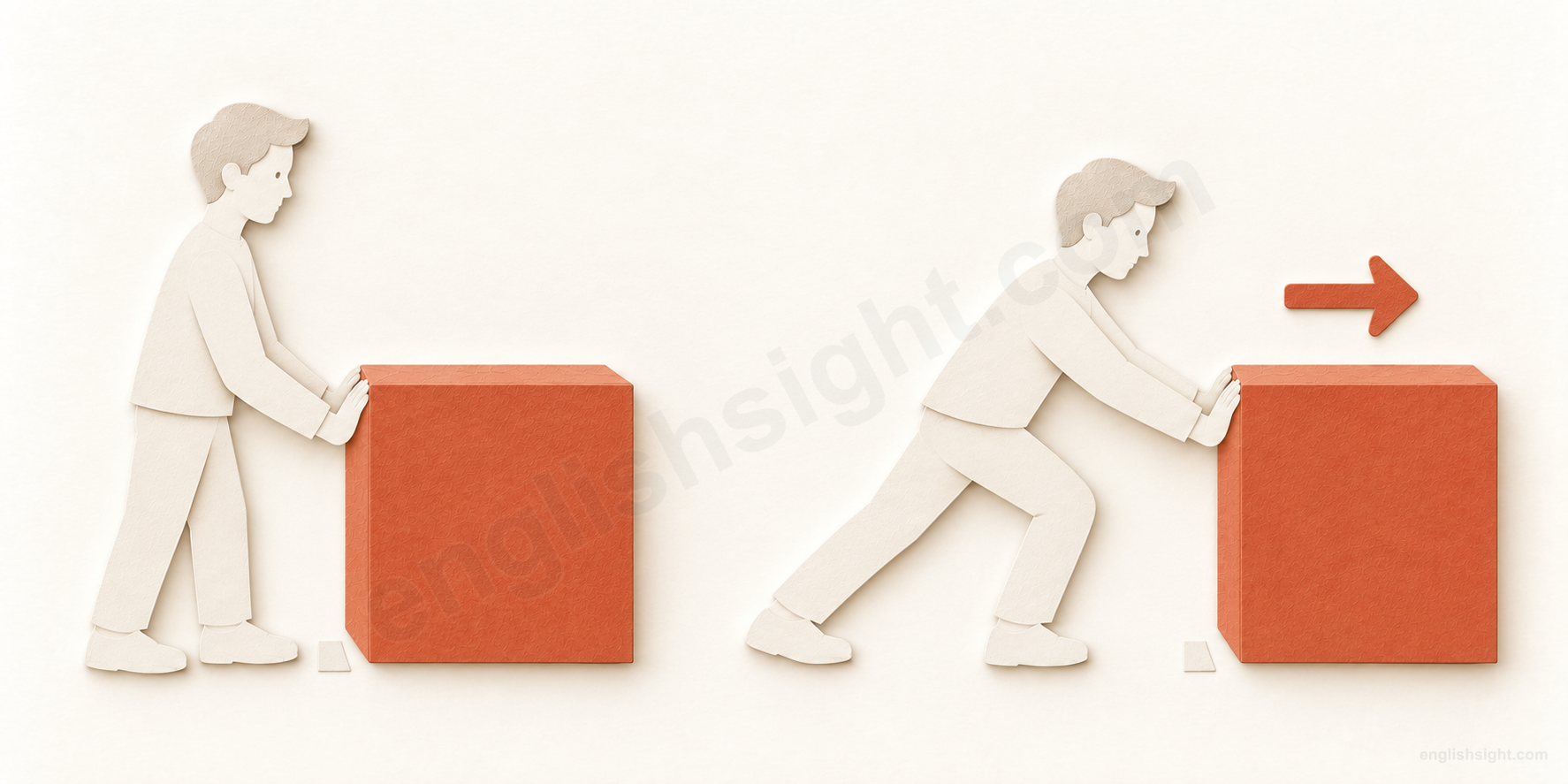
The person stands upright with both palms against the box.
push
The right-pointing arrow shows the direction of the applied force.
Leaning forward with braced legs, the person presses the box to the right.
Push applies directed force to try to move something; movement is not guaranteed.
Apply force against something to try to move it from where it is; in many extended uses, direct pressure or effort toward an action, outcome, or change.
The diagram shows successful physical movement as one example. Pushing need not succeed, and social or abstract pressure does not require literal contact. The model organizes a family of uses; it does not mechanically generate every idiom.
Start with a person pressing against a box to move it. Push focuses on applying force; the box may move, or it may resist. Direction and result words tell you more about the outcome.
English also uses push for pressure on choices, effort toward a goal, and causes of change. These connections help you organize the word, but established expressions such as push the boat out still need their own meanings.
01
Force, contact, and movement
Start with someone or something applying force. A direction, result word, or larger expression tells you what moves and whether a change actually happens.
01
push + object; push; push at / against + object
push a cart / push at a door
apply force to try to move something
Starting situation
A cart stands in front of you.
Action or outcome
Your hands apply force to it.
Push describes the force; movement may fail.
The person pushing is the subject; the cart is the object receiving force. With no object, context supplies the task: You pull and I’ll push.
A physical push presses against an object, usually to drive it away from the pushing hand or body; a pull draws it toward the person or thing pulling. The direction is not relative to every observer: I pushed the cart toward Maya is perfectly natural.
Push at the door highlights an attempt against it. We pushed, but it would not move makes the lack of success explicit. Push does not automatically mean open, start, or move successfully.
In a sentence
We pushed the cart, but one wheel was stuck.
Watch the difference Press often emphasizes contact or pressure; shove suggests a rough or abrupt push. Choose the word that fits the action, not a universal one-word substitute.
02
push + object + adjective / direction; push + object + into / under / towards + place
push it open / push it away
cause movement or a resulting position by pushing
Starting situation
A door is closed.
Action or outcome
The door ends up open.
The complement supplies the direction or achieved result.
In push the door open, open describes the door after the action. Push the door alone describes what you do to it and does not guarantee that it opens. Push it shut gives the opposite result.
In push the box into the corner, into supplies the destination. Away, back, together, aside, and under the door can also locate the result: I pushed the chairs together. These transparent combinations do not each need an unrelated dictionary meaning.
Put a personal pronoun before a directional particle: push it away, not push away it. With a following place phrase, keep its complement: push it into the corner. A passive keeps the result: The door was pushed open.
In a sentence
Mina pushed the cupboard door shut with her elbow.
Watch the difference Open and shut describe the object, not how politely or quickly someone pushes. A change of complement changes the result.
03
push / press + button; at the push of a button
push a button
press a control to operate something
Starting situation
A machine is waiting for input.
Action or outcome
Someone presses its control.
The button receives pressure; the machine’s response comes from its design.
Push and press are both natural with a physical button. The object is the control, not the whole machine: push the start button to start the washer.
At the push of a button uses the noun push and often emphasizes how easily an operation happens. The control may trigger something complicated; push itself does not mean complete every possible task.
On a screen, tap or click is often a more precise instruction, depending on the device. Do not treat every use of push in technology as physically pressing a button.
In a sentence
Push the green button to start the timer.
Watch the difference A push notification is a separate computing compound, not a button that the receiver must push.
04
push + through / past / into + place; push + possessive + way + direction
push your way through
move past obstacles by using force
Starting situation
People crowd the route.
Action or outcome
You force a path through them.
The subject moves; way is not an object being handed over.
Push through the crowd and push your way through the crowd describe someone moving with force past people in the way. Through supplies the route; past and to the front give other paths or destinations.
The possessive follows the mover: she pushed her way, we pushed our way. In reports, an army can push into an area, meaning advance into it. That is movement by the subject, not persuasion of the area.
Compare push a proposal through: there a proposal is the object being advanced through approval. The crowd example is a literal path construction, so do not give every push through sentence the policy meaning.
In a sentence
We pushed our way through the crowd to reach the exit.
Watch the difference Walk through does not suggest the same force. Push your way can describe intrusive behavior, not simply an ordinary walk.
05
push + object + over; push over + noun
push something over
make something fall by pushing
Starting situation
A stool stands upright.
Action or outcome
It falls after a push.
Over marks falling, not merely moving to another location.
The object loses its upright position. Push the stool over differs from push the stool over here, where over here points to a destination.
This particle verb allows push over the stool or push the stool over; use push it over with a pronoun. It can also describe a person being knocked down.
A pushover, written as one word, is a related noun for someone easily persuaded or defeated, or something easily done. It is not the verb pattern in this example.
In a sentence
The child accidentally pushed the little stool over.
Watch the difference Push over and push away specify different results: falling versus movement farther away.
06
push in; push in front of + waiting people
push in
take a place ahead of people waiting
Starting situation
Others are waiting for their turn.
Action or outcome
Someone goes ahead of them unfairly.
The established queue meaning depends on turn-taking, not just entering.
In British English, push in means join a queue ahead of people who should be served first. It does not require a literal shove. Cut in or cut in line is familiar in American English.
Compare push the drawer in: that has an object and describes moving the drawer inward. In Don’t push in, no drawer or other movable object is missing; the queue context supplies the meaning.
In a sentence
Please wait at the back instead of pushing in.
Watch the difference Do not use push in for a neutral entrance into a room; say go in or come in.
07
push off; push off from + surface
push off from the side
use a surface to launch yourself or a boat away
Starting situation
A swimmer is beside the pool wall.
Action or outcome
The swimmer moves away after pressing against it.
The contacted surface provides the starting force.
A swimmer pushes off from the wall; people in a small boat can push off from the bank. Off marks separation from the starting surface.
This physical meaning differs from the informal instruction Push off!, which tells somebody to leave. The surrounding words and setting decide whether water or a rude dismissal is involved.
In a sentence
She pushed off from the pool wall and glided forward.
Watch the difference The surface is introduced by from; this example is not an instruction to push another person.
02
Encouragement, pressure, and persuasion
Physical force becomes a useful comparison for social pressure. Who is being influenced, and toward what action? Encouragement, bullying, campaigning, and selling need different patterns.
08
push + person + to + verb; push + person + into + noun / -ing
push someone to do / into doing
urge or pressure someone toward an action
Starting situation
A person is hesitant about a decision.
Action or outcome
Someone applies pressure for a particular choice.
The object is the person influenced; the complement names the action.
Push someone to apply and push someone into applying can both describe strong encouragement or pressure. Into often makes the decision feel imposed, but context determines whether the speaker welcomes the influence.
After to use the base verb; after into use a noun or -ing form. A passive focuses on the person affected: I was pushed into signing before I had read the agreement.
Pressure is not the same as permission. Let her apply allows her choice; push her to apply actively tries to influence it. A sentence about pushing does not always prove that the action happened: They pushed me to apply, but I refused.
In a sentence
They pushed me into accepting before I had considered the cost.
Watch the difference Say into accepting, not into accept. Do not omit the person in push someone to do something.
09
push + person / reflexive pronoun (+ hard); push + person + to the limit
push yourself / push someone hard
demand more effort or better performance
Starting situation
A learner is working within a comfortable range.
Action or outcome
Someone asks for greater effort.
Pressure is directed at effort; it may help or overburden.
A coach can push a learner, and a learner can push herself. The reflexive pronoun makes the source and receiver of the pressure the same person.
Hard describes the intensity of the demand: The coach pushed us hard. Push yourself to improve adds a goal, while push yourself to the limit describes the edge of what you can manage.
This use does not necessarily describe cruelty or success. The coach pushed us, but we still lost is possible. The context tells you whether the demands were helpful, excessive, or ineffective.
In a sentence
I pushed myself hard during practice, then took a rest.
Watch the difference Match the reflexive to the subject: she pushes herself; they push themselves. Hard and hardly have different meanings.
10
push + person + too far; push + person + over / to the edge
push someone too far
put more pressure on someone than they can tolerate
Starting situation
A person has already faced repeated demands.
Action or outcome
Further pressure risks anger or a loss of control.
Far measures tolerance here, not physical distance.
Don’t push me can warn someone to stop demanding, provoking, or testing your patience. Push someone too far suggests that a limit has been exceeded.
Push someone over the edge is stronger: an event or pressure causes a loss of emotional or behavioral control. For example, The extra demand pushed him over the edge describes a breaking point, not a physical cliff.
A person, an event, or a situation can be the cause. This is pressure on a person, whereas push the boundaries usually concerns the range of what can be done.
In a sentence
She usually stays calm, but the repeated insults pushed her too far.
Watch the difference Do not treat every push someone sentence as emotional harm; the complement and context establish that reading.
11
push + person + around / about; be pushed around
push someone around
control someone through rude orders or intimidation
Starting situation
Someone tries to dictate all your choices.
Action or outcome
You recognize or resist their bullying.
Around belongs to an established social meaning.
Push someone around means boss or bully that person. No physical movement is necessary. British English also has push someone about.
The person is the object: Don’t push me around. A passive is equally useful: New staff should not be pushed around. Compare push the trolley around the shop, which describes an actual route.
In a sentence
The new assistant refused to be pushed around.
Watch the difference Put a pronoun between push and around: push them around, not push around them for this meaning.
12
push + person + away; push away + noun
push someone away
behave in a way that creates emotional distance
Starting situation
People try to be close or supportive.
Action or outcome
Someone’s behavior keeps them at a distance.
Away can describe emotional distance as well as physical separation.
In relationships, pushing people away can mean rejecting closeness or acting in ways that discourage support. Physical contact is not required. This is a figurative extension of distance, not a claim that feelings literally move like a box.
The behavior may be deliberate or unintended. She did not mean to push her friends away makes that distinction explicit. Compare She pushed his hand away, where an actual hand is moved.
With a noun, push away her friends or push her friends away is possible; with a pronoun, say push them away. The surrounding explanation should make clear whether separation is physical or emotional.
In a sentence
When I felt embarrassed, I stopped answering messages and pushed my friends away.
Watch the difference Do not assume that every push someone away describes physical force or that emotional distancing is always intentional.
13
push for + outcome; push + person + for + answer / decision
push for a change / push someone for an answer
press for a desired outcome
Starting situation
A change is wanted but not agreed.
Action or outcome
People keep pressing for it.
For introduces what is sought; it is not a destination.
Push for safer roads means work or argue strongly to obtain that result. With a person before for, you identify whom you are pressing: I won’t push you for a decision today.
Compare push for a refund, which names your aim, and push someone into requesting a refund, which names the person and action you influence. A campaign may fail, so pushing for something does not mean obtaining it.
In a sentence
Residents are pushing for a safer crossing near the school.
Watch the difference Use push for a crossing when you mean request that one be built. Push a proposal for a crossing instead describes actively promoting a proposal.
14
push + product / idea / point; push + person / reflexive pronoun + forward
push a product / push yourself forward
actively seek acceptance, sales, or attention
Starting situation
A product or person is not getting enough attention.
Action or outcome
Someone actively promotes it or them.
The object is what is promoted, rather than the buyer being pressured.
Push a product or an idea is an informal way to describe forceful promotion. Push a point can mean keep pressing an argument: I explained my concern but did not push the point.
Push yourself forward means deliberately attract notice, often for an opportunity. For example, She pushed herself forward as a candidate describes seeking attention, not walking a short distance.
In crime reports, push drugs means sell illegal drugs. Learn that object-specific meaning for recognition; ordinary product promotion does not imply criminal sales.
In a sentence
The shop is pushing its new range of recycled notebooks.
Watch the difference Push can suggest persistence or pressure. Recommend is often a less forceful description of advice.
15
push + thing + on / onto + person
push something on someone
urge someone to accept something they may not want
Starting situation
A person has not asked for more advice.
Action or outcome
Another person keeps offering it insistently.
The thing comes before on; the receiver follows it.
Push advice, food, or a belief on someone means press them to accept it. The emphasis is on an unwanted or insistent offer, not on an object moving across a surface.
Compare push on with the journey, which means continue traveling. In push advice on me, advice is the thing imposed and me is the receiver; the phrase structure changes the interpretation.
In a sentence
Please stop pushing your advice on me when I have not asked for it.
Watch the difference Do not replace the pattern with push me advice. Use the preposition to identify the receiver.
03
Change, progress, resistance, and attention
Here the object may be a price, a plan, a date, or a thought. The full construction determines the change; the arrow in the sketch cannot predict these meanings by itself.
16
push + amount + up / down; push + object + to + level; push + person / thing + into + state
push prices up / push someone into debt
cause a level or condition to change
Starting situation
A cost or condition is at one level.
Action or outcome
A cause makes it rise, fall, or enter a different state.
The subject can be a cause rather than a person applying physical force.
Up, down, higher, and lower specify the direction of a change: competition pushed prices down. Push prices up and push up prices are both possible; use push them up with a pronoun.
A destination can be a number or a condition: The fee pushed the total to £60; the repairs pushed us into debt. Into debt names the resulting condition. It does not mean someone persuaded the debt to act.
The physical sketch offers a comparison for directed influence. There is no literal hand behind a price, and a forecast such as may push prices up does not report a completed rise.
In a sentence
The extra delivery charge pushed the total above our budget.
Watch the difference Distinguish the cause from the change: prices rose; higher costs pushed prices up.
Ahead or forward presents progress; with introduces the project.
Push ahead with the work and push forward with the work mean continue to develop or carry out the work energetically. The project follows with, not as a direct object after ahead.
Push the project forward is another natural structure: here the project is the object you advance. Compare push yourself forward, which instead concerns attracting attention to yourself.
In a sentence
The team is pushing ahead with the repairs despite the rain.
Watch the difference Do not say push ahead the repairs. Use push ahead with the repairs or push the repairs forward.
18
push on; push on to + destination; push on with + activity
push on
keep going, often despite difficulty
Starting situation
Travelers pause on a tiring journey.
Action or outcome
They continue toward the next stop.
On marks continuation, not pressure on an object.
Push on is useful for continuing a journey or task with effort. A destination can follow to: We pushed on to the village. With can introduce the activity: push on with the work.
Push forward can likewise describe continued difficult movement. These expressions need not involve pushing another person or an object in front of you.
In a sentence
After a short rest, we pushed on to the next village.
Watch the difference Push on with the work means continue it; push the work on someone would mean impose it on that person.
19
push + proposal / law + through; push through + noun; push + proposal + through + decision-making body
push a proposal through
get something accepted despite opposition
Starting situation
A proposal is delayed or opposed.
Action or outcome
Determined action gets it approved.
Through describes progress across a decision process.
Push a law or proposal through means use effort or influence to obtain acceptance. In managed to push it through, acceptance is achieved; tried to push it through describes only the attempt.
You can put a noun before or after through: push the proposal through or push through the proposal. A pronoun goes before the particle: push it through. A body such as the council can follow through as the process location.
Compare pushing your way through a crowd: that is physical movement by a person. Here an abstract object advances through approval, not through a literal hole.
In a sentence
The committee pushed the new rules through before the summer break.
Watch the difference Push for new rules describes seeking them. Push the rules through describes driving them through a process of acceptance.
20
push + event + back (by + interval / to + new time)
push a meeting back
move a scheduled event to a later time
Starting situation
The meeting is planned for Tuesday.
Action or outcome
Its new date is Thursday.
Back means later on the schedule in this expression.
Push the meeting back and push back the meeting both mean delay it. Use push it back with a pronoun. The passive is common when the person changing the plan is unimportant: The meeting has been pushed back.
A by phrase gives the length of delay; to gives the new time. We pushed it back by two days specifies a two-day delay. We pushed it back to Thursday specifies the new day.
Because calendar language can confuse people, give an actual date or time when arranging something important. Push back does not mean move the event earlier in this use.
In a sentence
The appointment has been pushed back from Tuesday to Thursday.
Watch the difference Pushing a chair back is literal movement; pushing a meeting back changes its scheduled time.
21
push back; push back against / on + proposal / claim
push back against / on a claim
oppose or resist something
Starting situation
Someone proposes a change or makes a claim.
Action or outcome
Others challenge it or resist the change.
There may be no direct object: the opposition follows against or on.
Push back can stand alone when the disputed proposal is already clear. Against or on introduces it: Staff pushed back against the new timetable. On is especially associated with North American use.
Unlike push the meeting back, this construction means resist, not postpone. Resistance may or may not succeed; the phrase does not guarantee that the proposal is withdrawn.
The related noun pushback is normally one word: There was strong pushback against the plan. Keep the two-word spelling for the verb.
In a sentence
Staff pushed back against the plan to shorten their breaks.
Watch the difference Do not assume every push back concerns a calendar. Read the object or preposition before deciding.
22
push + thought / feeling + aside; push + thought + to the back of + possessive + mind
push a worry aside
deliberately stop giving a thought your attention
Starting situation
A worry occupies your attention.
Action or outcome
You put it out of focus to do something else.
The thought leaves the focus of attention, not necessarily memory.
Push worries aside means avoid dwelling on them. Push a thought to the back of your mind is a related expression for trying not to think about it.
Compare push the papers aside, which is literal movement to make space. An abstract object such as doubt or fear gives the attention meaning. A thought can return later; the expression does not promise permanent forgetting.
In a sentence
I pushed my doubts aside and concentrated on the first question.
Watch the difference With a pronoun say push them aside. Avoid claiming that push aside means solve the problem causing the worry.
23
push + person + out (of + group / organization); be pushed out
push someone out
force someone to leave a group or position
Starting situation
Someone belongs to an organization.
Action or outcome
Pressure makes them leave.
Out marks exclusion from membership or a role.
Push a person out of a group can mean make them leave without physically touching them. The passive focuses on the excluded person: She felt she was being pushed out.
This differs from push the box out of the room, which describes literal movement. It also differs from the production use factories pushing out goods: there the object is output being produced, not a member being excluded.
Push someone aside can describe ignoring or displacing them: The experienced staff felt pushed aside when all the planning went to the new team. This need not mean they actually left, whereas push them out describes pressure to leave.
In a sentence
He felt that the new management was trying to push him out.
Watch the difference Out does not automatically mean dismissal in every sentence; identify whether the object is a person, a physical item, or output.
04
A push: an action or an effort
The countable noun can name a physical action, a concentrated effort, or encouragement that helps someone start. Notice give a push and make a push.
24
give + person / thing + a push; a gentle / hard push
give it a push
perform one act of pushing
Starting situation
A car needs help to start moving.
Action or outcome
Someone applies a push.
The noun packages the action as an event.
In give the car a push, give is a light verb: the action is pushing, not transferring a possession called a push. Give it a gentle push describes a mild action; a hard push describes greater force.
Push is countable here: one push, two pushes. With the verb use push the car. Both patterns can describe the same action from different grammatical angles.
In a sentence
Could you give the cart a gentle push while I steer?
Watch the difference Say give it a push or push it. Do not insert a into the ordinary verb pattern.
25
make a push; a push for + goal; a push to + verb
make a final push / a push for change
make a concentrated effort toward a goal
Starting situation
A goal remains unfinished.
Action or outcome
People make a focused extra effort.
The noun can summarize an organized campaign or a last effort.
Make a final push describes concentrating effort near the end of a task. A push for safer roads names an organized effort to obtain that result, and a sales push is a period of concentrated selling activity.
In news, a military push is a determined advance or attack. That military reading needs the setting; a final push to finish homework does not imply violence.
For introduces an aim; to plus a verb can state a goal: a push to reduce waste. Compare push for a change, where push is the verb rather than the noun.
In a sentence
We made one final push to finish the report before lunch.
Watch the difference Make a push is natural for a concerted effort; give the car a push is the physical-action pattern.
26
need / give + a push (in the right direction)
need a push in the right direction
need encouragement to begin or make progress
Starting situation
Someone has an aim but hesitates to start.
Action or outcome
Helpful encouragement gets them moving toward it.
The push is a prompt to act, not necessarily a physical shove.
Need a push can describe needing encouragement, confidence, or an outside prompt. In the right direction adds that the help guides the person toward a useful course of action.
Whether a push feels welcome depends on the situation. Compare She needed a push to apply with They pushed her into applying: the second can emphasize pressure she did not welcome.
In a sentence
Ravi wanted to join the class but needed a little push from a friend.
Watch the difference A little push can be social encouragement. Do not infer physical contact without a suitable context.
05
Established expressions in everyday English
Learn these expressions as units. Some keep an image of pressure or a limit; others have meanings you cannot safely infer from push plus individual words.
27
be pushing + age / number
be pushing fifty / be pushing £100
be nearly a stated age or number
Starting situation
An age or amount is close to a stated number.
Action or outcome
You describe how close it is, informally.
Pushing presents approach to a number, not an action on a person.
He is pushing fifty informally says he is almost fifty. The expression is often used with round ages and can carry a speaker’s attitude about getting older, so consider whether it is tactful.
This is an established use of pushing rather than a command to exert effort. Keep pushing in the expression: He is pushing fifty, not He pushes fifty. Collins labels this use of pushing separately from the ordinary verb.
This informal use can also describe a quantity: The total is pushing £100 means it is nearly £100. The subject and unit decide whether the number describes an age, a cost, or another amount.
In a sentence
My uncle is pushing sixty and has just started learning the violin.
Watch the difference In an age description, pushing sixty means nearly sixty, not already well past it. With a money unit, pushing £60 describes a cost instead.
28
push + possessive + luck; be pushing it; don’t push it
push your luck / push it
take a risk by asking or doing too much
Starting situation
Something has already gone in your favor.
Action or outcome
You risk trouble by demanding more.
The limit concerns risk or tolerance, not strength.
Push your luck warns that continuing to take chances may end badly. The possessive follows the person taking the risk: I won’t push my luck.
You’re pushing it can warn that a request, claim, or action is becoming excessive. For example, Asking for a second free meal is pushing it criticizes the demand, not a literal push on the meal.
The it in this fixed expression refers broadly to the situation. Do not confuse it with push it open, where it stands for a physical object.
In a sentence
They let us leave early once, but asking again today would be pushing our luck.
Watch the difference The expression is informal and can be a warning. It does not simply mean try hard.
29
push the boundaries / limits (of + activity); push the envelope
push the boundaries / push the envelope
explore beyond accepted or established limits
Starting situation
A method has an accepted range.
Action or outcome
Someone tests whether more is possible.
The boundary is what people consider possible or acceptable.
Push the boundaries or limits can describe ambitious experiments in art, design, sport, or other work. The boundary need not be a physical fence.
Push the envelope is an informal idiom for a similar idea. Envelope here does not mean a paper container you happen to move across a desk. Learn the whole expression.
These expressions describe challenging limits, not guaranteed improvement. Whether the experiment is admired or criticized comes from the context.
In a sentence
The designers are pushing the boundaries of what recycled materials can do.
Watch the difference Push your luck warns about excessive risk; push the boundaries often highlights experimentation. They are not interchangeable in every situation.
30
push / press + person’s + buttons; push / press all the right buttons
push someone’s buttons / push all the right buttons
trigger a reaction or do what appeals to someone
Starting situation
Someone knows what produces a strong response.
Action or outcome
Their words or actions trigger that response.
The button is a metaphor for a person’s response, not a body part.
Push someone’s buttons means provoke a reaction, which can be positive or negative. In an argument it often suggests deliberately irritating them: He knows how to push my buttons.
Push all the right buttons instead highlights pleasing someone or appealing to their tastes. The film pushes all the right buttons for me says that its features work especially well for the speaker.
Press can replace push in these expressions, especially in British English. The words right and the possessive matter; do not assign the same emotional direction to every buttons phrase.
In a sentence
Those repeated jokes about my work really push my buttons.
Watch the difference Push my buttons is not automatically praise. Push all the right buttons gives the positive evaluation explicitly.
31
push / press the panic button
push the panic button
react suddenly or excessively in alarm
Starting situation
Something unexpected goes wrong.
Action or outcome
Someone reacts with extreme alarm.
The idiom describes the reaction; no actual button is required.
Don’t push the panic button yet asks someone not to overreact to worrying news. Press the panic button is also used.
There can also be a real emergency button. In The guard pushed the panic button beneath the desk, physical equipment may be meant. Context distinguishes an alarm control from the figurative reaction.
In a sentence
One late delivery is no reason to push the panic button.
Watch the difference Keep panic in the expression. Push a button by itself normally describes using a control.
32
if / when push comes to shove, + clause
if / when push comes to shove
if or when a difficult situation requires decisive action
Starting situation
Several easier options may still exist.
Action or outcome
You consider what to do if they fail.
The whole clause marks a difficult final choice.
If push comes to shove introduces a fallback when circumstances become difficult. When push comes to shove can present the decisive moment as something that will occur or as a general reality.
The expression is informal. It need not describe a physical confrontation: If push comes to shove, we can use our savings names a financial fallback.
In a sentence
If push comes to shove, we can stay with my sister for a few nights.
Watch the difference Learn the article-free wording push comes to shove. It is not an ordinary prediction that one person will shove another.
33
can / could + clause + at a push
at a push
if necessary, but only with difficulty
Starting situation
A limit is nearly reached.
Action or outcome
A little more is possible with difficulty.
The expression qualifies how feasible a result is.
At a push is an informal British expression. It often accompanies an upper limit: We could fit six at a push means six is possible but would be difficult or uncomfortable.
Compare with a push, which can describe an actual act of force. At a push evaluates feasibility rather than explaining how an object moves.
In a sentence
The room could sleep four people at a push.
Watch the difference Keep a in at a push. It does not mean easily or with plenty of space.
34
be hard pushed to + verb; be pushed for + time / money
be hard pushed to / be pushed for time
have difficulty, or have too little of a resource
Starting situation
A task needs more time or resources than you comfortably have.
Action or outcome
You describe the difficulty or shortage.
Pushed can describe a constrained state rather than a physical passive.
Be hard pushed to finish means find finishing difficult. The informal expression does not require someone actually to be pushing you.
Be pushed for time or money describes a shortage: I’m pushed for time, so I’ll call later. In I know you’re pushed, pushed can mean busy.
Compare I was pushed to sign, which may be a passive describing pressure from another person. Hard pushed to sign emphasizes difficulty managing the action; pushed into signing emphasizes being influenced to do it.
In a sentence
We’ll be hard pushed to finish the painting before Friday.
Watch the difference Pushed for time means short of time. It does not mean asking someone else for more time.
35
give + person + the push; get the push
give someone / get the push
dismiss someone, or be dismissed
Starting situation
Someone has a job or a romantic relationship.
Action or outcome
The other party ends it.
The push is an informal ending, not necessarily physical force.
In informal British English, give someone the push can mean dismiss them from a job. Get the push describes the dismissed person’s experience.
The same expression can describe ending a romantic relationship: He got the push from his girlfriend means she ended the relationship. The surrounding people and situation supply which ending is meant.
Contrast give someone a push, with a, which can mean physical help or encouragement. The fixed article the changes the interpretation.
In a sentence
He got the push after repeatedly missing his shifts.
Watch the difference This is informal British usage. In neutral workplace writing, dismissed or lost his job is clearer.
36
push the boat out (for / on + occasion)
push the boat out
spend generously on enjoyment or a celebration
Starting situation
A celebration is planned.
Action or outcome
Someone chooses to spend more than usual.
This idiom concerns generous spending, not a literal boat.
Push the boat out is an informal British expression, often used for a special meal, party, or other enjoyable occasion. The whole phrase supplies the meaning.
Compare push off from the bank, which is actual boating movement, and push a boat into the water, which describes a physical action. Those do not automatically suggest an expensive celebration.
In a sentence
We pushed the boat out for Dad’s birthday and booked his favorite restaurant.
Watch the difference Do not replace the boat with an arbitrary vehicle and expect the idiom to keep its meaning.
37
push off!; push off (+ time / reason)
push off! / I’d better push off
go away or leave, informally
Starting situation
Someone is present.
Action or outcome
They leave, or are rudely told to leave.
Tone and sentence form distinguish a departure from a dismissal.
Push off! is a rude way to tell someone to go away, particularly in British English. It is not a polite request to move slightly to one side.
A speaker can also use push off informally about leaving: I’d better push off before the last bus goes. This self-directed departure need not be hostile.
The physical use in swimming or boating has an actual surface to push against. A conversation about catching a bus normally has no such physical action.
In a sentence
I’d better push off now if I want to catch the last bus.
Watch the difference Use I should go or Could you leave? when you need neutral or polite wording.
Follow the force, then check the grammar
Forms and sound
Push /pʊʃ/ is both a verb and a countable noun. Verb forms are push, pushes, pushed, pushing; pushed is pronounced /pʊʃt/, and pushes has an extra syllable /ˈpʊʃɪz/. The noun plural is pushes. The vowel is the one in put, not the one in rule.
Effort is not guaranteed success
Push the door can describe an unsuccessful attempt. Push the door open adds an achieved result in a straightforward completed-event statement. Tried to push it open does not say it opened. Keep attempts, actual changes, and predictions separate.
Objects, complements, and passives
Push someone to act / into acting influences a person; push prices up causes a change; push for a result names a goal. Transitive patterns can often be passive: I was pushed into it; the date was pushed back. Push on and push in in their intransitive uses do not have an ordinary direct object to turn into a passive.
Particles are not all the same kind of phrase
Push it away / back / over places a pronoun before a separable particle. Keep the complement after a preposition: push for it; push through the crowd. In push your way through, way belongs to a path construction. A whole fixed expression such as push your luck has its own conventional meaning.
A useful model has limits
Physical contact links many uses of push to directed force. Effort and pressure provide a teaching comparison for abstract uses, not evidence that all speakers picture the same scene. Derived words and compounds such as push-up, pushy, and push notification have their own entries; they are not automatically explained by every use in this lesson.
Choose the meaning from the whole pattern
Look for the object, the following words, and the situation. The same spelling can express a different kind of pressure or change.
1. You apply force to a heavy box, but it stays in place. Which sentence fits?
2. An appointment changes from Monday to Wednesday. Which description fits?
3. A manager pressured you to accept an offer. Complete: She pushed me…
4. You want a chair moved farther away. Replace the chair with it.
5. Residents want a safer crossing and keep asking the council for one. Which phrase names their campaign?
6. A British friend says he got the push from his employer. What happened?
7. A joke deliberately irritates you. Which interpretation fits It pushes my buttons?
8. Which sentence says you were pressured into a decision, rather than short of a resource?
Sources and teaching notes
Publisher entries were checked for senses, patterns, expressions, and regional labels. The explanations and examples are original teaching material. The force model is a teaching interpretation, not a dictionary claim about a universal mental picture.
The diagram shows directed physical force; abstract and fixed uses need the accompanying explanations.