Follow the object and the position, state, or role it is given.
Cause an object to be placed
Cause an object to be placed
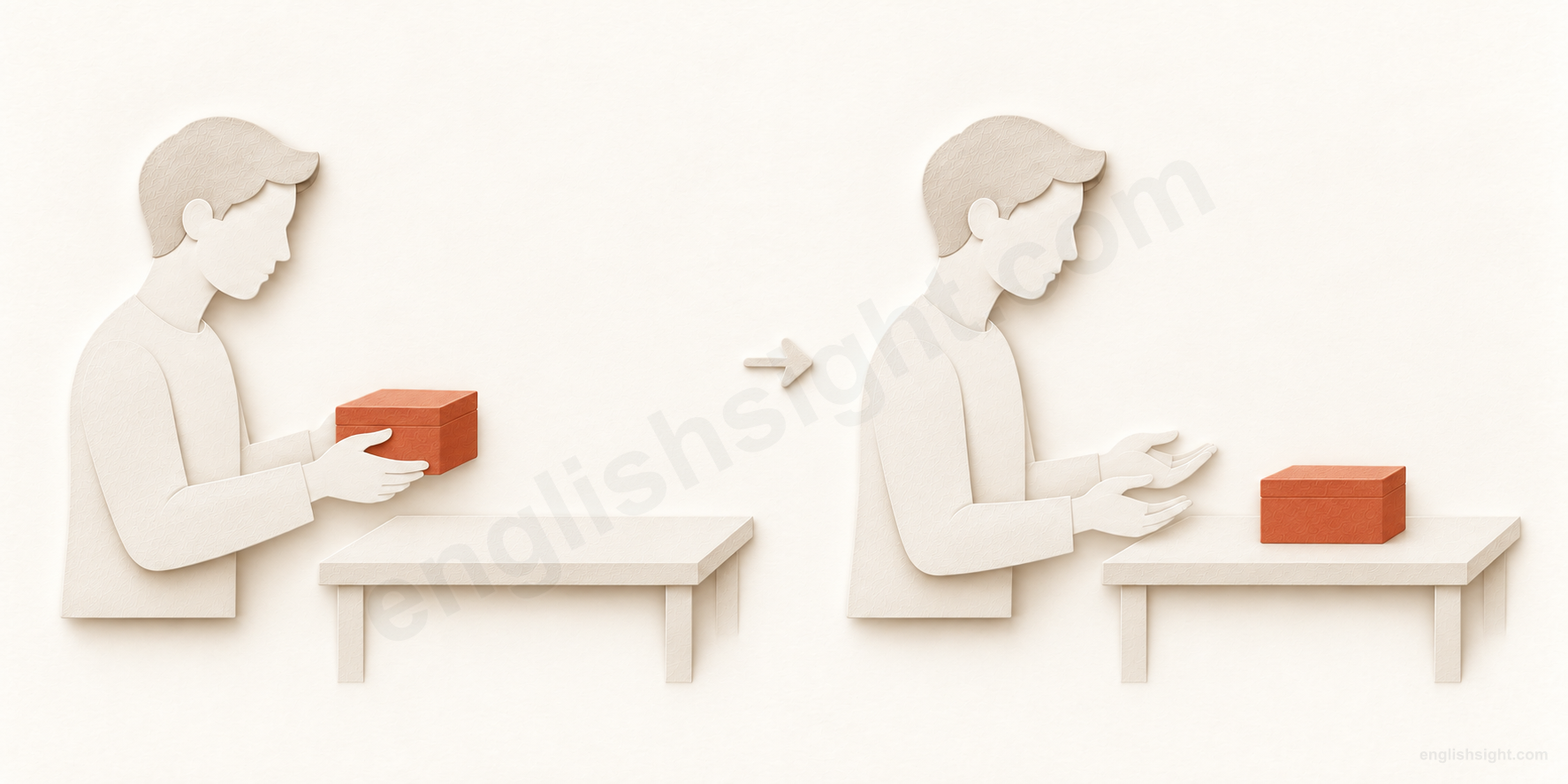
The person holds a box above an empty tabletop.
put
The box rests on the tabletop, clear of the person's hands.
The person places the box on the table and releases it.
Someone causes the box to occupy the specified place: on the table.
Ask who causes the placement, what is affected, and which complement names the intended place or situation.
Put commonly highlights caused placement. It does not generally tell us the movement method, and its idioms cannot all be calculated from one picture.
A useful image for put is a person causing something to be in a chosen relation. The shelf may be a real destination; a responsibility or state is an abstract result.
The picture is a memory model, not a universal definition or a scene every native speaker sees. Conventional expressions still need to be learned as expressions.
01
Places, states, and assigned relations
Find the object and the complement. A place can be physical, a role, a condition, or an assigned value.
01
put + object + place / direction
put something somewhere
cause an object to be in a place
Situation in the example
Please place the keys on the shelf.
Intended meaning
cause an object to be in a place
An object is given a location, condition, or relation.
The keys are the object; on the shelf supplies their destination. Put describes causing that placement, without specifying whether you carry, slide, or lower them.
In a sentence
Please put the keys on the shelf.
Watch the difference For ordinary placement, name a location: I put the keys is usually unfinished.
02
put + object + on + surface
put a notice on the door
attach or fix something to a surface
Situation in the example
We attached a notice to the door.
Intended meaning
attach or fix something to a surface
An object is given a location, condition, or relation.
A notice ends up fixed to a door. The pattern resembles ordinary placement, but the object and purpose suggest attachment, not merely holding it nearby.
In a sentence
We put a notice on the door.
Watch the difference Put a new lock on a door means install it; put a coat on means dress. Read the object too.
03
put + written information + place
put your name here
write, type, or mark information somewhere
Situation in the example
Write your name at the top of the form.
Intended meaning
write, type, or mark information somewhere
An object is given a location, condition, or relation.
A form provides a place for written information. Put your name here asks for writing or typing; no separate name-object moves through space.
In a sentence
Put your name at the top of the form.
Watch the difference You can put something in a diary or on a list. The usual preposition follows the kind of record.
04
put + person / thing + state or situation
put someone in charge
cause someone or something to enter a situation
Situation in the example
The manager assigned Ana responsibility for the project.
Intended meaning
cause someone or something to enter a situation
An object is given a location, condition, or relation.
Ana becomes responsible because the manager assigns the role. Compare put someone in a bad mood, put someone at risk, and put things right: each complement specifies the resulting situation.
In a sentence
The manager put Ana in charge of the project.
Watch the difference This is causative meaning, but not a general put someone to do pattern. Say put someone to work, a fixed expression.
05
put pressure / strain / emphasis on + person / thing
put pressure on someone
cause a person or thing to bear an effect
Situation in the example
The deadline makes the whole team feel under pressure.
Intended meaning
cause a person or thing to bear an effect
An object is given a location, condition, or relation.
Pressure is figuratively placed on the team; the deadline is the cause. Put emphasis on quality likewise directs importance toward a subject rather than moving a physical object.
In a sentence
The deadline puts pressure on the whole team.
Watch the difference Learn pressure on someone, not pressure to someone. The following to-infinitive may state the demanded action.
06
put + value + on; put + estimate + at
put a value on / put at
assign or estimate value, level, or category
Situation in the example
They estimated the repair would cost about two hundred pounds.
Intended meaning
assign or estimate value, level, or category
An object is given a location, condition, or relation.
Put the cost at £200 states an estimate. Put a high value on honesty assigns importance; put someone in a category classifies them. These are judgments, not guaranteed measurements.
In a sentence
They put the repair cost at about £200.
Watch the difference At introduces an estimate; on introduces the thing receiving value. Do not swap them freely.
07
put trust / faith / confidence in + person / thing
put your trust in someone
decide to rely on someone or something
Situation in the example
You can rely on this team.
Intended meaning
decide to rely on someone or something
An object is given a location, condition, or relation.
Trust is treated as something directed toward a person or institution. The pattern identifies the reliance, not a physical item passed into another person.
In a sentence
You can put your trust in this team.
Watch the difference Use trust in someone. Put pressure on someone is a different relation with a different preposition.
08
put + person + to work; put + thing + to good use / to the test
put someone to work / put something to good use / to the test
assign work, use something effectively, or test its qualities
Situation in the example
The repair project made effective use of my old tools.
Intended meaning
assign work, use something effectively, or test its qualities
assign work, use something effectively, or test its qualities
Put the volunteers to work sorting supplies gives them a task. Put tools to good use uses them for a useful purpose. The storm put the new roof to the test means it tested the roof’s real strength. These are established result expressions, not one freely interchangeable complement.
In a sentence
The repair project put my old tools to good use.
Watch the difference Work, use, and test are nouns here; to is a preposition. This does not license a general put someone to repair pattern.
02
Messages and complete results
An idea can be expressed, proposed, assembled, or turned into action. Read each conventional complement.
09
put + message + manner; put something into words
put it another way
express an idea in a particular way
Situation in the example
To express the point differently, we need a simpler plan.
Intended meaning
express an idea in a particular way
A message or result is presented or established.
It refers to the message; another way describes the wording. Put into words means express a feeling verbally. Simply put and to put it mildly comment on the manner of expression.
In a sentence
Let me put it another way: we need a simpler plan.
Watch the difference Put it mildly intentionally understates something; it does not mean speak quietly.
10
put + question / proposal + to + person
put a question to someone
address a question or proposal to someone
Situation in the example
I asked both candidates the same question.
Intended meaning
address a question or proposal to someone
A message or result is presented or established.
The question is presented for a response; to marks the person asked. Put a proposal to a committee similarly presents it for consideration.
In a sentence
I put the same question to both candidates.
Watch the difference Ask is usually the simpler everyday verb. Put a question to someone is more formal.
11
put + idea + across; put it across to + person
put an idea across
communicate an idea successfully
Situation in the example
She communicated her idea by using an example.
Intended meaning
communicate an idea successfully
A message or result is presented or established.
The idea reaches another person’s understanding. Across is a helpful memory image, but this established combination means communicate, not physically move a thought.
In a sentence
She used an example to put her idea across.
Watch the difference With a pronoun say put it across; add to someone to identify the listener.
12
put forward + proposal; put + proposal + forward
put forward a suggestion
suggest something for discussion
Situation in the example
He suggested a plan for reducing waste.
Intended meaning
suggest something for discussion
A message or result is presented or established.
A proposal is brought to other people’s attention. You can also put someone’s name forward as a candidate; the person is being nominated, not moved.
In a sentence
He put forward a plan to reduce waste.
Watch the difference With scheduling, put a meeting forward can mean move it earlier; give the new date to avoid ambiguity.
13
put + parts / work + together
put something together
assemble parts or prepare a complete piece of work
Situation in the example
We prepared a short report after the meeting.
Intended meaning
assemble parts or prepare a complete piece of work
A message or result is presented or established.
Putting a shelf together joins parts. Putting a report, meal, or team together gathers and organizes components into something usable. The object determines the kind of preparation.
Three other constructions need their own reading: all the others put together means all of them combined; put two and two together means infer an explanation from clues; put our heads together means discuss or think as a group. Neither thinking idiom requires physical assembly.
In a sentence
We put together a short report after the meeting.
Watch the difference Say put it together, not put together it. This can describe planning and writing without physical assembly.
14
put + idea / knowledge + into practice
put something into practice
use an idea in real action
Situation in the example
The workshop helped us apply the advice.
Intended meaning
use an idea in real action
A message or result is presented or established.
Advice moves from being known to being used. Into practice is the established result expression; the diagram helps connect application with placement only metaphorically.
In a sentence
The workshop helped us put the advice into practice.
Watch the difference Practice here is a noun. Do not replace the expression with put advice to practice.
15
put a stop to + noun / -ing
put a stop to something
bring an activity to an end
Situation in the example
The new lock ended unauthorized entry.
Intended meaning
bring an activity to an end
A message or result is presented or established.
The whole expression means stop something happening or continuing. To connects stop with the activity being ended; it is not an infinitive marker here.
In a sentence
The new lock put a stop to people entering without permission.
Watch the difference A following activity uses -ing: put a stop to shouting, not to shout.
16
put one over on + person
put one over on someone
deceive or trick someone
Situation in the example
Do not try to deceive me with the false receipt.
Intended meaning
deceive or trick someone
A message or result is presented or established.
The receipt is used to try to make the listener accept a false claim. One over on is a fixed informal expression; one is not an object literally lifted over someone.
In a sentence
Don’t try to put one over on me with that fake receipt.
Watch the difference Keep on before the person: put one over on me. This is not put an idea across.
17
put words in / into + possessive + mouth
put words in someone’s mouth
claim someone said something they did not say
Situation in the example
I did not call the plan impossible; do not misrepresent my words.
Intended meaning
claim someone said something they did not say
A message or result is presented or established.
The speaker rejects an inaccurate version of their view. Words are metaphorically assigned to the speaker, but the established idiom concerns misrepresentation.
In a sentence
I didn’t say the plan was impossible. Don’t put words in my mouth.
Watch the difference Do not confuse it with put something into words, which means express your own thought.
18
put in + comment; put in a good word for + person
put in a word / put in a good word for someone
add a brief comment; speak in someone’s favour
Situation in the example
Could you recommend Leila to the coach?
Intended meaning
add a brief comment; speak in someone’s favour
add a brief comment; speak in someone’s favour
Can I put in a word before we decide? asks to contribute a comment, often while others are speaking. Put in a good word for Leila asks someone to praise or recommend her to help her. For introduces the person being supported; with can name the person being approached.
In a sentence
Could you put in a good word for Leila with the coach?
Watch the difference A good word is not necessarily one word. The recommendation idiom differs from simply adding a comment to a discussion.
03
Clothes, routines, people, and small-word contrasts
The same particle may support several established meanings. The object and situation keep the meanings apart.
19
put on + clothing / substance; put it on
put on clothes / make-up
dress yourself or apply something to your body
Situation in the example
Dress in your coat before going outside.
Intended meaning
dress yourself or apply something to your body
The object and the whole expression select the result.
A coat ends up on your body. Put on make-up or sunscreen similarly applies a substance. The action is distinguished from the continuing state of wearing it.
In a sentence
Put your coat on before you go outside.
Watch the difference Put it on, not put on it. Wear a coat describes having it on, rather than dressing.
20
put + device / recording + on
put the kettle / music on
start equipment, cooking, or a recording
Situation in the example
I will start some music while we cook.
Intended meaning
start equipment, cooking, or a recording
The object and the whole expression select the result.
With music, put on means start playback. Put the kettle on starts heating water; put the potatoes on can mean start cooking them. On names familiar operating situations, not one universal action.
In a sentence
I’ll put some music on while we cook.
Watch the difference You may put music on without putting a physical device on a surface. Switch on is more explicit for equipment.
21
put on + weight / amount
put on weight
become heavier by an amount
Situation in the example
He gained two kilos during winter.
Intended meaning
become heavier by an amount
The object and the whole expression select the result.
In put on weight, the subject gains body weight. Weight or an amount is the object, unlike putting on an item of clothing.
In a sentence
He put on two kilos during the winter.
Watch the difference This is an established meaning, not a rule that put on plus any noun means gain.
22
put on + performance / pretended quality
put on a show / an accent
stage an event; pretend a quality
Situation in the example
The school will present a play next month.
Intended meaning
stage an event; pretend a quality
The object and the whole expression select the result.
Put on a play means organize or present a performance. Put on an accent means deliberately adopt a way of speaking. Both concern presentation, but a school show need not involve deception.
Put 10p on the price adds that amount to a price; it is not the betting meaning of put money on a team. The price is the amount increased, and 10p is the increase.
In a sentence
The school is putting on a play next month.
Watch the difference Put on extra buses means provide extra services, especially in British English; the object changes the sense again.
23
put + object + away; put it away
put something away
return something to its storage place
Situation in the example
Please return your toys to their storage places before dinner.
Intended meaning
return something to its storage place
The object and the whole expression select the result.
After playing, toys go where they are kept. Away signals removal from the current activity into storage. Put money away is also used for saving.
Informal put away food or drink means consume a large amount: After the hike, Maya put away three bowls of soup. The food object selects this sense, rather than storage or saving.
In a sentence
Please put your toys away before dinner.
Watch the difference Put them away, not put away them. Put someone away can mean imprison them informally, not tidying a person.
24
put + object + back; put back + event
put something back
return to an earlier place; postpone in a schedule
Situation in the example
Return the book to the place where you found it.
Intended meaning
return to an earlier place; postpone in a schedule
The object and the whole expression select the result.
With a book, back means restore its earlier position. Put a meeting back means postpone it; put a clock back means adjust it to an earlier clock reading.
In a sentence
Put the book back where you found it.
Watch the difference For dates, state the new time: a spatial picture alone does not reliably tell listeners earlier or later.
25
put off + event / -ing; put it off
put off doing something
move an action or event to a later time
Situation in the example
We postponed painting the kitchen until Saturday.
Intended meaning
move an action or event to a later time
The object and the whole expression select the result.
The kitchen painting is postponed. The following -ing phrase names the delayed activity; off does not describe physically removing paint.
In a sentence
We put off painting the kitchen until Saturday.
Watch the difference Use put off painting, not put off to paint. With a pronoun, put it off.
26
put + person + off + noun / -ing
put someone off something
make someone dislike or avoid something
Situation in the example
One bad lesson should not discourage you from learning to drive.
Intended meaning
make someone dislike or avoid something
The object and the whole expression select the result.
A bad experience reduces someone’s willingness to continue. The person comes between put and off; the following noun or -ing names what they are discouraged from.
In a sentence
One bad lesson should not put you off learning to drive.
Watch the difference Put off learning can mean postpone learning; put you off learning means discourage you. The extra object matters.
27
put + person + off; put me off
put someone off
interrupt someone’s concentration
Situation in the example
Please be quiet; the noise is distracting me.
Intended meaning
interrupt someone’s concentration
The object and the whole expression select the result.
Noise disrupts your attention while you are doing something. This sense of put someone off concerns distraction, not necessarily losing interest in the activity permanently.
In a sentence
Please be quiet; the noise is putting me off.
Watch the difference The situation distinguishes distraction from dislike; the wording put me off alone may fit either meaning.
28
put out + fire / flame; put it out
put out a fire
stop fire or light from burning or shining
Situation in the example
The firefighters extinguished the fire quickly.
Intended meaning
stop fire or light from burning or shining
The object and the whole expression select the result.
The fire is the object; out specifies an extinguished result. Put out a candle is not placing a candle outdoors.
In a sentence
The firefighters put the fire out quickly.
Watch the difference Say put it out. For electrical lamps, turn the light off is often a clearer everyday choice.
29
put out + information / product
put out a statement
publish information or produce something
Situation in the example
The station broadcast a storm warning.
Intended meaning
publish information or produce something
The object and the whole expression select the result.
A warning is made public or broadcast. A factory can put out products too: something becomes available outside the producing organization.
With household objects, put out can mean take outside for collection or set out ready for use: Please put the recycling out tonight; I put clean towels out for our guests. Those are placement uses, separate from publishing a warning.
In a sentence
The station put out a warning about the storm.
Watch the difference Do not infer that every object is physically placed outdoors; a statement and rubbish create different scenes.
30
put + person + out; be / feel put out
put someone out / be put out
inconvenience someone; feel offended
Situation in the example
I hope collecting me does not cause you inconvenience.
Intended meaning
inconvenience someone; feel offended
The object and the whole expression select the result.
Put you out asks whether the favor creates extra work. Be put out can mean feel annoyed or offended: She was put out by the remark. The passive-looking form has its own emotional use.
In a sentence
I hope collecting me from the station won’t put you out.
Watch the difference Don’t put yourself out means don’t make a special effort. It does not mean go outside.
31
put + object + down; put it down
put something down
lower something and stop holding it
Situation in the example
Lower the heavy bag onto a surface and rest your arms.
Intended meaning
lower something and stop holding it
The object and the whole expression select the result.
The bag changes from being held to resting on a surface. Down supplies the lowering result; the surface may be understood from the situation.
In British telephone usage, She put the phone down on me means she ended the call before I had finished speaking. The telephone object and on me distinguish this from lowering a bag.
In a sentence
Put the heavy bag down and rest your arms.
Watch the difference I couldn’t put the book down often means it was so interesting I kept reading. This is a familiar extension.
32
put down + information; put + amount + down
put something down in writing
write a note; pay an initial amount
Situation in the example
I wrote the address in my notebook.
Intended meaning
write a note; pay an initial amount
The object and the whole expression select the result.
Putting an address down records it. Putting £50 down on a purchase pays an initial part of the price. A number alone needs context to distinguish payment from writing.
In a sentence
I put the address down in my notebook.
Watch the difference Put it down in writing makes the recording meaning explicit. A deposit is not necessarily the whole price.
33
put + person + down
put someone down
criticize or belittle a person
Situation in the example
Do not belittle yourself because of one mistake.
Intended meaning
criticize or belittle a person
The object and the whole expression select the result.
The person is made to feel inferior through words. Down provides a useful metaphor of reduced standing, but the established expression must be learned with its object.
In a sentence
Don’t put yourself down because of one mistake.
Watch the difference Put yourself down is negative self-criticism. It is not the same as put your name down to register.
34
put + animal + down; have + animal + put down
have an animal put down
euthanize an animal
Situation in the example
Their seriously ill dog had to be euthanized.
Intended meaning
euthanize an animal
The object and the whole expression select the result.
With a seriously ill animal, put down is an established euphemism for intentionally ending its life, usually by a veterinary drug. No physical lowering picture supplies that meaning.
In a sentence
Their very ill dog had to be put down.
Watch the difference Put the dog down can also literally mean lower a dog you are holding. The veterinary context is essential.
35
put + result + down to + cause
put something down to something
attribute a result to a cause
Situation in the example
We attributed the delay to bad weather.
Intended meaning
attribute a result to a cause
The object and the whole expression select the result.
The delay is the result; bad weather is the proposed cause. Down to creates an attribution, not movement downward. The explanation may still be a judgment rather than proven causation.
In a sentence
We put the delay down to bad weather.
Watch the difference Keep the order put the delay down to weather. To is a preposition, so put it down to being tired is possible.
36
put up + structure / displayed object
put up a tent / notice
erect a structure or display something
Situation in the example
They erected a tent beside the lake.
Intended meaning
erect a structure or display something
The object and the whole expression select the result.
A tent is made to stand; a notice is fixed where people can see it. These conventional uses relate to establishing a visible position without prescribing one building method.
In a sentence
They put up a tent beside the lake.
Watch the difference Put up a notice means display it. Put a price up means increase it, a different established use.
37
put up + price / rent; put up + fight / resistance
put up prices / put up a fight
increase an amount; offer resistance
Situation in the example
The owner has increased the rent again.
Intended meaning
increase an amount; offer resistance
The object and the whole expression select the result.
Put the rent up increases its amount. Put up a fight means offer resistance, while put up money means provide funding. The same small word does not predict these distinct object combinations.
In a sentence
The owner has put the rent up again.
Watch the difference Specify by for the increase and to for the new total: up by £20, up to £500.
38
put + guest + up; put you up
put someone up
let a guest stay in your home
Situation in the example
My cousin can give us a place to stay for two nights.
Intended meaning
let a guest stay in your home
The object and the whole expression select the result.
You provide temporary accommodation. The guest is the object between put and up; no upward motion is involved.
In a sentence
My cousin can put us up for two nights.
Watch the difference Put us up differs from put up with us, which means tolerate us. The extra with changes the construction.
39
put up with + noun / -ing
put up with something
tolerate something unpleasant
Situation in the example
I will not tolerate people shouting at me.
Intended meaning
tolerate something unpleasant
The object and the whole expression select the result.
You continue accepting an annoying situation. Learn put up with as a whole; combining literal up and with does not predict tolerance.
In a sentence
I won’t put up with people shouting at me.
Watch the difference The object stays after with: put up with it, not put it up with. After with, an activity uses -ing.
40
put + person + up to + noun / -ing
put someone up to something
encourage someone to do something wrong or foolish
Situation in the example
Who encouraged you to hide my keys as a prank?
Intended meaning
encourage someone to do something wrong or foolish
The object and the whole expression select the result.
The person is persuaded to perform a prank or misdeed. Up to introduces the act, not a destination or a deadline.
In a sentence
Who put you up to hiding my keys?
Watch the difference Use put someone up to doing it, not up to do it. This is not the same as ordinary encourage.
41
put + person + on
put someone on
let a person speak on the phone; deceive as a joke
Situation in the example
Can you let Sam speak on the phone?
Intended meaning
let a person speak on the phone; deceive as a joke
The object and the whole expression select the result.
On the phone, the person becomes the next speaker. In North American informal You’re putting me on, the same wording means you are joking to make me believe something untrue.
In a sentence
Can you put Sam on? I need to speak to him.
Watch the difference The phone and North American joking senses are distinct; the joking sense is usually progressive: You’re putting me on. Neither means dress the person.
42
put + person + down for + activity; down as + description
put someone down for / as
register someone; judge what type of person they are
Situation in the example
Please register me for the Saturday workshop.
Intended meaning
register someone; judge what type of person they are
The object and the whole expression select the result.
Put me down for a workshop adds my name to a list. Put her down as the organizer means judge or identify her as that person, without necessarily writing a list.
In a sentence
Please put me down for the Saturday workshop.
Watch the difference For introduces what is reserved or entered; as introduces a description. Do not drop the final preposition.
43
put + possessive + foot down
put your foot down
insist firmly on a limit or refusal
Situation in the example
I firmly refused to lend the car.
Intended meaning
insist firmly on a limit or refusal
The object and the whole expression select the result.
This idiom expresses a firm decision against what someone wants. A planted-foot image can help memory, but the social meaning belongs to the whole expression.
In a sentence
I put my foot down and refused to lend the car.
Watch the difference In British driving contexts it can instead mean press the accelerator and drive faster; context decides.
44
put + possessive + foot in it / in + possessive + mouth
put your foot in it / your mouth
make a socially embarrassing or offensive mistake
Situation in the example
I made an embarrassing mistake by criticizing her cooking unknowingly.
Intended meaning
make a socially embarrassing or offensive mistake
The object and the whole expression select the result.
The speaker says something tactless without realizing the background. The foot-and-mouth picture is a memorable idiom, not a literal action or a general rule about put.
In a sentence
I put my foot in it by criticizing the meal before I knew she had cooked it.
Watch the difference Put your foot in it is British; put your foot in your mouth is used in North America and Britain.
45
put + reflexive + in + possessive + shoes
put yourself in someone’s shoes
imagine another person’s situation
Situation in the example
Imagine her situation before judging her.
Intended meaning
imagine another person’s situation
The object and the whole expression select the result.
The reflexive yourself names the person doing the imagining. Someone’s shoes represent their circumstances, often a difficult one. This is perspective-taking rather than changing footwear.
In a sentence
Put yourself in her shoes before you judge her.
Watch the difference Change the reflexive to match the subject: she puts herself in their shoes.
46
put + possessive + feet up
put your feet up
sit down and relax
Situation in the example
After working all day, sit down and relax.
Intended meaning
sit down and relax
The object and the whole expression select the result.
The feet may actually be raised and supported, but the familiar expression invites rest. It is not a general instruction to lift any part of the body.
In a sentence
You’ve been working all day. Sit down and put your feet up.
Watch the difference Put your foot down has a different singular noun and means be firm, or drive faster in British usage.
47
put + person + to bed / to sleep
put someone to bed / to sleep
help someone settle in bed; cause unconsciousness in a medical context
Situation in the example
I’ll help the twins settle in bed after their story.
Intended meaning
help someone settle in bed; cause unconsciousness in a medical context
help someone settle in bed; cause unconsciousness in a medical context
Putting children to bed is part of their bedtime care; put the baby down can also mean settle the baby in bed. In surgery, put someone to sleep informally means give an anaesthetic. With a sick animal, put to sleep is a euphemism for euthanasia. A dull talk can also put you to sleep: it is very boring.
Put the twins to sleep can also describe settling them for the night; the phrase is not limited to medicine.
In a sentence
I’ll put the twins to bed after their story.
Watch the difference To bed does not guarantee that someone is already asleep. Read the person or animal and the context; the medical and veterinary meanings cannot be predicted from the shelf picture.
48
put + unpleasant experience + behind + person
put something behind you
stop dwelling on an unpleasant experience and look ahead
Situation in the example
After the apology, we tried to move on from the argument.
Intended meaning
stop dwelling on an unpleasant experience and look ahead
stop dwelling on an unpleasant experience and look ahead
The argument belongs to the past; we try not to let it dominate the future. Behind us is a useful time metaphor, but the established expression concerns moving on emotionally, not relocating an object.
In a sentence
After the apology, we tried to put the argument behind us.
Watch the difference Match the pronoun to the people moving on: I put it behind me; we put it behind us. It does not mean the past never happened.
04
Resources, requests, services, and experiences
Put can organize contributions, installation, connections, and experiences imposed on people.
49
put + resource + into + noun / -ing; put in + effort
put time / money into something
devote effort, time, or money to something
Situation in the example
She devoted much time to learning Spanish.
Intended meaning
devote effort, time, or money to something
A resource, service, or experience is directed toward a purpose or person.
Time and effort are resources used in an activity; money put into a business is invested. In or into suggests contribution, but the object and purpose determine the resource.
In a sentence
She put a lot of time into learning Spanish.
Watch the difference Into is a preposition: put time into learning. Put in twelve hours names the amount of work.
50
put + resource + aside; put it aside for + purpose
put money / time aside
reserve money or time for later use
Situation in the example
We save a little money each month for repairs.
Intended meaning
reserve money or time for later use
A resource, service, or experience is directed toward a purpose or person.
Money is kept available instead of spent now. Put aside half an hour similarly reserves time for a purpose; literal movement to the side is not required.
In a sentence
We put a little money aside each month for repairs.
Watch the difference Put it aside for repairs names the intended use. Saving is different from investing in a business.
51
put + feeling / disagreement / task + aside
put differences aside
stop focusing on a disagreement, feeling, or task
Situation in the example
We temporarily ignored our disagreements and worked together.
Intended meaning
stop focusing on a disagreement, feeling, or task
A resource, service, or experience is directed toward a purpose or person.
Differences are not solved necessarily; people choose not to let them block cooperation. Put a task aside instead pauses work on it while attention goes elsewhere.
In a sentence
We put our differences aside and worked together.
Watch the difference Setting differences aside does not prove agreement. The object distinguishes ignoring disagreement from reserving money.
52
put in + equipment; have + equipment + put in
put in a new shower
install equipment so it can be used
Situation in the example
We have arranged installation of a new shower next week.
Intended meaning
install equipment so it can be used
A resource, service, or experience is directed toward a purpose or person.
A shower is fitted into its working position. Having a shower put in means arranging for someone else to install it; the subject need not do the work personally.
In a sentence
We’re having a new shower put in next week.
Watch the difference Compare put the towel in the shower, which is ordinary placement. The equipment object suggests installation.
53
put in + request; put in for + benefit / job
put in a request / put in for
formally submit a request or claim
Situation in the example
I submitted a request to take a day off.
Intended meaning
formally submit a request or claim
A resource, service, or experience is directed toward a purpose or person.
Put in a request submits it for consideration. Put in for leave or a job, especially British usage, means apply for it. The application does not guarantee approval.
In a sentence
I put in a request for a day off.
Watch the difference Distinguish put in a request from put in for leave; for introduces what is being sought.
54
put + caller + through to + person
put someone through
connect a caller to another person
Situation in the example
Please connect my call to the accounts team.
Intended meaning
connect a caller to another person
A resource, service, or experience is directed toward a purpose or person.
The receptionist directs the call to the requested team. Through describes an established telephone connection, not a physical passage through somebody.
In a sentence
Could you put me through to the accounts team?
Watch the difference Say put me through to the manager. The caller is the object and to introduces the destination person.
55
put + person + through + difficult experience
put someone through something
make someone undergo a difficult experience
Situation in the example
The lengthy investigation caused the family considerable hardship.
Intended meaning
make someone undergo a difficult experience
A resource, service, or experience is directed toward a purpose or person.
The family experiences the strain because of the investigation. Through can support a journey metaphor, but the expression commonly emphasizes an unpleasant experience imposed on someone.
In a sentence
The long investigation put the family through a lot.
Watch the difference Someone goes through a difficulty; another cause puts them through it. This changes who causes and who experiences it.
56
put + person + through + education
put someone through college
finance or arrange someone’s education
Situation in the example
Her parents helped finance her college education.
Intended meaning
finance or arrange someone’s education
A resource, service, or experience is directed toward a purpose or person.
A parent provides the means for a child to attend and complete education. Through connects with progressing through a course, but the financial-support meaning is conventional.
In a sentence
Her parents helped put her through college.
Watch the difference Put someone through college differs from put someone through an exam, which concerns making them undergo a test.
57
put + amount / money + on + outcome
put money on something
bet money on an outcome
Situation in the example
He bet five pounds that the home team would win.
Intended meaning
bet money on an outcome
A resource, service, or experience is directed toward a purpose or person.
The amount is the stake; on introduces the team or result being backed. It is different from investing money in a business or placing notes on a table.
In a sentence
He put five pounds on the home team to win.
Watch the difference This sentence describes a bet, not a recommendation or a guaranteed return.
58
put + money + towards + purchase / cost
put money towards something
use money to pay part of a cost
Situation in the example
I’ll use the birthday money to pay part of the price of a new bicycle.
Intended meaning
use money to pay part of a cost
use money to pay part of a cost
The money contributes toward the bicycle’s cost; it need not cover the full price. Towards names the purpose of the contribution rather than a physical direction for moving notes.
In a sentence
I’ll put the birthday money towards a new bicycle.
Watch the difference Put money aside saves it for later; put money towards a purchase allocates it to that cost. Neither says the purchase has already happened.
59
put + item + up for sale
put something up for sale
offer something for people to buy
Situation in the example
They offered their old camper van for people to buy in April.
Intended meaning
offer something for people to buy
offer something for people to buy
The van becomes available to buyers; the sentence does not say anyone has bought it. Up for sale is an established description of availability, not upward movement.
In a sentence
They put their old camper van up for sale in April.
Watch the difference Put up the price raises the price; put something up for sale offers the item. Keep for sale together.
05
Forms and construction limits
Past forms, passive subjects, and complements should be checked separately from meaning families.
60
put / puts / put / putting; be + put; put yourself + complement
put → put → put; putting
recognize unchanged past forms and object patterns
Situation in the example
Someone placed the boxes in the wrong room.
Intended meaning
recognize unchanged past forms and object patterns
Grammar identifies the affected object and its complement.
Put has the same base, past, and participle: put, not putted. Putting doubles t. In The boxes were put in the wrong room, the former object becomes the passive subject.
In a sentence
The boxes were put in the wrong room.
Watch the difference Put is causative in meaning but does not generally allow put someone to do anything. Follow each established complement.
61
stay + put
stay put
remain in the same place
Situation in the example
Remain by the entrance; I’ll bring the tickets to you.
Intended meaning
remain in the same place
remain in the same place
This informal fixed expression describes remaining where you are. Stay is the verb; put is the fixed complement. There is no affected object being moved, so this is an independent branch from the caused-placement diagram.
In a sentence
Stay put by the entrance; I’ll bring the tickets over.
Watch the difference Say she stays put and they stayed put. Put stays unchanged; this is not an instruction to put an unnamed object somewhere.
Common uses and their boundaries
Related meanings are not one universal definition
Put commonly highlights caused placement. It does not generally tell us the movement method, and its idioms cannot all be calculated from one picture.
Meaning comes from more than the small word
The same particle may support several established meanings. The object and situation keep the meanings apart.
An illustrated lesson is a selection
These are common senses, constructions, and expressions, not separate frequency-ranked dictionary meanings. Nautical uses, shot-putting, financial put options, sexual slang, and numerous regional or literary idioms are not expanded.
Choose the right expression
Read the object, the small words, and the situation.
1. You offer friends a place to sleep. Which expression describes your offer?
2. A task is moved from today to Saturday. Which expression fits?
3. You mean tolerate an annoying noise. Which word order works?
4. You arrange for a plumber to install a shower. Which sentence explicitly presents you as arranging the installation?
Sources and teaching notes
Definitions and usage were checked against the sources below. Explanations, example sentences, and the diagram were written for this lesson; the visual connection is a teaching interpretation.
This diagram helps explain a connection; it is not a picture shared by every native speaker.