Use quick for rapid actions, brief activities, and prompt reactions—and recognize the separate noun the quick.
A short interval matters
A short interval matters
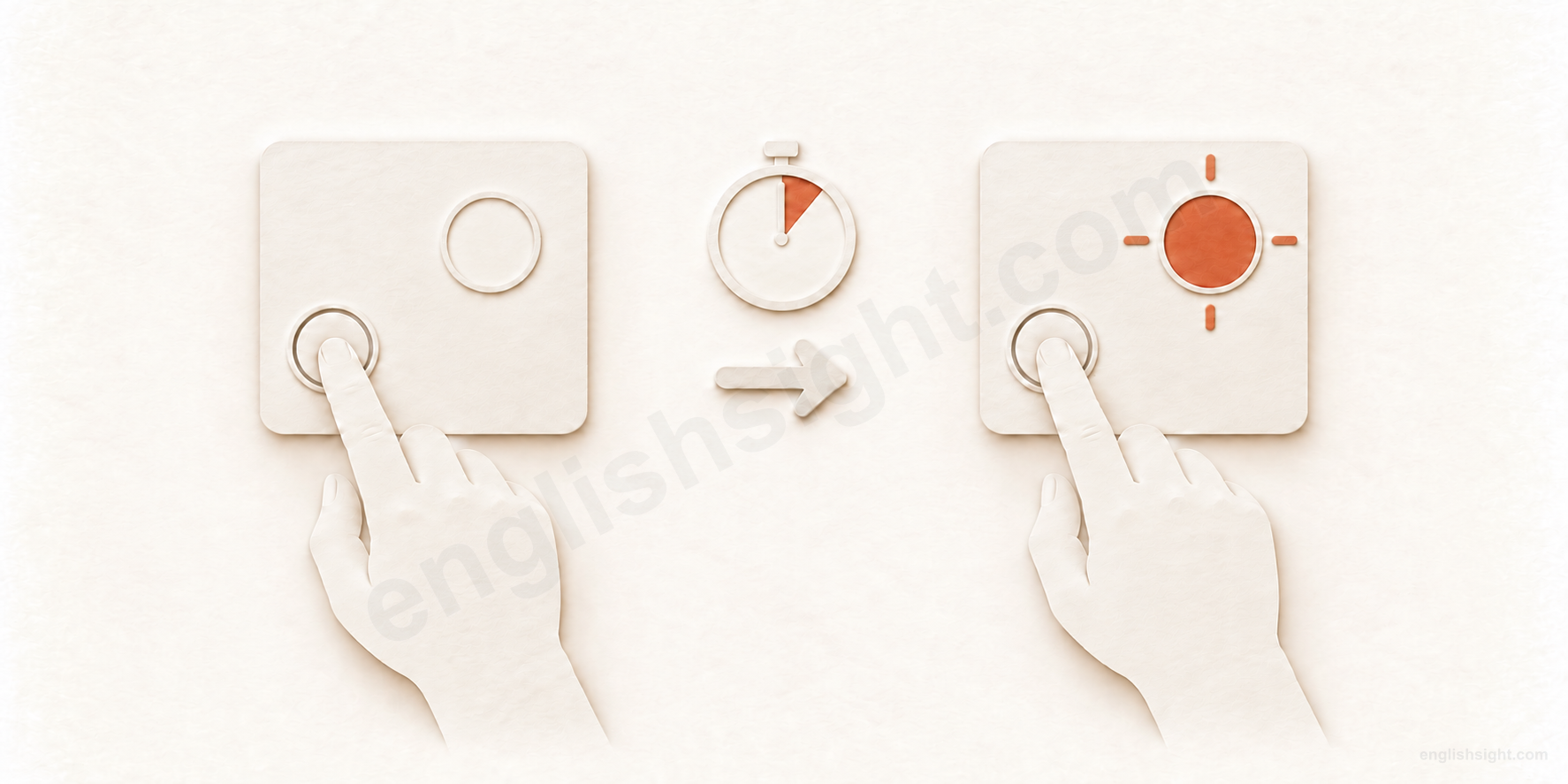
A finger presses the button while the indicator is unlit.
quick
The same indicator is already lit.
A short interval passes between the press and the response.
The light comes on shortly after the button is pressed.
A quick action takes little time; a quick response follows with little delay.
The sketch focuses on a quick response: a light comes on soon after a button is pressed. Other uses concern the duration of an activity or a person’s speed. The noun the quick has a separate meaning.
A quick reply arrives soon; a quick chat lasts a short time; quick hands move rapidly. These uses share attention to time, but they measure different parts of a situation.
This lesson gives a teaching connection between common uses. It does not claim that every native speaker sees the same image, or that one picture predicts every fixed expression.
01
Speed, duration, and delay
Ask which time is short: the action itself, a visit or break, the wait for a response, or the gaps between events.
01
quick + movement / step / worker; be quick
a quick movement
a movement performed with speed
Situation / starting point
A cup starts to slide off a shelf.
Meaning / outcome
A hand moves rapidly to catch it.
Quick describes how rapidly the movement happens.
A quick movement or quick step is performed rapidly. With a person, a quick worker says the person gets things done fast; it does not identify the work as easy.
Fast is especially natural for sustained speed: a fast car or a fast runner. Quick often focuses on an individual action. This is a tendency in word choice, not a ban on quick describing moving people or things.
Quick hands move rapidly; quick reflexes let someone react rapidly to a stimulus, such as a falling cup. These phrases describe bodily speed or responsiveness, not the length of time the person remains active.
In a sentence
With a quick movement, Lena caught the sliding cup.
Watch the difference A quick movement can still be careless or unsuccessful; quick alone does not promise skill or success.
02
a quick + look / chat / break / coffee / question
a quick look / break
an activity lasting only a short time
Situation / starting point
You have a few minutes before work.
Meaning / outcome
You look at a message briefly.
Here quick measures the duration of the activity.
A quick look, quick chat, or quick break is brief. A quick coffee usually means a short stop to drink coffee, rather than a special kind of coffee. Just a quick question presents the request as taking little time; the real answer may still take longer.
In British informal conversation, have a quick one can mean have a drink, usually alcoholic. In another context, one may simply replace a previously mentioned noun, so read the situation.
In a sentence
Can we have a quick chat before you leave?
Watch the difference A quick look need not be a thorough examination. Do not assume that brief means complete.
03
a quick + reply / response / decision / recovery / result
a quick reply / recovery
a response or result that comes with little delay
Situation / starting point
You send a request for a room.
Meaning / outcome
Confirmation arrives soon afterward.
A short wait is different from a short message.
A quick reply arrives soon. It may be long or short. A brief reply is short in length; it might arrive days later. A quick recovery means returning to a better condition in a short time.
Thanks for the quick response acknowledges promptness. Quick results similarly puts attention on how soon results appear. The noun supplies the event; quick does not itself tell us whether the result is good.
In a sentence
Thanks for your quick reply about the room.
Watch the difference Quick does not mean early by the clock: an early reply arrives before an expected time, while a quick reply follows soon after a request.
04
thing + be quick + to make / prepare / cook
quick to make
requiring little preparation time
Situation / starting point
You want dinner without a long cooking session.
Meaning / outcome
The dish is ready after a short preparation.
The thing being described is what someone prepares.
This soup is quick to make means making the soup takes little time. Soup is the subject, but a cook does the making. Compare The cook is quick to answer, where the cook performs the action named by the infinitive.
Quick and easy gives two separate judgments: little time and little difficulty. Related compounds include quick-drying paint and quick-thinking helpers; the second part identifies what happens rapidly. Their full meaning still depends on that second part.
In a sentence
This soup is quick to make with leftover vegetables.
Watch the difference Quick to make does not necessarily mean easy to make, and a quick meal is not necessarily fast food bought from a restaurant.
05
quicker than…; the quickest way; quick enough to + verb
quicker / quickest
taking less time than another option
Situation / starting point
Two routes lead to the same station.
Meaning / outcome
You choose the route that takes less time.
The comparison concerns time, not necessarily distance.
Quick forms the comparative quicker and superlative quickest. A quicker route takes less time; a shorter route covers less distance. Traffic can make the shorter route slower.
It is quicker to walk than to wait for the bus compares whole options. The quickest way names the option requiring the least time in the relevant set. Not quick enough means the speed or response does not meet a need.
In a sentence
It is quicker to walk than to wait for the next bus.
Watch the difference Use much quicker or a little quicker, not more quicker. Quickest usually needs the when it modifies a noun: the quickest route.
Quick measures the intervals between separate events.
In quick succession describes events following closely after one another. It does not say that each event itself lasts only a moment: several long speeches could begin in quick succession in different rooms.
The phrase is an established time expression. In introduces the manner or sequence; succession supplies the idea of one event following another. Quick alone does not mean a series.
In a sentence
Three messages arrived in quick succession.
Watch the difference Distinguish a single quick message from several messages in quick succession.
02
Ability, readiness, and reactions
Quick can describe what a person does rapidly. The following noun, infinitive, or preposition tells you which ability or reaction is involved.
07
a quick learner; have a quick mind; be a quick study
a quick learner
someone who learns new things rapidly
Situation / starting point
A new colleague is shown a procedure.
Meaning / outcome
She understands it after little instruction.
Learning takes little time, rather than speech being fast.
A quick learner picks up new knowledge or skills rapidly. A quick mind also concerns thinking and understanding. These descriptions do not say someone knows everything or never needs practice.
A quick study is an informal North American expression for a person who learns something rapidly. Here study names the person, not a short period spent reading.
In a sentence
Maya is a quick learner and soon mastered the booking system.
Watch the difference A quick learner and a fast talker describe different abilities; fast speech does not prove understanding.
08
person + be quick at + noun / -ing
quick at doing something
able to perform a specified activity rapidly
Situation / starting point
Your colleague calculates the total.
Meaning / outcome
You notice how little time the calculation takes.
At identifies the activity in which someone is quick.
Quick at mental arithmetic or quick at finding errors describes speed in a particular activity. At is a preposition, so use a noun or an -ing form after it.
Being good at an activity concerns ability or quality more generally. Being quick at it emphasizes time. Someone can work quickly yet still make mistakes.
In a sentence
Nora is quick at spotting duplicate entries.
Watch the difference Say quick at spotting, not quick at spot. Quick to spot is another grammatical pattern, with a different structure.
09
person + be quick to + verb; too quick to + verb
quick to do something
doing something readily or with little hesitation
Situation / starting point
A colleague helps you.
Meaning / outcome
You thank her without waiting.
The person who is quick performs the following action.
Quick to thank, quick to notice, or quick to respond presents a prompt reaction or readiness to act. It may describe one occasion or a habitual tendency. The infinitive names what the subject does.
The judgment depends on the verb and context. Quick to help can be praise; quick to blame can criticize a tendency. Too quick to judge says the person judges sooner or more readily than is sensible, not that the judgment is accurate.
A quick eye describes alert perception: Her quick eye spotted the tiny change in the label. This can suggest perceptiveness as well as prompt noticing; it does not mean the eye itself moves rapidly. The short-interval picture captures the promptness, but not every nuance of this description.
In a sentence
He was quick to thank the volunteers.
Watch the difference To is part of an infinitive here: quick to help. Do not use quick to helping for this construction.
10
have / use one’s quick wits; a quick-witted person / response
quick wits / quick-witted
the ability to think of a useful response rapidly
Situation / starting point
An unexpected problem interrupts an event.
Meaning / outcome
Someone rapidly finds a useful alternative.
The speed is in thinking and responding.
Quick wits can help someone deal with an unexpected difficulty. Quick-witted describes the person or response. It can involve a clever remark, but it is not limited to making jokes.
Wits supplies the mental ability, so this expression does not mean quick physical movements. Quick-thinking is another compound used for a person who reacts intelligently without delay.
In a sentence
Her quick wits helped her find another room for the meeting.
Watch the difference Quick-witted is a whole adjective. Witty more specifically suggests clever humor; the two are not interchangeable in every context.
11
have a quick / short temper; be quick-tempered
a quick temper
a tendency to become angry easily and rapidly
Situation / starting point
A small inconvenience occurs.
Meaning / outcome
Someone becomes angry almost at once.
A rapid reaction can be undesirable.
Have a quick temper and be quick-tempered describe someone who becomes angry easily. Short temper is another familiar expression with a similar meaning.
This is about the threshold and onset of anger, not necessarily how long the anger lasts. A person with a quick temper may calm down slowly or quickly; the expression does not decide that.
In a sentence
He has a quick temper and gets angry over small delays.
Watch the difference Do not interpret quick temper as anger that always ends quickly.
03
Established expressions
These expressions keep a connection with speed or promptness, but their wording and tone need to be learned together.
12
be quick / slow on the uptake
quick on the uptake
quick to understand what is meant
Situation / starting point
Someone explains a new rule.
Meaning / outcome
The listener understands with little repetition.
Uptake concerns understanding, not moving or collecting something.
Be quick on the uptake is an informal expression for understanding rapidly. Its contrast is slow on the uptake, which can sound insulting when said about another person.
Learn the expression with on the. Do not replace the preposition by at just because quick at learning is also possible; the two constructions have different wording.
In a sentence
You will not need to explain it twice; she is quick on the uptake.
Watch the difference This is an adjective phrase with a fixed complement, not a phrasal verb.
13
be quick / slow off the mark; quick off the mark in + -ing
quick off the mark
quick to act or respond when an opportunity appears
Situation / starting point
Tickets become available.
Meaning / outcome
Someone books before the opportunity disappears.
The focus is on a prompt start or response.
Quick off the mark, used mainly in British English, can describe quickly understanding or responding to news, or taking an opportunity. It recalls getting started from a starting mark, but it need not describe a literal race.
Slow off the mark describes a delayed response. Quick on the uptake emphasizes understanding; quick off the mark often emphasizes acting on what has happened.
In a sentence
Ravi was quick off the mark and booked the last two seats.
Watch the difference The expression does not guarantee that the whole task is finished rapidly or correctly.
14
be quick / fast on the draw
quick on the draw
ready to understand or react rapidly
Situation / starting point
Someone notices a change in the rules.
Meaning / outcome
She responds before others have worked it out.
The figurative expression concerns a rapid reaction.
In informal use, quick on the draw describes someone who understands or reacts rapidly. Fast on the draw is a variant. Context shows what kind of response is involved.
The expression also has a literal gun-related meaning: drawing a gun rapidly. The figurative office example does not imply a weapon. Do not reduce every use to intelligence alone.
In a sentence
Jules is quick on the draw; she spotted the changed rule immediately.
Watch the difference This fixed expression cannot normally become quick on a draw with the same idiomatic meaning.
15
(as) quick as a flash
(as) quick as a flash
extremely quickly
Situation / starting point
A question takes the group by surprise.
Meaning / outcome
Someone answers almost immediately.
The flash is a comparison for very little time.
As quick as a flash intensifies speed. Quick as a flash can also introduce a sentence to say an action happened extremely rapidly. There need not be any real flash of light.
The comparison is expressive, not a precise measurement. As quick as lightning is a related familiar comparison; do not use the picture to infer a scientific claim about speed.
In a sentence
Quick as a flash, Ana named the missing ingredient.
Watch the difference Use as in the comparison, not quick than a flash.
16
a quick fix for + problem; there is no quick fix
a quick fix
an immediate or easy solution, often temporary or inadequate
Situation / starting point
A repeated problem needs attention.
Meaning / outcome
Someone proposes a simple immediate solution.
Speed of a solution does not establish its lasting value.
A quick fix is a way of dealing with a problem without much time or effort, often only temporarily or without adequately addressing its cause. The expression commonly suggests that a deeper problem remains. It is not automatically a repair to a physical object.
There is no quick fix for… warns that a problem needs more time, effort, or a more substantial approach. Quick supplies the time idea; fix supplies the solution idea. Judge permanence from context.
In a sentence
There is no quick fix for the team’s communication problems.
Watch the difference A quick fix need not be useless, but the expression often questions whether it is adequate or lasting. A solution that happens to be quick does not automatically have that implication.
17
a quick-and-dirty + estimate / method / solution
quick and dirty
done rapidly and simply, with limited refinement
Situation / starting point
You need an initial estimate before the meeting.
Meaning / outcome
You produce a rough calculation rather than a polished analysis.
The phrase adds a trade-off beyond ordinary quick.
A quick-and-dirty estimate or method saves time by keeping things simple and rough. It may be useful for an immediate purpose while leaving detail, accuracy, or presentation to improve later.
This informal expression can be pragmatic or disapproving. Dirty is figurative here; there need not be physical dirt. Hyphens commonly join the words before a noun, as in a quick-and-dirty estimate.
In a sentence
We used a quick-and-dirty estimate to decide whether to investigate further.
Watch the difference Do not use this expression when you want to promise a careful, complete final result.
18
make a quick / fast buck
make a quick buck
earn money rapidly and easily
Situation / starting point
A seller sees a chance for immediate profit.
Meaning / outcome
The seller aims to earn money with little delay or effort.
The expression often suggests criticism of the motive.
Make a quick buck is informal and often disapproving. It can suggest that someone cares about easy short-term profit more than quality or lasting value.
Buck is an informal word for a dollar, but the expression can discuss profit more generally; it need not mean exactly one dollar. Quick here concerns earning, not how fast money is spent.
In a sentence
They sold poor-quality copies just to make a quick buck.
Watch the difference Do not assume this expression is neutral praise in a professional recommendation.
04
Quick, quickly, and informal calls
Choose the adjective or adverb to match its job in the sentence. Spoken shortcuts have their own register.
19
be quick; make it quick; verb + quickly; Quick!; informal verb + quick
Quick! / Come quickly.
urge speed or describe an action done rapidly
Situation / starting point
Someone needs help immediately.
Meaning / outcome
You call for a prompt response.
The adjective and adverb have different grammatical jobs.
Be quick describes the subject with an adjective. Come quickly describes how to come with an adverb. Quickly is the usual general-purpose adverb, especially in neutral writing: She answered quickly.
Come quick! and as quick as you can occur in informal speech. Quicker and quickest also occur adverbially: This method works quicker. More quickly is a useful neutral alternative. Quick! is an urgent call; it can sound abrupt outside an emergency.
Double quick is an informal British intensifier meaning very quickly, not a measured doubling of speed. Real quick is particularly associated with informal North American speech. For neutral writing choose very quickly or quickly, according to your meaning.
Make it quick is another direct way to ask someone to hurry: Please fetch the key, and make it quick—we are late. It refers to the activity already mentioned. Quick describes how that activity should be, so make is the verb here; quick has not become a verb. This wording can sound impatient.
In a sentence
Quick! Save the file before the battery dies.
Watch the difference Do not use quickly before a noun: a quick reply, not a quickly reply. Fast is already an adverb as well as an adjective; fastly is not the normal word.
05
The quick: a separate noun branch
The quick refers to sensitive living tissue, and an idiom uses it for deep feelings. These uses do not mean speed.
20
the quick; bite one’s nails (down) to the quick
the quick
sensitive living tissue under a nail
Situation / starting point
A nail has been bitten very short.
Meaning / outcome
Its sensitive underlying area is exposed or reached.
This noun concerns living tissue, not a short time.
The quick is the sensitive flesh under a fingernail or toenail. Bite one’s nails to the quick means bite off the projecting white part right down to that sensitive area. It describes extremely short nails; it does not by itself say that the flesh has been bitten or is bleeding.
The definite article belongs to this familiar noun use: to the quick. It is a separate branch from the modern speed adjective. You cannot explain it by saying the nails were bitten rapidly.
In a sentence
Her nails were bitten down to the quick.
Watch the difference The sentence describes how far the nails have been bitten, not how quickly the biting happened.
21
something + cut + person + to the quick; be cut to the quick
cut someone to the quick
hurt someone’s feelings deeply
Situation / starting point
Someone hears a cruel personal remark.
Meaning / outcome
The remark causes deep emotional pain.
The idiom treats deep feelings as a sensitive inner area.
Cut someone to the quick means upset or hurt them deeply. It is an established figurative expression, marked literary in Collins. It is useful to recognize, but hurt someone deeply is a simpler everyday alternative.
The remark can be the subject: Her remark cut him to the quick. A passive is also possible: He was cut to the quick by her remark. This is the verb cut with an idiomatic complement; quick is a noun here.
In a sentence
The cruel remark cut her to the quick.
Watch the difference This expression neither reports a fast physical cut nor requires an actual injury.
Keep time, grammar, and fixed wording distinct
Quick does not automatically mean good
Quick may praise a prompt response or criticize haste. A quick decision can be wise or careless. The surrounding words supply that judgment.
Choose the construction
Compare quick at finding errors (speed in an activity), quick to find an error (a prompt action), and an error that is quick to find (finding it takes little time). Quick is primarily an adjective, so productive verb-object patterns and phrasal verbs do not apply. Cut someone to the quick belongs to cut.
Forms and coverage boundary
Pronunciation is /kwɪk/; adjective forms are quick, quicker, quickest. Quickly and quickness are related forms. Compounds such as quick-drying take their particular meaning from both parts; quicksand and quicksilver are separate words to look up. Historical quick meaning alive survives in the quick and the dead, but is not the normal everyday word for alive. Specialized plant, fire, bend, and old verb senses are outside this beginner lesson.
The picture has a limited job
The short interval in the diagram models response time. It does not depict the length of every quick activity, prove that speed is desirable, or explain the noun the quick.
Choose the time meaning or construction
Read the whole situation. Decide what is short or rapid, and what job quick has in the sentence.
1. A detailed answer arrives one minute after your question. Which description is supported?
2. Choose the standard pattern for someone who finds mistakes rapidly.
3. A person has a quick temper. What can you infer?
4. Choose the neutral sentence for a written report.
5. An insult cut Sam to the quick. What happened?
6. This dish is quick to prepare. Who performs the preparation?
Sources and teaching notes
The sources below support the usage inventory. Explanations and examples are original; the short-interval picture is a teaching model with stated limits.
The diagram illustrates one time relationship; it does not represent an image shared by every English speaker.