Use quiet for low noise, low activity, and an unshowy manner—and learn the patterns that add change or secrecy.
A low level of disturbance
A low level of disturbance
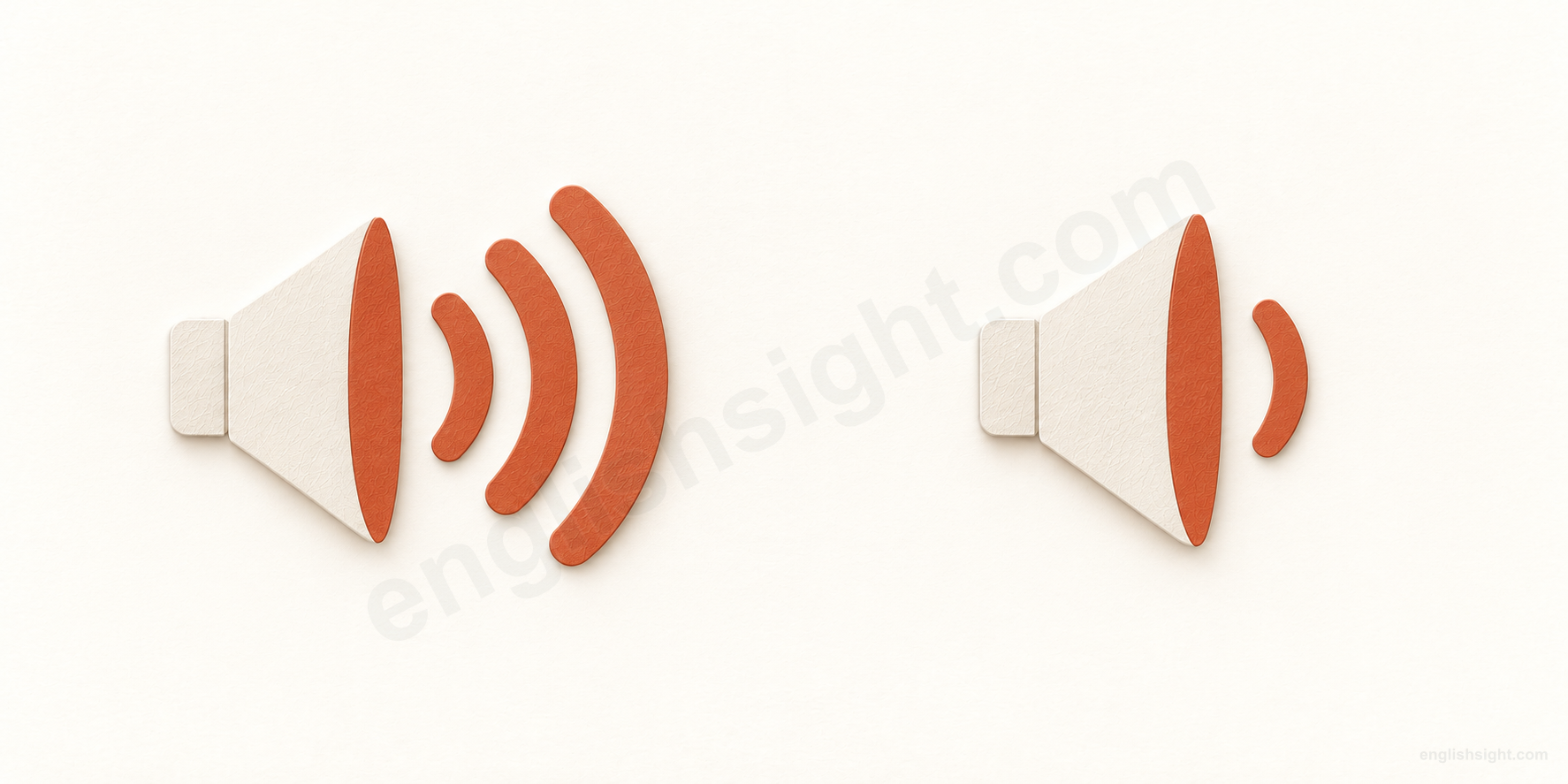
More sound: three large waves
quiet
Little sound: one small wave
Compare the amount of sound.
The right speaker is quiet compared with the left: little sound, not necessarily none. This is a comparison, not a change over time.
Quiet describes little noise, activity, or outward display in the relevant situation.
The sound comparison illustrates one central use. Quiet itself can describe an existing state; become, go, fall, or the verb quiet adds a change. Privacy expressions require their own explanation.
A quiet room, a quiet day, and quiet confidence put different things in the background: sound, activity, or outward display. Ask which feature the context makes small.
This connection is a teaching aid. Some expressions, such as on the quiet, have established meanings to learn as a whole; the model does not mechanically predict every use.
01
Little sound, little speech
Quiet can describe a sound level, a request to reduce noise, a change into silence, or a person who says little. These are related but different judgments.
Quiet is relative to the situation: soft speech can still be audible.
A quiet room has little noise in it; a quiet voice or engine produces little noise. The adjective can describe a place or the source of a sound.
Quiet does not always mean silent. You can hear soft conversation in a quiet café. Silent more strongly suggests no sound or no speech, depending on context.
Quiet has two syllables, /ˈkwaɪət/. Its usual comparative and superlative are quieter and quietest: This room is quieter than the kitchen.
In a sentence
This room is quiet enough to record in.
Watch the difference Do not confuse quiet with quite, the different word in quite good.
02
be / keep / stay + quiet; (as) quiet as a mouse
Be quiet! / keep quiet
stop making noise or continue without speaking
Situation
People are talking while someone is trying to listen.
What is described
You ask them to reduce the noise.
Be quiet requests a state; keep quiet asks for that state to continue.
Be quiet is a direct command. It can sound impatient, especially with an exclamation. Could you be a little quieter, please? is a gentler request.
Keep quiet during the announcement asks people to remain silent or avoid noise. Quiet, please! is a shortened request, not a different meaning.
As quiet as a mouse is a familiar comparison for being extremely quiet: The children were as quiet as mice during the story. It is figurative, not a rule about mice.
In a sentence
Could you be a little quieter, please? I’m on a call.
Watch the difference Be quiet can be rude when it dismisses another person; please and a softer question help when making an ordinary request.
03
go / fall / become + quiet
go quiet / fall quiet
stop talking or become much less noisy
Situation
A lively conversation reaches an awkward subject.
What is described
The people stop speaking.
Go or fall adds a change; quiet describes the resulting state.
She went quiet means she stopped saying much. It does not mean she went somewhere quietly. The linking verb go introduces a change of state.
The room fell quiet describes a similar transition, often fairly sudden. The room stands for the people and sounds in it.
Quiet does not identify the emotion behind silence. Someone may be listening, embarrassed, angry, tired, or simply thinking.
In a sentence
Maya went quiet when we mentioned the missing letter.
Watch the difference Went quiet describes a change into quietness; was quiet only describes the state.
04
a quiet + person; person + be + quiet
a quiet person
someone who usually talks little or behaves calmly
Situation
A new colleague listens more than he speaks.
What is described
You describe his usual manner.
A quiet personality is a tendency, not an instruction or a diagnosis.
He is a quiet person describes a general characteristic. He is quiet today can describe a temporary difference in behavior.
Quiet may suggest a reserved, calm manner. It does not by itself mean shy, unfriendly, unintelligent, or unwilling to help. Shy specifically concerns social nervousness.
In a sentence
Our new neighbour is quiet, but she always offers to help.
Watch the difference Do not infer why someone speaks little from quiet alone.
02
Peace, activity, and movement
Ask what is low: interruptions, the amount of work, or physical disturbance. A quiet place need not be empty, and a quiet period need not be completely silent.
05
a quiet + time / life / activity / place
a quiet evening / a quiet life
peaceful time without much disturbance or excitement
Situation
Your week has been full of meetings and travel.
What is described
You plan an undemanding evening at home.
The low level concerns disturbance and demands, not only sound.
A quiet evening or quiet life has relatively little excitement, trouble, or interruption. Music and conversation are still possible.
A quiet drink or a quiet meal describes the peaceful circumstances of the activity. Quiet describes the setting rather than a property of the food or drink.
A quiet street may have little traffic and few people as well as little noise. The context decides which feature matters most.
In a sentence
We’re planning a quiet evening at home after the trip.
Watch the difference Quiet is not automatically a judgment of boring or enjoyable; the speaker’s attitude and context supply that.
06
business / work + be + quiet; a quiet day
Business is quiet.
there are few customers, orders, or tasks
Situation
The restaurant usually fills up at lunchtime.
What is described
Today only two tables are occupied.
Here quiet measures how busy things are, not how loud the room is.
A quiet day at work means there is less work or activity than usual. Business is quiet often means trade is slow.
A shop can be quiet in this sense even if loud music is playing. Conversely, a busy library may have many people working with very little sound.
In a sentence
Business has been quiet since the holiday ended.
Watch the difference Ask whether the context is about sound or activity; quiet does not establish both at once.
07
quiet + waters / sea; lie + quiet
quiet waters / lie quiet
little agitation or movement
Situation
A lake is sheltered from the wind.
What is described
Its surface has little movement.
Quiet can concern physical disturbance rather than voices.
Quiet waters or a quiet sea are calm, with little turbulent movement. Calm is often the clearer everyday choice when the focus is specifically on waves.
Lie quiet asks someone to rest without moving about or disturbing themselves. Quiet describes the person’s state after the linking use of lie; lie quietly focuses on the manner of lying.
In a sentence
The boat rested on the quiet waters of the lake.
Watch the difference Quiet water is not a guarantee of safe swimming; the adjective describes a feature, not every condition.
03
Present without drawing attention
A feeling can be strong while its outward expression is quiet. Conversations and visual choices can also avoid attracting attention.
08
quiet + feeling / attitude; quietly + confident
quiet confidence / quiet determination
a real feeling or attitude expressed without display
Situation
A speaker feels sure of her preparation.
What is described
She answers steadily without boasting.
The outward display is small; the confidence itself need not be weak.
Quiet confidence combines confidence with a restrained manner. Quiet determination means a firm intention that is not loudly announced.
The same connection can apply to quiet satisfaction or quiet despair: a feeling may be present without an obvious public display.
Quietly confident uses the related adverb to modify the adjective confident. It means confident without making a show of it, rather than confident only to a small degree.
In a sentence
She spoke with quiet confidence about the work ahead.
Watch the difference Quiet does not mean slightly here: quiet determination can be very strong.
09
have a quiet word with + person; quiet + activity
have a quiet word with someone
speak discreetly, often away from other listeners
Situation
You need to raise a sensitive issue with a colleague.
What is described
You ask for a private conversation.
Quiet can concern discretion as well as volume.
A quiet word is usually a short, discreet conversation. Word does not mean literally one word. Depending on context, the talk may be advice, a warning, or an ordinary private matter.
Quiet diplomacy similarly avoids publicity or conspicuous confrontation. These uses extend the idea of not attracting attention; they do not require every word to be whispered.
In a sentence
Could I have a quiet word with you after the meeting?
Watch the difference The phrase can sound serious, but it does not always mean a reprimand.
10
quiet + colour / clothes / style quality
quiet colours / quiet elegance
a restrained appearance that does not demand attention
Situation
You compare a bright patterned room with a restrained one.
What is described
You describe the restrained design.
This is a visual extension, not a claim that colour makes sound.
Quiet colours, clothes, or furnishings are subdued and unobtrusive. They avoid a strong or showy effect.
Quiet elegance praises an attractive, restrained style. Quiet is evaluative in such descriptions and does not name one fixed set of colours.
In a sentence
The designer chose quiet colours for the reading room.
Watch the difference For a beginner giving a precise colour instruction, subdued or muted colours can be clearer than quiet colours.
04
Keeping information out of public view
These established expressions concern who knows something. Low sound alone does not guarantee secrecy.
11
keep quiet about + topic; keep + information + quiet
keep quiet about it / keep it quiet
avoid revealing information
Situation
You are arranging a surprise celebration.
What is described
You ask someone not to tell the guest.
The object or about-phrase identifies the information being withheld.
Keep quiet about the plan asks a person not to talk about that topic. Keep the plan quiet asks for the plan not to become known. You can speak about other things.
With a pronoun, say keep it quiet. Compare Keep the baby quiet: the baby is a person making noise, so the likely meaning is to prevent noise, not to conceal information.
The plan was kept quiet is a natural passive. It leaves the people responsible unnamed and describes information that was not made public.
In a sentence
Please keep our plans for the party quiet until Friday.
Watch the difference Keep quiet alone can mean remain silent. Keep the party quiet can instead mean keep its noise down; name the plans or use keep quiet about the party when you need to make secrecy clear.
12
do something + on the quiet
on the quiet
secretly or without attracting notice
Situation
Someone is looking for a new job without telling coworkers.
What is described
The search continues privately.
The full phrase describes discretion; it is not a location.
On the quiet is an informal expression particularly associated with British English. It means secretly or without others noticing.
It does not merely mean at a low volume. Reading job advertisements on the quiet concerns who knows about it, even if no sound is involved.
In a sentence
He’s been applying for jobs on the quiet.
Watch the difference Keep the article: on the quiet. In quiet is not a substitute for this secrecy expression.
05
The state, the change, and the manner
The noun names calm or low noise. The verb describes becoming or making quiet. Quietly describes how something happens, including some established nonliteral uses.
13
some / a little + quiet; peace and quiet; the quiet of + place / time
some quiet / peace and quiet
the state of calm with little noise or disturbance
Situation
You have spent the day in a crowded office.
What is described
You want time free from disturbance.
Quiet is now an uncountable noun naming the state itself.
You can ask for some quiet or a little peace and quiet. The familiar pair emphasizes relief from noise or disturbance.
The quiet of the early morning identifies a particular setting’s stillness. In the quiet of the room locates an activity within that calm setting.
Quietness is another noun for the quality of being quiet. For an ordinary request, I need some quiet is more direct than treating quiet as a countable object.
In a sentence
I need a little peace and quiet before I start writing.
Watch the difference Use some quiet or a quiet moment, not a quiet when asking for a short period of calm.
14
person / thing + quiet (down)
quiet down
become less noisy, active, or agitated
Situation
A crowd is talking over the announcement.
What is described
The crowd becomes less noisy.
The subject itself changes into a quieter state.
The crowd quieted down describes becoming less noisy or less agitated. Down reinforces a reduction; it does not describe downward movement.
The verb quiet is especially North American. British English often uses quieten or quieten down. Both varieties also use settle down or become quiet where appropriate.
Forms are quiet, quiets, quieted, quieting. The bare verb can be intransitive too: The sea quieted as the wind dropped.
In a sentence
The crowd quieted down when the announcement began.
Watch the difference Quiet down changes a state; be quiet requests or describes a state.
15
quiet + object + (down); quiet down + noun object
quiet someone (down)
make someone or something calmer or less noisy
Situation
The children are restless before bedtime.
What is described
A calm activity reduces their noise and excitement.
The subject causes a change in the object.
Quiet the children and quiet the children down describe causing them to become calmer or less noisy. With a noun, quiet down the children is possible too.
With an object pronoun, put it between the verb and particle: quiet them down, not quiet down them. This is a separable particle construction.
Compare keep the children quiet, which emphasizes maintaining a state, and quiet the children, which emphasizes bringing that state about. A passive such as The crowd was quieted by the announcement is also possible.
In a sentence
The bedtime story helped quiet the children down.
Watch the difference Do not add to before the object: quiet the children, not quiet to the children.
16
quiet + fears / doubts / anxiety
quiet fears / doubts
reduce worry or doubt
Situation
A delay has made customers anxious.
What is described
A clear explanation reassures them.
The disturbance being reduced is mental rather than audible.
Quiet someone’s fears or doubts means make them less worried or doubtful. The reassurance may be a fact, an explanation, or a helpful action.
This is a figurative transitive use, especially in American English. It does not mean ordering the person to stop speaking or proving that every risk has disappeared.
In a sentence
The clear explanation helped quiet their fears about the delay.
Watch the difference Quiet fears means ease them; quiet complaints can also suggest reducing expressed objections, so read the object and context.
17
action verb + quietly; quietly + action verb
speak quietly / leave quietly
do something with little noise or without attracting attention
Situation
Someone is asleep in the next room.
What is described
You close the door with little noise.
Quietly gives the manner of an action; quiet normally describes a state or a noun.
Speak quietly and close the door quietly concern sound. Sit quietly can concern calm behavior without disruptive activity.
They quietly changed the rule can instead mean they changed it without drawing public attention. The verb and context determine which feature is relevant.
Use a quiet voice but speak quietly. In Please be quiet, quiet follows be as an adjective; in Please speak quietly, quietly modifies speak.
In a sentence
Please close the door quietly; the baby is asleep.
Watch the difference Do not make the blanket rule that quiet can never follow a verb: be quiet and go quiet correctly use the adjective.
18
not + go quietly
not go quietly
resist leaving a position or accepting removal
Situation
A club asks its chairperson to step down.
What is described
The chairperson plans to challenge the decision.
This established expression concerns resistance, not just loudness.
Not go quietly commonly means refuse to leave a job, position, or place without protest or resistance. The person might appeal formally rather than shout.
Go quietly can also be literal, meaning leave with little noise. The removal or disagreement context supports the idiomatic interpretation.
Compare go quiet, which means become silent. Quiet is an adjective after go in that pattern; quietly is the adverb in go quietly.
In a sentence
The chairperson says she won’t go quietly and plans to appeal.
Watch the difference Do not confuse refusing to go quietly with suddenly going quiet in a conversation.
Choose the feature and the grammatical role
Quiet, silent, calm, and still
Quiet allows relatively little sound. Silent commonly means no sound or no speech. Calm highlights lack of agitation, and still highlights lack of movement. These descriptions can overlap without being interchangeable in every context.
State, change, and manner
Be quiet describes a state, go quiet marks a change into it, quiet the room makes it happen, and speak quietly describes how someone speaks. Use quieter and quietest for comparisons; the spelling quite belongs to a different word.
Scope and register
This lesson covers ordinary adjective and noun uses, the chiefly North American verb quiet, and selected related adverb expressions. Legal quiet title, solar activity terminology, historical senses, and specialist compounds are outside the lesson. Some dictionaries also record a flat adverb quiet; quietly is the neutral learner choice for an ordinary action’s manner.
Read the context, then choose
Identify sound, activity, privacy, or a change before choosing.
1. The café is playing loud music but has almost no customers. What can “Business is quiet” mean?
2. You can discuss anything except the surprise party. Which request fits?
3. Maya was talking, then stopped speaking when she heard the news. Which describes this change?
4. Replace “the children” with a pronoun in “quiet the children down.”
5. A speaker has quiet confidence. What does quiet tell you?
Sources and teaching notes
The sources below were used to check meanings and patterns. The explanations and examples are original; the comparison is a teaching interpretation rather than dictionary evidence.
The diagram illustrates a useful connection, not an image shared by every English speaker.