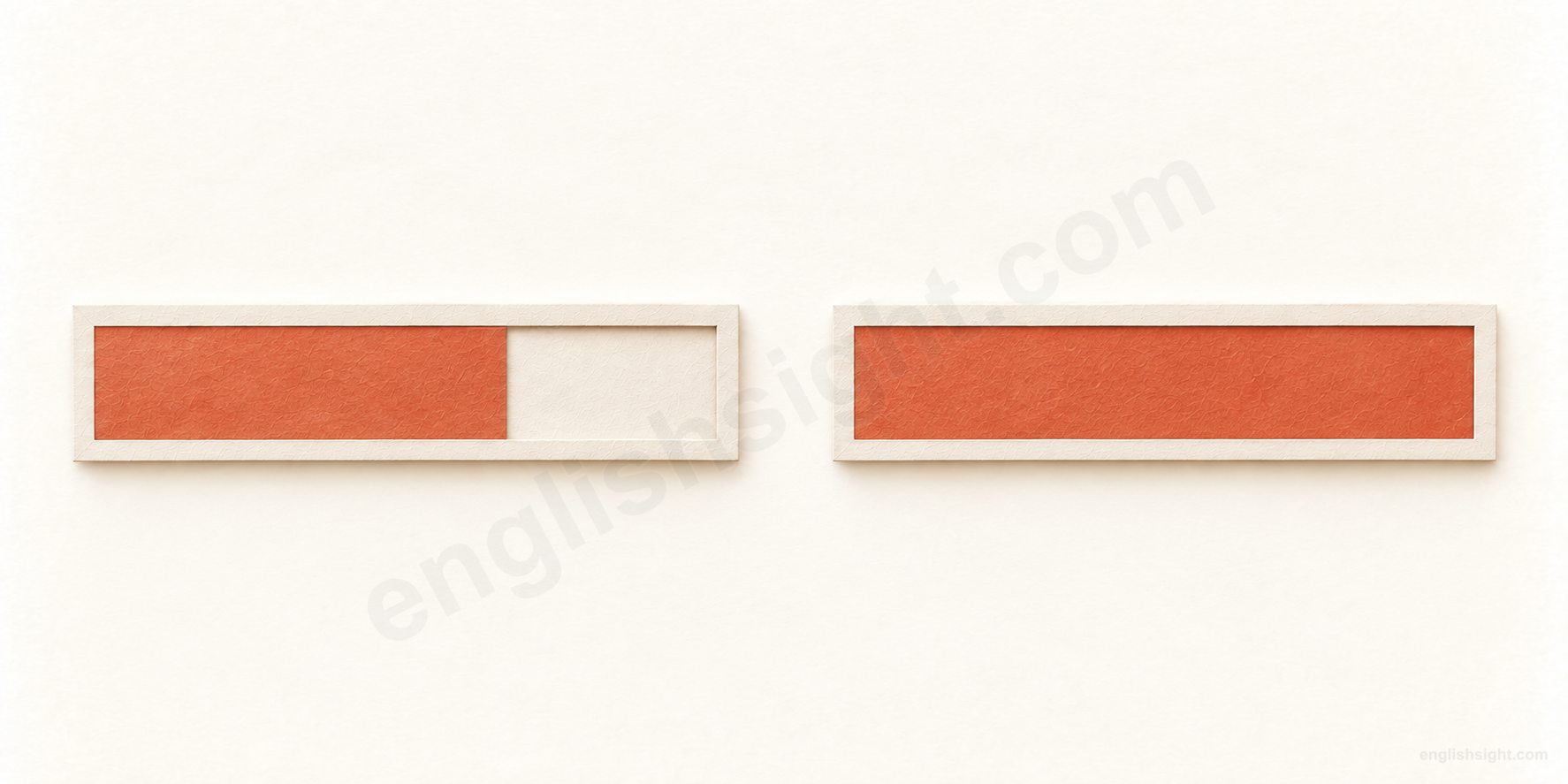
Read quite with its description, its pattern, and the speaker’s context.
Degree and completeness
How fully does the description apply?
A noticeable degree
quite
The full extent
Read the description and context: these are alternative readings, not stages in time.
A noticeable degree or full extent: the description and context decide, not a fixed percentage.
Quite adjusts how strongly a description applies: noticeably on a scale, or fully when a limit is in view.
This is a teaching model for degree and completeness. It does not give quite a fixed numerical value, explain every idiom mechanically, or depict a change over time.
Quite is a degree word, usually classed as an adverb. It can describe a noticeable degree, make a description stronger, or emphasize completeness. That is why quite warm and quite empty do not need the same interpretation.
Learn the combinations too: not quite leaves a gap, quite a few presents a substantial number, and Quite so is a conversational response. No single translation predicts them all.
01
How strongly does the description apply?
Quite can mark a noticeable degree, strengthen a description, or emphasize a complete state. Read the word it modifies and the situation.
01
quite + adjective / adverb
quite warm / quite well
a noticeable or strong degree of a quality
Situation
You assess how warm the room feels.
What the expression conveys
You describe a noticeable level of warmth.
Quite modifies the degree; warm supplies the quality.
With a quality that can vary, quite places it at a noticeable degree. The room is quite warm can be a moderate assessment in British English; in North American English quite often sounds closer to very.
Quite also modifies adverbs: She explained it quite clearly; We meet quite often. It goes before the adjective or adverb, not after it.
Tone, expectations, and context matter. Quite good can be restrained praise or enthusiastic praise, especially when the result is unexpectedly good. Do not assign quite a fixed percentage or a universal place between fairly and very.
In a sentence
The room is quite warm, so I’ll open a window.
Watch the difference Quite good does not always mean only fairly good, and quite warm does not by itself mean too warm.
02
subject + quite + like / enjoy + object
quite like / quite enjoy
like or enjoy something to a noticeable degree
Situation
Someone asks for your opinion of a café.
What the expression conveys
You express approval without necessarily saying it is your favorite.
Before like or enjoy, quite qualifies the strength of the feeling.
I quite like this café is especially familiar in British English. It often expresses measured approval, though tone and context can make the approval stronger.
Put quite before the main verb: I quite enjoyed the concert. In I quite like this café, this café is the object of like; quite has no object of its own.
Not liking something very much is normally I don’t like it very much. I don’t quite like it is not the ordinary negative counterpart of I quite like it. Negatives with quite often shift to the idea of not fully or not exactly.
In a sentence
I quite like this café; the tables by the window are lovely.
Watch the difference Do not move quite to the end: I like this café quite is not the normal pattern.
A complete-state description supports the full-extent reading.
With descriptions such as empty, impossible, or certain uses of sure, quite can emphasize a full state: quite empty means completely empty; Are you quite sure? asks whether the person is fully certain.
The meaning depends on the whole expression, not a rigid list of adjectives. Quite happy to wait commonly means very willing or perfectly content to wait. It does not measure a container reaching a physical top.
Quite enough can strongly mark sufficiency: We’ve had quite enough noise for one evening. It can signal that the speaker wants the noise to stop. The irritation comes from the situation and the whole utterance, not from quite alone.
That’s quite all right can reassure someone after a minor apology: “Sorry to keep you waiting.” “That’s quite all right.” Here all right expresses acceptance, and quite reinforces it.
The complete reading can also modify a verb: I quite forgot about our appointment means I completely forgot it. With an auxiliary, quite normally follows it: I had quite forgotten about our appointment. This use does not mean that you forgot only moderately.
In a sentence
The rice jar is quite empty; we need another bag.
Watch the difference Quite is not always weaker than very: quite impossible is emphatic. Use completely empty, not very empty, when you want an unambiguous full-state description.
04
quite + agree; be + quite right
I quite agree.
agree fully with an opinion
Situation
A colleague says the instructions need to be shorter.
What the expression conveys
You strongly support that view.
With agree, quite commonly reinforces agreement.
I quite agree expresses full agreement, particularly in British usage. Unlike I quite like it, it is not normally a deliberately lukewarm response.
Quite goes before agree. With an explicit person or opinion, keep the prepositions required by agree: I quite agree with you about the instructions.
You’re quite right similarly endorses a judgment. Quite strengthens agree or right; it does not create a new verb meaning.
In a sentence
I quite agree with you: these instructions need to be shorter.
Watch the difference Do not assume quite always softens praise or agreement.
02
A limit has not quite been reached
With a negative, quite often concerns completeness or exactness. A small gap may remain, but the expression does not always measure how small it is.
05
not quite + adjective / participle; Not quite.
not quite ready / Not quite.
not fully ready or finished
Situation
The bag is packed, but you still need your passport.
What the expression conveys
You say that you are not fully ready to leave.
The negative denies that the relevant limit has been reached.
Not quite ready means not fully ready. It often suggests that only a little remains, but the words do not guarantee that completion is seconds away.
The same pattern works with finished, full, or enough: The money is not quite enough. Not quite can stand alone when the missing description is understood.
Compare not ready, which simply denies readiness, with not quite ready, which frames the issue around reaching full readiness. Almost ready is often a useful paraphrase when the situation really is close to completion.
In a sentence
“Are you ready to leave?” “Not quite—I still need my passport.”
Watch the difference Not quite does not mean not at all, and it does not promise immediate completion.
06
do not / cannot + quite + base verb
don’t quite understand / can’t quite reach
not fully understand or not manage to reach the intended point
Situation
You understand most of the directions but miss one step.
What the expression conveys
You ask for clarification.
Quite often limits a negative statement about understanding or ability.
I don’t quite understand can acknowledge partial understanding or politely soften a request for explanation. The speaker may in fact be very confused; politeness is not a precise measurement.
I can’t quite reach the shelf describes failing to reach it, often by a small margin. I can’t quite believe it can express surprise or difficulty accepting news, rather than a physical inability.
In these examples, place quite after don’t or can’t and before the main verb. The verb supplies the activity; quite concerns its full achievement or acceptance.
In a sentence
I don’t quite understand the last step. Could you show me again?
Watch the difference This is different from I quite understand, which can mean I fully understand.
07
not quite + the same / what-clause; not quite as + adjective + as
not quite the same / not quite what I meant
not exactly the same or not an exact match
Situation
A proposed meeting time is close to your suggestion but different.
What the expression conveys
You correct the mismatch.
The gap can concern identity or exactness rather than quantity.
Not quite the same says two things do not match exactly. Not quite what I meant similarly rejects an exact match between what was said and what you intended.
Not quite as expensive as the other one means slightly less expensive in an ordinary comparison. Not quite so simple says the description simple does not fully fit, often correcting an oversimplification.
The same, what I meant, and as…as contribute the relationship being assessed. Quite does not itself mean same, mean, or less.
In a sentence
That’s not quite what I meant: I suggested meeting after lunch.
Watch the difference Do not treat every not quite phrase as unfinished work; this one can concern an inaccurate interpretation.
03
Descriptions, quantities, and differences
The whole noun or quantity expression matters: quite a few is a substantial number, while quite a day makes the day stand out.
Quite normally comes before a/an in this everyday noun pattern.
Compare The day was quite long with It was quite a long day. The second puts an adjective and a singular countable noun inside the noun phrase.
The usual learner pattern is quite a/an + adjective + noun: quite a useful tool, quite an interesting book. Choose a or an by the sound of the following word.
Article placement has a real qualification. In British English, a quite impossible task is possible when quite means completely; North American English can put quite before the article in that reading too. The ordinary moderate pattern quite a small room remains the safest model for everyday production.
In a sentence
It was quite a long day, with meetings until seven.
Watch the difference Do not learn a quite small room as the normal British pattern for a moderately small room.
09
quite a/an + noun; quite the + noun; quite some + noun; be quite something
quite a day / quite something
particularly remarkable, impressive, or unusual
Situation
A single day includes a surprise visit and an unexpected award.
What the expression conveys
You call attention to how exceptional it was.
With a noun, quite can make the whole person or event stand out.
What a day becomes That was quite a day when you describe an exceptional experience. The judgment may be admiring, weary, or ironic; quite a problem can be a serious problem, not a compliment.
Quite the expert presents someone as an impressive or conspicuous example of an expert, sometimes humorously. Informal quite some car similarly makes a car stand out.
That was quite something is a set expression for something remarkable. Something here does not mean that the speaker is unsure whether anything happened. This evaluative reading is related to emphasis, not to a literal filling process.
In a sentence
Winning the prize on your first attempt was quite something.
Watch the difference Quite a day does not simply mean a moderately good day; context tells you what made it exceptional.
10
quite a few + plural noun; quite a few of + specific group
quite a few
a fairly large number
Situation
More than twenty neighbors offer to help.
What the expression conveys
You describe the number as substantial.
The whole phrase has a different force from a few.
Quite a few volunteers means a fairly large number of volunteers. A few alone normally presents a small number; adding quite changes the force of the whole quantity phrase.
Use a plural countable noun: quite a few questions. With a specific group, use of: quite a few of the questions. If the noun is understood, it can be omitted: We answered quite a few.
There is no fixed numerical threshold. What counts as quite a few depends on the situation and expectations, not a particular number on the diagram.
In a sentence
Quite a few neighbors have offered to help with the garden.
Watch the difference Keep a: quite few is not the standard expression. Quite a few is not the same as very few.
11
quite a lot of + noun; quite a bit of + uncountable noun; verb + quite a bit / lot
quite a lot / quite a bit
a substantial amount or number; to a considerable extent
Situation
The repairs require a substantial sum.
What the expression conveys
You emphasize how much money is involved.
Read lot or bit as part of an established quantity phrase.
Quite a lot of work and quite a bit of work both describe substantial amounts. Quite a lot also works with plural countable nouns: quite a lot of messages. For an ordinary count, use quite a few messages rather than quite a bit of messages.
Of introduces the following noun phrase. Without a following noun, leave it out: We still have quite a lot to do. I’ve learned quite a bit describes the extent of learning.
Quite a bit contrasts with a bit, which normally means a small amount. The large-amount interpretation belongs to the whole expression, not to a rule that quite always reverses the word after it.
In a sentence
The roof repairs cost quite a bit of money.
Watch the difference Do not omit of before an expressed noun: quite a bit of money, not quite a bit money.
12
for / in + quite some time; for + quite a while / quite a long time
quite some time / quite a while
a fairly long period
Situation
You last saw a friend a long time ago.
What the expression conveys
You stress the length of the interval.
The quantity being evaluated is time.
Quite some time presents an appreciable stretch of time: We haven’t met for quite some time. Here some does not mean an impressive person or thing, as in quite some player.
Quite a while and quite a long time are natural alternatives. The grammar differs: while is a singular countable time noun here, so it keeps a; time in quite some time does not take a.
In quite some time in a negative or superlative context can set the period being compared: That’s the best meal I’ve had in quite some time. The context supplies the time relationship.
In a sentence
We haven’t spoken for quite some time; how have you been?
Watch the difference Quite some time is normally a long period, not just an unspecified brief moment.
13
quite a bit / lot + comparative adjective or adverb
quite a bit better
better by a considerable amount
Situation
A new chair supports your back better than the old one.
What the expression conveys
You emphasize the size of the improvement.
A bit or a lot provides the amount of difference before the comparative.
Quite a bit better means substantially better, not merely a little better. The same structure works with older, cheaper, and more comfortable.
Compare a bit better, which normally describes a small improvement. In quite a bit better, quite a bit is a whole degree phrase modifying better.
For this ordinary difference pattern, say quite a bit better or much better. Quite better is not the normal model for expressing a substantial comparison.
In a sentence
This chair is quite a bit more comfortable than the old one.
Watch the difference Keep the comparative form: more comfortable, not quite a bit very comfortable.
04
Emphasis in conversation and argument
Established combinations help you correct a claim, add a reason, speak frankly, agree, or ask about an exact explanation.
14
quite the opposite / contrary; Quite the contrary.
quite the opposite / quite the contrary
emphatically the reverse of a previous claim
Situation
Someone thinks the new timetable makes travel easier.
What the expression conveys
You say it has made travel harder.
The opposite or contrary supplies reversal; quite emphasizes it.
Quite the opposite rejects a suggestion and points to its reverse. You can use it as part of a sentence or as a short response.
Quite the contrary has the same corrective function and often sounds more formal or deliberate. It is stronger than merely saying the details are different.
Quite different does not necessarily mean opposite. Two plans can differ in many ways without one being the reverse of the other.
In a sentence
“Has the new timetable made your journey easier?” “Quite the opposite—it now takes longer.”
Watch the difference Keep the in these expressions: quite the opposite, not quite an opposite for this reply.
15
quite apart from + noun / -ing form / wh-clause
quite apart from
setting one consideration aside to focus on another
Situation
The fare is high, and the journey is also very slow.
What the expression conveys
You introduce the slow journey as another reason.
Apart from supplies the separation of considerations; quite reinforces it.
Quite apart from the cost, the journey takes all day draws attention to the long travel time while acknowledging the cost as a separate issue. Often both considerations support the same decision.
After from, use a noun phrase, an -ing form, or an appropriate clause: quite apart from being expensive; quite apart from what it costs.
This expression concerns reasoning, not physical distance. It does not mean the cost is unimportant; it means the next point deserves attention independently.
In a sentence
Quite apart from the cost, the journey takes all day.
Watch the difference Do not read apart from here as saying that the journey is distant from the money.
16
quite frankly / honestly, + clause
quite frankly / quite honestly
speaking with emphasized frankness or honesty
Situation
You need to give a direct opinion about a proposal.
What the expression conveys
You signal that the opinion will be candid.
The adverb introduces your stance toward what you are saying.
Quite frankly often introduces an unusually direct or unwelcome assessment. Frankly supplies the idea of speaking openly; quite intensifies that stance.
Quite honestly can likewise introduce a sincere admission. These are sentence-level comments, often separated by a comma at the beginning: Quite honestly, I need more time.
The expression can sound blunt. Quite does not automatically make every statement polite, and adding honestly does not prove that a claim is true.
In a sentence
Quite frankly, this plan needs more work before we can approve it.
Watch the difference Distinguish a stance comment from manner: She spoke quite clearly describes how clearly she spoke.
17
Quite.; Quite so.
Quite. / Quite so.
I agree, or I understand your point
Situation
Someone explains why a difficult situation matters.
What the expression conveys
You acknowledge or endorse the point.
The short reply refers back to the preceding statement.
Quite can stand alone as a British response showing agreement or understanding. Quite so does the same job and often sounds formal.
The response is not a shortened way of saying fairly. Its conversational function belongs to the established reply, related to full endorsement.
Use context to judge its warmth. Such a short response can sound reserved or dry; I agree is a clear alternative across varieties.
In a sentence
“We should check the figures before sending them.” “Quite so.”
Watch the difference Not quite is a different reply: it withholds complete agreement or says something is not fully achieved.
18
quite + what / why + clause
quite what / quite why
exactly what or why, often when the answer is unclear
Situation
You know a decision was made but cannot explain its reason.
What the expression conveys
You focus on the precise reason.
Quite can sharpen a question word rather than describe an amount.
I don’t know quite what happened focuses on the exact events. The sequence quite why similarly focuses on the precise reason: Quite why they left is unclear.
This use is useful to recognize in questions, embedded questions, and comments about uncertainty. It is not permission to insert quite before every question word in any sentence.
The explanation still belongs to what or why and its clause. Compare not quite what I meant, which says a proposed interpretation does not exactly match an intention.
In a sentence
I don’t know quite why the meeting was cancelled.
Watch the difference In an embedded question, use statement order: why the meeting was cancelled, not why was the meeting cancelled.
19
there is nothing quite like + noun / -ing form
nothing quite like
nothing that matches a special experience
Situation
A warm meal feels especially welcome after working outdoors.
What the expression conveys
You praise the experience as hard to match.
Quite sharpens the comparison; nothing like supplies the idea of having no match.
There’s nothing quite like a warm meal after a day outdoors praises that experience as especially satisfying. The established there’s nothing like pattern expresses enjoyment; quite makes the comparison more pointed.
Nothing like can also deny resemblance, as in The copy looks nothing like the original. That use describes dissimilarity, whereas There’s nothing quite like a warm meal praises a satisfying experience. The surrounding construction matters.
This is not the unfinished-action meaning of not quite ready. Read what is being compared and whether the speaker is praising an experience or denying resemblance.
In a sentence
There’s nothing quite like a warm meal after a day outdoors.
Watch the difference Do not read nothing as a claim that the meal does not exist; it denies that something else matches it.
Read the whole expression
Degree is not a fixed score
The adjective, construction, intonation, and variety of English all matter. British quite good may be moderate or enthusiastic; North American quite often leans toward very. These are tendencies, not rules about every speaker.
A negative changes the scope
The ordinary moderate reading is not simply negated word for word. Not quite usually denies full achievement or exact fit, and may also soften a correction. It does not always assert that only a tiny amount remains.
Quite, quiet, and quit
Quite /kwaɪt/ has one syllable. Quiet /ˈkwaɪət/ normally has two and means making little noise. Quit is a different word meaning stop or leave. Quite is not an adjective that you can use in a quite room.
Grammar and coverage
Quite has no tense or plural forms. It is normally an adverb; Collins also labels its use before a noun group a predeterminer. Verb passive, causative, and particle-verb families are not applicable. This lesson selects modern general uses, not every older, literary, or regional combination.
Choose the reading that fits
Use the context and the complete expression, not a fixed translation of quite.
1. Twenty-five neighbors volunteer. Which phrase presents a substantial number?
2. You are almost ready, but still need your passport. Which reply fits “Are you ready?”
3. The jar has no rice left. What does “quite empty” convey?
4. Choose the usual everyday noun pattern for a noticeably long journey.
5. The new chair is much more comfortable. Which phrase expresses the size of the difference?
6. A speaker says “quite good.” Which interpretation is safest without hearing the tone or context?
Sources and teaching notes
Usage and grammar were checked against the publisher pages below. Explanations and examples are original; the visual model is a teaching interpretation.
This degree model is a memory aid, not an image shared by every English speaker.