From handrails and train tracks to transport, recovery, and angry criticism.
A fixed line of support
A fixed line of support
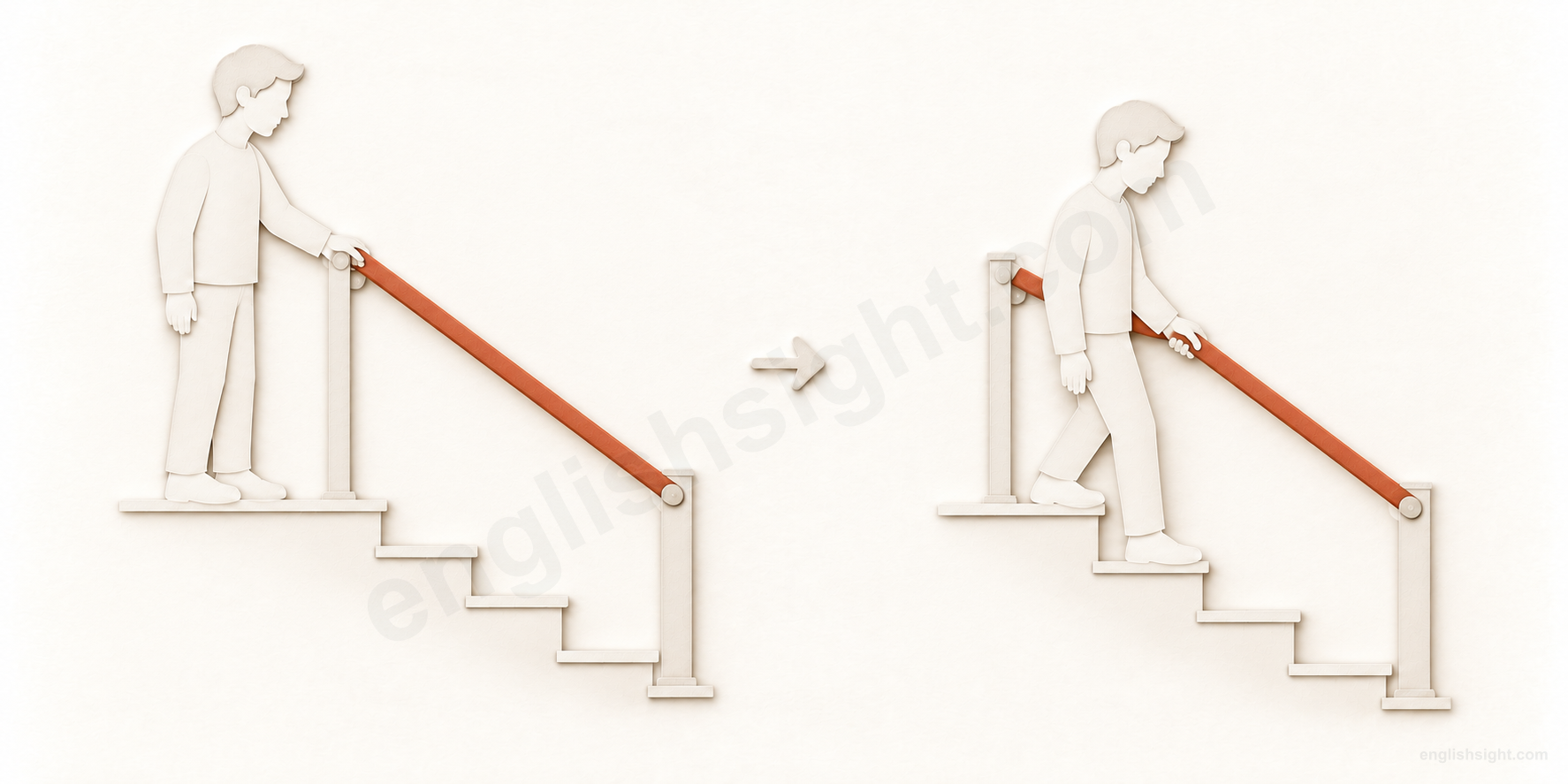
The person holds the upper end of a fixed rail beside the steps.
rail
The person is one step lower, still holding the anchored bar for support.
As the person steps down, the hand moves along the rail.
The person moves; the fixed rail provides a steady handhold.
A rail is a long bar fixed in place to support, guard, or guide something.
The sketch shows one protective rail on posts. It illustrates a physical relationship; the railway idioms are established extensions, while the angry-speaking verb is a separate branch.
A rail is often a long bar fixed in place for support, protection, or guidance. What matters is its job: a hand can grip one, clothes can hang on one, and train wheels can run on rails.
The physical noun helps connect several uses, but not every meaning comes from it. Rail against means criticize angrily and belongs to a separate word history. Learn the complete expressions rather than trying to predict them all from the sketch.
01
Bars that support, guard, and guide
Start with a physical rail and ask what it is doing: providing a handhold, carrying something, or guiding wheels.
01
a/the rail; hold on to / grip / lean on / look over + the rail
hold on to the rail
use a fixed bar for support or protection
Situation / object
Someone needs a firm handhold by steps.
Role / result
They hold a bar that stays in place.
The rail is the long supporting or protective bar, not the whole staircase.
A rail can provide a handhold or form part of a barrier. Hold on to, grip, lean on, and look over describe different relations to that same object. A ship’s rail is the barrier along the deck edge.
Handrail highlights support for a hand; guardrail highlights protection at an edge or beside a road. A railing usually means a barrier made from rails and upright parts, rather than just one bar. Context may also use rail for the barrier as a whole.
In a sentence
Hold on to the rail while you walk down the steps.
Watch the difference A rail is not necessarily part of a railway. Here it is a handhold.
02
a clothes / towel / curtain rail; hang + object + on / from / over + a rail
hang something on a rail
support hanging objects with a bar
Situation / object
Clothes need somewhere to hang.
Role / result
Hangers rest on a fixed bar.
The object hangs from or rests over the rail; it does not travel along a railway.
A clothes rail holds hangers, a towel rail holds towels, and a curtain rail supports curtains. The first noun tells us the purpose; rail supplies the idea of the supporting bar or fitting. A clothes rail can be freestanding.
On a rail locates the hanging item; from a rail emphasizes suspension. A towel can hang over a rail because it folds across it. In American household descriptions, rod or bar may be more natural for particular fittings, as in curtain rod and towel bar.
In a sentence
We hung the spare coats on a rail near the door.
Watch the difference A clothes rail is a bar for hanging clothes; a clothesline is a line or cord, often used for drying them.
03
a rail; the rails; run on / along the rails; come off / jump the rails
the rails
the metal bars that train wheels run on
Situation / object
Two parallel metal bars form the running surfaces.
Role / result
A train follows those bars.
One rail is one bar; the rails are not all the parts of the track.
The railway sense usually appears in the plural because a train runs on a pair of rails. Rails are part of the track; track can include the sleepers or ties and the supporting structure too.
Run on or along the rails describes normal movement. A train that comes off the rails has physically left its track; jump the rails is another literal expression for a train suddenly leaving it. These literal uses help explain the later idioms, but an actual train accident is not required there.
In a sentence
Workers replaced a cracked rail before the first train arrived.
Watch the difference Do not use a rail to mean one passenger train: a rail here is a component of the track.
02
Talking about train transport
Rail also names a means of transport. Here it is uncountable, rather than one metal bar you could count.
04
travel / go / send / transport + by rail
travel / send something by rail
use trains as the means of transport
Situation / object
People or goods need to reach another place.
Role / result
They travel on trains.
By rail names the transport method, not one particular vehicle.
Rail is uncountable when it means train transport. By rail works for passengers and freight: travel by rail, transport goods by rail, or send a parcel by rail. There is no article after by in this construction.
By train is a familiar everyday alternative. On the train describes being aboard a train or taking a particular service: I left my bag on the train. You can contrast transport methods with by road, by air, and by sea.
In a sentence
The company sends its heavy equipment by rail.
Watch the difference Say by rail, not by a rail or by rails, when naming the means of transport.
05
rail + service / fare / ticket / link / network; high-speed rail
rail services / a rail link
describe transport connected with trains
Situation / object
Two towns need a reliable transport connection.
Role / result
A train connection serves them.
Rail before another noun identifies the transport sector or system.
In rail services, rail fares, rail travel, and the rail network, rail modifies the next noun. The network is the connected system; a rail link is a train connection between places. A rail ticket is a ticket for train travel, not ownership of a metal bar.
Compare a rail with the rail network: the first counts a physical object, while the second names a system. The following noun controls the plural in these combinations: one rail service, several rail services. High-speed rail names train transport designed for high speeds.
In a sentence
The new rail link connects the airport with the city centre.
Watch the difference Railway is usual in British English and railroad in American English; rail works in transport combinations in both.
03
Leaving a course, recovering, and making comparisons
Some expressions build on the shape or function of a rail. Learn their established meanings and tone as whole expressions.
06
person + go / be + off the rails
go off the rails: behaviour
begin behaving in an uncontrolled or unacceptable way
Situation / object
Someone has been managing ordinary responsibilities.
Role / result
Their behaviour becomes seriously disruptive.
The person departs from an expected course; no physical rails are involved.
This informal idiom can describe someone beginning to behave recklessly or losing control of their life. It is stronger than simply making a mistake or choosing something unusual.
Go marks the change; be off the rails describes the resulting condition. The railway connection is a useful teaching comparison: leaving the rails means leaving an expected course. The phrase can sound judgmental when applied to a person, so describe the actual behaviour when precision or sensitivity matters.
In a sentence
After he lost his job, he went off the rails and began getting into fights.
Watch the difference Going off the rails does not simply mean disagreeing with someone, and it is not a clinical diagnosis.
07
plan / discussion / process + go off the rails
go off the rails: a plan or process
stop developing or functioning as intended
Situation / object
A discussion or project has an intended course.
Role / result
It becomes disorganized or stops working properly.
The whole process loses its course, rather than a person necessarily misbehaving.
A project, company, discussion, or negotiation can go off the rails when it loses direction or control. This applies the established idiom to a process, not just to personal behaviour.
The context supplies the kind of failure: a meeting might turn into an argument; a project might become unmanageable. A small delay alone need not justify this stronger description. The rail image explains the connection, but does not tell us exactly what went wrong.
In a sentence
The discussion went off the rails when everyone started arguing about the budget.
Watch the difference This does not mean that a train left its track; the subject and context determine the figurative reading.
08
be / get back on the rails; get + object + back on the rails
get something back on the rails
restore normal functioning or progress after trouble
Situation / object
A project has stopped working well.
Role / result
It begins progressing normally again.
Back signals a return; get can describe bringing about that return.
Be back on the rails describes a recovered state. Get back on the rails describes returning to it, and get something back on the rails describes helping a process recover. The object of get names what is being restored.
Oxford labels this idiom informal; Collins labels it journalism. It is used for careers, organizations, plans, and other activities. It can mean recovery is under way, not that every problem has been solved. Keep back and the plural rails in the established expression; back on track is a related alternative.
In a sentence
A clear timetable helped us get the project back on the rails.
Watch the difference Get the project back on the rails does not mean installing railway tracks; here get causes a change in the project’s condition.
09
be / look + (as) thin as a rail
(as) thin as a rail
be extremely thin
Situation / object
Someone describes a person’s very slender build.
Role / result
They make an exaggerated comparison with a narrow bar.
This is a comparison of shape, not support or railway travel.
As thin as a rail is a fixed simile. In He is as thin as a rail, the two as words frame the comparison; the first as can be omitted: He is thin as a rail.
The comparison uses the narrow shape of a bar. It describes appearance and need not imply illness. Comments about someone’s body can be unwelcome; this is useful to recognize in stories and conversation rather than a compliment to assume people want.
In a sentence
In the old photograph, my grandfather is as thin as a rail.
Watch the difference Keep a in as thin as a rail; this is not the uncountable transport sense.
04
Electricity, angry words, and putting up barriers
A third rail has literal and figurative uses. The angry-speaking verb is a separate branch; the fencing verb relates directly to physical rails.
10
a / the third rail; draw power from the third rail
the third rail: electricity
an extra rail that supplies electric power to trains
Situation / object
An electric railway needs a source of power.
Role / result
Trains draw electricity from an additional rail.
This rail supplies power, rather than being one of the two running rails.
Third rail is a countable compound for an extra conducting rail beside the track or between the two running rails on some electric railways. Third identifies its role relative to the pair of running rails.
The phrase belongs to train systems and descriptions of their equipment. Do not assume that every railway has one: some trains receive power in other ways. This literal electrical meaning also supplies the danger comparison in the political expression.
In a sentence
These trains draw power from a third rail beside the track.
Watch the difference A third rail is not a third railway route or a third train.
11
a political third rail; the third rail of + political field
a political third rail
a sensitive issue that politicians avoid because of the likely reaction
Situation / object
An issue could provoke strong public opposition.
Role / result
Politicians treat it as dangerous to discuss or change.
The danger is political; the speaker is not describing electrical equipment.
In North American informal political language, a third rail is an issue treated as too risky to touch. The metaphor compares public backlash with the danger of contacting a live electrical rail.
It often appears as the third rail of politics or a political third rail. Which issue qualifies depends on the country, period, and speaker; the phrase does not establish that an issue must always be avoided. This is a useful news-reading expression, rather than a general synonym for any hard question.
In a sentence
The columnist called pension reform a political third rail.
Watch the difference The meaning belongs to third rail as a whole. Rail alone does not mean a controversial topic.
12
rail against / at + person or thing
rail against / at
complain or attack someone or something very angrily
Situation / object
A person is deeply angry about a decision or another person.
Role / result
They express forceful criticism.
This verb names angry speech; it is a separate branch from the physical bar.
The subject is the angry speaker. Against or at introduces the target: rail against a policy, rail at an official. Against often suits opposition to a policy or situation; both prepositions can introduce a person. They are prepositions here, not separable particles.
Oxford marks this verb formal and Collins marks it written. It is useful in reporting forceful criticism; complain is a more neutral everyday choice. The forms are rail, rails, railed, and railing: They were railing against the fees describes an ongoing angry protest.
In a sentence
Residents railed against the sudden increase in parking fees.
Watch the difference Say They railed against it, not They railed it against. The noun railing can also mean a physical barrier; context distinguishes it from the verb form.
13
rail + object + in / off; rail in / off + noun; be railed in / off
rail something in / off
separate an area by putting rails around it
Situation / object
A space or object is accessible from the surrounding area.
Role / result
Rails mark it off or enclose it.
The object is the area or thing being separated; rails form the boundary.
This physical verb relates to the noun: to rail an area is to provide it with rails. With in or off, it means to enclose it or separate it from nearby space. Off emphasizes separation, while in suggests enclosure; actual arrangements may overlap.
You can say rail off the area or rail the area off. A pronoun goes between the verb and particle: rail it off. The passive is useful when the barrier matters more than who installed it: The area has been railed off. These are less everyday than fence off, but occur in descriptions of places and safety arrangements.
In a sentence
The workers railed off the damaged steps.
Watch the difference Rail off refers to physical rails. Rope off specifies a rope barrier; fence off is broader and can include a fence made of rails.
Choose the noun, construction, and tone
Count a bar; name a transport method
A rail and two rails count physical bars. By rail uses an uncountable transport noun. Rail services uses that noun as a modifier; services, not rail, takes the plural ending.
Rail, railing, track, and train
A rail may be one bar or, in context, a protective barrier. A railing is typically the whole barrier of bars and supports. Railway track includes more than the individual rails; the train is the vehicle running on it.
Keep the two verbs apart
The fencing verb can take a direct object and form a passive: They railed off the steps; the steps were railed off. The angry-speaking verb usually takes at or against before its target. A direct speech quotation can also follow rail in written narrative, but that does not license treating a policy as its ordinary direct object.
Limits of the model
The bird called a rail is another separate noun. Furniture joints, nautical details, billiards, and specialist technical uses are outside this everyday selection. The diagram is a teaching model, not evidence that all native speakers share one mental picture.
Choose the meaning in context
Use the situation and the whole expression, not just the spelling rail.
1. You are choosing how to send goods. Which sentence names train transport?
2. A project had nearly failed, but a new plan has restored progress. Which sentence fits?
3. Residents angrily criticized the new charges. Which sentence fits the angry-speaking verb?
4. Workers installed rails to keep visitors away from an unsafe area. Replace the area with it.
5. A journalist calls a reform a political third rail. What is the point?
Sources and teaching notes
Dictionary entries support the uses and constructions below. The explanations, examples, and compatibility sketch were created for this lesson; the visual connection is a teaching interpretation.
The diagram illustrates the physical noun. It does not describe every meaning or a picture shared by every native speaker.