From everyday weather to falling quantities and familiar expressions.
From clouds to falling drops
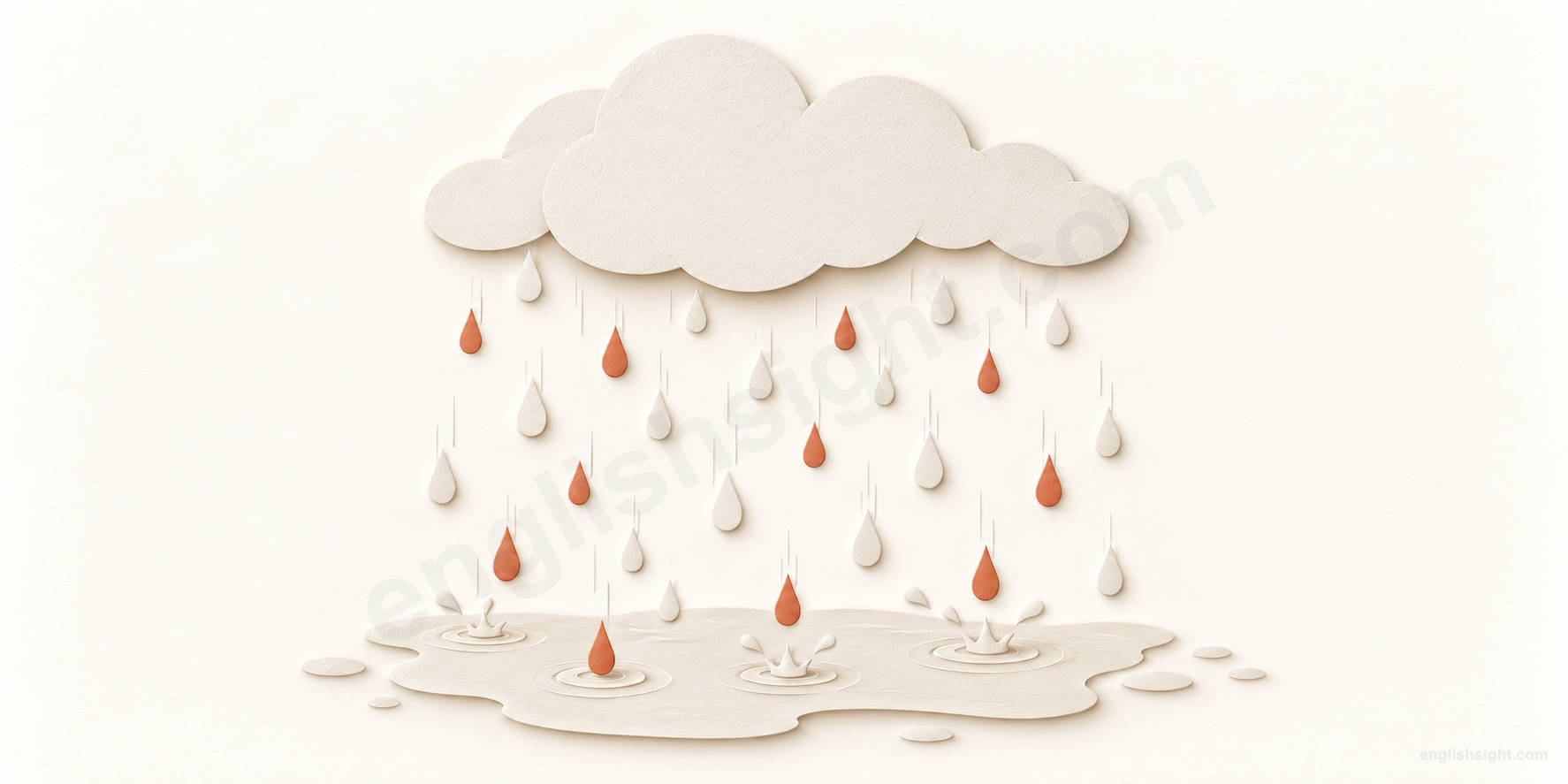
Many drops falling from clouds
A cloud hangs above the ground.
rain
Drops reach a puddle, making splashes and ripples.
Many separate drops of water fall from the cloud.
Rain falls as many separate drops from clouds to the surface below.
Rain is water falling from clouds as separate drops; the verb describes that fall. A comparison with rain can present other things falling or arriving in quantities.
The picture shows the literal relation: a cloud above, many falling drops, and the surface they reach. Wetness is a possible effect, not the definition of every figurative use.
Rain names both water falling from clouds and the event of that water falling. English uses the noun and verb differently: We need rain; It is raining.
The falling-drop relationship helps with showers of other things. Expressions about plans, trouble, or recovery have established meanings of their own; the picture does not predict every combination.
01
Water, weather, and daily plans
Name the water with a noun, describe the event with a verb, and explain what the weather means for your day.
01
rain as a noun; the rain + verb
rain / the rain
water falling in drops from clouds
Situation
Clouds gather above the garden.
What happens / what is meant
Water drops reach the soil.
Rain names the water or the weather event, without counting individual drops.
Rain is normally uncountable: some rain, a lot of rain, not three rains when you mean three drops. Use the rain for the particular rain in the situation; rain without the can describe weather generally.
Compare Rain helps the garden with The rain has stopped. Both use a noun. Rainy is an adjective: a rainy afternoon; It is rainy describes the weather, while It is raining describes falling rain. Rain can also modify another noun: rain clouds are clouds associated with rain, and rain gear is equipment or clothing for protection from rain.
In a sentence
The rain has soaked the garden.
Watch the difference Say a drop of rain when counting drops. Do not use a rain to mean one drop.
02
heavy / light / torrential rain; a light rain; measurement + of rain
heavy rain / a light rain
describe intensity or measure a fall of rain
Situation
You check the forecast before leaving.
What happens / what is meant
You know whether to expect a little rain or a lot.
Adjectives describe rain; measurements state an amount.
Heavy rain is strong rain; light rain is gentle. Torrential rain emphasizes an exceptionally large amount. With a description, a light rain can refer to a particular fall of rain; this limited singular use does not make ordinary rain freely countable.
Five millimetres of rain measures accumulated water, not five drops. A shower is a short spell; drizzle has fine drops; a downpour is a heavy fall. These words distinguish duration, drop size, and intensity.
In a sentence
The forecast warns of heavy rain after lunch.
Watch the difference Use heavy rain as the usual noun phrase; in the verb phrase use rain heavily or rain hard.
03
in the rain; get caught in the rain; shelter from / come in out of the rain
in the rain / out of the rain
describe being exposed to rain or sheltered from it
Situation
You are walking when rain begins.
What happens / what is meant
You look for a dry place to wait.
In describes exposure; out of describes leaving that exposure.
We waited in the rain means rain was falling where we waited. Get caught in the rain adds the idea of unexpectedly meeting rain while outdoors. Shelter from the rain names what you want protection against.
Come in out of the rain invites someone into shelter. Here in and out of belong to the movement and location expression; they are not particles forming a rain phrasal verb.
In a sentence
We got caught in the rain on the way to the station.
Watch the difference In the rain does not mean inside a single drop; it describes the surrounding weather.
04
the rains + plural verb; seasonal / monsoon rains
the rains
seasonal rains or the season when they arrive
Situation
A region has a long dry season.
What happens / what is meant
The regular wet season begins.
This established plural names seasonal weather, not individual drops.
The rains can mean the recurring wet season, especially in tropical regions. Seasonal rains can also describe the rainfalls associated with a season. Compare The rains are late with Rain is expected tonight: the first concerns a seasonal pattern.
The plural takes plural agreement: The rains have arrived. It is not the ordinary way to count a few showers in one afternoon.
In a sentence
The farmers are waiting for the rains to begin.
Watch the difference Do not replace some rain with some rains in an ordinary weather forecast.
05
it + rain; it is / was raining; it will / is going to rain
It is raining.
say that rain is falling
Situation
You look outside before your walk.
What happens / what is meant
You report the weather happening now.
Weather it supplies a subject without naming a person or thing.
Use It is raining for rain happening now, It rains for a regular pattern, and It rained for a past event. Weather it is a grammatical subject, not the cloud. Questions and negatives use the usual auxiliaries: Is it raining? It did not rain.
Rain is intransitive in this weather use: it has no object. Rain on the roof adds a location. It is going to rain predicts the event; It looks like rain uses the noun after like. Forms: rain, rains, rained, raining.
In a sentence
It rains a lot here in November, but it is not raining now.
Watch the difference Say It is raining, not Is raining alone or It is rain when reporting the event.
06
start to rain / start raining; keep / stop raining; rain hard / heavily
start to rain / stop raining
describe rain beginning, continuing, or ending
Situation
Clouds darken while you are outside.
What happens / what is meant
Rain begins and later stops.
The preceding verb controls how the weather event is presented.
It started to rain and It started raining both describe the beginning. It kept raining describes continuation; It stopped raining describes the end. It has been raining for an hour looks back over a period continuing up to now or very recently.
The rain has let up describes rain becoming less intense or stopping. Let up belongs to let, not to a new sense of rain. In It is raining hard, hard is an adverb; heavily is another choice.
In a sentence
It started to rain as we left, but it stopped raining before we reached home.
Watch the difference Stop raining means the rain ends. Stop to rain does not express that meaning.
07
event + be / get + rained off (BrE) / rained out (NAmE)
be rained off / be rained out
have an event cancelled or stopped because of rain
Situation
An outdoor match is scheduled.
What happens / what is meant
Rain prevents play or forces it to stop.
The event becomes the subject of this usual passive expression.
The match was rained off is British English; The match was rained out is the usual North American equivalent. Either can concern an event that never starts or one that has to stop. A later date is possible but is not guaranteed by the phrase.
In an active construction, the subject names the weather causing cancellation: The storm rained out the game. With an object pronoun, put it before the particle: The storm rained it out. The passive The game was rained out is a straightforward learner pattern. Ordinary weather rain has no object; this cancellation construction is different.
In a sentence
The school match was rained off, so the players went home.
Watch the difference Rained off does not mean the rain has stopped; it says what happened to the event.
02
Other things fall or arrive like rain
These extensions compare many separate things with falling drops. The subject and object show what falls and who causes it.
08
plural / mass subject + rain (down) + on / onto + target
rain down on…
fall in many separate pieces or repeated impacts
Situation
Paper pieces are released above a stage.
What happens / what is meant
Many pieces fall onto the stage.
The falling things are the subject; down highlights descent.
Confetti rained down describes many pieces falling like drops. On or onto can identify the surface or people they reach. Down can be omitted: Confetti rained on the stage still describes a shower of pieces.
The comparison also appears in accounts of danger: debris rained down, or blows rained down on someone means repeated hits. Rain here does not turn those things into water; it presents their quantity and repeated arrival.
In a sentence
Confetti rained down onto the empty stage.
Watch the difference Down shows the direction; it does not by itself mean cancellation as out can in rained out.
09
subject + rain + object + (down) + on / upon + target
rain something on someone
cause many things to fall or be directed at a target
Situation
People on a balcony hold paper petals.
What happens / what is meant
They release the petals over the celebration.
The subject causes the shower; the object names what is showered.
In They rained petals down on us, they are the source, petals is the object, and on us identifies the receivers. Compare Petals rained down on us: now the petals are the subject, and the sentence does not name who released them.
The same construction can describe directing repeated attacks or words at someone: rain blows on an opponent or rain abuse on someone. With abuse, nothing needs to fall physically; it is a forceful description of a large amount directed at a target.
The things given need not be hostile: They rained praise on the young musician means they praised the musician a great deal. This figurative use describes giving something in abundance, with no physical falling required.
In a sentence
The guests rained paper petals down on the couple.
Watch the difference Check who does what: Petals rained down differs grammatically from Guests rained petals down.
10
a rain of + plural / mass noun
a rain of…
a large quantity arriving or falling in a shower
Situation
A branch shakes above the path.
What happens / what is meant
Many petals fall together.
The noun phrase packages many arrivals as one shower.
A rain of petals describes a mass of petals falling together. A rain of stones or bullets has the same grammatical pattern but a very different situation. Of names what the shower consists of.
A rain of criticism or abuse extends the comparison to a large amount of hostile language. The article belongs to the singular figurative noun rain, while the following noun can be plural or uncountable.
In a sentence
A rain of petals drifted onto the path.
Watch the difference A rain of petals does not mean a type of wet weather or a single petal.
03
Established expressions for everyday situations
Learn these expressions as whole units. Their meanings cannot all be predicted from falling water.
11
clause + (come) rain or shine; come rain or shine, + clause
(come) rain or shine
continue regardless of weather or circumstances
Situation
The weather may be good or bad.
What happens / what is meant
A plan or commitment still holds.
The alternatives stand for changing conditions that will not alter the action.
Rain or shine can literally promise that an event goes ahead whatever the weather. Come rain or shine has the same function; come here does not instruct anyone to approach.
It also applies to reliability in other circumstances: I will support you, come rain or shine means my support will continue through difficulties. The full expression supplies the commitment; rain alone does not mean determination.
In a sentence
The market opens every Saturday, rain or shine.
Watch the difference Do not understand shine as a second verb with the market as its subject; this is a fixed expression.
12
it + be + raining cats and dogs
rain cats and dogs
rain very heavily
Situation
You hear loud rain against the windows.
What happens / what is meant
You comment emphatically on the weather.
This informal idiom intensifies the weather meaning.
It is raining cats and dogs is an informal way to say it is raining very hard. The animals are not actual objects falling from the sky. Keep cats and dogs together as the established phrase.
It is pouring is a shorter everyday alternative. Heavy rain is suitable in a forecast; raining cats and dogs gives a more conversational tone. Neither wording measures an exact amount.
In a sentence
Bring an umbrella—it is raining cats and dogs outside.
Watch the difference Do not invent an explanation about animals literally falling; the modern meaning is a fixed idiom.
13
it never rains but it pours (BrE); when it rains, it pours (NAmE)
It never rains but it pours.
several difficulties arrive close together
Situation
One thing goes wrong.
What happens / what is meant
More problems follow soon after.
The saying compares accumulating trouble with increasingly heavy rain.
Use the saying when a run of problems makes a situation feel especially difficult. British English has It never rains but it pours; North American English commonly uses When it rains, it pours.
The example may have no connection with weather. The saying comments on a cluster of events; it is not a factual claim that every problem always causes another. Learn but in this fixed wording rather than treating the sentence as an ordinary weather report.
In a sentence
My laptop broke, and then I lost my keys. It never rains but it pours.
Watch the difference This expression usually comments on misfortune; it does not predict how long a rainstorm will last.
14
rain on + possessive + parade
rain on someone’s parade
spoil someone’s enjoyment or plans
Situation
Someone is excited about a plan.
What happens / what is meant
A criticism or obstacle dampens that excitement.
The celebration is figurative; an actual parade is unnecessary.
Rain on someone’s parade means interfere with their enjoyment or undermine their plans. I do not want to rain on your parade often introduces an unwelcome objection to something the listener is pleased about.
The phrase is informal and can sound critical of the person spoiling the excitement. It does not necessarily imply deliberate cruelty: a practical warning can have the same disappointing effect. The possessive names the person whose enjoyment is affected.
In a sentence
I do not want to rain on your parade, but the venue is already booked.
Watch the difference Keep on in the idiom. Rain your parade is not the same construction.
15
be / feel + (as) right as rain
(as) right as rain
well again or in excellent condition
Situation
Someone has felt unwell.
What happens / what is meant
They feel fine again.
Right means well or all right in this informal comparison.
Right as rain often reassures someone that a person has recovered or feels fine. The first as is optional: I feel right as rain and I feel as right as rain are both possible.
The expression can also concern something being in good condition. Its meaning belongs to the whole comparison; the falling-water model does not explain why right has this meaning. It is conversational, especially associated with British English.
In a sentence
After a quiet evening, I felt right as rain again.
Watch the difference It does not mean someone’s answer is factually correct or that rain guarantees good health.
16
take a rain check; take a rain check on + noun / -ing
take a rain check (on…)
decline now while leaving open a later opportunity
Situation
A friend invites you to lunch.
What happens / what is meant
You cannot go now but would welcome another chance.
The whole expression softens a refusal; rain need not be involved.
Can I take a rain check? is an informal response to an invitation or offer, especially in North American English. On can introduce the proposed activity: take a rain check on lunch. It leaves the possibility of accepting later without setting a definite new date.
A literal rain check is a ticket usable later when rain causes a game or show to be cancelled. That provides a useful connection for remembering the invitation expression. Check here does not mean inspect the weather.
In a sentence
Can I take a rain check on lunch? I have a deadline today.
Watch the difference Keep a in take a rain check. The phrase does not confirm a replacement date.
17
save / put aside + something + for a rainy day
save something for a rainy day
keep resources for a possible future need
Situation
You have money left after paying your bills.
What happens / what is meant
You keep some for unexpected expenses.
Rainy day stands for a future difficult time, not a weather forecast.
Save money for a rainy day means keep it available in case you need it later. Put something aside for a rainy day expresses the same intention. This is an established use of the related adjective rainy, included because it is useful in everyday money talk.
The literal phrase a rainy day can simply mean a day with rain: We stayed indoors on a rainy day. Saving for a rainy day instead concerns possible future need and does not require bad weather.
In a sentence
I put a little of each payment aside for a rainy day.
Watch the difference For marks the future purpose of saving. Do not read this as a plan to spend the money whenever it rains.
Read the noun, verb, and whole expression
Rain, raining, and rainy
Rain /reɪn/ is a noun or verb; raining is the -ing form; rainy is an adjective. Compare heavy rain, it is raining heavily, and a rainy day. Rein and reign sound the same but are different words.
A shower is not a storm
A shower names a short spell of precipitation; a storm concerns disturbed weather and can involve strong wind or thunder. Rain can fall without a storm. Rain does not always imply a downpour.
Grammar depends on the sense
The weather verb uses it and normally takes no object; the figurative verb can be transitive or intransitive. Cancellation expressions commonly use a passive. There is no need to invent a general causative construction for the weather verb.
The model has limits
Falling quantities resemble drops; rain on someone’s parade and right as rain are learned as whole expressions. This is a teaching connection, not a claim about one picture shared by all English speakers.
Choose the intended meaning
Check the grammar and situation before choosing.
1. You want to say that water is falling from the clouds now. Which sentence describes the event?
2. Which phrase naturally describes a large amount of rain?
3. The match was rained out. What happened?
4. In The guests rained petals down on us, what falls?
5. You cannot accept today’s invitation but hope for another chance. Which reply fits?
6. The market opens rain or shine. What does the notice promise?
Sources and teaching notes
Noun, verb, regional patterns, and idioms were checked against the dictionary pages below. Explanations and example sentences are original; the visual connection is a teaching aid.
The picture explains a relationship; it is not a mental picture shared by every native speaker.