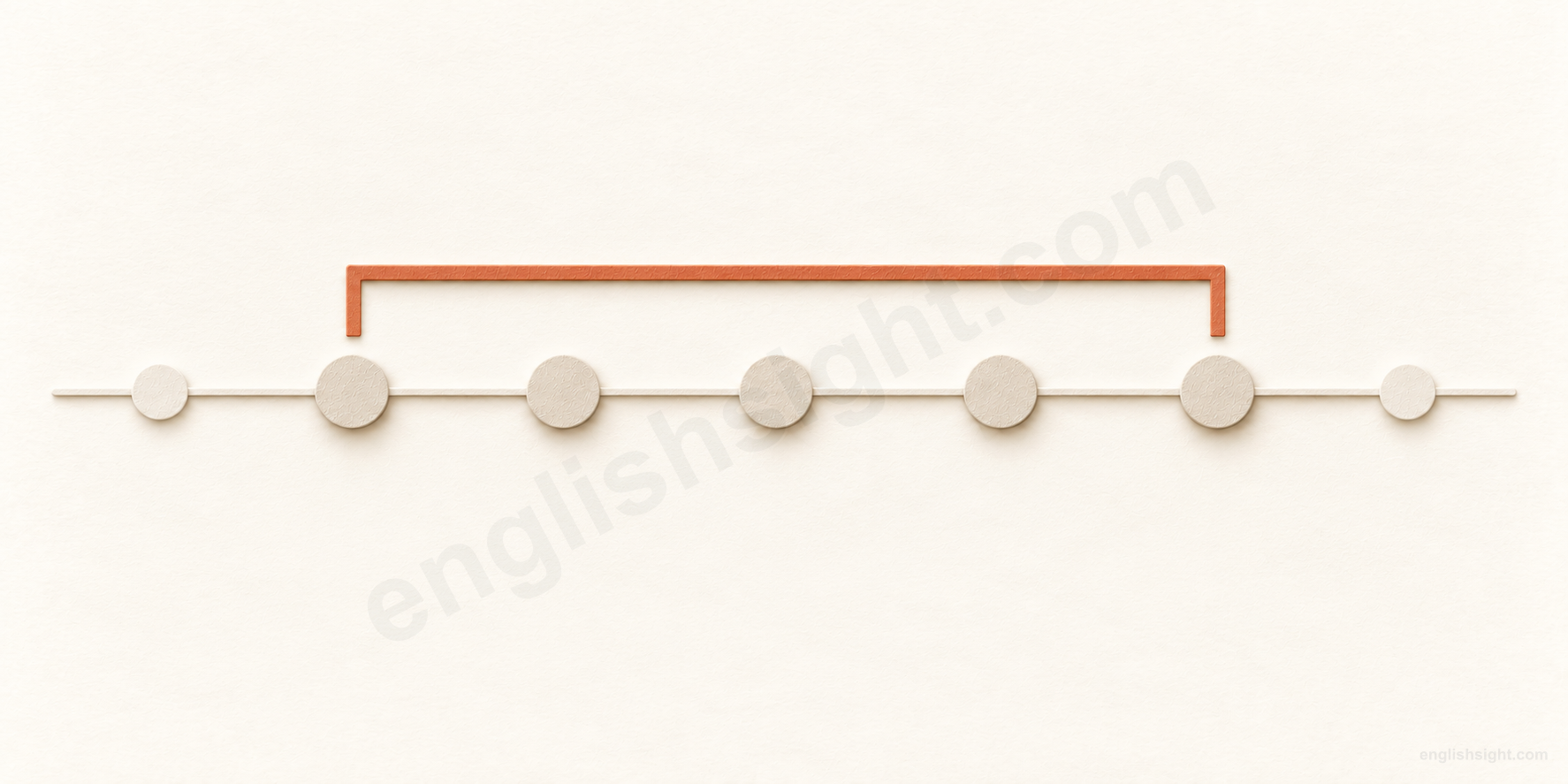
Use range for varied choices, values between limits, and the extent something can cover or reach.
Several possibilities, one extent
Several possibilities, one extent
Separate values on one scale
range
One range, with two limits
Consider the span from the first main value to the last.
The bracket shows the span of these values; the gaps do not imply every intermediate value is present.
Range can present a spread of things or values, or the extent that something can cover or reach.
The sketch uses values on a scale as a teaching model. It shows a relation, not an event in time. It helps with variation and limits; it does not derive every established meaning of range or describe a mental picture shared by all English speakers.
A range invites you to consider a spread: different options, values from one limit to another, or the extent of an ability. Ask what is spread out and what defines its limits.
The noun can name the spread; the verb can describe how things vary or cover an area. Some uses, including a kitchen range, are established names that need their own explanation.
01
Choices, limits, and abilities
A range can bring different options together or describe how far a set of values or abilities extends. Ask what is included and what its limits are.
01
a + wide / broad / narrow / limited / full + range of + plural or uncountable noun
a wide range of options
many different choices of a related kind
Situation / starting information
A library offers several kinds of activity.
What the expression tells us
You can choose among different activities.
Range highlights variety within a set.
Use a range of when you want to show that the choices differ: a range of activities, sizes, colours, or services. Wide and broad emphasize variety; narrow and limited emphasize fewer kinds of choice.
Compare a large number of books with a wide range of books. Thousands of copies of one title make a large number, but not a wide range. A full range means the whole selection relevant to the context, not everything that exists.
In a sentence
The library offers a wide range of weekend activities.
Watch the difference Keep of: a range of options, not a range options. Range concerns diversity here, not just a large count.
02
a range of + products; product range; launch / expand + a range
a new product range
a related collection sold by a business
Situation / starting information
A company develops several related products.
What the expression tells us
The company presents them as one collection.
The range is a collection, not one item or its price.
A product range is a group of related goods a business offers. A shop can stock several ranges, and a company can launch or expand its range. This use is particularly familiar in British retail English; American businesses also use product line.
Our range of lamps identifies what the collection contains. Our price range instead identifies the band of prices. The same products can belong to one product range and have very different prices.
In a sentence
The company has launched a new range of desk lamps.
Watch the difference Do not assume every member of a range is identical or costs the same.
03
in / within / outside + a range; a price / age / temperature range of A to B
in our price range
inside a relevant band of values
Situation / starting information
You set a budget for a bicycle.
What the expression tells us
You compare its price with the amount you can afford.
A range can have a lower and an upper limit.
A price range, age range, or temperature range groups values between limits. A bicycle in our price range is affordable within our budget. A price outside or beyond our price range is usually too high in this shopping context.
For an explicit interval, use a temperature range of 10 to 20 degrees or values in the range of 10 to 20. Within the normal range says a measured value falls inside the limits regarded as normal for the particular context.
The age range is six to ten does not say there is a child of every age. It describes the span of ages represented or allowed, depending on the context.
In a sentence
We need a bicycle in our price range, ideally under $300.
Watch the difference Write from A to B or between A and B; avoid from A and B. Being inside an age range does not describe physical location.
04
a range of skills / abilities; somebody’s range as + role; outside the range of + experience; restrict + somebody’s range of motion
a range of skills
the variety or extent of what someone can do
Situation / starting information
A task calls for different abilities.
What the expression tells us
You assess which abilities someone has.
The relevant extent can concern skills, experience, performance, or physical movement.
A range of skills names different capabilities. An actor’s range concerns how varied their performances or roles can be. A limited range does not necessarily mean poor work: someone may do one kind of work very well.
Outside my range of experience means beyond what I have experienced. Here the boundary is figurative. The phrase does not mean that the event happened far away from my body.
A range of emotions means different feelings someone experiences or expresses. An actor’s emotional range is the variety of feelings they can portray. The first describes a variety of feelings; the second describes performance capability.
Range of motion concerns the limits of physical movement. This jacket restricts my range of motion means that its cut stops me moving as freely or as far as I otherwise could. The phrase can also describe how far a joint or a mechanical part can move; it does not describe movement speed.
In a sentence
The job requires a broad range of practical skills.
Watch the difference Distinguish breadth from quality: a wide range of skills does not by itself prove expertise in every skill.
05
a vocal range; the range of + voice / instrument; within / outside somebody’s range
vocal range
the span of notes a voice can produce
Situation / starting information
A song contains low and high notes.
What the expression tells us
You check whether its notes fit the singer’s voice.
The endpoints are pitches, not loudness levels.
A singer’s vocal range extends from their lower notes to their higher notes. Instruments have ranges too. The song is outside my range can mean some of its notes are too low or too high for me.
This is a specific musical use of limits. A wide vocal range does not simply mean a loud voice, and it does not establish that every note in the span is equally comfortable.
In a sentence
The last note is too high for my vocal range.
Watch the difference Use range for pitch limits here; volume concerns how loud the sound is.
06
a mid-range + product; a top-of-the-range + product; be top of the range
mid-range / top-of-the-range
positions within a product market or collection
Situation / starting information
You compare basic, middle, and premium models.
What the expression tells us
You describe where a model sits in that comparison.
A product tier is relative to the relevant market or collection.
A mid-range phone sits in the middle part of the available market, rather than at the basic or premium end. The comparison often involves price and features together; it is not an exact arithmetic midpoint.
British English uses top-of-the-range before a noun for a premium, typically most expensive model: a top-of-the-range camera. After be, write This model is top of the range. North American English commonly uses top-of-the-line. These expressions do not mean top of a mountain.
In a sentence
A mid-range laptop should be enough for my everyday work.
Watch the difference Mid-range does not mean halfway through the battery charge. The hyphen joins a compound adjective.
02
Values and topics spread across a range
As a verb, range often describes variation across a group or coverage of different subjects. It need not describe anything moving or changing with time.
07
range from A to B; range between A and B; range in + age / size / price + from A to B; range up to B
range from A to B
have different values within stated limits
Situation / starting information
The cheapest ticket is $12 and the most expensive is $40.
What the expression tells us
You report the spread of ticket prices.
The subject supplies the values or the things being compared.
Prices range from $12 to $40 describes variation across prices. The prices do not have to change over time. Use range between $12 and $40 for the same pair of limits.
Range in names the dimension: The children range in age from six to ten. It is their ages that differ. Range up to gives only the upper endpoint: Prices range up to $40; it leaves the lower endpoint unstated.
This sense is intransitive. The subject is already what varies: say The prices range from…, not We range the prices from… when you only mean that the prices differ.
In a sentence
Tickets range in price from $12 to $40.
Watch the difference Pair from with to, and between with and. Range does not mean rise: no increase over time is implied.
08
plural subject + range from + category A + to + category B
range from cooking to coding
include different kinds across a broad selection
Situation / starting information
A centre offers several kinds of course.
What the expression tells us
You name contrasting examples to show the variety.
The endpoints may be categories rather than numbers.
Courses range from cooking to coding uses two different subjects to suggest the breadth of the offering. It does not imply that subjects have a precise order like numbers, or that every possible course exists between these two.
Keep the two sides grammatically parallel: from cooking to coding, from basic lessons to advanced workshops, or from very simple to extremely complex. The whole construction supplies the idea of variety.
In a sentence
The centre’s courses range from cooking to coding.
Watch the difference Do not interpret A and B as necessarily the only two choices. Range from…to… often gives examples of breadth.
09
noun + ranging + from A to B; noun + ranging in + dimension + from A to B
items ranging from… to…
describe the variation within a noun phrase
Situation / starting information
You need to describe the selection after its noun.
What the expression tells us
An -ing phrase adds the limits without a new full clause.
Ranging modifies the preceding things; it is not automatically a progressive tense.
Tents ranging from small to large means tents that range from small to large. The -ing phrase follows the noun it describes. It can contain numeric or qualitative endpoints.
Compare We sell tents ranging in price from $80 to $400 with The tents range in price from $80 to $400. The first embeds the description; the second makes it the main statement. Neither says that staff are moving the tents.
In a sentence
We sell tents ranging in size from two-person models to family tents.
Watch the difference Keep an actual main verb when making a full sentence: We sell tents ranging…, or The tents range….
10
discussion / conversation + range over / across + topics; range widely; a wide-ranging + discussion
range over / across topics
cover different subjects in speech or writing
Situation / starting information
A conversation touches several subjects.
What the expression tells us
You describe its breadth rather than one destination.
The discussion covers subjects; it does not physically travel.
A conversation can range over or across several subjects. Widely emphasizes the breadth: Our conversation ranged widely. This use is somewhat more characteristic of descriptions of talks or writing than of a simple request in conversation.
A wide-ranging discussion covers many areas. Wide-ranging is an adjective; a wide range of topics is a noun phrase. Both describe breadth, but only the verb pattern uses a subject and tense: The discussion ranged over….
In a sentence
Our conversation ranged over food, housing, and local history.
Watch the difference Choose cover if you need a simpler verb: We covered three topics. Over here introduces subjects, not a physical obstacle.
11
the range = maximum value − minimum value
the range of a data set
the difference between the greatest and least values
Situation / starting information
A list contains the values 4, 7, and 10.
What the expression tells us
You subtract 4 from 10 and get 6.
In elementary statistics, range is one number measuring spread.
To find the statistical range of 4, 7, and 10, subtract the smallest value from the largest: 10 minus 4 is 6. The range is 6, while the observed values extend from 4 to 10.
The middle value does not affect this calculation unless it becomes a new minimum or maximum. This technical meaning differs from a shop’s price range, which normally gives a band of prices rather than only their difference.
In a sentence
For the values 4, 7, and 10, the range is 6.
Watch the difference Do not answer 4 to 10 when a statistics question asks you to calculate the range as a single number.
03
How far something reaches
Distance expressions concern what a signal, vehicle, observer, or action can reach. Read the surrounding words to identify the relevant limit.
12
have a range of + distance; the range of + device / signal / vision / hearing
a range of twenty metres
the distance over which something can operate or be detected
Situation / starting information
A speaker connects to a nearby phone.
What the expression tells us
You describe how far the connection can work.
The range belongs to an ability or device, not to a list of options.
The range of a signal or device describes its reach. A speaker with a range of twenty metres can, under the stated conditions, connect over that distance. Vision and hearing also have ranges: beyond my range of vision means too far away for me to see.
Range is a noun in has a range of twenty metres. Reach can be a verb: The signal reaches the garden. A stated maximum range describes a limit, not a guarantee that every situation permits a connection.
In a sentence
The wireless speaker has a range of about twenty metres.
Watch the difference A wide range of speakers is a varied selection of speakers; a speaker’s range is how far its connection or sound can reach in the relevant context.
13
be in / within / out of / beyond range (of + source); move into / out of range
in / within / out of range
near enough, or too far away, for the relevant effect
Situation / starting information
A phone is too far from the speaker to connect.
What the expression tells us
You bring it closer until a connection is possible.
The boundary is the operating limit of a particular source or ability.
Within range of the speaker means near enough for the relevant connection. In range has a similar meaning. Out of range and beyond range place something past that limit. Of names the source, observer, or device whose reach matters.
Move into range and move out of range describe crossing the boundary. Be within range describes a state. The same patterns work for sight, hearing, and the effective distance of a weapon; the context supplies the kind of reach.
In a sentence
Keep your phone within range of the speaker.
Watch the difference For this distance expression use out of range, not out range. Out of stock instead concerns availability for sale.
14
at / from close range; a close-range + noun; at point-blank range
at / from close range
at a short distance from the target or object
Situation / starting information
You stand near a bird.
What the expression tells us
You take a photograph without a long gap between you and it.
Close range describes the actual short distance involved.
Photograph a bird at close range means photograph it from nearby. From close range emphasizes the position from which an action happens. The phrase also occurs in descriptions of sports and shooting.
A close-range photograph uses a hyphenated adjective before the noun. Close here concerns nearness. It does not mean that a selection is limited, and it does not mean physically touching the object.
At point-blank range is an established expression for an extremely short distance, especially in reports of shooting: The shot was fired at point-blank range. It is more specific than the general phrase at close range. Point-blank in a point-blank refusal instead means blunt and direct; that separate use does not describe a distance.
In a sentence
She photographed the bird at close range.
Watch the difference Use at close range without a before close. A short distance can still be outside a particular device’s operating range.
15
a vehicle’s range; have a range of + distance; on a full tank / charge; feel / experience + range anxiety
a car’s range
how far it can travel before needing more energy
Situation / starting information
A car starts with a full charge or fuel tank.
What the expression tells us
You estimate the distance it can travel before replenishing it.
Range measures possible travel between charging or refuelling stops.
A vehicle’s range is the distance it can cover before needing more fuel or charge. A range of 300 kilometres does not mean the vehicle has already travelled that distance, and it does not describe the total distance it can last over its lifetime.
Compare The car’s range is 300 kilometres with This company sells a range of cars. The first is a travel capability; the second is a selection of models. An estimated range is useful for planning, rather than a promise independent of driving conditions.
Range anxiety is worry that an electric vehicle will lose its remaining battery power before reaching the destination or somewhere to charge. He feels range anxiety on longer trips describes that concern. Range supplies the travel-distance limit; anxiety supplies the feeling.
In a sentence
This electric car has a range of about 300 kilometres on a full charge.
Watch the difference Range is a distance here. Speed is distance per unit of time; a car’s range is not its top speed.
relating to a long or short distance, or to the distant or near future
Situation / starting information
You consider either travel distance or a planning horizon.
What the expression tells us
The noun tells you which kind of extension matters.
These compounds can concern physical distance or future time.
A long-range aircraft is designed for long-distance travel. A short-range device or weapon operates over a shorter distance. The comparison is relative to the kind of thing being discussed, not one universal number of metres.
Long-range plans concern a distant future period. Short-range plans focus on a nearer future period. Time replaces physical distance in this established extension. A long-range plan need not be a long document, and a short-range plan need not be brief.
In a sentence
The school needs long-range plans as well as plans for next term.
Watch the difference Read the noun: long-range flight concerns distance; long-range planning concerns the future. Neither means a wide choice of plans.
04
Mountains, places, equipment, and living areas
Some uses name a particular thing or place. Learn these with their identifying words; the span model alone will not tell you that a kitchen range is a cooker.
17
a mountain range; a range of mountains / hills; cross a range
a mountain range
a connected line or group of mountains
Situation / starting information
You see several mountains extending across the landscape.
What the expression tells us
You describe them together as one geographical feature.
Range names the group, not the height of one peak.
A mountain range brings a line or connected group of mountains together as a geographical unit. You can cross a range or see several ranges in the distance. A range of hills uses the same grouping idea.
The Andes are a mountain range does not give a minimum and maximum height. Here range names a landscape feature. Different peaks can belong to the same range while having different heights.
In a sentence
We could see a snow-covered mountain range beyond the lake.
Watch the difference One mountain is a mountain or peak. A mountain range contains more than one peak.
18
a shooting / firing / rifle range; at / on the range
a shooting / firing range
an area set aside for target practice
Situation / starting information
People need a designated place to practise shooting.
What the expression tells us
The place is identified by its purpose.
Range names a location, not the maximum reach of a weapon.
A shooting range, firing range, or rifle range is a place for target practice. On the range locates someone at that practice area. Range can also name an area used for testing weapons or similar equipment.
Compare The rifle has a long range, about a capability, with They are at the rifle range, about a place. The words around range disambiguate the meaning.
In a sentence
The club holds its target-practice sessions at an indoor shooting range.
Watch the difference A shooting range is not the distance of a particular shot. The place meaning is learned as an established noun use.
19
go to / practise at + a driving range
a driving range
a place for practising golf shots
Situation / starting information
A golfer wants to practise hitting balls.
What the expression tells us
They go to a practice area rather than play a full course.
Driving here belongs to golf, not to learning to drive a car.
At a driving range, people practise hitting golf balls. Drive can name a golf shot, which explains driving in the compound. This is a particular kind of sports facility.
A driving range is different from a driving school, where people learn to operate cars. It is also different from a car’s driving range, which describes how far the car can travel. Context matters even when driving and range appear together.
In a sentence
We spent an hour hitting golf balls at the driving range.
Watch the difference In Let’s go to the driving range after golf, do not infer a car-driving lesson.
20
a gas / electric / kitchen range; cook on the range
a gas / electric range
a cooking appliance with an oven and a top cooking surface
Situation / starting information
You choose an appliance for a kitchen.
What the expression tells us
Food can be cooked on its top and in its oven.
This established equipment name is a separate vocabulary branch.
In North American English, a kitchen range is a cooking appliance with burners or heating elements on top and an oven below. Stove is also common; British English commonly uses cooker for this appliance.
In British contexts, range can also refer to a large, often traditional cooker. A gas range identifies the energy source of an appliance. A range of gas cookers instead names a selection of different appliances. Do not try to calculate a distance to understand this meaning.
In a sentence
The new kitchen has an electric range with a large oven.
Watch the difference A range of cookers is a selection of appliances; a cooker described as a range is one appliance. Keep the noun group intact.
21
the range; on the open range; cattle on the range
cattle on the range
livestock on a large area of open grazing land
Situation / starting information
Cattle feed over open land.
What the expression tells us
You describe the land used for their grazing.
The range is an area, particularly in North American settings.
The range can mean a broad area of open land where cattle or other livestock graze. This use is especially associated with North American ranching. On the range means on that land.
Compare cattle on the range with cattle within range of a camera. The first names grazing land. The second says they are close enough for a camera’s relevant reach. The prepositions and context select different meanings.
In a sentence
The cattle spend the summer grazing on the open range.
Watch the difference Do not treat every occurrence of on the range as ranching: it can also mean at a practice facility or on a cooker.
22
the natural range of + species; a species + range across / over + region
the natural range of a species
the region where a kind of plant or animal normally occurs
Situation / starting information
A map shows where a bird species normally lives.
What the expression tells us
You describe that species’ geographical distribution.
A species’ range is an area of occurrence, not one animal’s journey.
The natural range of a bird or plant is the region in which that species normally occurs. Its range may cover several countries. A range can expand or shrink as the area of occurrence changes.
The verb also appears in nature descriptions: This species ranges across the island. That can describe where it is found, without claiming that a particular individual travels across the whole island. Distinguish this from an animal ranging around as it searches for food.
In a sentence
This map shows the natural range of the bird species.
Watch the difference Do not confuse a species’ range with its population: range is where it occurs; population concerns how many there are.
23
free-range + chickens / hens / eggs
free-range eggs / chickens
farming animals with freedom to move around, and food from them
Situation / starting information
You read an egg carton or a farming description.
What the expression tells us
The label describes the way the hens are kept.
The compound describes a farming system, not the price of the food.
Free-range chickens are kept in a farming system that allows them to move around freely rather than remain confined in cages. Free-range eggs are eggs from hens kept under that system. The eggs themselves are not moving around.
Treat free-range as a compound adjective: the meaning belongs to the whole expression. Free does not mean that the eggs cost nothing. The phrase is a vocabulary description here, not a statement of a particular country’s certification rules.
In a sentence
The recipe uses two free-range eggs.
Watch the difference Free-range and a wide range of eggs answer different questions: farming conditions versus variety of products.
05
Moving around, arranging, and taking sides
These verb uses describe actual movement, positioning, or support. Their grammar and register differ from prices range from….
24
range over / across / through + area; range freely / far and wide; eyes range + area
range over an area
move around across an area
Situation / starting information
Deer search for food in different parts of a forest.
What the expression tells us
Their movement covers the area rather than one fixed route.
In this sense, a person or animal actually moves.
Animals range over, across, or through an area as they move around it. Range freely and range far and wide emphasize freedom or extent of movement. This is often found in descriptions of animals, exploration, and landscapes; roam is a useful everyday comparison.
Range can also take an area directly, especially in descriptive writing: Her eyes ranged the room means her gaze moved around it. The room is what her eyes scan, not an object she arranges.
Ranging over a forest concerns physical movement. A discussion ranging over topics uses a figurative coverage pattern. Over contributes the relevant area or subject matter; it is not a detachable particle to place after an object.
In a sentence
The deer range freely through the forest in search of food.
Watch the difference Do not read The deer range across the forest as a statement of their age or price. The subject and place phrase signal movement.
25
range + object + along / around / in + position; be ranged + position; range oneself + position
be ranged along a wall
be positioned in a row or ordered arrangement
Situation / starting information
Someone places chairs next to one another.
What the expression tells us
The chairs stand in a line along the wall.
A person arranges the things; the things can be the passive subject.
In formal or descriptive English, range can mean arrange in a position or order. Someone ranged the chairs along the wall describes the action. The chairs were ranged along the wall presents the resulting arrangement or its placement.
Range oneself places the subject: Guests ranged themselves around the table. In ordinary conversation, arrange the chairs or line up the chairs is usually an easier choice. This transitive use differs from intransitive Prices range from….
In a sentence
Chairs were ranged along the wall for the waiting guests.
Watch the difference The passive fits the arranging sense. Do not make Prices are ranged from $10 to $20 the normal passive of Prices range from $10 to $20.
26
range oneself with / against + side; be ranged with / against + side
range yourself with / against someone
take a position of support or opposition
Situation / starting information
A group debates a proposal.
What the expression tells us
People choose to support or oppose a side.
The positioning is social or political, not necessarily a physical line.
Range yourself with a group means put yourself on its side. Range yourself against a proposal or person means take an opposing position. With supplies the side supported; against supplies the target opposed.
These are formal expressions, often found in reporting. The passive is common: Several groups were ranged against the proposal. They need not be standing together. Support or oppose is usually simpler in everyday speech.
Keep the object before with or against: She ranged herself with the campaigners. In this construction, with and against introduce the sides; they do not move after a pronoun like a separable particle.
In a sentence
Several residents ranged themselves against the proposed road.
Watch the difference Ranged against can mean opposed to, not merely physically placed opposite. Read the issue being debated.
Identify the kind of range
A span need not be a complete list
A wide range of choices emphasizes variety. Values ranging from 2 to 9 need not include every intermediate value. A full range is complete relative to the context, not a promise of every imaginable option.
Keep the verb patterns distinct
The past tense and past participle are both ranged; the third-person singular is ranges. Write ranging without the final e. Prices range from… is intransitive variation. Range the chairs… is transitive arrangement and permits the passive. Range oneself with… expresses alignment. There is no general range someone to do something causative pattern.
Countable nouns and fixed expressions
Use a range of activities or two product ranges. Say The range includes three sizes when treating the selection as one set. In range, out of range, and at close range normally have no article before range. A mountain range and a kitchen range are countable things.
Range, reach, variety, and scope
Variety highlights differences between kinds. Range can also identify numeric limits or an operating distance. Reach often emphasizes the ability to get as far as something: The signal reaches the garden. Scope often concerns the area a task or investigation includes. These overlaps do not make the words interchangeable in kitchen range or driving range.
Read the context before extending the model
A cooker, mountain group, practice area, grazing region, and act of formal arrangement are established branches. Do not force all of them into a story about physical movement. Mathematical function range, surveying, navigation, and other specialist senses are outside this introductory selection.
Choose the useful meaning
Look at the subject, the noun after of, and the words around range. Select the answer that fits the stated situation.
1. A shop sells one thousand identical copies of one book. Which description is supported?
2. Tickets cost between $12 and $40. Which sentence reports their spread with the standard preposition pair?
3. Your phone is too far from a speaker for its wireless connection to work. Which instruction fits?
4. A friend invites you to hit golf balls at a driving range. What kind of place is this?
5. In a statistics exercise, the data values are 4, 7, and 10. What is their range?
6. A North American housing description says the kitchen has a new electric range. What is new?
7. You want to say that someone arranged the chairs in a row along the wall. Which formal description fits?
8. A report says residents ranged themselves against a proposal. What does it mean?
Sources and teaching notes
Dictionary entries were consulted for meanings, patterns, and register. The explanations, examples, exercises, and sketch are original teaching material. The span model is a teaching interpretation, not a claim about every speaker’s mental imagery.
The sketch connects variation and limits. Other established meanings are explained in their own sections.