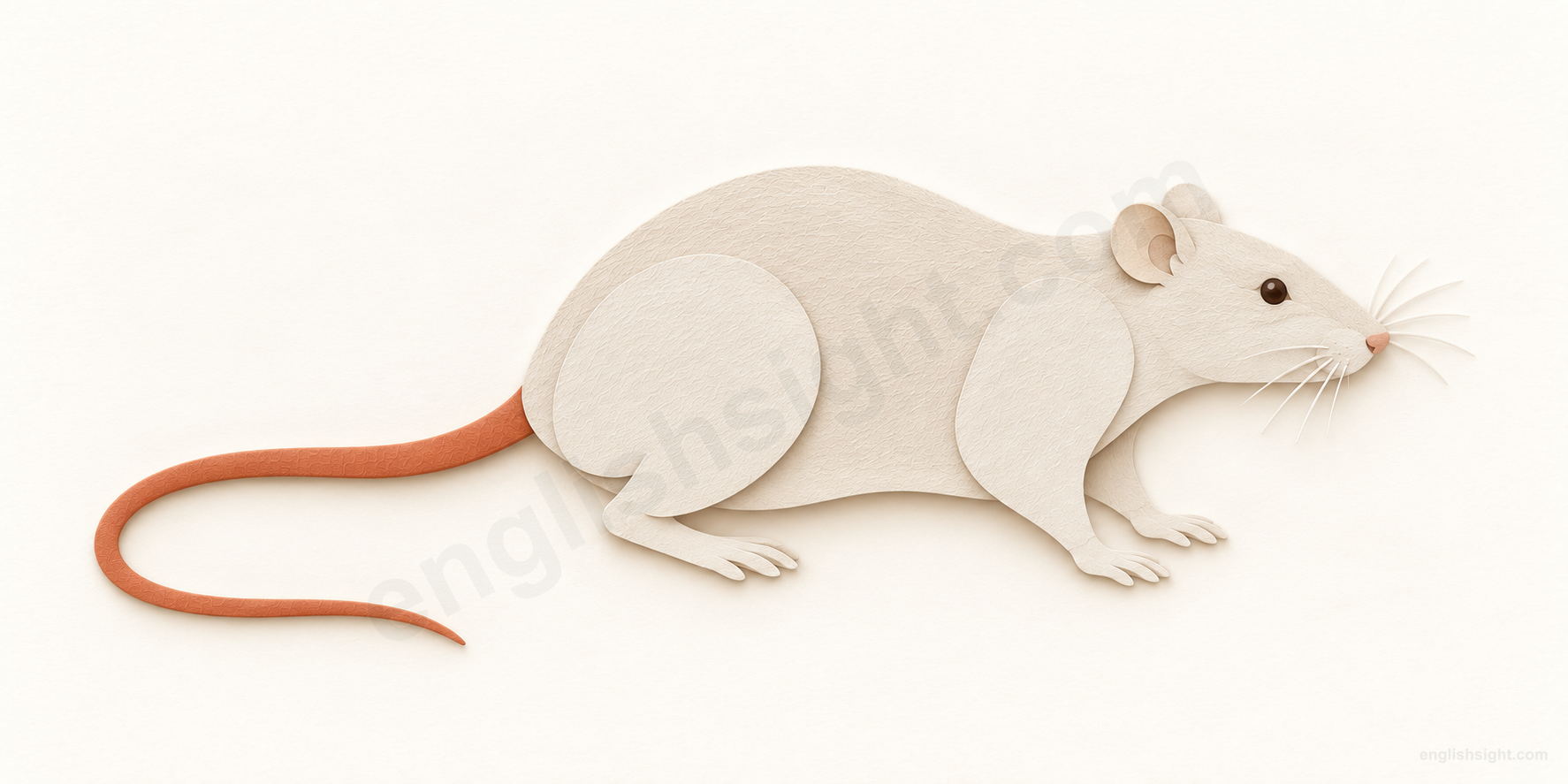
Recognize the rat, then read each expression in context.
The animal as a starting point
A concrete anchor; separate figurative branches
Notice the animal’s shape.
rat
Recognize a rat.
Look at the body, pointed snout, and long thin tail.
The animal anchors the literal noun; figurative expressions need their own context.
Recognize the animal by its mouse-like body and long, thin tail; learn the human judgments and idioms from their complete expressions.
The animal outline anchors the literal noun. It does not derive every idiom from one animal trait or claim that real rats are disloyal.
Rat /ræt/ first names a long-tailed rodent. In everyday English it also appears in judgments about people and in fixed expressions about suspicion, competition, and other situations.
Keep these branches distinct. An animal’s shape helps with recognition; it cannot tell you whether rat on refers to reporting a person or breaking a promise. The whole construction supplies that difference.
01
The animal and its surroundings
Start with the countable animal noun. Describing its role or surroundings does not automatically create an idiom.
01
a / the + rat; plural rats; rat + noun
a rat / rats
a rodent with a long tail and a mouse-like body
Situation
A small animal emerges beside a garden wall.
Meaning in context
You identify it as a rat.
Rat names an animal category, not simply any small unwanted animal.
A rat is a rodent with a long tail, generally larger than a mouse. Use a rat for one and rats for more than one. A young rat is still a rat; it does not become a mouse just because it is small.
In rat droppings, rat poison, and a rat trap, rat modifies another noun. The final noun tells you what the thing is: a trap for rats is not itself a rat. A rat-infested building has many rats in it.
In a sentence
We saw a rat beside the garden wall.
Watch the difference The plural is rats. Mice is the plural of mouse, a different word.
02
a lab / laboratory rat; use somebody as a lab rat
a lab rat
a rat used in scientific experiments
Situation
Scientists are conducting an experiment.
Meaning in context
You describe the animal’s role in the research.
Lab shortens laboratory and tells you how the rat is used.
A laboratory rat, or lab rat, is an animal used in research. Lab rats is the regular plural. Lab describes the rat’s role here, not a separate everyday verb meaning.
People also use lab rat figuratively for a person or thing being tested, as in We don’t want to be lab rats for untested software. That comparison treats the users as test subjects; it does not mean they are dishonest. The dictionary’s usage examples also show this extension.
In a sentence
The researchers observed the lab rats while they slept.
Watch the difference In a human context, lab rat can convey concern about being experimented on; test participant is more neutral.
02
People, reporting, and broken trust
These informal uses often express the speaker’s disapproval. Keep the person reported on separate from the authority receiving the report and from a promise being broken.
03
be a rat; call somebody a rat; what a rat!
He’s a rat. / What a rat!
an unpleasant or disloyal person; an insult
Situation
A person cheats or badly lets someone down.
Meaning in context
An angry speaker condemns that person.
This is an insulting judgment, not a neutral description.
Calling someone a rat expresses strong dislike, often because of cheating, desertion, or betrayal. The noun can also refer to an informer in informal speech. Context tells you which bad behavior is meant.
The connection to an unwanted animal is a conventional human comparison. It is not a scientific claim about how real rats behave, and the word alone does not prove any accusation.
In a sentence
He took her savings and disappeared—what a rat!
Watch the difference Do not use rat as a polite synonym for an unreliable person.
04
rat on + person (+ to + authority)
rat on somebody
report someone’s wrongdoing to an authority, with disapproval
Situation
One person knows another has broken a rule.
Meaning in context
They tell someone in authority about it.
The person after on is the one being reported, not the recipient.
Rat on someone means tell an authority about that person’s wrongdoing. The expression usually presents the reporting as disloyal. It reflects a viewpoint; it does not establish that reporting the behavior was actually wrong.
Keep on before its object: rat on him. A following to-phrase can name the recipient, as in rat on him to the teacher. For a neutral description, say report what happened or tell the teacher.
In a sentence
Leo accused me of ratting on him to the teacher.
Watch the difference Say rat on him, not rat him on. The on-phrase stays together.
05
rat somebody out (to somebody); rat out + noun; be ratted out
rat somebody out
report someone’s wrongdoing; especially North American English
Situation
The coach does not know who broke a rule.
Meaning in context
Someone identifies the person responsible.
Out can follow a noun object, but a pronoun goes before out.
Rat someone out has much the same reporting meaning as rat on someone and is especially North American. You can rat Maya out or rat out Maya; with a pronoun, use rat her out.
To the coach identifies who receives the information. The reported person can become the subject of a passive: Maya was ratted out. Out here does not mean physical movement to the outside.
In a sentence
Someone ratted him out to the coach.
Watch the difference Use ratted him out, not ratted out him. Do not replace on with out without changing the object pattern.
06
rat on + promise / agreement / deal
rat on a promise / an agreement
fail to do what was promised or agreed
Situation
A person has agreed to do something.
Meaning in context
They fail to honor that commitment.
The object after on is a commitment, not a person being reported.
Rat on a promise or deal is an informal expression, marked British English by Oxford. It means break the commitment. It does not mean tell an authority about a promise.
The grammar looks like rat on a person, but the kind of object changes the meaning. Compare She ratted on her colleague with She ratted on their agreement. Break a promise is a more neutral alternative.
In a sentence
The company ratted on its promise to refund the tickets.
Watch the difference Do not use rat out a promise to mean break it; rat somebody out targets a person.
03
Read these expressions as a whole
Suspicion, competition, wet clothes, and frustration are different meanings of established expressions. A picture of the animal cannot predict them all.
07
smell a rat; begin to smell a rat
smell a rat
suspect that something is wrong or dishonest
Situation
Details in an offer do not fit together.
Meaning in context
You become suspicious.
Smell refers figuratively to detecting trouble, not necessarily an odor.
Smell a rat is an informal idiom for becoming suspicious. You may notice an impossible price, an inconsistent story, or a strange request. Suspicion is not yet proof.
Keep the whole expression. The rat need not be an actual animal or an identified dishonest person. Compare a literal smell of a rat in a cellar, where an odor really is involved.
In a sentence
When the seller refused to show me the bike, I smelled a rat.
Watch the difference In this idiom, use a rat; smell the rat suggests a particular animal unless context establishes otherwise.
08
look like a drowned rat
look like a drowned rat
look extremely wet and bedraggled
Situation
Someone gets caught in heavy rain.
Meaning in context
Their hair and clothes are soaked.
Look like introduces a comparison about appearance.
This informal comparison describes someone who looks thoroughly soaked, often with wet hair hanging down. It can be humorous or unkind, depending on the relationship and tone.
Drowned belongs to the fixed comparison. The person need not have been in danger of drowning, and the expression does not say that they are dishonest.
In a sentence
I forgot my umbrella and arrived looking like a drowned rat.
Watch the difference This describes a very wet appearance, not merely feeling cold or tired.
09
like rats leaving / deserting a sinking ship
like rats leaving a sinking ship
criticize people for abandoning a failing organization
Situation
A company or organization gets into trouble.
Meaning in context
People leave it, protecting themselves.
The ship stands for the troubled organization; the rats stand for those leaving.
Like rats leaving a sinking ship is a humorous but disapproving comparison. Deserting can replace leaving. It suggests that people abandon others when an organization’s future looks bad.
The judgment comes from the speaker. Simply resigning from a difficult job does not automatically deserve this label. Learn the entire comparison rather than treating every use of leave as rat.
In a sentence
After the funding disappeared, the directors left like rats leaving a sinking ship.
Watch the difference This is a critical metaphor, not a neutral way to describe staff changes.
10
the rat race; get out of / escape the rat race
the rat race
the stressful competition for money or success
Situation
Work and status become a constant contest.
Meaning in context
Someone wants a less competitive way of life.
The whole noun phrase names a pressured lifestyle.
The rat race describes continual, exhausting competition to succeed, especially in working life. It is an informal and usually critical description, not the ordinary name for any busy day.
Get out of or escape the rat race means leave that way of life. It does not necessarily mean stop working altogether: someone might choose a quieter job instead.
In a sentence
She left her city job to escape the rat race.
Watch the difference Rat race is not simply a running race and does not mean a rat infestation.
11
Rats! + optional explanation
Rats!
an informal exclamation of disappointment or annoyance
Situation
You discover a small setback.
Meaning in context
You express frustration in a short exclamation.
The isolated exclamation is not a report of animals.
Rats! can express disappointment or irritation at a setback. It can also dismiss an idea with scorn or disbelief: Rats! I don’t believe a word of it. In a sentence about animals, rats is simply a plural noun; here intonation and the surrounding situation make it an exclamation.
Rats! The shop is closed expresses a reaction to the closure. It does not accuse anyone of betrayal and does not mean that rats closed the shop.
In a sentence
Rats! I’ve left my keys upstairs.
Watch the difference The exclamation uses the plural form rats, not the noun phrase a rat.
12
not give a rat’s ass about + noun; not give a rat’s ass + wh-clause
not give a rat’s ass
not care at all; vulgar
Situation
Someone is asked whether an opinion matters to them.
Meaning in context
They dismiss it with deliberately rude language.
The negative idiom expresses complete lack of concern.
This vulgar expression means not care at all. The meaning belongs to the fixed phrase, not to giving someone an animal or a body part. Recognize it when reading informal dialogue.
For ordinary conversation or professional writing, I don’t care or It doesn’t matter to me avoids the vulgarity. The harsher version can sound contemptuous toward the person addressed.
In a sentence
“I don’t give a rat’s ass about their rankings,” he said angrily.
Watch the difference This is stronger and ruder than the exclamation Rats!; do not treat them as interchangeable.
04
Established names for people and places
The other word in each compound matters. These labels have different meanings and tones; rat does not always insult someone.
13
be a gym rat; be a mall rat; plural gym / mall rats
a gym rat / a mall rat
someone strongly associated with spending time in a place
Situation
A person spends much of their free time in a familiar place.
Meaning in context
People describe that habit with an established compound.
The first noun identifies the place and helps determine the meaning.
A gym rat spends a lot of time exercising at the gym. The informal label can be used about oneself without implying betrayal: I’m a gym rat. A mall rat, especially in North American English, is a young person who spends much time in shopping malls, often with friends. For example, As teenagers, we were mall rats and met our friends at the shopping center every weekend.
Both expressions are established compounds. Their tone depends on context; neither is automatically as hostile as calling someone a rat. Do not assume any place name plus rat will sound natural.
In a sentence
My sister is a gym rat; she trains there almost every evening.
Watch the difference Gym rat describes a habit, not necessarily someone’s job or athletic skill.
14
be a pack rat; plural pack rats
a pack rat
a person who keeps many things they do not really need
Situation
Someone keeps old receipts, boxes, and spare objects.
Meaning in context
Their collection grows because little is thrown away.
This North American label describes keeping things.
A pack rat is someone who collects and stores unnecessary things. It may be a lighthearted description of oneself, but calling another person this can sound critical. It does not by itself describe a medical condition.
Pack rat also names a small North American animal that gathers material. The person sense is an established comparison; pack does not mean the person belongs to a gang. A rat pack is a different expression.
In a sentence
I’m a pack rat—I still have receipts from ten years ago.
Watch the difference Pack rat and rat pack have different word order and meanings.
15
a rat run; become / use a rat run
a rat run
a small road used to avoid traffic on main roads; British English
Situation
The main road is congested.
Meaning in context
Drivers take a smaller road, often through a residential area.
This is a name for a traffic route, not an animal’s exercise.
In informal British English, a rat run is a small road drivers use when main roads are busy. A quiet residential street can become a rat run during rush hour.
Run is a noun in this compound. Compare Rats run behind the bins, where rats is the subject and run is a verb. In the traffic expression the users are drivers, not rats.
In a sentence
Our street has become a rat run during the morning rush hour.
Watch the difference Keep the regional context in mind; a shortcut is a broader and more neutral term.
16
a rug rat; plural rug rats
a rug rat
an informal North American word for a child
Situation
Adults are talking casually about children.
Meaning in context
Someone uses a playful or dismissive nickname.
The compound refers to a child, not an animal under a rug.
Rug rat is an informal North American name for a child. It is often used playfully, but it can sound dismissive depending on who says it and how.
Use child or children when a neutral tone is needed. The playful compound has its own established meaning; rug alone does not turn every following animal name into a word for a child.
In a sentence
We’re taking the rug rats to the park this afternoon.
Watch the difference This is casual language, unsuitable as the neutral term for children in a formal report.
Keep meaning, grammar, and tone separate
Forms and pronunciation
The noun is countable: a rat, two rats. The verb forms are rat, rats, ratted, ratting; double the t before -ed and -ing. Rat is /ræt/; ratted has two syllables, /ˈrætɪd/.
Objects change the interpretation
Rat on a person concerns reporting that person; rat on a promise concerns failing to keep it. Rat him out is separable; rat on him keeps on before its object. A passive such as He was ratted out is possible. These action uses can be progressive: Someone is ratting us out. There is no special causative construction to memorize.
Disapproval belongs to a speaker
Calling someone a rat or saying they ratted on you often frames behavior as disloyal. Neutral reporting language avoids that judgment. Gym rat and pack rat have their own tones; they do not automatically accuse someone of betrayal.
Scope and the picture
This lesson covers the animal, useful compounds, reporting and broken-promise patterns, and established everyday expressions. Specialist animal names, rat-hunting terminology, historical hairdressing senses, and further regional slang are not expanded. The picture is a teaching aid, not a shared mental image claimed for all English speakers.
Choose the meaning and construction
Use the object, the whole expression, and the speaker’s tone.
1. The company ratted on its agreement. What happened?
2. Which sentence places the pronoun correctly?
3. The seller’s story changes twice, and you smell a rat. What does that mean?
4. A friend calls herself a gym rat. Which interpretation fits?
5. You need a neutral way to say that a ranking does not interest you. Which is suitable?
Sources and teaching notes
Dictionary meanings, patterns, and register labels were checked against the sources below. The explanations and sentences are original; the animal outline is a teaching aid. The lab-rat extension is also illustrated by the usage examples on its source page.
The diagram supports recognition; it does not represent a mental picture shared by every English speaker.