Use rate for pace, proportions, charges, and judgments on a scale.
Compare amounts on the same basis
Compare amounts on the same basis
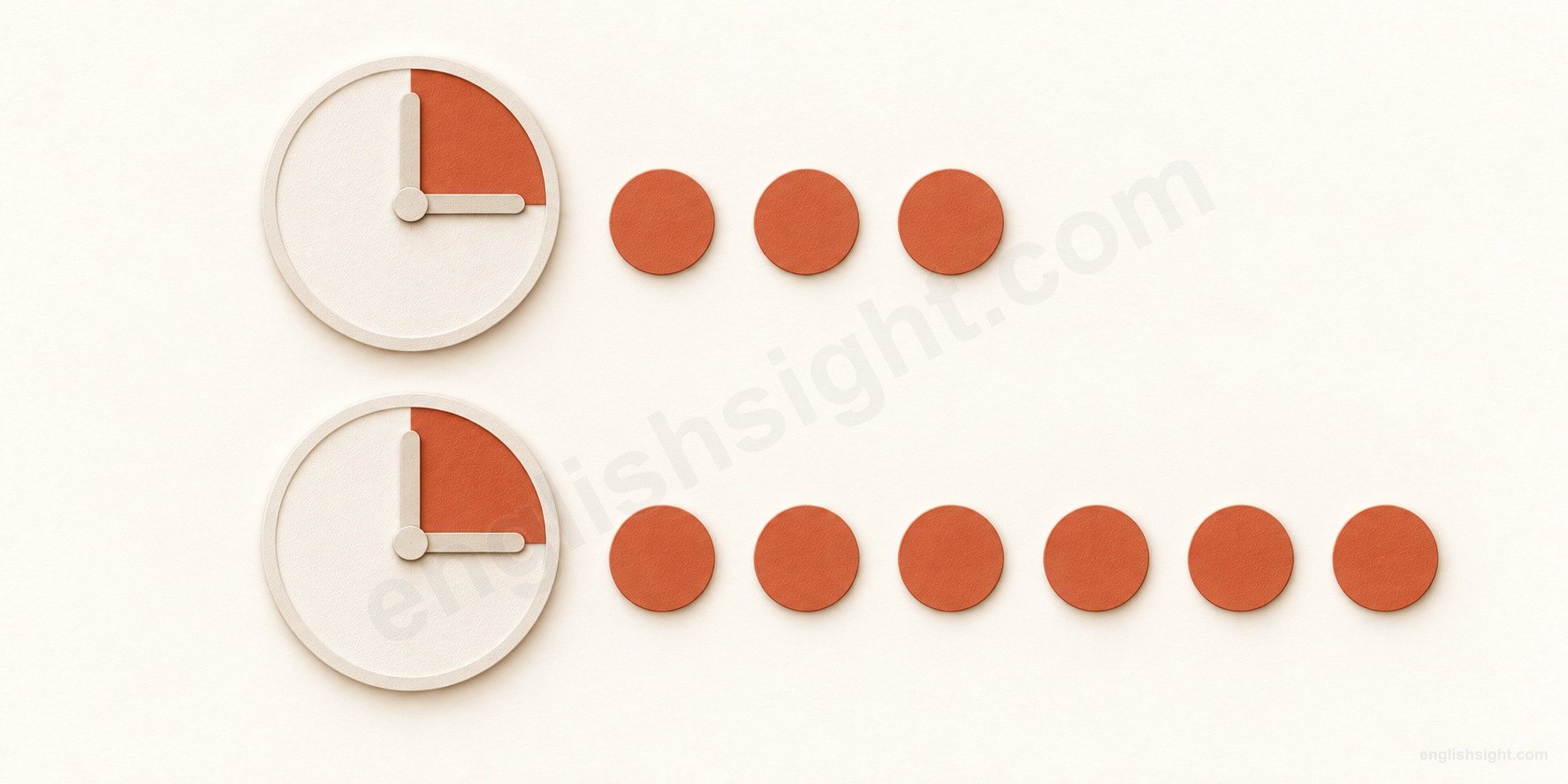
Both timers mark the same time interval.
rate
Three units above; six units below.
Compare the completed units for each equal interval.
For the same time interval, six completed units give twice the production rate of three.
A rate relates an amount to a reference unit. With equal time intervals, more completed units mean a higher rate.
The sketch compares two outputs over the same interval; it is not a before-and-after increase. Quality judgments use a different kind of scale, and conversational idioms must be learned as expressions.
Six completed units tell you a total. Six units in one minute tell you a rate. Ask “How much, for each what?” when you meet rates of work, pay, or change.
The verb rate belongs to a related branch of assessing: someone gives a person or thing a value, score, position, or category. Fixed expressions also have their own uses, which the measurement sketch cannot predict.
01
How much happens, and in relation to what?
A total alone does not tell you a rate. Identify the time interval, the relevant group, or another reference unit before comparing amounts.
01
happen / change / work + at a(n) + adjective + rate; the rate of + noun; the rate at which + clause
at a steady rate
describe the pace of an activity or change
Situation / reference
You watch how quickly a task progresses.
What the expression tells you
You describe its pace over time.
A rate concerns how fast something happens, not just how much exists.
Use at with a description of pace: at a slow rate, at a rapid rate, or at a steady rate. The subject can be a person working, a machine producing things, or a quantity changing.
Rate of growth and rate of decline name the speed of a change. The rate at which the water rises uses a clause to identify the process. A falling rate of growth can still mean that the amount is increasing, just more slowly.
Steady describes consistency. It does not by itself mean fast or slow. In the sketch, comparing output only works because the time intervals are equal.
In a sentence
The water level is rising at a steady rate.
Watch the difference Say at a steady rate, not in a steady rate. A high water level and a high rate of rise describe different things.
02
at a/the rate of + amount + a/an/per + time unit
at a rate of twenty pages an hour
give an amount for each unit of time
Situation / reference
Two printers produce different totals over different periods.
What the expression tells you
You compare their output for the same length of time.
The reference unit makes the number a rate.
At a rate of introduces the numerical amount and its basis. Twenty pages an hour means twenty pages for each hour; twenty pages per hour expresses the same basis more explicitly.
Both at a rate of and at the rate of occur. A introduces a rate; the often points to a particular rate already identified. Do not treat the article choice as a difference in the arithmetic.
The sketch compares three units with six units in equal intervals. The second rate is twice the first. If the intervals differed, comparing the totals alone would not establish that.
In a sentence
The printer produces labels at a rate of forty a minute.
Watch the difference Include the basis when it is not already understood: forty labels is a total; forty labels a minute is a rate.
03
heart / pulse / birth / death / accident + rate; a rate of + number + per + unit
heart rate / birth rate
count events against a time or population basis
Situation / reference
You count repeated events.
What the expression tells you
You report how often they occur on a specified basis.
A frequency rate counts occurrences rather than the size of one occurrence.
Heart rate and pulse rate concern how often the heart beats, commonly stated in beats per minute. They do not describe how strong each beat is.
Birth rate, death rate, and accident rate describe occurrences relative to a stated population, time, or exposure. The exact basis belongs to the measure: do not assume every rate means a percentage or events per minute.
A report may leave the units in a heading. Read that heading before comparing two figures. This is the same need for a reference unit that the matching clocks illustrate.
In a sentence
The monitor shows a heart rate of seventy beats per minute.
Watch the difference A rate is not automatically a medical judgment. This sentence reports a measurement, without saying whether it is suitable for a particular person.
04
a high / low + success / failure / response / unemployment + rate; a rate of + percentage
a high success rate
give the share of a relevant group with an outcome
Situation / reference
You know how many attempts succeeded and how many were made.
What the expression tells you
You compare successes with all relevant attempts.
The denominator can be a group of attempts or people rather than a time interval.
Success rate means the proportion of attempts that succeed. If eight out of ten attempts succeed, the success rate is eighty per cent. Failure rate and response rate similarly require a defined set of attempts or recipients.
An unemployment rate is a share of a defined workforce, not simply the number of unemployed people or a percentage of everyone in a country. Context supplies the relevant group.
High and low evaluate the figure on the relevant scale. A high success rate is generally welcome; a high failure rate is generally unwelcome. Rate itself does not mean good.
In a sentence
Eight of our ten applications succeeded, giving us an eighty per cent success rate.
Watch the difference Do not compare raw counts as if they were rates. Eight successes out of ten and eight out of a hundred give very different rates.
02
Pay, charges, and financial proportions
Rate can name the amount charged or paid on a stated basis. The basis may be an hour, a night, an order, a sum of money, or a unit of another currency.
05
an hourly / daily rate (of pay); pay / charge + amount + an hour; at a rate of + amount
an hourly rate of pay
state payment for a unit of work or time
Situation / reference
A worker needs to know how earnings are calculated.
What the expression tells you
A sum is attached to an hour or another unit.
The rate is the basis for pay; the total also depends on how much work is done.
Hourly rate and rate of pay describe the payment basis. At a rate of twenty pounds an hour tells you the amount for each hour, not the worker’s weekly total.
Ask What is your hourly rate? when hiring a tutor or another service provider. Charge describes the provider asking for payment; pay describes the customer or employer giving it.
A piece rate uses units completed rather than time worked. Learn the stated basis instead of assuming that every pay rate is hourly.
In a sentence
The tutor charges an hourly rate of twenty-five pounds.
Watch the difference Rate and salary are not interchangeable: a salary is an agreed regular payment, while an hourly rate gives a per-hour basis.
06
offer / charge + reduced / special / competitive rates; rates for + people/service; at the + category + rate
reduced rates for students
name the charge offered for a service or customer category
Situation / reference
A hotel or service has several prices.
What the expression tells you
A particular customer qualifies for one charge.
Plural rates can mean a schedule of charges.
Room rates, postal rates, and insurance rates are charges based on a service and its conditions. The relevant unit can be a night, a parcel category, or a policy period; it need not appear beside rate every time.
Reduced rates and special rates identify a different price for a group or occasion. At the student rate describes the price basis used for a transaction; rates for students identifies the customers.
Price is the broad word for what something costs. Rate often draws attention to a standard basis or price category. Fee commonly names payment for a service or membership; fare names a transport charge.
In a sentence
The hotel offers reduced rates for students during the winter.
Watch the difference Competitive rates means prices intended to compare favorably with alternatives; it does not guarantee the lowest price.
07
charge / pay + a flat rate (of + amount); a flat-rate + noun
a flat rate
use one uniform charging basis within the offer
Situation / reference
Customers want to know whether the charge varies.
What the expression tells you
The offer applies one stated charge or percentage.
Flat concerns uniformity under the stated terms.
A flat rate removes a variation that might otherwise affect the charge. A delivery service can charge the same amount for every order covered by an offer, instead of charging more for larger orders.
Flat-rate delivery uses the hyphenated form before a noun. Flat does not automatically mean unlimited service, no conditions, or the cheapest price: the offer still defines what is covered.
A uniform percentage can also be called a flat rate. A fixed rate emphasizes that a rate stays unchanged for an agreed period. These expressions can overlap, but ask what is uniform and what is fixed over time.
In a sentence
We charge a flat rate of five pounds for delivery within the town.
Watch the difference A flat delivery rate and an hourly rate use different charging rules; flat is not another word for low.
08
the going rate for + work/service; at / above / below the going rate
the going rate
refer to the usual current price or pay
Situation / reference
You want to know what people normally pay locally.
What the expression tells you
You use the prevailing amount as a comparison.
Going means current or usual in this fixed expression.
The going rate for something is what is normally charged or paid at the relevant time and place. It can describe wages, rent, or a service charge.
Pay above the going rate means offer more than that usual amount. At the going rate means use it as the basis. Going here does not describe somebody physically going somewhere.
In a sentence
What is the going rate for an hour of guitar teaching around here?
Watch the difference The going rate is a market comparison, not necessarily an official or legally required amount.
09
the interest rate on + loan/account; the rate of interest / tax; raise / cut rates; a fixed-rate + loan
interest rate / tax rate
state a financial amount as a proportion of a base sum
Situation / reference
You need a basis for calculating a payment or return.
What the expression tells you
A percentage is applied to the relevant amount.
The percentage is a rate; the money amount depends on the base and the calculation.
An interest rate concerns interest on borrowed or saved money. A tax rate concerns tax on a relevant taxable amount. Both commonly use percentages, but they describe different payments.
The interest rate on a loan and the rate of interest are ordinary patterns. Raise or cut interest rates describes a change in the rate; rates rise or fall describes what happens to it.
Fixed-rate describes an account or loan whose interest rate stays the same for an agreed period. It does not mean the total interest in money is the same for every borrower. Rate of return similarly compares a gain or loss with the amount invested; its calculation depends on context.
In a sentence
The leaflet gives an annual interest rate of four per cent for the account.
Watch the difference A rate of four per cent is not a payment of four pounds. Identify the sum and time basis before interpreting a figure.
10
the exchange rate between + currencies; an exchange rate of + amount + to/for + unit
exchange rate
relate one currency to another
Situation / reference
You have money in one currency.
What the expression tells you
A quoted ratio tells you its equivalent in another currency.
The reference unit is a unit of currency, not an hour.
An exchange rate tells you how much of one currency corresponds to a unit of another. Rate of exchange is another form. Which currency is the reference matters.
In a made-up example, a quote of two dollars for one pound means that ten pounds corresponds to twenty dollars before any separate charges. Reversing the quote gives half a pound for one dollar.
A better exchange rate is better for a particular direction of exchange. The bare statement that a rate is higher does not tell you who benefits unless the quote and transaction are clear.
In a sentence
Before changing the cash, Lena checked the exchange rate from pounds to euros.
Watch the difference Exchange rate is a ratio between currencies. A commission or service fee can be a separate cost.
11
pay + business rates; business rates + are + adjective
business rates
recognize a regional plural name for a local property tax
Situation / reference
A shop lists the costs of using its premises.
What the expression tells you
One item is a local property tax.
Rates can name the tax itself, not just a percentage used to calculate it.
In UK usage, business rates refers to a local tax on business premises. The plural form can name this tax collectively: The business rates are high.
Rates also occurs for domestic property tax in some places, including Northern Ireland. This is a regional vocabulary use; it is not the name for every household tax throughout the UK.
Compare a tax rate, which names a percentage or assessment basis. In a bill, rates may name the actual tax liability rather than that basis.
In a sentence
The shop’s costs include rent, electricity, and business rates.
Watch the difference Do not assume rates always means several prices. A discussion of business premises may use the regional tax meaning.
03
Put something on a scale
As a verb, rate concerns an assessment, a score, a rank, or an assigned category. The scale can be subjective, numerical, or official; it need not measure a speed.
The subject judges; the object is the person or thing being judged.
Rate something highly expresses a favorable assessment. Rate it poorly expresses an unfavorable one. Rate someone as an expert identifies a category; rate the work excellent uses an adjective as the assessment.
A noun can follow with or without as: We rate her as a strong candidate; We rate her a strong candidate. The words after her describe her rather than a second thing she receives.
The passive changes the viewpoint: The course is highly rated by students. Highly rated means well regarded, not highly priced. This evaluative branch uses a scale of value rather than the sketch’s amount-per-time scale.
In a sentence
The volunteers rated the training highly because it prepared them for real situations.
Watch the difference High in a rating does not mean objectively best. The assessment belongs to particular people and criteria.
13
rate + object + on a scale of + numbers; rate + object + number + out of + number; be rated + rank / among + group
rate something on a scale
assign a score or comparative position
Situation / reference
A form supplies a scale, or a list supplies positions.
What the expression tells you
An item receives a score or rank on that basis.
A score uses points; a rank gives a position among alternatives.
Rate the service on a scale of one to five asks for a score using stated endpoints. Rate it eight out of ten gives eight points on a ten-point scale. The question How would you rate it? asks for an assessment.
Be rated number two or be rated among the best gives a comparative position. A number-two ranking is not the same thing as two stars. Read what the number measures.
The passive is common when the result matters more than the assessor: The route is rated difficult. The rating follows a system or judgment; it does not physically change the route.
In a sentence
Please rate the clarity of the instructions on a scale of one to five.
Watch the difference Rate and rank overlap, but ranking normally orders items relative to each other; a rating can give several items the same score.
14
subject + rate + high / low (+ with + person); subject + rate as + noun phrase
rate high / rate as important
have a level of standing without an expressed object
Situation / reference
You compare priorities or people’s assessments.
What the expression tells you
The subject itself holds a level of importance or quality.
There is no object after rate in this construction.
In Comfort rates high on my list, comfort is the thing with a high position. In I rate comfort highly, I am the assessor and comfort is the object. These are different grammatical viewpoints.
Rate as something can also describe how the subject is judged: The visit rates as a highlight of the trip. It is close to be rated as, although there is no passive be in the sentence.
With can identify whose opinion matters: It does not rate very high with the committee. This concerns standing or importance, not a charge paid to the committee.
In a sentence
Safety rates high on our list of priorities.
Watch the difference Distinguish We rate safety highly from Safety rates high. Do not add an object just because another use of rate takes one.
In this informal use, rate already suggests thinking well of the object.
I really rate her means I think she is good or capable. I do not rate it means I do not think it is very good. This use is especially associated with informal British English.
Compare the neutral question How do you rate her? That asks for an evaluation. Bare I rate her in the informal pattern communicates a favorable opinion without adding highly.
It can express respect for ability rather than personal liking. You can rate a competitor’s skill even when you would prefer someone else to win.
In a sentence
I really rate Nia as a drummer; her timing is excellent.
Watch the difference This is informal approval, not a promise to give a numerical rating or pay a fee.
16
a film + be rated + classification; a film rated + classification
a film rated PG
assign an audience-suitability category
Situation / reference
Viewers need information about a film’s content.
What the expression tells you
A classification identifies its intended or permitted audience.
An audience category is different from a quality score.
A film can be rated PG or given another category under a particular classification system. The passive foregrounds the film and the assigned category.
An age rating is not a review score. A film can receive an age-restrictive classification and still be judged excellent or poor by reviewers. The category labels and their detailed rules depend on the system.
In a rated film, rated is a participle describing a completed classification. It does not mean that the film is charging the viewer money.
In a sentence
The cinema page says that the film is rated PG.
Watch the difference Do not read PG as a score for artistic quality. Check the relevant classification system for its precise meaning.
17
equipment + be rated at + figure/unit; equipment + be rated for + load/use
a motor rated at 500 watts
state an assigned or specified technical capacity
Situation / reference
You read equipment specifications.
What the expression tells you
A stated figure describes its rated power or capacity.
Rated assigns a specification; it need not describe a measured flow per second.
A motor rated at a certain power has that stated power rating under the relevant specifications. A device rated for a particular load is specified for use with that load.
This is related to assessing capacity, rather than giving a product a good review. The unit after the number tells you which property is being specified.
Rated at and running at are not interchangeable: the former gives a specification, while the latter can describe an actual operating condition. The specification alone does not tell you the present operating value.
In a sentence
The label describes a motor rated at five hundred watts.
Watch the difference Highly rated equipment has favorable reviews; equipment rated at a figure has an assigned specification. Read the following words.
18
event/person/thing + rate + a mention / a second glance / other response
rate a mention
be important enough to receive a response
Situation / reference
An event competes for attention.
What the expression tells you
Someone judges it worthy of a certain amount of attention.
The subject merits the reaction named by the object.
Rate a mention means be worth mentioning. In this pattern, rate is close to deserve or merit: the event does not judge a mention or charge for it.
Barely rates a mention and does not even rate a mention suggest that little importance is given to something. The expression often comments critically on how much attention an event receives.
Other reactions can follow, such as a second glance. Learn the meaning of the whole pattern instead of treating every noun after rate as the thing being scored.
In a sentence
The team’s achievement did not even rate a mention in the newsletter.
Watch the difference In We rate the report, the report is assessed. In The report rates a mention, the report is worthy of attention.
04
Forecasts, conversation, and quality labels
Some expressions retain an understandable link with pace or grade. Others perform an established conversational job and should be learned as whole expressions.
19
at this/that rate, + prediction; at the rate + clause, + prediction
at this / that rate
forecast a result if the present pattern continues
Situation / reference
You notice a continuing pace or trend.
What the expression tells you
You predict what it would lead to.
The prediction depends on the pattern continuing.
At this rate points to the pace or trend now being observed. It often introduces a warning, complaint, or exaggerated prediction, although the forecast can also be welcome.
At that rate points back to a pace or figure already mentioned. At the rate we are working expresses the same kind of forecast with a clause identifying the process.
The phrase does not assert that the pace cannot change. It draws a conditional conclusion from what is happening so far.
In a sentence
We have packed only two boxes in an hour; at this rate, we will still be here tonight.
Watch the difference At this rate predicts from the current pattern. At any rate usually organizes a conversation and does a different job.
20
at any rate, + clause; clause + at any rate; or at any rate + more limited statement
at any rate
return to a main point or limit a claim to what is certain
Situation / reference
Some details are uncertain or less relevant.
What the expression tells you
You state the point you want to keep or make more precise.
This whole expression manages the conversation rather than measuring a rate.
At any rate can mean in any case or anyway: I do not know why the bus was late. At any rate, we missed the train. The second statement is the point that matters regardless of the uncertain reason.
It can also narrow or correct a claim: Everyone enjoyed it—or at any rate, nobody complained. The speaker retreats to the more defensible statement. To me, at any rate similarly limits a judgment to the speaker’s own view.
In We lost, but at any rate we played well, it can highlight one fact that remains true or offers some consolation. These are related conversational uses of the established expression, not rates that you calculate.
In a sentence
The whole group agreed—or at any rate, no one objected.
Watch the difference Do not interpret this as at every speed. Changing any to this changes the expression and its usual function.
21
activity/change + happen / proceed + at a rate of knots
at a rate of knots
say that something is happening very quickly
Situation / reference
An activity moves along unusually fast.
What the expression tells you
You emphasize its speed in informal language.
This British idiom is emphatic, not an exact speed measurement.
At a rate of knots is an informal British expression meaning very quickly. It can describe work, spending, growth, or progress, not only travel by boat.
The full phrase is established. You do not need to supply a number of knots, and it does not mean a rate of zero simply because no number appears.
For a neutral international description, very quickly or at a rapid rate is easier to use. Keep the idiom for contexts where its informal tone fits.
In a sentence
With both ovens working, we were getting through the orders at a rate of knots.
Watch the difference Keep a in the expression: at a rate of knots. It is an idiom rather than a technical report of a boat’s speed.
22
a first-rate / second-rate / third-rate + noun; subject + be + first-rate / second-rate / third-rate
first-rate / second-rate / third-rate
describe quality with established compound adjectives
Situation / reference
You want a short judgment about quality.
What the expression tells you
A compound adjective gives praise or criticism.
Rate refers to a grade here, not a price or speed.
First-rate means excellent: a first-rate guide is a very good guide. It does not mean the first guide to arrive or the first price quoted.
Second-rate means mediocre or not very good. It is criticism, not a precise statement that something came second in a contest. A second-place finisher can still be a first-rate athlete.
Third-rate is stronger criticism, meaning very poor in quality: The hotel charged a high price for third-rate service. These quality labels do not describe finishing first, second, or third in a race.
These are hyphenated compound adjectives, used before a noun or after be: a first-rate performance; The performance was first-rate. Learn their quality meanings as established forms.
In a sentence
The guide was first-rate, but the audio equipment was second-rate.
Watch the difference A first-rate service has excellent quality; a low rate for the service describes its price. The two judgments are independent.
Find the basis, then read the construction
A total is not a rate
A rate needs a basis, even when context leaves it unstated. Time, population, attempts, and money can supply different bases. Never assume that every rate is a percentage or that every high rate is desirable.
Of, at, for, and per do different jobs
The rate of growth identifies the process. Grow at a steady rate describes its pace. A rate for delivery names the service. Twenty pounds per hour states the reference unit. These prepositions belong to their constructions, not to a universal rule after rate.
Countability and verb forms
The noun is normally countable: a rate, the rate, different rates. The regional tax name rates uses the plural. Verb forms are rate, rates, rated, and rating; rated has two syllables. Evaluative rate normally uses simple forms: I rate it highly. Passive forms such as It is highly rated and It is rated PG are common.
Look past the same spelling
Rate a restaurant, a restaurant rates highly, and a restaurant rates a mention give the subject different roles. There is no ordinary family of particle verbs to build by attaching up or out; rate something out of ten is a scoring construction. The rare separate verb rate meaning scold and specialist historical uses are outside this lesson.
A teaching comparison has limits
The matching clocks illustrate amount per equal time. They do not turn an audience classification into a quality score or explain at any rate word by word. The model helps organize use; it is not a claim that all English speakers share one mental picture.
Choose the right basis or interpretation
Read what is measured, who judges, and what the whole expression contributes.
1. One printer makes six labels in one minute; another makes six in two minutes. Which statement follows?
2. Eight of ten applications succeed. What describes this outcome?
3. A tutor charges twenty pounds an hour and teaches for three hours. What does twenty pounds describe?
4. A film is rated PG. What does this tell you?
5. Work is progressing slowly, and you predict a late finish if it continues. Which phrase fits?
6. You cannot prove that everyone liked the talk, but nobody complained. Which sentence limits your claim?
7. The achievement did not even rate a mention. What happened?
Sources and teaching notes
The dictionary pages below were used to check senses, patterns, idioms, and regional labels. The explanations, examples, and teaching comparison were created for this lesson.
The diagram is a teaching aid, not a mental picture shared by every English speaker.