Use ray for light, small signs of hope, and a few distinct meanings.
A source and its narrow beam
From a light source to a narrow beam
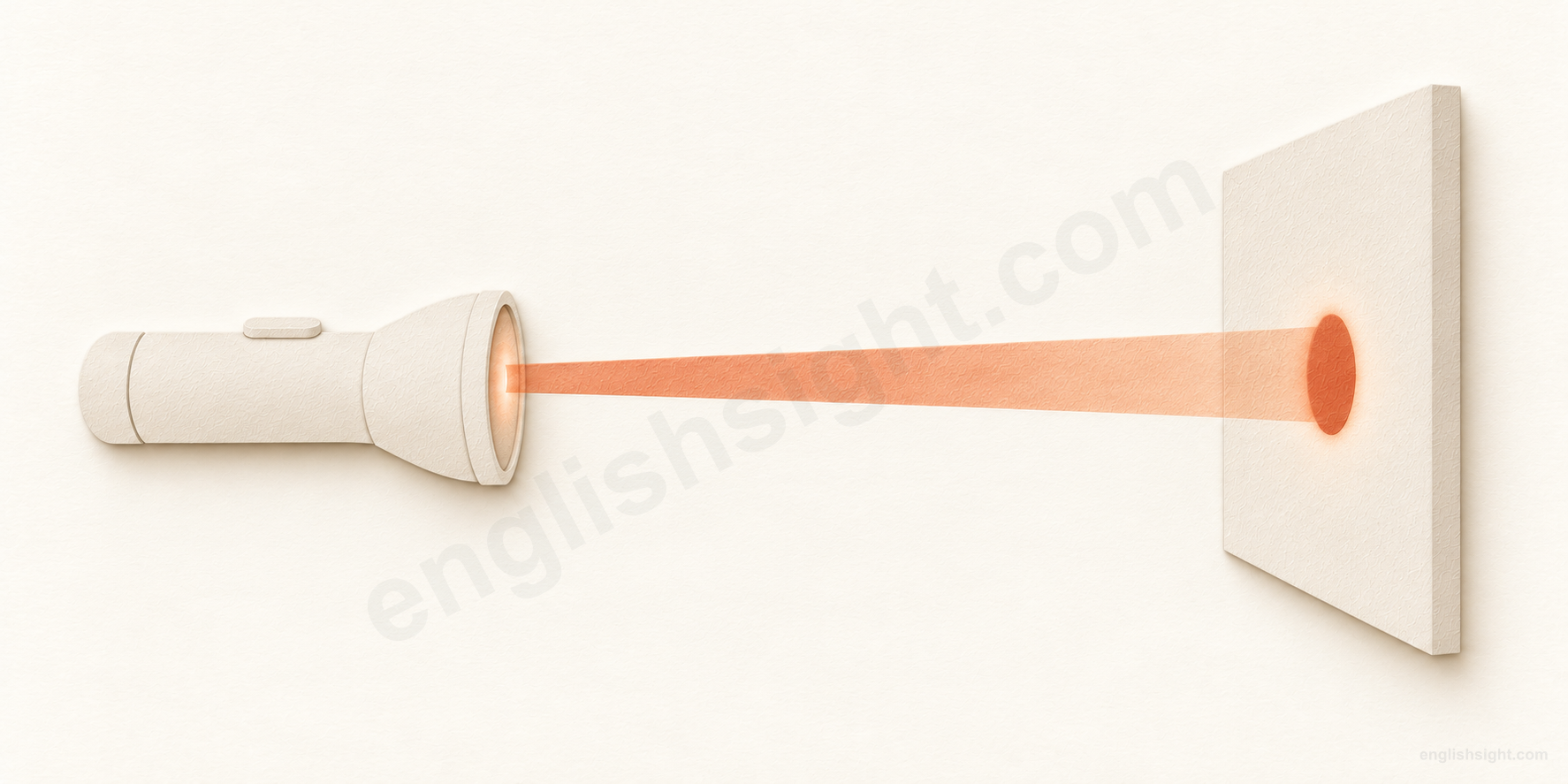
A flashlight is the light source.
ray
A small patch on the wall is lit.
A narrow beam extends rightward from its lens.
A ray of light is a narrow beam extending from a source.
A ray of light extends outward from a source as a narrow beam.
This model connects literal light with a small bright sign such as a ray of hope. It does not explain the fish name or replace scientific and mathematical definitions.
A ray is often a narrow beam of light coming from a source. English also uses that light image for a small welcome sign in a difficult situation.
The fish called a ray is a separate word. Geometry and scientific compounds have specific meanings, so the light image is a guide to some connections, not a rule for everything.
01
Light and radiation
Describe a beam, the sun’s rays, and established radiation vocabulary.
01
a ray of + light / sunlight; a ray from + source
a ray of light
a narrow beam extending from a light source
Situation
A lamp shines into a dark room.
What is described
A narrow beam reaches the opposite wall.
Ray picks out a narrow beam, rather than all the light in the room.
Ray is a countable noun: a ray, one ray, several rays. In a ray of light, of light tells us what kind of ray it is. Light itself is normally uncountable in this meaning.
A ray of sunlight is a beam from the sun. From names the source in a ray from the lamp; through names a route in a ray through the curtains. Those prepositions add relationships rather than forming phrasal verbs.
Beam is a close alternative for a visible shaft of light: a flashlight beam. Ray is also useful when talking about individual paths of light.
In a sentence
A ray of light from the lamp fell across the empty chair.
Watch the difference Use a ray of light, not a ray light. A light can mean a lamp, which is a different countable use of light.
02
the sun’s rays; rays of the sun
the sun’s rays
light or energy coming from the sun
Situation
The sun comes out from behind a cloud.
What is described
Sunlight reaches the garden.
The plural rays can describe the sun’s light collectively.
The sun’s rays and rays of the sun both identify the source. Sunlight is a useful uncountable alternative; rays draws attention to beams or radiation coming from that source.
In literal descriptions, verbs such as shine, fall, and filter describe what the light does. The phrase the last rays of the sun places the scene near sunset; the adjective last does not create a separate sense of ray.
In a sentence
The last rays of the sun lit the garden wall.
Watch the difference The sun’s rays are plural: say The rays are bright. Sunlight is singular: The sunlight is bright.
03
ultraviolet / UV + rays; gamma rays; cosmic rays
ultraviolet rays / UV rays
a named kind of radiation, not necessarily visible light
Situation
A text discusses energy from the sun.
What is described
It identifies ultraviolet radiation as UV rays.
A technical modifier tells us what kind of rays are meant.
Ray also occurs in the language of radiation. Ultraviolet rays, often shortened to UV rays, are not visible beams that you can identify just by looking at sunlight. The plural has the same ordinary -s ending.
Gamma rays and cosmic rays are further established scientific terms. Do not assume that every kind of ray is visible light or that all these terms describe the same physical thing. Learn the full term when a science text requires it.
In a sentence
The museum display explains how UV rays differ from visible light.
Watch the difference Do not use a visible orange beam in a teaching picture as proof that all radiation can be seen.
04
take / have an X-ray; X-ray + object; be X-rayed
X-rays / an X-ray
radiation, a picture made using it, or the action of making that picture
Situation
A clinician needs a view of a bone.
What is described
An X-ray image shows the bone.
The full word X-ray has several uses of its own.
X-rays can refer to the radiation. An X-ray can instead mean an image made using that radiation. In take an X-ray, take means make the picture; have an X-ray describes undergoing the examination.
X-ray is also a verb: They X-rayed the bag; The bag was X-rayed. Forms include X-rays, X-rayed, and X-raying. Lowercase x-ray is also used. Keep the X: the ordinary phrase an X-ray cannot be shortened to a ray when you mean the image.
In a sentence
The doctor took an X-ray of my wrist.
Watch the difference The radiation and the resulting picture are related but different. A ray on its own does not normally mean a medical image.
02
Hope and happiness
Use conventional light metaphors for small positive changes and welcome influences.
05
a ray of + hope / comfort / optimism
a ray of hope
a small welcome sign that something may improve
Situation
The search has produced no useful news.
What is described
One new clue gives people some hope.
A small positive sign is pictured as light within difficulty.
A ray of hope offers a little reason to expect a better outcome. The new clue does not guarantee success. The hope is the positive possibility; ray presents it as small but welcome.
A ray of comfort and a ray of optimism use the same positive metaphor. The first ray of hope marks a beginning; the only ray or last ray emphasizes how little remains. This is a conventional figurative use, not literal radiation.
In a sentence
The new clue gave the search team a ray of hope.
Watch the difference A ray of hope is not a promise that the problem has been solved. Do not freely replace hope with any abstract noun.
06
someone / something + be + a ray of sunshine
a ray of sunshine
a person or thing that brings happiness or relief
Situation
A day has been tiring and disappointing.
What is described
A cheerful visit makes it feel better.
The whole expression describes a welcome bright influence.
Calling someone a ray of sunshine praises the happiness they bring. A message, visit, or piece of good news can also be a ray of sunshine. This established expression extends the light image to a positive effect on someone’s feelings.
Compare a ray of hope: that concerns a possible better outcome. A ray of sunshine can simply bring joy now, without changing anyone’s prospects. In context, Well, you’re a ray of sunshine! can be ironic when someone is gloomy or negative; tone matters.
In a sentence
Your cheerful message was a ray of sunshine on a difficult day.
Watch the difference A person described this way is not producing light. Check the speaker’s tone before treating it as praise.
03
Relaxing in the sun
Recognize an informal expression about enjoying sunshine.
07
get / grab / catch some rays
get / grab / catch some rays
spend time relaxing in the sunshine
Situation
Friends have time to sit outside.
What is described
They relax in the sun.
The full informal expression means sunbathe or enjoy the sun.
Get some rays is informal, especially associated with American English; grab some rays is another recorded form. Catch some rays is also an established informal expression for sunbathing. Rays stands for sunshine in these expressions, rather than separate objects that people obtain or catch.
Learn these as complete expressions. They are not phrasal verbs: some rays is a noun phrase. For example, We found two sunny seats and caught some rays describes spending time in the sun. In this leisure context, the expressions do not mean obtain an X-ray image or catch the sea animal.
In a sentence
We sat on the balcony to get some rays before lunch.
Watch the difference This is casual wording. In neutral descriptions, say relax in the sun or sunbathe.
04
Geometry and the fish name
Keep a precise school meaning and an independent animal name separate.
08
a ray from + point; ray AB
a ray in geometry
a straight path with one endpoint that continues indefinitely in one direction
Situation
A diagram marks a starting point A.
What is described
A line starts there and continues past B in one direction.
The mathematical meaning specifies an endpoint and unlimited extension.
In geometry, a ray begins at one endpoint and extends without end in one direction. It is also called a half line. The drawn arrow indicates continuation; the finite drawing is only a representation.
A line extends in both directions. A line segment has two endpoints. Ray AB begins at A and passes through B; ray BA begins at B and points the other way. A shared light-path image can help memory, but the geometry definition is precise.
In a sentence
Draw a ray from A through B.
Watch the difference A ray has one endpoint, not two. It is not simply any short straight line.
09
a ray; two rays; a manta ray / stingray
a ray / rays
a broad, flattened fish with wide side fins
Situation
You look into a large aquarium tank.
What is described
A flat fish moves past with broad fins spread out.
The fish name is a separate word, not a kind of light.
A ray is a fish with a flattened body and broad, winglike fins. In this sense, one ray and two rays count animals. Stingrays and manta rays are familiar names containing this word.
The light word and the fish word have different historical origins. Do not invent a rule that derives the animal from a beam of light. The context resolves the meaning: a ray swimming refers to an animal; a ray of sunlight refers to light.
In a sentence
Two rays glided above the sandy bottom of the tank.
Watch the difference The plural rays can name fish as well as light beams. Do not assume that all rays are stingrays.
Choose the whole expression
Sound and countability
Ray rhymes with day: /reɪ/. Its regular plural is rays, /reɪz/, which sounds like raise. Use a ray of light, several rays, or the sun’s rays. Light and sunshine are normally uncountable in these meanings.
The ordinary noun and less useful verb
Ray is mainly taught here as a noun. Dictionaries also record a verb ray, with forms rays, rayed, and raying, for emitting light or spreading in radiating lines. Those uses are not expanded into everyday speaking units; shine, send out rays, and radiate are clearer choices for a beginner. X-ray has its own established verb use.
Limits of the picture
A ray of hope is a conventional metaphor; the fish name is independent. Specialized plant parts, fin supports, starfish arms, lunar streaks, the musical spelling ray, and the personal name Ray are outside this lesson. This selection is a guide to useful meanings, not a frequency ranking or a complete science course.
Read the context
Choose the expression that matches the situation.
1. A new clue makes success seem possible, but nobody knows the outcome yet. Which expression fits?
2. A friend’s visit makes a difficult day happier. Which sentence uses the figurative expression?
3. In geometry, which description defines a ray?
4. You mean the image made using X-rays. Which sentence is natural?
5. Two rays are swimming near the seabed. What does rays mean?
Sources and teaching notes
Dictionary usage was checked against the sources below. Explanations and examples are original; the diagram is a teaching model of the light meaning.
The diagram illustrates a meaning connection; it is not a picture shared by every native speaker.