Use reaction for the response an event prompts, then let the context identify what kind.
A trigger and what it prompts
A trigger and what it prompts
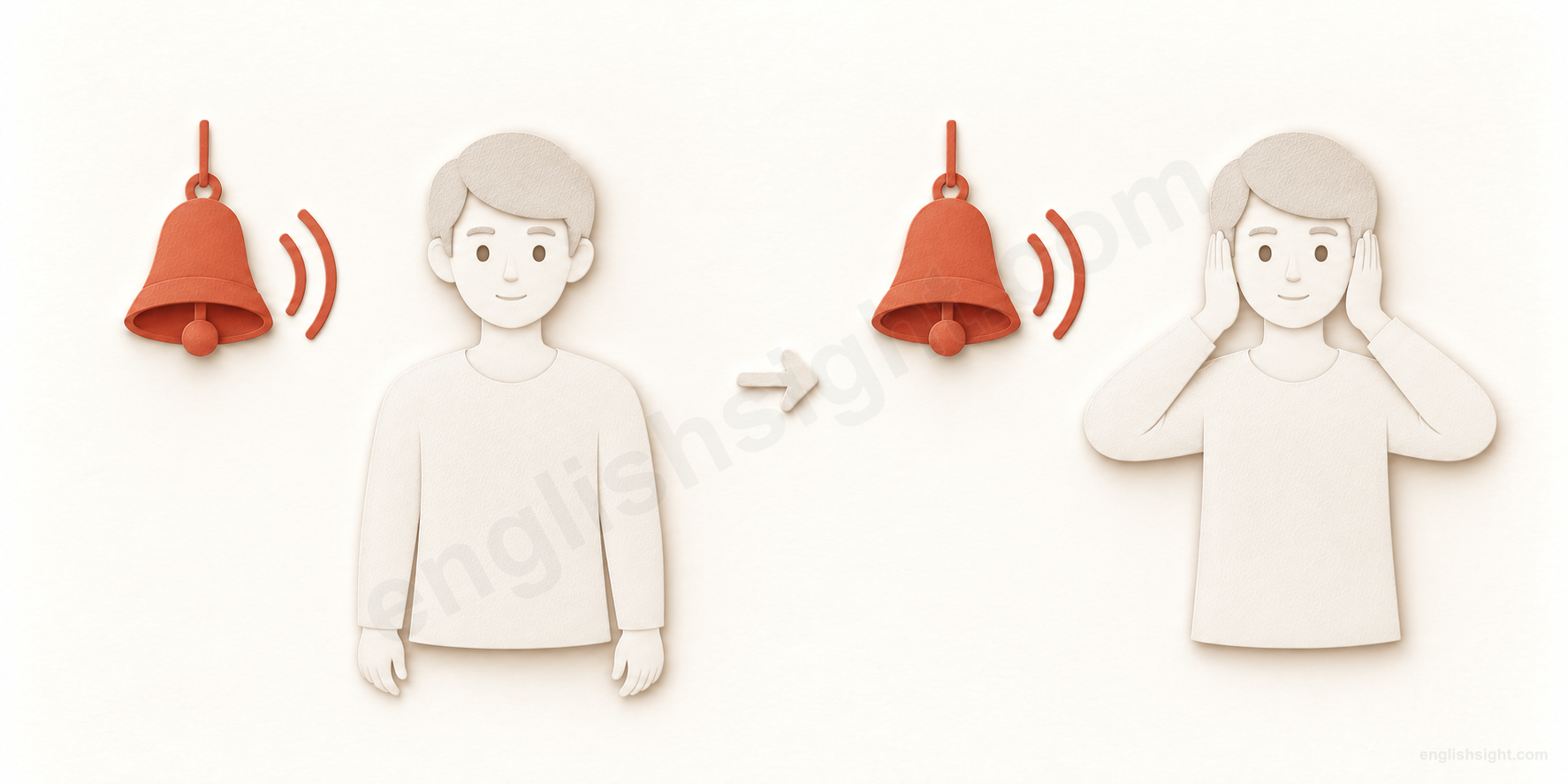
A bell rings beside a listener whose arms are lowered.
reaction
The same listener covers both ears while the bell continues ringing.
The sound prompts the listener to raise both hands to their ears.
The ringing is the trigger; covering the ears is the reaction.
Something happens, and a person or system responds because of it.
The model connects a trigger with a response. It does not require opposition, emotion, or an immediate response. Chemistry and mechanics have specific meanings explained separately.
A reaction is often what happens on the responding side: a feeling, a comment, an action, or a bodily effect. Ask what prompted it and who or what responded.
Some established scientific meanings need their own definitions. This lesson connects useful everyday patterns without claiming that every use is the same process or that every speaker imagines the same picture.
01
Feelings, actions, and public responses
Name what follows an event, describe its tone, and identify the people responding. A reaction can be felt, shown, or spoken.
01
a / someone’s reaction to + noun / -ing; What was your reaction?
a reaction to something
what someone feels, thinks, says, or does because something happens
Trigger / situation
A friend tells you that the trip has been cancelled.
Response / result
You feel disappointed and ask what happened.
The cancellation is the trigger; your feeling and question are reactions.
Reaction is a noun. It names the responding side of the event: the disappointment, a smile, an objection, or words someone says. Ask What was your reaction? to invite someone to describe that response.
To introduces what prompted it: her reaction to the cancellation. Because this to is a preposition, an activity can follow in the -ing form: his reaction to losing the game.
The bell in the diagram is the trigger and covering the ears is the reaction. In conversation the trigger can instead be news, an idea, or another person’s behavior. A spoken reaction may come after reflection; the noun alone does not mean immediate or irrational.
In a sentence
What was your reaction to hearing that the trip was cancelled?
Watch the difference For a single countable response, use a determiner: a reaction or my reaction. For a verb, say I reacted to the news, not I reaction to the news.
02
a positive / negative / mixed reaction from + people; the reaction of + people; little / no reaction to + event
a mixed reaction from the audience
a response whose tone, source, or variety can be described
Trigger / situation
Some listeners enjoy a new song; others dislike it.
Response / result
The audience gives it a mixed reaction.
From names the responders; mixed describes differing views.
Positive, negative, enthusiastic, angry, and strong describe different features of a reaction. Strong tells you intensity, not approval. A mixed reaction contains both favorable and unfavorable responses; one person can also have mixed reactions.
From points to the people the response comes from: a reaction from the audience. Of identifies whose reaction it is: the reaction of the audience. To identifies the trigger: their reaction to the song. These phrases can appear together.
Use a reaction for an overall response and reactions for separate responses. Uncountable reaction is possible when discussing response generally: There was little reaction to the announcement. No reaction means none was observed or expressed in that context; it does not prove that no one felt anything.
In a sentence
The new song received a mixed reaction from the audience.
Watch the difference A negative reaction is unfavorable; a strong reaction can be either favorable or unfavorable.
03
cause / provoke / trigger / get + a reaction; gauge + someone’s reaction
provoke / get / gauge a reaction
cause a response, obtain one, or judge what it shows
Trigger / situation
A designer shows a new logo to customers.
Response / result
Their comments and expressions reveal how they feel about it.
The verb tells us what someone does in relation to the reaction.
Cause, provoke, and trigger a reaction put the trigger first: The remark provoked a reaction. Provoke often suits a noticeable or strong response, but it does not by itself mean the speaker intended to upset anyone.
Get a reaction can describe the effect achieved: The joke got no reaction. With a person trying to get a reaction, context can suggest a deliberate attempt to make someone respond. Neither use means acquiring a physical object.
Gauge someone’s reaction means assess it from the evidence available, such as words, expressions, or actions. Compare have a reaction, which names the responder’s experience. These are verb–noun combinations, not phrasal verbs built from reaction.
In a sentence
The designer watched the customers’ faces to gauge their reaction to the logo.
Watch the difference Gauge a reaction means assess it; provoke a reaction means bring it about.
04
an initial / immediate / delayed reaction; someone’s first reaction was to + verb; a reaction of + feeling
an initial / immediate / delayed reaction
describe when a response occurs or where it comes in a sequence
Trigger / situation
You receive a difficult request.
Response / result
Your first impulse may differ from what you decide later.
Initial orders responses; immediate and delayed describe timing.
An initial or first reaction is the earliest response under discussion. Immediate emphasizes little or no delay. A delayed reaction happens later than the event that prompted it. These modifiers supply timing that reaction alone does not specify.
My first reaction was to refuse uses to refuse to name the action you first took or were inclined to take. Here to begins an infinitive after was. Compare my reaction to being asked: that to is a preposition followed by an -ing form.
A reaction of surprise names the feeling involved, as in Her reaction was one of relief. That is different from the reaction of the audience, where of identifies the people responding. Read the noun after of.
In a sentence
My first reaction was to refuse, but after a short talk I agreed to help.
Watch the difference First does not promise that the reaction remains your final view, and delayed does not mean weak.
02
Instinct, thought, and opposition
Whole expressions tell us whether a response comes from intuition, lacks thought, explains a later action, or pushes against an earlier influence.
05
someone’s gut reaction to + noun; My gut reaction is that + clause
a gut reaction
an instinctive response based on feeling and experience
Trigger / situation
You encounter a plan before you have examined every detail.
Response / result
You have an immediate sense of liking or distrusting it.
Gut marks intuition rather than a reasoned account of each step.
A gut reaction comes from instinct and accumulated experience. Gut literally names part of the body, but this expression does not describe digestion or a stomach illness.
Someone can ask for your gut reaction to hear your unfiltered first impression. You can then check the details. The expression does not guarantee that the impression is correct, and it need not condemn it as foolish.
Compare a considered reaction, which follows deliberate thought. Knee-jerk reaction is more openly critical of a lack of thought; gut reaction can be a neutral description of intuition.
In a sentence
My gut reaction is that the plan is too complicated, but I want to read it carefully.
Watch the difference A gut reaction is an intuition, not necessarily an allergic or other medical reaction.
06
a knee-jerk reaction to + noun; dismiss something as a knee-jerk reaction
a knee-jerk reaction
a response criticized for happening automatically without enough thought
Trigger / situation
Someone hears an unfamiliar suggestion.
Response / result
They reject it before considering the reasons.
The phrase criticizes the unthinking quality of the response.
Knee-jerk goes before reaction as a hyphenated adjective. In discussions it suggests that someone has responded by habit or impulse instead of thinking the matter through. It usually sounds disapproving.
This is an established figurative expression. You do not need a literal moving knee in the situation. The criticism comes from knee-jerk, not from reaction by itself.
Quick reactions in a game can be a skill. Calling a policy a knee-jerk reaction instead questions its judgment. Speed alone is not enough to make a response knee-jerk.
In a sentence
Rejecting every new idea without discussion is a knee-jerk reaction.
Watch the difference Do not use knee-jerk as a compliment for a goalkeeper’s quick reactions.
07
do something in reaction to + noun / -ing; do something as a reaction to + noun
in reaction to something
because of an event and as a response to it
Trigger / situation
Residents complain that a path is too dark.
Response / result
The council adds lighting because of those complaints.
The phrase links a later action to what prompted it.
In reaction to can modify a whole action: The council changed the plan in reaction to complaints. The council is acting; the complaints explain why. As a reaction to can express the same cause-and-response link.
The response can be practical, emotional, welcome, or unwelcome. The phrase does not say that the council opposes the complaints. It might be accepting them and making the requested improvement.
Compare a change after the complaints, which gives time order without explicitly saying why the change happened. In reaction to states that the event prompted the response.
In a sentence
The council added lighting in reaction to complaints about the dark path.
Watch the difference To gives the trigger. Use against when you specifically want to express resistance to an influence or trend.
08
a reaction against + noun; develop / arise as a reaction against + noun
a reaction against something
a movement or change of behavior that resists an earlier influence
Trigger / situation
A style or set of expectations has become dominant.
Response / result
People deliberately favor something different or opposite.
Against adds resistance; the earlier influence helps explain the change.
A reaction against a trend can show itself through changed choices rather than a direct argument. A preference for plain clothes might develop as a reaction against very elaborate fashion.
Collins distinguishes deliberately different behavior from a loss of popularity; Oxford groups them under changed attitudes or behavior. Both can involve people moving away from what came before. The lesson keeps that shared relationship while mentioning both outcomes.
Compare a reaction to a trend, which leaves the attitude open: it could be approval. A reaction against the trend explicitly points toward rejection or resistance. Against does not automatically make the reaction violent.
In a sentence
The return to plain furniture was partly a reaction against elaborate designs.
Watch the difference A positive reaction to a proposal supports it; a reaction against it signals resistance.
09
the forces of reaction; political reaction [uncountable]
the forces of reaction
people or influences opposing social or political change
Trigger / situation
A reform is proposed.
Response / result
Some groups try to preserve or restore an older order.
This is a political meaning, not merely any response to news.
In political or historical writing, uncountable reaction can refer to resistance to reform or a wish to return to an earlier social order. The forces of reaction is a conventional way to name the groups or influences involved.
The wording often expresses the writer’s disapproval. It tells us how that writer frames the political conflict; the noun does not establish whether a particular reform is good.
Learn this as a recognition use. Public reaction to a reform may include support, opposition, and uncertainty. Reaction in the phrase forces of reaction specifically concerns opposition to change.
In a sentence
The historian described the groups blocking reform as forces of reaction.
Watch the difference Do not call every person who reacts to a political speech a force of reaction.
03
The body and the speed of responding
A reaction to a substance, quick reactions in sport, and a measured reaction time describe different aspects of responding.
10
have / experience / suffer a reaction to + substance; an allergic / adverse / severe reaction
have an allergic / adverse reaction to something
experience a bodily response, often an unwanted one, to a substance
Trigger / situation
Someone uses a new skin cream.
Response / result
Their skin becomes irritated.
Here the responding system is the body, not a person’s opinion.
Have or experience a reaction to a medicine, food, or other substance describes a physical effect. A bad or adverse reaction is unwanted. A severe reaction describes its intensity.
Allergic is more specific than bad or adverse: it identifies an allergy-related response. The words are not interchangeable simply because an effect is unpleasant. A report of a bad reaction alone does not identify its biological cause.
The body can respond in many ways, so reaction itself is broader than illness. In everyday talk about a new substance, however, have a reaction often suggests an unwanted effect. The surrounding words and situation tell you which meaning is intended.
In a sentence
She had a bad reaction to the new skin cream.
Watch the difference A bad reaction to a cream does not by itself mean a confirmed allergy. An angry reaction to a price rise is a different, social use.
11
have + quick / fast / slow reactions; someone’s reactions are + quick / slow
have quick reactions
be able to respond rapidly when something happens
Trigger / situation
A ball suddenly comes toward the goal.
Response / result
The goalkeeper moves quickly enough to stop it.
The plural noun reactions describes a responsive ability.
In sport, driving, and similar situations, quick or fast reactions describe someone’s ability to notice a change and act promptly. Slow reactions describe a less rapid ability.
This use normally has the plural: She has quick reactions. One quick reaction, by contrast, can be a single response on one occasion. The plural ability use does not require a list of several separate incidents.
The diagram shows one response prompted by a sound. That illustrates a single reaction; this expression generalizes to the person’s ability across situations. It does not describe approval or dislike.
In a sentence
The goalkeeper’s quick reactions helped her stop the ball.
Watch the difference Use quick reactions for the general ability, rather than She has a quick reaction when no particular event is being described.
12
someone’s reaction time; a short / long reaction time; measure / compare reaction times
reaction time
the interval between a trigger and a response
Trigger / situation
A light appears on a test screen.
Response / result
The participant presses a button a fraction of a second later.
Reaction time measures the delay, not the length of the whole task.
Reaction time names how long a person or system takes to begin responding after a signal or event. It can be discussed generally or as a particular measured value; plural reaction times can compare people, trials, or conditions.
A shorter reaction time means less delay. In a button test, the interval starts when the signal appears and ends when the required response is registered. Time spent finishing a long activity is a different measure.
Reaction modifies the noun time. This is a compound noun, not a verb followed by an object. The idea also applies to systems such as a touchscreen responding to input.
In a sentence
The test measured my reaction time between the light appearing and my button press.
Watch the difference A shorter reaction time indicates a quicker response, even though the number is smaller.
04
Scientific processes and connected events
Learn these established meanings with their subject areas. Chemical change, a chain of consequences, and a pair of forces are not interchangeable.
13
a chemical reaction between A and B; the reaction of A with B; a reaction occurs / takes place
a chemical reaction
a process in which substances undergo chemical change
Trigger / situation
Substances interact under suitable conditions.
Response / result
Different substances are formed.
Reaction here names a chemical process, without anyone’s feelings or decisions.
A chemical reaction changes the substances involved. This is an established scientific use of reaction. Merely putting things together does not guarantee that a chemical reaction occurs.
Use a reaction between A and B, the reaction of A with B, or a reaction involving a substance to identify participants. Say a reaction occurs or takes place to report that the process happens. The process, rather than a person, is the subject.
The bell picture illustrates a trigger and a human response, not chemical change. Keep the scientific definition with this branch rather than imagining that chemicals hear or decide. Nuclear reaction is another scientific term, about changes involving atomic nuclei; it is distinct from a chemical reaction.
In a sentence
The class observed a chemical reaction between two substances in a sealed container.
Watch the difference A reaction is a noun: The reaction occurred. For a verb, use The substances reacted, not The substances reaction.
14
set off / trigger a chain reaction; a chain reaction of + consequences
set off a chain reaction
start a sequence in which one event causes another
Trigger / situation
A delayed delivery stops a workshop from starting on time.
Response / result
The late workshop delays a meeting, which delays another appointment.
Each consequence becomes the trigger for the next event.
In ordinary speech, a chain reaction is a connected series of consequences. Set off or trigger a chain reaction means start that series. Chain contributes the linked sequence; reaction contributes the cause-and-response relationship.
The expression also has a scientific meaning: products or effects of one chemical or nuclear step cause further steps. That technical process supplies a useful analogy, but an everyday chain reaction need not involve chemicals or atoms.
Many unrelated events happening on the same day are not automatically a chain reaction. The expression presents causal links. It can describe helpful consequences as well as problems, although the example here involves delays.
In a sentence
The late delivery set off a chain reaction of delays across the afternoon.
Watch the difference A chain reaction involves linked causes and results, not simply several people having different opinions.
15
action and reaction; a reaction force
action and reaction
a pair of forces in opposite directions in mechanics
Trigger / situation
One object exerts a force on another.
Response / result
The second object simultaneously exerts an equal opposite force on the first.
The two forces act on different objects; this is not a delayed emotional reply.
In mechanics, reaction can name the force associated with another object’s action on it. The paired forces are equal in size and opposite in direction. They act on different objects, so do not treat them as two forces cancelling on one object.
For this meaning, imagine a hand pushing a wall and the wall pushing back on the hand. The forces exist together. They are not a first action followed later by a reaction.
This is a recognition introduction to the scientific expression, not a rule for social behavior. Someone’s reaction to criticism need not equal the criticism in strength or oppose it.
In a sentence
As her hand pushed on the wall, the wall exerted a reaction force on her hand.
Watch the difference In the mechanics meaning, the reaction force is simultaneous with the action force, not a later response.
Keep the noun, the trigger, and the context clear
Reaction is the noun; react is the verb
Use a reaction, her reaction, reactions, or uncountable reaction when discussing response generally. Use react / reacts / reacted / reacting as verb forms. Reaction has no verb tense, passive form, or phrasal-verb family. A reaction was caused is the passive of cause, with reaction as its noun subject.
To, from, of, and against do different jobs
A reaction to the news identifies the trigger. A reaction from the students and the reaction of the students identify the responders. A reaction against a trend expresses resistance. In a reaction of surprise, of names the feeling instead. These are noun phrases; the prepositions are not verb particles.
Reaction and response overlap
Response is often useful for a reply or a planned action; reaction often draws attention to what an event prompted. Both can describe spoken or considered responses. Avoid the absolute rule that reaction is always emotional and automatic while response is always calm and deliberate.
One model does not erase technical definitions
An allergic reaction, a chemical reaction, a nuclear reaction, and a reaction force belong to different contexts. In mechanics the paired forces occur simultaneously. The diagram’s sequence is an everyday example, not a diagram of every scientific use.
Find the response and read the whole phrase
Choose the sentence or interpretation that fits the situation.
1. You want to ask how a friend responded when a concert was cancelled. Which question fits?
2. People choose very plain designs because they reject the elaborate style that came before. Which phrase makes that resistance explicit?
3. A player consistently moves quickly when the ball changes direction. Which expression describes that ability?
4. A decision is criticized as a knee-jerk reaction. What is being criticized?
5. A late train makes you miss a bus, which makes you miss an appointment. Which description fits?
6. One test records 0.2 seconds between a signal and a button press; another records 0.5 seconds. Which result shows the quicker response?
7. A speaker thinks carefully before giving a reaction to a proposal. Is reaction the wrong noun solely because there was reflection?
Sources and teaching notes
The linked dictionaries support the meanings and constructions. The explanations, situations, examples, and compatibility diagram are original teaching material; the trigger-and-response picture is a learning aid.
The diagram illustrates one relationship; it is not a claim about a picture shared by every English speaker.