Keep facts and performances, assess a history, or compare a result with what came before.
From an event to a lasting trace
From an event to a lasting trace
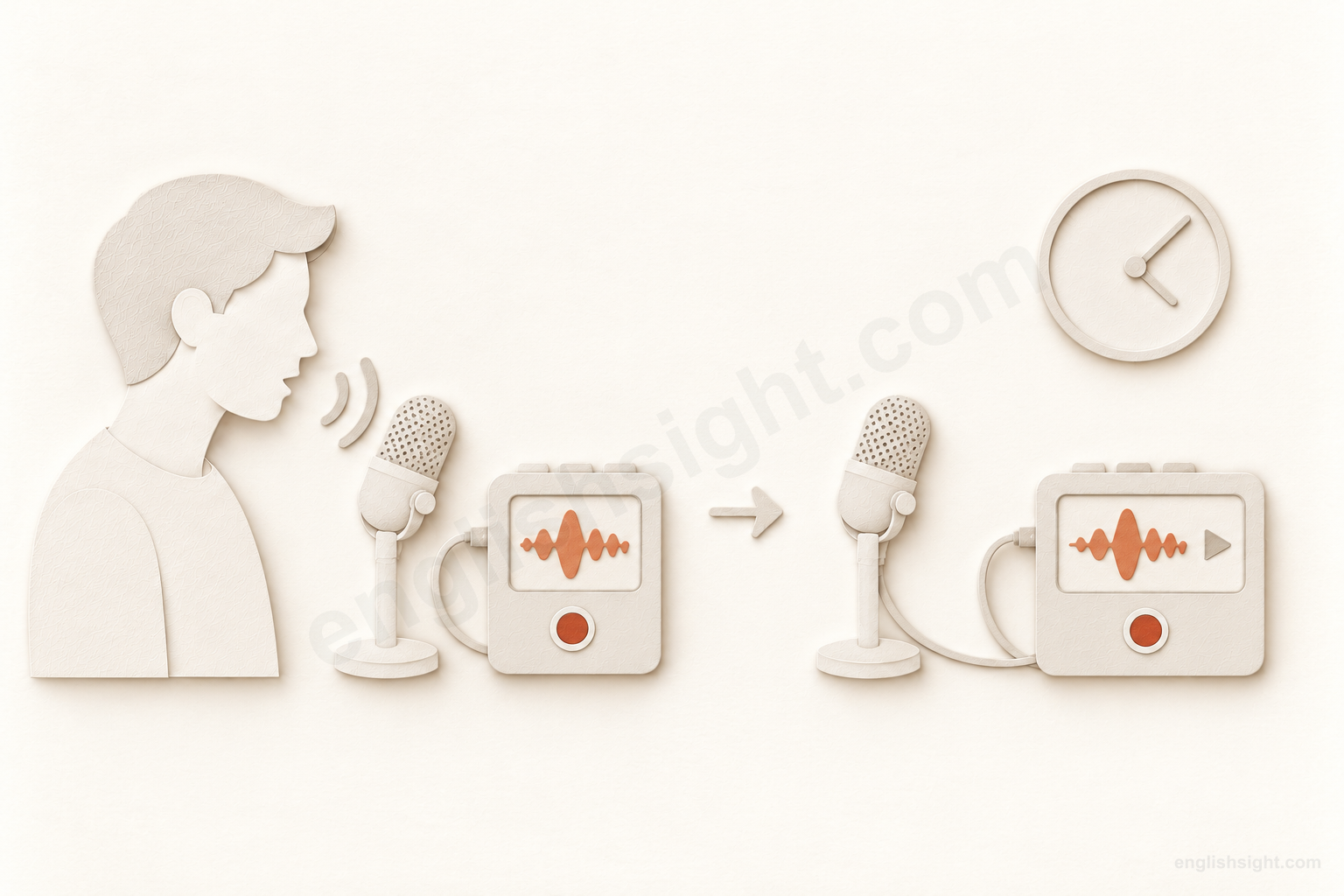
A person speaks into a microphone.
record
The speaker is gone; the saved sound remains available.
The recorder captures the sound.
The event ends; its recorded trace remains available for replay. Sound is one kind of information that can be recorded.
Capture information about what happens so that a trace can be consulted or replayed later.
The waveform illustrates capture and later availability. Measurements can merely register a value, and best-result uses add comparison with previous results; neither should be reduced to audio recording.
A useful starting point is a trace that remains available after an event: a list you can check, a performance you can replay, or a history you can assess. Record can name the trace or describe making it.
An exceptional result is a separate established use: a record is the benchmark others have not surpassed. The connection to retained results helps with memory, but it cannot predict every phrase.
Stress matters: the usual account, music, and best-result nouns and the modifier have first-syllable stress, RE-cord; the verb has second-syllable stress, re-CORD. The device function in press record is a special case, explained below. The visual model is a teaching aid, not a claim that all English speakers imagine the same picture.
01
Keep information available
A record is something you can consult after an event. The verb describes making that trace, or registering information and measurements.
01
keep / make a record of + noun / what-clause; keep records
keep a record of
retain an account for later reference
Situation / information
You pay several small expenses.
Available account / result
A list lets you check each payment later.
Of introduces what the account concerns.
A record of something is a saved account, not merely a memory. It may be written, photographed, or stored electronically. Keep a record of your expenses means maintain that account as payments occur.
Make a record emphasizes creating an account; keep or maintain records emphasizes retaining and updating information. Keep records is natural without an article when referring to record keeping generally.
In a sentence
I keep a record of what I spend on train tickets.
Watch the difference Say a record of the payments; a record for can instead name a best result in an activity.
02
medical / financial / historical records; a record of; according to the records
medical records / historical record
stored information and evidence about the past
Situation / information
A clinic has information from earlier appointments.
Available account / result
The doctor checks that information before the next visit.
Plural records often names a collection of stored documents or entries.
Medical, school, financial, and court records contain information retained by an organization. Check, update, and access records describe using that information; according to the records identifies it as the source of a claim.
There is no record of the visit says no saved evidence is available; it does not by itself prove the visit never happened. The historical record can mean the surviving body of evidence. Fossil or geological records extend this idea to physical traces, without anyone deliberately writing them down.
In a sentence
According to the clinic’s records, my last appointment was in March.
Watch the difference A record is evidence to assess, not a guarantee that an account is complete or correct.
03
record + information; record it in / on + medium; be recorded
record the details
save facts in a lasting form
Situation / information
The organizer hears the names of new members.
Available account / result
Those names are entered in the membership list.
The subject stores information; the object is what is stored.
Record information can mean write it down, photograph it, or enter it into a system. It does not require an audio recorder. Record the names in a notebook and record the data on a computer specify where or how the information is kept.
The verb is normally transitive here: record something, record it, or the details were recorded. A book can also be the subject: The diary records her travels means the diary contains an account of them.
In a sentence
The organizer recorded each member’s name in a spreadsheet.
Watch the difference Remember means retain something in your mind; record means create or register a trace outside that mental act.
04
record + what / how / who-clause; record that + clause; it is recorded that…
record what happened / record that…
save the content of a fact or event
Situation / information
Several people leave a meeting at different times.
Available account / result
The written account states who left and when.
A clause supplies the information being recorded.
Record can take a what, how, when, or that-clause. Record who attended tells someone to preserve the answer to a question; record that the meeting ended early preserves a complete statement.
It is recorded that… is a formal passive reporting pattern. Here it is a grammatical placeholder, and the following clause gives the content found in an account. It does not name a person who is recording.
In a sentence
The minutes record that the committee rejected the proposal.
Watch the difference Record what happened is natural; do not insert about before the content clause.
05
record + object + as + description; be recorded as + value / noun phrase
be recorded as
enter something under a stated description or value
Situation / information
An arrival time needs an entry in the log.
Available account / result
The log gives a particular time for that arrival.
As introduces the value or description assigned in the account.
The arrival was recorded as 8:15 tells us what the account says. The entry may later be corrected. As does not mean that recording caused the arrival or changed its actual time.
An active version is also possible: They recorded the result as a draw. The passive is useful when the saved classification matters more than the person who entered it.
In a sentence
Her arrival time was recorded as 8:15.
Watch the difference Be recorded as is not be regarded as: one concerns an entry or account, the other an opinion.
06
instrument / survey + record + measurement / change
record a temperature
register or show a measured value
Situation / information
A sensor measures the air.
Available account / result
Its reading gives a temperature.
A measuring device can be the subject without a human writer.
A thermometer records a temperature means it registers or shows that reading. A data logger may also save measurements over time, but the verb alone does not always promise long-term storage.
Reports also use record a rise or fall for a registered change. The figures or the organization can be the subject: The survey recorded a fall in demand. This describes a reported measurement, not sound recording.
In a sentence
The sensor recorded a temperature of 18°C at noon.
Watch the difference A thermometer can record a reading without creating an audio or video file.
07
record + decision / vote / verdict
record a decision / verdict
formally enter or state an official conclusion
Situation / information
A hearing reaches a conclusion.
Available account / result
That conclusion is entered in the official account.
Record can describe an official act, not just a private note.
In formal reports, record a decision, vote, or verdict means give it an official place in the proceedings. A verdict is a conclusion announced in a legal process; the specialized details belong to that process, not to record itself.
Compare record the hearing, which could mean capture its sound or video. Record a verdict focuses on the conclusion formally stated. The object guides the interpretation.
In a sentence
The panel recorded a unanimous decision in its final report.
Watch the difference This formal use does not mean the panel achieved a sporting record.
08
a database / customer record; add / update / delete a record
a customer record
one unit of related information in a database
Situation / information
A system stores details about many customers.
Available account / result
One entry brings a particular customer’s details together.
The computing noun names a data unit rather than a best result.
A customer record may contain a name, contact details, and an account number. Add, edit, or delete a record refers to one stored unit, not necessarily one entire file.
This is a practical computing extension of retained information. Different systems organize records differently; the word alone does not define a database design or a programming type.
In a sentence
Please update the address in this customer record.
Watch the difference A database record is not automatically a recording of someone speaking.
02
Capture sound and make music
Recording preserves a performance for later listening or viewing. A record may also be a physical disc or a released piece of music.
09
record + event; record + someone / something + -ing; record on / from; be recorded
record a conversation / video
capture sound or moving images for replay
Situation / information
A conversation can be heard only as it happens.
Available account / result
A saved version can be played afterward.
The object is the event or signal captured, not the recording device.
Record a conversation or programme means preserve sound, images, or both for later playback. Record it on your phone names the device. Record it from the radio names the source. These are ordinary prepositional phrases, not separate phrasal verbs.
Record someone doing something identifies the person or thing captured and the activity: We recorded the birds singing. The recording documents the activity; it does not cause the birds to sing.
The passive is natural: The interview was recorded. A recorded message is one prepared earlier and played back, rather than necessarily spoken live.
In a sentence
We recorded the birds singing outside our window.
Watch the difference Record her singing means capture her performance; make her sing means cause or require it.
10
record (without an object); be recording; press record; a recording of
start recording
operate a recorder or make a recording
Situation / information
The equipment is ready.
Available account / result
It begins capturing sound or video.
The object may be omitted when the activity is understood.
Are you recording? can ask whether a device or person is currently capturing what is happening. The present continuous is ordinary because this is an ongoing activity.
Press record uses the label of a device function or button; here record has verb-like second-syllable stress, re-CORD, even when treated as a function noun. A recording is the saved audio or video, or the act of making it: I listened to the recording later. Use a recording of the meeting for a replayable file; a record of the meeting may instead be written minutes.
In a sentence
Wait a moment—the microphone isn’t recording.
Watch the difference Recording and record overlap, but a recording usually suggests captured media more clearly than a written record does.
11
musician / band + record + song / album; record in a studio
record a song / album
perform music to produce a replayable version
Situation / information
Musicians have music to perform.
Available account / result
Their performance becomes a recorded version.
The subject may be a performer, not merely an operator copying existing sound.
A band recording an album is performing music for a recording. The engineer may also be described as recording the band, with the technical capture in focus. Context decides whose contribution is meant.
The band is recording in June works without an object. Record an album does not by itself mean release it: a finished recording may remain unpublished.
In a sentence
The trio is recording a new album this week.
Watch the difference Write a song concerns composition; record a song concerns making a recorded performance.
12
a vinyl record; play / put on a record; a record player
play a record
play music stored on a physical disc
Situation / information
A vinyl disc is in its sleeve.
Available account / result
A record player reproduces its stored sound.
The countable noun can name a grooved disc.
A record in this sense is a flat disc played on a record player or turntable. A record collection may be a collection of these physical objects. Vinyl often names the material or this format.
Put on a record means start playing it. Here put on is a separate expression used with record as its object; record itself has not become a verb meaning play.
In a sentence
Mina put an old jazz record on the turntable.
Watch the difference Record the music captures it; play the record reproduces sound already stored.
13
release / make a record; a hit record; record company / label
release a record
make a musical recording available as a release
Situation / information
A singer has finished a recording.
Available account / result
Listeners can obtain the released music.
Record may name the music release even without a vinyl disc.
A singer’s latest record may be an album or another musical release available digitally. The format is supplied by context; record does not always mean a physical object.
A record company or record label works in the recorded-music business. Make a record describes producing a musical recording; release a record specifically concerns making it available to listeners.
In a sentence
You can stream the duo’s first record from Friday.
Watch the difference A record is not necessarily one individual song; it can be a collection such as an album.
03
Past performance and exceptional results
A record can summarize what someone has done or name a result that others have not surpassed. The surrounding words distinguish these meanings.
14
have a good / poor + safety / attendance record; record of + noun; record on + issue
a good safety record
known facts about past behavior or performance
Situation / information
An airline has operated for many years.
Available account / result
Its history can be assessed for safety.
This record summarizes a history, not an unbeaten best result.
A good safety record means a favorable history of safety. A poor attendance record means a pattern of missed attendance. Record of achievement and record on housing similarly specify what aspect of a person or organization is assessed.
This history need not be one document you can pick up. Our record speaks for itself means our past performance supplies convincing evidence; it does not literally speak.
In a sentence
The airline has a strong safety record.
Watch the difference A good record is a favorable history; the record may instead refer to a particular best result in a competition.
15
a track record of + noun / -ing; a track record in + field
a proven track record
past results used to assess reliability or ability
Situation / information
You need to choose someone for a difficult project.
Available account / result
Their earlier results provide evidence of ability.
Track record emphasizes a history relevant to judging future performance.
A track record of completing projects refers to demonstrated past performance. A track record in design identifies the field. Good, poor, and proven commonly describe the quality or evidential value of that history.
Despite track, the expression does not require a running track. A company, product, or person may have a track record. Prior success provides evidence, not a promise of the same future outcome.
In a sentence
We need a designer with a proven track record of meeting deadlines.
Watch the difference A world record names an unsurpassed result; a track record describes a broader performance history.
16
have a criminal record / a record; a clean driving record
have a criminal record
have an officially recorded history of crime
Situation / information
An application asks about past criminal offenses.
Available account / result
The answer concerns a person’s official criminal history.
In this context, have a record can mean have a criminal record.
Criminal record refers to an official history connected with past crimes. Have a record without criminal is understood this way when crime is already the topic; outside that context, record has many other meanings.
A clean record may describe an absence of recorded offenses in the context under discussion. A clean driving record concerns driving history. What a particular official check includes depends on the system, so the expression alone cannot settle that detail.
In a sentence
The application asks whether the applicant has a criminal record.
Watch the difference Do not infer a criminal meaning from medical records or a good academic record.
17
set a new record; hold the record for + event / -ing; a record holder
set / hold a record
establish or possess an unsurpassed result
Situation / information
Earlier results provide a benchmark.
Available account / result
A competitor establishes or remains associated with the best result.
Set concerns establishing the benchmark; hold concerns who currently has it.
Set a record means establish a new best or extreme result. Hold the record means be the person or organization associated with the standing benchmark. A record holder is that person or organization.
A world record has a worldwide comparison class; a national or school record has a narrower one. Record for introduces the activity or category. Whether a lower or higher number is better depends on the activity: a faster race time is a lower time.
In a sentence
Tariq holds the school record for the 400 metres.
Watch the difference A personal best concerns one individual’s previous results; it is not automatically a school or world record.
18
break / beat a record; equal / tie a record; an unbeaten record
break / equal a record
surpass or match an existing best result
Situation / information
A previous best result stands.
Available account / result
A new performance either improves on it or matches it.
Break and equal describe different comparisons with the same benchmark.
Break or beat a record means produce a better result than the previous record. Equal or tie a record means reach the same result. Equaling it does not break it.
An unbeaten record in a team’s history may instead mean a run of games without defeat. They lost their unbeaten record can mean they finally lost a game, not that someone beat a speed or scoring benchmark.
In a sentence
Leah equalled the club record but did not break it.
Watch the difference Break a record usually has no physical breaking; smashing a vinyl record would be a different, literal event.
19
record + noun; a record high / low; reach record levels
record profits / a record high
a level beyond previous recorded levels
Situation / information
Earlier years establish a range of figures.
Available account / result
A new figure reaches an extreme beyond that range.
Before a noun, record describes a historically exceptional level.
Record profits means profits greater than the previous maximum in the relevant comparison. A record low is the lowest recorded level, not the greatest amount. Unwanted things, such as costs or unemployment, can also reach record levels.
Collins and Merriam-Webster label this use adjective; Oxford includes examples under the best-result noun. Learn the behavior: record commonly precedes a noun, as in record sales or a record high.
In a sentence
Water use fell to a record low in April.
Watch the difference Record does not mean good: record losses describes an exceptionally bad financial result.
20
do something in record time
in record time
faster than previous occasions, or remarkably quickly
Situation / information
A task usually takes much longer.
Available account / result
It is completed unusually quickly.
This familiar phrase can be enthusiastic rather than a certified result.
In record time may literally describe the fastest measured completion, but in everyday speech it often just emphasizes speed. We packed in record time does not require an official competition.
In names the time taken to complete the task. Compare a record time, a noun phrase that may name a measured sporting result. The surrounding context tells you how literal the claim is.
In a sentence
With everyone helping, we packed the van in record time.
Watch the difference Record time concerns speed; on time concerns meeting an expected time.
21
superlative + noun + on record; since records began
the warmest year on record
an extreme within the available documented history
Situation / information
A report compares years with saved measurements.
Available account / result
One year is the warmest in that documented series.
On record limits the comparison to what has been documented.
The warmest year on record means the warmest year for which the relevant records exist. It does not establish the warmest conditions in all of Earth’s history.
Since records began similarly states the starting point of a documented series: the driest spring since records began. Neither phrase tells you that date unless the context supplies it.
In a sentence
It was the driest spring on record in the region.
Watch the difference This on record is a historical comparison; be on record as saying something concerns a public statement.
22
team / player + record + win / victory / score; company + record + loss
record a win / loss
achieve a result reported as part of a performance
Situation / information
A team plays a match.
Available account / result
Its result becomes a win in the season’s results.
In sports reporting, the subject achieves the result.
The team recorded a win means the team won. A club may record a defeat, and a company may record a loss; record does not imply a favorable result or a new all-time best.
This report-style verb is related to an outcome going into the results, but it is not simply the act of someone writing. Contrast The official recorded the score, where the official enters information about a game.
In a sentence
Despite the rain, our club recorded a 2–0 win away from home.
Watch the difference Record a win does not mean break a record; an ordinary victory can be recorded.
04
What is said publicly, corrected, or repeated
These established expressions use the idea of an account people can refer to. Learn the whole phrase: its meaning is not supplied by a preposition alone.
23
keep / have + information + on record; be a matter of record
keep something on record
retain information so it can be consulted
Situation / information
A customer provides an updated address.
Available account / result
The company retains the address in its information.
On record here describes stored information, not publication.
Keep your address on record means retain it in a system or file. Have something on record means it is already retained there. The information need not be public.
A matter of record is a more formal expression for a fact that has been documented. It emphasizes that an account exists, while the everyday keep on record focuses on retaining information.
In a sentence
We will keep your new address on record.
Watch the difference On record does not always mean available for anyone to read; context distinguishes stored details from a public statement.
24
go / be on (the) record as saying + clause; put / place something on record
go on record as saying…
state a position publicly or officially
Situation / information
A person has a view that is not yet publicly attributed.
Available account / result
They agree to state that position publicly.
Go describes taking a public position; be describes its documented existence.
Go on record as saying something means make a statement openly enough to be quoted or documented. Be on record as saying something points to an existing public statement. On the record is also used.
Put or place something on record formally adds it to the public or official account: I want to place my thanks on record. This does not refer to putting music on a disc.
In a sentence
The director went on record as saying that the plan would change.
Watch the difference As saying introduces what was publicly stated; it does not describe the sound quality of a recording.
25
speak / say something off the record; off-the-record + noun
off the record
said privately without intended public repetition or attribution
Situation / information
Someone has information to share privately.
Available account / result
They ask for it to stay outside the public account.
The expression concerns how information may be used, not just whether a recorder is running.
Off the record signals that a comment is not intended as an official public statement or for public quotation. In an interview, speakers use it to seek a private understanding about the information.
The phrase does not itself stop a machine recording or erase existing files. Compare off-the-record comments: the hyphens connect the words when the expression comes before a noun.
In a sentence
“May I explain the delay off the record?” the manager asked.
Watch the difference Off record omits the usual the; learn the established phrase off the record.
26
(just) for the record, + clause; state something for the record
just for the record
state something so it is noticed or remembered accurately
Situation / information
Others may not have the right account.
Available account / result
You explicitly put your information or position before them.
The phrase can introduce a formal entry or an emphatic conversational point.
In a meeting, for the record can request that a statement become part of the official account. In everyday conversation, Just for the record, I did ask her can simply emphasize a fact the speaker wants others to remember.
The tone may be corrective or defensive, but the expression does not always announce an argument. Just can soften the introduction or emphasize that the point should be acknowledged.
In a sentence
Just for the record, I sent the invitation on Monday.
Watch the difference For the record is not for a record: the fixed expression concerns an acknowledged account, not winning a competition.
27
set / put the record straight (about / on + topic)
set the record straight
correct an inaccurate account or belief
Situation / information
A report incorrectly says an event was cancelled.
Available account / result
You explain what actually happened.
Straight is a metaphor for accuracy, not the shape of a document.
Set or put the record straight means correct misinformation. The account may be an actual published report or simply what people have come to believe.
About or on can introduce the topic: set the record straight about the cancellation. The whole phrase supplies the correction meaning; it is not a phrasal verb record straight.
In a sentence
Let me set the record straight: the event was postponed, not cancelled.
Watch the difference This expression corrects information; it does not mean improve an athlete’s record.
28
sound / be like a broken record; like a stuck record (also British English)
sound like a broken record
repeat the same point so often that it annoys people
Situation / information
Someone has already made the same request several times.
Available account / result
They repeat it again.
The comparison comes from a damaged disc repeatedly playing a short section.
Sound like a broken record describes repetitive talk. I know I sound like a broken record can acknowledge that you are repeating yourself while still insisting on the point.
British English also uses like a stuck record. Neither phrase says the speaker’s information is false. The problem is repeated wording or demands, not a sporting record being surpassed.
In a sentence
I know I sound like a broken record, but please back up your files.
Watch the difference A broken record in this idiom is different from breaking the world record in sport.
Let the construction identify the meaning
Stress and forms
Noun: British /ˈrekɔːd/, American /ˈrekərd/; verb: British /rɪˈkɔːd/, American /rɪˈkɔːrd/. The modifier in record profits has noun-like first-syllable stress. Verb forms are record, records, recorded, recording. The past ending in recorded adds a syllable. The device-function noun in press record is an exception to the usual noun stress: re-CORD.
Countable accounts and special expressions
Use a record of the visit and medical records for ordinary countable accounts. Fixed phrases such as on record, off the record, and for the record have their own article patterns. A person’s safety record can summarize a whole history rather than one document.
Voice, aspect, and complements
Recording an activity can be ongoing: The camera is recording. Passive forms are ordinary: The names were recorded. Record somebody doing something captures an activity; it does not cause it. There is no productive record somebody to do something causative construction.
A record is not automatically accurate or complete
A saved entry may contain an error, and an absence of records is not proof that an event did not happen. A record high or low refers to the relevant comparison and available history, not necessarily every event that has ever occurred.
Scope of this lesson
The lesson covers modern everyday nouns, verbs, the record modifier, and familiar fixed expressions. Detailed legal registration procedures, programming record types, specialist geological analysis, and historical uses are not expanded. Ordinary on, in, and from phrases are not all phrasal verbs.
Choose the intended record
Use the object, the full expression, and the situation to decide.
1. Which pronunciation fits record in “Please record the interview”?
2. A runner matches the existing best time exactly. Which statement is accurate?
3. A report says “The team recorded a win.” What must be true?
4. A speaker asks to explain something off the record. What are they asking?
5. Which description would help you evaluate a builder’s previous performance?
6. “We recorded Jo playing the piano.” What does this say?
7. “Demand reached a record low.” How does demand compare with the documented past?
Sources and teaching notes
The publisher pages below were read to check meanings and constructions. Explanations and examples are original; the event-to-trace connection is a teaching model rather than a dictionary definition for every use.
The diagram illustrates a useful connection; it is not a picture shared by every native speaker.