Use regular for recurring patterns, familiar routines, and the usual standard—and learn where the meaning changes.
A recurring or established pattern
A recurring or established pattern
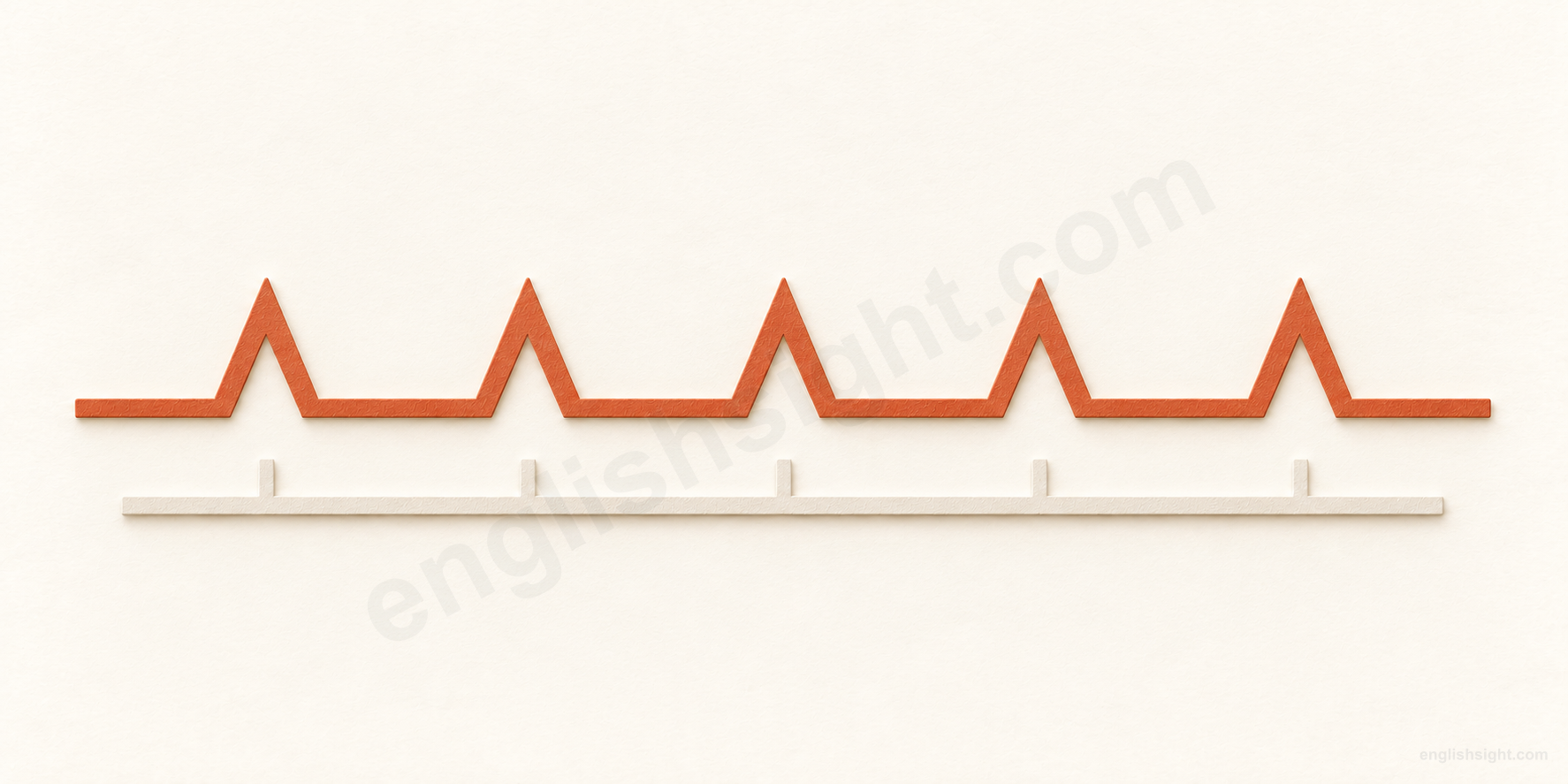
One pulse establishes a recognizable shape.
regular
The sequence forms a regular rhythm.
Matching pulses recur at equal intervals.
The same pulse returns at equal intervals: a regular rhythm.
Regular often describes something that follows a recurring pattern or matches an established usual standard.
The sketch isolates even repetition. Habits need not have exactly equal gaps, and standard products, military categories, and emphatic expressions require their own context.
A regular beat has even timing; a regular customer keeps coming back; a regular verb follows an inflection rule. Ask what pattern, routine, or standard is relevant in each situation.
These connections are a teaching model, not a claim that all senses mean exactly the same thing or that every English speaker imagines the same picture.
01
Patterns across time and space
Regular can describe equal gaps, a repeated rhythm, or a familiar habit. The noun and the context tell you how exact the repetition is.
01
at regular intervals; on a regular basis; regular + service / meeting
at regular intervals / on a regular basis
with a repeated spacing or schedule
Situation or reference
A light flashes, pauses, and flashes again.
What regular describes
The pauses follow a recurring pattern.
Regular intervals concern the gaps between events or objects.
At regular intervals can describe time or space. A warning light may flash every few seconds; trees may stand every few metres along a road. The repeated gaps are the point, not the total number of lights or trees.
On a regular basis means as a continuing routine. It does not specify a time: add weekly, monthly, or another expression when the schedule matters. We inspect it regularly is a shorter way to express the same routine.
A regular bus service runs repeatedly according to an established arrangement. Regular alone does not tell you how many buses run each hour. A yearly event can be regular without being frequent.
In a sentence
The alarm flashed at regular intervals until we reset it.
Watch the difference Do not equate regular with frequent: once a year can be regular, while many unpredictable interruptions can be frequent.
02
regular + beat / rhythm / breathing; a rhythm is regular
a regular beat / regular breathing
a rhythm whose parts return evenly
Situation or reference
You listen to a sequence of taps.
What regular describes
The taps continue at an even pace.
A regular rhythm has a recurring timing pattern.
Regular describes the timing of repeated sounds or movements: a beat, pulse, or breathing. It can describe a slow rhythm or a fast one; speed is a separate feature.
This is the use shown by the repeated pulses in the diagram. A rhythm is regular when its timing follows a consistent pattern, not merely because it happens many times. Irregular is the usual opposite in this sense.
In a sentence
The drummer kept a slow, regular beat.
Watch the difference Regular does not mean loud, fast, or necessarily healthy; it describes the pattern.
03
regular + activity noun / habits; be in regular contact with + person; regular in + possessive + habits
regular exercise / regular contact
something repeated as part of an ongoing habit
Situation or reference
You keep making time for an activity.
What regular describes
It becomes a repeated part of your life.
Habitual repetition need not follow a clock.
Regular exercise, practice, maintenance, or updates happen repeatedly rather than only once or occasionally. The phrase does not promise the same hour or exactly equal gaps each time.
Be in regular contact with someone means communicate with them repeatedly. With names the other person; it is not part of a phrasal verb. Regular use of something similarly describes an ongoing habit of using it.
A regular occurrence is something that keeps happening. The event may be unwelcome: repeated delays can be a regular occurrence. Regular does not imply that the routine is desirable.
Regular habits can also emphasize an orderly, consistent way of living. Someone who is regular in their habits follows an established routine; the focus can be methodical behaviour rather than a count of repeated events.
In a sentence
We are in regular contact with the design team.
Watch the difference Use regularly to modify a verb: We practise regularly. Regular practice uses the adjective before a noun.
04
(as) regular as clockwork
(as) regular as clockwork
so predictable that it resembles a clock mechanism
Situation or reference
A neighbour arrives at almost exactly the same time each day.
What regular describes
You can reliably predict the next visit.
The whole comparison emphasizes dependable repetition.
The idiom compares an event or routine to the predictable working of a clock. It can describe someone’s repeated arrival or another event that recurs in the same way.
Both as regular as clockwork and regular as clockwork occur. The first as can be omitted, especially when the phrase comments on a whole routine. This is a fixed comparison, not a requirement to mention a real clock.
In a sentence
Her postcard arrives every December, as regular as clockwork.
Watch the difference The idiom suggests reliable repetition; it does not require a daily event or a literal clock.
05
regular + periods / bowel movements; keep + person + regular
regular periods / keep someone regular
bodily functions happening at their usual intervals
Situation or reference
Someone describes the timing of a bodily cycle.
What regular describes
The cycle follows its usual pattern.
In body-related contexts, regular has a particular established meaning.
Regular periods refers to menstrual periods recurring in a reasonably consistent cycle. Regular bowel movements describes a usual pattern of passing stools. The word does not require identical intervals to the minute.
In a phrase such as keep me regular, without a following noun, regular commonly refers to bowel movements. This interpretation comes from the context and established usage, not from a rule that regular always means something about digestion.
In a sentence
She described her periods as regular.
Watch the difference This is vocabulary for describing timing, not a medical diagnosis or a promise that every other aspect is normal.
02
Familiar people, places, and work
A repeated relationship can make someone a regular customer or make something your usual choice. These uses do not require a perfectly timed schedule.
06
a regular + customer / visitor / reader / user
a regular customer / visitor / reader
someone who repeatedly uses, visits, or follows something
Situation or reference
A person returns to the same shop many times.
What regular describes
They become a familiar customer there.
Regular before a person noun describes a repeated relationship.
A regular customer buys from the place repeatedly. A regular visitor comes repeatedly, and a regular reader follows a publication. The exact frequency depends on what counts as normal in that setting.
The adjective describes the person’s habit, not their personal character or an evenly shaped body. It normally comes before the noun in this sense: She is a regular customer. For the person noun on its own, use She is a regular.
In a sentence
Maya is a regular customer at the bakery.
Watch the difference A regular customer is not necessarily a customer who arrives at precisely the same time.
07
a regular at + place; one of the regulars; team / series regular
a regular / the regulars
a familiar repeat customer or recurring participant
Situation or reference
Several people come to a café week after week.
What regular describes
The staff know them as returning customers.
Regular can be a countable noun naming the recurring person.
At a café, pub, or shop, a regular is someone who comes often. Say a regular, two regulars, or one of the regulars. The place can be supplied with at: a regular at this café.
The noun also names recurring participants: a team regular normally plays often, and a series regular appears repeatedly in a television series. They need not be customers. In military writing, regulars can mean professional soldiers; see the army unit.
The noun points to an established relationship. It does not mean that every ordinary person is a regular; the context must identify what they regularly take part in.
In a sentence
The café’s regulars noticed the new opening hours.
Watch the difference Use the plural ending for people: several regulars. Several regular customers keeps regular as an adjective.
Today a different doctor is covering the appointment.
Regular identifies the established usual choice or arrangement.
My regular doctor means the doctor I usually see. My regular seat, our regular supplier, and regular duties work similarly. The possessive or surrounding context supplies whose routine is involved.
Regular hours can mean the normal operating hours: during regular opening hours contrasts with special or after-hours access. A regular price is the normal price rather than a temporary sale price.
In sport, the regular season is the main scheduled part of a season, contrasted in many leagues with the playoffs or other stages. Here regular identifies the established stage; it does not mean that matches are always equally spaced.
In a sentence
My regular doctor is away, so I am seeing someone else today.
Watch the difference For the usual-choice meaning, keep a noun: my regular doctor. She is regular on its own suggests a different context.
09
regular + job / employment / income / hours
a regular job / a regular income
ongoing work or dependable recurring earnings
Situation or reference
Someone has only occasional short jobs.
What regular describes
They find continuing work with recurring pay.
Regular can contrast with intermittent or temporary work.
A regular job can mean continuing, established employment rather than occasional jobs. A regular income is money received on an ongoing basis, often at predictable intervals.
Context still matters: my regular job can simply mean the job I normally do, contrasted with an extra task. Regular hours may emphasize a consistent work schedule rather than the normal opening hours of a business.
Neither regular employment nor a regular income automatically specifies full-time work, a particular salary, or an unbreakable guarantee. Those details require separate words.
In a sentence
After months of occasional work, he found a regular job.
Watch the difference Regular pay concerns a recurring pattern; it does not necessarily mean high pay.
03
The usual kind or standard option
In everyday choices, especially in North American English, regular often contrasts with a special version, size, or feature. Check the actual contrast.
10
a regular + person / guy / thing
a regular person / a regular guy
ordinary, or informally friendly and unpretentious
Situation or reference
Someone expects a celebrity to act differently from other people.
What regular describes
The celebrity behaves in an ordinary, approachable way.
The comparison is with a special or exceptional type.
Especially in North American English, regular before a noun can mean ordinary: a regular person, a regular house, or a regular shirt. It does not say that the person or object repeats at intervals.
A regular guy can also carry approval, suggesting someone friendly, dependable, or unpretentious. The positive judgment belongs to this established informal expression and its context; regular is not a general replacement for kind.
Ordinary is often a clearer alternative when you simply mean not special. Normal and regular overlap in some contexts, but you cannot replace one with the other everywhere.
In a sentence
Despite the awards, she still lives like a regular person.
Watch the difference Do not interpret a regular guy as a man who repeatedly attends a place unless the context gives that different meaning.
the standard product rather than a named alternative
Situation or reference
A shop offers more than one version of a drink.
What regular describes
You distinguish the standard version from a special one.
The product and the alternatives determine the contrast.
Regular cola often contrasts with diet or sugar-free cola. Regular coffee can contrast with decaf when caffeine is the choice being discussed. These are standard-version uses, not statements about how often you drink them.
In North American fuel labels, regular gasoline names a standard grade contrasted with grades such as premium. Regular can also stand alone as a fuel noun: They sell regular. This does not describe fuel arriving at regular times.
Do not assume that regular tells you every ingredient or preparation detail. Local coffee-ordering customs can use it differently; ask what the seller means if the contrast is unclear.
In a sentence
Would you like regular cola or diet cola?
Watch the difference Regular does not always mean medium size. First identify whether the choice concerns type, ingredients, grade, or size.
12
regular + serving / clothing noun; regular or large; a regular (size noun)
regular or large?
a size sold under the label regular
Situation or reference
A menu offers several serving sizes.
What regular describes
You choose the one marked regular.
Regular is a commercial size label, not a universal measurement.
In many North American food orders, regular is the standard or medium-sized option: regular fries, a regular drink. The exact amount depends on the business and its other sizes.
In clothing, regular can identify a fit or length intended for an average build or height, contrasted with options such as short or long. A regular in a clothing-size discussion can also be a noun.
This branch extends the idea of a standard option. The actual menu or size chart supplies the measurements; the word itself does not.
In a sentence
I will have regular fries and a large drink.
Watch the difference Do not assume regular equals small or has the same measurements in every shop.
04
Forms, established roles, and emphasis
Some uses concern a rule or an established category rather than repeated events. Grammar and geometry have precise meanings; informal emphasis is a separate established use.
13
regular + verb / plural; a form is regular
a regular verb / a regular plural
a form that follows the usual inflection rule
Situation or reference
You know the usual way to form a past tense.
What regular describes
You apply that pattern to a verb.
Regular in grammar concerns how forms are made.
A regular English verb forms its past tense and past participle with the usual -ed pattern: walk, walked, walked. The written ending can be -d after an existing e, and spelling adjustments occur: stop becomes stopped.
Regular plurals follow the usual noun pattern: books or boxes. A regular verb is not a verb used frequently: go is common but has the irregular past went.
The rule or grammatical category supplies the relevant pattern. The diagram’s repetition can help you remember consistency, but grammar is not about repeated events on a timeline.
In a sentence
Walk is a regular verb, but go is irregular.
Watch the difference Regular -ed has different pronunciations, as in walked, played, and wanted. Regular does not mean every ending sounds identical.
14
regular + pattern / arrangement / shape / polygon
a regular pattern / a regular polygon
an orderly arrangement, or a shape meeting an exact mathematical rule
Situation or reference
Objects are arranged according to one repeated spacing rule.
What regular describes
The resulting arrangement is even and predictable.
Everyday order and the technical polygon definition need different levels of precision.
A regular pattern or arrangement has an orderly repeated structure, such as evenly spaced rows. Here the recurring relationship is spatial rather than temporal.
In everyday descriptions, a regular shape can mean an even or symmetrical shape with an orderly outline. This broad description is less exact than the technical term regular polygon: a smooth or symmetrical outline alone does not meet that definition.
In geometry, a regular polygon has all sides equal and all interior angles equal. A square is regular; a rectangle whose adjacent sides have different lengths is not. Equal sides alone are not enough: a non-square rhombus has equal sides but unequal angles.
The mathematical meaning is a precise category. Do not reduce it to looks neat or has a smooth outline; those descriptions may fit other shapes.
In a sentence
The teacher drew a regular hexagon with six equal sides and six equal angles.
Watch the difference A circle is not a regular polygon: a polygon has straight sides.
15
regular + features / teeth; features are regular
regular features
an even or balanced arrangement of facial features
Situation or reference
Someone describes the shape and arrangement of a face.
What regular describes
They notice its balanced proportions.
Regular features describes form, not repeated appearances.
Regular features refers to facial features with an even, balanced shape or arrangement. It is a descriptive, somewhat formal use. Regular teeth similarly describes an even arrangement.
This relates to spatial order, but it is not the mathematical claim that a face has exactly equal sides and angles. It also differs from a regular visitor, where regular concerns repeated visits.
In a sentence
The portrait shows a face with regular features.
Watch the difference Regular features does not mean features you see often, and it is not a universal standard of beauty.
the permanent professional armed force, or its members
Situation or reference
A report distinguishes permanent troops from other forces.
What regular describes
It identifies soldiers in the standing army.
Regular marks an established military category.
The regular army is the permanent armed force of a country. Regular troops and regular soldiers belong to that force. In suitable military contexts, the countable noun regular or regulars names its members.
The contrast may be with reserve, militia, or irregular forces, depending on the system and the report. The word does not mean that a soldier simply trains at equally spaced times.
This is a useful reading branch for news and history. Its connection to an established organization is more important than the diagram’s literal repeated rhythm.
In a sentence
The report distinguished regular troops from reserve units.
Watch the difference An army regular is a soldier; a café regular is a repeat customer. Read the setting before choosing the meaning.
17
a regular + evaluative noun
a regular disaster / a regular expert
a clear or complete example, sometimes said ironically
Situation or reference
An event goes wrong in many ways.
What regular describes
The speaker strongly characterizes the whole event.
Informal regular can intensify a description rather than describe a routine.
In a regular disaster, regular can mean something like an absolute disaster. The speaker emphasizes how thoroughly the description fits; the sentence need not describe repeated disasters.
A regular expert may sincerely praise someone’s knowledge or jokingly exaggerate it. Tone and context decide whether the description is approving or ironic. This use is informal and should be learned with its surrounding noun.
Compare regular disasters: the plural phrase can instead describe disasters that happen repeatedly. Number and context help, but no single grammar rule settles every ambiguous sentence.
In a sentence
The picnic turned into a regular disaster when the tent collapsed and the food blew away.
Watch the difference This does not mean every picnic was disastrous. Do not force the repeated-events model onto this emphatic use.
Identify the pattern before choosing the meaning
Regular, frequent, and normal
Frequent emphasizes many occurrences. Regular can emphasize a repeated schedule even when events are far apart, or an ongoing habit without exact timing. Normal describes what is usual or expected; it is not a universal substitute for regular.
Adjective, noun, and adverb
Regular is mainly an adjective: regular visits. It is also a noun: a regular, several regulars, and specialized uses for fuel or sizes. Use regularly with a verb: We visit regularly. Regularity names the quality. This lesson does not treat the derived words as new meanings of the adjective.
Position and grammar depend on the sense
A beat can be regular, and a verb can be regular. For a familiar person or usual choice, use the noun phrase: a regular visitor, my regular doctor. A regular is a person noun and needs a determiner in the singular. Passive, progressive, causative, and particle-verb families do not apply to regular itself because this lesson concerns an adjective and a noun.
Context supplies the standard
Regular can contrast with irregular timing, an occasional visit, a special product, a large size, or an irregular grammatical form. It does not always mean correct, good, frequent, medium, or predictable to the minute. Informal emphasis and specialist categories are established branches, not predictions from the sketch.
Choose what regular contributes
Read the situation and the noun or comparison around regular.
1. A meeting takes place every January. There is only one each year. Which description fits its schedule?
2. Alex has visited this café for years. Complete: Alex is ___.
3. Go is used very often, but its past tense is went. What does that tell you?
4. A rhombus has four equal sides but unequal angles. Is it a regular polygon?
5. A menu offers regular or diet cola. What is the main contrast?
6. A speaker calls one badly organized trip a regular disaster. What can regular mean here?
Sources and teaching notes
The dictionary pages below were read to check meanings, constructions, and boundaries. Explanations, examples, and the compatibility sketch are original teaching material. The pattern model is a teaching interpretation.
The diagram illustrates a meaning connection; it does not represent a picture shared by every native speaker.