Explore rest as recovery, support, a settled concern, and the separate family the rest.
From active effort to a supported pause
From active effort to a supported pause
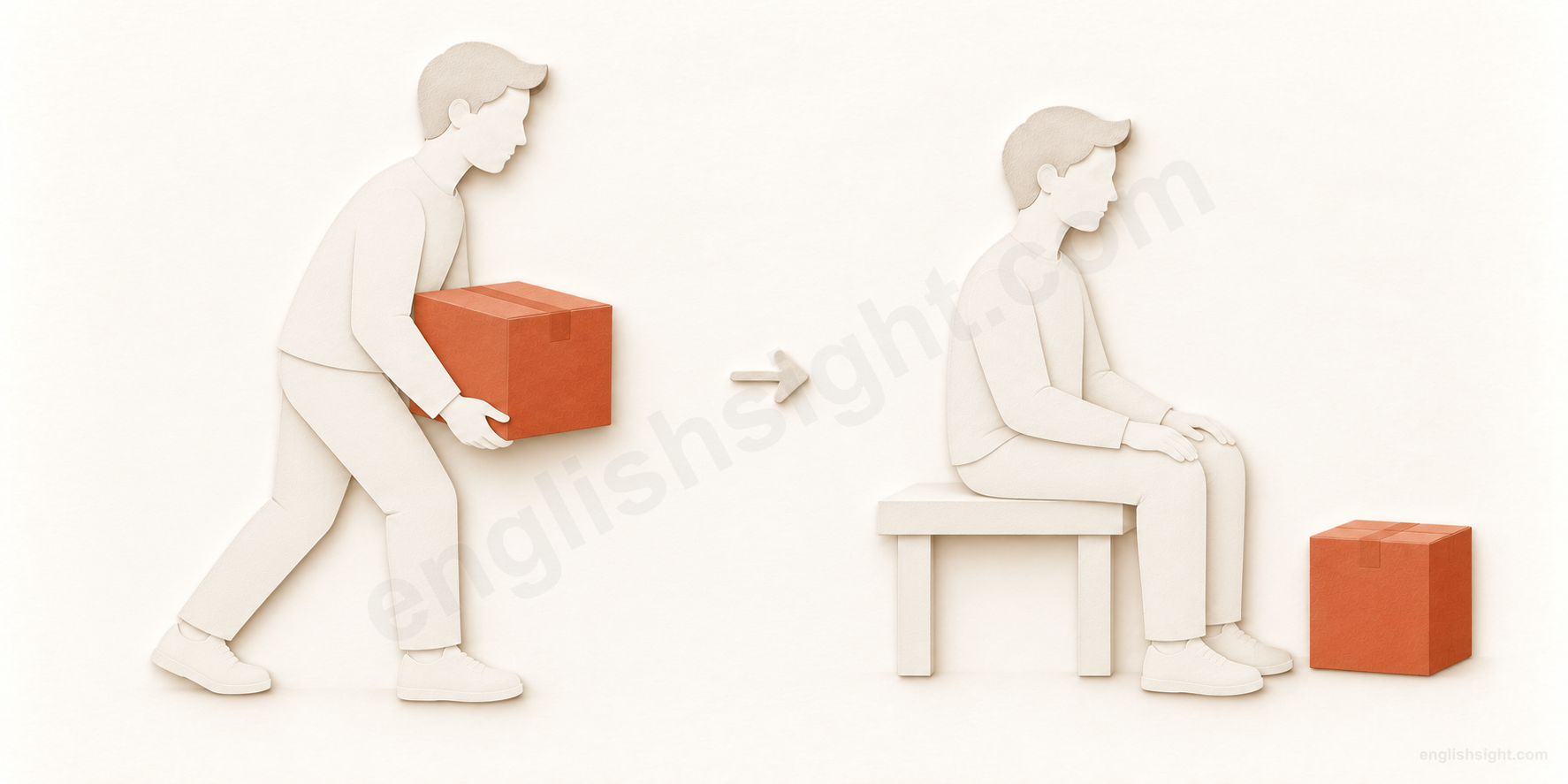
A person carries a box above the ground.
rest
The same person sits at ease; the box rests on the ground.
Put down the load and pause the effort.
The effort pauses: the person sits at ease, and the ground supports the box.
For recovery, someone pauses activity and spends time without that effort. Related uses describe a person or thing staying still or supported.
The picture follows one person who stops carrying a box and sits down. It illustrates a pause and physical support; the rest meaning a remainder is a separate branch, and the fixed expressions need their own explanations.
A person can rest without falling asleep; an object can rest on a surface without being alive. These uses connect with being free from active effort, staying still, or being supported. The construction tells you which relationship matters.
The rest of the cake is a different family: it means the portion that remains. This lesson keeps that branch distinct instead of forcing every use into a picture of relaxation.
01
Pause activity and recover
Rest can be an activity, a period without effort, or something you allow a body part or a player to have. It need not mean sleeping.
01
rest; rest for + duration; rest after + activity
rest for a while
spend time without active effort
Situation
You have been carrying boxes.
Meaning in context
You stop working and sit quietly.
Rest concerns relief from activity; sleep is possible but not required.
The person who rests is the subject. You can rest sitting up or lying down, awake or asleep. Rest for ten minutes measures the time; rest after work names the earlier activity.
I’m resting describes an activity in progress. I’m rested describes a refreshed condition. A break interrupts an activity; rest emphasizes time without exertion, so a busy shopping break may provide little rest.
In a sentence
Let’s rest for ten minutes before we carry the next box.
Watch the difference Rest already works as a verb: say I need to rest, without adding a before rest.
02
get / need some rest; have / take a rest; a rest from + noun / -ing
get some rest / take a rest
have time for relaxation or sleep
Situation
An early journey has left you tired.
Meaning in context
You have a quiet interval before going out.
Some rest treats rest as an amount; a rest treats it as one period.
Get some rest and need rest use an uncountable noun. Have a rest and take a rest present one interval. A good night’s rest often includes sleep; rest itself is broader.
Rest from work names what you pause. In We stopped for a rest, for gives the purpose. A rest day is a day without the usual training or work; it does not mean you must sleep all day.
In a sentence
We had a short rest from packing before lunch.
Watch the difference Choose a noun or a verb: I need a rest and I need to rest are both natural; I need to a rest is not.
03
rest + body part; let + body part + rest
rest your eyes / knee
avoid using a body part for a time
Situation
You have been looking at a screen.
Meaning in context
You give your eyes time away from that effort.
The object is the part receiving relief, not a place you visit.
Rest your eyes asks you to stop using them so intensely; rest an injured knee concerns avoiding strain on it. A following place phrase can change the interpretation: rest your head on a pillow means position it with support.
Rest yourself is possible, but the ordinary Rest for a while needs no reflexive object. Let your eyes rest uses let + object + the base verb.
In a sentence
I closed the laptop to rest my eyes.
Watch the difference Compare rest your eyes (give them a break) with your eyes rest on a photograph (look at it).
04
rest + player; player + be rested
rest a player
leave someone out of a game to give them a break
Situation
A player has played several matches.
Meaning in context
The coach does not select her for the next one.
A person can be the object when someone arranges their rest.
In sports reporting, the coach rests a player by keeping them out of a match temporarily. The passive The captain was rested focuses on the player receiving the break.
This does not mean the player has retired or has necessarily been dropped for poor performance. The sporting context supplies the selection decision.
In a sentence
The coach rested the captain for Saturday’s match.
Watch the difference A player was rested is passive; a player was resting describes what the player was doing.
05
rest up; rest up for + event
rest up
get a thorough rest
Situation
Tomorrow’s trip will be tiring.
Meaning in context
You spend the evening resting.
Up is part of a familiar expression for getting plenty of rest.
Rest up emphasizes resting thoroughly. It is informal and especially associated with American usage. Rest up for the trip gives the event you are preparing for.
It does not describe upward movement. This use has no direct object to move around: rest up tonight, rather than rest tonight up.
In a sentence
I’ll stay home tonight and rest up for tomorrow’s trip.
Watch the difference Rest up does not guarantee that someone will feel fully recovered afterward.
06
be on bed rest; put + person + on bed rest
bed rest
time spent resting in bed during recovery
Situation
A story describes someone recovering from an illness.
Meaning in context
The person spends the prescribed period in bed.
This compound names a recovery arrangement, not simply a good night’s sleep.
Bed rest is normally uncountable: on bed rest, not on a bed rest. In a report, The doctor put him on bed rest says that a doctor required this arrangement.
The phrase describes where someone rests. Whether a particular person needs it is a separate medical decision, not something the word itself tells us.
In a sentence
In the story, Ana was on bed rest for several days.
Watch the difference Do not confuse bed rest with bedtime, the usual time for going to bed.
07
rest + dough; let + dough + rest
rest the dough / let the dough rest
leave food undisturbed for a period in a recipe
Situation
You have finished kneading the dough.
Meaning in context
You leave it without further handling for the specified interval.
The pause belongs to food preparation; the dough is not feeling tired.
A recipe can tell you to rest the dough or let the dough rest. Both leave it undisturbed for an interval. In the first, dough is the object of rest; in the second, dough is the subject of the base verb after let.
The recipe supplies the duration and conditions. Rest names the interval without handling; rise names an increase in size. Those words do not give the same instruction, even when one recipe calls for both.
In a sentence
The recipe says to let the dough rest before rolling it out.
Watch the difference Use let the dough rest, without to after let. Do not read rest as a command to stop cooking for the day.
02
Stay still, supported, or directed at something
An object can rest on a surface; eyes can rest on a target. The subject and the words after rest tell you which relationship is intended.
08
rest + object + on / against / in + support; object + rest + place phrase
rest something on / against something
place something so that a surface supports it
Situation
You are holding a heavy picture frame.
Meaning in context
You lean it against a wall.
The object is positioned with support; it is not a person taking a break.
Rest the frame against the wall describes placing it there. The frame rests against the wall describes its supported position. Both an object and a body part can appear in this pattern.
On usually identifies a supporting surface below or in contact with it. Against identifies something it leans against. In can name a supporting enclosure: her head rested in her hands. These are ordinary spatial complements.
In a sentence
He rested the frame against the wall while he found a hook.
Watch the difference A frame resting against a wall does not mean the frame is tired. Keep the place phrase when it is needed to explain the support.
09
a + supporting-object noun; armrest / headrest / spoon rest
a spoon rest / an armrest
an object or part designed to support something
Situation
A used cooking spoon needs a place to sit.
Meaning in context
You put it on a small supporting dish.
A countable rest can name the support itself.
A spoon rest holds a spoon while you cook. An armrest is the supporting part of a seat for an arm; a headrest supports the head. These are names for objects or parts, not intervals of relaxation.
Compounds have established spellings: armrest and headrest are commonly one word; spoon rest is two. The noun before rest identifies what is supported.
In a sentence
The chair has an armrest on each side.
Watch the difference Two armrests are two chair parts, not two breaks from work.
10
be at rest; come to rest + place phrase
at rest / come to rest
be still, or finish moving
Situation
A ball rolls across a floor.
Meaning in context
It stops beside the door.
At rest names a state; come to rest names the arrival at that state.
A body at rest is not moving, especially in scientific descriptions. Came to rest says movement ended. The phrase often appears in descriptions of an object’s final position.
In The ball came to rest beside the door, beside the door tells you where it stopped. Come to rest does not have to mean moving toward the speaker, and to is followed by the noun rest here.
In a sentence
The ball rolled under the chair and came to rest beside the door.
Watch the difference Use came to rest for the stopping event; was at rest describes the state after it.
11
eyes / gaze + rest on / upon + person or thing; rest + eyes / gaze + on / upon + target
your eyes / gaze rest on…
look steadily at a particular target
Situation
You look around a room.
Meaning in context
Your attention settles on a photograph.
Eyes or gaze identify what is directed, and on introduces the target of looking.
Her eyes rested on the photograph means she looked at it. This is especially a written or narrative use. No physical weight is being supported by the photograph.
Compare She rested her eyes after reading, which means she gave them a break. The subject–object arrangement and the words that follow rest help distinguish the meanings.
A written narrative can also use the transitive pattern She rested her gaze on the photograph. Here she directs her gaze at it; she is not giving her eyes a break. The on phrase names the target of looking.
In a sentence
His gaze rested on the empty chair by the window.
Watch the difference This does not say he closed his eyes or slept. Upon is a more formal alternative to on.
12
a rest; a + duration + rest
a rest in music
a measured silence, or the sign for it
Situation
You are playing a line of music.
Meaning in context
For one marked interval, you do not play.
The silence belongs to the rhythm, rather than being a mistake or the end.
A rest can be the silence in a musical part or the written symbol instructing the performer to leave that silence. A two-beat rest has a specified duration.
Other performers may still be playing during your rest. The word does not require the whole piece to become silent. This specialized noun use connects helpfully with a pause, but has its own musical rules.
In a sentence
There is a two-beat rest before the final phrase.
Watch the difference Continue counting the rhythm during a rest; it does not mean to stop the musical timing.
03
Depend on something or hold responsibility
Abstract uses of support identify a foundation, a necessary condition, or the person responsible. On and with do different jobs.
13
argument / claim + rest on / upon + basis; rest + argument / case + on + basis
an argument rests on…
have something as a foundation
Situation
A claim needs support.
Meaning in context
A particular assumption supplies its basis.
On identifies the foundation of a claim, plan, or explanation.
An argument rests on an assumption when the argument uses it as a basis. This is an abstract support relationship; it does not say the assumption has been proved.
Rest upon has the same basic use with a more formal tone. On is followed by its complement: The claim rests on it. This is not a separable put-it-down type of particle construction.
A person can also rest an argument or case on particular evidence: We rest our case on the signed contract. This is the transitive pattern: a person is the subject, the argument is the object, and the on phrase gives its basis.
In a sentence
Her argument rests on the assumption that prices will stay low.
Watch the difference If the assumption is false, the argument may fail. Rest on does not certify the basis as true.
14
hope / success + rest on / upon + person / thing / clause; rest + hopes + on + person / thing
success / hopes rest on…
depend on a person, thing, or condition
Situation
A rescue depends on the weather improving.
Meaning in context
The weather is the crucial condition.
The on phrase identifies what the outcome depends on.
Our hopes rest on you places hope in your action or ability. The success of the event rests on good planning makes planning a condition for success. Neither is about relaxation.
This overlaps with the foundation use, but the focus is an outcome or reliance, rather than the structure of an argument. The complement can be a clause: it rests on whether help arrives in time.
The transitive pattern rest your hopes on something names the person placing their hope: We rested our hopes on the final interview. It highlights our reliance, rather than asserting that success was certain.
In a sentence
The success of the trip rests on everyone arriving on time.
Watch the difference Rest on names a dependency; it does not guarantee a successful outcome.
15
decision / responsibility + rest with + person; it rests with + person + to-infinitive
the decision rests with…
belong to someone’s authority or responsibility
Situation
Several people offer advice.
Meaning in context
One person has the authority to decide.
With identifies the responsible person or body.
The decision rests with the owner means the owner has the power or duty to decide. It rests with the owner to approve the plan expresses the responsibility with an infinitive. This wording is formal.
Compare Success rests on the owner’s support: that describes dependence. Responsibility rests with the owner assigns responsibility. Responsibility can also be described as resting on someone; the noun and context matter as well as the preposition.
In a sentence
The final decision rests with the owner.
Watch the difference With does not mean the owner is merely accompanying a decision. Keep the person after with: it rests with her, not it rests her.
04
Stop pursuing, worrying, or arguing
These familiar expressions connect rest with leaving something undisturbed. Learn their whole meaning, tone, and limits.
16
let + matter / subject / it + rest; the matter + rest (there / until + time)
let the matter rest
stop discussing or pursuing a matter
Situation
People keep reopening the same disagreement.
Meaning in context
You decide to take it no further.
The matter is left without further action; it need not be resolved.
Let the matter rest asks people to leave it alone. I won’t let it rest promises to keep pursuing it. The construction is let + object + the base form rest, without to.
The issue can remain unresolved even when you let it rest. This is different from proving an accusation false, which can lay it to rest. Compare the recipe instruction let the dough rest: that leaves food undisturbed, rather than ending a discussion.
The matter can also be the subject: There the matter rested until Monday means nobody discussed it or took further action until Monday. There refers to that stage of the discussion, rather than a physical resting place.
In a sentence
We still disagree, but let’s let the matter rest for tonight.
Watch the difference Let it rest does not necessarily mean admit that it was wrong or forget it forever.
17
give + activity / topic / it + a rest
give something a rest / Give it a rest!
stop an activity for a while, or tell someone to stop being annoying
Situation
You have spent all evening talking about scores.
Meaning in context
Someone wants the repeated discussion to stop.
The object names what should stop; the imperative can express irritation.
Give running a rest for a week means pause that activity. Give it a rest! often tells someone to stop repeating complaints, jokes, or another annoying action. The words a rest belong together as a noun phrase.
Tone matters: Give it a rest! can sound impatient. Could we give this topic a rest? is a softer request. Give your legs a rest is also possible, with the literal meaning of allowing them relief.
In a sentence
Could we give this topic a rest and talk about something else?
Watch the difference This is give + object + a rest, not a separable phrasal verb. Keep a: give it a rest.
18
lay / put + fear / doubt / rumour + to rest; be laid / put to rest
lay / put doubts or rumours to rest
end doubts or rumours by dealing with their cause
Situation
People think the shop may close.
Meaning in context
The signed renewal disproves the rumour.
Evidence settles the concern, rather than merely postponing discussion.
Lay a rumour to rest commonly means show it to be false so it no longer causes concern. Put the doubts to rest is similar: the doubts are answered or removed.
The past of lay is laid: the report laid the rumour to rest. A passive is natural: the doubts were finally laid to rest. This fixed expression does not mean the rumour is taking a nap.
In a sentence
The signed lease finally laid the rumours of closure to rest.
Watch the difference Let a matter rest means stop pursuing it; lay doubts to rest means settle or remove them.
19
put / set + person’s mind + at rest
put / set someone’s mind at rest
reassure someone so that they stop worrying
Situation
You worry that your booking has been lost.
Meaning in context
A confirmation shows that it is secure.
The person’s worry settles; their mind does not physically move.
Put my mind at rest and set my mind at rest describe reassurance. The information, an action, or a person providing it can be the subject.
The possessive identifies whose mind: set her mind at rest. It is a fixed expression, comparable in function to reassure her, and does not require sleep.
In a sentence
The confirmation email put my mind at rest about the booking.
Watch the difference Say my mind at rest, rather than my mind to rest in this expression.
20
can / cannot rest easy; will not rest until + clause
rest easy
feel able to stop worrying
Situation
You fear that a file has been lost.
Meaning in context
You learn that a backup exists.
Easy names freedom from worry in this established expression.
You can rest easy reassures the listener. I can’t rest easy while she is missing means I cannot stop worrying. Neither requires lying down.
Compare I won’t rest until I find it: the speaker promises not to stop trying. Can’t rest easy emphasizes anxiety; won’t rest until emphasizes continued determination.
In a sentence
You can rest easy: I saved a second copy of the file.
Watch the difference Keep easy in the familiar expression. Rest easily can instead describe the manner of physical rest.
21
rest assured + (that) clause; can / may rest assured
rest assured (that…)
be certain of the assurance being given
Situation
A customer worries about a refund.
Meaning in context
The speaker gives a firm assurance.
Assured is part of a fixed formula, not permission to sleep.
Rest assured that we will reply is a formal or emphatic assurance. You can rest assured and You may rest assured are also familiar forms. That introduces the proposition the listener is asked to trust.
The expression can emphasize determination as well as comfort: Rest assured, we will investigate every complaint. Its force comes from the full formula; rest does not freely combine with every adjective in this way.
In a sentence
Rest assured that we will send your refund today.
Watch the difference Assured describes the listener’s confidence here. Assure is the verb in I assure you, a different construction.
22
rest + possessive + case; the defence / prosecution rests
I rest my case.
say you have finished presenting your argument
Situation
Someone supplies evidence for your point.
Meaning in context
You say that no further argument is needed.
The speaker claims their point is made; the phrase does not prove it.
In conversation, I rest my case is often humorous or triumphant: that is enough to support my point. In court, a lawyer rests a case when they finish presenting it; that does not mean the court has decided who wins.
The defence rests is also used without an object in the legal setting. My case means my argument here, not a suitcase placed on the floor.
In a sentence
“You said this chair was weak, and now a leg has broken.” “I rest my case.”
Watch the difference Finishing a legal case presentation is different from winning the case.
23
rest on + possessive + laurels
rest on your laurels
stop making an effort because of past success
Situation
A team wins an award.
Meaning in context
It feels it has no need to improve.
The expression criticizes relying on achievement instead of continuing effort.
Laurels represents past achievement in this established idiom. Don’t rest on your laurels urges someone to keep working even after doing well.
This is usually disapproving. It is not a general criticism of taking a needed physical break. Change the possessive with the subject: she rests on her laurels; we rest on ours.
In a sentence
We won the award, but we can’t rest on our laurels.
Watch the difference The idiom needs laurels; rest on a chair has an ordinary physical support meaning.
24
lay + person + to rest; be laid to rest; may + person + rest in peace
be laid to rest / rest in peace
be buried, or receive a respectful wish after death
Situation
An obituary describes a funeral.
Meaning in context
The deceased person is buried.
These are respectful death-related expressions, not ordinary instructions to relax.
She was laid to rest means she was buried. A person can also be described as resting in a cemetery. May she rest in peace expresses respect and sympathy after her death; RIP is a familiar abbreviation.
At rest can be a gentle way to say someone is dead. The object changes the meaning of lay to rest: lay a person to rest concerns burial; lay a rumour to rest concerns disproving or ending it.
In a sentence
Her family laid her to rest near the village where she grew up.
Watch the difference Do not use Rest in peace as an ordinary good-night wish to a living person.
25
(there is) no rest / peace for the wicked
No rest for the wicked!
joke about having more work to do
Situation
You finish cleaning one room.
Meaning in context
Another task immediately needs attention.
The speaker humorously complains that there is no chance for a break.
This saying is often a lighthearted response to a busy day. Someone using it about themselves is not normally confessing to being a wicked person.
There’s no rest for the wicked and No peace for the wicked are variants. Tone and context make the humorous intention clear.
In a sentence
“The kitchen’s clean, but the laundry’s waiting.” “No rest for the wicked!”
Watch the difference Treat this as a saying; it is not a literal rule about who deserves sleep.
05
The part or people that remain
The rest belongs to a separate meaning family: everything outside the part already taken, used, or mentioned. No one has to be relaxing.
26
the rest of + specified noun phrase / pronoun; the rest; for the rest of + time
the rest (of something)
the part left outside a part already used or mentioned
Situation
You spend a small amount of your money.
Meaning in context
The unspent amount remains.
This is a remaining portion, separate from the relaxation family.
The rest of the money means the money remaining after the amount already spent, set aside, or mentioned. Use of before a specified whole: the rest of the cake, the rest of my life.
If the whole is understood, use the rest alone: I’ll save the rest. Time also forms a whole: for the rest of the day means during all the time still left today. It does not mean taking a break for the day.
In a sentence
I used some of the money for lunch and saved the rest.
Watch the difference Say the rest of the money, not the rest money. Rests is not the plural for remaining portions in this pattern.
27
the rest of + us / you / them; the rest + singular or plural verb according to referent
the rest of us / them
the other people or things in a known group
Situation
Two students leave early.
Meaning in context
The other students stay.
Rest refers back to a known group, rather than introducing additional people.
The rest of us includes the speaker among those remaining. The rest of them refers to others. Compare Two left; the rest stayed, where the group is understood without an of phrase.
Agreement follows what the remaining amount represents: The rest of the soup is cold, but The rest of the guests are outside. The singular form rest does not require a singular verb when it stands for plural people or things.
In a sentence
Two guests left early, but the rest of them are staying for dinner.
Watch the difference Rest has no -s here: the rest of them are, not the rests of them are.
28
list + and (all) the rest (of it); “And the rest!” as a reply about an amount
and (all) the rest (of it)
include the related things you have not listed
Situation
You name several things needed for a picnic.
Meaning in context
You refer generally to the other expected items.
The rest completes an understood category without an exact list.
Cups, plates, and all the rest of it refers loosely to the related equipment. This is conversational and assumes the listener can supply the general idea.
A separate informal reply, And the rest!, can mean that a quoted price or amount is much too low: “It must cost a hundred.” “And the rest!” The response claims it costs more; it is not simply continuing a shopping list.
In a sentence
We packed cups, plates, napkins, and all the rest of it.
Watch the difference This is deliberately vague. Give exact details when the listener needs a complete checklist.
29
describe an initial event + and the rest is history
the rest is history
leave out what followed because it is already well known
Situation
You describe the first meeting of a famous partnership.
Meaning in context
You leave the familiar later events unstated.
The rest is the remaining story, not spare time for the characters.
This formula lets a storyteller jump from an important beginning to a later outcome assumed to be familiar. A speaker may also use it playfully about their own life.
It does not mean that the story stopped at that point. History here presents the following events as known, so they do not need to be retold.
In a sentence
The two musicians met at a school concert, and the rest is history.
Watch the difference The phrase assumes a known or easily understood outcome; it does not supply the missing facts.
Read the whole pattern
Two families, with a real boundary
Rest meaning a pause or support and the rest meaning a remainder have different historical origins. Their present spellings coincide. The picture is a teaching model for the first family, not an explanation of every meaning.
Forms, objects, and passive sentences
The verb forms are rest, rests, rested, resting; rested has an extra syllable, /ˈrestɪd/. I am resting is a normal progressive. I feel rested describes a condition. Body parts, players, and supported objects can be direct objects, so context can permit a passive, such as The player was rested. A person who simply rests has no direct object to make passive.
Do not manufacture a new phrasal verb
Rest on and rest with have established abstract uses, but rest on a bench can simply be rest followed by a place phrase. Rest up is an intransitive expression. Give it a rest and lay something to rest are larger fixed constructions. Their grammar and meaning cannot be predicted just by replacing the final preposition.
A practical selection
This lesson covers ordinary recovery and support, the main abstract constructions, remainder expressions, and familiar idioms. It includes a brief musical sense and respectful death-related expressions for reading. It does not teach specialist snooker supports, medieval armour, poetic metre, or every compound and regional use.
Choose the meaning and construction
Look at the subject, the object, and the words that follow rest.
1. Mia sits quietly after a long walk, but she stays awake. Which statement fits?
2. Leo places his head on a cushion. What does the cushion do?
3. The owner has the authority to approve a plan. Which sentence says this directly?
4. You stop discussing a disagreement tonight, although it remains unresolved. Which expression fits?
5. Two guests leave. Choose the careful standard form for the remaining people.
6. A service representative says, “Rest assured that we will reply.” What are they doing?
7. In a courtroom report, “The defence rests” means which of these?
Sources and teaching notes
The sources below were read to check meanings, constructions, and usage labels. The explanations and examples are original. The visual connection is a teaching interpretation, and the coverage record identifies the sources for each use.
The picture illustrates a relationship; it does not claim that all English speakers share the same mental image.