Hear the connection between musical timing, recurring cycles, and a workable flow.
A pattern returns over time
A pattern returns over time
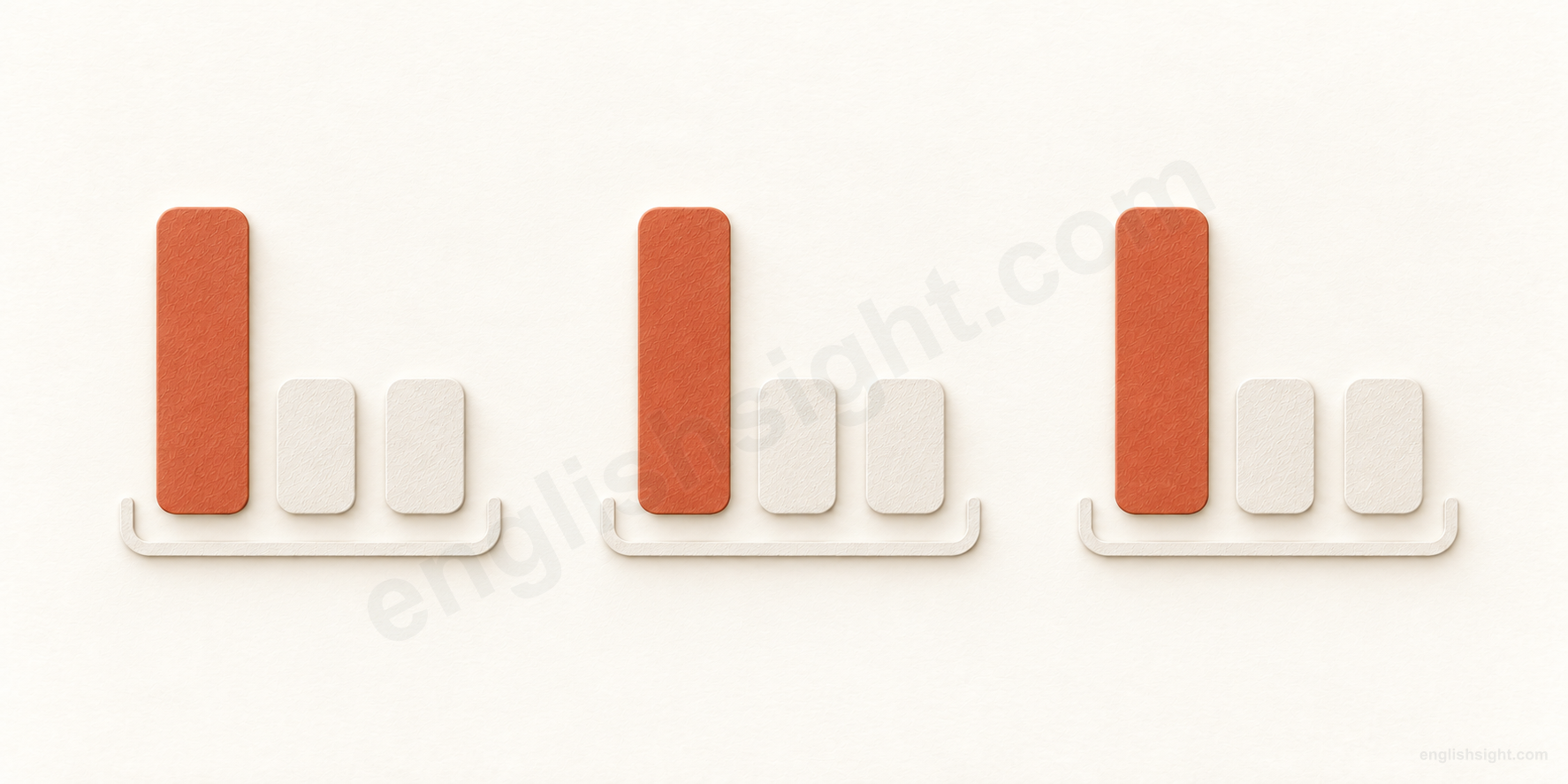
One stronger tap is followed by two weaker taps.
rhythm
Three successive groups repeat the strong–weak–weak pattern.
The same arrangement returns as time passes.
Read left to right through time: strong–weak–weak returns. Height represents emphasis, not pitch. This is one possible rhythm; other rhythms can have different groupings and uneven timing.
Rhythm is a recognizable pattern in how sounds, movements, or events unfold and recur.
The sketch represents one possible sound pattern. It shows recurrence rather than a change from a wrong state to a right one; not all rhythms are equally spaced or perfectly regular.
Rhythm draws attention to a pattern in how sounds, movements, or events unfold and recur. That pattern may be heard in drumming, felt in movement, or noticed across a day or year.
This is a teaching connection across common uses, not a claim that every English speaker pictures the word in the same way. Music names and familiar expressions still need to be learned in context.
01
Sounds, words, and movement
Hear a pattern, produce it, or coordinate movement with it. The grammar tells us which relationship you mean.
01
a / the + adjective + rhythm; different rhythms; rhythm of + noun
a steady rhythm
a recognizable pattern in sounds or movements
Situation / first part
You hear a strong tap followed by two softer taps.
Pattern / relationship
The same arrangement returns, so you recognize a pattern.
The timing and emphasis form the rhythm; the individual sounds are its parts.
Use rhythm for the way sounds or movements are arranged over time. A rhythm can be simple, complex, gentle, or forceful. A steady rhythm keeps a consistent pattern; a fast rhythm moves quickly.
A rhythm identifies one pattern: The two songs have different rhythms. Rhythm without an article can refer to the musical quality more generally: The exercise develops rhythm.
The sketch repeats one strong–weak–weak group. Real rhythms can include pauses and uneven spacing; they need not copy this particular group.
In a sentence
The train wheels made a steady rhythm as we crossed the bridge.
Watch the difference Rhythm is not a synonym for noise. Random sounds need not form a recognizable pattern.
02
tap / beat out + a rhythm; clap + a rhythm
tap out a rhythm
produce a rhythmic pattern by tapping
Situation / first part
A pattern is in your mind or in the music.
Pattern / relationship
Your fingers make that pattern audible.
The tapping produces the pattern; rhythm names what is produced.
Tap out a rhythm means make a series of taps with a particular timing. You can also clap a rhythm or beat out a rhythm on a drum.
Out belongs to tap out or beat out, not to a new meaning of the noun rhythm. Tap it out is possible when it refers to an already mentioned rhythm. Tap to the rhythm instead means follow an existing pattern.
In a sentence
Mina tapped out a rhythm on the empty box for us to copy.
Watch the difference Tap out a rhythm produces one; tap to the rhythm follows one. The whole construction makes the difference.
03
have + a good / natural sense of rhythm; have no sense of rhythm
a sense of rhythm
the ability to feel and follow musical timing
Situation / first part
A song gives you a timing pattern to follow.
Pattern / relationship
You can keep your claps or steps coordinated with it.
Sense names an ability here, rather than one particular rhythm.
A person with a good sense of rhythm can recognize timing and coordinate movements or playing with it. A natural sense of rhythm suggests that this comes easily to them.
Have no sense of rhythm is a familiar way to say someone struggles with musical timing. It is often a casual exaggeration, not a technical assessment of all their abilities.
In a sentence
Her sense of rhythm helps her learn new dance steps.
Watch the difference Use a sense of rhythm for the ability. A rhythm is the pattern, not the person’s skill.
04
dance / sway / move + to the rhythm of + music
dance to the rhythm
move in response to the timing of music
Situation / first part
Music supplies a pattern you can follow.
Pattern / relationship
You fit your dancing or swaying to that pattern.
To connects the movement to the musical timing it follows.
Dance to the rhythm of the music focuses on matching your movements to the sound. Sway to the rhythm and move to the rhythm work in the same way.
The phrase of the music identifies where this rhythm comes from. To here does not describe travel toward a destination: the music guides the timing.
In a sentence
We swayed to the rhythm of the song while waiting for the bus.
Watch the difference Dance to the music is also natural. The longer phrase highlights its timing rather than a different destination.
05
in rhythm (with + noun); out of rhythm (with + noun); keep the rhythm
in rhythm with
coordinated in timing with something else
Situation / first part
There are two streams of sound or movement.
Pattern / relationship
Their timing fits together.
With names the other sound or movement whose timing is matched.
Clap in rhythm means clap with coordinated timing. Add with to name what you follow: clap in rhythm with the drummer. The expression can also describe non-musical movement, such as a boat rising and falling with waves.
Out of rhythm means the timing fails to fit an expected pattern. He clapped out of rhythm with the group says his claps did not fit theirs; it does not mean he left the group.
Keep the rhythm means maintain the pattern. Keep in rhythm emphasizes staying coordinated. Neither expression requires every sound or movement to be equally strong.
In a sentence
The children clapped in rhythm with the drummer.
Watch the difference In rhythm describes coordination; in a slow rhythm describes the kind of pattern being produced.
06
the rhythm of speech / a poem / a sentence; speech rhythm
the rhythm of speech
the timing and emphasis that give spoken language its flow
Situation / first part
A sentence contains prominent syllables, less prominent ones, and pauses.
Pattern / relationship
Their arrangement gives the sentence a recognizable flow.
The pattern belongs to spoken timing, not to matching word endings.
Speech and poetry have rhythm through differences in stress, duration, and pauses. Read the line aloud to notice its rhythm means listen to how those features work together.
Rhyme is different: light and night rhyme because their endings sound alike. Rhythm concerns the flow of the line, so a poem can have rhythm without rhyme.
Ordinary speech is flexible. Calling it rhythmic does not mean that every stressed syllable must arrive at exactly equal intervals.
In a sentence
Reading the poem aloud helped me hear its rhythm.
Watch the difference Rhythm /ˈrɪðəm/ and rhyme /raɪm/ differ in both sound and meaning. Without rhyme or reason is an idiom with rhyme, not rhythm.
02
Names used in music
In these established names, rhythm helps identify a musical role or a style. Learn the whole expression.
07
the rhythm section; play rhythm guitar
rhythm section / rhythm guitar
musicians or playing that support the rhythmic foundation
Situation / first part
A band needs accompaniment beneath a tune or solo.
Pattern / relationship
Some players provide a steady rhythmic foundation.
Rhythm identifies a role in the band, not a special shape of instrument.
The rhythm section is the part of a band that supplies its rhythmic foundation. It typically includes drums and bass, with other instruments depending on the band.
Rhythm guitar means guitar playing based mainly on chords and rhythmic accompaniment, in contrast to lead guitar playing a prominent melodic line or solo. The same guitar can be used for either role.
These are noun combinations: section is the head in rhythm section and guitar is the head in rhythm guitar. Rhythm here remains a noun used before another noun.
In a sentence
Jo plays rhythm guitar while her brother plays the solo.
Watch the difference A rhythm section is a group or part of a band, not a section of a song. Rhythm guitar describes a musical role or style.
08
rhythm and blues; R&B; listen to + rhythm and blues
rhythm and blues
an established name for a kind of popular music
Situation / first part
You want to identify a musical style.
Pattern / relationship
You use the full genre name or its abbreviation.
The whole name identifies the genre; rhythm alone does not.
Rhythm and blues, often written R&B, is a music name. Learn it as a complete expression rather than treating it as any rhythm played alongside something sad.
It is normally uncountable in this use: listen to rhythm and blues. The lesson introduces recognition of the label, not the history or the full range of styles called R&B.
In a sentence
My aunt introduced me to rhythm and blues through her record collection.
Watch the difference Blues is part of the established genre name; do not change the expression to rhythm and blue.
03
Bodies, nature, and daily life
A rhythm can be a pattern of recurring activity even when there is no music and nothing makes a sound.
09
heart rhythm; the rhythm of + breathing / a heartbeat; a regular / irregular rhythm
heart rhythm / the rhythm of breathing
the recurring timing of a bodily movement
Situation / first part
The heart beats or the body breathes repeatedly.
Pattern / relationship
You describe how those movements recur.
The body supplies a recurring pattern without a musical performance.
Heart rhythm refers to the pattern of heartbeats; the rhythm of breathing refers to how breaths follow one another. These extend the sound-and-movement use directly to the body.
Regular and irregular describe how consistent a pattern is. An irregular heart rhythm is an established expression even though irregular rhythm may at first seem contradictory.
Rhythm describes the pattern. Rate describes how many beats or breaths occur in a period. They are related observations, but the words do not always convey the same information.
In a sentence
The recording captured the rhythm of his breathing as he slept.
Watch the difference This is vocabulary for describing patterns, not guidance for judging a person’s health.
10
body / biological / daily rhythms; a circadian rhythm
body rhythms / circadian rhythm
recurring cycles in how the body functions
Situation / first part
Some bodily activities rise and fall across a day.
Pattern / relationship
Their repeated timing can be described as a bodily cycle.
A cycle may unfold over hours; it need not be an audible beat.
Body rhythms and biological rhythms refer to repeated patterns in bodily functioning. A daily rhythm is one that recurs across days; circadian rhythm is a more technical term for a roughly twenty-four-hour biological cycle.
The plural rhythms lets us talk about multiple patterns rather than one pattern or the general quality of rhythm. This is a broader time scale than the rhythm of an individual breath.
In a sentence
The lecture explored daily rhythms in sleep and alertness.
Watch the difference Do not assume every body rhythm has the same period. The modifier, such as daily, specifies the time scale.
11
the rhythm of + the seasons / the tides; a seasonal rhythm
the rhythm of the seasons
the recurring pattern of natural changes
Situation / first part
Weather and seasonal activities change through a year.
Pattern / relationship
Similar phases return in later years.
Recurring changes create a pattern without producing musical notes.
The rhythm of the seasons describes the way seasonal changes return. The same idea can describe tides or other natural cycles.
Of identifies the changing system: the rhythm of the tides is their pattern of recurrence. The rhythm may be observed across months or years rather than seconds.
In a sentence
The village’s festivals follow the rhythm of the seasons.
Watch the difference One change is not by itself a seasonal rhythm. This expression draws attention to a recurring sequence.
12
the rhythm / rhythms of + life / daily life / village life
the rhythm of life
the characteristic flow of recurring daily activities
Situation / first part
Work, meals, rest, and social activities form recurring sequences.
Pattern / relationship
Together they give life in a place or household a characteristic flow.
Rhythm highlights recurring flow rather than only how fast life moves.
The rhythm of life can mean the regular flow of daily experience. The rhythms of village life allows for several patterns, such as workdays, weekends, and local gatherings.
A routine is a usual set of actions. Rhythm can describe the felt timing and flow of those actions more broadly; it need not be an exact timetable. Pace of life focuses more directly on speed.
In a sentence
After a month, we grew used to the quiet rhythms of village life.
Watch the difference This use can be figurative. No actual music is required, and a rhythm of life is not necessarily a written schedule.
04
Finding and interrupting a workable flow
In work and sport, rhythm often describes a way of acting that becomes regular and feels coordinated.
13
get / settle / fall into + a rhythm; find + your / one’s rhythm
get into a rhythm / find your rhythm
establish a regular, workable way of doing something
Situation / first part
A task or repeated movement feels awkward or uneven.
Pattern / relationship
You establish timing and a flow you can maintain.
Into contributes entry into a pattern; find contributes reaching a workable flow.
Get into a rhythm, settle into a rhythm, and fall into a rhythm describe activity becoming regular. They can be used for studying, cleaning, exercising, or working together. They do not refer to entering a physical place.
Find your rhythm is common when someone’s timing starts to work well, especially in sport or performance. The possessive your links the flow to you; it does not mean that you own a tune.
These are ordinary verbs combined with noun phrases or prepositional phrases, not phrasal verbs formed from rhythm. Into a rhythm names the state you move into.
In a sentence
By the third lap, I had found my rhythm and stopped rushing each stroke.
Watch the difference Find your rhythm means achieve a workable flow; it does not necessarily mean discover the rhythm of some music.
14
break / disrupt + someone’s rhythm; lose + your rhythm; get back into + a rhythm
break / lose your rhythm
interrupt or stop maintaining a regular flow
Situation / first part
Your movements or work follow a regular pattern.
Pattern / relationship
An interruption makes that flow uneven or difficult to maintain.
Break and disrupt name an interruption; lose describes no longer maintaining the flow.
A noise or interruption can break your rhythm or disrupt your rhythm. You can also lose your rhythm when you stop coordinating repeated movements comfortably.
The noun keeps its pattern meaning; the verbs explain what happens to the pattern. Get back into a rhythm means establish a regular flow again after an interruption.
This need not mean losing a skill permanently. A runner who loses her rhythm may simply need time to recover her usual timing.
In a sentence
Each phone alert broke my rhythm while I was typing.
Watch the difference Break your rhythm is figurative: nothing physical has to snap. The problem is interruption of timing or flow.
Choose the pattern, then check the grammar
Rhythm, beat, and tempo
For practical music discussion, think of the beat as the underlying pulse, rhythm as the arrangement of sounds and silences, and tempo as the speed. The words can overlap in ordinary use. A familiar rhythm can be played faster or slower without becoming a completely different arrangement.
Countable and uncountable
Use a rhythm for one pattern and rhythms for different or multiple patterns. Use uncountable rhythm for the general musical quality or ability, as in a sense of rhythm. The usual plural is rhythms; rhythm is a noun in the uses taught here.
Words around the noun contribute meaning
Steady describes consistency; fast describes speed. In rhythm with expresses coordination; get into a rhythm expresses establishing a flow. These meanings belong to the whole combination, not to hidden new meanings inside rhythm.
Spelling and related forms
Rhythm /ˈrɪðəm/ has two syllables and is different from rhyme /raɪm/. Rhythmic is an adjective and rhythmically is an adverb: rhythmic movement, moving rhythmically. Verb tense, passive, and causative paradigms do not apply to this noun.
Scope of the lesson
Art critics also use rhythm for recurring visual elements or the flow of a film or story. This lesson notes that extension but does not teach specialist art analysis, poetic metre, clinical rhythm classifications, the rhythm method, or the history of music genres.
Notice what the pattern does
Use the situation and the whole expression to choose an answer.
1. A drummer repeats the same arrangement of taps more quickly. Which word most directly names the change in speed?
2. Your claps fit the drummer’s timing. Which description matches?
3. After a hesitant start, your packing becomes steady and easy to maintain. What has happened?
4. A poem has a clear pattern of stresses and pauses, but its line endings do not sound alike. Which statement can still be true?
5. A farming village repeats a sequence of festivals through each year. What does the rhythm of the seasons highlight?
Sources and teaching notes
The sources below support the senses, grammar, and established expressions. Explanations and examples are original. The repeated pattern is a teaching model, not a claim about a universal mental picture.
The sketch illustrates one rhythmic pattern; it does not represent every possible rhythm.