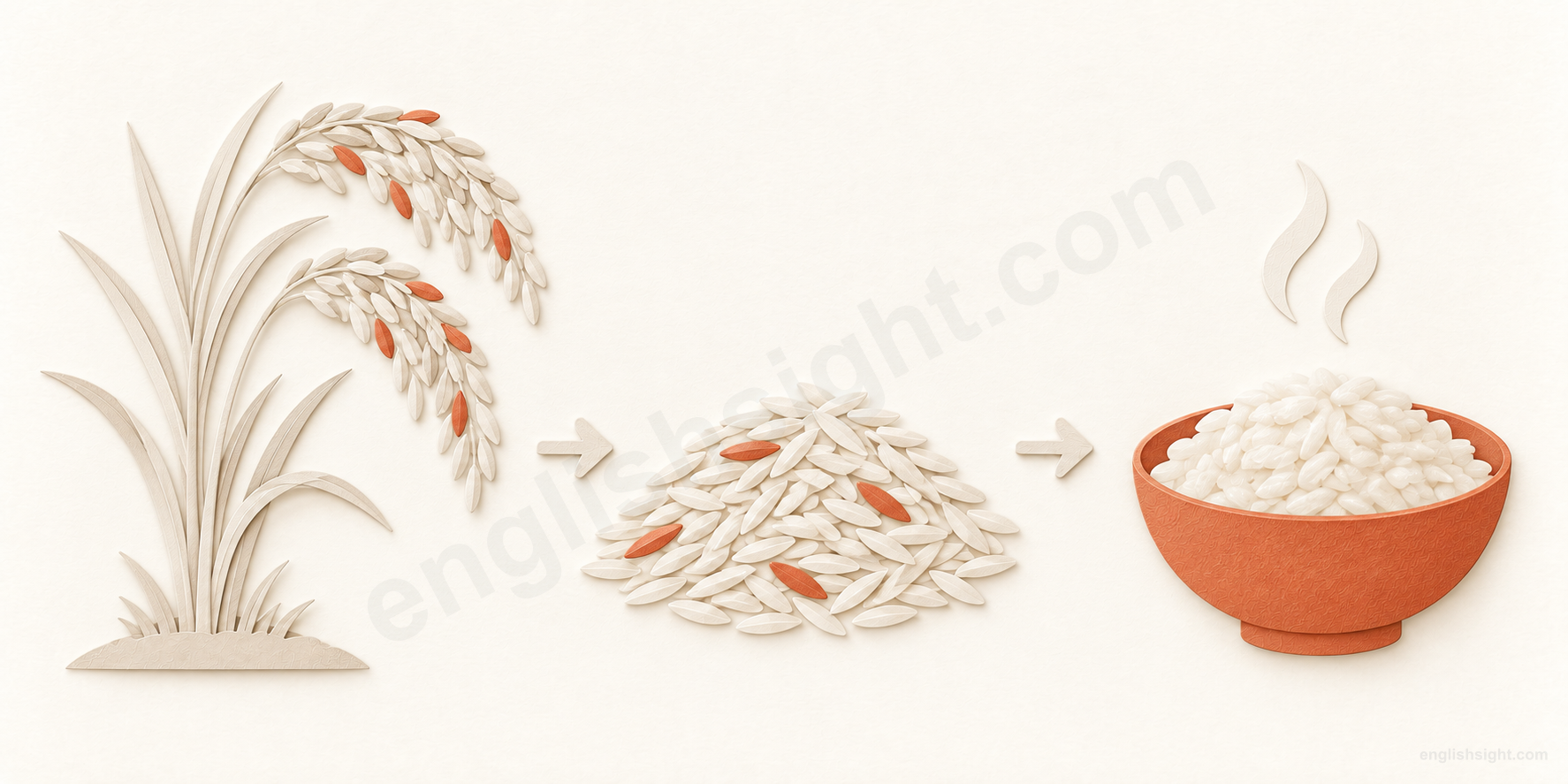
Use rice for the food and its crop; add words for amounts, kinds, and preparation.
The crop, its grain, and the cooked food
The crop, its grain, and the cooked food
Rice grows as a crop with grain-bearing heads.
rice
Cooked rice is ready to eat in a bowl.
The grains are harvested, then cooked.
The crop, uncooked grains, and cooked food can all be called rice.
Rice names the grain used as food, whether uncooked or cooked, and the plant grown for that grain.
Harvesting and cooking connect the pictured stages. The noun rice names the crop or food; it does not itself mean harvest or cook. The verb rice is a separate culinary use based on grain-like form.
Rice /raɪs/ usually names a food made up of many small grains. English uses the same word before and after cooking, and also for the plant grown to produce those grains.
The connections here are a learning aid. Compounds and the cooking verb need their own explanations; one picture cannot predict every expression.
01
Food, amounts, and kinds
Name the food first, then use another word to specify a quantity or kind.
01
some / more / a little rice; rice + singular verb
some rice
the grain as food, cooked or uncooked
Situation
You are choosing food for dinner.
What you mean
You put rice on the shopping list.
Rice names a food substance, not just one grain or one bowl.
In ordinary food talk, rice is uncountable. Use some rice, more rice, or a little rice. Rice is ready uses singular agreement even though many individual grains are present.
The same word can refer to dry grains in a packet or cooked food on a plate. Context or words such as uncooked and cooked tell you which state is intended.
In a sentence
We have some rice, but we need vegetables.
Watch the difference For an ordinary amount of food, say some rice, not a rice or many rices.
02
a grain / bowl / bag / cup of rice; two grains / bowls of rice
a grain / bowl of rice
count individual grains or measured portions
Situation
You need to say how much rice there is.
What you mean
You name the unit and its quantity.
The unit word carries the count: grain, bowl, bag, or cup.
A grain of rice means one small seed; two grains of rice means two seeds. A bowl of rice means a portion held in a bowl, not one seed.
Use two bowls of rice or a bag of rice when the container is your unit. How much rice? asks about the amount; How many bowls of rice? asks for a count of bowls. A cup of rice may be a recipe measure; the recipe must specify whether it is cooked or uncooked.
In a sentence
Please bring two bowls of rice to the table.
Watch the difference Pluralize the unit: two bowls of rice, not two bowl of rices.
03
brown / white / long-grain / short-grain / basmati / sticky rice; kinds of rice
brown / white / long-grain rice
specify processing or grain characteristics
Situation
Several rice packets are on the shelf.
What you mean
You choose a particular kind.
A modifier narrows the kind; rice still names the food.
Brown rice retains more of the grain’s outer layers than white rice. Brown here identifies a kind of rice, not simply a cooked dish with brown sauce.
Long-grain and short-grain describe grain length. Basmati names a kind; sticky rice names rice associated with a sticky cooked texture. These labels distinguish products rather than creating unrelated senses of rice.
Ordinary conversation usually says different kinds of rice. The plural rices is possible when discussing varieties, for example in a specialist comparison; it does not mean a few individual grains.
In a sentence
This shop sells three kinds of rice, including brown rice.
Watch the difference Use grains for individual seeds and kinds of rice for varieties.
02
Cooking, serving, and dishes
Verbs describe preparation; prepositions show how rice fits into a meal. Dish names add their own information.
The verb supplies the action; rice names what is being prepared.
Cook rice is a general expression. Boil rice and steam rice specify methods; boiled rice and steamed rice describe the resulting food.
Cook can also have the food as its subject: The rice is cooking. The rice is cooked can describe its ready state or, in context, a passive action. You do not need a new meaning of rice to understand these patterns.
In a sentence
The rice is cooking while I chop the carrots.
Watch the difference Say cook rice to prepare the grain. The verb rice has a different use.
05
serve something with / over rice; have rice for + meal
serve with / over rice
describe rice as part of a meal
Situation
You have a curry and cooked rice.
What you mean
You combine them for serving.
With names an accompaniment; over places food on top.
Serve the curry with rice treats rice as an accompanying food. Serve the curry over rice places the curry on top of the rice. The preposition contributes that relationship.
Have rice for lunch and eat rice name what someone eats. Rice with vegetables may describe a combined dish; the phrase alone does not specify a recipe or cooking method.
In a sentence
We served the bean stew over rice.
Watch the difference With does not necessarily mean on top of; over is more specific about placement.
06
fried rice; egg / vegetable fried rice
fried rice
a dish of cooked rice fried with other ingredients
Situation
There is cooked rice to use in a dish.
What you mean
It is fried in a pan with other ingredients.
The name identifies a preparation, not a new grain.
Fried rice is cooked rice that is then fried, often with vegetables, egg, or meat. Egg fried rice and vegetable fried rice identify ingredients added to that dish.
For a normal food amount, use some fried rice or a portion of fried rice. The dish name does not tell you that every version contains egg or meat.
In a sentence
I ordered vegetable fried rice and a small soup.
Watch the difference Do not assume fried rice means dry, uncooked grains put straight into a frying pan.
07
some rice pudding; a rice pudding
rice pudding
a sweet dish made by cooking rice with milk and sugar
Situation
You are choosing a dessert.
What you mean
You choose a rice-based sweet dish.
Pudding identifies the dish; rice identifies a main ingredient.
Rice pudding is a dessert, not another name for plain rice served with a meal. Its familiar preparation combines rice, milk, and sugar.
You can say some rice pudding for an amount. A rice pudding can refer to an individual pudding or a whole prepared one, depending on context. Countability belongs to the full expression, so it need not follow the ordinary mass-noun use of rice alone.
In a sentence
We shared some rice pudding after dinner.
Watch the difference The word rice alone does not imply a sweet dish; pudding supplies that information.
03
Crops, products, and a cooking verb
Rice can name the growing crop or modify another noun. As a verb, it describes a different kind of preparation.
08
grow / harvest rice; a rice plant / field / paddy; rice production
grow rice; a rice field
the plant or crop that produces the grain
Situation
A farmer chooses a crop to plant.
What you mean
Rice grows in the field.
The crop and its edible grain share the name rice.
Grow rice usually concerns cultivating the crop, not making a bowl of food larger. A rice plant is an individual plant; rice can name the crop collectively.
A rice field and a rice paddy name land used for growing rice. Rice farmer and rice production concern agriculture. Rice is the modifier in these combinations; the final noun tells you whether you mean a person, a place, or an activity.
In a sentence
The farmers grow rice near the river.
Watch the difference In grow rice, grow describes cultivation. To describe meal preparation, use cook rice.
09
rice + product noun: rice flour / noodles / cakes
rice flour / rice noodles / rice cakes
products whose ingredient is rice
Situation
Rice is used to make another food.
What you mean
The finished product has its own name and form.
Rice tells you the ingredient; the final noun names the product.
Rice flour is flour made from rice. Rice noodles are noodles made using rice flour; the plural noodles is usual when talking about a serving. Rice cakes name rice-based cakes or snacks, whose form depends on the product and cuisine.
The final noun governs the grammar: some rice flour, some rice noodles, two rice cakes. These products need not look like loose rice grains. Learn each product name as a combination rather than treating rice as a verb.
In a sentence
We bought rice noodles for the soup.
Watch the difference Rice noodles are not a bowl of ordinary rice with noodles added; rice describes the noodle ingredient.
10
a rice cooker; cook rice in a rice cooker
a rice cooker
an electric pot designed for cooking rice
Situation
You want to cook rice in an appliance.
What you mean
You put it in a rice cooker.
Cooker names the device; rice identifies its intended task.
A rice cooker is an electric cooking pot. It is an object, so a rice cooker and two rice cookers are normal countable expressions.
Compare rice noodles, made using rice, with a rice cooker, used for cooking rice. The relationship in rice + noun comes from the whole combination; rice does not always mean made of rice.
In a sentence
Our rice cooker is on the kitchen counter.
Watch the difference A rice cooker is a device, not a person who cooks rice.
11
rice + food; riced / ricing; riced cauliflower
rice potatoes; riced cauliflower
process another food into small rice-like pieces
Situation
The ingredient is a different vegetable.
What you mean
It is processed into small pieces or particles.
The verb describes a rice-like form; it does not turn the vegetable into the grain.
To rice food is to process it into small pieces resembling rice. Ricing cooked potatoes can involve pressing them through a ricer. Riced cauliflower is cauliflower processed into grain-like pieces.
This culinary verb takes an object: rice the potatoes. Its forms are rices, riced, and ricing. The potatoes were riced is passive. This branch depends on resemblance to grains, whereas cook rice means preparing actual rice.
In a sentence
Rice the cooked potatoes before adding the butter.
Watch the difference Riced cauliflower is still cauliflower; the name describes its form rather than its botanical identity.
Keep the word and the combination distinct
Uncountable does not mean impossible to count
Individual grains are countable, but ordinary rice is a mass noun. Choose a unit when counting portions or seeds. Rices can refer to varieties in a suitable context.
Read the final noun
Rice flour names a material, rice noodles name a product, and a rice cooker names equipment. These combinations do not all have the same grammar or ingredient relationship.
Scope of this lesson
This lesson covers the modern food and crop noun, useful combinations, and the culinary verb. It does not present a full catalogue of rice dishes, agricultural terminology, regional expressions, names, or the uppercase abbreviation RICE.
Choose the right meaning and form
Read the situation and choose the expression that fits.
1. You can see exactly three individual seeds on the counter. Which phrase counts those seeds?
2. You want to describe preparing actual rice for dinner. Which instruction fits?
3. Which expression names an appliance rather than a food?
4. A recipe calls for riced cauliflower. What should you understand?
5. A shop stocks basmati, brown rice, and another variety. Which wording clearly describes its range?
Sources and teaching notes
Definitions and usage were checked against the sources below. Explanations, example sentences, and the diagram were written for this lesson; the visual connection is a teaching interpretation.
The diagram connects uses of the word; it is a teaching aid, not a shared mental picture.