Understand the watercourse, use it to describe places and journeys, and recognize its figurative extensions.
Flowing water within a natural course
Flowing water within a natural course
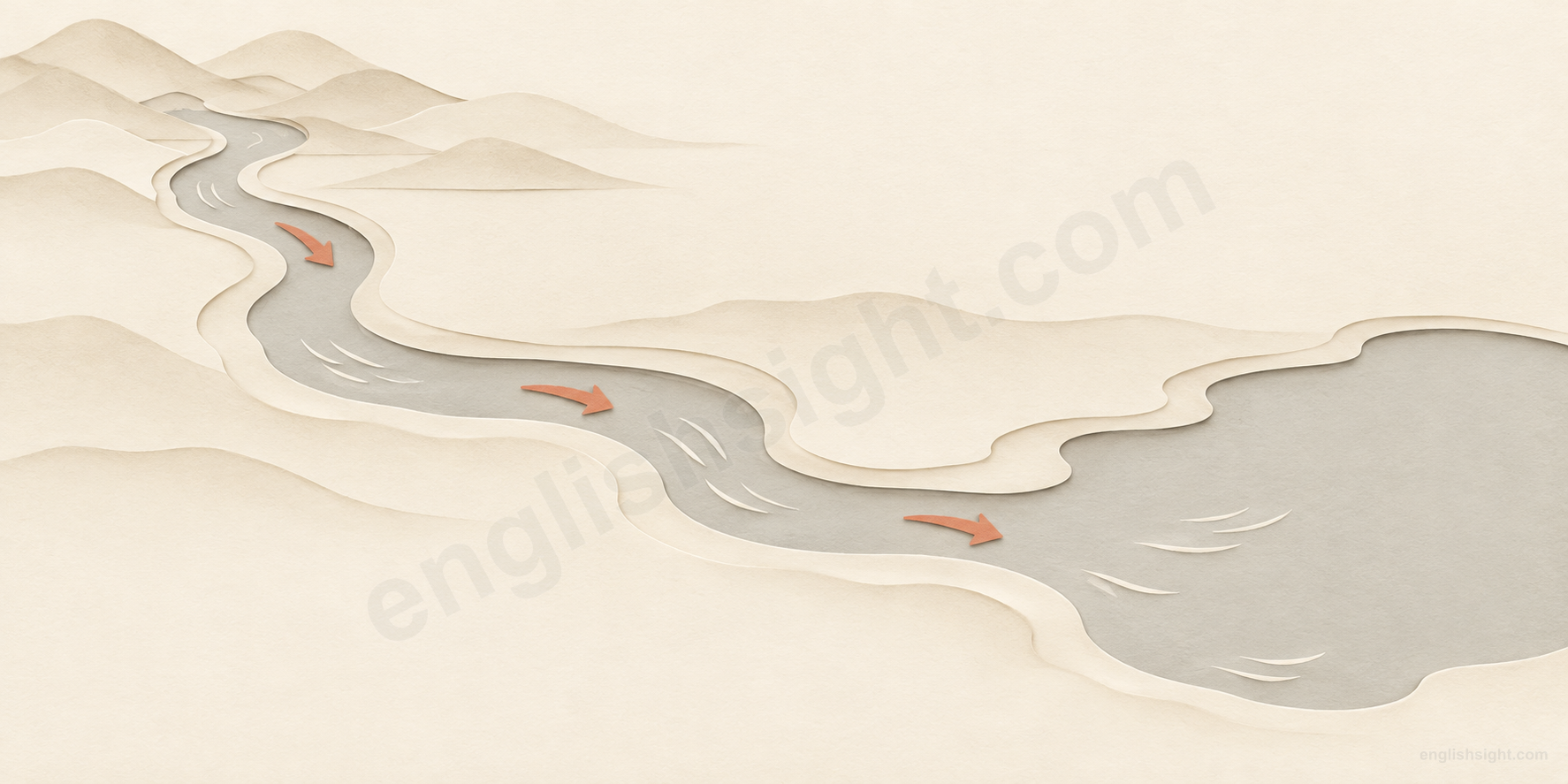
Water is farther upstream among the low hills.
river
Farther downstream, the river joins a broader body of water.
Water flows along the winding course between the banks.
Water follows the natural course downstream between the banks.
A river carries flowing water along a natural course across land toward other water.
The winding course is a teaching model. It helps with direction and large-flow comparisons; it does not predict the meanings of fixed idioms.
A river is a natural watercourse: its water flows across land and can join another river, a lake, or the sea. The course gives us a reference for banks, crossings, and upstream or downstream movement.
River is mainly a noun in this lesson. Prepositions and neighboring words supply much of the meaning in walk along the river or river traffic. Fixed idioms need separate explanations.
01
The watercourse and its parts
Name a river, describe its course, and recognize words for the land and water associated with it.
01
a / the + river; plural rivers
a river / rivers
a natural watercourse carrying flowing water across land
Situation / starting point
You see moving water following a long course through the countryside.
Meaning / result
You identify the whole watercourse as a river.
River names the watercourse; flow describes what its water does.
River is a countable noun: a river, the river, two rivers. Water is usually uncountable: some water. A river is more than an individual drop or a puddle.
In ordinary descriptions, a river carries water through a natural channel. It can join another river or enter a lake or the sea. Do not make reaching the sea directly a requirement.
River often suggests a larger watercourse than stream or brook, but these names are not a precise size measurement. A canal is a channel built or adapted for a purpose; a lake is a body of water rather than a long flowing watercourse.
In a sentence
Two rivers meet just outside our town.
Watch the difference Say a river, not a water, when you mean one countable watercourse.
02
the River + name; the + name + River; the + river name
the River Thames / the Hudson River
use river as part of a geographical name
Situation / starting point
A map gives a river its own name.
Meaning / result
You refer to that particular river in a sentence.
A proper name identifies which river; it does not remove the usual article.
River can appear before or after a name. River Thames illustrates a familiar British pattern; Hudson River illustrates a familiar American pattern. Established names vary, so follow the form used for that river.
In ordinary sentences, river names normally take the: the Thames, the Hudson River. Capitalize River when it is part of the name, but use lowercase in a general description such as a wide river. Map labels and headings may omit the article.
In a sentence
Our hotel overlooks the Hudson River.
Watch the difference Do not turn the naming tendency into a rule that every British name must put River first.
03
the bank / bed / source / mouth of a river; a bend in the river
the river’s banks, bed, source, and mouth
name the sides, bottom, beginning, and outlet
Situation / starting point
You follow a river from its beginning to the place where it joins other water.
Meaning / result
You can name distinct parts instead of calling everything the river.
The bank is beside the water; the bed is underneath its usual course.
A riverbank, or river bank, is the ground along a side. The riverbed, also written river bed, is the ground the river flows over. A dry riverbed can remain when the water has gone.
The source is where the river begins. Its mouth is where it empties into another body of water. A bend is a curve in its course. These words describe different relationships to the same watercourse; mouth and bed are established geographical uses, not a real face or a sleeping place.
In a sentence
We sat on the riverbank above the stony riverbed.
Watch the difference The riverbank is not the riverbed: sitting on the bank need not put you in the water.
04
a river flows / runs through + place; flows into + water body; rises in + place
a river flows through / into…
describe its course and destination
Situation / starting point
You trace the watercourse on a map.
Meaning / result
You say which places it passes through and what it enters.
The river is the subject; the following verb and preposition describe its course.
Flow through a town places the town along the course. Flow into a lake identifies the receiving body of water. Run through is also natural; it does not mean the river has legs.
A river rises in a place when it begins there. This differs from its water level rising after rain. The sketch’s bends show a possible course, not a claim that every river follows that exact shape.
In a sentence
The river runs through the village and flows into a lake.
Watch the difference Into marks the destination; through marks the place traversed.
05
river + noun: river water / traffic / valley / basin / delta
river water / a river valley
use river before another noun to specify its connection
Situation / starting point
You need to describe water, transport, or land associated with a river.
Meaning / result
River identifies what kind of water, transport, or landscape you mean.
In river water, water is the main noun and river specifies its source.
River water is water from a river; river traffic is boats moving on it. River remains a noun used before another noun. Compare two rivers with two river boats: the boats, rather than the rivers, are being counted.
A river valley is the long area of lower land through which a river runs. A river basin is the area drained by a river and its branches. A river delta is a deposit of land, often with branching channels, near a river’s mouth. These geographical terms need their own meanings; river alone does not tell you what valley, basin, or delta means.
In a sentence
The river valley is dotted with small farms.
Watch the difference Not every river has a delta; the compound does not describe a necessary feature of every river.
02
Where things are and how they move
Prepositions distinguish a place beside the river, movement along it, crossing it, and travel with or against the flow.
06
in the river; on the river; by / beside the river
in / on / by the river
distinguish water, surface activity, and a nearby location
Situation / starting point
You describe a swimmer, a boat, and a café.
Meaning / result
The preposition makes their different positions clear.
The same river can be a body of water, a surface for boats, or a landmark.
In the river places something within the water: a swimmer or a lost key. A boat on the river is supported on its surface. These meanings come from the prepositions, not separate meanings built into river.
By or beside the river locates something nearby. A house or café on the river usually means at its edge, not floating: the subject and situation guide the reading. For an unambiguous meeting place, say by the river or on the riverbank.
In a sentence
We ate at a café by the river and watched boats on the water.
Watch the difference Do not assume a house on the river is a houseboat.
07
walk / cycle / travel along the river; follow the river
walk along the river
follow its length rather than cross its width
Situation / starting point
Your path stays beside the water as it bends.
Meaning / result
You make progress following the river’s course.
Along gives a lengthwise route; it does not specify which way the water flows.
Walk along the river commonly means walk on a path beside it. A boat can travel along the river on the water. The verb and context tell you where the traveler is.
Compare cross the river: that moves from one bank toward the other. Follow the river is useful in directions when the river provides the route’s reference line.
In a sentence
Cycle along the river until you reach the old mill.
Watch the difference Along does not automatically mean downstream.
08
cross the river; get / go across the river; a bridge across / over the river
cross / get across the river
reach the opposite side
Situation / starting point
You are on one bank and need to reach the other.
Meaning / result
You arrive on the opposite bank using a bridge or boat.
Across concerns the width; along concerns the length.
Cross is a verb and can take the river directly as its object. Across is a preposition or adverb: get across the river, a bridge across the river. Do not add across after cross in the simple pattern cross the river.
A bridge over the river emphasizes its position above the water; a bridge across the river emphasizes its span between sides. Both can describe the same bridge. A ferry can take you across without going above the water.
In a sentence
The ferry took us across the river to the market.
Watch the difference Use cross the river or go across the river, not cross across the river.
09
go / sail up / down the river; upstream / downstream of + landmark
up / down the river
move toward its source or in its usual flow direction
Situation / starting point
You know which way the river’s water normally flows.
Meaning / result
You can describe movement with or against that direction.
Downriver follows the flow; upriver goes toward the source.
Travel down the river means travel downstream; travel up the river means travel upstream. The direction belongs to the river’s course, not the top or bottom of your map.
Downstream and downriver can stand alone: The boat drifted downstream. Upstream and upriver name the opposite direction. A place upstream of the bridge lies farther toward the source; it need not be north of it.
Ordinary sailing up the river is literal. The prison expression in the last section is a separate established use.
In a sentence
The current carried the empty boat down the river.
Watch the difference Up the river does not necessarily mean north, and down does not necessarily mean south.
10
the river rises / falls / dries up; overflows / bursts its banks; a high / deep / wide river
the river rises / overflows its banks
describe a change in water level or flooding
Situation / starting point
Heavy rain adds water to the river.
Meaning / result
The level rises and may reach beyond the usual banks.
Rising water level is a change over time, not the river’s geographical source.
The river is high describes its present level. The river is rising describes a level increasing now. If it overflows its banks, water spreads beyond the channel; it can also be described as bursting its banks.
A wide river concerns distance from side to side; a deep river concerns distance below the surface. A swollen river has more water than usual. A river can dry up and leave its bed visible. Read these words separately rather than treating every description as a new sense of river.
In a sentence
After two days of rain, the river overflowed its banks.
Watch the difference The river rises in the hills gives its source; the river is rising reports increasing water level.
03
Large flows and established idioms
The large-flow image extends to other substances and exaggerated quantities. Betrayal and prison expressions must be learned as whole idioms.
11
a river of + substance
a river of mud / lava
compare a large moving mass with a river
Situation / starting point
A broad mass of mud moves down a slope.
Meaning / result
You describe its flowing shape and scale using river.
Of names the material; the image of a large flow is retained.
A river of mud is not an ordinary watercourse filled with clean water. The noun transfers the idea of an extensive moving flow to another substance.
Compare mud in the river: that identifies material inside an actual river. A river of mud presents the mud itself as the river-like flow. Context decides whether the expression is a close physical comparison or vivid descriptive language.
In a sentence
A river of mud swept across the road after the storm.
Watch the difference Do not interpret every river of… expression as the name of a geographical river.
12
a river of / rivers of + noun
rivers of tears / coffee
use the flowing-water image for an exceptionally large quantity
Situation / starting point
Someone wants to emphasize the amount of crying or drinking.
Meaning / result
Rivers makes the description vivid and exaggerated.
The plural can emphasize abundance even without one continuous physical channel.
Rivers of tears emphasizes extensive crying. Rivers of coffee can humorously suggest an enormous amount of coffee consumed. Such expressions are expressive exaggeration, not measured quantities.
This connects to the large-flow image, but the whole context carries the exaggeration. A river of tears is possible too; the plural often strengthens the sense of abundance. Rivers of words can suggest an overwhelming outpouring of speech or writing, without any liquid. For a neutral factual report, use a lot of or give an actual amount.
In a sentence
The night-shift crew joked that rivers of coffee kept them awake.
Watch the difference This vivid wording is less neutral than saying how many cups you drank.
13
sell + someone + down the river; be sold down the river
sell someone down the river
betray someone who trusted you
Situation / starting point
A colleague trusts you to support her.
Meaning / result
You act against her interests to protect your own position.
The established idiom expresses betrayal; no boat journey or sale is required.
Sell someone down the river is informal and accusatory. The person after sell is the one betrayed. It often concerns abandoning promised help or sacrificing someone’s interests for an advantage.
The expression has a history connected with the sale of enslaved people to plantations farther down the Mississippi. Learn its modern meaning as an idiom rather than deriving it from an ordinary river journey. Betray is a direct alternative.
In a sentence
Maya felt sold down the river when her partner blamed her for their shared mistake.
Watch the difference Keep the person after sell: sell her down the river. The idiom is stronger than simply disagree with her.
14
send + someone + up the river; be up the river
send someone up the river
send someone to prison in US slang
Situation / starting point
A crime story reports a prison sentence.
Meaning / result
A speaker uses an informal idiom instead of naming the prison directly.
Context distinguishes the prison idiom from ordinary upstream travel.
In US slang, send someone up the river means send them to prison. Be up the river can mean be in prison. This is useful for understanding crime stories; sent to prison is a clearer neutral choice.
The river sketch does not explain this conventional meaning by itself. They sailed up the river normally describes actual movement toward the source, whereas The judge sent him up the river for robbery signals imprisonment.
In a sentence
In the crime drama, the judge sent the thief up the river for five years.
Watch the difference Do not use the slang reading automatically whenever up the river appears.
Keep the watercourse, grammar, and idiom apart
Count rivers, describe water
Use a river or two rivers for watercourses. In river water, river modifies the uncountable main noun water. River is not an ordinary verb meaning flow in everyday beginner English.
Related words are not interchangeable
Stream often suggests a smaller flow; lake names a body of water; canal names a constructed or adapted channel. These descriptions help with ordinary usage without imposing an exact size boundary.
The model has limits
Not every river flows all year, runs straight, or reaches the sea directly. The diagram selects the relationship of water to its course. Fixed expressions can carry meanings that a physical river does not reveal.
Choose the meaning that fits
Use the whole sentence, especially the preposition and the situation.
1. You meet a friend on dry ground beside the water. Which phrase identifies that place?
2. The ferry carries you from one bank to the opposite bank. Which expression fits?
3. The current carries a leaf in the water’s usual direction. Where does the leaf go?
4. After heavy rain, the water level increases. Which sentence describes that change?
5. A partner breaks your trust and shifts all the blame onto you. What does You sold me down the river accuse them of?
Sources and teaching notes
Definitions and usage were checked against the sources below. Explanations, example sentences, and the diagram were written for this lesson; the visual connection is a teaching interpretation.
The diagram is a teaching model, not an image shared by every English speaker.