From a road for vehicles to routes through a process, time, and choices.
A route connecting places
A route connecting places
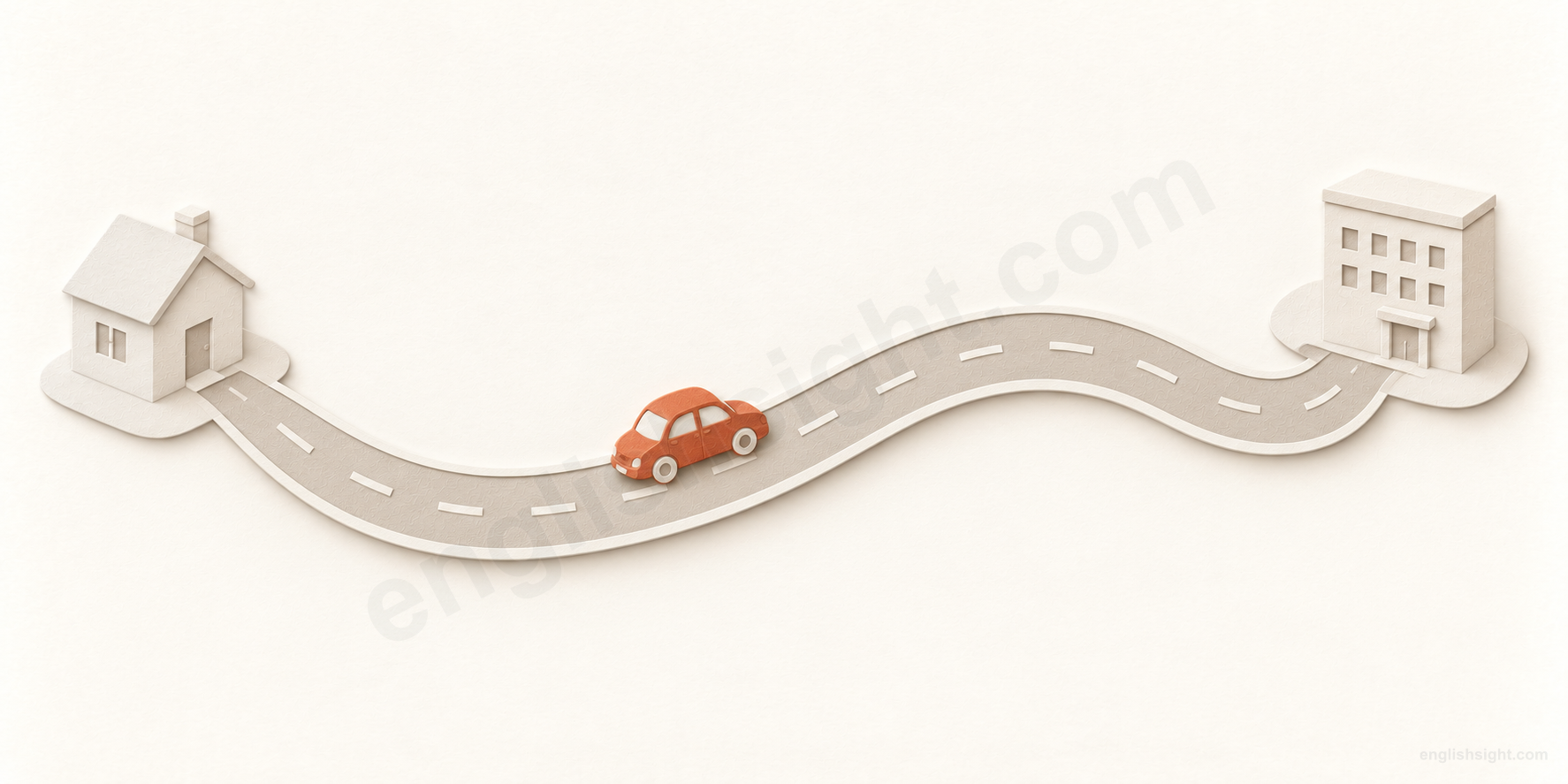
One place is at the left end.
road
Another place is at the right end.
A winding road provides a route for a car.
The road connects two places, and the car is partway along it. This route offers a teaching link to a process leading toward a result, without showing arrival.
A road is a route built for vehicles to travel from one place to another; figuratively, a road can be a process or course leading toward a result.
The sketch shows the physical connection, not a change in the road itself. The route helps explain progress metaphors; it does not explain every conventional idiom on its own.
A road gives vehicles a route from one place to another. We can talk about the surface, its position, its name, or traveling along it. In figurative uses, a result can become a destination and a process can become the route toward it.
The connection is a teaching model, not a claim about one picture shared by all English speakers. Fixed expressions such as hit the road and kick the can down the road need to be learned as expressions.
01
Real roads, addresses, and directions
Start with the physical route, then let prepositions specify location, movement, and transport.
01
a / the + road; road from A to B; road leads / runs to + place
a road between two towns
a route built for vehicles to travel along
Situation / starting point
Two towns are separated by open land.
Meaning / outcome
A road connects them and carries vehicles.
Road names the route or its surface, not the act of traveling.
A road is a physical route for vehicles. A main road carries important traffic; a side road branches away from it. A dirt road has an unpaved surface, so road does not require asphalt. A toll road requires payment.
Use a road for one route and roads for several. The road from the station to the coast identifies its connection. In The road leads to the village, the road stays still: leads describes where following it takes you.
In a sentence
A narrow road connects the two villages.
Watch the difference Road is countable here: a busy road or several busy roads. In heavy road traffic, traffic is uncountable and road modifies it; do not add a before heavy road traffic.
02
number + name + Road / Rd; live on + road name
Park Road / Rd
Road as part of an address or place name
Situation / starting point
You need the exact location of a building.
Meaning / outcome
A road name and number identify its address.
A capital letter marks Road as part of the proper name.
Road can be part of an official name, as in Park Road. Rd is its common written abbreviation. A name ending in Road can belong to a street inside a town; it does not imply an isolated country route.
A street usually has buildings along it in a town or city. Road has a wider range. A lane is narrow; in British English it can be a country road. These descriptions overlap, and you should preserve the actual name in an address.
In a sentence
Our new office is at 18 Park Road.
Watch the difference Do not replace Road with Street in a real address merely because the route has buildings.
03
on / in / across / at the side of + the road; cross + the road
on / in / across the road
locate something beside a road, on its surface, or on the opposite side
Situation / starting point
You describe the position of a café and a fallen branch.
Meaning / outcome
The café is beside the route; the branch obstructs its surface.
The preposition and the noun together establish the position.
The café is on the main road usually places it along that road, with access from it. A branch in the road lies in the area used by traffic. On the road can also describe something on its surface: context matters.
The café across the road is on the opposite side. Cross the road describes movement to that side. At the side of the road places something near the edge. Across need not describe movement when the whole phrase locates a building.
In a sentence
The café is across the road, but a fallen branch is lying in the road.
Watch the difference A house on a road is ordinarily beside it, not sitting in a traffic lane.
04
walk / drive along + road; up / down the road; take + road
along / up / down the road
move along a road or locate something farther along it
Situation / starting point
You are at the station and need a nearby shop.
Meaning / outcome
You follow the road to reach it.
Along follows the length; up and down do not always indicate a slope.
Walk along the road follows its length. The shop is up the road or down the road often just means farther along the same road; the speaker’s local viewpoint supplies the direction. Neither expression reliably means north, south, uphill, or downhill.
Take the next road on the left means choose that route at a junction. Follow the road tells you to continue along it. Compare across the road, which relates the two sides rather than two positions along its length.
In a sentence
There’s a bakery just down the road from the station.
Watch the difference Down the road can also refer to the future; check whether the context mentions places or time.
05
travel / go / transport something + by road
travel by road
use road transport rather than another transport system
Situation / starting point
You compare ways of sending a parcel.
Meaning / outcome
You choose a vehicle route rather than air transport.
By introduces the method of transport.
By road tells us the transport system, while by car names a particular vehicle. A delivery can go by road in a van or truck. Contrast by rail, by sea, and by air.
There is no article in by road for this meaning. On the road can instead locate traffic or describe a person traveling. Two hours by road estimates the journey time using roads, not the straight-line distance.
In a sentence
We sent the equipment by road instead of by air.
Watch the difference For the transport method, say by road, not by the road. By the road can mean beside a particular road.
02
Travel and road-related situations
Use complete expressions to describe journeys, vehicle condition, traffic topics, and departure.
06
go on / take + a road trip
go on a road trip
make a long journey in a car, bus, or motorcycle
Situation / starting point
Friends plan a journey with several stops.
Meaning / outcome
They travel between places by a road vehicle.
Trip names the journey; road specifies its transport setting.
A road trip is a journey over a long distance by a road vehicle. It is often discussed in holiday planning, but the expression itself does not require a holiday, a particular number of stops, or a return to the starting point.
Use go on a road trip or take a road trip. Compare road with journey: The road was narrow describes the route; The trip was tiring describes the traveling experience.
In a sentence
We’re taking a road trip along the coast next month.
Watch the difference A short walk to a nearby shop is not normally called a road trip.
use road to identify the setting of traffic topics
Situation / starting point
A radio report explains a traffic delay.
Meaning / outcome
You understand the repair work and other road-related issues.
The following noun supplies the main meaning in a compound.
In road safety, road signs, and road accidents, road specifies what the topic concerns. It is normally singular before another noun: road signs, even when there are many roads. These are noun combinations, not verbs or phrasal verbs.
Roadworks is the usual British plural noun for repairs to roads or the places being repaired; North American English uses uncountable roadwork. Road rage is uncountable and describes extreme anger or violence directed at another driver over driving behavior, not merely a busy road.
In American sports reporting, road games are games played at an opponent’s venue. For example, The team has three road games this month means it will play three times away from home. This modifier has an away-from-home meaning, not the meaning of playing in the street.
In a sentence
The roadworks are causing delays near the bridge.
Watch the difference Road rage names aggressive anger between drivers; do not use it as a general synonym for traffic congestion.
08
person / group + be + on the road; spend time on the road; team + play / win + on the road
be on the road
be traveling; in American sports, play away from home
Situation / starting point
A musician leaves home for a tour.
Meaning / outcome
She spends weeks traveling between performances.
The phrase can describe a period of travel, including its stops.
With a traveler as subject, on the road often describes being away traveling. A touring band, a truck driver, or a salesperson can be on the road for weeks. It need not mean the person is inside a moving vehicle at every moment.
Life on the road can also mean a mobile life without a permanent home. The surrounding context tells us whether this is a temporary work trip, a tour, or a way of living. It does not automatically mean homelessness.
In American sports, a team playing on the road plays away from its home venue: The team won four games on the road. Contrast at home. The phrase describes where the games are played, not whether the team is traveling at that moment.
In a sentence
The band will be on the road for six weeks.
Watch the difference Do not confuse this with be on the road to recovery, which names progress toward a result.
09
car + be on / off the road; get + car + back on the road
get a car back on the road
restore a car to a usable, legally drivable condition
Situation / starting point
The car needs repairs and cannot be driven normally.
Meaning / outcome
Repairs make it fit for use on public roads again.
With a car as subject, on the road can refer to its usable condition.
My car is off the road can mean it is unavailable for normal road use because of its condition. Get it back on the road means make it usable again. This established sense is especially familiar in British English.
Distinguish that from a car going off the road in an accident, which describes leaving the road surface. Off-road driving means driving away from ordinary public roads, often over rough ground. The hyphenated modifier off-road does not by itself mean broken.
In a sentence
The repairs should get our van back on the road by Friday.
Watch the difference A parked car may be perfectly roadworthy. Off the road in this condition sense is not simply parked.
10
hit + the road
hit the road
leave or begin a journey
Situation / starting point
Everyone has packed and is ready.
Meaning / outcome
The group sets off.
The whole informal expression means start traveling.
Let’s hit the road is an informal way to suggest leaving or setting off. Hit does not describe striking the surface here; learn hit the road as a complete expression.
The departure is the focus, while be on the road describes the traveling period. We hit the road at eight gives a start time; We were on the road all morning describes its duration. An abrupt Hit the road! can sound like an order to leave.
In a sentence
Let’s hit the road before the traffic gets heavy.
Watch the difference The article belongs to this idiom: hit the road, not hit a road for this meaning.
11
have / offer + one for the road
one for the road
a final alcoholic drink before leaving
Situation / starting point
A guest prepares to leave a gathering.
Meaning / outcome
Someone offers a last drink.
One refers to a drink in this conventional informal expression.
One for the road is an informal expression for a final alcoholic drink before leaving. The road evokes departure; the phrase does not say the drink is carried out onto a road.
It does not establish how the person is traveling. In the example, the speaker refuses the drink because they will drive. Learn the expression for recognition rather than treating it as a general way to ask for any item to take away.
In a sentence
“One for the road?” “No thanks, I’m driving.”
Watch the difference One for the road is not the usual expression for a takeaway coffee or a packed lunch.
03
Routes through time, choices, and change
A route toward a place offers a useful teaching link to a process toward a result. Check the exact expression.
12
the road to + noun / -ing; be on the road to + result
on the road to recovery
be in a process leading toward a result
Situation / starting point
Someone is ill but begins to improve.
Meaning / outcome
Improvement puts recovery ahead as a possible result.
A result functions like a destination in the teaching model.
The road to recovery treats the process as a route toward a result. Be on the road to success similarly describes progress. The destination may also be unwelcome: the road to ruin.
To is a preposition in this noun phrase: the road to recovery or the road to becoming independent. Being on that road does not mean you have already arrived or that setbacks are impossible. The picture supports this connection without predicting every road idiom.
In a sentence
After several difficult weeks, she is finally on the road to recovery.
Watch the difference Use on the road to recovery, not on the road to recover in this fixed pattern.
13
go down / follow / choose + a road; go down that road
go down that road
choose or pursue a course of action
Situation / starting point
Your team considers using aggressive sales tactics.
Meaning / outcome
You reject that approach.
Choosing a route can stand for choosing a way to act.
We don’t want to go down that road means we do not want to take that approach. The previous conversation must make clear which course that road refers to. It can be a warning about likely consequences rather than literal movement.
A fork in the road is literally a place where a road divides; as a teaching comparison, it can help you think about choices. But road does not by itself mean decision: read the full expression and context.
In a sentence
We could cut the training budget, but I don’t want to go down that road.
Watch the difference Go down that road can describe choosing a method; it does not always refer to a later time.
14
further along / down the road; time period + down the road
further down the road
at a later stage or time
Situation / starting point
You make a decision now.
Meaning / outcome
Its effects may appear later.
Progress along a road supplies a metaphor for later time.
In future-oriented contexts, further down the road means later. A few years down the road specifies the time interval. No actual journey needs to be involved.
Compare The garage is down the road: a named place and a local setting make that spatial. In We may need a larger office down the road, the subject is a later need. The same words require different interpretations.
In a sentence
We may need a larger office a few years down the road.
Watch the difference The phrase itself gives no exact date; add a time expression when you need one.
15
reach / come to + the end of the road; the end of the road for + noun
reach the end of the road
reach a point where something cannot continue
Situation / starting point
A club loses its last source of funding.
Meaning / outcome
Its present operation cannot continue.
The end of a route stands for the limit of continuation.
The end of the road for something is the point where it can no longer carry on. It can concern an organization, a relationship, or a particular plan. The end of the line is a related expression.
The literal end of a road is simply where that road stops. The figurative expression often signals a serious final limit, not successful arrival at a goal. Specify for our plan when you want the scope to be clear.
In a sentence
Without new funding, this could be the end of the road for the club.
Watch the difference The end of the road for one project does not mean the person has no possible future at all.
16
a road map of + area; a road map for / to + goal
a road map for the project
a map of roads or a plan showing how to proceed
Situation / starting point
A team has a goal but needs organized steps.
Meaning / outcome
A plan lays out how to move toward it.
A map represents the route; a figurative road map represents the plan.
A literal road map shows the roads in an area, helping drivers navigate. Figuratively, a road map gives guidance or an organized plan for reaching a goal. The two uses share the idea of showing a route.
A road map for the project may set out stages, priorities, and decisions. Calling it a road map does not guarantee every step will work. Compare on the road to success, which describes progress rather than the document or plan guiding it.
In a sentence
The team has drawn up a road map for launching the service.
Watch the difference A figurative road map need not contain roads, a drawing, or physical directions.
04
Established expressions and judgments
These expressions carry conventional meanings. The road image can help you remember them, but does not let you invent their meanings word by word.
17
get + the show + on the road
get the show on the road
start a planned activity or journey
Situation / starting point
The equipment is ready but the event has not begun.
Meaning / outcome
You call for the activity to start.
Show can stand for the undertaking, not only a stage performance.
Let’s get the show on the road is an informal call to begin. It can launch a meeting, a project, or a journey; a literal theater show is not required.
Get something on the road presents the activity as being put into action. Treat get the show on the road as the established expression. Compare hit the road, which mainly focuses on leaving or setting out.
In a sentence
Everyone’s here, so let’s get the show on the road.
Watch the difference Do not infer that a meeting must involve travel just because this expression includes road.
18
kick + the can + down the road
kick the can down the road
postpone dealing with a problem
Situation / starting point
A difficult decision needs attention now.
Meaning / outcome
The decision is delayed for someone to face later.
The full idiom carries criticism of postponement.
Kick the can down the road is informal and usually disapproving. It suggests pushing a problem into the future instead of resolving it. The can belongs to the figurative scene, not to a literal description of waste.
Down the road supplies the later-time idea; kick the can makes the whole expression an image of postponing the problem. Compare We’ll discuss it tomorrow, which can be a neutral scheduling decision without that criticism.
In a sentence
Another temporary patch would just kick the can down the road.
Watch the difference The phrase does not mean solve a problem gradually; the central point is delaying action.
19
take + the high road
take the high road
choose a positive or principled response
Situation / starting point
Someone insults you during a public disagreement.
Meaning / outcome
You respond without returning the insult.
High gives this conventional route metaphor a positive evaluation.
Take the high road is especially associated with North American English. It describes choosing a constructive or principled way to act, for example refusing to answer an insult with another insult.
The expression does not refer to physical height. Elsewhere, high road to something can mean a direct route to it, while literal high road meaning main road is old-fashioned outside names. Learn the positive-response idiom as a whole.
In a sentence
She took the high road and answered the criticism without insulting anyone.
Watch the difference A high road is not automatically morally better in a literal travel description.
20
middle-of-the-road + noun; be middle-of-the-road
a middle-of-the-road policy
a moderate position; music that is pleasant but unadventurous
Situation / starting point
A policy debate has two opposing extremes.
Meaning / outcome
A proposal stays between them.
The whole adjective expresses moderation, not a physical location.
Middle-of-the-road describes people, views, or policies that avoid extremes and are acceptable to many people. Hyphens join the words as an adjective, as in a middle-of-the-road candidate.
With music, it describes an accessible, pleasant style that is not especially exciting or adventurous. We played middle-of-the-road music at the reception illustrates that second sense. In contrast, a car in the middle of the road gives a literal location.
In a sentence
The party chose a middle-of-the-road candidate to appeal to a wider audience.
Watch the difference The musical sense can sound mildly critical; it is not simply praise for high quality.
21
where + the rubber + meets + the road
where the rubber meets the road
the point where an idea faces a practical test
Situation / starting point
A system works well in demonstrations.
Meaning / outcome
Real users now test whether it works in practice.
The contact image evokes practical performance rather than a promised result.
Where the rubber meets the road is a North American expression for the point at which something is tested in real conditions. Rubber evokes a vehicle’s tires touching the road, but the topic can be a business plan, a service, or an idea.
It names the test or moment of practical application, not proof of success. In the example, the service may still fail. Read what happens at that point rather than assuming the idiom itself supplies a favorable result.
In a sentence
The pilot went well; the full launch is where the rubber meets the road.
Watch the difference This expression does not mean the end of the project or an inevitable success.
22
the road to hell + is paved with + good intentions
The road to hell is paved with good intentions.
good intentions alone do not ensure good action or outcomes
Situation / starting point
Someone promises to help but never takes action.
Meaning / outcome
The intended benefit fails to happen.
The proverb warns about the gap between intention and effective action.
This saying warns that meaning well is not enough: intentions need to become useful action. It is not an ordinary instruction about religion or road construction.
The whole sentence is a proverb. Do not turn it into a rule that all kindness causes harm. In the example, the speaker emphasizes the need to do the promised work rather than merely announce good intentions.
In a sentence
“We keep promising to help but never do anything. The road to hell is paved with good intentions.”
Watch the difference The saying criticizes reliance on intentions; it does not claim that every intended good action ends badly.
Choose the whole expression
Road, street, way, and journey
Road names a vehicle route; street usually places that route among buildings in a town. Way is broader and can mean direction or method. Journey and trip name an occasion of traveling. A long road is not the same grammatical description as a long journey.
Articles and prepositions matter
Say by road for the transport method, on the road for established travel and vehicle-condition expressions, and on the road to recovery for progress. Down the road may be spatial or temporal. None of these prepositions has one meaning in every context.
Forms and scope
Road is chiefly a countable noun here: road, roads. It stays singular in many noun combinations such as road signs. Road and rode sound alike in standard British and American pronunciation; rode is the past tense of ride. This is not a verb lesson, so passive, causative, and particle-verb families do not apply to road itself.
Use the route model within its limits
A road can be blocked, chosen, followed, or imagined as leading toward an outcome. Those relationships make useful teaching connections. Established idioms still have their own meanings and registers; do not assume that every phrase containing road follows one literal formula.
Choose the meaning that fits
Look at the subject, preposition, and situation before choosing.
1. You want to say that goods will travel in trucks rather than by aircraft. Which sentence fits?
2. A mechanic says, “Your car will be back on the road tomorrow.” What is the intended meaning?
3. A patient is on the road to recovery. What does this say?
4. “We may face this problem a few years down the road.” What does down the road mean here?
5. A team keeps delaying a necessary decision. Which phrase criticizes that behavior?
Sources and teaching notes
Definitions and usage were checked against the sources below. Explanations, example sentences, and the diagram were written for this lesson; the visual connection is a teaching interpretation.
The route is a teaching model; individual speakers need not share a mental picture.