Recognize rods in everyday objects, then learn the fixed expressions separately.
A long body with little thickness
Length is the defining feature
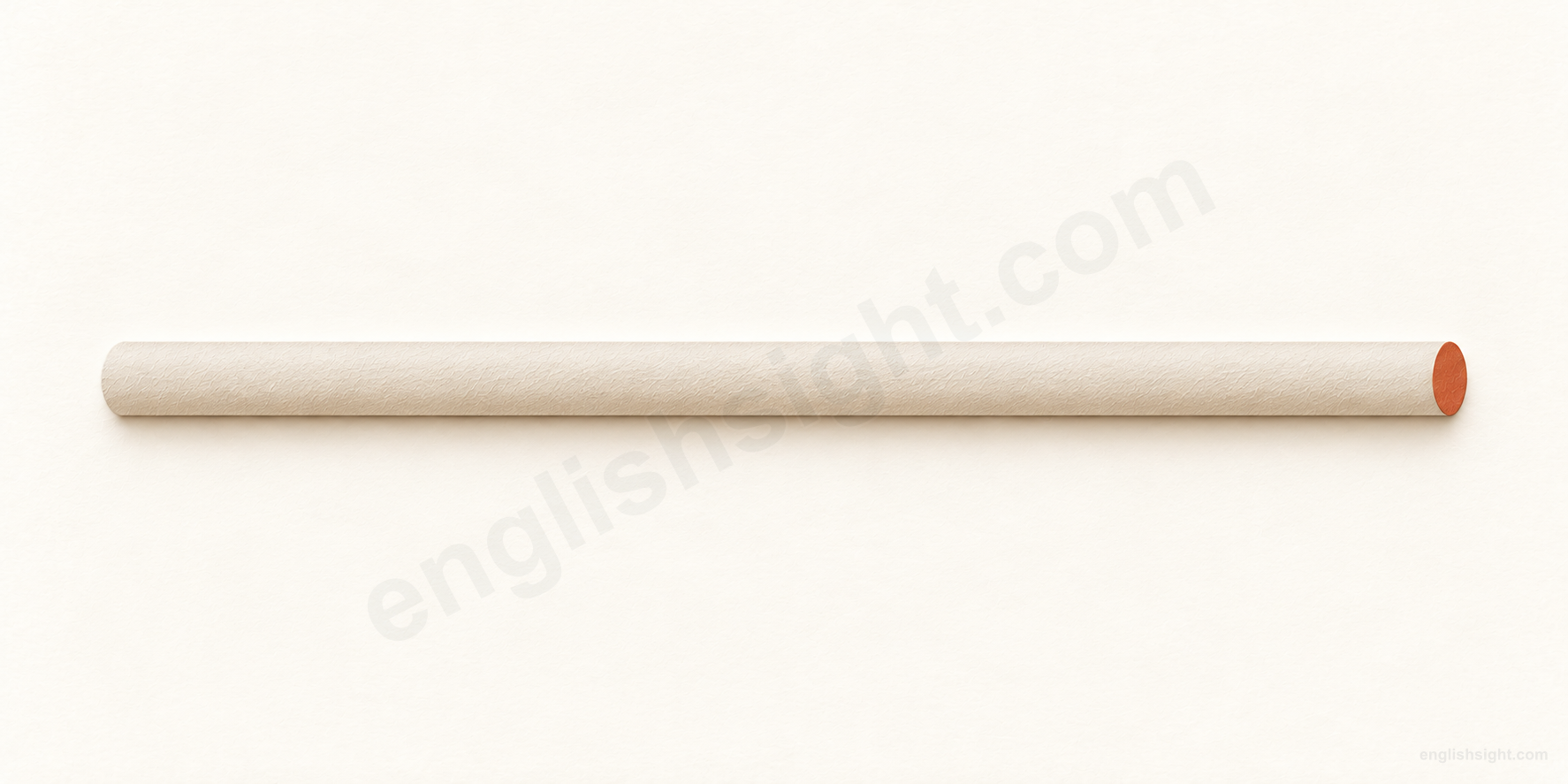
A single continuous piece of material is shown.
rod
The narrow solid end belongs to the same long body.
Its length is much greater than its thickness.
A rod is identified here by its long, slender form; no action or transformation is shown.
A rod is a continuous, slender length of material, usually straight; its particular job is supplied by context or a modifier.
The sketch isolates the physical shape. It is not a transformation: no before-and-after action is required for this noun. Shape-based scientific names and fixed idioms are explained separately.
A rod is a long, narrow piece of material, usually straight. It may support something, form part of a tool, or serve as a machine component. The word names an object rather than an action.
Start with the form, then read the modifier and context. A fishing rod, a rod cell, and a hot rod belong to different situations; one visual model cannot predict every established expression.
01
Materials and useful objects
A rod has much more length than thickness. Material words identify what it is made of; other modifiers name its job. These are noun combinations, not phrasal verbs.
01
a/an + material + rod; rods; a rod of + material
a metal rod
a long, slender piece of material
Situation
You need a narrow piece for a repair.
What is understood
You choose one continuous length of metal.
Rod names the form; metal names the material.
A rod is generally straight and narrow relative to its length. Wood, metal, glass, and plastic can all form rods. Use a rod for one and rods for more than one.
A steel rod or a rod of steel identifies material. A rod is not necessarily a natural branch, and a fishing rod may bend. The word does not promise complete rigidity.
Example in context
We cut the steel rod to the required length.
Watch the difference Do not use bare singular rod here: say a rod or the rod.
02
curtain / shower + rod; hang a curtain on a rod
a curtain rod / a shower rod
a rod that supports a hanging curtain
Situation
The curtain needs a support above it.
What is understood
Its rings hang from a narrow horizontal rod.
The first noun identifies the rod’s purpose.
A curtain rod holds a curtain; a shower rod holds a shower curtain. These objects may be hollow tubes, so everyday rod does not always mean solid material all the way through.
The plural is curtain rods, with the plural ending on rod. A curtain rail is another support term, especially in British English; use the name appropriate to the fitting.
Example in context
The shower curtain slides along the rod.
Watch the difference A rod is the support, not the fabric hanging from it.
03
a fishing rod; fish with rod and line
a fishing rod; rod and line
a flexible rod used to catch fish with a line
Situation
You prepare fishing equipment by the river.
What is understood
You use the rod to handle the fishing line.
Fishing supplies the purpose; the rod and line are different parts.
A fishing rod is the long handled part used with a line, often with a reel. In a fishing conversation, my rod is enough when the equipment is already clear. Fishing pole is also used, particularly in North American English.
Fishing with rod and line names the method. A rod is not the line or hook itself. Its ability to flex is normal, so the core shape should not be understood as perfectly rigid.
Example in context
Mina packed her fishing rod before leaving for the lake.
Watch the difference Say a fishing rod, not a fishing stick, when naming this equipment.
04
a lightning rod; install a lightning rod
a lightning rod
a grounded metal rod used for lightning protection
Situation
A building has lightning-protection equipment.
What is understood
A metal rod connects to the system leading to earth.
The compound names a protective device, not a bolt of lightning.
A lightning rod is placed on a structure and connected to earth as part of lightning protection. Rod still names a physical object; lightning identifies the hazard it deals with.
The same compound has a figurative use for a target of criticism. A roof or grounding context points to the device; a dispute or criticism context points to the figurative expression.
Example in context
The old tower has a lightning rod on its roof.
Watch the difference Rod alone does not mean lightning protection in an unrelated context.
05
a connecting / piston rod; replace a rod
a connecting rod / a piston rod
a slender machine part that connects parts or transmits motion
Situation
You inspect a diagram of an engine.
What is understood
You identify the named rod within the mechanism.
The modifier specifies a mechanical role, not a new verb meaning.
In machinery, rod can name a shaft or bar that transmits motion. A connecting rod joins moving parts; a piston rod is associated with a piston. The full technical name matters.
These are useful recognition terms in a repair description. They do not make every engine part a rod, and the lesson is teaching names rather than instructions for repairing an engine.
Example in context
The mechanic found a bent connecting rod.
Watch the difference Connecting rod and piston rod are not freely interchangeable names.
02
Shape names and a car expression
Some specialist nouns extend the physical shape. Hot rod is a separate established compound: its meaning cannot be worked out from temperature and shape.
06
rod-shaped + noun; rods and cones; rod cells
rod-shaped; rods and cones
having a rod’s shape; light-sensitive rod cells in the eye
Situation
A science text describes long, narrow structures.
What is understood
Shape helps you recognize the naming connection.
Shape motivates these names, but each scientific term has its own meaning.
Rod-shaped means shaped like a long, narrow piece. A bacterium described as a rod is being classified by its form, not called a metal object.
In a discussion of the retina, rods are light-sensitive cells important in dim light. Cones are a different type. Here rods names cells, not tiny tools inside the eye.
Example in context
The diagram labels two types of cells: rods and cones.
Watch the difference Rod cells is a fixed scientific name; rod does not mean every long cell.
07
a hot rod; hot rods
a hot rod
a car built or modified for speed
Situation
You visit a display of modified cars.
What is understood
You see a car whose design emphasizes performance.
The whole compound names a vehicle.
Hot rod is an informal term for a car built or altered for rapid acceleration and speed, often an older car with a modified engine. Learn the two words together.
Hot does not simply report temperature here, and rod does not name a loose engine component. A hot rod can be parked with its engine cold. The plural is hot rods. In American slang, rod can also be short for hot rod; the car context distinguishes it from a physical rod.
Example in context
A bright red hot rod stood beside the garage.
Watch the difference A hot rod is not simply any car that has overheated.
03
Criticism, control, and trouble
Learn these expressions as complete units. Their images involve lightning or older uses of rods for punishment; the ordinary shape alone does not predict their meanings.
08
be / become a lightning rod for + criticism / controversy
a lightning rod for criticism
a person or thing that becomes a focus of criticism or dispute
Situation
Many people are angry about a decision.
What is understood
Their criticism concentrates on one visible target.
Criticism replaces lightning in this established metaphor.
A person, policy, or issue can become a lightning rod for criticism or controversy. The expression is especially associated with American English. It identifies where reactions gather.
Sometimes the target takes blame that also belongs to others; that is not required in every use. For introduces what the target attracts. It does not say that the person deserves the criticism.
Example in context
The new fee became a lightning rod for criticism.
Watch the difference The metaphor does not require a literal rod or a thunderstorm.
09
make a rod for + possessive + own back
make a rod for your own back
create a situation that will cause trouble for yourself
Situation
You offer more help than you can realistically give.
What is understood
Others expect the same help every time.
Your present choice creates your own later difficulty.
This British idiom warns that an apparently useful choice can create future trouble for the person making it. Your changes with the person: I made a rod for my own back.
The phrase evokes an instrument of punishment, but ordinary uses need no physical injury. It often describes setting an expectation that later becomes burdensome. Make trouble for yourself is a plainer alternative.
Example in context
By offering free delivery on every order, I made a rod for my own back.
Watch the difference Keep own: the trouble falls back on the person whose choice created it.
10
a rod / stick to beat + somebody + with
a rod to beat somebody with
a fact or argument used to criticize or punish someone
Situation
Someone makes one mistake.
What is understood
An opponent keeps using it against that person.
The argument functions like a weapon in the fixed expression.
A rod to beat somebody with is something used as grounds for criticism or punishment. A stick to beat somebody with is a familiar variant.
The infinitive tells how the rod is used metaphorically; with belongs with beat. This is not the same as make a rod for your own back, which highlights self-created trouble.
Example in context
That one late report became a rod to beat her with.
Watch the difference Read the criticism context; the idiom does not describe an actual beating.
11
rule + (person / group) + with a rod of iron
rule with a rod of iron
control people very severely
Situation
A leader demands complete obedience.
What is understood
People have little freedom to challenge decisions.
Iron strengthens the image of harsh authority.
Rule somebody or something with a rod of iron describes very strict control. The rod evokes authority and punishment; this is a judgment about how someone rules.
Compare an iron rod on a workbench: that simply names a material. The full rule with construction gives the figurative meaning.
Example in context
The director ruled the company with a rod of iron.
Watch the difference This is stronger than saying someone organizes a group efficiently.
12
the rod; spare the rod; spare the rod and spoil the child
the rod; spare the rod
an old-fashioned punishment reference
Situation
You read a historical account or an older saying.
What is understood
You recognize a rod as an instrument or symbol of punishment.
This use carries a punishment association beyond the object’s shape.
The rod can mean a stick used for physical punishment, or punishment itself. It is old-fashioned in this sense. Spare the rod means refrain from that punishment.
The traditional saying Spare the rod and spoil the child expresses a belief that children need punishment to learn proper behavior. It is an older viewpoint being quoted, not neutral parenting advice from this lesson.
Example in context
The novel describes a school where teachers used the rod.
Watch the difference Do not treat the rod as the ordinary modern word for all teaching or discipline.
Choose the object or the whole expression
Rod, stick, bar, and pole
These words overlap, but their usual contexts differ. Stick often suggests a piece of wood; rod emphasizes a slender form. Bar can suggest a thicker piece, and pole often suggests a longer support. These are tendencies, not exact size rules: learn established names such as fishing rod and curtain rod.
Countable noun and noun modifiers
Use a rod, the rod, and two rods. In curtain rods, curtain describes the purpose while rods carries the plural. Rod-shaped is an adjective: rod-shaped objects. This noun lesson has no productive family of particle verbs or causative patterns to learn.
Recognition beyond the main lesson
An older length unit, a rod, equals 16½ feet or 5½ yards; a square rod is an area unit. Ceremonial staffs, specialist surveying and workshop uses, slang for a gun, and vulgar slang are recorded in dictionaries but are not expanded here. Specialist verbs such as rod / rodded / rodding are outside this everyday noun lesson.
Read the whole expression
Use the situation to decide whether rod names an object, a shape, or a fixed expression.
1. You need the long flexible part of fishing equipment. What do you ask for?
2. You offer to do a task every day and now regret the expectation you created. Which expression fits?
3. A new policy attracts most of the complaints in a public debate. What has it become?
4. A textbook describes rods and cones in the retina. What are the rods here?
Sources and teaching notes
Dictionary sources support the uses below. The lesson’s wording, examples, and visual teaching model are original.
The diagram is a teaching model, not a claim about an image shared by all native speakers.