Follow the movement, then learn the established meanings of the whole expression.
Turning changes which side faces where
Turning changes which side faces where
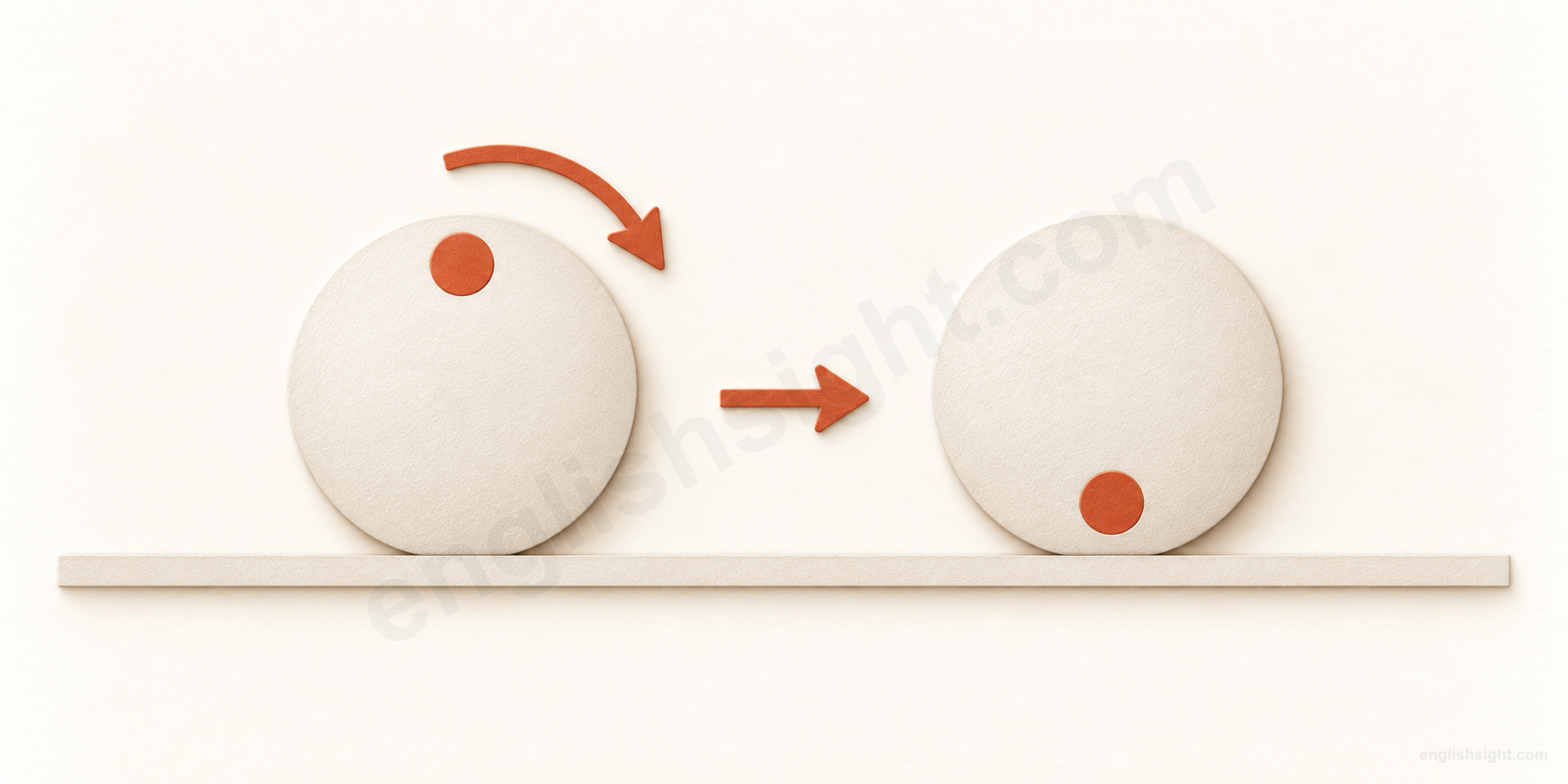
A round object rests on a level surface, with its orange marker near the top.
roll
The same object is farther right, with its marker now near the bottom.
It turns clockwise as it moves to the right.
The object turns as it travels; the marker makes the change in orientation visible.
Something turns over or around; it may travel, face another way, or be shaped around itself.
The picture shows turning together with travel. Roll can also describe turning in place or making a rounded shape. Flow, progress, sound, and fixed expressions need their own explanations; the picture does not establish a single origin for every sense.
A ball rolls across the floor: it turns as it travels. A person can roll over without traveling far, and paper can be rolled into a tube. These related physical uses provide a useful starting point.
Roll also names a small loaf of bread, a package of material, or a list of names. Expressions such as on a roll and roll back a decision have their own established meanings. Learn their patterns and situations rather than trying to calculate every meaning from a turning wheel.
The diagram is a teaching model for a central physical relationship. It does not claim that every English speaker imagines the same picture.
01
Turning, traveling, and flowing
Notice what moves and whether roll has an object. Direction words tell you where something goes or which way it turns.
01
something rolls + direction; roll + object + direction; be rolled + direction
roll a ball / a ball rolls
move by turning over and over, or make something do this
Situation before
A small ball is beside your foot.
What changes or is meant
It turns across the floor toward another person.
The moving object can be the subject or the object.
In The ball rolled, the ball moves. In I rolled the ball, I cause its movement. This is a direct cause-and-motion pattern, not a special construction meaning arrange for another person to act.
Across, down, off, away, and back can describe the path: The ball rolled off the table and rolled away. These are understandable spatial combinations; they do not each require a separate idiom.
A passive is possible when the mover is less important: The barrels were rolled into the shed. Roll emphasizes turning contact with a surface; slide usually emphasizes movement along a surface without that turning.
Roll can also describe turning without traveling: She rolled a pencil between her fingers. A path such as across the floor adds travel; the verb by itself does not always require it.
In a sentence
Maya rolled the ball across the kitchen floor to her brother.
Watch the difference A ball can spin in one place. Rolling across the floor includes travel as well as turning.
02
roll over; roll onto + body position; roll + object + over
roll over / roll onto your side
turn the body so that another side faces up or rests on the surface
Situation before
You are lying on your back.
What changes or is meant
You turn and lie on your side.
Over highlights turning; onto identifies the resulting position.
Roll over can describe a single turn in bed; it does not require repeated full revolutions. Roll onto your back or side specifies the position reached. A dog rolling in the grass may turn repeatedly near the same spot.
Someone can also roll an object over: Roll the cushion over to see the label; roll it over. With this separable pattern, a pronoun goes between roll and over.
In an accident report, The car rolled over means it overturned, rather than simply moving on its wheels. The vehicle and situation distinguish this from ordinary forward motion.
In a sentence
I rolled onto my side and reached for the lamp.
Watch the difference Turn over in bed does not mean get out of bed. Roll over also has nonphysical meanings in later entries.
03
vehicle rolls + direction; roll + wheeled object + direction
roll a trolley / a car rolls
move on wheels, or move something that is supported by wheels
Situation before
A loaded trolley is near the entrance.
What changes or is meant
It moves through the room on its wheels.
The wheels turn; the entire trolley need not turn over.
Roll can describe a vehicle moving smoothly or gradually: The bus rolled forward. It does not say whether an engine, a person, or gravity supplies the force.
Roll a trolley or suitcase means move it using its wheels. In a sentence such as They rolled the patient into the room, the patient is being transported on wheeled equipment, not turned repeatedly across the floor.
In a sentence
We rolled the trolley through the doorway without lifting it.
Watch the difference The car rolled into the garage and The car rolled over describe very different events.
04
roll + a die / the dice; roll + number; a roll of the dice
roll the dice / roll a six
throw dice in a game, or obtain a number by doing so
Situation before
It is your turn in a board game.
What changes or is meant
The die lands with a number facing up.
The object can name the dice or the result.
Roll the dice names the action. Roll a six names the resulting score, not an object shaped like the written number six. You can also say a roll of the dice for one throw.
Die is a standard singular and dice its plural, especially in American English. Dice is also widely used for a single piece, particularly in British English. The noun phrase and game context make the quantity clear.
In a sentence
Nina rolled a four, so she moved her counter four spaces.
Watch the difference Outside a game, roll the dice can mean take a risk; that figurative use is explained separately.
05
fog / clouds / waves roll + direction; tears roll down + surface; rolling hills
clouds roll in / tears roll down
move or flow in a continuous, often swelling movement
Situation before
Fog is approaching from the sea.
What changes or is meant
It moves across the harbor and surrounds the boats.
The motion can resemble rolling without a solid object rotating.
Fog, smoke, clouds, and waves can roll in or across an area. Roll suggests their advancing movement; in points toward the place being described. A wave rolling onto a beach is a natural example of this family.
Tears or beads of sweat can roll down someone's face. They move along the skin; you need not imagine each drop rotating like a rigid wheel.
Rolling hills describes land with repeated gentle rises and falls. The hills themselves are not moving. This established adjective use is related to the shape or rhythm of rolling.
In a sentence
A bank of fog rolled across the harbor before sunrise.
Watch the difference The material and context matter: rolling clouds are moving; rolling hills describe a landscape's shape.
06
boat / ship rolls; the roll of + vessel; a rolling walk
the boat rolls
tilt from side to side
Situation before
Waves reach the side of a small boat.
What changes or is meant
One side rises and then the other does.
Roll can be a partial back-and-forth turn.
A boat that rolls leans from one side to the other. It need not turn upside down. The noun roll can name this motion too: the roll of the boat.
In descriptions of ships and aircraft, roll concerns side-to-side rotation; pitch concerns the front and back rising and falling. A rolling walk similarly involves a noticeable side-to-side sway.
In a sentence
The boat rolled from side to side as the waves grew larger.
Watch the difference The boat rolled does not by itself mean the boat capsized or completed a full turn.
07
roll your eyes (at + person / thing); someone's eyes roll
roll your eyes
move the eyes upward or around, often to show irritation or disbelief
Situation before
Someone repeats an excuse you have heard many times.
What changes or is meant
Your eye movement shows your reaction.
The movement can communicate an attitude.
Roll your eyes at someone or something commonly describes a gesture of impatience, disapproval, or disbelief. Its social message depends on the situation; it is not just a neutral instruction to look upward.
Eyes can also roll because of fear, illness, or another physical condition. Do not infer deliberate rudeness from every sentence containing eyes rolled.
In a sentence
Leo rolled his eyes when I told the same joke again.
Watch the difference Use a possessive: she rolled her eyes. The expression does not mean she moved her whole head.
02
Wrapping, shaping, and opening
The material and the result matter: rolling paper makes a tube, while a rotating roller can flatten dough or spread paint.
08
roll up + noun; roll + noun / pronoun + up; a rolled-up + noun
roll up a mat
wind flexible material around itself into a compact tube
Situation before
A mat lies flat on the floor.
What changes or is meant
It forms a compact cylinder for storage.
Up can mark completion of a compact shape, rather than upward travel.
Roll up the mat and roll the mat up are both possible. A pronoun belongs in the middle: roll it up. The action brings successive parts of the material around the growing roll.
The passive The map was rolled up describes what happened to the map. A rolled-up map describes its resulting form. Compare fold the map, which makes creases and flat sections rather than a continuous roll.
Roll a cigarette is another established use of making a tube from flexible material. The object supplies what is being made; up is not required.
In a sentence
After the class, we rolled the exercise mats up and put them away.
Watch the difference Say roll it up, not roll up it. Up does not mean that you must lift the mat into the air.
09
roll + material + into + shape; something rolls (up) into + shape
roll clay into a ball
make a rounded shape by turning or working the material
Situation before
You have an uneven piece of soft clay.
What changes or is meant
It is a smooth ball.
Into names the result, not a place entered.
Roll the clay into a ball explains both the action and the new shape. The same result pattern works for dough rolled into small balls or a towel rolled into a cylinder.
A subject can also change its own shape: The hedgehog rolled into a ball. That animal curls up; it is not necessarily traveling across the ground.
In a sentence
Roll each piece of clay into a small ball between your palms.
Watch the difference Roll into the room gives a destination. Roll clay into a ball gives a resulting shape.
10
roll + sleeves / trouser legs + up / down; roll + clothing + to + level
roll your sleeves up / down
turn clothing back to shorten it, or undo the turned-back part
Situation before
Your sleeves cover your wrists.
What changes or is meant
Their ends are folded back toward your elbows.
Up and down describe different clothing adjustments.
Roll your sleeves up means turn their ends back repeatedly so that more of your arms are exposed. Roll them down usually means let the rolled sections extend again. You can similarly roll up trouser legs.
The endpoint can be stated directly: She rolled her jeans to her knees. Context matters with down: clothing can also be turned downward, as when someone rolls a sock down from the top.
Roll up your sleeves also has a familiar figurative meaning, prepare to work. The clothing adjustment and the figurative expression are distinguished later.
In a sentence
I rolled my sleeves up before washing the dishes.
Watch the difference The opposite of shortening rolled sleeves is often roll them down or unroll them, not roll them out.
11
roll up / down + noun; roll + noun / pronoun + up / down
roll a window down / a blind up
raise or lower a window, blind, or similar mechanism
Situation before
A car window is closed and the passenger wants fresh air.
What changes or is meant
The glass is lower and the window is open.
Direction is not the same as opening or closing for every object.
Roll the car window down means lower the glass to open it. Roll it up means raise it to close it. These expressions remain natural with electric windows, although the older mechanism used a turning handle.
A blind often works the other way: roll it up to uncover the window and down to cover it. A rolling shutter can similarly move down to close a shop. Up and down identify movement; the mechanism determines the effect.
With a noun, both roll down the window and roll the window down are possible. With a pronoun, use roll it down. The glass does not have to curl into a tube.
In a sentence
Could you roll the window down a little? It is warm in here.
Watch the difference Do not translate roll up as always open: it usually closes a car window but opens a rolled blind.
12
roll + dough / pastry + (out); roll + object + adjective; be rolled out
roll out the dough
make something flatter by moving a roller over it
Situation before
A piece of dough is thick.
What changes or is meant
It is a thin sheet ready to cut.
The tool turns while pressure changes the material.
Roll the dough or roll the dough out means flatten it with a rolling pin. Out emphasizes spreading it into a sheet; it does not mean form a tube and then move that tube outside.
A result can follow the object: Roll the pastry thin. A passive is natural in recipes: The dough is rolled out before it is cut. The dough rolls easily describes how readily it responds to this work.
The same pressure principle appears in roll a lawn or a cricket pitch with a heavy roller. This is a groundskeeping use, not a separate everyday meaning to predict for any surface.
In a sentence
Roll the dough out until it is thin enough to cover the tin.
Watch the difference Roll up the dough makes a compact roll. Roll out the dough normally makes a flat sheet.
13
roll + paint + onto / over + surface
roll paint onto a wall
spread paint over a surface with a rotating roller
Situation before
A wall needs a fresh coat of paint.
What changes or is meant
Paint covers the wall in an even layer.
The roller turns and transfers paint; the wall does not change shape.
Roll paint onto a wall means apply the paint with a roller. The paint is the object being spread, and onto a wall names the receiving surface. For example: We rolled the paint onto the wall in even strokes.
The tool turns against the surface, but the purpose differs from rolling out dough. Painting adds a coating; rolling dough makes the material flatter. Roll out the paint is not the usual instruction for painting a wall.
In a sentence
We rolled the paint onto the bedroom wall in even strokes.
Watch the difference Rolling paint onto a wall and rolling dough out both use a roller, but only the second means making the material flatter.
14
roll + object + in + coating; roll yourself / something up in + covering
roll something in breadcrumbs / a blanket
turn something in a coating or wrap it in flexible material
Situation before
A small piece of food has no outer coating.
What changes or is meant
Its surface is covered in breadcrumbs.
In names the covering material, with different results for crumbs and cloth.
Roll a piece of food in breadcrumbs or sugar means turn it through that material so the coating sticks to different sides. It need not become a different overall shape.
Roll yourself up in a blanket instead means wrap the blanket around your body. Compare roll the blanket up, which makes the blanket itself into a compact roll. The object tells you what is being wrapped or shaped.
In a sentence
Roll each cheese ball in the chopped herbs before serving it.
Watch the difference Roll in the grass means move your body there. Roll food in herbs means coat the food, not place it inside a hollow herb.
03
Things and actions called a roll
Use the surrounding words to distinguish bread, packages, names on a list, a movement, and a sound.
15
a / two roll(s) of + material; toilet roll; kitchen roll
a roll of paper / a roll of tape
a quantity of material wound into one package
Situation before
Long paper or tape has been wound around itself or a core.
What changes or is meant
You can take a length from that package.
Roll counts the package, while of identifies its contents.
A roll of wrapping paper, tape, fabric, or film is one wound package. Two rolls of tape counts two packages; a piece or strip of tape counts a length taken from one.
Toilet roll and kitchen roll are familiar British terms; toilet paper and paper towels are common American terms. Packaging can also be a tube of small items: a roll of mints or, especially in North America, a roll of coins.
Rolls of fat refers to rounded folds of body fat. It is a shape description, not a package or a movement, and commenting on another person's body can be unwelcome.
In a sentence
We used two rolls of tape to seal all the boxes.
Watch the difference A roll is not a fixed length: a roll of tape and a strip of tape measure different kinds of quantity.
16
a (bread) roll; two rolls; spring roll; Swiss roll
a bread roll / a spring roll
a small loaf of bread, or a food identified by a rolled form
Situation before
You order something to eat with soup.
What changes or is meant
You receive one small loaf of bread.
A food name is a noun, not an instruction to turn something.
A bread roll, often simply a roll, is a small individual loaf of bread. A cheese roll can be a bread roll filled with cheese; the food and local menu context help identify it.
Other compounds name different foods: a spring roll has a wrapper and filling; a Swiss roll is rolled cake with a filling. These are established food names, not promises that all foods called rolls have the same ingredients or preparation.
In a sentence
Could I have a bowl of soup and a bread roll, please?
Watch the difference Rolls is the ordinary plural noun. Rolled describes something that has undergone an action.
17
be on the + school / electoral + roll; call / take the roll; roll call
the school roll / call the roll
an official list of names, or checking attendance from that list
Situation before
The teacher has a list of enrolled pupils.
What changes or is meant
Names are read aloud to check who is present.
List membership and attendance are related but different.
A school roll lists pupils; an electoral roll lists registered voters. Someone on the roll has their name on the relevant list. This does not automatically say they are present today.
Call the roll or take the roll means check attendance, typically by reading names and waiting for replies. Roll call names the attendance-checking event: We have roll call before leaving.
This list sense is learned as its own noun meaning. A modern roll can be digital; the list need not be on a physically rolled sheet.
In a sentence
The teacher called the roll before the class boarded the bus.
Watch the difference On the roll means listed. On a roll, with a, is an idiom about continuing success.
18
do a forward / backward roll; have a roll in + place
do a forward roll
perform one turning movement, especially a body movement on the ground
Situation before
A child begins a gym exercise on a mat.
What changes or is meant
The child's body has turned forward over the head.
A countable roll names one action.
A forward roll and a backward roll are gym movements in which the body turns over on the ground. Do a roll treats the movement as a countable action, rather than using roll as a verb.
Animals can have a roll in the grass, meaning an episode of turning their bodies around there. The noun also occurs in a roll of the dice and the roll of a boat, whose particular movements are explained in the movement group.
In a sentence
The children practised forward rolls on the thick gym mats.
Watch the difference Do a forward roll is a specific exercise, not an ordinary way of saying walk forward.
19
a drum roll; a roll of thunder; thunder / drums roll; roll your r's
a drum roll / thunder rolls
a sustained rumbling sound or rapid succession of drum beats
Situation before
A drummer prepares to announce a winner.
What changes or is meant
Rapid repeated beats create a continuous-sounding buildup.
The sound develops in a sequence; no round object has to travel.
A drum roll consists of rapid repeated drum beats. A roll of thunder is a deep continuing rumble. Roll can also be a verb: Thunder rolled in the distance; the drums rolled.
Drum roll, please! can jokingly ask for suspense before an announcement, even without a real drummer. Its function comes from the announcement setting.
Roll your r's is a separate pronunciation use: produce an r with a vibrating or trilling tongue. It is not a rule for all English r sounds.
Rock and roll, also written rock 'n' roll, is an established name for a style of popular music with a strong beat. In Let's rock and roll!, the full expression can informally mean let's get going energetically; it does not name a drum technique.
In a sentence
A drum roll filled the pause before the winner's name was announced.
Watch the difference A drum roll is not a drum moving across the floor. Sound and pronunciation uses need their own context.
04
Arriving, continuing, and changing plans
These patterns extend beyond literal rotation. Their objects and context help distinguish arrival, launch, reversal, and continuation.
20
cameras are rolling; roll the cameras; get rolling (on + task); ready to roll; let's roll
the cameras are rolling / get rolling
be recording or operating; begin moving or making progress
Situation before
The crew and equipment are ready.
What changes or is meant
Recording begins and work is underway.
The subject determines what has started or is continuing.
The cameras are rolling means they are recording. Roll the cameras! is an instruction to start recording. This remains natural with digital cameras; nothing needs to be visibly rotating.
Get rolling can mean get an activity underway: We need to get rolling on the report. Keep things rolling means maintain activity or progress. These uses draw on continuing movement as a teaching comparison, not a claim about literal machinery in every task.
Ready to roll means ready to start. Let's roll is an informal suggestion to leave or begin, especially familiar in North American English.
In a sentence
The cameras are rolling, so please keep quiet on the set.
Watch the difference A camera that is rolling is operating, not necessarily moving. Ready to roll describes readiness, not completed work.
21
person rolls in / up; roll into + place; roll up at + place / time
roll in / roll up
arrive, often casually and sometimes late
Situation before
The meeting has already begun.
What changes or is meant
Someone finally arrives without appearing hurried.
People can roll in or up without physically rolling.
Someone who rolls in often arrives casually or late. Roll into the office specifies the destination. Roll up also means arrive informally; it does not always imply lateness or disapproval.
The old-fashioned street or fairground call Roll up! Roll up! invites passing people to gather and watch. It is not a general polite substitute for Come here in every situation.
These arrival uses have no direct object: Sam rolled up at noon. Roll the poster up instead has an object and describes shaping material.
In a sentence
Ben rolled in twenty minutes late with a coffee in his hand.
Watch the difference Roll up a person does not mean make that person arrive. Check whether there is a direct object.
22
orders / offers / money + roll in; keep + something + rolling in
orders are rolling in
be arriving or being received in large amounts
Situation before
An announcement has just been posted.
What changes or is meant
Many orders or messages keep arriving.
The subject is what comes in, not a person possessing it.
Orders, offers, donations, and messages can roll in. This informal use often appears in a continuous form. It presents their continuing arrival in noticeable numbers, rather than saying one item has rotated into a room.
Compare Money is rolling in, which describes money being received, with She is rolling in money, which describes someone's wealth. Changing the subject and the position of money changes the meaning.
In a sentence
Offers of help began rolling in after we shared the appeal.
Watch the difference Do not treat rolling in money and money rolling in as the same grammatical pattern.
23
time / occasion + rolls around; time + rolls by / on; Roll on + awaited time!
Friday rolls around / the years roll by
a time arrives, or time continues to pass
Situation before
You are waiting through the working week.
What changes or is meant
Friday arrives again.
Around highlights an arriving occasion; by or on highlights passing time.
When Friday rolls around means when Friday comes, often as part of a recurring cycle. When your turn rolls around similarly means when it becomes your turn.
The weeks rolled by and the years rolled on present time as continuing to pass. These are figurative motion descriptions; they do not tell you a clock is physically rolling.
Roll on Friday! is a British informal exclamation meaning you wish Friday would come soon. It is a wish, not the same sentence pattern as Friday rolls around.
In a sentence
When Friday rolled around, we were ready for a quiet evening.
Watch the difference Roll around can also describe uncontrolled laughter in another context; the time subject selects the arrival meaning here.
24
roll out + product / service; roll + object + out; be rolled out
roll out a new service
introduce a product, service, or system for people to use
Situation before
A service has been prepared but is not yet available to customers.
What changes or is meant
Customers begin getting access to it.
The object is what becomes available, rather than material being flattened.
Roll out a service, feature, or system means introduce it for use. It can happen in stages, but roll out does not by itself guarantee a gradual launch or universal access.
Both roll out the service and roll the service out work; use roll it out with a pronoun. The passive is common when the release matters more than the organization: The service will be rolled out next month.
A rollout or roll-out is the related noun for the introduction. Keep two words for the verb: We will roll out the update. This is an established business and technology use, distinct from rolling out dough.
In a sentence
The library will roll out its new booking system at three branches first.
Watch the difference Roll out an update means release it. Roll back an update means reverse or undo its introduction or effects.
25
roll back + change / policy / prices; roll + object + back; be rolled back
roll back a change / roll back prices
reverse a change or reduce something toward an earlier level
Situation before
A rule, price, or system setting has changed.
What changes or is meant
The change is undone or the level is reduced.
Back points toward an earlier state; the object says what is reversed.
Roll back a policy or reform means undo it or reduce its effects. Roll back prices means lower them, often toward an earlier level; this price use is particularly associated with North American English.
In computing, roll back an update or a change means undo it or return to an earlier version. The whole expression supplies this established reversal meaning; no physical object needs to roll backward.
The pattern is separable: roll the change back; roll it back. Passive wording is useful when the change is the topic: The decision was rolled back after complaints.
In a sentence
After the new version failed, the team rolled the update back.
Watch the difference Back does not always mean improvement: rolling back a useful reform can remove progress.
26
roll over + loan; roll + funds + over into + account / plan; jackpot + rolls over
roll over a loan / a prize rolls over
continue an amount or arrangement into a later period
Situation before
A loan is due, or a lottery prize has not been won.
What changes or is meant
The arrangement continues, or the prize moves to the next drawing.
Over can bridge one period and the next in an established financial use.
Roll over a loan means extend or renew the borrowing arrangement rather than require it to end at the original date. Roll it over is the pronoun pattern. This is a business meaning, not a physical turning action.
Roll funds over into another account or pension plan can describe transferring or reinvesting them under the relevant arrangement. This is language explanation; the phrase alone tells you nothing about fees, eligibility, or tax treatment.
A lottery jackpot rolls over when nobody wins it and the money is added to a later prize. Here the amount is the subject and there is no direct object. Rollover is a related noun.
In a sentence
The bank agreed to roll the loan over for another six months.
Watch the difference Roll over a loan does not mean pay it off, and it does not by itself promise the same terms.
27
(not) just roll over; roll over and give in; roll + opponent + over
roll over and give in
stop resisting or accept defeat too easily
Situation before
Someone expects you to accept an unfair demand.
What changes or is meant
You would accept without putting up a fight.
This figurative use evaluates resistance, not body position.
They won't just roll over means they will resist rather than allow themselves to be defeated easily. It is informal and often occurs with just, simply, or a negative.
British informal roll someone over can mean defeat them easily, especially in sport: The visitors rolled us over. That transitive pattern gives the winner as subject; in We rolled over, the subject is the side offering little resistance.
In a sentence
The tenants refused to roll over and accept the unexplained charge.
Watch the difference Refusing to roll over means refusing to give in; it does not mean refusing to turn in bed.
05
Everyday expressions and idioms
Learn these expressions as units. A physical image may help you remember one, but the full phrase carries its conversational meaning.
28
be on a roll; get on a roll
be on a roll
be having a continuing run of success
Situation before
Several attempts have gone well.
What changes or is meant
You are succeeding repeatedly and have momentum.
Keep the whole idiom, including a.
On a roll describes a period when things keep going well, such as winning several games or completing tasks smoothly. The image of continuing movement can help with memory, but the success meaning belongs to the established phrase.
It does not promise future success or mean someone is physically on top of a roll. On the school roll instead means listed as a pupil.
In a sentence
We solved four difficult clues in a row; we were on a roll.
Watch the difference Say on a roll for this idiom, not on roll or on the roll.
29
get / set / start the ball rolling; keep the ball rolling
get / keep the ball rolling
start an activity or maintain its progress
Situation before
A discussion or project needs an initial action.
What changes or is meant
Someone starts it, and others help it continue.
Get or start initiates; keep maintains.
Get, set, or start the ball rolling means do something that starts a process. Keep the ball rolling means prevent the process from stopping.
The ball is part of the idiom; it need not be a real object. A first suggestion can get a meeting going, while follow-up questions keep the discussion active.
In a sentence
I'll get the ball rolling by suggesting a date for our first meeting.
Watch the difference Starting the ball rolling does not mean finishing the project. Keep changes the focus to continued activity.
30
roll up your sleeves (and + work action)
roll up your sleeves
prepare to do some serious or practical work
Situation before
A task needs effort rather than more discussion.
What changes or is meant
You prepare to work on it actively.
A practical clothing action can stand for readiness to work.
Figuratively, roll up your sleeves means get ready to work with effort or determination. Someone can say it while wearing a short-sleeved shirt or working on a computer.
In a kitchen, the same words may be literal. Decide from context whether the speaker means adjust clothing, prepare to work, or both. The figurative meaning belongs to the full expression, not to up alone.
In a sentence
We need to roll up our sleeves and sort out these booking problems.
Watch the difference The idiom does not require actual sleeves and does not mean the work has already been completed.
31
roll with the punches
roll with the punches
adapt to difficulties instead of being stopped by them
Situation before
An unexpected problem disrupts your plan.
What changes or is meant
You adjust your response and continue.
Flexibility is the point, not accepting every demand.
Roll with the punches means respond flexibly when things go wrong. In ordinary conversation the punches are difficulties, not necessarily physical blows.
The expression suggests adjusting rather than insisting the original plan must remain unchanged. Compare roll over, which can criticize giving in too easily; adapting to a problem and surrendering to a person are different judgments.
In a sentence
Travel plans can change suddenly, so we try to roll with the punches.
Watch the difference Roll with the punches emphasizes adapting to setbacks; roll over can criticize giving in too easily.
32
A and B (all) rolled into one; be + several roles + rolled into one
all rolled into one
combined in a single person or thing
Situation before
Several functions could be provided separately.
What changes or is meant
One person or object supplies all of them.
The expression combines identities or functions, not necessarily physical material.
A clock, lamp, and speaker rolled into one is one device with all three functions. A person can similarly be a guide and translator rolled into one.
Rolled is a past participle in this established expression. The physical shaping pattern roll material into a ball can suggest a memory connection, but functions are being combined rather than literally wound around each other.
In a sentence
This little device is a radio, a torch, and a phone charger rolled into one.
Watch the difference Keep rolled, not roll, in the phrase A and B rolled into one.
33
person + be rolling in money / it
be rolling in money / it
have a great deal of money
Situation before
Someone appears to have far more money than needed.
What changes or is meant
You describe that person as very wealthy.
The person is the subject; money follows in.
Rolling in money is informal and emphatic. Rolling in it has the same meaning when it is understood as money. Speakers often use the negative: We're not exactly rolling in money.
It describes wealth, without explaining how the money was obtained. Money is rolling in instead describes money arriving; it need not establish that its recipient is already wealthy.
In a sentence
We are not exactly rolling in money, so we are repairing the old chairs.
Watch the difference Rolling in it is informal. The pronoun it refers to money in this idiom, not just any nearby object.
34
roll out the red carpet for + visitor; red-carpet treatment
roll out the red carpet
give someone an especially grand or enthusiastic welcome
Situation before
Important or much-loved visitors are due to arrive.
What changes or is meant
Their hosts make a special effort to welcome them.
The whole expression describes the welcome, even without a carpet.
A red carpet can literally be laid out for an important guest. Figuratively, roll out the red carpet for someone means treat their arrival as special, with unusual attention or hospitality.
This is different from roll out a new product, which means launch it. Red-carpet treatment is a related noun phrase describing the special treatment.
In a sentence
Our cousins rolled out the red carpet for us, with a huge meal and a room full of flowers.
Watch the difference Keep the red carpet in this idiom; roll out a carpet alone can be a straightforward physical action.
35
roll the dice (on + choice)
roll the dice on something
take an action whose outcome is uncertain
Situation before
You cannot be sure whether a choice will work.
What changes or is meant
You choose to try it despite the risk.
Chance is the connection to the literal game action.
Figuratively, roll the dice means take a risk or chance by acting. On can introduce the uncertain choice: roll the dice on a new idea.
The expression does not imply the choice is random, foolish, or certain to fail. It highlights the lack of a guaranteed outcome. In an actual board game, roll the dice can retain its literal meaning.
In a sentence
They rolled the dice on an unfamiliar venue, and the concert went well.
Watch the difference A successful result does not remove the uncertainty that existed when the choice was made.
36
name / phrase + rolls off the tongue
roll off the tongue
be easy or pleasing to say
Situation before
You try saying a name aloud.
What changes or is meant
It comes out smoothly, without awkward sounds.
The phrase evaluates how an expression sounds when spoken.
A name or phrase that rolls off the tongue is easy to pronounce or has a smooth, pleasing sound. The words are the subject: The name rolls off the tongue.
This is different from roll your r's, a deliberate pronunciation action. It also differs from on the tip of your tongue, which means you nearly remember something but cannot quite retrieve it.
In a sentence
We wanted a short café name that would roll off the tongue.
Watch the difference Off the tongue concerns ease of speaking; it does not mean the speaker has forgotten the words.
37
that's how + person + roll(s)
that's how I roll
that is my usual way of behaving or doing things
Situation before
Someone notices your characteristic choice or habit.
What changes or is meant
You present it as part of your personal style.
How introduces a manner of behaving, not a route of movement.
That's how I roll is very informal and often playful or self-confident. It comments on a characteristic way of doing things, such as being prepared, taking risks, or choosing unusual clothes.
A speaker can adapt the subject: That's how she rolls. This use is an established behavioral sense of roll; it cannot be predicted just by attaching how to a picture of a wheel.
In a sentence
I brought a spare notebook for everyone. That's how I roll.
Watch the difference This wording can sound joking or boastful. A neutral alternative is That's how I usually do things.
38
heads will roll (for + mistake); someone would roll (over) in their grave if + clause
heads will roll / roll over in your grave
predict punishment, or imagine a dead person's shocked disapproval
Situation before
A serious mistake or a surprising change has become known.
What changes or is meant
A speaker uses a vivid expression to emphasize a reaction.
These two fixed expressions describe different reactions and need their full wording.
Heads will roll means people will be punished, often by losing their jobs, for what has happened. It can be exaggerated or humorous: Heads will roll when the manager sees this bill. It is not ordinarily a literal prediction of physical violence.
Someone would roll over in their grave means a dead person would be shocked or angry if they knew what was happening now. For example, Her grandfather would roll over in his grave if he saw the old workshop turned into a car park. British English commonly uses turn in their grave.
These expressions are useful to recognize but can sound dramatic or insensitive. Their punishment and imagined-disapproval meanings do not follow from roll alone.
In a sentence
Heads will roll if the confidential files have been lost.
Watch the difference Heads will roll predicts consequences for living people. Roll over in their grave imagines a dead person's reaction.
39
have / keep + audience + rolling in the aisles; roll around / about laughing
have people rolling in the aisles
make an audience laugh a great deal
Situation before
An audience watches a comic performance.
What changes or is meant
People laugh extremely hard.
The expression exaggerates a physical reaction to laughter.
Have the audience rolling in the aisles means make them laugh very hard. Aisles are the passages between rows of seats, but the audience need not actually leave their seats or roll on the floor.
Roll around laughing, or British roll about laughing, can similarly describe someone laughing uncontrollably. Unlike Friday rolls around, the subject is a person and the surrounding words select laughter.
In a sentence
The comedian's story had the audience rolling in the aisles.
Watch the difference This expression describes strong laughter, not a requirement for actual rolling or a passageway in every setting.
Check the object, the direction, and the whole phrase
One spelling, two word classes
Roll is a noun and a verb. Verb forms are roll, rolls, rolled, rolled, rolling; the noun plural is rolls. British /rəʊl/ and American /roʊl/ are common pronunciations. Role, meaning a function or acting part, is a different word with the same pronunciation.
Active, progressive, and passive
The ball rolled and I rolled the ball distinguish movement from causing movement. The ball is rolling describes action in progress; the mat was rolled up is a passive. The dough rolls easily describes how the material responds. Roll is not normally followed by a person plus to-infinitive to mean persuade that person to act.
Particles and ordinary path phrases
Roll across the floor is a transparent movement pattern; roll out a service is an established phrasal-verb use. In separable transitive patterns, pronouns come between the verb and particle: roll it up, roll it out, roll it back, roll it over. Do not apply that rule to a following preposition: roll the ball across it, not roll across the ball it.
Turning is a starting point, not a decoding rule
A list of names, a bread roll, a successful run, and a product launch have established uses that need to be learned. The diagram connects several physical meanings; it does not prove that every noun, idiom, or compound comes from one mental image.
Coverage boundary
This lesson covers modern general uses and selected business and media expressions. It gives recognition notes for cigarettes, groundskeeping, money arrangements, and dramatic idioms. Specialist aviation maneuvers, printing and metalworking, detailed financial rules, the slang verb meaning rob, sexual idioms, and a complete catalog of food compounds and proverbs are not expanded.
Choose the meaning that fits the situation
Read the subject, object, and full phrase before choosing.
1. A passenger wants fresh air through the car window. Which request fits?
2. You need a thin sheet of dough for a pie. Which instruction fits?
3. The poster must be wound into a tube. Complete the instruction using it.
4. Your team has won five games in succession. Which expression describes that run?
5. A faulty update must be undone so the earlier version can be used again. Which action fits?
6. You want to say that many donations are arriving, rather than describing a person's wealth. Which fits?
7. The venue changes, so you adjust your plans and continue. Which description highlights flexibility?
Sources and teaching notes
Usage was checked against the dictionary entries below. The explanations and example sentences were written for this lesson. Connections to the diagram are teaching interpretations, not dictionary claims about a universal mental image.
The diagram illustrates a turning relationship and helps connect physical uses of roll.