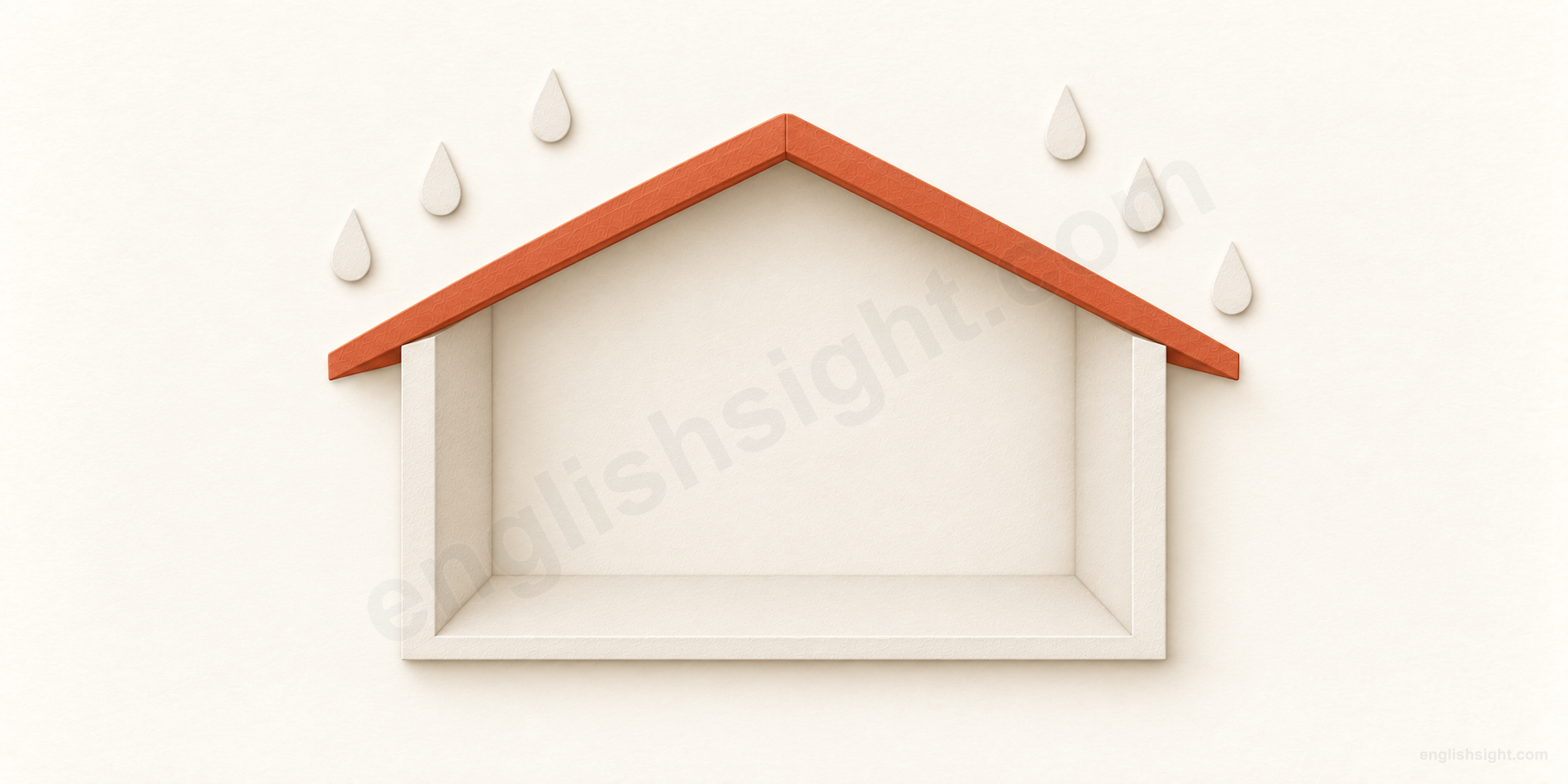
Recognize a roof, then understand how it stands for shelter, a shared home, or an imagined upper boundary.
The covering over a space
The covering over a space
Rain falls outside the building.
roof
The interior lies beneath the covering.
The roof spans the top of the space.
The roof covers the space from above; a roof can also be flat.
A roof forms the top covering or upper boundary of a space.
The building sketch highlights an overhead covering and the interior below it. Mouth and cave uses share the upper-boundary relationship; idioms add meanings that this picture alone cannot predict.
Roof most often names a building’s top covering. It also names the top of a vehicle or the upper boundary of an enclosed space. Start with the relation between what is above and the space below.
Home expressions use the covering to stand for accommodation. Other phrases, such as hit the roof, have conventional meanings that must be learned with the whole expression.
01
Coverings and upper boundaries
Start with a building, then recognize the same upper position in vehicles, caves, and the mouth.
01
a/the roof; the roof of + building; on/in the roof
the roof of a building
the structure covering a building from above
Situation / reference
The walls surround the rooms.
Relationship / result
The roof covers the space above them.
Roof names the upper covering, whether flat or sloping.
Use a roof when first introducing one and the roof when the building makes it identifiable: The shed needs a roof; the roof must be waterproof. A tiled roof describes its covering material; a flat roof describes its shape. Flat-roofed is an adjective, as in a flat-roofed garage.
On the roof locates something on the upper surface; a hole in the roof is an opening in its structure. A leaking roof lets water through. The ceiling is the surface you look up at inside a room; the roof is the covering of the building. They are not interchangeable in an ordinary house.
In a sentence
There is a small hole in the garage roof.
Watch the difference Use the standard plural roofs: two roofs or a new roof. Roof is countable here; adding -s does not change the spelling to rooves.
02
a car roof; the roof of + vehicle
the roof of a car
the top covering above a vehicle’s occupants
Situation / reference
Passengers sit inside a car.
Relationship / result
The car’s roof is above them.
The same covering relationship applies to a vehicle.
The roof is the part over the passenger space, not the bonnet or hood over the engine. A car roof and the roof of a car name the same part; the first noun tells us what the roof belongs to.
We put something on the roof when it is above the car, not inside it. This is a physical extension of the building sense, not an idiom. A convertible can have a roof that folds or opens.
In a sentence
Snow covered the roof of our car.
Watch the difference Do not use roof as a general name for every upper panel of a vehicle.
03
the roof of + cave/tunnel/mine
the roof of a cave
the upper surface over an underground space
Situation / reference
A cave contains an open space.
Relationship / result
Rock forms its upper boundary.
A natural space can have a roof without a constructed building.
In a cave, tunnel, or mine, roof names the rock or other material directly overhead. It extends the upper-boundary relationship; it does not imply that someone built a protective covering.
The roof may be low, cracked, or supported. A collapse means that the material above the space falls down. Keep the whole phrase: the roof of the cave tells us which upper boundary is meant.
In a sentence
We could not stand upright because the cave roof was so low.
Watch the difference A roof need not be triangular, tiled, or man-made.
04
the roof of + possessive + mouth
the roof of your mouth
the upper surface inside the mouth
Situation / reference
Your tongue is inside your mouth.
Relationship / result
The surface above it is the roof of your mouth.
The mouth has an upper internal boundary, not a weatherproof cover.
The roof of your mouth is the part at the top inside your mouth. It is also called the palate. Use a possessive that matches the person: the roof of my mouth, her mouth, or your mouth.
This is an established body-part expression based on position. It does not refer to the lips or the outside of the head. You can touch this surface with your tongue or burn it on hot food.
In a sentence
The hot soup burned the roof of my mouth.
Watch the difference Keep of: the roof of my mouth, not my roof mouth.
02
Putting a roof on something
Use roof as a verb when workers supply an overhead covering, and name the material when it matters.
05
roof + object; roof + object + over/in; be roofed with/in + material
roof a building / roof it over
provide a building or open area with a roof
Situation / reference
The new shed has walls but no top covering.
Relationship / result
Workers fit a roof above the space.
The noun becomes a verb meaning supply the covering.
Roof is also a transitive verb: workers roof a shed. The building or area is its object. The passive is useful when the material matters more than the workers: The shed was roofed with metal sheets. Roofed with or roofed in can introduce the roofing material.
Roof over and roof in emphasize covering a previously open space. We plan to roof over the courtyard means add an overhead covering. With a pronoun, roof it over is natural. These construction-work uses do not create a general family of unrelated particle meanings.
In a sentence
The builders roofed the shed with recycled metal sheets.
Watch the difference Forms are roofs, roofed, roofing. Roofed is also used in compound adjectives; it does not always describe a new action.
03
Shelter and sharing a home
In these expressions, a roof stands for accommodation or the building where people live and services are offered.
06
have/keep a roof over + possessive + head(s); put a roof over someone’s head
a roof over your head
somewhere to live
Situation / reference
A person needs accommodation.
Relationship / result
They have a place that provides shelter.
The covering stands for the home as a basic need.
Have a roof over your head means have somewhere to live. Put or keep a roof over someone’s head focuses on providing or maintaining that accommodation, often when discussing money or hardship.
The phrase does not promise ownership, comfort, or a large house. A rented room can provide a roof over your head. Change the pronoun and number naturally: a roof over my head; a roof over our heads.
In a sentence
Her wages keep a roof over the family’s heads.
Watch the difference This is about accommodation, not merely standing beneath any overhead surface.
07
under one/the same roof; live under the same roof as + person
under one roof / under the same roof
in the same building or home
Situation / reference
People or services could be in different places.
Relationship / result
They are together in a single building.
One covering stands for a shared location.
Under one roof often highlights convenience: several services are available in one building. Under the same roof commonly describes people living together. Both can refer to a single shared building; they do not require everyone to occupy one room.
Use live under the same roof as someone when naming the other person. Shared accommodation does not itself imply friendship, family membership, or agreement. The expression tells us where the people are, not how they get along.
In a sentence
The new centre has a library and a café under one roof.
Watch the difference Use the same roof, not a same roof. This expression is about a shared location, not simply nearby buildings.
08
under + possessive/person’s + roof
under my roof
in my home
Situation / reference
A host is responsible for a home.
Relationship / result
Someone is staying in that home.
The possessive identifies whose home is involved.
Under my roof means in my home, and under her roof means in hers. The home is identified through the person connected with it; the phrase is not a claim about whose name is on a legal ownership document.
It can sound welcoming or protective: You will always be welcome under our roof. In a rule such as No smoking under my roof, it can emphasize the householder’s authority. That tone comes from the sentence and situation, not from roof alone.
In a sentence
You will always be welcome under our roof.
Watch the difference Under one roof emphasizes a common location; under my roof identifies a particular person’s home.
04
High levels, strong reactions, and public noise
Read these conventional expressions as wholes. The subject and situation distinguish sharp increases, anger, loudness, announcements, and nervousness.
09
prices/costs/demand + go through the roof; be through the roof
prices go through the roof
prices or other levels rise very sharply
Situation / reference
Bills are at an earlier level.
Relationship / result
They increase to a strikingly high level.
The idiom treats a roof as an imagined upper boundary.
In informal English, when prices, costs, or demand go through the roof, they rise dramatically. The subject is something measurable, rather than the roof of a real building. The boundary image can help you remember the phrase, but the meaning belongs to the established expression.
With be, through the roof can describe an extremely high level: Our heating bills are through the roof. Go emphasizes the increase; be emphasizes the high state. Neither expression supplies a numerical threshold or means that a legal price limit has necessarily been broken.
In a sentence
Heating costs went through the roof during the cold winter.
Watch the difference Look at the subject: costs going through the roof describes an increase; a person going through the roof can mean anger.
10
person + hit the roof / go through the roof
hit the roof / go through the roof
suddenly become very angry
Situation / reference
Someone receives unwelcome news.
Relationship / result
They react with intense anger.
With a person as subject, the expression can describe an angry reaction.
In informal English, a person who hits the roof becomes extremely angry. Go through the roof can have the same meaning. No literal jumping or damage is required; the complete expression supplies the emotional meaning.
Compare My landlord hit the roof with The rent went through the roof: the first reports anger, the second a sharp increase. Context matters. The ordinary past of hit remains hit: She hit the roof when she heard. Do not replace the roof with a roof in the idiom.
In a sentence
My manager hit the roof when he discovered the missing files.
Watch the difference Raise the roof usually describes loud noise, not this specific change into anger.
11
people/cheers/voices + raise the roof
raise the roof
make a great deal of noise, often by cheering or singing
Situation / reference
A crowd is watching a performance.
Relationship / result
Their loud cheers fill the building.
The expression exaggerates the force of the sound.
To raise the roof is to make a very loud noise, for example by cheering, shouting, or singing. People or their voices can be the subject. It often describes enthusiastic applause, but loudness does not always imply happiness.
The idiom does not report an actual roof moving. In a building-work context, raise the roof can instead be literal: builders may lift it to add space. Read the situation rather than assuming every occurrence is an idiom. Hit the roof, by contrast, points to anger.
In a sentence
The fans raised the roof when the team returned to the stage.
Watch the difference Do not use raise the roof just to mean raise a price; costs go through the roof.
12
shout + news/something/it + from the rooftops
shout it from the rooftops
tell people about something very publicly
Situation / reference
Someone has news they are eager to share.
Relationship / result
They want everyone to know.
A high public place is an image for a public announcement.
A rooftop is the outside top of a building. Shout something from the rooftops is an established expression for making it widely known. A speaker may be excited or emphatic without literally standing on a roof or shouting.
The thing announced is the object of shout, and from the rooftops follows it: shout the news from the rooftops; shout it from the rooftops. This is different from raise the roof, which emphasizes the volume of noise, not making particular information public.
In a sentence
After months of keeping the award secret, she wanted to shout it from the rooftops.
Watch the difference Keep the conventional plural rooftops in this expression.
13
be + like a cat on a hot tin roof
like a cat on a hot tin roof
very nervous and restless
Situation / reference
A person waits for an important result.
Relationship / result
They cannot relax or keep still.
This longer idiom supplies the nervous image as a whole.
Like a cat on a hot tin roof describes someone who is very nervous and restless. The imagined cat cannot settle comfortably on the hot surface. It is a vivid comparison, not a new independent meaning of roof.
Use be like a cat on a hot tin roof or describe someone moving around like one. British English also has like a cat on hot bricks. Learn the expression as a unit rather than replacing its parts and expecting the same established meaning.
In a sentence
He was like a cat on a hot tin roof while he waited for the interview.
Watch the difference This phrase describes nervous agitation, not necessarily anger or a high temperature in the room.
Keep the covering and the whole expression apart
Roof, ceiling, and rooftop
A roof covers a building; a ceiling is the upper surface of a room’s interior; a rooftop is the outside top of a building. In an ordinary house, a stain on the ceiling may be caused by a leak in the roof above it.
Forms and grammar
Roof is usually a countable noun: a roof, several roofs. The regular verb has roofed and roofing and is often passive. It can be progressive during building work: They are roofing the new shed this week. Roofed with metal names the covering material.
An image is a guide
The physical upper covering helps connect several uses. Anger, noise, and nervousness belong to particular expressions; a drawing cannot establish their meanings or predict arbitrary new combinations.
Read the situation and the whole phrase
Choose the expression that matches the intended meaning.
1. You are inside a bedroom, looking up at the painted surface directly above you. What is it usually called?
2. Your electricity bill has risen dramatically. Which sentence describes the change?
3. Your brother was extremely angry when he saw his broken phone. Which phrase fits?
4. A clinic, a pharmacy, and a café are all in one building. How can you describe their location?
5. Workers have just fitted metal sheets as the shed’s top covering. Which sentence describes their work?
Sources and teaching notes
Dictionary entries support the usage inventory below. Explanations and examples are original; the upper-covering diagram is a teaching model.
The diagram highlights a useful relationship; it does not claim every speaker imagines the same picture.