Roots anchor plants; sources and strong connections give the word wider uses.
An underlying source or firm attachment
An underlying source or firm attachment
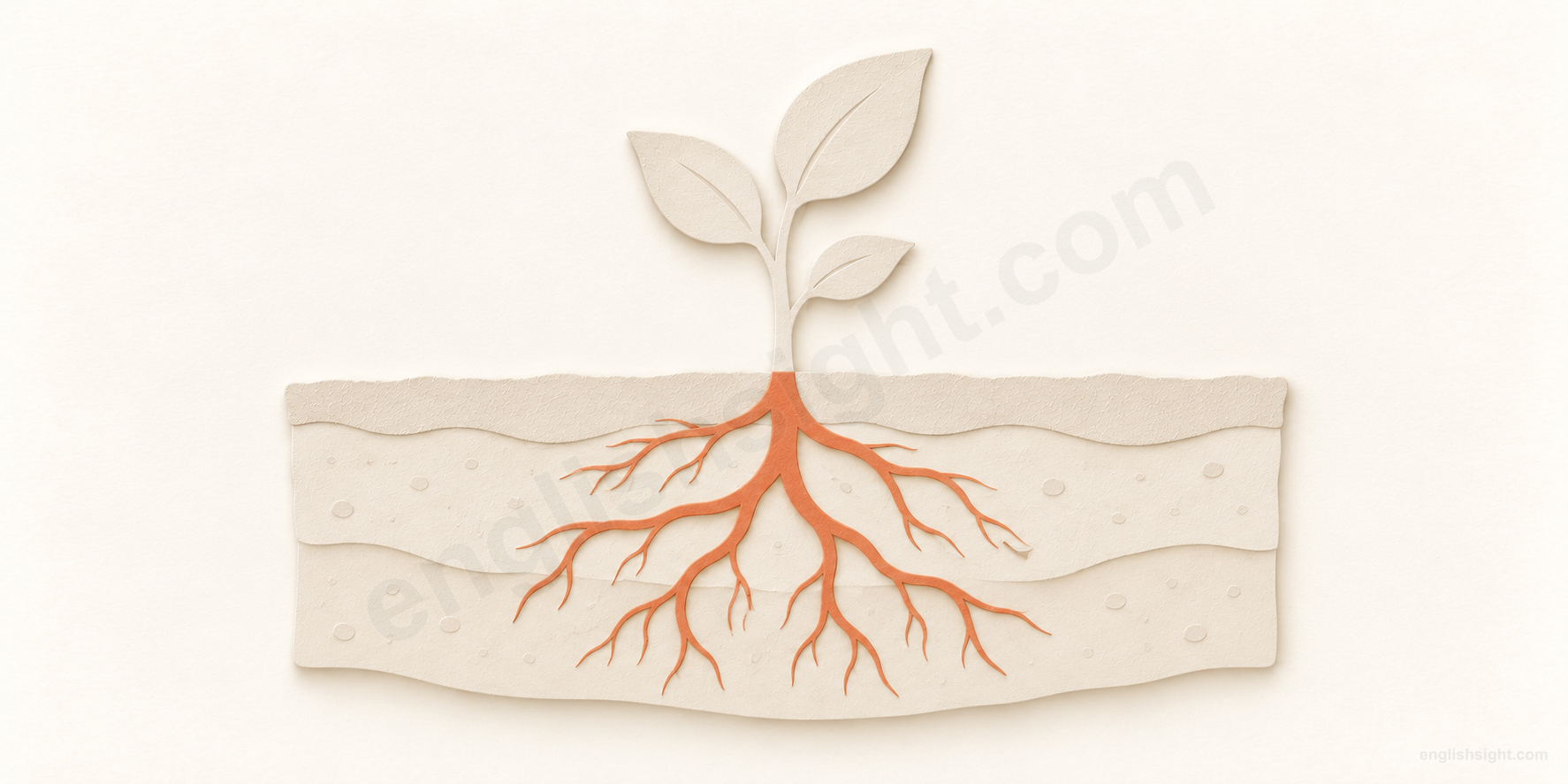
An ivory stem and three leaves rise above the soil.
root
Terracotta roots branch downward and outward through the soil.
The stem connects directly to the roots at the soil surface.
The connected roots beneath the surface support the visible plant.
A plant’s roots anchor it and take in what it needs to grow. Many figurative uses highlight a source, basis, or lasting connection.
The sketch shows a relationship within one plant, not a before-and-after transformation. Searching, cheering, and technical meanings require their own conventions.
A root can be part of a plant, the cause of a problem, or a connection with your background. Several meanings highlight an underlying source or a firm attachment.
That connection is a teaching model, not a rule for guessing every expression. Root around and root for need their own explanations, and no single picture represents every English speaker’s thoughts.
01
Plants, food, and the body
Begin with actual roots, then notice what changes when root becomes a verb or modifies another noun.
01
a root; the roots of + plant; root system
the roots of a plant
the parts that anchor a plant and take in water and minerals
Situation or starting point
A plant grows above the soil.
Meaning in this situation
Its branching roots spread through the soil below.
Root names a plant part; stem names the part that bears leaves.
A root is countable: one root, several roots. We often use the plural when speaking about the whole network under a plant. The root system means that network together.
The diagram shows a typical plant in a soil cross-section. Roots are usually underground, but being underground alone does not make every plant part a root.
In a sentence
The roots of the young tree spread beyond the pot.
Watch the difference Do not use root as the ordinary word for a leaf-bearing stem or a tree trunk.
02
root + vegetables / crops
root vegetables
vegetables grown for edible underground parts
Situation or starting point
You choose vegetables for a soup.
Meaning in this situation
You select carrots and other root vegetables.
Root modifies the following noun and normally stays singular.
Root vegetables and root crops are useful food and farming terms. Carrots are a clear example: the enlarged root is the part we eat.
This everyday food category can be broader than a strict botanical classification. Learn the category without assuming that every underground vegetable is technically a root.
In a sentence
We roasted carrots and other root vegetables.
Watch the difference Say root vegetables, not roots vegetables. The plural ending belongs on vegetables.
03
the root of + tooth / hair; my roots
the root of a tooth / hair
the embedded or attached base of a body structure
Situation or starting point
The visible part of a tooth sits above the gum.
Meaning in this situation
Its root anchors it below the gum.
The attachment or base is the relevant connection with a plant root.
A tooth root and a hair root are not plant parts. Root names their embedded base. The roots of your hair are at the scalp, rather than at the free ends.
In hair-color conversation, My roots are showing refers to new growth near the scalp whose natural color differs from the dyed lengths. Context supplies hair without saying it again.
In a sentence
My dark roots are showing beneath the blonde dye.
Watch the difference Roots in this hair context does not mean split ends or family background.
04
plant + root; root + cutting; plant + take root
root a cutting / take root
develop roots, or help a plant develop them
Situation or starting point
A cutting has a stem and leaves but no roots yet.
Meaning in this situation
New roots form and the cutting can establish itself.
Root can be a verb with or without an object.
The cutting is rooting describes the plant developing roots. We are rooting the cuttings describes people encouraging that growth. The cutting is the subject in the first pattern and the object in the second.
The cuttings have taken root reports successful root development. The roots are not something the plant picks up elsewhere: take root is an established expression.
In a sentence
The cuttings have taken root in their new pots.
Watch the difference Keep root singular in take root. Put down roots is another expression for developing roots.
05
root up + plant; root + plant / pronoun + up
root a plant up
pull or dig a plant out with its roots
Situation or starting point
An unwanted plant is established in the soil.
Meaning in this situation
You remove the plant, including its roots.
Up here marks removal from the ground, rather than new root growth.
Root up is a separable phrasal verb: root up the weeds or root the weeds up. With a pronoun, say root them up.
Pull a plant up by the roots describes the same kind of complete physical removal. Uproot is a useful one-word alternative. This is the opposite practical outcome from rooting a cutting.
In a sentence
We rooted the weeds up before planting the flowers.
Watch the difference Root the cutting means encourage roots; root the cutting up means remove it from the ground.
02
Causes, origins, and basic elements
The underlying part becomes a useful model for a cause, an origin, an identity, or a meaningful word element.
06
the root of + problem; root cause; at the root of; get to the root of
the root of the problem
the underlying cause rather than just a visible effect
Situation or starting point
The same error keeps returning after small repairs.
Meaning in this situation
You investigate the cause that keeps producing it.
The root is the cause; a symptom is a sign or effect.
The root of a problem names its fundamental cause. A root cause is the same idea in a compound noun. At the root of the problem locates that cause: Poor communication is at the root of the problem.
Get to the root of the problem means discover or understand that cause. It does not by itself say that the problem has been solved. The plant image helps connect an unseen basis with visible consequences.
In a sentence
We need to get to the root of these repeated delays.
Watch the difference Finding the root cause and removing it are separate steps; do not promise a solution merely by saying get to the root.
07
have + possessive + roots in + source; share a common root
have its roots in…
develop from an earlier source or tradition
Situation or starting point
A modern festival has a long history.
Meaning in this situation
You identify the older customs it developed from.
In names the origin; it need not name a physical location.
A tradition has its roots in earlier practices means those practices helped give rise to it. The plural roots allows several influences, although a common root can name one shared origin.
Have its roots in reports origin or basis. It does not necessarily mean that the present thing still looks exactly like its source. Compare the root of the problem, which focuses on cause rather than cultural history.
In a sentence
The festival has its roots in local harvest celebrations.
Watch the difference Make the possessive agree with the subject: the festival has its roots; the festivals have their roots.
08
my / your / their roots; return to + possessive + roots; trace + possessive + roots
my roots / go back to my roots
family origins and lasting cultural or personal connections
Situation or starting point
Your family came from a place you no longer live in.
Meaning in this situation
That background remains part of your identity.
Personal roots are usually plural and commonly follow a possessive.
My roots can refer to family background, culture, or connections formed by growing up somewhere. The expression is broader than an address or birthplace.
Go back to your roots or return to your roots can mean revisiting that background, including earlier creative influences. Trace your roots means investigate your ancestry. None of these expressions requires literal roots.
In a sentence
She returned to her musical roots for her latest album.
Watch the difference I have roots in a place describes a connection; I live there describes present residence. One does not guarantee the other.
09
at root, + clause; clause + at root
at root
at the most basic level
Situation or starting point
Two proposals look very different on the surface.
Meaning in this situation
You recognize the same basic concern behind both.
At root comments on the underlying nature of a whole claim.
At root means fundamentally. It can introduce a sentence or occur later: At root, this is a question of trust; The disagreement is about trust at root.
Compare at the root of the disagreement: that longer phrase introduces a cause and needs an of-complement. At root works on its own. This is a fixed expression, not a freely interchangeable article choice.
In a sentence
At root, both plans aim to give children more time to play.
Watch the difference Do not insert of into At root, both plans…; use at the root of only when a following noun phrase is needed.
10
the root of + word; a common root
the root of a word
the basic meaningful element from which related words are formed
Situation or starting point
You compare help, helpful, and unhelpful.
Meaning in this situation
You identify help as their shared meaningful base.
Root belongs to word structure here, rather than to a sentence’s main topic.
A root carries a word’s central lexical meaning. In helpful and unhelpful, help is the root; the added parts contribute further meaning.
Some roots occur as complete English words and others do not. Recognizing a root can help you understand a word family, but it cannot safely predict every modern word meaning.
In a sentence
Help is the root of helpful and unhelpful.
Watch the difference A prefix or suffix is an added element; it is not automatically the root.
03
Becoming established or staying fixed
These expressions use the idea of roots to describe belonging, acceptance, strong beliefs, and sudden immobility.
11
put down roots + in + place
put down roots
settle somewhere and build lasting connections
Situation or starting point
You have moved frequently and know few neighbors.
Meaning in this situation
You make one place your home and build a life there.
The plant image becomes a model of belonging and stability.
People put down roots when they settle and become connected to a place. Staying, making friends, and joining community life can all contribute; buying property is not required.
The expression also has a literal plant use. A business or organization can put down roots in an area when it becomes firmly established there. With people, the phrase describes settling and belonging; it is not about putting an object on a table.
In a sentence
After years of moving, we put down roots in a small coastal town.
Watch the difference Use plural roots in this expression. Take root uses singular root and often describes an idea becoming established.
12
idea / belief / custom + take root + in / among + people
an idea takes root
an idea or practice becomes established
Situation or starting point
A few people try a new way of sharing tools.
Meaning in this situation
The practice gains acceptance and begins to last.
Taking root marks establishment, not proof or universal acceptance.
An idea, belief, or custom takes root when it becomes established in a person or community. The image connects acceptance with a plant gaining a lasting hold.
The subject is the idea or practice: The habit took root. This intransitive expression has no direct object and no normal passive. The past form is took root, and the perfect form is has taken root.
In a sentence
The idea of a shared garden soon took root among the neighbors.
Watch the difference Do not say took roots here. Put down roots is the different plural expression.
13
be + (deeply / firmly) + rooted in + source
be rooted in…
have a strong origin or basis in something
Situation or starting point
A community’s rules reflect older customs.
Meaning in this situation
Those customs remain the basis for the rules.
In introduces the basis, influence, or origin.
Be rooted in connects a present belief, practice, or problem to a strong underlying source. The phrase often describes an established relationship rather than an action someone is carrying out now.
Deeply or firmly can strengthen it: The policy is firmly rooted in local experience. Compare rooted to the spot, where to introduces a fixed position, not a source.
In a sentence
Their teaching approach is rooted in practical experience.
Watch the difference Use in for a basis or origin: rooted in experience, not rooted from experience.
14
deep-rooted + noun; deeply rooted + noun
a deep-rooted belief
a belief or feeling that is firmly established and hard to change
Situation or starting point
A fear has developed over many years.
Meaning in this situation
It remains strong despite reassurance.
Depth emphasizes strength and persistence; it does not identify the source.
Deep-rooted is an adjective for feelings, beliefs, or problems that are firmly established. A deeply rooted fear expresses the same kind of strength.
A belief rooted in experience names a basis. A deep-rooted belief emphasizes how firmly the belief is held, without necessarily telling us where it came from.
In a sentence
She has a deep-rooted fear of deep water.
Watch the difference Write a deep-rooted fear, but a deeply rooted fear: the -ly adverb normally takes no hyphen.
15
be / stand / remain + rooted to the spot
be / stand rooted to the spot
be unable to move because of fear, surprise, or shock
Situation or starting point
A sudden crash startles you.
Meaning in this situation
You remain motionless instead of stepping away.
The body feels fixed in place, as if it had roots.
Rooted to the spot is figurative: the person is not physically growing roots. It describes a reaction that leaves someone motionless, often briefly.
Common verbs are be, stand, and remain: He remained rooted to the spot. This is a fixed expression; to identifies the position where the person seems stuck.
In a sentence
When the alarm sounded, I stood rooted to the spot.
Watch the difference Do not replace the spot with the root or use rooted in the spot for this idiom.
04
Searching, supporting, and removing
Read the whole expression. Searching and cheering are separate branches; out, for, and around are not interchangeable.
16
root (around / about) in + place + for + item; root through + contents
root around / through / in…
search by moving things about
Situation or starting point
Your key is somewhere in a crowded drawer.
Meaning in this situation
You move the contents around while looking for it.
The place follows in or through; the wanted item can follow for.
Root around in a drawer and root through a bag describe informal searching. British English also uses root about. Unlike look at, this usually suggests disturbing or turning over the contents.
Pigs can root in the soil for food, using their snouts. The search verb has a distinct history from the plant noun; do not try to derive every use from the diagram.
In a sentence
I rooted through my bag for the missing key.
Watch the difference In and through come before the place or contents being searched: root through it, not root it through. Compare rooting for you, which usually means supporting you.
17
root for + person / team
root for someone
support someone and hope they succeed
Situation or starting point
Your friend is about to enter a competition.
Meaning in this situation
You support your friend and hope they succeed.
For names the person or team receiving encouragement.
I’m rooting for you is informal encouragement for a competition or a difficult task. Root for a team also means support that team; audible cheering is possible but not required.
Keep for before the person: We are rooting for her. The progressive is very natural for support during an ongoing challenge. You need not tell the person or cheer aloud. This expression does not normally form a passive; learn it separately rather than as a plant metaphor.
In a sentence
Good luck with your audition—we’re all rooting for you.
Watch the difference Rooting for a key can mean searching for it; rooting for a friend usually means supporting the friend. Read the situation.
18
root out + problem; root + object / pronoun + out
root out a problem
find and eliminate something harmful
Situation or starting point
Dishonest practices keep recurring in an organization.
Meaning in this situation
An investigation identifies and removes them.
In this use, out marks removal; merely noticing a problem is not the full meaning.
Root out often takes a harmful practice such as fraud or corruption. It suggests thorough discovery and removal, with the force of pulling something out at its source.
It is separable: root out the problem or root the problem out; with a pronoun, root it out. The passive is natural: The fraud was rooted out. With people, it can imply finding and forcing them out, so the tone can be harsh.
In a sentence
The new checks helped us root out fraud in the payment system.
Watch the difference Get to the root of a problem means understand its cause; root it out includes getting rid of it.
19
root out + wanted thing; root + pronoun + out
root out an old photograph
find something after a determined search
Situation or starting point
A photograph is buried among stored papers.
Meaning in this situation
You eventually find it after searching.
This sense involves finding; the object need not be harmful.
Root out can also mean locate something hard to find. I rooted out an old photograph says you found it; it does not say you destroyed it.
Compare I rooted around in the box, which describes the search without guaranteeing a find. Root out names the successful discovery in this use. The object’s nature and context distinguish it from eliminating a problem.
In a sentence
I finally rooted out the photograph you wanted.
Watch the difference Do not assume that every root out sentence means remove something bad.
Root and branch together suggest the whole structure.
Reform something root and branch means change it thoroughly. Destroy or eliminate something root and branch means remove it completely. The phrase is especially useful to recognize in formal discussion and writing, rather than as a neutral word for every small change.
Before a noun, it can be written with hyphens: a root-and-branch review. Here the phrase modifies review. It does not mean that actual plants are involved.
In a sentence
The committee recommended a root-and-branch review of the rules.
Watch the difference A root cause is a fundamental cause; a root-and-branch review is a comprehensive review. They are not interchangeable.
05
Recognize roots in school and computing
These brief technical branches explain expressions a learner may meet without turning the lesson into a specialist manual.
21
the square / cube root of + number; a root of + equation
square root / cube root
a number that produces another through repeated multiplication
Situation or starting point
You know that 5 multiplied by itself gives 25.
Meaning in this situation
You describe 5 as a square root of 25.
The mathematical meaning follows a specific operation, not visible plant growth.
A square root gives the original number when multiplied by itself. A cube root uses three equal factors: 2 × 2 × 2 = 8, so 2 is the cube root of 8.
In elementary arithmetic, √25 denotes the nonnegative square root, 5. The equation x² = 25 has two real solutions, 5 and −5. Root can also mean a value that satisfies an equation; more advanced mathematics is outside this lesson.
In a sentence
The square root of 25 is 5.
Watch the difference Root here is a technical noun. You cannot calculate a square root by dividing the number by two.
22
the root directory; root user / access; root + device
root directory / root user
the top of a directory hierarchy, or an account with full system control
Situation or starting point
Folders form a hierarchy on a computer.
Meaning in this situation
You distinguish its top directory from an administrator’s privileges.
The directory and the user are different computing concepts.
A root directory is the top-level directory in the hierarchy being discussed. Files and other folders are organized beneath it. Root points to a structural base even though diagrams often place it at the top.
A root user or root access concerns full administrative control in relevant operating systems. Rooting a device means obtaining that kind of privileged access. These are technical uses; this lesson teaches recognition rather than device procedures.
In a sentence
Save the file in the project’s root directory.
Watch the difference Being in a root directory does not by itself mean that you are logged in as the root user.
Keep the connection and the limits
Forms and grammar
The noun is countable in its main senses, with plural roots. Personal background usually takes plural roots; the cause of a problem is often singular. Verb forms are root, roots, rooted, rooting. Rooting a plant and rooting around are activities, so progressive forms are possible.
Objects, passives, and small words
Root a cutting has an object; the cutting roots does not. Transitive root up and root out allow pronouns before the particle and can be passive. Use root for someone in the active, rather than making the supported person a passive subject. Be rooted in often describes a state. There is no need to invent a general root someone to do causative construction.
Separate branches and register
The search and support verbs are not predictable extensions of plant growth. Root for is informal. Australian and New Zealand English also use root as taboo sexual slang; keep the full expression and audience in mind. That slang is not developed into practice activities here.
Scope of the lesson
The course covers common everyday families and a few useful technical terms, without a frequency ranking. Specialist music, advanced mathematics, detailed computing procedures, and separate compounds such as root beer and grassroots are not developed here.
Choose the whole expression
Use the situation, the following words, and the intended result to decide.
1. A friend has an important interview. Which sentence offers encouragement?
2. You discover why a delay keeps happening, but have not fixed it yet. Which sentence fits?
3. A family settles in a town and builds lasting friendships. Which expression fits?
4. Someone finally roots out an old receipt. What happened?
5. A teaching method developed from long practical experience. Which phrase names its basis?
6. New roots have appeared on a cutting. Which sentence reports that growth?
Sources and teaching notes
Word senses and constructions were checked against the linked publisher pages. The explanations, examples, and teaching model were written for this lesson.
The diagram is a teaching connection, not a shared mental picture for all native speakers.