Use the surrounding words to tell texture, difficulty, and approximation apart.
Unevenness as a starting point
A useful contrast: lacking smoothness or finish
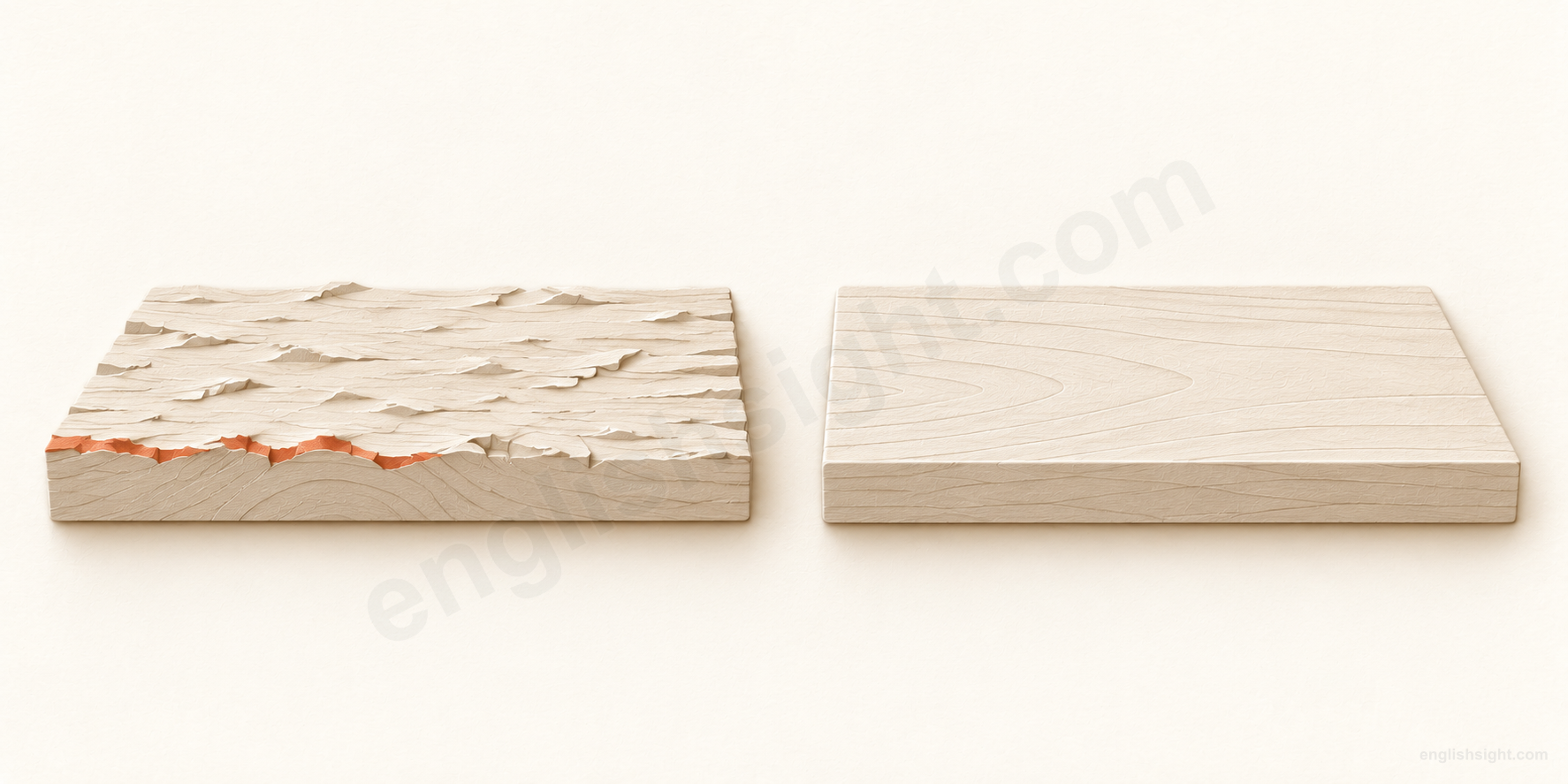
Left: uneven wooden surface
rough
Right: smooth wooden surface
Compare the textures; no change is shown.
Rough contrasts with smooth here. The texture comparison is a starting point, not a picture of every use.
Rough can describe something uneven, ungentle, or unpolished; the noun and the full expression tell us which kind of roughness matters.
The sketch compares textures. It does not show a required change: something rough need not become smooth. Approximate information may be useful, and fixed idioms require learning the whole expression.
Feel the uneven edge of a board and compare it with a smooth one. That contrast gives us a useful starting point for rough. English also uses the word for forceful treatment, difficult experiences, and work that has not been finished in detail.
These meanings form related teaching families, not a rule that predicts every expression. Rough justice and rough it need their own explanations. The model is a learning aid, not a claim that every English speaker pictures the same scene.
01
Texture, movement, and sound
Start with uneven surfaces, then notice how rough also describes unsettled water, jolting motion, and a harsh voice.
01
rough + noun; be / feel + rough
a rough surface
uneven or coarse to the touch
Situation
You touch a piece of wood before choosing it for a shelf.
What the expression communicates
You notice bumps and a coarse texture.
Rough describes the surface, rather than how strong the material is.
A rough surface has irregularities you can see or feel. Rough skin, rough hands, rough fabric, and a rough edge apply this idea to different materials. The opposite for texture is smooth.
Compare This board feels rough with This board is tough. Rough concerns texture; tough can concern strength or resistance to damage. A board can be both smooth and tough.
In a sentence
The underside of the shelf is still rough.
Watch the difference Hard means resistant to pressure; a hard surface can be perfectly smooth.
02
rough + ground / terrain / road / track
rough ground / a rough road
uneven ground that is difficult to cross
Situation
A route has stones, holes, and changing levels.
What the expression communicates
Walking or driving along it takes extra care.
The ground itself is irregular; the difficult journey is a consequence.
Rough ground, rough terrain, and a rough road describe an uneven surface that makes travel harder. Rough country may also be wild and hard to travel through.
A rough road need not have heavy traffic, and a rough track is not necessarily long. The description concerns its condition, not its length or the number of travelers.
In a sentence
We slowed down where the road became rough.
Watch the difference Do not use rough to mean steep alone: a smooth road can also be steep.
03
rough + sea(s) / weather / conditions; the sea is rough
rough seas / rough weather
water or weather with strong, unsettled conditions
Situation
The wind rises and large waves form.
What the expression communicates
A boat trip becomes uncomfortable or unsafe.
Rough water is agitated, rather than coarse to the touch.
A rough sea has substantial waves. Rough weather, especially in a sea-travel context, suggests stormy or windy conditions. The boat or its passengers do not have to be the cause.
The sea is rough describes conditions now. We had a rough crossing describes the journey through those conditions. Calm is a natural contrast for the sea; smooth is especially natural for the ride.
In a sentence
The ferry stayed in port because the sea was too rough.
Watch the difference Rough weather is not simply any weather you dislike; a hot, still day is not rough for that reason alone.
04
a rough + ride / flight / landing; an engine runs rough
a rough ride / run rough
movement or operation that is uneven and jolting
Situation
A vehicle shakes instead of moving steadily.
What the expression communicates
Passengers feel jolts, or a mechanic notices irregular running.
Here lack of smoothness belongs to motion or performance.
A rough ride, flight, or landing can be physically bumpy or jolting. This is separate from a figurative rough ride, in which someone faces difficulties or criticism.
An engine can run rough in informal usage: its operation is irregular. Rough is a flat adverb here. Runs roughly is possible too; this does not make rough a substitute for roughly in every sentence.
In a sentence
The engine runs rough when it is cold.
Watch the difference A rough flight describes how the flight felt or went; it does not necessarily mean the aircraft was damaged.
05
a rough voice; a voice is / sounds rough
a rough voice
a voice that sounds harsh rather than clear and smooth
Situation
Someone speaks after a long evening of shouting.
What the expression communicates
The sound is harsh or gravelly.
Rough transfers a texture contrast to the sound of a voice.
A rough voice describes its audible quality. It may reflect tiredness, emotion, illness, or a speaker’s usual voice; the adjective alone does not identify the cause.
Rude words are impolite in meaning or manner. A person can speak kindly in a rough voice. Rough can also describe a harsh taste, as in rough wine, but that use is less useful for a beginner than the voice expression.
In a sentence
His voice sounded rough after the concert.
Watch the difference Do not infer that the speaker is angry or impolite just from rough voice.
02
Treatment, places, and difficult experiences
Read the noun and the surrounding situation to distinguish force, danger, personal difficulty, illness, and established idioms.
06
be rough with + person / thing; rough handling / treatment; play rough
be rough with / rough handling
use force without enough care or gentleness
Situation
A child squeezes a kitten too hard.
What the expression communicates
An adult asks the child to handle it gently.
With names the person or thing receiving the forceful treatment.
Be rough with someone or something means handle or treat them without enough gentleness. Rough handling and rough treatment put the same description before a noun. A rough sport involves forceful physical contact, but rough does not automatically mean every action breaks the rules. In informal warnings, rough stuff means violent or forceful behavior: We want a fair game, with no rough stuff.
In Don’t play rough, rough works as an adverb modifying play. Roughly is the more general manner adverb: They handled the boxes roughly. Rough is not a verb in be rough with.
In a sentence
Please don’t be rough with the kitten.
Watch the difference Rough with is about treatment; it does not mean that the person’s skin has a rough texture.
07
a rough + area / neighborhood / part of town / crowd
a rough area
a place associated with violence or crime
Situation
Someone asks about a neighborhood’s safety.
What the expression communicates
The speaker describes it as dangerous.
Rough evaluates safety and behavior in a place, rather than its street surface.
A rough area, neighborhood, or part of town suggests violence, crime, or threatening behavior. A rough crowd similarly describes a group considered aggressive or troublesome.
This is an evaluative description, not a precise measure of safety. Say what you mean when accuracy matters: poorly lit streets or several reported assaults gives more specific information. Poverty alone does not establish that a place is rough.
In a sentence
They warned us that the station was in a rough area.
Watch the difference A rough road is uneven; a rough neighborhood concerns the social environment. Do not confuse the two.
08
have a rough + time / day / start; go through a rough patch; have it rough
have a rough time / go through a rough patch
experience a difficult or unpleasant period
Situation
Work problems and family worries arrive together.
What the expression communicates
Someone describes that period as hard to manage.
Time words turn physical unevenness into a teaching analogy for difficulty.
Have a rough time, have a rough day, and get off to a rough start describe unpleasant experiences or a difficult beginning. Have it rough is another informal way to say someone’s circumstances are difficult.
Go through a rough patch refers to a period of problems, for a person, relationship, business, or activity. Patch suggests a stretch within a larger story, but the expression does not guarantee that things will improve soon.
That’s rough is an informal sympathetic response to bad news. It acknowledges the difficulty; it does not describe a surface.
In a sentence
Our café went through a rough patch after the road closed.
Watch the difference Tough also works in a tough time, but tough can praise a resilient person; rough does not ordinarily express that praise.
09
event + be rough on + person; person + be rough on + person
be rough on someone
be hard for someone, or treat them harshly
Situation
A change causes a child distress, or an adult criticizes the child severely.
What the expression communicates
The speaker identifies who bears the difficulty or harsh treatment.
The subject tells you whether on introduces the affected person or the target of criticism.
The move was rough on the children means the experience was difficult or upsetting for them. Don’t be so rough on her means do not judge, criticize, or punish her so harshly. The first subject is an event; the second is a person behaving harshly.
This informal pattern is especially noted in British usage, though it also occurs in American English. Compare rough with her, which can point more directly to forceful handling. Context, not the preposition alone, settles the exact kind of treatment.
In a sentence
The sudden move was rough on the children.
Watch the difference On does not make rough a phrasal verb here: be is the verb and rough is an adjective.
10
feel / look rough; have a rough night
feel rough / look rough
feel unwell or look tired and unwell
Situation
You wake up with a headache and little energy.
What the expression communicates
You describe your physical condition informally.
The person’s condition, rather than their manners, is being described.
In British informal English, I feel rough means I feel ill or physically bad. You look rough can suggest visible tiredness or illness, and may sound blunt when said directly to someone.
A rough night often means a night with poor sleep or other difficulty. It does not necessarily involve alcohol. Compare My hands feel rough: there, hands makes texture the likely interpretation.
In a sentence
I’m still feeling rough, so I’ll stay home today.
Watch the difference Feeling rough is a regional informal expression, not a medical diagnosis or a statement about someone’s character.
11
give + person + a rough ride; have a rough ride
give someone a rough ride
make someone face opposition, criticism, or difficulty
Situation
A new proposal is discussed in a meeting.
What the expression communicates
The person presenting it faces hostile questions.
Give assigns the source of difficulty; have describes the person’s experience.
Give someone a rough ride is an informal idiom for making things difficult for them, often through criticism or opposition. Have a rough ride describes being on the receiving end.
The committee gave her a rough ride over the budget concerns its response to her proposal. The bus gave us a rough ride over the potholes can be literal. The surrounding situation selects the reading.
In a sentence
The committee gave the new director a rough ride over the budget.
Watch the difference A rough ride in a meeting does not require any travel.
12
get / have a rough deal; give + person + a rough deal
get a rough deal
receive unfair treatment
Situation
Two workers do the same work but receive different treatment.
What the expression communicates
One says the arrangement is unfair.
Deal names how someone is treated, not necessarily a purchase.
Get a rough deal and have a rough deal describe unfair treatment. Give someone a rough deal puts the responsible person or institution in subject position.
This expression is narrower than have a rough time: an experience can be difficult without anyone treating you unfairly. Explain the unfairness when the context does not make it clear.
In a sentence
Part-time staff got a rough deal under the old rules.
Watch the difference A deal here is treatment or an arrangement; no sale or negotiation is required.
13
rough and tumble; the rough and tumble of + activity; rough-and-tumble + noun
rough and tumble
energetic physical play, or aggressive competition
Situation
Children wrestle playfully, or rivals compete in a demanding public arena.
What the expression communicates
The activity includes pushing, struggle, or forceful competition.
The physical and figurative readings belong to the whole expression.
Rough and tumble can name lively, somewhat forceful play by children or animals: The puppies enjoyed some rough and tumble. This can be play rather than a serious fight.
The rough and tumble of politics describes aggressive competition and conflict in political life. Before another noun, use hyphens: rough-and-tumble play. Do not confuse this expression with rough-and-ready, which often means basic but serviceable.
In a sentence
She soon got used to the rough and tumble of local politics.
Watch the difference The figurative use does not claim that the politicians are literally wrestling.
14
it is rough justice that + clause; there is a kind of rough justice in + outcome
rough justice
an unfair outcome, or unofficial but arguably deserved consequences
Situation
An outcome seems unfair, or a wrongdoer suffers a fitting setback.
What the expression communicates
A speaker evaluates it using an established expression.
The context determines whether the speaker sees unfairness or a kind of fitting consequence.
It was rough justice that the better team lost calls the result unfair. By contrast, There was a kind of rough justice when the dishonest seller lost all his customers suggests an outcome the speaker sees as deserved, even without a formal judgment.
These are two established readings. Rough justice is not simply a synonym for justice delivered violently, and it does not identify a particular legal procedure.
In a sentence
It seemed rough justice that the team lost after playing so well.
Watch the difference Do not decide from rough alone whether the speaker thinks the result unfair or deserved; read the whole context.
03
Approximation, first versions, and lack of polish
Rough can be useful: an estimate or first draft supplies enough information before precise details and finishing are available.
15
a rough estimate / calculation of + amount; at a rough guess; as a rough guide
a rough estimate / at a rough guess
an approximate figure rather than an exact one
Situation
You need a budget before all the prices are known.
What the expression communicates
You offer a useful approximate amount.
Rough limits the precision of the number; it does not automatically make the number useless.
A rough estimate, calculation, or guess gives an approximate answer. As a rough guide introduces a general figure or rule to help planning. At a rough guess marks a number as a guess rather than an exact count.
A rough estimate of 200 dollars can be based on experience; an exact quotation would make a stronger claim. Use roughly 200 dollars when the adverb directly qualifies the amount, rather than rough 200 dollars.
In a sentence
At a rough guess, the repairs will cost two hundred dollars.
Watch the difference Approximate is not the same as careless: a rough estimate can be exactly what early planning needs.
16
have / give + a rough idea of + noun; have a rough idea + question-word clause
have a rough idea
know the general features without precise details
Situation
You remember the route but not every turn.
What the expression communicates
You can give someone a general description.
The missing precision concerns information, not a physical surface.
Have a rough idea of something means know its general shape or main features. Have a rough idea where it is uses a clause instead of an of-phrase. Give someone a rough idea offers that general information to them.
I have a rough idea what it costs gives a general expectation, not a firm price. I have no idea is stronger: it denies even that general knowledge.
In a sentence
I have a rough idea where the campsite is, but I need a map.
Watch the difference Rough idea does not necessarily mean a bad idea; rough describes how detailed or precise the understanding is.
17
a rough draft / sketch of + noun; write / draw something in rough
a rough draft / sketch
an initial version showing the main content without final polish
Situation
You write the main points before revising the wording.
What the expression communicates
There is a version to improve and discuss.
Rough describes the current level of finish rather than the final quality.
A rough draft is an early version of writing; a rough sketch shows main visual features without finished detail. These versions can contain useful thinking even when they still need correction.
Especially in British English, write or draw something in rough means produce an informal first version. In design work, a rough or several roughs can name preliminary drawings. These noun uses are less general than a rough draft.
In a sentence
I sent Maya a rough draft so she could check the main argument.
Watch the difference Rough does not promise that a later version exists already. A rough draft and a final draft are different stages.
18
rough + furniture / work / paper
rough furniture / rough paper
basic or unfinished materials and work
Situation
Someone builds a simple bench for practical use.
What the expression communicates
It works without fine finishing.
Lack of refinement may concern how something is made, not only its texture.
A rough wooden bench can be simply made, unfinished, or visibly coarse. Rough work can mean work at an early stage, but it can also mean hard physical work: We hired help for the rough work of clearing the site.
In British usage, rough paper is paper for notes, calculations, or drafts that do not need to be kept neat. It need not feel coarse. For international readers, scrap paper or paper for rough work may make the intended function clearer.
In a sentence
Use rough paper to work out the answer before you fill in the form.
Watch the difference Check the noun: rough paper for notes describes purpose, while rough-textured paper explicitly describes touch.
19
be rough around the edges; have (a few / some) rough edges
be rough around the edges
have small flaws or lack polish
Situation
A useful app still has awkward details, or a helpful person has blunt manners.
What the expression communicates
The main value is recognized alongside imperfections.
Literal uneven edges provide a teaching connection; the idiom can concern nonphysical details.
A performance, plan, product, or person can be rough around the edges. The phrase points to imperfections or a lack of polish. Have a few rough edges is a closely related form.
The new app is rough around the edges can acknowledge awkward details without rejecting the whole app. About a person, the expression may concern manners, but it does not by itself mean the person is violent or dishonest.
In a sentence
The app is useful, though it is still rough around the edges.
Watch the difference Do not interpret the idiom as a claim about an object’s physical boundary.
20
a rough-and-ready + method / guide / solution
a rough-and-ready solution
simple and quickly prepared, but adequate for the purpose
Situation
You need a workable answer before a polished system is available.
What the expression communicates
You choose a basic method that is good enough for now.
This expression combines limited finish with practical usefulness.
A rough-and-ready method, guide, or solution is basic and may be imprecise, but serves the immediate purpose. That usefulness distinguishes it from a criticism that something is merely badly made.
The expression can also describe a person with little social polish. That description can sound judgmental; it does not establish the person’s education, honesty, or ability. Hyphenate the phrase when it comes before a noun.
In a sentence
We used a rough-and-ready method to divide the work equally.
Watch the difference Ready here is part of the established expression; the phrase does not mean ready to become violent.
21
a diamond in the rough (North American); a rough diamond (British)
a diamond in the rough / a rough diamond
a person with good qualities beneath an unpolished manner
Situation
A person speaks bluntly but repeatedly helps others.
What the expression communicates
Someone recognizes the good qualities behind the manner.
The diamond metaphor contrasts value with an unpolished exterior.
A diamond in the rough is the North American form; a rough diamond is the usual British equivalent. For a person, these expressions recognize good qualities despite a manner that lacks social polish.
The literal phrase a rough diamond can also mean a diamond before cutting or polishing. In the idiom, diamond supplies the positive value; rough alone does not mean secretly excellent. Calling someone this can sound patronizing, even when intended kindly.
In a sentence
Jo can be blunt, but she is a rough diamond who always helps her neighbors.
Watch the difference Do not call every unfinished object a rough diamond; the positive judgment is essential to the figurative use.
04
Fixed expressions, particle verbs, and a noun
Learn the whole form. Rough it, sleep rough, rough something out, and rough someone up have different grammar and meanings.
22
rough it; roughed it; be roughing it
rough it
live temporarily without the usual comforts
Situation
Travelers stay in a basic cabin without hot water.
What the expression communicates
They manage without the comforts they normally have.
It is fixed in this idiom and does not name an object being made rough.
Rough it is an informal verb expression for managing with basic living conditions, often temporarily while traveling. It can involve camping, but a simple indoor cabin can count too.
The verb changes normally: we roughed it last summer; we’re roughing it this weekend. Keep it in each form. Unlike sleep rough, the expression does not normally imply homelessness.
In a sentence
We roughed it in a cabin with no electricity for two nights.
Watch the difference Say rough it, not rough ourselves. Rough it is an idiom, not an ordinary verb plus a replaceable object.
23
sleep / live rough
sleep rough / live rough
sleep or live outdoors without proper shelter
Situation
Someone has nowhere indoors to stay.
What the expression communicates
They spend the night outside.
This British expression concerns shelter, rather than the quality of sleep.
Sleep rough and live rough are British expressions for staying outdoors, usually because someone has no home. Rough is an adverb in this fixed pattern; no it follows.
I slept rough says where and under what conditions I slept. I had a rough night says the night was difficult or sleep was poor; it does not imply being outdoors. Roughing it can describe a chosen temporary lack of comfort, including indoors.
In a sentence
The charity helps people who are sleeping rough find safe shelter.
Watch the difference Do not use sleep rough merely to say you slept badly in your own bed.
24
rough out + noun; rough + noun / pronoun + out; be roughed out
rough something out
produce the main outline before adding details
Situation
A team needs a first plan to discuss.
What the expression communicates
Someone writes its main shape without final details.
Out belongs to the established particle verb for producing a preliminary outline.
Rough out a plan, sketch, or set of ideas means put down its main features before completing the details. It is transitive and separable: rough out the plan or rough the plan out; with a pronoun, rough it out.
The plan was roughed out yesterday is a normal passive. Compare work out the plan, which can involve solving or completing its details. Rough out specifically leaves refinement for later.
In a sentence
Let’s rough out a schedule before we book the rooms.
Watch the difference Use rough it out, not rough out it. This is different from rough it, meaning live without usual comforts.
25
rough + person + up; rough up + noun; be roughed up
rough someone up
physically attack and hurt someone
Situation
An attacker hits or manhandles another person.
What the expression communicates
A report describes the assault informally.
This particle verb names physical violence, not merely criticism.
Rough someone up is an informal separable phrasal verb meaning physically assault them. Say They roughed him up, not They roughed up him. A full noun can go in either position: rough up a passenger or rough a passenger up.
The passive is common in reports: He was roughed up outside the station. Compare The reviewer was rough on him, which can mean severe criticism without physical contact. The shared adjective does not make the expressions interchangeable.
In a sentence
The witness said two men had roughed him up outside the station.
Watch the difference This describes an assault. Do not use it for an ordinary disagreement or a harsh review.
26
take the rough with the smooth
take the rough with the smooth
accept the difficult parts together with the good parts
Situation
A person likes an activity but dislikes its setbacks.
What the expression communicates
Someone reminds them that both are part of the experience.
The rough and the smooth stand for contrasting sides of an experience.
Take the rough with the smooth is an established idiom about accepting bad or difficult experiences alongside good ones. The definite articles belong to the expression; rough and smooth refer to kinds of experience rather than particular surfaces.
It can express realism about a job or hobby. Used in response to someone’s serious difficulty, it may sound dismissive, so consider the listener and the situation.
In a sentence
Freelancing has quiet months as well as busy ones; you have to take the rough with the smooth.
Watch the difference Take means accept in this idiom; it does not describe carrying two physical objects.
27
the rough; in / into / out of the rough
in the rough
in the longer grass on a golf course
Situation
A golf ball misses the closely cut playing strip.
What the expression communicates
It lands in longer grass where the next shot is harder.
Here the rough names an area, not an adjective describing the ball.
In golf, the rough is the area of longer grass near the fairway. Hit into the rough and land in the rough describe where the ball goes or finishes. The noun normally appears with the in this use.
This is a useful recognition item for sports reports rather than a general expression for trouble. Contrast write it in rough, a British expression for making a first version; that phrase does not use the.
In a sentence
Her first shot landed in the rough beside the fairway.
Watch the difference Keep the sporting context: in the rough is not a general substitute for in difficulty.
Choose the meaning through the whole phrase
Forms and pronunciation
Rough is pronounced /rʌf/, with the final sound /f/. Its comparative and superlative are rougher and roughest. The verb forms are rough, roughs, roughed, roughing; roughed ends in /t/. The adjective can follow be, feel, look, sound, or get where the meaning fits: The sea got rough. Get rough describes a change; get is doing that grammatical work.
Rough and roughly
Use rough before a noun or after a linking verb: a rough estimate; the wood feels rough. Use roughly for an approximate amount or general manner: roughly ten minutes; handle it roughly. Fixed or informal flat-adverb uses include sleep rough, play rough, and an engine runs rough. They do not license rough ten minutes in place of roughly ten minutes. Roughness is the related noun for the quality.
Rough, tough, coarse, and rude
Rough and coarse can both describe texture, but coarse often emphasizes large particles or a thick texture. Tough can mean strong, resilient, hard to cut, or difficult; a tough person may be admirable. Rude specifically concerns impoliteness. A rough voice can belong to a polite person, and a rough draft can be a good beginning.
Read social descriptions with care
A rough area concerns perceived danger; rough around the edges concerns imperfections or manners; a rough diamond adds a positive judgment. None is an objective measure of a person’s worth. State specific behavior when a broad label would obscure what you mean.
The scope of this lesson
This lesson covers modern everyday adjective uses, familiar idioms, the main particle verbs, and selected noun/adverb uses. It gives recognition notes for golf and design. Technical machining, sports penalties called roughing, historical uses, and rare regional expressions are outside the main lesson. It does not claim a frequency ranking or every possible compound.
Read the situation and the construction
Choose the expression that fits the intended meaning. Check both the sense and the grammar.
1. You can offer an approximate repair cost, but the final price is not known. Which phrase fits?
2. You stayed in your own bed but woke repeatedly. Which sentence describes that without suggesting you slept outdoors?
3. You want to put a preliminary plan on paper. Which sentence places the pronoun correctly?
4. A basic holiday cabin has no hot water or electricity. You are willing to manage temporarily. Which expression fits?
5. A kind person speaks with a gravelly sound after shouting at a match. What does a rough voice tell you?
6. A critic is too harsh about a beginner’s mistake, with no physical contact. Which request fits?
7. The journey takes approximately ten minutes. Which form is standard?
8. A useful app still has small awkward details. Which statement acknowledges both the value and the flaws?
Sources and teaching notes
The sources below were consulted for meanings, constructions, regional labels, and idioms. The explanations, examples, and visual teaching model were created for this lesson.
The diagram is a teaching aid; it is not a shared mental picture claimed for every native speaker.