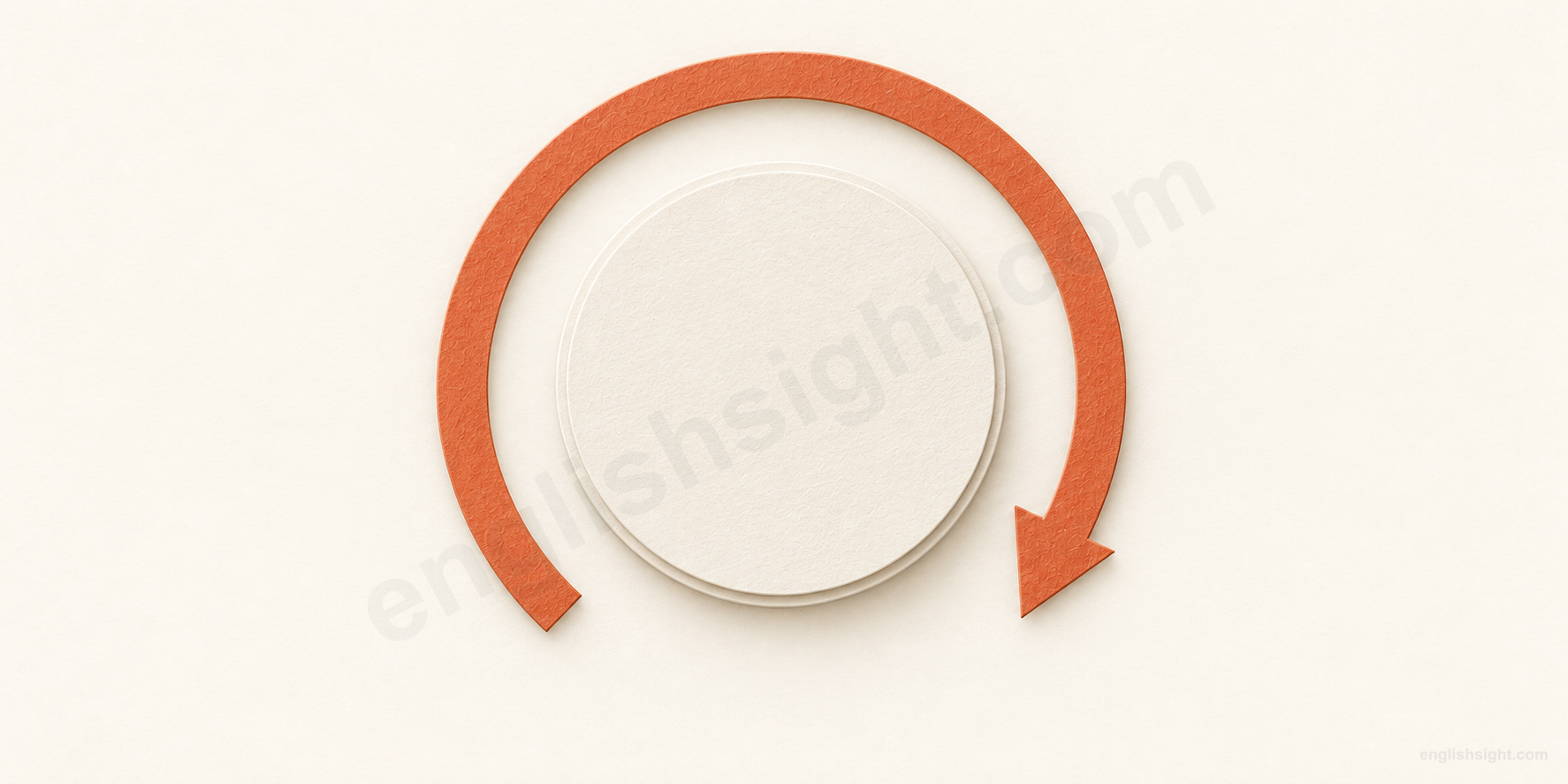
A curved outline, a turning path, a recurring cycle.
Connect round’s spatial uses, then learn its stages, numbers, and established expressions.
An outline or route curves around a center
An outline or route curves around a center
A round shape provides a central reference.
round
The route reaches the other side without closing the loop.
The orange route curves around its outside.
A curved outline and a route around it; a complete circuit is not required.
A useful starting model is a curved outline, or a path that turns around a center or reference point rather than going straight through it.
This spatial model links shape, surrounding positions, and turning routes. Stages, numerical rounding, visiting, and fixed expressions also require their own learned meanings; not every use traces a circle.
Round /raʊnd/ can describe a shape, relate something to a center, or count one stage or set of activity. Its grammar matters as much as its image: a round table, walk round the table, and a round of talks use different word classes.
For spatial and many particle uses, round is especially British; around is usually the American choice. This does not let you replace the adjective or noun: say a round ball and the next round, not an around ball or the next around.
01
Shape, sides, and turning paths
Start with a curved shape and paths or positions related to a center. Round does not always mean completing a full circle.
having a circular, ball-like, or smoothly curved shape
Situation / starting point
You choose the shape of a table.
Meaning / outcome
Its curved edge has no corners.
Round describes shape; it need not describe motion.
A plate can be round in its flat outline; a ball can be round in three dimensions. A round object need not be hollow like a ring.
In This table is round, round is an adjective after is. In a round table it comes before the noun. Rounder and roundest compare shapes that are more or less circular or ball-like.
Round eyes can suggest eyes opened wide in surprise or interest: Her eyes were round with surprise. That effect comes from the body description and context, not a separate motion.
Round can also describe a smooth curve without a complete circle: round hills have curved outlines. Round brackets are the curved punctuation marks ( ), unlike square brackets [ ].
In a sentence
We chose a round table so everyone could see one another.
Watch the difference Use circular for a specifically circular outline and spherical for a specifically ball-shaped object when precision matters. Around cannot replace this adjective.
02
sit / stand / gather + round + noun; put / wrap + object + round + noun
round the table / neck
on different sides of a reference point or enclosing it
Situation / starting point
Children take seats at a table.
Meaning / outcome
They occupy positions around it.
The central object organizes the surrounding positions.
With a following noun phrase, round is a preposition: round the table. Sitting round something describes position, even when nobody moves.
A scarf round your neck follows an enclosing curve. Put the scarf round your neck adds an action through put; round supplies the spatial relation.
Gather round can omit the reference object when it is understood: Gather round and listen. The group need not make a perfect geometric circle.
In a sentence
The children sat round the table while Mina read the letter.
Watch the difference Round the table does not mean on top of it. These preposition/adverb uses are especially British; around is the usual American choice.
03
go / walk + round + noun; turn / spin + round; round and round
walk round / spin round
follow a curved course or rotate
Situation / starting point
A path follows the outside of a pond.
Meaning / outcome
You travel along its curved route.
The route turns around a reference point rather than passing through it.
Walk round the pond usually suggests following its edge; the context tells you how much of the route you cover. Round alone does not guarantee a completed circuit.
A wheel goes round by rotating about its own axis. A planet goes round a star by orbiting an external center. The verbs and subjects distinguish the two movements.
Round and round emphasizes repetition: The wheel kept going round and round. A thought going round and round in your head similarly keeps returning.
In a sentence
We walked round the pond before going home.
Watch the difference Walk through the park goes inside it; walk round the park can follow its boundary or visit different parts, depending on context.
04
go / look + round + corner; round + a corner / bend
go round a corner / round a bend
pass along a curve to the other side
Situation / starting point
A bend hides the next part of a road.
Meaning / outcome
The bus follows the curve into that part.
A partial turn is enough; no complete circuit is required.
The bus went round the bend uses went plus the preposition round. The bus rounded the bend makes rounded the main verb, with the bend as its object.
Look round the corner means direct your view beyond it. Be round the corner locates something beyond a nearby turn, rather than describing motion.
Round an obstacle can describe taking a route past its side. Through an obstacle would suggest penetrating it, which is a different route.
In a sentence
The bus slowed as it rounded the bend.
Watch the difference Do not add an unnecessary preposition to the verb: rounded the corner, not rounded round the corner for the same single turn.
05
turn / look + round; turn / move + object + round
turn round / move things round
change facing direction or rearrange positions
Situation / starting point
The chair faces into the room.
Meaning / outcome
It faces the window instead.
Turning changes orientation; rearranging changes where things are.
Turn round can have no object: I turned round when I heard my name. Turn the chair round makes the chair the thing whose orientation changes.
Move the chairs round usually means rearrange them in different positions, not necessarily rotate every chair or move them in a circle.
With a pronoun in these object-plus-particle patterns, put it before round: Turn it round. Move them round.
In a sentence
I turned the chair round to face the window.
Watch the difference Turning round does not always mean exactly 180 degrees. The required new direction comes from the situation.
06
measurement + round; measurement + round + body part
two metres round
measuring the outside circumference
Situation / starting point
You measure a tree with a tape around it.
Meaning / outcome
The tape gives the length of the enclosing loop.
Round measures around the outside, not across the middle.
Two metres round gives a circumference. The tree can be much narrower than two metres across.
A measurement round the waist similarly follows the body’s outside. Here round identifies the route of measurement rather than the shape of the measuring tape.
In a sentence
The trunk is nearly two metres round.
Watch the difference Do not confuse round with diameter or height. State the unit as well as the number.
02
Places, people, and arrangements
Round can extend through an area or group. The verb and its objects distinguish exploring, visiting, distributing, and organizing.
07
look / travel + round + place; show + person + round + (place)
look round / show someone round
inspect or visit different parts of a place
Situation / starting point
Visitors arrive at a museum.
Meaning / outcome
A guide takes them to its different parts.
Round distributes attention or movement through an area.
Look round the museum means explore or inspect it; it does not have to mean walk only around the outside. Show us round adds a guide and the people being guided.
If the place is understood, omit it: Would you like to look round? I can show you round. The person still belongs after show: show them round.
Travel round a country similarly suggests visiting different parts. It does not require a journey precisely following its border.
In a sentence
A volunteer showed us round the museum.
Watch the difference Look round can also mean turn your head to look behind you. A place object and the situation help identify exploring.
08
round here / there; hang / sit + round + (place)
round here / hang round
in the nearby area or spending time in a place
Situation / starting point
You need a service near your present location.
Meaning / outcome
You ask about the surrounding neighborhood.
The reference point can be the speaker’s current location.
Round here is especially British conversational English for in this area. It gives an approximate location rather than a circular route.
Hang round outside the station means stay there, often waiting or without a particular activity. Sit round chatting describes spending time sitting and talking.
Do not add a noun after here merely to imitate round the station: here already supplies the place.
In a sentence
Is there a cash machine round here?
Watch the difference Around here is the usual American form. Hanging round can sound aimless; waiting is more neutral when purpose matters.
09
pass / hand + object + round; enough + noun + to go round; ring round + (people / places)
pass it round / enough to go round
share among a group or spread from person to person
Situation / starting point
One person has the photographs.
Meaning / outcome
Other members of the group see them in turn.
Round extends something through the group.
Pass the photographs round and pass round the photographs both work with a noun object. With a pronoun, use pass them round, not pass round them.
Enough chairs to go round means enough for everyone who needs one. It does not mean the chairs physically travel in a circle.
News going round is information spreading among people. A rumor going round is not necessarily true; circulation and accuracy are separate.
In British English, ring round means telephone several people or places to organize something or obtain information: I rang round three garages to compare their prices. With no stated object, I’ll ring round leaves the people or businesses understood. This is a series of calls, not passing one object from hand to hand.
In a sentence
Please pass the photographs round so everyone can see them.
Watch the difference The verb supplies passing, handing, or spreading. Round by itself does not mean that everyone receives ownership.
10
come / go + round + (to + place); invite / bring + person + round
come / go round / invite someone round
visit a person’s home or another understood place
Situation / starting point
You arrange a meal at your home.
Meaning / outcome
The neighbors are invited to visit.
Round can point to a familiar destination without describing the route.
Come round usually presents a visit toward the speaker’s place; go round presents a visit elsewhere. I’ll be round at six promises to be at the understood place at six.
Use go round to Maya’s house in standard written English. Informal British speech may omit to, but that is not the neutral model for this lesson.
Invite them round and bring them round put the visiting people before round. This visit meaning differs from bring someone round meaning revive or persuade them.
In a sentence
We invited our neighbors round for lunch.
Watch the difference Visiting is an established use. It does not say the home is circular or that the route curves.
11
organize / build / base + something + round + noun
organize life round something
make something a central consideration
Situation / starting point
School dates constrain the family’s travel.
Meaning / outcome
The travel plan fits those dates.
A practical priority acts as a center for the arrangement.
Round the holidays identifies the consideration that shapes the plan. The trip is not literally moving around a calendar.
A story built round one character takes that character as its organizing focus. Round connects the other parts with this center; organize or build supplies the actual operation.
In a sentence
We organized our trip round the children’s school holidays.
Watch the difference Round in this pattern does not automatically mean approximately the same time as. Read the organizing verb and its object.
03
Numbers and actions with round
Round is also a verb. Learn numerical rounding separately from gathering people, completing an activity, and criticizing someone.
12
round about + time / amount; round + time (informal British)
round about six
approximately a time or amount
Situation / starting point
You estimate an arrival time.
Meaning / outcome
You give a nearby time rather than an exact promise.
Approximation is a conventional use, not a circular journey.
Round about six leaves room on either side of six. About six and around six are widely usable alternatives.
Informal British English also has round six. Round about can refer to a nearby area in a different context: the villages round about.
In a sentence
We should arrive round about six.
Watch the difference For a precise appointment, use at six. Do not assume an approximate expression gives a fixed number of minutes of tolerance.
13
a round number / figure; in round figures
a round number / in round figures
a convenient number used instead of fine detail
Situation / starting point
The estimate contains smaller amounts.
Meaning / outcome
You report an easy overall number.
Round modifies the numerical expression rather than its written shape.
A round number is convenient for general calculation, often a multiple of ten, a hundred, or a thousand. In round figures signals that the figures are approximate.
This adjective use normally comes before the noun: a round figure. The exact calculation may be 2,973 even when the summary is a round 3,000.
In a sentence
In round figures, the repairs will cost three thousand pounds.
Watch the difference Round figures are not necessarily small numbers. Around 3,000 approximates the quantity; a round number classifies the kind of number.
14
round + number + (up / down / off) + to + precision
round up / down / off a number
replace a number with a value at a chosen precision
Situation / starting point
A measurement has more detail than needed.
Meaning / outcome
You express it at the requested precision.
The precision determines the possible rounded values.
Round to the nearest whole number can raise or lower a value: 4.76 becomes 5, while 4.24 becomes 4. Specify the precision, such as one decimal place or the nearest ten.
For positive quantities, round up selects the higher permitted value and round down the lower: round 4.2 up to 5 or down to 4. This differs from rounding to the nearest value.
Round it off to the nearest pound uses off in numerical rounding. Pronouns go before the particle: round it up, round it down, round it off. A passive is natural: The totals were rounded to the nearest pound.
In a sentence
Round 4.76 to one decimal place: the answer is 4.8.
Watch the difference Do not treat up, down, and nearest as interchangeable. Exact halfway cases can use different conventions; state the rule when that matters.
The action changes a contour toward a round shape.
Round the edges or round off the corners describes changing a physical outline. Off here belongs to a phrasal verb, not a route away from the corner.
Round can also describe making or becoming round without off: He rounded his lips to whistle. Her eyes rounded in surprise describes a visible change without an external agent.
Forms are round, rounds, rounded, rounding. Rounded corners describes the resulting shape; the corners can also be rounded by a worker, using the passive.
In a sentence
She rounded off the sharp corners with sandpaper.
Watch the difference Rounded corners do not make the whole object circular. The object of round identifies which part changes.
16
round + activity + off + (with + noun / -ing)
round off the day with something
finish with a suitable final activity
Situation / starting point
Several afternoon activities have taken place.
Meaning / outcome
A final walk completes the occasion.
The expression presents a satisfying ending rather than numerical rounding.
Round off the evening with coffee makes coffee the final element. With introduces what provides that ending.
You can say round the evening off or round it off. North American English also uses round out in this completion sense. The activity’s context distinguishes this from sanding a corner or rounding a number.
In a sentence
We rounded off the afternoon with a walk by the river.
Watch the difference Round off does not inherently mean cancel or stop suddenly; it commonly presents an appropriate completion.
17
round + people / animals / things + up; round + them + up
round people / animals up
find scattered members and gather them
Situation / starting point
People are in different parts of the garden.
Meaning / outcome
They gather for a photograph.
Up contributes gathering into a group, not movement upward.
Round up combines finding with gathering. The object can be friends, children, animals, or needed things; nobody has to trace a circle.
Police rounded up the suspects has a stronger meaning: they located and detained them. That arrest meaning comes from the whole expression and its situation.
A pronoun goes in the middle: round them up. The passive is common in reports: Several suspects were rounded up.
In a sentence
Could you round everyone up for the group photo?
Watch the difference Round up the children does not imply arrest. Round up 4.2 is numerical, so choose the interpretation from the object and context.
18
round + on + person
round on someone
suddenly direct angry criticism at a person
Situation / starting point
You ask someone a question.
Meaning / outcome
They react with an angry verbal attack.
The combination names an abrupt hostile response.
Round on someone is stronger than simply turn to face them. The hostile response is part of the established meaning.
On introduces the target of the criticism. Keep it before the person or pronoun: rounded on me, not rounded me on.
In a sentence
When I asked about the delay, he rounded on me.
Watch the difference Do not use this expression for an ordinary friendly reply or a physical turn with no anger.
04
Rounds as stages, sets, and regular visits
A countable round packages an activity into one stage or set. Its contents depend on the following noun and the situation.
19
in + the first / next round; a round of + golf
the next round / a round of golf
a competition stage or a complete session of a sport
Situation / starting point
The competition has several stages.
Meaning / outcome
Your team advances beyond the opening stage.
A round is one bounded unit of an activity.
In a tournament, a round groups matches at one stage. Reaching the second round does not necessarily mean winning the whole competition.
In boxing, a round is one timed fighting period separated from the next by a break. In golf, a round is a game played over a course, commonly eighteen holes.
The noun is countable: a round, two rounds. The sport determines what one round includes; there is no universal duration or number of actions.
In a sentence
Our team reached the second round of the competition.
Watch the difference A tournament round is not always just one match. Use in the second round for the stage, not at the second round as the ordinary model.
20
a / another / the next + round of + activity noun / plural events
a round of talks / interviews
a set of related activities within a larger process
Situation / starting point
The first set of interviews has ended.
Meaning / outcome
Another set begins in the same selection process.
A round packages related events into a stage or cycle.
A round of talks, voting, or interviews can follow an earlier round and precede another. The noun after of tells you what activities make up the set.
A new round of price cuts means another set of reductions, not a circular shape. A daily round of tasks is a regular sequence of activities rather than one isolated task.
In a sentence
The company has invited me to a second round of interviews.
Watch the difference The phrase does not promise a successful result. A round of talks may end without agreement.
21
do / make + your / the + rounds; on + your rounds
do / make the rounds
make regular or repeated visits; circulate
Situation / starting point
Patients need regular checks.
Meaning / outcome
A nurse visits them one after another.
Rounds can be a route or a series of calls without a circular map.
A doctor’s rounds are repeated visits to patients. A delivery round is a regular route; a paper round is a British newspaper-delivery job or route.
Make the rounds can mean visit a series of places or people. If a joke or story does, goes, or makes the rounds, people pass it on: That old joke is making the rounds again.
Keep the noun plural in the fixed circulation expression the rounds. A delivery round can be singular because it names one route.
In a sentence
The nurse checks each patient on her morning rounds.
Watch the difference On her rounds describes the ongoing series of visits; in the second round describes a competition or process stage.
22
buy / order + a round of drinks; it is + possessive + round
a round of drinks / my round
one set of drinks for a group, often paid for by one person
Situation / starting point
A group is ordering drinks together.
Meaning / outcome
You offer to pay for the next set.
One round covers the group for this ordering occasion.
Buy a round means buy drinks for the people you are with. My round identifies whose turn it is to pay, not which glass belongs to that person.
Another round requests another set. This is a social convention expressed by the whole phrase; it does not require a round table, and the drinks need not be alcoholic.
In a sentence
It’s my round; what would everyone like?
Watch the difference A round is more than a single drink for yourself in this use. The group’s arrangements determine who pays and when.
23
cut + food + into rounds; a round of + toast / sandwiches
rounds of pastry / toast
circular food pieces, or a British bread portion
Situation / starting point
A sheet of pastry is ready to cut.
Meaning / outcome
You have small circular pieces.
A round can name a circular piece, but some food portions are conventional.
Rounds of cucumber or pastry are circular slices or pieces. The countable noun refers to the cut pieces, not an action of turning them.
In British English a round of toast is a whole slice. A round of sandwiches is a sandwich portion made from two whole slices; the bread does not have to be circular.
In a sentence
Cut the pastry into small rounds before baking.
Watch the difference Do not infer circular bread from a round of toast. Food and regional usage determine whether round describes shape or a serving.
24
give + person + a round of applause; a round of applause + for + person
a round of applause
a brief collective burst of clapping
Situation / starting point
The volunteers have finished helping.
Meaning / outcome
The audience claps to acknowledge them.
One round groups a short shared response.
The round is the episode of applause, not a circular arrangement of people. Applause is uncountable, while a round lets you count one burst.
Give someone a round of applause and a round of applause for someone both identify the people receiving recognition.
In a sentence
Let’s give the volunteers a round of applause.
Watch the difference Use a round of applause, not an applause. Clapping does not need to go around the audience person by person.
25
a round of ammunition; fire + number + rounds
rounds of ammunition
individual units of ammunition or shots
Situation / starting point
A report counts shots.
Meaning / outcome
The count is expressed in rounds.
This is an established counting sense used in reports.
A round can mean ammunition for one shot or the shot itself. Three rounds were fired counts firing, while three rounds left counts remaining ammunition.
This noun sense is useful for reading news. Its meaning cannot be worked out by drawing a circle, and it is separate from a round of applause.
In a sentence
The report said that three rounds had been fired.
Watch the difference Ammunition is uncountable; rounds provides a count. This lesson teaches recognition of the expression, not technical ammunition categories.
05
Established combinations and idioms
These expressions need their own meanings and grammar. A turning or cycle image may help you remember them, but cannot determine their meaning by itself.
26
event + come(s) round; this / next / first + time round
come round again / this time round
recur, or identify one occasion in a repeating sequence
Situation / starting point
The previous festival is in the past.
Meaning / outcome
Its next occurrence arrives.
A cycle image helps connect recurrence with another occasion.
A birthday, holiday, or regular event comes round when it happens again. The event is the subject; no physical visitor is required.
This time round means on this occasion, often compared with an earlier attempt: This time round, we booked in advance. First time round looks back at the first occasion.
In a sentence
The festival has come round again already.
Watch the difference This time round does not by itself mean a complete year has passed. The repeated event sets the interval.
27
person + come(s) round; bring + person + round
come round / bring someone round
regain consciousness or cause someone to regain it
Situation / starting point
A person is unconscious.
Meaning / outcome
They regain awareness.
The context selects recovery rather than visiting or agreement.
Come round after fainting or an anesthetic means regain consciousness. Bring someone round describes causing that recovery.
Come round has no object in this sense. Bring someone round has the recovering person as its object: bring him round. Come around and bring someone around are also used, especially in American English.
In a sentence
He fainted, but came round a minute later.
Watch the difference Come round to my house describes visiting; come round to my view describes a changed opinion. The same words need different contexts.
A changed viewpoint can be remembered as a turn, without predicting the idiom.
She came round presents her own change of opinion. We talked her round, brought her round, or won her round presents someone else’s successful persuasion.
To introduces the accepted idea: come round to the idea of sharing an office. It is a preposition here, so an action after it uses -ing: come round to working together.
Put a pronoun before round in the persuasion patterns: talk her round. Get round someone is another expression, often suggesting winning their agreement by charm or pleasing them: He knows how to get round his grandmother.
In a sentence
At first she opposed the plan, but she came round to it.
Watch the difference Talk someone round implies successful persuasion. Talk to someone does not. Come round need not involve physically turning.
29
get + round + problem / rule; a way + round + difficulty
get round a problem / rule
deal with a difficulty or avoid a restriction
Situation / starting point
There is no room large enough.
Meaning / outcome
An alternative arrangement allows the meeting.
An obstacle image helps explain an alternative route to a result.
Get round a difficulty means find a way to handle it successfully. You do not necessarily remove the underlying problem; an alternative can make it manageable.
Get round a rule can mean evade its restriction. That can sound disapproving, unlike a neutral solution to a shortage of space.
Keep round before its object, even with a pronoun: get round it. This is different from round it up, where round is the main verb.
In a sentence
We got round the lack of space by meeting online.
Watch the difference Get round someone may mean persuade that person by charm, not solve a person. The object changes the interpretation.
30
get round to + noun / -ing
get round to doing something
finally find time for an intended task
Situation / starting point
A repair has been waiting for attention.
Meaning / outcome
You finally do it.
The full expression concerns a delayed task, not a physical route.
Get round to a task suggests it was intended but other things delayed it. I haven’t got round to it yet reports that it remains undone.
To is a preposition followed by a noun, pronoun, or -ing form: get round to it, get round to calling. Get around to is the corresponding widespread form, especially in North American English.
In a sentence
I finally got round to repairing the shelf.
Watch the difference Say got round to calling, not got round to call. Do not confuse get round a problem with get round to dealing with a problem.
discuss without directly addressing the main issue
Situation / starting point
A difficult issue needs a direct answer.
Meaning / outcome
The discussion stays with surrounding points.
The center is avoided rather than dealt with directly.
Talk round something, also talk around something, can imply avoiding the crucial point. It differs from talk about it, which does not itself imply avoidance.
Compare talk her round: that persuades her. Talk round the problem has a topic after round; talk her round puts a person between talk and round.
Bring the conversation round to a subject has a different purpose: it steers the discussion toward that subject. She brought the conversation round to travel means she directed it to travel, rather than avoiding travel. Here to introduces the new topic, and the conversation is the object being redirected.
In a sentence
We talked round the issue for an hour without deciding anything.
Watch the difference Do not treat talk round the problem as meaning solve it. Get round the problem can express successful handling, but talk round it need not.
32
get + possessive + head + round + noun / clause
get your head round something
manage to understand or accept a difficult idea
Situation / starting point
A system seems confusing.
Meaning / outcome
You try to form a workable understanding.
The expression concerns understanding, not moving your head.
Get your head round an idea is informal. It often appears with can’t or takes time when the idea is complicated, surprising, or difficult to accept.
The possessive follows the thinker: I get my head round it; we get our heads round it. Around is also used, especially in American English.
In a sentence
I can’t get my head round how the new system works.
Watch the difference Understanding and approving are different. You can get your head round a proposal and still disagree with it.
33
verb + all year round; all the year round
all year round
throughout every season of the year
Situation / starting point
You check whether the campsite closes for winter.
Meaning / outcome
Its opening season covers the whole year.
Round extends coverage through the full annual cycle.
All year round says the activity or condition is not limited to one season. All the year round is another form.
This does not guarantee the campsite is open every hour of every day. A place can operate all year round but close each night or on Mondays.
In a sentence
The campsite is open all year round.
Watch the difference Use round the clock when you mean continuously day and night. The two expressions describe different kinds of coverage.
34
verb + round the clock; round-the-clock + noun
round the clock
continuously through day and night
Situation / starting point
Help is needed at any hour.
Meaning / outcome
The service continues through daytime and nighttime.
A complete time cycle represents continuous availability.
Round the clock means without stopping through day and night. Different workers can take shifts; it need not mean one person never sleeps.
Before a noun, use a compound adjective: round-the-clock support. Around the clock is another common form.
In a sentence
The support team works round the clock.
Watch the difference Round the clock does not just mean regularly or once a day. All year round concerns seasons, not necessarily every hour.
35
be / put + object + the other way round; it is + the other way round
the other way round
the opposite orientation, order, or relationship
Situation / starting point
You have identified helper and recipient incorrectly.
Meaning / outcome
Their roles are reversed.
The reversal can concern a relationship as well as an object’s orientation.
Put the lid on the other way round reverses its physical orientation. Read the names the other way round reverses their order.
In a statement about two people or events, the other way round reverses the relationship: Pat helped Jo. Around is a common alternative, especially in American English.
In a sentence
I thought Jo helped Pat, but it was the other way round.
Watch the difference The phrase needs a recoverable comparison. It does not merely mean somewhere else.
36
go / run + round in circles
go / run round in circles
repeat effort or discussion without progress
Situation / starting point
A discussion repeats the same points.
Meaning / outcome
It returns to them without a useful result.
The repeated route is a metaphor for lack of progress.
Go round in circles can describe unsuccessful work or repetitive discussion. Run round in circles emphasizes being busy without achieving much.
Literal running in a circle is also possible, so context matters. Around in circles is another ordinary form.
In a sentence
We keep going round in circles because nobody will make a decision.
Watch the difference Repeated effort alone is not enough for the idiom: it specifically suggests little or no progress.
37
be + (just) + round the corner
just round the corner
nearby in space, or expected very soon
Situation / starting point
The holidays have not begun.
Meaning / outcome
They are close in time.
A nearby turn provides a metaphor for an approaching event.
The café is round the corner can literally locate it beyond a nearby turn. The holidays are round the corner moves that idea into time.
The time meaning is an idiom, not a prediction of an exact date. Around the corner is common in both British and American English.
In a sentence
With the holidays just round the corner, the shops are getting busy.
Watch the difference Do not read a future event as a literal street location. Claims that success is round the corner are expectations, not guarantees.
38
noun / adjective + all round; all-round + noun
all round / an all-round success
for everyone or in every relevant respect
Situation / starting point
A timetable is being compared with the old one.
Meaning / outcome
You judge the overall effect favorably.
All round extends the assessment across the relevant sides of a situation.
Better all round means better overall or for all concerned, depending on context. Smiles all round means smiles among everyone present.
An all-round success is successful in its different aspects. An all-round player has skills in several parts of a sport. As an adjective before a noun, all-round is hyphenated; all-around is an American alternative.
In a sentence
The new timetable is better all round.
Watch the difference All round can be literal too: a fence all round encloses an area. The noun or adjective being modified identifies the intended scope.
Read the word class and the whole combination
A model with limits
The outline and curved-route model is a memory aid, not a claim that every native speaker imagines the same picture. It does not establish the history or predict all modern meanings of round.
Round and around are not universally interchangeable
Around is usually preferred in American spatial and visiting expressions. Round remains standard in American English as an adjective, noun, and verb, including a round ball, the next round, and round up a number. Learn fixed phrases individually.
Forms and objects
The noun has plural rounds. The adjective has rounder and roundest where a comparison makes sense. The verb has rounds, rounded, and rounding; rounded ends in an extra syllable /ɪd/. Physical changes and numerical operations can be progressive or passive: She is rounding the edges; The figures were rounded. Prepositional and adjective uses have no verb tense of their own.
Particles and prepositions behave differently
Use round them up and round it off, but get round it, get round to it, and round on them. In come round and turn round, round follows another verb; in round the number, round is itself the verb. Do not label every occurrence a phrasal verb.
Coverage boundary
This is a selection of modern general uses, including common British patterns, not a frequency ranking. The musical round, in-the-round art and theatre, specialized meat and phonetic senses, and longer idioms such as run rings round or a square peg in a round hole are outside the detailed lesson. A musical round uses the same tune begun at staggered times; that technical sense is not explained by the spatial sketch.
Choose the meaning from the situation
Identify the word class, the object, and any particle before choosing.
1. You need 4.2 expressed to the nearest whole number. Which result fits?
2. You finally found time for a repair after delaying it. Which form fits?
3. Maya first rejected the idea, then accepted it. Which sentence shows her change of opinion?
4. The children are scattered through the garden. Ask someone to gather them.
5. A shop opens in every season but closes each night. Which claim fits?
6. Pat helped Jo, although you first thought Jo helped Pat. Which correction fits?
Sources and teaching notes
Definitions and usage were checked against the sources below. Explanations, example sentences, and the diagram were written for this lesson; the visual connection is a teaching interpretation.
The visual model helps connect spatial uses. Fixed expressions still need their own meanings.