Use rub for friction at a surface, then read what the whole construction adds.
Pressure plus movement at a surface
Pressure plus movement at a surface
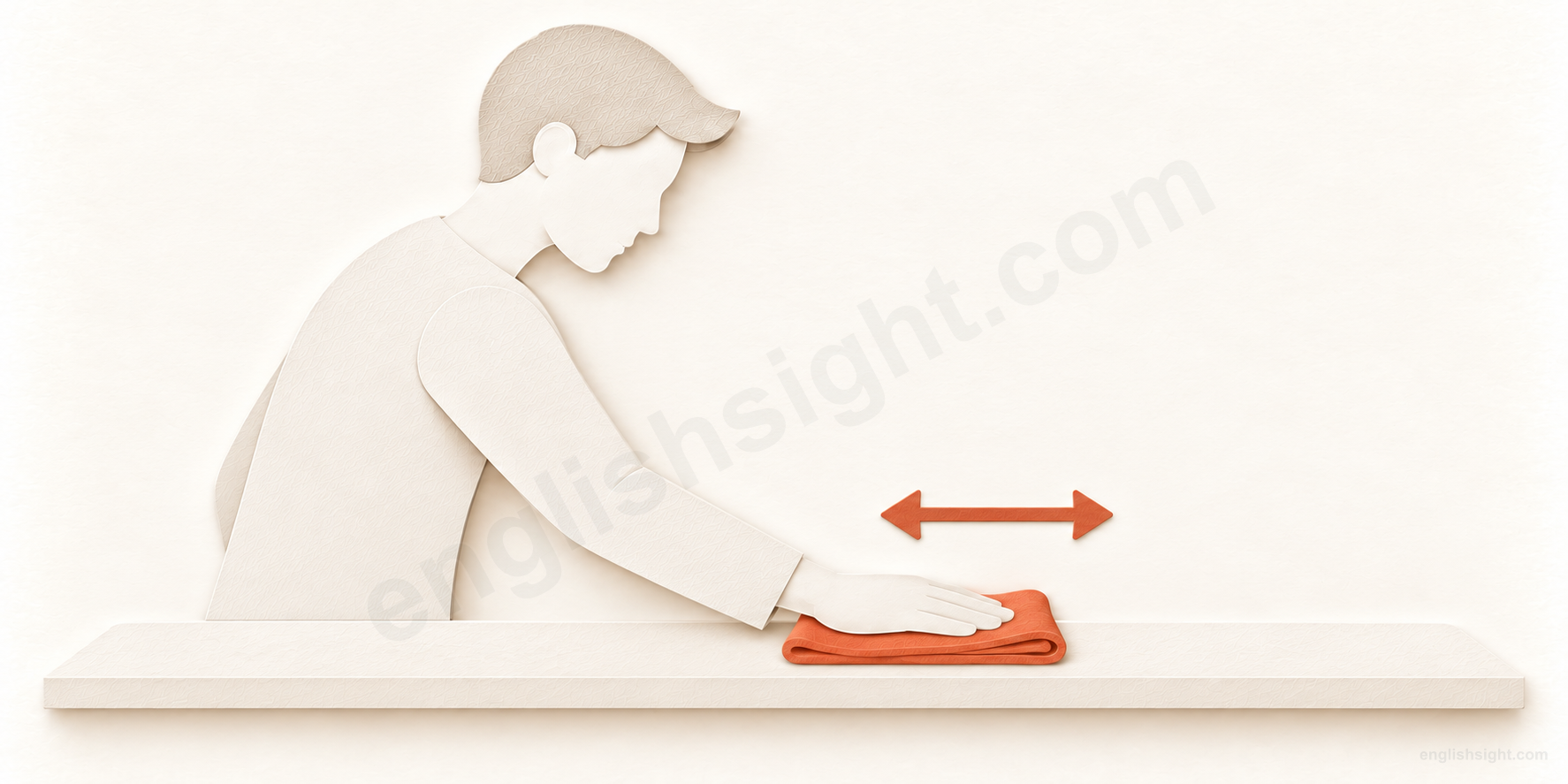
A folded cloth touches the tabletop beneath a hand.
rub
The cloth moves while staying in contact; no particular change to the surface is shown.
The hand presses the cloth against the surface and moves it back and forth.
Pressure keeps the surfaces together while movement produces friction. The result depends on the situation.
Rub means move one surface against another while they press together, often repeatedly or in circles.
Movement and contact are central to the physical uses. Cleaning, applying, and wearing away are possible effects, not promises made by rub alone. Social idioms and the noun the rub need separate explanation.
A hand can rub a shoulder, two surfaces can rub together, and a shoe can rub against a heel. The shared physical relation is contact with pressure and movement along the contact. The result may be comfort, cleaning, spreading, warmth, or damage.
Expressions such as rub off on someone and rub it in have established social meanings. The physical relation can help organize them, but it cannot predict every phrase. This is a teaching model, not a claim that every English speaker sees the same mental picture.
01
Contact, pressure, and movement
Identify the moving object, the surface it touches, and whether the sentence names an action or its effect.
01
rub + surface / body part + (with + tool); rub at + spot
rub your eyes / rub a surface
move over a surface while pressing against it
Starting situation
Your eyes feel tired, or a surface needs attention.
Action or effect
A hand or tool moves across the area.
The object can name the surface receiving the rubbing.
In rub your eyes, the eyes are the area touched; in rub the table with a cloth, with names the tool. Rub describes the movement and contact, without promising that the surface becomes clean.
Movement may go back and forth or in circles. Rub your chin can accompany thought; rub your eyes can accompany tiredness or disbelief. Those interpretations come from the situation, not a separate built-in meaning of rub.
Rub at a stain focuses on action directed at one spot, often with effort. It leaves success open: I rubbed at the stain, but it remained.
In a sentence
He rubbed the cloudy glass with a soft cloth.
Watch the difference Touch only requires contact. Wipe emphasizes passing something over a surface, often to remove liquid or dirt; rub highlights pressure and friction.
Rub your hands together names both contacting surfaces. The subject makes them move; Two branches rubbed together describes the contacting objects themselves as the subject.
The gesture may be used for warmth or may show pleased anticipation. The sentence alone does not guarantee either purpose; context supplies it.
In a sentence
I rubbed my hands together while waiting outside.
Watch the difference Say rub them together when replacing hands with a pronoun. Together is an adverb; them is the direct object.
03
rub against + surface; rub + object + against + surface
rub against / rub something against
move in contact with another surface
Starting situation
A cat stands beside your leg.
Action or effect
Its body moves along your leg.
Against introduces the surface contacted by the moving thing.
The cat rubbed against my leg describes the cat moving in contact with the leg. The cat rubbed its head against my leg explicitly names the moving body part.
Compare rub the wall with a cloth and rub the cloth against the wall: the first object changes, but the cloth and wall may participate in the same physical action. These are ordinary prepositional descriptions, not one fixed idiom.
In a sentence
The cat rubbed its head against my ankle.
Watch the difference Against does not by itself mean hostility, and rub against does not always imply damage.
04
something rubs; rub on / against + surface; rub + body part + raw
My shoes rub.
cause irritation or wear through repeated contact
Starting situation
A shoe touches the same part of your heel as you walk.
Action or effect
That contact makes the skin uncomfortable.
The contacting object can be the subject, with no person acting deliberately.
My shoes rub is complete when the uncomfortable contact is understood. Add a contact point in The shoe rubs against my heel.
A transitive sentence can name the affected area: The strap rubbed my shoulder. Rubbed raw describes a damaging result; it is stronger than ordinary rub and does not belong to every use.
In a sentence
This stiff seam rubs against my neck.
Watch the difference A rubbing shoe is causing friction; it is not giving someone a massage.
05
rub + object + result adjective; be rubbed + result adjective
rub something dry / smooth
produce a named condition by rubbing
Starting situation
The wooden edge is rough.
Action or effect
Rubbing makes it smoother.
The adjective names the result; rub names how it is produced.
Rub the edge smooth means make the edge smooth by rubbing it. Rub your hair dry has the same result structure. An adjective follows the object because it describes the object’s resulting condition.
The passive is possible when the affected material is central: The edge was rubbed smooth. A result construction can express causing a change without needing a special causative meaning of rub.
In a sentence
She rubbed the wooden edge smooth with sandpaper.
Watch the difference Rub it gently describes the manner. Rub it smooth describes the intended or achieved result; smoothly would change that grammar.
02
Work something in, off, out, or down
Particles and result words specify what rubbing does to a substance or surface. The same action can spread, remove, dry, or smooth.
06
rub + substance + into / on / over + surface; rub + substance + in
rub cream into your skin / rub it in
spread a substance while pressing it into or over a surface
Starting situation
A little cream sits on the skin.
Action or effect
Hand movements spread and work it into the skin.
The substance is the object; into or on names where it goes.
Rub cream into your skin focuses on working it into the surface. Rub oil on the wood or rub seasoning over the fish locates the coating over that surface. Into and on are prepositions with their own following objects.
When the destination is understood, say Rub the cream in or Rub it in. This literal use concerns a substance, unlike the teasing expression Don’t rub it in.
In a sentence
Rub a little oil into the wooden handle.
Watch the difference With a pronoun, say rub it in, not rub in it. Rub the handle with oil instead makes the handle the direct object.
07
rub + fat + into + flour; rub + fat + in
rub butter into flour
mix fat and flour using the fingertips
Starting situation
Small pieces of butter sit in flour.
Action or effect
Fingertip movements distribute the butter through the flour.
A cooking instruction uses rubbing to break up and combine ingredients.
Recipes use rub the butter into the flour for working the fat through flour with your fingertips. The ingredient is the direct object; into introduces the mixture receiving it.
Rub in the butter and rub the butter in are possible when the flour is understood. With a pronoun use rub it in. This is a particular kitchen technique, not a general substitute for stir or beat.
In a sentence
Rub the cold butter into the flour until the mixture looks like fine crumbs.
Watch the difference Do not interpret into as placing a whole block of butter inside flour without working the ingredients together.
08
rub + mark / coating + off + (surface); mark / coating + rub off
rub something off / rub off
remove a surface layer or mark through friction
Starting situation
A label has left a sticky mark.
Action or effect
Rubbing removes the mark from the surface.
Off marks separation from a surface; the subject can be the mark itself.
Rub the mark off the jar names what is removed and where it starts. Rub off the mark and rub the mark off are both possible; a pronoun goes between the verb and particle: rub it off.
The paint rubs off easily is intransitive: the coating is the subject, and no person doing the rubbing is named. It describes how readily the coating comes away when rubbed, rather than saying someone is currently removing it.
Colour can also rub off onto another surface: The dye rubbed off onto my sleeve. That is physical transfer, distinct from a habit rubbing off on a person.
Rub a stain away uses away to emphasize its disappearance through rubbing. Rub mud from a boot names the material removed and its starting surface. These removal patterns describe a result; ordinary rub at the stain need not succeed.
In a sentence
I rubbed the sticky mark off the jar with a cloth.
Watch the difference Do not assume rub off always means disappear completely; context can describe transfer onto something else.
09
rub + written mark + out; rub it out
rub out a pencil mark
erase a written mark
Starting situation
There is an unwanted pencil line.
Action or effect
An eraser removes it.
Out presents erasure, especially in British English.
In British English, rub out a word or rub out a mistake commonly refers to erasing a pencil or similar removable mark. Erase works in both British and American English.
The particle is separable: rub the line out, rub out the line, rub it out. A passive is natural: The answer had been rubbed out.
Rub somebody out has a separate North American slang meaning, murder somebody. Recognize that meaning in crime stories; it is not a way to ask someone to leave a photograph or a meeting.
In a sentence
I rubbed out the extra line and drew it again.
Watch the difference Rub out does not normally mean delete a computer file. Use delete for that action.
10
rub + person / animal / reflexive pronoun + down + (with + towel)
rub someone / yourself down
dry, clean, or massage the body by rubbing it
Starting situation
A person or animal is wet.
Action or effect
A towel removes water through rubbing.
Down here concerns treatment over the body, not movement to a lower place.
Rub yourself down with a towel describes rubbing over your body to dry it. The same pattern can describe drying a horse after exercise.
The object may come before or after down: rub the horse down or rub down the horse. A personal pronoun comes before it: rub it down.
Rub someone down can also mean massage their body, especially in American English. After training, the therapist rubbed the runner down describes a massage; it need not involve drying a wet body. A rubdown is the related noun for this treatment.
In a sentence
After the swim, he rubbed himself down with a towel.
Watch the difference Choose yourself, myself, or himself when the person doing the rubbing is also receiving it.
11
rub + surface + down + (with + abrasive)
rub wood down
smooth a surface with an abrasive material
Starting situation
A wooden frame has rough patches.
Action or effect
Sandpaper removes the roughness.
The material and purpose distinguish this from towel drying.
Rub the frame down with sandpaper means prepare a smoother surface by rubbing it. Down is part of the established combination; it does not say which physical direction your hand moves.
This shares the action in rub the frame smooth, but rub down need not specify the final degree of smoothness. A passive such as The frame was rubbed down before painting is also natural.
In a sentence
Rub the frame down before applying the paint.
Watch the difference Rub it down can mean different treatment with wood and with a wet animal. Read the object and tool.
03
Influence and relationships
These established expressions describe influence, irritation, embarrassment, or social contact. Learn their full wording; physical rubbing need not happen.
12
quality / behaviour + rub off + (on / onto + person)
rub off on someone
influence someone through time spent together
Starting situation
A colleague often speaks calmly in difficult meetings.
Action or effect
You gradually begin to respond in a similar way.
A quality or habit is usually the subject; a person after on receives the influence.
Her calm manner rubbed off on me means being around her helped me acquire something of that manner. No literal touching or intentional lesson is required.
Habits, attitudes, enthusiasm, and similar qualities can rub off. The influence need not be good. Onto is also possible, and on someone can be omitted when the affected people are understood.
In a sentence
His enthusiasm for gardening has rubbed off on the whole family.
Watch the difference Say His enthusiasm rubbed off on me, not He rubbed me off. The latter does not express this influence pattern.
13
rub it in; rub + embarrassing fact + in
Don’t rub it in.
do not keep stressing an embarrassing or painful fact
Starting situation
You have already admitted a mistake.
Action or effect
Someone keeps pointing out the same failure.
It refers to the unwelcome fact, not to cream or another material.
Don’t rub it in asks a person to stop reminding you about something you would prefer to forget. It can be serious or mildly humorous, depending on the relationship and tone.
The full expression supplies the interpersonal meaning. It is not explained by the literal instruction rub the cream in. This reminder sense is not normally used in the passive.
In a sentence
I know I missed an easy goal; you don’t have to rub it in.
Watch the difference This means more than simply repeat information: the repeated fact embarrasses or upsets the listener.
14
rub + person + up the wrong way (BrE); rub + person + the wrong way (AmE)
rub someone (up) the wrong way
irritate someone by what you say or do
Starting situation
Someone uses a tone you find unpleasant.
Action or effect
You feel annoyed by that person’s behaviour.
The phrase describes an irritating effect, often without deliberate intent.
Rub someone up the wrong way is the British form; rub someone the wrong way is the usual North American form. The object names the person annoyed.
A person, manner, remark, or habit can be the cause. The physical image of uncomfortable contact can help you remember the phrase, but no contact is part of its actual social meaning.
In a sentence
His habit of interrupting rubs me the wrong way.
Watch the difference Keep the person directly after rub: rub me the wrong way. Do not substitute in the wrong way for the fixed wording.
15
rub + person’s nose + in it / in + failure
rub someone’s nose in it
make someone dwell on an embarrassing failure
Starting situation
A friend made a costly error.
Action or effect
Another person repeatedly brings that failure to their attention.
The idiom targets someone’s shame rather than their physical nose.
Rub someone’s nose in it presents the reminders as unkind or humiliating. It refers back to a known failure; an explicit noun phrase can follow in, as in rub her nose in her mistake.
It overlaps with rub it in, but makes the person subjected to humiliation especially explicit. Learn the possessive noun phrase together: my nose, your nose, his nose, and so on.
In a sentence
She admitted the error, so there is no need to rub her nose in it.
Watch the difference Rub her nose is an ordinary physical description without in it; it does not carry the full idiom.
16
rub salt into / in the wound; rub salt into + person’s wounds
rub salt into the wound
make an already painful situation feel worse
Starting situation
A person is upset by an earlier disappointment.
Action or effect
A further event or remark adds to that distress.
The subject can be an event, so deliberate cruelty is not required.
The wound and salt are figurative in this idiom: an existing hurt becomes worse. It can concern a tactless reminder or another setback after the first one.
Rub salt in the wound and rub salt into someone’s wounds are also found. Unlike rub someone’s nose in it, this expression does not require repeated reminders of a personal mistake.
In a sentence
The team lost the final, and the travel delays rubbed salt into the wound.
Watch the difference This is an idiom about added distress, not advice about treating a physical injury.
17
rub shoulders with + people; rub elbows with + people
rub shoulders / elbows with someone
meet and mix socially with people, often famous people
Starting situation
You attend an event with well-known guests.
Action or effect
You have the chance to meet and talk with them.
With introduces the people in the social contact.
Rub shoulders with often highlights access to people who are famous, important, or unusual for you to meet. Rub elbows with is an alternative, especially in American English.
The expression does not require shoulders to touch, and it does not guarantee close friendship. Standing in the same building without meeting anyone may not justify the description.
In a sentence
At the festival, young actors rubbed shoulders with experienced directors.
Watch the difference Keep shoulders or elbows plural in this expression; with is followed by the people you meet.
18
rub along + (with + person / together); rub along + (on + resources)
rub along with someone
live or work together reasonably peacefully
Starting situation
Two housemates have different routines.
Action or effect
They manage their shared life without much conflict.
This is an informal British expression for a workable relationship.
We rub along together does not claim deep friendship or perfect agreement. It suggests the relationship works well enough, sometimes despite differences.
One person can rub along with another, or a plural subject can rub along together. A broader British use means manage despite difficulties: We are rubbing along on a small income. That sense concerns getting by rather than mutual relations.
In a sentence
We are very different, but we rub along together quite well.
Watch the difference This is not a physical action along a path. Get along is a more widely usable alternative for the relationship meaning.
04
An action, a mixture, or a difficulty
The noun can name an instance of rubbing, a preparation applied by rubbing, or the central problem in a situation.
19
give + surface / person + a rub; a back rub; a chest / muscle rub
give something a rub / a back rub
an instance of rubbing, sometimes a massage
Starting situation
A shoulder feels tense or a surface needs attention.
Action or effect
Someone rubs the area for a short time.
A rub packages the activity as a countable occasion.
Give the glass a rub means rub it; a quick rub or a gentle rub describes the action’s length or manner. A back rub commonly means a massage of the back.
Rub can also name a preparation applied by rubbing, as in a chest rub or a muscle rub. That is a substance sense: the product is put on the skin, rather than being the rubbing action itself.
In a sentence
Would you like a gentle back rub after the long drive?
Watch the difference In give it a rub, give forms an activity expression; it does not mean hand over an object called a rub.
20
a dry / spice rub; a rub for + food
a dry rub / a spice rub
a seasoning mixture spread over food before cooking
Starting situation
Meat or vegetables need seasoning.
Action or effect
A mixture coats their surface before cooking.
The noun names what is applied, rather than the hand movement.
A dry rub is a dry seasoning mixture, typically containing spices and often salt, worked onto the outside of food before cooking. A spice rub can identify a particular mixture.
Compare rub the mixture over the meat: there, rub is the verb and the mixture is its object. In Prepare a rub for the meat, rub names the mixture. A marinade normally involves a liquid mixture and a period of soaking.
In a sentence
We made a smoky spice rub for the mushrooms.
Watch the difference A dry rub is not a towel or a way of drying food; dry describes the seasoning mixture.
21
there is / lies the rub; the rub is + (that) + clause
There’s the rub.
that is the difficulty or catch
Starting situation
A plan looks attractive until one obstacle appears.
Action or effect
You identify the obstacle that makes it hard to carry out.
The rub is a singular noun phrase with the, not a rubbing action.
There’s the rub, There lies the rub, and The rub is that… identify the troublesome point. This use can sound formal, literary, or humorous rather than being the plainest everyday way to say problem.
Treat it as a separate established noun use. A physical obstacle is a helpful memory link, not proof that every use of the modern noun means friction.
In a sentence
The cottage is affordable, but the rub is that there is no public transport nearby.
Watch the difference Use the rub for the catch in this expression. A rub usually means an action or a preparation instead.
22
not have two pennies / cents to rub together
not have two pennies to rub together
have very little money
Starting situation
Someone has almost no money to spend.
Action or effect
They describe their situation emphatically.
The negative expression suggests not even having two small coins.
Not have two pennies to rub together is an informal exaggerated way to say be very poor or temporarily short of money. Cents is another version, especially with American currency.
The meaning belongs to the whole negative idiom. It does not literally require checking someone’s coins, and it is not a neutral exact statement of their bank balance.
In a sentence
As students, we didn’t have two pennies to rub together.
Watch the difference Do not drop the negative and assume have two pennies to rub together means be wealthy.
Read the object and the whole expression
Forms and grammar
Rub /rʌb/ has the forms rubs, rubbed, rubbed, rubbing: double the final b before -ed and -ing. It can be transitive or intransitive. Ongoing physical actions allow the progressive, as in The strap is rubbing. Transitive material uses allow a passive, as in The mark was rubbed off; this does not make every idiom passivizable.
Objects, particles, and prepositions
Rub it in, rub it off, rub it out, and rub it down place a pronoun before the particle. In rub against the wall and rub oil into the wood, the preposition introduces a following surface. In rub off on me, on names the receiver of an influence. These patterns should not all be treated as interchangeable verb-plus-small-word combinations.
Related words and scope
A rubbing can be an impression made by placing paper over a textured surface and rubbing the paper with graphite, wax, or a similar material. It is a related noun rather than an extra meaning of every rub sentence. Mainly British rub up on a subject means refresh your knowledge; brush up on is a broadly useful alternative. Regional rub minds together means exchange ideas in Nigerian English. These are recognition notes; specialist sporting and medical senses are outside this everyday lesson.
Choose the meaning that fits
Check the object, particle, and situation before choosing.
1. You have put cream on your hand and now want to spread it. Which instruction has the natural pronoun position?
2. Your colleague’s good humour gradually influences you. Which sentence fits?
3. The instruction is Rub the wood smooth. What does smooth tell you?
4. You already feel embarrassed about a missed goal. A friend keeps mentioning it. What can you say?
5. A holiday apartment is cheap, but impossible to reach without a car. What does the rub mean here?
6. My new shoes rub. What is the usual implication?
Sources and teaching notes
Usage and regional labels were checked against the publisher pages below. Explanations and examples are original. The contact-and-movement model is a teaching aid, and fixed social expressions need their own wording.
This diagram helps explain a connection; it is not a picture shared by every native speaker.