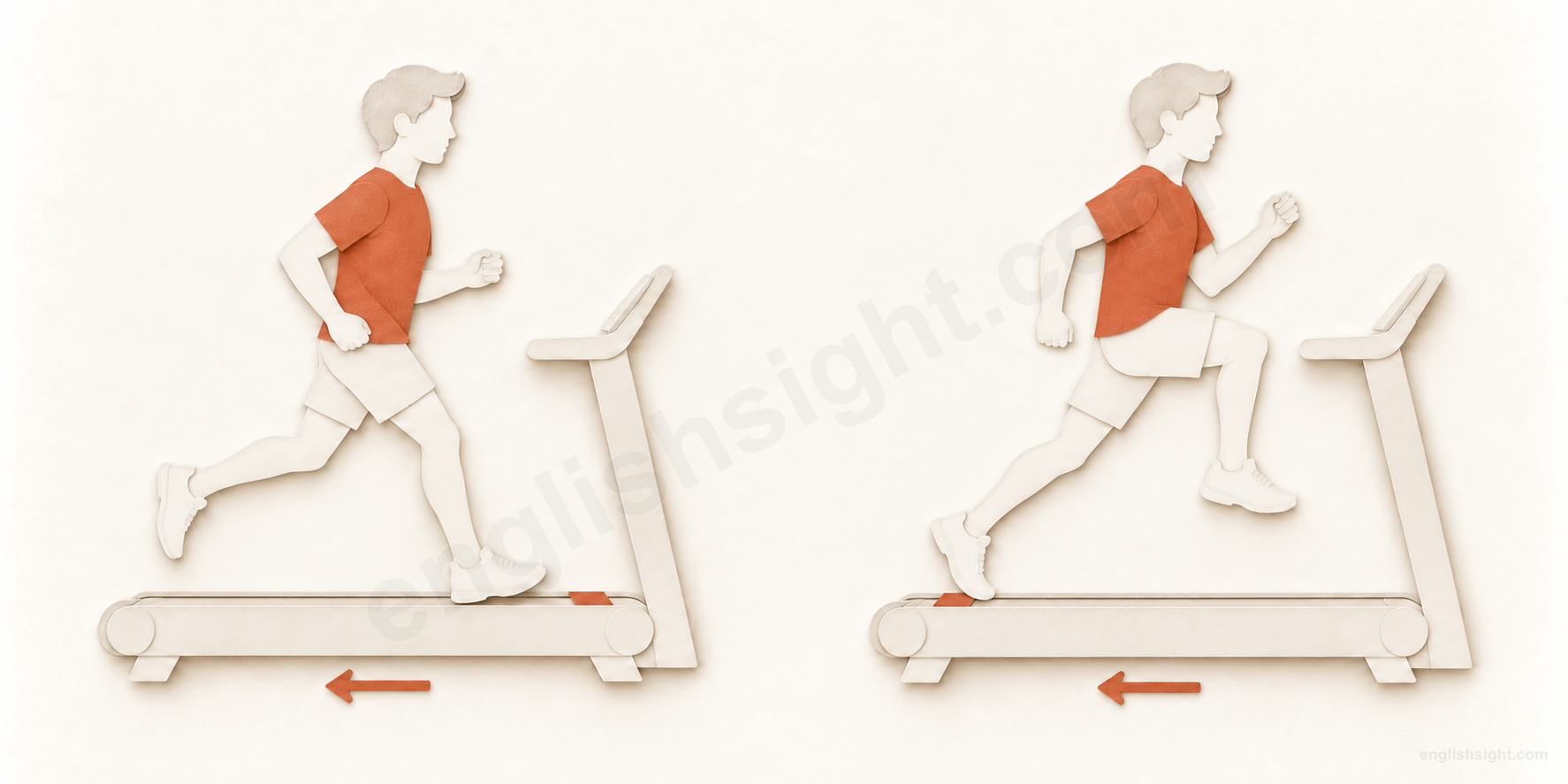
Follow the subject, the object, and the small words to understand run.
Successive steps, continuing activity
Successive steps, continuing activity
One stride; the belt is moving.
run
A later stride; the treadmill keeps operating.
The steps continue and the belt moves backward.
The runner takes successive strides while the treadmill keeps operating.
Run can present movement or activity as carrying on through successive steps or cycles. A runner keeps taking strides while the treadmill keeps operating, even though neither travels across the room.
The same useful connection extends to operating a system and the course of events. A road can run along a coast without moving at all. Fixed expressions and specialized noun meanings remain separate learning branches.
Run often presents motion or activity as continuing along a course: a person takes successive strides, water flows, and a machine keeps working. Other uses describe how something extends, progresses, or reaches a limit.
This connection is a teaching model, not a formula for predicting every phrase. Run a fever, run for office, and many noun uses have established meanings that need their own examples. The lesson organizes common modern uses; it does not rank their frequency.
01
Movement, trips, and competition
Begin with running on foot, then distinguish chasing, leaving, short trips, lifts, and an election campaign.
01
run + direction; go running
run / go running
move with repeated quick strides
Situation before
You are walking toward a departing bus.
What happens or holds
You move faster on foot to reach it.
The person advances by repeated strides, not by one jump.
Run can stand alone or take a direction: run upstairs, run away, run through the park. Direction words describe the route; they do not automatically form an idiom. Running is a manner of movement, not simply any fast action.
Go running describes the sporting activity: We go running on Sundays. In I ran to catch the bus, to catch gives the purpose. Spoken Run and fetch your coat combines an instruction to hurry with the next action.
Original example
I ran across the square to catch the bus.
Watch the difference Say run home, without to; say run to the station, with to.
02
run + distance / race; run in + event
run five kilometres / run a race
cover a distance or participate in a race
Situation before
A runner starts a measured course.
What happens or holds
The runner completes the distance or takes part in the event.
The object can measure the route rather than name a thing being moved.
A distance follows run directly: run a mile, run ten kilometres. Run a marathon also names participation in that kind of race; run in the marathon is possible too.
A different transitive use concerns staging a race: The final will be run on Saturday. Here the passive concerns when the event takes place, not which person will run. The surrounding nouns and grammar identify the reading.
Original example
She ran five kilometres before breakfast.
Watch the difference Run a race does not mean win it; run in a race emphasizes participation.
03
run after + person / moving thing
run after someone
chase or persistently pursue someone
Situation before
A dog sees a cyclist pass.
What happens or holds
The dog follows, trying to catch up.
After identifies the pursued target rather than a later time.
With a moving target, run after can describe literal pursuit. With a person in a social context, it can instead mean trying persistently to gain their affection or attention; that reading can sound disapproving.
He is always running after his adult children can criticize excessively attentive service. These social meanings belong to established combinations; neither necessarily describes physical running.
Come running can describe a person responding eagerly or readily to a request: If she asks for help, he comes running. Context can make this a comment on willingness rather than a claim that he literally runs.
Original example
The dog ran after the bicycle until its owner called.
Watch the difference Say run after it, not run it after.
04
run away (from); run off; make a run for it
run away / run off / run for it
leave, escape, or avoid facing something
Situation before
A loud noise frightens a cat.
What happens or holds
The cat leaves quickly and hides.
Away and off mark departure; the whole phrase can extend to avoidance.
Run away often suggests escaping a threat or leaving home. Run off can simply describe a hurried departure. Run for it! and make a run for it present an urgent attempt to escape, rather than running for an elected job.
Run away from responsibility extends departure to avoidance. Run away with a partner, or run off with a partner, can mean leaving secretly to live together. These expressions do not specify the means of transport.
Original example
The cat ran away when the gate slammed.
Watch the difference Running away from a problem means avoiding it; the problem need not be a place.
05
run an errand; run to / over to + place
run an errand / run to the shops
make a short practical trip
Situation before
You need to collect a parcel nearby.
What happens or holds
You make a brief trip and do the task.
Run can suggest a quick trip without specifying running on foot.
Run an errand usually means go somewhere to collect, buy, or deliver something. Run to the shops and run over to a friend’s house can describe brief visits, even by car. Context decides whether literal running is intended.
Run along now is a familiar way of telling someone, especially a child, to leave. It can sound patronizing to an adult. That conversational use differs from the literal direction in run along the river.
I’ve been running around all morning can describe hurrying between many tasks. The places and tasks matter more than the means of travel; it does not necessarily describe exercise.
Original example
I need to run a few errands before lunch.
Watch the difference I must run is an informal way to say you must leave; it need not mean start jogging.
06
run + person + home / to + place
run someone home
take someone somewhere by car
Situation before
A friend has no ride after the meal.
What happens or holds
You drive the friend home.
The person is a passenger, not someone you force to run.
This informal transitive pattern offers or requests a short lift. Home, back, down to town, and to the station specify the destination. The object names the passenger.
Compare run home, where the subject travels, with run you home, where the subject provides transport. It is an established use, not a general permission to replace drive with run in every sentence.
Original example
Can you run me to the station after dinner?
Watch the difference Use run me to the station, not run to me the station.
07
run for + office; run against + opponent; run in + election
run for office
seek election to a position
Situation before
A person announces a candidacy.
What happens or holds
The person competes for voters’ support.
For introduces the desired office, not a physical destination.
Run for office is especially associated with American election language. Run against names an opponent; run in names the election. British English also commonly uses stand for election.
A run for the presidency is the corresponding noun phrase. Compare run a campaign: that describes organizing campaign activity and may refer to a manager who is not the candidate.
Original example
Maya plans to run for mayor next year.
Watch the difference Run for mayor takes no article before mayor; it does not mean already hold the job.
08
run + a red light / a stop sign
run a red light
drive through a red traffic signal without stopping
Situation before
A traffic light requires approaching vehicles to stop.
What happens or holds
A driver goes past it without stopping.
Run here concerns passing a required stopping point.
The driver or vehicle is the subject, and the red light is the signal passed without stopping. Run a stop sign uses the same conventional traffic pattern. It does not mean move the signal or make it function.
Compare run to the traffic light, which gives a destination for a person moving on foot. With the direct object in run a red light, the expression names disregarding the required stop. No collision is implied by this phrase alone.
Original example
The driver ran a red light at the next junction.
Watch the difference This expression is about driving past a stop signal, not operating the traffic light.
02
Managing and making things work
A person runs an organization or procedure; a machine or program runs when it operates. Notice which role is the subject.
09
run + business / organization / event
run a business
direct and organize an activity or organization
Situation before
A café needs decisions, staffing, and supplies.
What happens or holds
A manager keeps its work organized.
The object names the activity or organization under someone’s control.
The subject manages or takes responsibility; the object is the business, event, or campaign. A small charity can be run by volunteers. This passive is natural because the organization is the managed object.
Stop running my life criticizes someone for controlling personal decisions. A well-run hotel describes how the hotel is managed. The teaching connection is keeping activity going, not making the building move.
Original example
Two sisters run the café near our office.
Watch the difference Run a company does not necessarily mean own it.
10
run + course / service; run + vehicles
run a course / run a bus service
organize and provide a service
Situation before
People need an evening class or transport.
What happens or holds
An organization makes the service available.
Run can focus on providing an organized activity for others.
The object can be a course, helpline, workshop, or transport service. Run highlights responsibility for providing it, while attend describes using it as a participant.
Run extra buses means provide additional bus journeys. The buses run every hour describes the service from the vehicles’ side. The transitive and intransitive patterns describe different roles in the same operation.
Original example
The library runs free computer classes every month.
Watch the difference A library runs a class; a learner takes or attends it.
11
machine + run; run + machine; run on + fuel
the engine runs / run the engine
operate, or make equipment operate
Situation before
An engine is switched on.
What happens or holds
Its working parts keep moving.
The machine may be the operating subject or the object someone operates.
The engine runs describes operation. Run the engine gives an operator an object. An engine that runs on diesel uses diesel as fuel; on here introduces the energy source, not a surface.
The system is up and running means it is fully working. In mainly British usage, afford to run a car concerns the ongoing expense of having and using it, not just buying it. These are related to operation rather than speed.
Original example
We ran the pump for ten minutes to empty the tank.
Watch the difference A running engine is working; it need not be moving the vehicle.
12
run + program; program + run on + platform
run a program
execute software or use a compatible platform
Situation before
You start an application on a computer.
What happens or holds
The program carries out its instructions.
Run concerns execution; on can identify the device or operating environment.
You run a program, and the program runs. A laptop can run an operating system too. In runs on a phone, on marks the supporting platform rather than a fuel supply.
We kept the program running describes continued operation; we got it running describes successful startup or repair. These patterns use keep or get plus an object and -ing; they are not a new general run + infinitive construction.
Original example
This app runs on my old laptop without any problems.
Watch the difference Installed software is present; running software is currently operating.
13
run + test / check / experiment; run + data + through + system
run a test / run data through a system
carry out a procedure or process material
Situation before
You need to check whether a backup works.
What happens or holds
You execute a test and inspect its result.
The object is a procedure to perform, or material put through processing.
Run a test, run a check, and run an experiment are established combinations for carrying out organized procedures. They can be passive: The checks were run overnight.
Run the data through a filter makes data the object and identifies a processing route with through. This is distinct from run through the instructions, where the instructions themselves are the material being reviewed.
Original example
We ran a backup test before changing the settings.
Watch the difference Running a test does not itself say that the test passed.
14
run + story / advertisement; story + run
run a story / run an advertisement
publish or display material
Situation before
An editor selects a report.
What happens or holds
The report appears in a publication.
The publication provides a place for the material to appear.
The newspaper runs a story gives the publisher an object. The story ran on Monday makes the item the subject. Advertising can similarly run for a set period.
The headline ran as follows introduces the wording of a headline in a more literary reporting style. That wording sense is different from the decision to publish a story; learn it in context rather than reading ran as hurried.
Original example
The local paper ran a story about our garden project.
Watch the difference A story running in a paper is being published, not physically moving.
03
Courses through space and time
Run can trace an extent, describe progress, let liquid flow, or connect parts of a work. The complement specifies the course or condition.
15
run + direction / prepositional phrase; run the length of
a road runs along the coast
extend along a course or route
Situation before
You examine a coastal map.
What happens or holds
You trace a road following the shoreline.
The road stays in place; its length follows a course.
A road, fence, scar, or line can run in a direction without moving. The listener follows its extent mentally. Along gives the course, through gives an interior route, and from…to… gives endpoints.
Run a cable from the desk to the wall socket is transitive: someone installs or lays it along a route. The cable runs behind the desk describes its resulting position. The different subject roles matter more than a single translation.
Original example
A narrow road runs along the coast to the village.
Watch the difference A road runs means extends; a bus runs means travels or operates.
16
run for + duration; run from + start + to + end
run for three months
continue or remain in effect over time
Situation before
A temporary exhibition opens.
What happens or holds
It continues until its closing date.
Time supplies the course over which the activity continues.
A show, course, offer, or agreement can run for a period. A contract that runs until Friday remains in force until then. This use says how long something continues, not how quickly it happens.
A film runs for ninety minutes describes its length. A film’s three-week run at a cinema concerns the period in which screenings are offered. The noun and surrounding time expressions separate these two durations.
Original example
The exhibition runs from June to September.
Watch the difference Run for three months describes duration; run for mayor describes a candidacy.
17
be running late / behind schedule; run smoothly
run late / run smoothly
progress in a particular way or against a schedule
Situation before
The meeting begins behind schedule.
What happens or holds
Its actual progress remains later than planned.
Run evaluates the course of events rather than physical speed.
Run late and run behind schedule compare actual progress with a plan. Run on time or ahead of schedule gives the opposite comparison. The progressive is natural for the current state of progress.
The project is running smoothly says its activities are proceeding without serious difficulty. Smoothly describes the process, not a polished surface. Run does not itself promise a good outcome; the following expression supplies that evaluation.
Original example
We are running ten minutes late, so please start without us.
Watch the difference I am running late can be said while sitting still.
18
liquid + run + direction; nose / tap + be running
water runs / my nose is running
flow or send out liquid
Situation before
Water escapes from a damaged pipe.
What happens or holds
It flows across the floor.
Liquid, or its source, can be the subject.
Tears run down a face, water runs from a pipe, and a tap runs when water comes out of it. Down and from tell us the flow’s direction or source. The repeated-flow connection is useful without implying that liquid has legs.
My eyes are running describes watering eyes; my nose is running describes nasal discharge. His face was running with sweat means sweat was flowing over it. With introduces the liquid covering the surface.
Original example
Water ran down the wall after the pipe burst.
Watch the difference A running nose has liquid coming from it; the nose does not move across the face.
19
run + tap / water / bath; run + person + a bath
run the tap / run someone a bath
make water flow or fill a bath
Situation before
You turn on a tap over a bath.
What happens or holds
Water flows and fills it.
The person causes the flow; the object identifies water, its source, or the bath.
Run the tap asks someone to let water flow. Run warm water into the bowl names the liquid and destination. Run a bath focuses on filling the bath, with the actual water understood.
Run you a bath and run a bath for you identify the beneficiary. These established object choices do not make run equivalent to make everywhere: use make tea, not run tea, for preparing the drink.
For a flow instruction, say Run the tap for a few seconds, or Run cold water into the bowl. In both sentences a person causes the water to flow.
Original example
I’ll run you a warm bath while you unpack.
Watch the difference Run someone a bath is not a general pattern for making any object for a person.
20
colour / dye / ink + run
the colour runs
dye or ink spreads when wet
Situation before
A red shirt gets wet in the wash.
What happens or holds
Dye spreads into surrounding fabric or water.
Run can describe colour losing its original boundary.
With dye, colour, or ink as subject, run describes spreading or bleeding, often when wet. The connection is flowing beyond a boundary, not maintaining a schedule.
The wax began to run can describe melting into a flow. The material and context distinguish that from ink spreading. Neither use means that every solid object can run whenever it changes shape.
Original example
The red ink ran when rain hit my notes.
Watch the difference This use is usually intransitive: the ink ran; it does not mean someone printed it.
21
run + hand / fingers / object + over / through + thing
run your fingers over something
move something along a surface or through material
Situation before
You want to feel the edge of a fabric.
What happens or holds
Your fingertips move along it.
A person guides a body part or object along a course.
Run a hand over a surface and run a comb through hair are transitive movement patterns. Over and through contribute the relationship to the surface or material.
Run your eyes over a page extends the same pattern to looking. The object of run is your eyes, while over introduces the page. Contrast run over the page in a review context, where the page or its contents follow the whole review expression.
Original example
She ran her fingers over the rough fabric.
Watch the difference Run your eyes over a page means scan it; it does not mean understand every detail.
22
theme / feeling / thought + run through + whole
a theme runs through a book
be present throughout a work or a series
Situation before
You notice a concern in several chapters.
What happens or holds
You recognize it throughout the book.
Through can connect repeated presence across parts, without physical travel.
When a theme runs through writing, it connects many parts of the work. The pattern presents continuity across those parts. This differs from running through a list yourself to review it.
A thought ran through my mind describes a thought occurring; excitement ran through the crowd describes a feeling spreading among people. These uses have different subjects and situations, though through helps connect an experience with a wider whole.
Original example
A concern for fairness runs through all her stories.
Watch the difference A theme running through a book need not appear in every sentence.
04
Supplies, states, and exposure
Certain adjectives and noun objects describe a supply level, an illness, or a possible consequence. These are conventional choices, not unlimited combinations.
23
supplies + run low / short; run low on; run short of
run low / run short
have a diminishing or insufficient supply
Situation before
There are only a few sheets in the printer.
What happens or holds
The remaining supply is small.
The adjective describes the supply level; it need not have reached zero.
Paper is running low makes the supply the subject. We are running low on paper makes the people or organization the subject. Run short of something reports a shortage or insufficient amount.
Compare run out of paper: there is none left. Running out of paper can warn that zero is approaching, while running low describes a small remainder. Do not treat all three expressions as saying that the supply is already empty.
Original example
We are running low on paper, but there is enough for today.
Watch the difference Low on and short of are useful standard pairings; keep of in run short of paper.
24
well / river / supply + run dry
run dry
reach a state with no water or available supply
Situation before
A well’s water level falls.
What happens or holds
The well no longer provides water.
Dry is a result or limiting state of the continuing process.
A river or well that runs dry loses its water supply. The adjective names the resulting condition. This is a useful example of run + adjective, but that pattern does not freely accept every adjective.
Funds can run dry too: the available money is exhausted. The extension is conventional and depends on the idea of a supply; it does not claim money is literally a stream.
Original example
The village well ran dry during the drought.
Watch the difference Run dry does not mean deliberately dry something with a towel.
25
be running + a fever / a temperature
run a fever / run a temperature
have an abnormally high body temperature
Situation before
A child feels unwell and hot.
What happens or holds
A parent reports an elevated temperature.
This is a fixed health collocation, not movement or an instruction.
Run a fever and run a temperature are established health expressions. The progressive is common when describing the current condition.
The article belongs in a fever or a temperature. This phrase does not diagnose the illness or explain its cause. Learn the health collocation as a branch of run rather than trying to infer it from a runner’s speed.
Original example
Leo is running a fever and is resting at home.
Watch the difference Run a temperature means have a fever, not simply have any measurable temperature.
26
run a risk; run the risk of + noun / -ing
run the risk of…
expose yourself or something to a possible bad result
Situation before
You consider leaving without checking the route.
What happens or holds
You recognize that you might get lost.
The result is possible, not guaranteed.
Run a risk and run risks present exposure to an unwanted possibility. Run the risk of missing the train specifies what might happen. The expression concerns a consequence of an action or situation.
Take a risk often emphasizes choosing a risky action. Run the risk can simply state the exposure involved. The phrases overlap, but neither says the bad outcome will certainly occur.
Original example
Without a map, we run the risk of getting lost.
Watch the difference After of use getting lost, not get lost or to get lost.
05
Small words that change the relationship
Keep each full expression with its object pattern. Identical-looking combinations can express meetings, accidents, shortages, reviews, or criticism.
27
run into + person; run across + person / thing
run into someone / run across something
meet or find unexpectedly
Situation before
You go shopping without arranging to meet a friend.
What happens or holds
You happen to see that friend there.
The encounter is unplanned; nobody needs to be jogging.
The unexpected-meeting sense is common in conversation. Run across also allows finding something by chance: I ran across an old photograph while sorting a drawer.
An arranged meeting is usually meet someone, not run into someone. Compare I ran into a cyclist on the narrow path: context may instead indicate a collision. The same surface pattern can describe very different events.
Original example
I ran into my old teacher at the market.
Watch the difference Say run into her, not run her into, when you mean meet her by chance.
28
vehicle / person + run into + obstacle
run into a wall
collide with something
Situation before
A driver fails to stop in time.
What happens or holds
The vehicle hits a wall.
Into marks contact with an obstacle along the movement’s course.
This pattern can describe a vehicle or a moving person hitting something. It is distinct from run into the kitchen, which can simply describe entering the kitchen on foot.
A person driving may also be the subject: The driver ran into a post. The construction does not tell us whether anyone was hurt. Do not add an injury meaning unless the surrounding sentence supplies it.
Original example
The van ran into a wall beside the loading bay.
Watch the difference Run into a person can mean collide or meet unexpectedly; use the situation to decide.
29
run into + trouble / difficulty; run up against + obstacle
run into trouble / run up against opposition
encounter a difficulty or obstacle
Situation before
A project is proceeding.
What happens or holds
An unexpected problem interrupts progress.
An obstacle is encountered along the course of an activity.
Run into a problem introduces a difficulty met while doing something. Run up against opposition or a limit similarly emphasizes an obstacle that restricts progress.
Compare run out of time: that describes an exhausted resource. Run into trouble describes encountering difficulty. Both can occur in the same project, but changing the small words changes the relationship.
Original example
We ran into trouble when the replacement part did not fit.
Watch the difference Say run into it or run up against it; do not place it between run and into.
30
run into + large amount; run to + amount; run at + rate
run into thousands / run to twenty pages
reach a size, amount, or level
Situation before
You total the repair estimates.
What happens or holds
The total reaches a large amount.
The complement measures scale rather than a destination.
Costs run into thousands highlights their magnitude. A report runs to twenty pages gives its length; run at a stated rate gives a current level, as in Costs are running at about fifty dollars a day.
In mainly British usage, I can’t run to a new car means I cannot afford one. My tastes run to old furniture describes preferences. Those established run to uses should not be confused with a measured total or a literal trip.
Run to a person for help can also be figurative: Whenever a decision is difficult, he runs to his sister for advice. It names the source of support, unlike a report running to twenty pages.
Prices run from twenty to fifty dollars gives a range with lower and upper limits. That differs from a total that runs to fifty dollars or costs running at fifty dollars a day.
Original example
The repair costs could run into thousands of dollars.
Watch the difference Run into thousands suggests a large scale; it does not mean exactly one thousand.
31
person + run out of + supply; supply + run out
run out of milk / time runs out
use up the available supply
Situation before
You use the last milk in the bottle.
What happens or holds
No milk remains.
Either the user or the resource can be the subject, with different grammar.
Run out of names the resource after of. Run out alone is possible when the resource is understood: Do you have any paper? No, we’ve run out. The shortage may concern time, money, ideas, or physical goods.
Time is running out warns that little remains; time has run out says the available period has ended. Keep the subject change clear: We are running out of time, but Time is running out has no of.
Original example
We have run out of milk, so I’ll buy some more.
Watch the difference Say We ran out of milk or The milk ran out; not We ran out milk.
32
visa / lease / agreement + run out
a visa runs out
reach the end of a period of validity
Situation before
A visitor’s visa is valid until Friday.
What happens or holds
After Friday it is no longer valid.
A document’s permitted period reaches its endpoint.
With a visa, permit, lease, or similar item, run out commonly means expire. It is the period of validity that ends; the document is not physically consumed.
Compare a permit runs for three months, which gives the duration of validity. Runs out identifies its endpoint. Renewing it and using up a limited number of entries are separate ideas.
Original example
My parking permit runs out at the end of the month.
Watch the difference A permit runs out even if you have never used it.
33
run out on + person / commitment
run out on someone
leave someone without expected support
Situation before
A partner expects help with shared responsibilities.
What happens or holds
The other person leaves and abandons those responsibilities.
On introduces the person left behind, not the resource exhausted.
This informal expression is critical of leaving someone to cope without you. It often concerns relationships or responsibilities rather than simply leaving a room.
Keep the full sequence out on: She ran out on them. It is not separable in this meaning. The idiom does not specify whether the departure was fast, on foot, or permanent.
Original example
He ran out on his family when they needed him most.
Watch the difference Run out on me means abandon me; run out of money means have no money left.
34
run + person + over; run over + noun; be run over
run someone over
hit someone with a vehicle
Situation before
A vehicle reaches someone in its path.
What happens or holds
The vehicle knocks them down or passes over them.
The object is the person or animal struck.
A driver or vehicle can run someone over. The passive is common when attention is on the victim. It can mean knocking someone down or driving over them; do not assume the wheels necessarily passed across the body.
Compare run into someone, which can also describe a collision but need not involve a vehicle. Run over the plan belongs to the separate review sense. An object naming a person, a plan, or a time limit guides interpretation.
Original example
The cyclist was nearly run over by a reversing truck.
Watch the difference For the hit-by-vehicle expression, run him over is the standard separable pattern; a literal spatial over phrase can also put a pronoun after over.
35
event + run over; run over + time limit; container + run over
run over time / the bath runs over
go beyond a limit or overflow
Situation before
A discussion reaches its scheduled endpoint.
What happens or holds
It continues beyond the allowed time.
Over marks a crossed limit, whether time or container capacity.
Run over without an object can say an event lasts too long. Run over the time limit states the limit explicitly. Compare run late, which describes being behind schedule and may concern the starting time as well.
The bath ran over means water overflowed its edge. Here the limit is physical capacity. It does not mean somebody ran across the bath or that the water supply ran out.
The bath ran over while I was answering the phone is an overflow example: the water crossed the rim, rather than being used up.
Original example
The meeting ran over by fifteen minutes.
Watch the difference Run over by fifteen minutes describes the extra time, not the meeting’s total length.
36
run over / through + details / plan; run through + list
run over / run through the details
review information quickly
Situation before
You are about to send a booking request.
What happens or holds
You check the main details together.
Review treats information as a sequence to visit.
Run over the details and run through the list can both mean review quickly. Through especially suggests moving through items in sequence. Neither phrase guarantees a careful audit of every detail.
With an ordinary pronoun after these review expressions, say run through it or run over it. Contrast run it over in the vehicle sense, or run it through a scanner in the processing pattern.
The related noun a rundown means a summary of the main details: Give me a quick rundown of the changes. It is a noun, unlike the two-word verb run down, which can mean criticize or reduce.
Original example
Let’s run over the booking details before I send them.
Watch the difference Run through the list and run it through the printer have different object positions and meanings.
37
run through + performance / routine; a run-through
run through a performance
practise a planned sequence
Situation before
Musicians are preparing for a show.
What happens or holds
They perform the sequence as practice.
The sequence is enacted rather than merely discussed.
Run through a scene, song, or procedure describes practising the sequence. If you run through a list, you may merely read it; a performance object commonly triggers rehearsal instead.
The related count noun is run-through, as in a final run-through. The hyphen helps mark the noun; the verb remains two words: We will run through it again.
Original example
We ran through the opening scene twice before lunch.
Watch the difference A run-through is a practice, not necessarily a public performance.
38
run through + money / savings / fortune
run through your savings
spend a supply of money rapidly
Situation before
Someone has savings available.
What happens or holds
Repeated spending uses up the savings.
Through marks movement across a resource until it is used up.
Run through a fortune or your savings commonly criticizes how quickly money is spent. The savings are the resource consumed, not information being reviewed.
Compare run through the budget with the accountant: that often means discuss the figures. Run through the entire budget on travel can instead mean spend it. The activity and spending context disambiguate the same noun.
Original example
He ran through his savings in six months.
Watch the difference This usually suggests rapid or wasteful spending; it is not neutral bookkeeping.
39
run + idea / it + by / past + person
run something by / past someone
tell someone an idea to get a reaction
Situation before
You have a draft plan.
What happens or holds
You ask another person to consider it.
The proposal is presented to a person for comment or checking.
This conversational pattern seeks feedback, approval, or understanding. The idea goes between run and by; the person follows by. Past is also used in this pattern.
Could you run that by me again? asks for repetition or clarification. It does not ask the speaker to jog past you. Distinguish the active pattern from a café run by volunteers, where by names the managers.
Original example
Can I run an idea by you before the meeting?
Watch the difference Run it by her presents an idea; It is run by her is passive management.
40
run off + copies; run + them + off
run off copies
produce copies, often quickly
Situation before
You need printed handouts for a class.
What happens or holds
A printer produces the required copies.
Off belongs to an established production expression.
Run off a copy or run copies off means produce copies with a machine. It may suggest an easy or quick practical task; it does not guarantee a particular printing method.
Compare run the printer, which means operate the machine, with run off the forms, which names the output. Run off alone can mean leave quickly, so the copy object is important.
Original example
Could you run off twelve copies of this form?
Watch the difference With a pronoun use run them off, not run off them.
41
run up + bill / debt / costs; run + it + up
run up a bill / run up debts
accumulate an amount owed
Situation before
Small purchases are charged repeatedly.
What happens or holds
The total bill grows.
Up presents accumulation; the debt is created rather than paid.
The subject’s spending or borrowing creates a growing amount. A bill, debts, and costs are typical objects. The particle up helps mark accumulation; a literal run up the stairs instead uses a spatial route.
With a pronoun, the separable debt expression has the order run it up. Do not confuse run up debts with run down a debt, where the amount is reduced, or with run into debt, which concerns entering debt.
Original example
We ran up a large phone bill while travelling.
Watch the difference Run up a bill means increase what is owed, not pay it.
42
battery / machine + run down; run + battery + down
a battery runs down
gradually lose available power
Situation before
A battery powers a lamp.
What happens or holds
Its remaining charge becomes low.
Down marks declining energy rather than downward travel.
A battery runs down as its energy is used. Leaving the lights on can run the battery down. The first pattern makes the battery the subject; the second gives an action or person a battery object.
I feel run-down describes being tired or unwell. A run-down building is poorly maintained. These related adjectives need their own contexts; a person who is run-down has not necessarily been run over.
Original example
The battery ran down while I was using the torch.
Watch the difference Run-down as an adjective can mean tired or in poor condition; it is not always about batteries.
43
run + person / thing + down
run someone down
criticize someone or something unkindly
Situation before
Someone repeatedly makes negative comments about a colleague.
What happens or holds
The comments damage the colleague’s standing.
This is a conventional criticism sense, not a direction of motion.
Run someone down often suggests unfair or habitual criticism. It is separable: run the team down, run them down. The person criticized is the object.
The vehicle sense overlaps with run someone over: a driver runs someone down by striking them. Do not infer one reading from the small word down alone; the subject and situation determine which established sense applies.
Original example
Please stop running yourself down; you handled that well.
Watch the difference Run her down can mean criticize or strike with a vehicle; context is essential.
44
run down + stock / reserves / service; be run down
run down stocks / a service
reduce a supply or scale of activity
Situation before
A business stops replacing goods as they are sold.
What happens or holds
Its stock level falls.
An agent reduces something gradually, sometimes by allowing it to diminish.
In business language, especially British English, run down stocks or reserves means reduce their amount. It can involve using them without replacement rather than destroying them.
Run down a service or industry can mean gradually reduce its size or activity. The passive is possible: The service is being run down. This meaning is about planned reduction, unlike a battery simply losing charge.
Original example
The shop is running down its stock before the move.
Watch the difference Run down stock reduces inventory; run down a shop in conversation may mean criticize it.
45
run on (about + topic)
run on
continue, especially longer than wanted
Situation before
An explanation has already covered the main point.
What happens or holds
The speaker continues at length.
On marks continuation; a following about phrase names the subject matter.
Run on can describe speech or an event continuing, sometimes for too long. The context may convey impatience. It is intransitive in this conversational use.
Compare the engine runs on gas: on introduces fuel there. Small-word combinations must be read with their complements; run on is not one meaning that can be applied unchanged to every subject.
Original example
He ran on about the journey long after we had finished eating.
Watch the difference Run on about travel means keep talking; run on electricity means use a power source.
46
run away with + prize; imagination + run away with + person
run away with the prize / let imagination run away with you
win easily, or lose control of thoughts
Situation before
A contestant takes a strong lead.
What happens or holds
The contestant wins with little challenge.
The subject and object change the meaning of the whole expression.
Run away with a race or prize means win easily. Run away with someone’s money can mean steal it and leave. These are established meanings, not deductions from the word with.
If your imagination runs away with you, your thoughts become exaggerated or uncontrolled. Don’t run away with the idea that we are rich warns against accepting a mistaken assumption too quickly. Here the issue is judgment, not winning.
Compare The cashier ran away with the cash (stole it and left) and Her excitement ran away with her (her excitement overcame her judgment). The objects make the readings different.
Original example
The youngest team ran away with first prize.
Watch the difference The prize reading does not imply theft; run away with the money can.
47
run with + idea / proposal
run with an idea
adopt an idea and develop or act on it
Situation before
A colleague suggests a new format.
What happens or holds
The team takes it forward.
With joins the developing activity to the idea being adopted.
In work or creative conversation, run with an idea means take it forward rather than leave it as a suggestion. Keep the idea after with: run with it.
Run with a story can mean adopt or publicize an account, sometimes before checking it. Run with a crowd can mean associate with those people. These differ from literally running beside a partner; the object selects the reading.
Original example
The team liked my suggestion and decided to run with it.
Watch the difference Run with it is informal; it does not by itself mean the idea is correct or officially approved.
06
Established expressions for everyday situations
Learn these complete expressions for family traits, natural development, time horizons, control, competition, and energy.
48
trait + run in + family
run in the family
occur in several members or generations of a family
Situation before
Several relatives share a recognizable trait.
What happens or holds
You describe it as a family tendency.
The trait recurs across people; it does not physically travel between them.
Use a characteristic, ability, or condition as the subject. Curly hair runs in our family means it appears in several family members, often across generations.
The phrase is an established pattern with in. It does not require every relative to have the trait. Compare run the family business, where family modifies a business that someone manages.
Original example
Musical talent seems to run in their family.
Watch the difference This phrase reports a tendency; it does not prove a genetic cause.
49
process + run its course; let + process + run its course
run its course
develop to a natural end
Situation before
A temporary process is already under way.
What happens or holds
It completes its usual development.
The process follows its own course rather than a person’s route.
A dispute, enthusiasm, illness, or other process can run its course. The phrase focuses on development through to an end; it does not necessarily mean a desirable outcome.
Let it run its course means allow that development rather than intervene. That describes a choice in context; the phrase itself is not advice about when intervention is appropriate.
Original example
Their argument eventually ran its course, and they changed the subject.
Watch the difference Its refers back to the process: a dispute runs its course, not their course.
50
in the long run; in the short run
in the long run / in the short run
consider results over a longer or immediate period
Situation before
A repair costs more now.
What happens or holds
You compare its effects over several years.
The noun run gives a time horizon, not an exercise session.
In the long run evaluates what happens over a longer period. In the short run focuses on near-term effects. These expressions often contrast an immediate cost with a later benefit.
The period is relative to the situation; there is no fixed number of years. Keep the article the in these fixed expressions. A long run without in the can instead mean a lengthy exercise session.
Original example
Better insulation costs more now but saves money in the long run.
Watch the difference In the long run concerns eventual effects; at last says something finally happens.
51
be on the run (from); eat on the run
on the run
escaping capture, or constantly busy and moving
Situation before
A suspect has escaped, or a worker has many tasks.
What happens or holds
The person remains uncaught, or continues hurrying between activities.
The same fixed phrase has two distinct contexts.
On the run from the police means trying to avoid capture. It describes an ongoing situation and does not say that the person is physically running every moment.
I’ve been on the run all day can instead describe constant activity. I ate lunch on the run emphasizes a hurried meal fitted between tasks. Context separates a crime report from a busy-day complaint.
Original example
The escaped prisoner was on the run for two days.
Watch the difference Eating on the run normally means eating while busy or hurrying, not fleeing the police.
52
run wild; feelings / emotions + run high
run wild / feelings run high
be uncontrolled, or be strongly felt
Situation before
A garden receives no attention, or a crowd becomes excited.
What happens or holds
Growth is uncontrolled, or emotions are intense.
Wild describes lack of control; high describes emotional intensity.
Run wild can describe children behaving without restraint, plants growing unchecked, or imagination operating freely. The meaning depends on the subject; it is not always a criticism of a child.
Feelings run high means emotions are intense. Contrast a high temperature in run a fever: the temperature expression has a noun object. Do not generalize these adjective patterns to every quality; English normally says become happy, not run happy.
We let the grass run wild behind the shed describes unchecked growth. It does not say that the grass moves along a route.
Original example
Feelings were running high before the final result was announced.
Watch the difference Running high need not mean happy; anger and anxiety can also be intense.
53
person + run a tight ship
run a tight ship
manage with firm, efficient control
Situation before
A team needs clear routines and discipline.
What happens or holds
Its manager keeps work organized and controlled.
The management sense of run supports a fixed ship metaphor.
The whole expression describes strict, efficient management. It can be approving, although a context may stress excessive control. It is not about sailing speed.
Run supplies the management relationship, while a tight ship supplies the established image of well-controlled work. Compare run a business, which identifies management without itself saying how disciplined it is.
Original example
Our new manager runs a tight ship: everyone knows the deadlines.
Watch the difference The organization need not be a ship; keep tight, not tightly, before ship.
54
give + opponent + a run for their money
give someone a run for their money
make an opponent work hard to beat you
Situation before
A strong team expects an easy victory.
What happens or holds
A challenger makes the contest difficult.
The phrase evaluates competitive pressure rather than a payment.
This idiom describes being a serious challenge. It can apply beyond sport, for example when a new shop competes effectively with an established one.
The money is part of the fixed expression, not necessarily an actual stake. The possessive refers to the opponent: give her a run for her money, give them a run for their money.
Original example
We lost, but we gave the champions a run for their money.
Watch the difference This expression is compatible with losing; it does not mean you necessarily won.
55
person / project + run out of steam
run out of steam
lose the energy or enthusiasm to continue
Situation before
You start a demanding task enthusiastically.
What happens or holds
Your effort loses momentum before you finish.
A conventional fuel image stands for energy or motivation.
Run out of steam extends running out of a resource to losing energy, enthusiasm, or momentum. A campaign can run out of steam as well as a tired person.
Compare run out of time: the available time has ended, even if you still have energy. Run out of steam concerns the drive to continue and does not say how much time remains.
Original example
We cleaned the kitchen, then ran out of steam before tackling the garage.
Watch the difference This informal phrase need not refer to literal steam or a machine.
07
A run: one session, sequence, route, or rush
The count noun often packages an activity into a stretch or attempt. Some sports, clothing, and health uses are separate conventional terms.
56
go for a run; a + distance + run; break into a run
go for a run
take a period of exercise by running
Situation before
You plan some morning exercise.
What happens or holds
You spend a period running.
A countable noun packages the activity as one session.
A run can be a session or a measured stretch of running. A five-kilometre run gives the distance. Break into a run means begin running after moving more slowly or being still.
The noun is countable: a run, two runs. This differs from uncountable running in Running helps me relax. In go for a run, for belongs to the activity expression, not to the candidacy pattern run for office.
Original example
I went for a short run before work.
Watch the difference Go running names the activity; go for a run presents one session.
57
the school run; a delivery run; a run to + place
the school run / a delivery run
a practical journey, often made regularly
Situation before
A parent takes children to school.
What happens or holds
The regular journey is completed.
Run names one journey or a recurring route, not its speed.
A delivery run groups a trip or route made for deliveries. A run to the station can mean a short journey there. The purpose and vehicle come from context.
The school run is especially familiar British usage. Compare go for a run as exercise: a journey noun can involve driving, while the exercise expression normally means running on foot.
Original example
I do the school run on Tuesdays, and my partner does it on Fridays.
Watch the difference A school run is often by car and does not imply the children jog.
58
a run of + events; a long / short run
a run of good luck / a show’s run
a sequence or continuous period
Situation before
A team wins several games in succession.
What happens or holds
The sequence stops when the team next fails to win.
A noun run treats repeated events or performances as one stretch.
A run of good luck, bad results, or victories groups similar experiences into a continuing sequence. The details after of tell you what repeats.
A play’s run is the period or series of performances offered to audiences: The show had a six-week run. The normal run of things describes the usual course of events; the usual run of customers can mean the ordinary type of customer. These are related noun expressions, not physical races.
Original example
The team’s run of six victories ended on Saturday.
Watch the difference A run of victories is a sequence, not necessarily six games played on one day.
59
a print / production / test / dry run
a print run / a test run / a dry run
a production batch or one trial of a process
Situation before
A printer produces a planned number of copies.
What happens or holds
The batch is counted as one production run.
Run packages continued work into a bounded batch or attempt.
A production run is a batch made in one period of production. A print run specifies how many copies are produced in a batch. It does not say how many have been sold.
A test run checks a machine or procedure in operation. A dry run practises a planned activity before the real occasion: We did a dry run of the presentation. The modifying word tells you whether the bounded run is production, testing, or rehearsal.
Original example
The first print run was only five hundred copies.
Watch the difference A dry run is a rehearsal; it does not mean run dry or necessarily involve avoiding water.
60
score + runs; a ski run
score a run / a ski run
a sports score or a skiing route
Situation before
You read a baseball report or a ski map.
What happens or holds
The sport identifies the relevant noun meaning.
These are separate sports terms, not one rule about running fast.
Baseball and cricket use runs as scoring units. The detailed rules differ between the games; knowing the noun alone does not supply the scoring rules.
A ski run is a prepared or recognized downhill route for skiing. We chose an easy ski run describes a course, not a point scored. The sport and the surrounding verb separate the two noun senses.
Original example
Our team won the baseball game by two runs.
Watch the difference A run is a scoring unit in baseball or cricket; it is not the scoring term for every sport.
61
a run on + product / bank
a run on something
a sudden rush of demand or withdrawals
Situation before
Many customers decide to obtain the same item.
What happens or holds
Demand rises sharply at the same time.
On introduces the item or institution affected by the rush.
A run on batteries describes unusually concentrated demand. A run on a bank describes many customers trying to withdraw money. The noun expression names a collective rush.
Compare the verb the radio runs on batteries, where batteries provide power. The article and noun structure matter: a run on batteries and runs on batteries have different meanings and grammar.
Original example
The storm warning caused a run on batteries.
Watch the difference A run on a bank usually concerns withdrawals; it does not mean people buy the bank.
62
give + person + the run of; have the run of + place
have the run of a place
have freedom to use a place
Situation before
A host allows guests to use the whole house.
What happens or holds
The guests can move around and use its facilities.
The noun expresses permitted access, not ownership or speed.
This expression presents broad permission to use a place. Give someone the run of the house grants that freedom; have the run of it describes receiving it.
Compare run the house, which means manage its daily affairs. The fixed article the and the preposition of are essential to the access expression. Permission can still have practical limits set by the host.
Original example
While they were away, we had the run of their house.
Watch the difference Have the run of a house does not mean own or manage it.
63
a run in + stockings; have / get + the runs
a run in stockings / the runs
recognize a clothing term and an informal illness term
Situation before
You hear run in a clothing shop or in a health conversation.
What happens or holds
The context prevents a mistaken movement reading.
These lexicalized noun uses should be learned separately.
In American English, a run in tights or stockings is a long narrow line of damaged knitting; British English commonly calls it a ladder. The verb can also appear: My stocking has run.
The runs is an informal expression for diarrhoea: I had the runs yesterday. This is useful for recognition, but diarrhoea is the more neutral medical term. Neither noun meaning can be predicted reliably from the running diagram.
Original example
There is a run in my stocking just above the ankle.
Watch the difference The runs is informal and plural in form; it is not the same noun phrase as a run.
Choose the construction before the translation
Forms and pronunciation
Run /rʌn/ has runs, ran /ræn/, run, and running. Use I ran yesterday but I have run before. Double n before -ing. The noun has plural runs, except that the informal illness expression the runs is a fixed plural form.
Objects and passive forms
They run the hotel becomes The hotel is run by them. The engine runs has no object and is not made passive as The engine is run by itself. Someone can run an engine, which is a different transitive pattern. I run five kilometres contains a distance measure; Five kilometres are run every day is possible in a suitable reporting context but is not the ordinary way to describe your daily exercise.
Cause and result are expressed by the whole pattern
Run the pump and run a bath are established ways of causing operation or flow. Run yourself exhausted describes a result of running. Keep the pump running uses keep for continuation; get the pump running uses get for successful startup. None licenses a general run someone to do something pattern for persuading a person.
Continuous action does not always mean speed or travel
A machine may run slowly, a road may run north without moving, and a discussion may run for hours. Run late, run low, run dry, and feelings run high are established combinations; run is not a general replacement for become with any adjective.
Prepositions, particles, and word order
Run across the park gives a route; run across an old photograph means find it by chance. Separable expressions include run him over, run them down, run copies off, and run a bill up. Keep objects after into, across, through, out of, and up against in the encounter, review, shortage, and obstacle patterns taught here. These patterns are more useful than calling every run plus small word the same grammatical type.
Scope and register
The lesson includes common verb families, practical noun senses, and useful idioms, with selected clothing and informal health terms for recognition. It does not teach every technical, literary, historical, regional, gambling, farming, or specialist sporting sense. Expressions marked informal or mainly British should be chosen with the situation in mind.
Read the whole pattern
Use the subject, object, and context to choose the intended meaning.
1. There is no milk left. Which sentence correctly uses the people as subject?
2. A charity manages a café. Which sentence describes that relationship?
3. You unexpectedly meet an old friend while shopping. Which fits?
4. A meeting continued fifteen minutes beyond its planned finish. Which fits?
5. An engine is working while the car is parked. What can you say?
6. You want your colleague’s opinion of your plan. Which order is natural?
7. An improvement costs money now but should help over several years. Which phrase introduces the later benefit?
8. A printer still has ten sheets, but the supply is small. Which best matches the situation?
9. You printed twelve copies. Replace twelve copies with a pronoun: I…
10. Which sentence says many customers suddenly wanted batteries?
Sources and teaching notes
The dictionary pages below support the usage inventory. Explanations and example sentences are original. The connection between motion and continuing activity is a teaching model, with limits explained in the lesson.
The diagram connects successive movement and operation as a teaching aid; it does not claim a shared mental picture for every English speaker.